Home Blog Page 28

Wilcon Depot net income falls 3.24% on higher costs

WILCON DEPOT

LISTED construction supplies retailer Wilcon Depot, Inc. said its net income fell by 3.24% to P2.45 billion in 2025 from P2.53 billion a year earlier, as higher operating expenses and lower other income offset sales growth.

Net sales rose 3.7%, or P1.27 billion, to P35.44 billion, the company said in a disclosure to the stock exchange on Monday.

The company said full-year growth was driven mainly by store expansions, while comparable sales were flat at negative 0.3%.

Depot net sales, which accounted for 96.3% of total net sales, reached P34.136 billion, up 4% from 2024.

Do-It-Wilcon (DIW) stores contributed P1.123 billion, or 3.2% of total net sales, growing 12.8% mainly on the back of 6.8% same-store sales growth (SSSG) and the addition of a new outlet. Project sales declined 46.8% to P185 million.

“We are happy to announce that we were able to maintain positive same store sales growth in the fourth quarter, which resulted in a second half net income increase of 26%,” Wilcon Depot President and Chief Executive Officer Lorraine Belo-Cincochan said.

“We recalibrated some functional strategies, such as in-store organizational structure and processes, product marketing plans, store layouts, among others, which were aimed at reversing performance downturns,” she added.

In 2025, the company opened six new depots, closed two smaller-format DIW stores, and reopened one depot that had burned down in 2024, bringing the total number of operating stores to 104 by yearend.

Gross profit rose 2.5% to P13.68 billion, as higher-margin in-house and exclusive brands accounted for 52.4% of net sales, offsetting weaker margins from in-house and non-exclusive lines.

Operating expenses, which include lease-related interest, increased by 3.7% to P10.854 billion in 2025, driven mainly by higher depreciation and amortization, manpower costs, and repairs and maintenance. These were partially offset by lower trucking, supplies, taxes, and licenses.

Net other income declined by 12.3% to P424 million due to weaker supplier support and fees, although this was partly cushioned by lower calamity losses net of insurance claims and higher delivery fees.

For 2026, Wilcon Depot said it plans to accelerate its nationwide expansion with eight new stores, three of which have already opened early this year.

At the local bourse on Monday, shares in Wilcon Depot fell by 2.44% to close at P6 apiece. — Alexandria Grace C. Magno

IC sets deadlines for MBAs’ adoption of new frameworks on reserve valuation, capital

BW FILE PHOTO

THE Insurance Commission (IC) said mutual benefit associations (MBA) must adopt new regulatory frameworks on reporting, reserve valuation, and risk-based capital in their financial statements starting next year.

According to a circular dated March 25, MBAs must apply the new regulatory frameworks for their financial reporting framework (FRF), valuation of policy reserves, and risk-based capital in preparing their financial reports and annual statements beginning Jan. 1, 2027.

The IC said that prior to this mandatory application date, MBAs must use its current required regulatory frameworks.

“[The] Commission recognizes the need to provide clarity on the application date of the new regulatory frameworks to address industry concerns regarding the implementation date and the applicable framework after the transition period,” it said.

The IC also extended the transition period for MBAs, with the deadlines for parallel run requirements covering the period ending June 30 this year set on Dec. 29 and those for the period ending Dec. 31 this year scheduled for June 30, 2027.

“[The] cumulative prior-year impact of the changes arising from the adoption of the new FRF, including the shift in valuation basis from Net Premium Valuation (NPV) to Gross Premium Valuation (GPV), as well as any changes in assumptions under GPV computed based on the new valuation standards, shall be recorded in the Fund Assigned for Transition Adjustment account. This account shall be recognized only for the transition year 2027…,” it added.

The MBA industry recorded a 2.5% increase in contributions or premiums to P16.95 billion in 2025, while benefit payments and expenses rose by 6.26% to P8.23 billion. — A.M.C. Sy

D.M. Wenceslao’s Gallio Events Hall holds rates, explores expansion

GALLIOEVENTSHALL.COM

GALLIO EVENTS HALL, operated by D.M. Wenceslao & Associates, Inc., said it will keep its rates unchanged until the end of 2026 despite inflation and rising fuel costs.

“Steady rates until the end of 2026, then the next raise will be in 2027,” Gallio Events Hall Senior Operations Manager Sheila Bernardo told reporters last week.

“We don’t charge additional for this and that just because there’s inflation. Whatever prices we have throughout the year are applicable for the entire year, regardless if there’s war in Iran or America or other factors,” she added.

The company said price adjustments are typically implemented every two years.

Gallio Events Hall said it is also in talks about a possible expansion after reporting strong business growth over the past two and a half years.

“[The performance] has been great. We grew exponentially over the years. If you would consider, it’s just past 2.5 years but we are able to host other types of events, not just the typical weddings to a typical corporate event,” Ms. Bernardo said.

“Yes, there are [expansion plans], but we might take it slow. But we are in talks with the owners, and they are very happy with the performance we’ve made over the past two and a half years,” she added.

Gallio Events Hall is an event venue that incorporates Filipino architectural and design elements.

Located in Aseana City, the venue offers space for corporate events, exhibitions, and social gatherings.

The venue held its launch event last Friday, featuring a modern-contemporary Filipino-themed program.

The company said demand for modern and flexible venues is rising, as the Philippines’ MICE (meetings, incentives, conferences, and exhibitions) sector is projected to grow by about 8.5% annually through 2028.

It said Gallio Events Hall aims to cater to this demand. — Alexandria Grace C. Magno

US sends subpoenas in Warner-Paramount antitrust review as probe picks up steam

THE US Department of Justice (DoJ) has sent subpoenas in its investigation of Paramount Skydance’s acquisition of Warner Bros. Discovery, three sources familiar with the matter told Reuters.

The inquiries show the DoJ moving ahead with its probe into the $110-billion acquisition that would combine the two major studios, along with the companies’ streaming services and news operations. Hollywood and Wall Street are intensely interested in the high-stakes deal, which would bring together some of the entertainment industry’s most enduring franchises but deal a blow to film and television jobs.

The DoJ is seeking information on how the deal would affect studio output, content rights, and competition among streaming services, the sources said. The DoJ is also asking how the acquisition could affect movie theaters, two of the sources said.

Acting Assistant Attorney General Omeed Assefi told Reuters in an interview last week that Paramount will “absolutely not” have a fast track to approval because of political factors.

Paramount has been expecting authorities in many places to review the deal, Chief Legal Officer Makan Delrahim said at an antitrust conference in Washington on Wednesday.

Representatives of the DoJ, Paramount, and Warner Bros. did not immediately respond to requests for comment.

The European Commission is actively engaging with third parties on the deal, two sources said. Canada has also reached out to at least one company about the deal, one of the sources said. The California Attorney General’s office has also been eager to speak with third parties, the other two sources said.

Paramount fought aggressively to wrest the deal from Netflix and has bet on closing the deal quickly, promising to pay Warner Bros. shareholders a 25-cent-per-share quarterly “ticking fee” starting in October if the deal has not closed.

LABOR, THEATER CONCERNS IN THE US
One concern in the US is whether the merger would limit the number of buyers for films and shows.

Paramount sees $6 billion in cost “synergies” in the deal, which is often code for massive layoffs. Paramount has said it expects the majority of those savings to come from streamlining technology and real estate, and other “corporate-wide efficiencies.”

The DoJ has reached out to independent production companies asking about the proposed deal’s impact on competition, according to one industry veteran who requested anonymity because of the sensitivity of the issue.

The Teamsters union has expressed concern that the proposed merger “poses a direct threat” to employment, and urged the DoJ to block the deal unless enforceable safeguards are put in place to protect jobs and output.

Such safeguards have been negotiated before. After its unsuccessful attempt to block the merger between T-Mobile and Sprint, California secured an agreement that the merged company would maintain its California headcount for three years.

The organization representing theater owners also issued a statement in late February, noting that studio consolidation has historically led to the production of fewer movies.

“At this juncture, there is no reason to believe the outcome here will be any different,” said Cinema United President Michael O’Leary. “We continue to urge regulators to heed the lessons of the past.” — Reuters

Trump’s war and energy damage

We are now on the fifth week of US President Donald Trump’s war against Iran and things are still bad.

I have seen some good and bad news in BusinessWorld recently. The good news: “Marcos says Philippine oil supply secure beyond 45 days” (March 26), “ASEAN summit to go ahead in May, but shortened to ‘bare bones’ program due to Middle East conflict” (March 27), and, “Manila, Beijing resume talks on South China Sea, energy security” (March 29). The bad news: “PHL growth forecast cut to 4.5% — ING” (March 29), and, “Oil-shock vulnerability blamed on deregulation” (March 29).

Country leaders, especially those from East Asia, must meet in person and craft various options to sustain growth as all of them are more badly affected by the Trump war compared to Europe, or North and South America, or Africa. They can get their oil and gas from their respective continents, but East Asia is highly dependent on Middle East oil and gas.

The Philippines should prioritize energy cooperation with China, Vietnam, and Malaysia, not bickering with China. This should include wider exploration and development of offshore oil and gas resources in the South China Sea, and sharing of these resources, technology, and investments which will produce more common benefits.

And it is simply wrong to blame oil deregulation for the current oil price shocks. We would do better to blame the climate alarmism that demonizes further development of oil, gas, and coal production, which are all very useful.

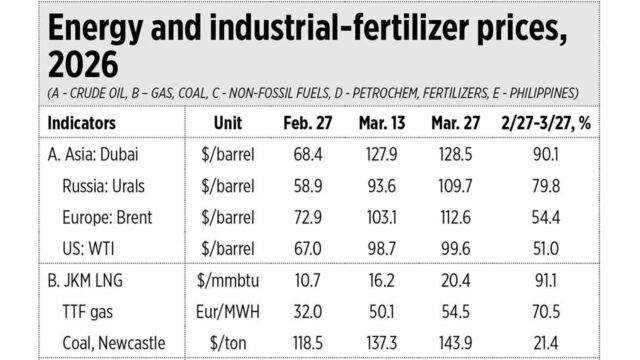
The prices of all fossil fuel products have risen. People will hate the higher prices, but they cannot honestly say, “Leave fossil fuels, save the planet.” They will prefer to save their economies, jobs, and businesses — and oil, gas, and coal produce many of the industrial by-products they use, like petrochemicals, fertilizers, and coal ash for cement production.

Non-fossil fuel sources of power — solar, wind, and nuclear — have experienced contractions in prices. Meaning investors and businesses are not rushing to go there, as they are not substitutes for fossil fuels.

Among the industrial and petrochemical products are bitumen used for asphalt and road construction, methanol for adhesives and foams, naptha for producing plastics and chemicals, sulfur and urea for fertilizers, styrene and butadiene monomers to produce synthetic rubber tires for our cars, trucks, tractors and even bicycles.

These are some of the byproducts that crude oil and gas can produce. Wind, solar, and biomass cannot produce these. Hence, investors are not rushing to wind-solar amidst the current oil and gas price and supply shocks.

Executive Secretary Ralph G. Recto announced last Sunday that the government has secured a firm order of 1.04 million barrels of diesel; the first batch will arrive this week. He added that the country will receive a steady supply of coal from Indonesia. This is good. We should see more energy diplomacy, more assurances of oil, gas, and coal supply via trade, not more war mongering.

Finally, some quick comments on three issues.

1. Some big solar plants are already in place, so we should use them. Yesterday Meralco PowerGen Corp. (MGEN) announced that its affiliate, Terra Solar Philippines, Inc. (MTerra Solar), has successfully energized the first 250 megawatts (MW) of its solar capacity. So it is now starting as an electricity producer and contributing to the country’s power needs.

MTerra Solar also energized the first of its battery energy storage system (BESS). It can deliver up to 450 megawatt-hours (MWh) of energy to the grid at night. This is largest operating BESS in the Philippines.

MGEN President and CEO Manny Rubio optimistically and correctly stated that “MTerra Solar plays an important role in supporting the country’s near-term energy requirements. The project’s phased energization enables earlier delivery of capacity to the grid, helping efforts to maintain stable electricity prices amid evolving global conditions.”

2. The real purpose of the suspension of market transactions of the Wholesale Electricity Spot Market (WESM) is not clear because market suspension is normally done during calamities like strong typhoons and earthquakes, when power plants and transmission or distribution lines are knocked out resulting in power shortages. Any available power plant anywhere then must dispatch power, and these running plants can dictate pricing, so “administered pricing” by the Energy Regulatory Commission (ERC) is done. Administered price is computed by averaging the last four weeks of similar days at similar intervals in prices.

But currently all generation companies (gencos) are available except those with scheduled maintenance. An increase in their prices is due to the rise in marginal costs, the fuel costs, and not to “market abuse” because competition is still working. If the government wants to conserve fuel and shut down certain power plants like those using diesel and bunker fuel, the easiest thing to do is for the Energy department to tell them to shut down, and not suspend market operations.

3. Earth Hour 2026, which was held last Saturday, was another failure in asking the public to “celebrate darkness for one hour.” I checked the website of the Independent Electricity Market Operator of the Philippines last Saturday night and saw that there was no decline, not even a blip, in electricity demand from 8:30-9:30 p.m. that day. People want brightness, not darkness. They want energy abundance, not energy poverty.


Bienvenido S. Oplas, Jr. is the president of Bienvenido S. Oplas, Jr. Research Consultancy Services, and Minimal Government Thinkers. He is an internationa fellow of the Tholos Foundation.

minimalgovernment@gmail.com

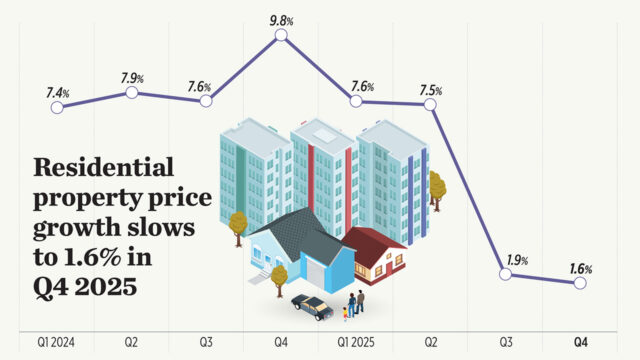
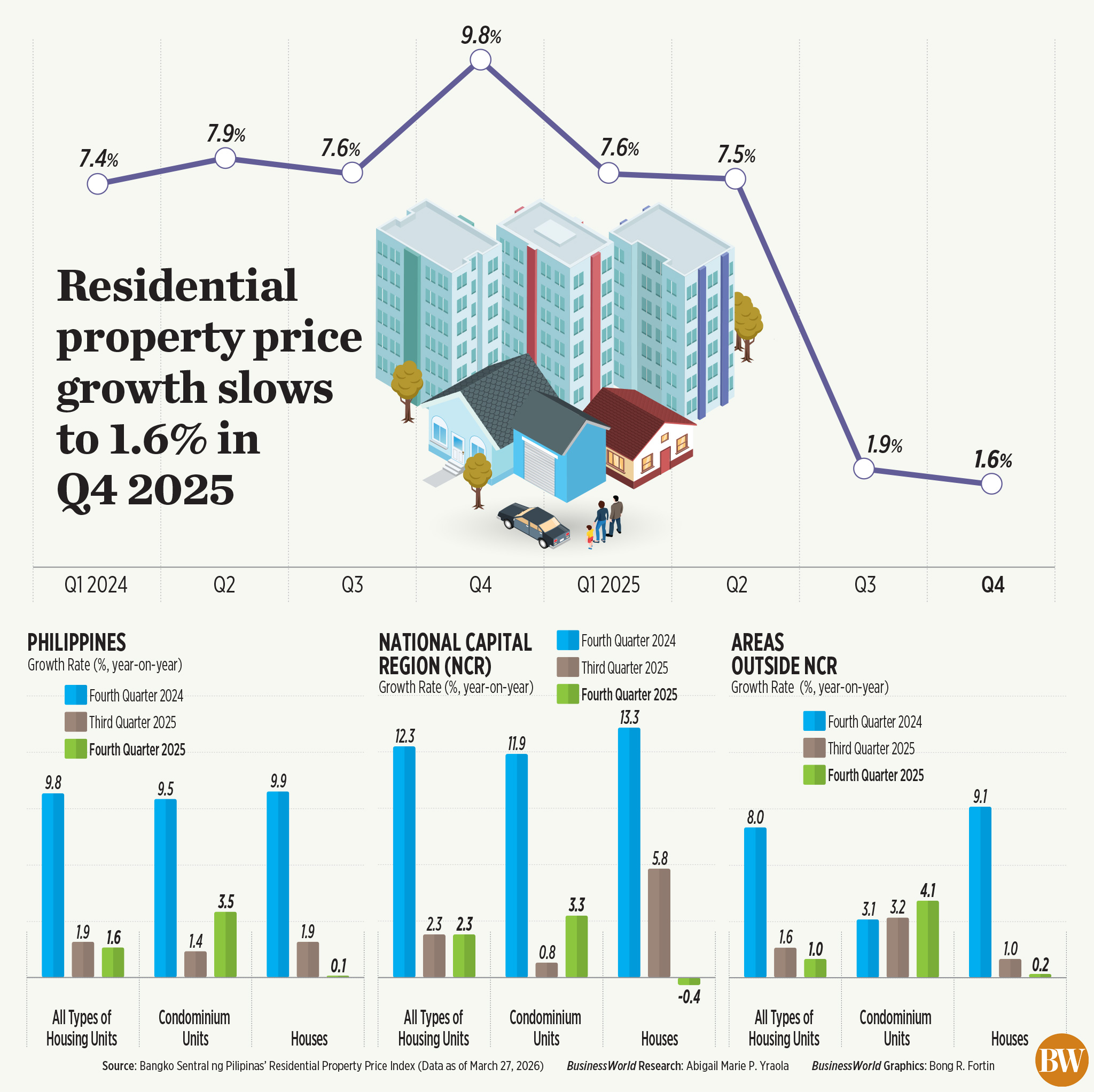
Residential property price growth slows to 1.6% in Q4 2025

Citicore Renewable income rises 14% on higher revenue, lower costs

CITICORE SOLAR Pampanga 1, Arayat, Pampanga — CREC.COM.PH

SAAVEDRA-LED Citicore Renewable Energy Corp. (CREC) said its net income rose by 14% to P1.15 billion in 2025, driven by higher revenue and lower costs.

Consolidated revenues grew by 3% to P5.32 billion, supported by stronger electricity sales, the company said in a statement on Monday.

Earnings before interest, taxes, depreciation, and amortization (EBITDA) increased by 3% to P1.81 billion.

CREC said earnings growth was supported by a 34% increase in service fees to P325 million and a 19% decline in finance costs following refinancing initiatives.

Last year, the company energized three solar plants in Batangas and Pampanga with a combined capacity of 239 megawatts (MW), which are expected to contribute fully to its financial performance this year.

In September 2025, CREC switched on what it described as the country’s “first baseload solar power plant” through a 197-MW solar farm in Batangas, equipped with a 320-megawatt-hour battery energy storage system.

“This milestone demonstrates how innovation in renewable energy can redefine the country’s power landscape. We now have definitive proof that solar, when paired with energy storage systems, can provide a truly reliable source of energy that supports national growth,” CREC President and Chief Executive Officer Oliver Tan said.

The company said it plans to activate six more solar plants in Batangas, Negros Occidental, and Pangasinan next month, with a combined capacity of 484 MW.

CREC has earmarked about $2 billion in capital expenditures this year to fund the rollout of more than one gigawatt of solar power projects.

CREC, directly and through its subsidiaries and joint ventures, manages a portfolio spanning renewable energy generation, power project development, and retail electricity supply.

The company currently has a combined gross installed capacity of more than 500 MW from its solar facilities in the Philippines. — Sheldeen Joy Talavera

OceanaGold extends Didipio mine life to 2037

OCEANAGOLD (Philippines), Inc. operates the Didipio gold and copper mine located in the northern Luzon region of the Philippines. — DIDIPIOMINE.COM.PH

OCEANAGOLD (Philippines), Inc. said the operational life of the Didipio gold and copper mine in Northern Luzon has been extended to 2037 following an updated mine plan based on recent exploration results.

In a disclosure on Monday, the listed miner said updated mineral resource estimates indicate that Didipio’s open-pit stockpiles will be exhausted by 2032, with a smaller portion of residual ore expected to support operations until 2037.

The company had previously projected the mine’s operations to end in 2035, based on its 2023 technical report.

The Didipio mine operates under a Financial or Technical Assistance Agreement with the government, under which the state receives 60% of net revenue while the company receives 40%.

OceanaGold said the Didipio mine has a combined measured and indicated ore volume of 45.2 million metric tons (MT) as of Dec. 31, including 32 MT from underground operations and 13.2 MT from open-pit stockpiles.

Measured and indicated gold resources totaled 1.34 million ounces (Moz), consisting of 1.21 Moz from underground operations and 0.12 Moz from open-pit stockpiles.

Silver resources were estimated at 2.4 Moz, while copper resources were placed at 0.16 MT.

Proved and probable reserves for the combined underground and open-pit stockpiles include 1.13 Moz of gold, 2.2 Moz of silver, and 0.13 MT of copper.

The company said the updated resource estimates provide a basis for medium- to long-term mine planning.

“While ongoing monthly, quarterly and annual reconciliation fluctuations are expected, the Mineral Resource estimates are believed to provide an acceptable basis for medium to long-term mine planning purposes,” it said.

OceanaGold said it plans to increase processing throughput to 4.3 MT per annum, the current permitted limit, by 2027.

To support the extended mine life and higher underground production, the company said it is upgrading its mining infrastructure.

“Upgrades are underway to existing infrastructure to support increased underground mining rates, including primary ventilation upgrades to support mining at depth and increased fleet requirements,” the company said.

OceanaGold said it is also improving its surface paste plant and underground reticulation network, and investing in dewatering and electrical infrastructure upgrades. — Vonn Andrei E. Villamiel

Japan steps up yen intervention threats, signals rate-hike chance

Banknotes of Japanese yen and US dollar are seen in this illustration picture taken on Sept. 23, 2022. — REUTERS

TOKYO — Japan stepped up yen intervention threats and signaled that further falls in the currency could justify a near-term interest rate hike, as policymakers grow increasingly concerned about inflationary pressures from the Middle East war.

In the strongest warning yet of yen-buying intervention, Japan’s top currency diplomat Atsushi Mimura said on Monday authorities may need to take “decisive” steps if speculative moves persist in the currency market.

“We are hearing that speculative moves are increasing in the currency market, in addition to the crude futures market. If this situation continues, it may be time to take decisive measures,” Mr. Mimura told reporters.

The remark marked an escalation from past verbal warnings as it was the first time Mr. Mimura, who oversees Japan’s currency policy, used the term “decisive” — language traders typically read as a signal of authorities’ readiness to intervene.

Markets have been rattled this month after the Iran war effectively shut the Strait of Hormuz, a chokepoint for about a fifth of global oil and gas flows, ​driving up crude oil prices and demand for the safe-haven dollar.

The yen bore the brunt and slid past the psychologically important ¥160-per-dollar level to its weakest since July 2024, when Japan last intervened to prop up the currency.

Soaring oil prices from the Middle East conflict add to inflationary pressures from the weak yen, which has been a political headache for policymakers by pushing up import costs.

STAGFLATION RISK LOOMS
Separately, Bank of Japan (BoJ) Governor Kazuo Ueda said the central bank would closely watch yen moves as they affect the economy and prices, suggesting inflationary pressures from ​a weak currency could justify raising interest rates in the coming months.

“Currency market moves are obviously among factors that hugely affect economic and price developments,” Mr. Ueda told Parliament on Monday.

“We will guide policy appropriately by scrutinizing how currency moves could affect the likelihood of achieving our growth and price forecasts, as well as risks,” he said, keeping alive the chance of a rate hike as soon as next month.

Mr. Ueda’s remarks highlight growing concern within the BoJ over the chance it could fall behind the curve in addressing the risk of too-high inflation, as high fuel costs hit an economy already experiencing years of steady price and wage increases.

While the BoJ kept rates steady in March, its policymakers debated further rate hikes with some flagging the chance of steady or faster-than-expected increases, the meeting’s summary showed on Monday.

Broadening cost pressures from rising oil prices could tip Japan into stagflation ​where the economy slumps and prices increase ​simultaneously, one member was quoted as saying, adding the BoJ may need to tighten policy if yen declines intensify.

Mr. Ueda said the BoJ must raise its short-term policy rate at an “appropriate pace” to avoid bond yields from overshooting, signaling its resolve to continue with steady rate hikes.

The BoJ ended a decade-long, massive stimulus in 2024 and raised rates including in December, when it hiked its short-term policy rate to a 30-year high of 0.75%, on the view Japan was making progress in durably achieving its 2% inflation target.

The central bank released last week several indices that help justify further rate hikes, including a new inflation gauge and revised output gap showing Japan running above capacity for a 15th straight quarter.

The summary of the BoJ’s March meeting, as well as last week’s release of a hawkish inflation, output gap and neutral rate estimates, suggests the bank is teeing up for its next rate rise, said Benjamin Shatil, an economist at JPMorgan Securities. “While the global risk environment remains fragile, and could affect the timing of the BoJ’s next move, we continue to pencil in a hike at the April meeting,” he said. — Reuters

Maxort to invest P400 million in LIMA Estate facility

MAXORT’S high-pressure pipe fittings manufacturing facility complementing the broader global supply chain is set to rise at LIMA Estate in Batangas. — ABOITIZ ECONOMIC ESTATES

MAXORT PHILIPPINES, INC., a manufacturer of export-oriented pipe fittings, plans to invest P400 million to open a 1.1-hectare (ha) facility at LIMA Estate in the second quarter.

Mintong Construction, Inc., which has built industrial facilities for Steelwell, Fong Shann, and Tang’s Realty, will develop the project.

“Maxort’s expansion through LIMA Estate demonstrates the strength of the Philippine market for global manufacturers. Each new investment brings valuable technology transfer and reinforces the Philippines’ capacity for sustainable, export-driven growth,” Aboitiz Economic Estates Vice-President for Commercial Strategy Monica Lorenzana Trajano said in a statement on Monday.

Maxort expects the project to generate about 150 construction jobs during the initial phase, with full operations targeted by the end of 2026.

The P400-million investment will add to LIMA Estate’s roster of international manufacturers and is expected to bring in foreign direct investment. Once operational, the facility is projected to create about 200 jobs, supporting local employment and regional economic activity.

“We chose LIMA Estate because the Philippines offers a strong foundation for growth. Its skilled workforce, reliable infrastructure, and supportive incentives allow us to scale responsibly while creating meaningful jobs for the local community,” Maxort Philippines, Inc. President Jinjun Zhao said.

LIMA Estate is a Philippine Economic Zone Authority-registered industrial hub, with 197 global manufacturers and service providers employing more than 75,000 workers across its industrial zones, central business district, and retail areas. It offers utilities, logistics connectivity, and infrastructure for export-oriented enterprises.

The estate plans to expand to 1,500 ha in Batangas over the next five to seven years, aiming to attract more foreign investment and support the province’s position as an industrial hub in Southeast Asia.

Aboitiz Economic Estates operates a 2,000-ha network of industrial townships across Southern Luzon and Central Visayas. Its developments host 260 locators and support about 100,000 jobs.

The company’s portfolio includes the 1,100-ha LIMA Estate in Batangas, the 63-ha Mactan Economic Zone 2 in Cebu, the 540-ha West Cebu Estate in Cebu, and the 384-ha TARI Estate in Tarlac. — Alexandria Grace C. Magno

Russia names Oscar-winning Mr Nobody film maker as a ‘foreign agent’

Mr. Nobody Against Putin (2025)

RUSSIA has designated Pavel Talankin, who secretly filmed pro-war propaganda in a school for the Oscar-winning documentary Mr Nobody Against Putin, as a foreign agent.

Mr. Talankin’s name appeared on Friday on the justice ministry’s online list of foreign agents — a term with connotations of spying that Moscow applies to people deemed to be engaged in foreign-backed anti-Russian activity.

The documentary by Mr. Talankin and David Borenstein uses two years of footage that Mr. Talankin recorded at a school where he was employed in Russia’s Chelyabinsk region, to show how students were exposed to pro‑war messaging.

It has been controversial even among Russians who oppose Mr. Putin and the war, with some criticizing Mr. Talankin for filming colleagues and children without their consent for his clandestine project.

Mr. Talankin, who fled Russia in 2024, has defended the film as a record for posterity to show how “an entire generation became angry and aggressive.” Accepting the Oscar earlier this month, the 35-year-old called for an end to wars.

People listed as foreign agents are subjected to onerous bureaucratic requirements and restrictions on their income in Russia. They are obliged to place the foreign agent label on social media posts or anything else they publish.

Kremlin spokesman Dmitry Peskov said after the Oscar awards that he had not seen the film and therefore could not comment on it. — Reuters

PhilWeb secures accreditation for gaming services

STOCK PHOTO | Image background from Freepik

PHILWEB CORP. said it has obtained accreditation from the Philippine Amusement and Gaming Corp. (PAGCOR) as a gaming affiliate and support service provider, allowing it to offer technology and operational services to licensed operators within PAGCOR’s regulated ecosystem.

“This is a pivotal stage for the industry as it moves toward a more structured and transparent framework,” PhilWeb President Brian Ng said in a statement on Monday.

“We are committed to supporting this transition by delivering reliable and scalable technology solutions, while actively engaging with stakeholders to help strengthen the overall ecosystem,” he added.

The company said it is increasing its participation in the regulated gaming sector through technical working group discussions with regulators and stakeholders, while expanding its technology infrastructure.

These discussions are focused on developing standards aimed at improving transparency, consumer protection, and industry governance.

“These engagements reflect the company’s alignment with ongoing efforts to formalize and modernize the sector,” PhilWeb said.

PhilWeb said it is positioning itself under an asset-light business-to-business (B2B) model focused on systems integration, platform management, and operational services for licensed operators.

The company said the accreditation also reflects its capabilities in platform technology, system integration, and operational support.

PhilWeb said it has worked with resort operators, including Hann Casino Resort and Okada Manila, to provide platform operations, system integration, and infrastructure for regulated online gaming.

The company also said it has collaborated with FBM Philippines to deploy platform solutions across a network of gaming venues nationwide. — Alexandria Grace C. Magno