Home Blog Page 273

Peso snaps five-day climb on hawkish Fed hints, BSP cut

BW FILE PHOTO

THE PESO retreated against the dollar on Thursday, ending a five-day rally, following hawkish hints from the US Federal Reserve and as the Philippine central bank delivered a sixth straight rate cut.

The local unit dropped by 13.5 centavos to close at P57.996 versus the greenback from its P57.861 finish on Wednesday, data from the Bankers Association of the Philippines showed.

The peso opened Thursday’s trading session slightly weaker at P57.88 against the dollar, which was already its intraday best. Its worst showing was at P58 against the greenback.

Dollars traded rose to $1.61 billion from $1.461 billion on Wednesday.

The local currency declined on “renewed dollar demand following the release of Federal Open Market Committee minutes, which showed that interest rate hikes are still on the table,” the first trader said in a phone interview.

Federal Reserve policymakers were in near-unanimous agreement to keep interest rates on hold at their meeting last month, but remained split over their next steps, with “several” open to rate hikes if inflation remains elevated, others inclined to support further cuts if inflation recedes as they expect, and the full table grappling with the emerging implications of artificial intelligence for the economy, Reuters reported.

The split evident in the readout from Fed Chair Jerome H. Powell’s third-to-last meeting as head of the US central bank underscores the challenge ahead for former Fed Governor Kevin Warsh, President Donald J. Trump’s pick to take over from Mr. Powell in May, in convincing the policymaking group to support the rate cuts Mr. Warsh and Mr. Trump say are needed.

The Federal Open Market Committee’s decision last month to hold its benchmark interest rate in the 3.5%-3.75% range was shared by “almost all” of its policymakers, according to the Jan. 27-28 meeting minutes released on Wednesday.

The peso also weakened as the Bangko Sentral ng Pilipinas’ (BSP) latest cut narrowed its rate differential with the Fed, the second trader said in an e-mail.

The Monetary Board on Thursday lowered the target reverse repurchase rate by 25 basis points (bps) to 4.25%, as expected by all 16 analysts in a BusinessWorld poll.

This brought cumulative cuts since August 2024 to 225 bps.

With this, the difference between the BSP’s key rate and the Fed is now at just 50 bps.

For Friday, the second trader said the peso could recover ahead of a potentially softer US gross domestic product report overnight.

The first trader sees the peso moving between P57.90 and P58.20 per dollar as players digest the BSP’s latest policy signals, while the second trader expects it to range from P57.85 to P58.10. — A.M.C. Sy with Reuters

Spain confirms Gaudí designed remote forest building

XALET DEL CATLLARÀS — TURISTREN.CAT

LA POBLA DE LILLET — Spanish authorities said on Wednesday that renowned modernist architect Antoni Gaudí designed a building in a remote forest area of Catalonia, ending speculation over who was behind the project built in the early 20th century.

Gaudí (1852-1926) had long been linked to the Xalet del Catllaras — a three-story mountain shelter built for workers at a cement factory 125 kilometers north of Barcelona — because the factory was owned by wealthy industrialist Eusebi Guell, for whom Gaudí built several projects.

But there had been no thorough technical and historical analysis to confirm Gaudí’s role until authorities commissioned an expert report from a Gaudí scholar in 2023.

“What’s most important is that it shows the new architectural approach that Gaudí had,” said Galdric Santana, the report’s author who also chairs commemorative events planned throughout 2026 to mark a century since Gaudí’s death.

Mr. Santana determined that Gaudí designed the house, built between 1901 and 1908 in the town of La Pobla de Lillet, at the midpoint of his career, because it contains structural elements used only by Gaudí at that time. They include specific types of arches, vaults, and rooms separated by walls positioned at 45-degree angles.

These techniques would not be followed by his disciples until 10 or 15 years later, Mr. Santana added.

The scholar said he found geometric, structural, and compositional evidence proving Gaudí’s authorship after analyzing floor plans for other Gaudí buildings, using 3D techniques and examining old documents and photographs.

Before conducting the report, Mr. Santana said it was feasible to consider Gaudí might not be the designer given the building’s remoteness and the fact that he had several prominent projects underway during those years, including Barcelona’s Park Guell and Casa Batllo.

But he believes Gaudí did not supervise its construction because the completed building was modified from the original plan.

That would explain why Gaudí never publicly acknowledged designing the Xalet, he added. At the time, it was common for architects to withhold their signature from a building if the finished work deviated from the original blueprint.

Around 10 other works remain unconfirmed as Gaudí designs, Mr. Santana said. — Reuters

Expanding the education voucher system

PHILSTAR FILE PHOTO

By Jam Magdaleno and Cesar Ilao III

LAST MONTH’s release of the final report of the Second Congressional Commission on Education (EDCOM II) stands as a culmination of years of policy debates needed to rescue the country’s education system from creeping irrelevance. Thankfully, the report signals serious openness to expanding the education voucher system, which currently covers only senior high school students. The report’s timing is especially significant, as the expansion of the education voucher system has now been included in the Legislative-Executive Development Advisory Council’s (LEDAC) priority legislative agenda.

A simple word count into the 634-page report, “Turning Point: A Decade of Necessary Reform (2026–2035),” reveals something telling: the word “voucher” appears 54 times.

The urgency of expanding the voucher system under the Government Assistance to Students and Teachers in Private Education (GASTPE) program has become undeniable. Our public schools remain congested. Classroom construction is slow, and reports of overpriced or substandard facilities periodically surface. For the 2025-2026 school year, the Department of Education (DepEd) faces a staggering shortage of 165,000 classrooms and more than 56,000 teachers to serve a projected 27.6 million enrollees.

At the core of this crisis lies a fundamental logic of information asymmetry, which economists refer to as the “knowledge problem.” Simply put, central planners (government bureaucracies) do not possess the ability to harness the dispersed and rapidly changing (tacit) knowledge embedded in millions of individual decisions made daily, in this case, by parents, students, and schools.

Whenever proposals for large-scale public classroom construction are floated, the “knowledge problem” stands as a warning: When the state attempts to forecast demand, allocate supply, and micromanage outcomes from the center, the informational burden quickly becomes overwhelming, and, in practice, paralyzing. DepEd, the country’s largest government agency with approximately one million employees, must correctly predict enrollment shifts across thousands of municipalities, determine where classrooms are needed most, bid out contracts, supervise construction, and monitor compliance.

This explains why shortages persist in some areas while facilities remain underutilized in others. Procurement controversies, from overpriced, substandard school buildings to chronic construction delays, are a result of decision-making detached from the information that matters most: local demand, school-level conditions, and family priorities.

This doesn’t mean government intervention should be abandoned. It means that some forms of intervention are structurally better suited to overcoming informational limits than others.

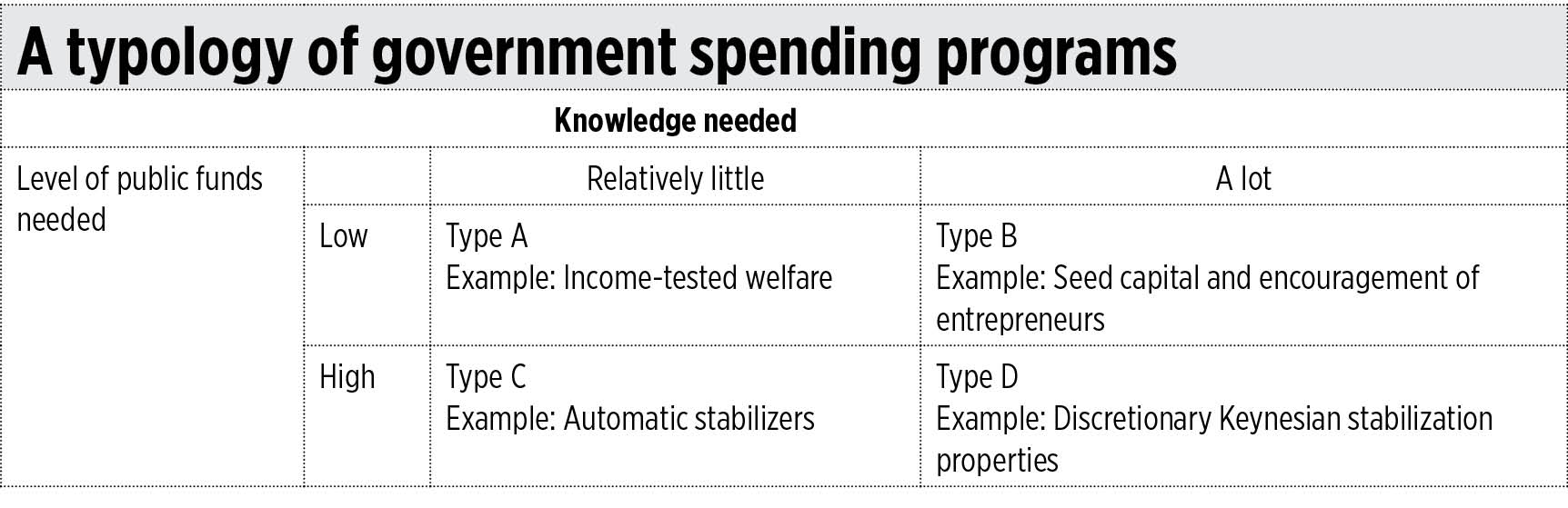
To explain our point better, we refer to a useful framework by Swedish economist Andreas Bergh. He classifies government programs along two dimensions: fiscal size and knowledge intensity (see the table). Programs that are large and knowledge-intensive are the riskiest. Programs that are large but knowledge-light — because they rely on decentralized decision-making — are likelier to succeed and be sustainable.
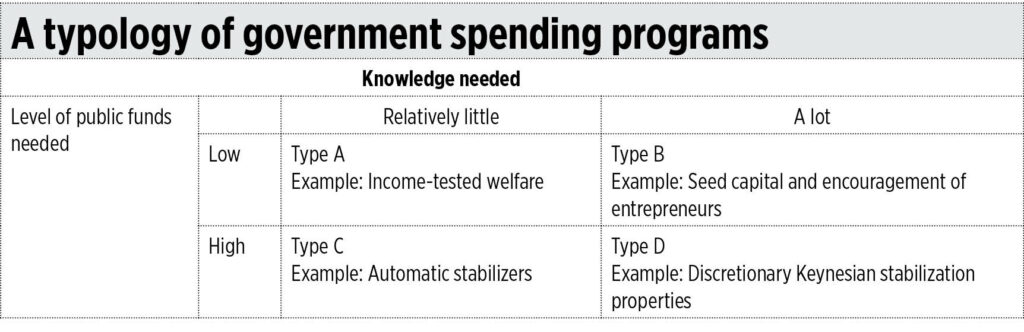
To ground this in our context, we will use two examples: the voucher system and the free tuition law.

Using Bergh’s typology above, we can surmise that education vouchers fall under Type C intervention: they are fiscally significant, yet they minimize the knowledge burden on the state.

This stands in stark contrast to Type A programs (low-cost, low-knowledge income transfers) and Type B programs (modest-cost but high-knowledge industrial “winner-picking”). On the other hand, the free tuition law falls under the high-risk Type D programs (expensive, knowledge-intensive macroeconomic fine-tuning).

Under the voucher system (Type C), the government finances the student, but families and schools — those closest to the relevant information — handle the complex decisions of enrollment and quality assessment.

Consider a student whose parents know that the nearby public school has 50 students per class, while a private school a few kilometers away maintains 25 and offers remedial reading support. They also know the true travel time, safety of the route, and whether the schedule fits their work hours. Localized realities like class size, support programs, commute constraints are information parents possess immediately but which no central planner can efficiently process at scale.

By contrast, the large-scale, centralized expansion of public school infrastructure is notoriously knowledge-intensive. Planners must predict precisely where to build, how much capacity to create, and how resources should be distributed across thousands of heterogeneous communities. This assumes demand forecasts will be accurate, and adjustments can be made in real time.

The same informational limits appear in higher education policy. Findings from the Philippine Institute for Development Studies (PIDS) shows that the Universal Access to Quality Tertiary Education Act (the free tuition law) disproportionately benefits students from better-off households. These students are more likely to have the resources to complete senior high school and, crucially, the academic preparation to pass competitive admission standards in state universities.

A universal subsidy doesn’t distinguish between the haves and the have-nots. In economic terms, this leads to resource misallocation arising from informational constraints. In plain language, it means public funds end up providing a “free ride” to individuals who could have afforded tuition anyway.

Vouchers operate on a different logic. Because the state is not locked into a single delivery mechanism, assistance can be directed toward students in overcrowded schools or poorer municipalities. This places school choice in the hands of families who best understand their circumstances.

A MARRIAGE OF EFFICIENCY AND EQUITY
The decentralized nature of educational vouchers also speaks to a longstanding tension in economics: the tradeoff between efficiency and equity. Rather than forcing policymakers to choose between fiscal prudence and social justice, a well-designed voucher system marries both goals.

By granting the decision to students and their parents to choose their schools, the voucher system achieves efficiency. From a fiscal perspective, supporting students in existing private schools is frequently cheaper than expanding public provision. Building classrooms and hiring permanent staff create long-term financial obligations. Vouchers allow the government to tap into existing capacity without locking itself into rigid commitments. This comes at an opportune time when many private schools are suffering from low-employment due to the mass exodus of students to public schools.

Studies cited in legislation proposing voucher expansion estimate that accommodating excess learners through public school expansion would cost P3.7 trillion over 30 years, while expanding vouchers would cost P2.6 trillion — saving P1.1 trillion. That fiscal gap is not trivial. It represents resources that could be redirected toward teacher training, curriculum improvement, or early-grade literacy interventions.

Equity gains are equally important. Rather than providing a blanket subsidy to all students regardless of income status, vouchers increase the likelihood that students from poor households and overcrowded public schools can access better learning environments.

In a 2025 PIDS paper, “Strengthening and Expanding Government Assistance for Private Education,” the authors cite evidence showing that students in private schools tend to perform better than their public-school counterparts, even after controlling for socioeconomic background.

On average, private institutions operate with smaller class sizes, stronger school-level management, and greater instructional flexibility — conditions that are consistently associated with improved learning outcomes. Over time, these gains accumulate. Students who master foundational skills early are less likely to drop out and more likely to succeed in higher education and work.

TIMING MATTERS
If vouchers improve access, efficiency, and learning at the senior high school level, restricting them to just the final two years makes little policy sense.

The logic of decentralized choice (what we identified earlier as a Type C intervention) does not magically apply only when a student turns 16. If anything, it is most compelling in the early years, when foundational skills are formed and when families make the most consequential educational decisions.

By Grade 11, the die is often cast. EDCOM II’s stark finding that only about four out of every 1,000 senior high school students pass expected learning standards underscores how deep the gap runs. Deficits in literacy and numeracy do not pop up overnight; they emerge in the primary grades and metastasize over time.

Trying to fix a decade of accumulated disadvantage with a two-year voucher is like applying a band-aid to a fracture. Expanding vouchers to the elementary and junior high levels allows the system to adapt sooner. It enables targeted access before congestion intensifies and, crucially, before inequality compounds.

There is also a glaring asymmetry here that we rarely acknowledge: Wealthier families exercise school choice from Grade 1. They do not wait for the government’s permission to seek better learning environments for their children. Poorer families, by contrast, are effectively locked into under-resourced public schools until the final stretch of basic education. Delaying vouchers is tantamount to widening this “choice gap.” Thus, to expand the voucher system is merely to follow the logic with which it was pursued in the first place: to allow decentralized actors — parents and schools — to process information early, not after the damage has already been done.

Education vouchers are not a silver bullet. In public policy, nothing really is. What we aim to demonstrate here is that, in light of the knowledge problem, an expanded voucher system can work. There are additional arguments in its favor: it is less prone to politicized decision-making and encourages public–private complementarity. At present, the education crisis demands a 634-page set of corrective measures, and its repeated calls for voucher expansion warrants a swift legislative approval.


Jam Magdaleno is head of Information and Communications at the Foundation for Economic Freedom (FEF) and an Asia Freedom fellow at the London School of Economics and Political Science (LSE) and King’s College London. Cesar Ilao III is a researcher and communications specialist for FEF. He is a lecturer at the University of the Philippines and was formerly a researcher at Monash University, Australia.


LRMC bets on new stations, upgrades to lift ridership to 450,000 by year-end

LRMC is a joint venture company of Metro Pacific Investments Corp.’s Metro Pacific Light Rail Corp. (MPLRC), Ayala Corp.’s AC Infrastructure Holdings Corp. (AC Infra), Sumitomo Corp., and the Philippine Investment Alliance for Infrastructure’s Macquarie Investments Holdings (Philippines) PTE Ltd. (MIHPL). — LRMC.PH

THE Light Rail Manila Corp. (LRMC), operator of Light Rail Transit Line 1 (LRT-1), expects to surpass its pre-pandemic ridership by the end of the year, driven by new stations and ongoing improvements.

“Right now, we are at 440,000 (daily) on average, that is the equivalent to our pre-covid numbers. By the end of the year, our target is to hit 450,000 daily ridership,” LRMC President and Chief Executive Officer Enrico R. Benipayo told reporters on the sidelines of the company’s 10th anniversary.

Mr. Benipayo said that since LRMC took over operations of LRT-1, the company has implemented critical improvements, including the opening of new stations and the deployment of new-generation train sets.

The opening of the LRT-1 Cavite extension in 2024 is one of the key drivers of ridership growth, he added.

In 2019, LRMC’s ridership averaged around 450,000 daily passengers, dropping to 350,000-370,000 in 2023. By November 2024, just before the opening of the Cavite Extension Phase 1, daily ridership stood at 323,000.

The first phase of the Cavite Extension was projected to add roughly 80,000 daily passengers, potentially bringing ridership to about 403,000.

“Last year, we were able to open a big extension, and you will notice that the facilities are more inclusive, and more modernized. We are committing to improve the older stations of the LRT in the next few years,” he said, noting that these future station improvements will further boost ridership growth.

Metro Pacific Investments Corp. (MPIC) holds a 35.8% stake in LRMC through its unit Metro Pacific Light Rail Corp., while Sumitomo Corp. owns 19.2% and Macquarie Investments Holdings (Philippines) Pte. Ltd. holds 10%. LRMC is a joint venture of MPIC, AC Infrastructure Holdings Corp. (a unit of Ayala Corp.), Sumitomo, and Macquarie Investments Holdings.

LRMC assumed operations and maintenance of LRT-1 in September 2015 under a P65-billion, 32-year concession agreement with the Light Rail Transit Authority and the Department of Transportation.

MPIC is one of the three key Philippine units of Hong Kong-based First Pacific Co. Ltd., along with Philex Mining Corp. and PLDT Inc. Hastings Holdings, Inc., a unit of MediaQuest Holdings under the PLDT Beneficial Trust Fund, holds a majority share in BusinessWorld through the Philippine Star Group. — Ashley Erika O. Jose

Argentine labor reform protests stall grain shipments

REUTERS

THE Argentine maritime workers federation FESIMAF launched a 48-hour strike on Wednesday over a planned labor reform, which grain exporters’ chamber said was paralyzing shipments in the nation’s ports.

Argentina is a top global supplier of grains, and the world’s largest exporter of soybean oil and meal.

“This (48-hour strike) is clearly bringing agro-export activities to a complete standstill,” Gustavo Idigoras, the president of Argentina’s CIARA-CEC grain exporters and processors chamber told Reuters.

“We believe it is a purely political measure that is far removed from specific needs,” he added.

FESIMAF said the strike action, which comes a day before a planned nationwide walkout called by Argentina’s powerful CGT labor federation, aims to defend workers’ labor rights and job stability from the proposed far-reaching changes in labor law.

Argentina’s SOEA oilseed crushers’ union also said it will go on a 24-hour strike on Thursday.

“We strongly condemn this misnamed modernization that only seeks to legalize labor setbacks, the destruction of thousands of jobs, and the dismantling of our national industry,” said SOEA leader Daniel Succi in a statement.

The strike is a protest against President Javier Milei’s planned labor reform bill, which has proposed to limit the right to strike, cap severance pay, tighten sick pay and limit workers’ ability to claim damages after dismissal.

The reform, a flagship policy for Milei’s administration, has drawn strong opposition from Argentine unions, which say the package threatens long-standing worker protections.

The maritime strike was expected to disrupt cargo loading and unloading, pilot transfers and other services for commercial vessels, mainly in the port area of ​​Rosario, one of the world’s largest agricultural export hubs.

Ships are being loaded, but once they’re two or three feet short of the draft needed for dispatch, they’ll almost certainly stop,” Guillermo Wade, manager of the Chamber of Port and Maritime Activities told Reuters.

Argentina’s lower house is scheduled to debate the bill Thursday, after its approval in the Senate last week. — Reuters

Vietnam’s quiet ascent and the Philippines’ crisis of governance

A recent visit to Hanoi and Sa Pa with a group of retiree friends left us with an uncomfortable consensus: Vietnam appears to be overtaking the Philippines in ways that are increasingly difficult to ignore. The contrast is visible not only in infrastructure and tourism, but in a deeper sense of national direction and institutional confidence.

Consider the numbers. In 2025, the Philippines welcomed about 6.48 million international tourists. Vietnam attracted an estimated 21.1 million — more than three times as many. For two Southeast Asian countries richly endowed with natural beauty, culture, and hospitality, such a disparity is not accidental. It reflects policy choices and, more fundamentally, the quality of governance.

Vietnam’s rise is anchored in deliberate strategy. Since launching its Đổi Mới (which translates to “renovation”) reforms in 1986, Vietnamese leaders made a practical choice: preserve political continuity while liberalizing the economy. The reforms dismantled collective farming in favor of household production, legalized private enterprise, encouraged foreign direct investment, and opened Vietnam to global trade. Over the next three decades, these policies transformed Vietnam into one of Asia’s fastest-growing manufacturing and export hubs.

Crucially, Đổi Mới was not a one-time adjustment but a sustained reform trajectory. Successive governments maintained policy continuity. The lesson of Đổi Mới is that economic transformation requires both bold initial reform and the discipline to stay the course — a combination that has underpinned Vietnam’s steady rise.

Even a casual visitor notices symbols of industrial ambition. VinFast, Vietnam’s homegrown automotive brand, dominates taxi fleets in Hanoi and is now entering the Philippine market through the Green GSM brand. This is not merely commercial success; it signals confidence in domestic capability and a long-term industrial vision.

Infrastructure reinforces that message. While Vietnam’s mass transit systems are still evolving, the broader transport ecosystem — airports, highways, and urban development — suggests sustained, disciplined investment. The government’s plan to gradually shift from gasoline-powered motorcycles to electric vehicles points to forward-looking environmental and industrial policy. There is a sense that projects are executed with urgency and continuity.

Tourism policy provides another contrast. Vietnam has streamlined visa processes, expanded air connectivity, and marketed itself aggressively as a diverse destination. The Philippines, despite world-class beaches and landscapes, continues to struggle with infrastructure bottlenecks, regulatory friction, and uneven execution. These weaknesses are not technical problems alone; they are symptoms of governance deficits.

Here, the comparison becomes more uncomfortable. The Philippines today faces a visible erosion of trust in public institutions. Persistent corruption scandals, perceptions of weak leadership, and the politicization of key agencies have created uncertainty that deters investment and undermines public confidence. Infrastructure programs that begin with promise too often become mired in allegations of graft or mismanagement. Funds that should translate into roads, airports, and efficient services are suspected of leaking into private pockets. The result is not merely wasted money but damaged credibility.

Vietnam’s centralized political system has its own trade-offs, particularly in terms of political freedoms. Yet it has delivered a degree of policy continuity and execution that investors value. Long-term infrastructure and industrial plans are pursued across political cycles. In the Philippines, democratic pluralism is a strength, but when combined with patronage politics and weak accountability mechanisms, it can fragment decision-making and slow implementation. Leadership vacuums and public infighting further erode the sense of national direction.

Historical legacies are often invoked to explain divergence. Vietnam endured roughly a century of French colonial rule and the devastation of a prolonged war that ended in 1975. The Philippines experienced more than three centuries of Spanish administration followed by American influence. While these histories shaped institutions and culture, they do not predetermine present outcomes. Vietnam emerged from war impoverished, yet forged a political consensus around reconstruction and reform. Its pivot toward globalization in the late 1980s was decisive and sustained.

The Philippines, by contrast, has struggled to maintain reform momentum. Episodes of political instability and recurring corruption controversies have distracted from long-term economic transformation. When citizens perceive that institutions serve private interests rather than the public good, trust erodes. Without trust, even well-designed policies face skepticism and resistance.

None of this diminishes the Philippines’ considerable strengths: a young and talented workforce, strong cultural ties to global markets, and a dynamic services sector. But Vietnam’s trajectory highlights a central lesson: development requires more than resources and demographics. It demands credible institutions, disciplined execution, and leadership capable of inspiring confidence.

The impressions from Hanoi and Sa Pa should not provoke envy but reflection. Vietnam’s quiet overtaking of the Philippines is a warning that in a competitive region, governance quality is destiny. If the Philippines is to narrow the gap, it must confront corruption decisively, rebuild trust in institutions, and pursue infrastructure and industrial policy with consistency that survives political cycles.

The challenge is ultimately political as much as economic. Nations advance when citizens believe their institutions are fair, competent, and accountable. Restoring that belief may be the Philippines’ most urgent development task.

The views expressed herein are the author’s own and do not necessarily reflect the opinion of his office as well as FINEX.


Benel Dela Paz Lagua was previously EVP and chief development officer at the Development Bank of the Philippines.  He is an active FINEX member and an advocate of risk-based lending for SMEs. Today, he is independent director in progressive banks and in some NGOs.

Is social media addictive?

STOCK PHOTO | Image from Freepik

How it keeps you clicking and the harms it can cause

By Quynh Hoang

FOR YEARS, big tech companies have placed the burden of managing screen time squarely on individuals and parents, operating on the assumption that capturing human attention is fair game.

But the social media sands may slowly be shifting. A test-case jury trial in Los Angeles is accusing big tech companies of creating “addiction machines.” While TikTok and Snapchat have already settled with the 20-year-old plaintiff, Meta’s CEO, Mark Zuckerberg, is giving evidence in the courtroom this week.

The European Commission recently issued a preliminary ruling against TikTok, stating that the app’s design — with features such as infinite scroll and autoplay — breaches the EU Digital Services Act. One industry expert told the BBC that the problem is “no longer just about toxic content, it’s about toxic design.”

Meta and other defendants have historically argued that their platforms are communication tools, not traps, and that “addiction” is a mischaracterization of high engagement.

“I think it’s important to differentiate between clinical addiction and problematic use,” Instagram chief Adam Mosseri testified in the LA court. He noted that the field of psychology does not classify social media addiction as an official diagnosis.

Tech giants maintain that users and parents have the agency and tools to manage screen time. However, a growing body of academic research suggests features like infinite scrolling, autoplay, and push notifications are engineered to override human self-control.

A STATE OF ‘AUTOMATED ATTACHMENT’
My research with colleagues on digital consumption behavior also challenges the idea that excessive social media use is a failure of personal willpower. Through interviews with 32 self-identified excessive users and an analysis of online discussions dedicated to heavy digital use, we found that consumers frequently enter a state of “automated attachment.”

This is when connection to the device becomes purely reflexive, as conscious decision-making is effectively suspended by the platform’s design.

We found that the impulse to use these platforms sometimes occurs before the user is even fully conscious. One participant admitted: “I’m waking up, I’m not even totally conscious, and I’m already doing things on the device.”

Another described this loss of agency vividly: “I found myself mindlessly opening the [TikTok] app every time I felt even the tiniest bit bored … My thumb was reaching to its old spot on reflex, without a conscious thought.”

Social media proponents argue that “screen addiction” isn’t the same as substance abuse. However, new neurophysiological evidence suggests that frequent engagement with these algorithms alters dopamine pathways, fostering a dependency that is “analogous to substance addition.”

STRATEGIES THAT KEEP USERS ENGAGED

The argument that users should simply exercise willpower also needs to be understood in the context of the sophisticated strategies platforms employ to keep users engaged. These include:

1. Removing stopping cues. Features like infinite scroll, autoplay and push notifications create a continuous flow of content. By eliminating natural end-points, the design effectively shifts users into autopilot mode, making stopping a viewing session more difficult.

2. Variable rewards. Similar to a slot machine, algorithms deliver intermittent, unpredictable rewards such as likes and personalized videos. This unpredictability triggers the dopamine system, creating a compulsive cycle of seeking and anticipation.

3. Social pressure. Features such as notifications and time-limited story posts have been found to exploit psychological vulnerabilities, inducing anxiety that for many users can only be relieved by checking the app. Strategies employing “emotional steering” can take advantage of psychological vulnerabilities, such as people’s fear of missing out, to instill a sense of social obligation and guilt if they attempt to disconnect.

VULNERABILITY IN CHILDREN
The issue of social media addiction is of particular concern when it comes to children, whose impulse control mechanisms are still developing. The US trial’s plaintiff says she began using social media at the age of six, and that her early exposure to these platforms led to a spiral into addiction.

A growing body of research suggests that “variable reward schedules” are especially potent for developing minds, which exhibit a heightened sensitivity to rewards. Children lack the cognitive brakes to resist these dopamine loops because their emotional regulation and impulsivity controls are still developing.

Lawyers in the US trial have pointed to internal documents, known as “Project Myst,” which allegedly show that Meta knew parental controls were ineffective against these engagement loops. Meta’s attorney, Paul Schmidt, countered that the plaintiff’s struggles stemmed from pre-existing childhood trauma rather than platform design.

The company has long argued that it provides parents with “robust tools at their fingertips,” and that the primary issue is “behavioral” — because many parents fail to use them.

Our study heard from many adults (mainly in their 20s) who described the near-impossibility of controlling levels of use, despite their best efforts. If these adults cannot stop opening apps on reflex, expecting a child to exercise restraint with apps that affect human neurophysiology seems even more unrealistic.

POTENTIAL HARMS OF OVERUSE
The consequences of social media overuse can be significant. Our research and recent studies have identified a wide range of potential harms.

These include “psychological entrapment.” Participants in our study described a “feedback loop of doom and despair.” Users can turn to platforms to escape anxiety, only to find that the scrolling deepens their feelings of emptiness and isolation.

Excessive exposure to rapidly changing, highly stimulating content can fracture the user’s attention span, making it harder to focus on complex real-world tasks.

And many users describe feeling “defeated” by the technology. Social media’s erosion of autonomy can leave people unable to align their online actions — such as overlong sessions — with their intentions.

A ruling against social media companies in the LA court case, or enforced redesign of their apps in the EU, could have profound implications for the way these platforms are operated in future.

But while big tech companies have grown at dizzying rates over the past two decades, attempts to rein in their products on both sides of the Atlantic remain slow and painstaking. In this era of “use first, legislate later,” people all over the world, of all ages, are the laboratory mice.


THE CONVERSATION VIA REUTERS CONNECT

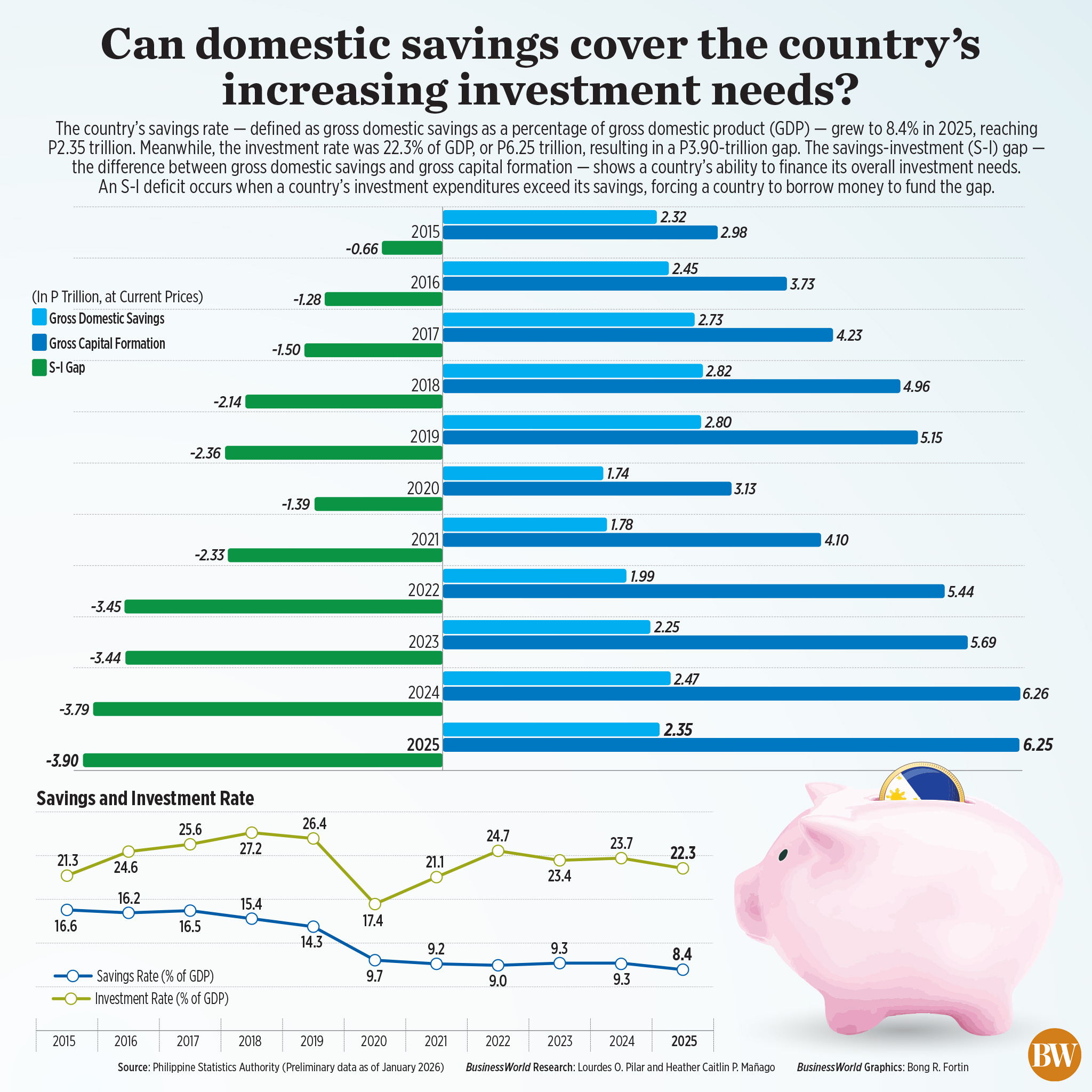
Can domestic savings cover the country’s increasing investment needs?

The country’s savings rate — defined as gross domestic savings as a percentage of gross domestic product (GDP) — grew to 8.4% in 2025, reaching P2.35 trillion. Meanwhile, the investment rate was 22.3% of GDP, or P6.25 trillion, resulting in a P3.90-trillion gap. The savings-investment (S-I) gap — the difference between gross domestic savings and gross capital formation — shows a country’s ability to finance its overall investment needs. An S-I deficit occurs when a country’s investment expenditures exceed its savings, forcing a country to borrow money to fund the gap.

Vitarich Corp. board approves Davao breeder farm acquisition

VITARICH.COM

LISTED poultry integrator Vitarich Corp. (VITA) said its board has approved the final terms and conditions for the P280-million acquisition of breeder farm facilities in Davao del Sur.

“Following this approval, the definitive agreement and the implementing contracts and documents of the foregoing acquisition are expected to be finalized, signed, and executed within the month of February 2026,” the company said in a disclosure on Thursday.

“The foregoing transactions are subject to customary closing conditions, such as execution of the definitive agreement and implementing contracts as well as full payment of the consideration,” it added.

The deal covers Vitarich’s acquisition of breeder farm facilities — including land, improvements, equipment; 125,000 common shares of stock; and advances of Broilers Club, Inc. (BCI) shareholders.

The total purchase price, based on third-party appraised value, was allocated as P95 million for 125,000 BCI shares, P130 million for BCI shareholders’ advances, P25 million for land owned by two BCI shareholders in the breeder farm, and P30 million to pay off BCI’s bank loan on one property.

Vitarich Corp. plans to operate the acquired breeder facilities as its own farm and make BCI a wholly owned subsidiary.

The acquisition aims to stabilize broiler chick supply and reduce production costs, with capacity projected to boost VITA’s total breeder output by up to 8%.

BCI is a private domestic corporation engaged in poultry and egg production, among others, with operations in Davao.

The Philippine Stock Exchange suspended trading of Vitarich shares on Thursday after classifying the recent board approval of the P280-million acquisition of BCI and breeder farm facilities as a substantial acquisition requiring further disclosure. — Alexandria Grace C. Magno

Ambitious TV adaptation of Allende’s House of the Spirits premieres in Berlin

ALFONSO HERRERA and Nicole Wallace in a scene from the 2026 miniseries House of the Spirits.

BERLIN — Isabel Allende’s novel The House of the Spirits, spanning several generations of women, was tough to translate to the screen, said the showrunners of an upcoming TV adaptation, but working with a Latin American cast made the challenge a joy.

“It was about time that we told the story ourselves,” Francisca Alegria told Reuters at the Berlin Film Festival, where the first three episodes were screened on Monday.

“For us, the novel, and for, I would say, all Latin America, is such an important piece of work. It talks so much about our identity, our history,” added Ms. Alegria.

“It’s just kind of like a dream come true.”

AN AMBITIOUS ADAPTATION
Ms. Alegria, along with Fernanda Urrejola and Andres Wood, are the creative trio behind the eight-part Spanish-language series that is set to stream on Amazon’s Prime Video this April.

Mr. Wood recalled that they felt a heavy responsibility to properly adapt the novel, but working on the project with a Latin American crew and cast in Chile was also a dream.

Ms. Allende, who is an executive producer, gave the team complete freedom to adapt her 1982 debut novel, they said.

The 83-year-old is one of the most widely read living writers in the Spanish language. Her books, which often blend historical events with magic and fantasy, have been translated into more than 40 languages.

A previous attempt in 1993 at a film adaptation featuring Meryl Streep and Glenn Close was a commercial flop.

AHEAD OF HER TIME
The TV series is told through granddaughter Alba’s perspective in the 1970s as she uncovers her family’s past and her country’s turbulent history through the diaries of her grandmother written half a century earlier.

Alba is played by Rochi Hernandez, who starred in the Argentine TV series La caida, while Clara is played by three actors: Francesca Turco, Nicole Wallace, and Dolores Fonzi.

Ms. Urrejola pointed out that Ms. Allende never mentioned Chile explicitly, a decision the showrunners also kept as they see the story as a universal tale of the region’s history.

Ms. Allende was ahead of her time in exploring intergenerational trauma long before it was an accepted concept, she added.

“Talking about healing generational trauma — it’s huge. And to understand how important memory is in order for us not to repeat the story. And we need that now,” said Ms. Urrejola. — Reuters

GoTyme Bank deposits hit P43 billion in 2025

GOTYME.COM.PH

GOTYME BANK’S customer deposits reached P43 billion last year, supported by higher payment volumes and usage.

The bank saw a 150% year on year increase in payment volume and reached more than eight million Visa debit card users, helping drive usage, it said in a statement on Thursday.

GoTyme Bank had the most used Visa debit card in the country, Visa said in the same statement.

It also saw the highest growth in debit payment volume, active debit cards, and contactless transactions for issuing.

“Together with Visa, we will continue delivering secure, seamless everyday experiences as we push toward our goal of becoming the largest and most loved retail bank in the Philippines,” Nathaniel C. Clarke, GoTyme Bank President and Chief Executive Officer.

“Our partnership with GoTyme is leveling up the payments experience for Filipinos, enabling innovative, safe and seamless payment experiences,” Visa Philippines Country Manager Jeffrey F. Navarro said. “This partnership also aligns with the government’s vision to build a digital-first, cash-lite society.”

GoTyme Bank, supported by Visa, will expand through enhanced card issuance programs and value-added experiences for cardholders, with specialized support in marketing, digital infrastructure, and data-driven financial services, the companies said.

The bank’s a partnership between the Gokongwei group and Singapore-based Tyme Group. It began commercial operations in October 2022 as one of the six digital banks licensed by the Bangko Sentral ng Pilipinas. — A.M.C. Sy

WNBA players lower salary cap, revenue sharing demands

REUTERS

THE Women’s National Basketball Players’ Association (WNBPA) eased its financial stance in the latest proposal it made to the Women’s National Basketball Association (WNBA) in collective bargaining, multiple media outlets reported.

The latest counterproposal came after a league proposal submitted earlier this month.

Per the reports, the union is now seeking an average of 27.5% of the league’s gross revenue, beginning at 25% in the first year of a prospective agreement.

The salary cap for the initial year would be below $9.5 million in the opening season, per the WNBPA’s reported proposal.

Previously, the union sought a 31% average of gross revenue, beginning at 28% in the first year. The opening-year salary cap was at $10.5 million in the WNBPA’s previous proposal.

A WNBA spokesperson told ESPN regarding the new union position, “The Players Association’s latest proposal remains unrealistic and would cause hundreds of millions of dollars of losses for our teams. We still need to complete two Drafts (a two-team expansion draft and college draft) and free agency before the start of training camp and are running out of time. We believe the WNBA’s proposal would result in a huge win for current players and generations to come.”

The WNBA’s latest offer features a $5.65 million salary cap. A key sticking point involves the league’s desire to peg the players’ share to net revenue rather than gross revenue. The WNBA reportedly is offering an average of more than 70% of net revenue to the players, but ESPN reported that figure would work out to less than 15% of the gross revenue.

The new union proposal reportedly seeks to retain housing for players, which the WNBA was trying to phase out from prior collective bargaining agreements.

The WNBPA is asking for housing to remain in place for the first few years of a new deal, but later players making higher salaries would be on their own to find housing.

The WNBA reportedly has offered one-bedroom apartments for players making the minimum salary and studio apartments for two developmental players per team.

The next WNBA season is currently scheduled to tip off on May 8 with three games, including the expansion Toronto Tempo playing host to the Washington Mystics. The expansion Portland Fire are due to face the visiting Chicago Sky on May 9. — Reuters

ADVERTISEMENT
ADVERTISEMENT