Home Blog Page 2677

Yields on government debt mixed

By Abigail Marie P. Yraola, Deputy Research Head

YIELDS on government securities (GS) traded in the secondary market edged lower last week following the release of US consumer inflation data and as investors looked ahead to the US Federal Reserve’s policy decision.

GS yields, which move opposite to prices, went down by an average of 1.12 basis points (bps) week on week, according to the PHP Bloomberg Valuation Service Reference Rates as of Sept. 13 published on the Philippine Dealing System’s website.

Rates at the short end of the curve were mixed, with the 91- and 364-day Treasury bills (T-bills) falling by 5.34 bps and 6.16 bps to fetch 5.8616%, and 6.0118%, respectively. Meanwhile, the 182-day T-bills inched up by 0.20 bp to fetch 5.9899%.

At the belly, yields fell across all tenors. The two-, three-, four-, five-, and seven-year Treasury bonds (T-bond) saw their rates decrease by 1.76 bps (to 6.0016%), 1.60 bps (6.0083%), 1.26 bps (6.0193%), 0.99 bp (6.0321%), and 0.5 bp (6.0556%), respectively.

On the other hand, tenors at the long end saw their rates climb. The 10-, 20-, and 25-year T-bonds rose by 1.65 bps, 1.78 bps and 1.67 bps to fetch 6.0926%, 6.214%, and 6.2134%, respectively.

GS volume traded was at P23.13 billion on Friday, lower than the P31.8 billion recorded a week earlier.

ATRAM Trust Corp. Vice-President and Head of Fixed Income Strategies Lodevico M. Ulpo, Jr. said market players started the week cautiously, but risk sentiment shifted after the release of key US data.

“Despite the selloff in US Treasuries following the higher-than-expected inflation figures in the US, bond investors in the local space remained resolute as they extended duration across the curve on expectations of policy easing from the US Federal Reserve and the Bangko Sentral ng Pilipinas (BSP),” Mr. Ulpo said in a Viber message.

A bond trader said the market’s main focus was the US consumer price index data released on Sept. 11, as well as the European Central Bank’s policy decision.

“Although the auctions were reflective of strong support in the market considering the upcoming rate cuts by central banks including the BSP, the main drive of the week was whether the Fed would cut by 25 or 50 bps [this] week, depending on the data released from the US,” the trader added.

For this week, the Fed’s two-day policy meeting will be the main driver of yield movements, both analysts said.

“We could see the market trade lower this week as the Fed begins its cutting cycle by at least 25 bps. There has been some holdover speculation that the Fed will cut more than 50 bps, but this is less likely given recent data,” the trader said.

“Along with the 10-year bond auction, the Federal Open Market Committee meeting is the highly awaited event for this week as the Fed will finally begin its easing cycle,” Mr. Ulpo said. “We expect Philippine bonds to recoup some losses this week as investors optimize fixed-income positioning before any yield correction from policy normalization.”

The Federal Reserve is nearly as likely to deliver an outsized interest-rate cut this week as a more-usual-sized reduction, trading in rate-futures contracts suggested on Friday, as financial markets priced in a bigger chance that the Fed will move more aggressively, Reuters reported. A quarter-point reduction at the Fed’s Sept. 17-18 meeting is still seen as the slightly more likely outcome, but only marginally so. — with Reuters

Origin of human bird flu case in Missouri still unknown — CDC

REUTERS

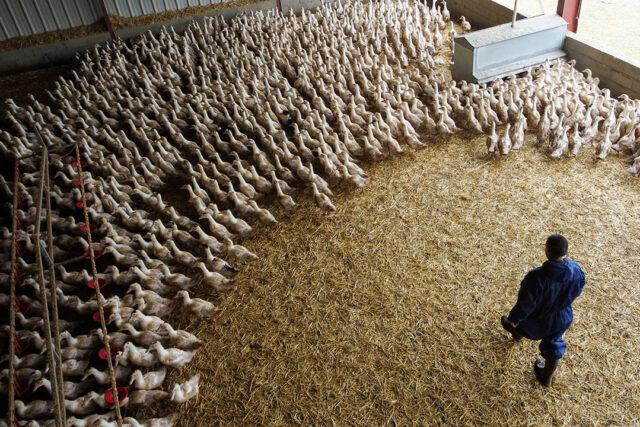
WASHINGTON — Epidemiologists have not yet identified exactly how a person in Missouri contracted bird flu last week, the Centers for Disease Control and Prevention (CDC) said.

The human case was the 14th diagnosed in the US this year. The other 13 cases were among farm workers and linked to bird flu outbreaks on poultry or dairy farms.

The infected individual was admitted to the hospital with symptoms including chest pain, nausea, vomiting and diarrhea, CDC principal deputy director Nirav Shah said on a Thursday call with reporters. It was unclear whether the patient’s underlying conditions caused the symptoms or the flu.

The investigation into the origin of the infection is ongoing and the CDC has been unable to determine if the case was related to the current outbreak of bird flu in dairy cattle, Mr. Shah said.

“Right now, evidence points to this being a one-off case,” said Mr. Shah. Missouri has not invited the CDC to conduct an on-site investigation but the CDC is working closely with state health officials on its response to the case, Mr. Shah said.

Mr. Shah also said the CDC will work with five commercial laboratory companies — Aegis, ARUP, Ginkgo BioWorks, Labcorp, and Quest — to develop their own diagnostic tests for public health outbreaks, including bird flu.

The USDA said eight dairy herds had been infected with bird flu in California since the first cattle case was identified there on Aug. 30.

Bird flu has infected more than 200 dairy herds in 14 states since March, USDA data showed. The California herds are quarantined and the state is expected to conduct bulk milk testing at dairies within a geographic zone around the affected farms, Eric Deeble, deputy under secretary for marketing and regulatory programs at the USDA, said.

The agency does not know how the virus arrived in California, Mr. Deeble said.

The CDC will launch its program to vaccinate farm workers against the seasonal flu in October, Mr. Shah said. The campaign is meant to prevent dual infection with bird flu and seasonal flu, which could lead to virus mutations. — Reuters

AREIT shares rise after asset disposition, investment

AREIT, Inc. saw its shares rise last week as it sold assets to fund investments while rate cut expectations bolstered market sentiment, analysts said.

AREIT was the 20th most actively traded last week with a total of 14.59 million worth P526.25 million changing hands from Sept. 9-13, data from the Philippine Stock Exchange showed.

Shares of the company closed at P37.85 apiece, 5.3% higher than the P35.95 close a week prior.

For the year, the stock’s price rose 13.3% from its P33.4 close on the last trading day of 2023.

Analysts attributed the week-on-week growth to positive market sentiment driven by asset dispositions and expectations of rate cuts later in the year.

AREIT has sold three office condominium units worth P42.69 million and covering 339 square meters (sq.m.) to partially pay for its acquisition of Seda Hotel in Lio, El Nido.

The real estate investment trust acquired the hotel on Jan. 17 from Econorth Resort Ventures, Inc. for P1.19 billion.

“AREIT’s decision was likely viewed positively by the market as this pivots the company towards assets that are expected to generate higher yields. Despite a recent pullback, driven largely by institutional selling, this move may have renewed investor confidence, suggesting strong forward-looking growth potential.” Jervin De Celis, equity trader at Timson Securities, said in an e-mail.

“After the news hit, AREIT’s stock jumped about [around 5%], showing the market’s clear optimism around the condo sellout,” Jemimah Ryla R. Alfonso, equity analyst at Regina Capital Development Corp., likewise said in a separate e-mail.

She added that rate cut expectations later in the year further the stock upward.

“REITs have been trekking upwards as interest rates are likely to go down further until the remaining months of the year,” she said.

On Aug. 15, the Bangko Sentral ng Pilipinas (BSP) cut benchmark interest rates by 25 basis points to 6.25%, its first cut in nearly four years.

BSP Governor Eli M. Remolona, Jr. signaled another rate cut before the end of the year.

Meanwhile, AREIT’s net income surged 38% to P1.42 billion in the second quarter from P1.03 billion in the same period last year. This brought the company’s net income to P4.28 billion for the first six months of the year.

For the whole year, Ms. Alfonso expects AREIT to record P7 billion in its bottom line.

Mr. De Celis sees full-year earnings at around P6 billion.

“We project that AREIT’s [third quarter] net income will be approximately P1.5 billion. For the full year, earnings are expected to fall within the range of P5.8 to P6 billion, given the company’s asset infusions and strategic investments. AREIT’s revenue-generating capabilities remain solid…” Mr. De Celis said.

This week, Mr. De Celis placed his immediate support at P37.1 and resistance at P38.

Ms. Alfonso pegged her support at P36.9 and immediate resistance at P38.5. — Karis Kasarinlan Paolo D. Mendoza

Improving diagnosis for patient safety

RAWPIXEL.COM-FREEPIK

Patient safety is a fundamental principle of healthcare and is now being recognized as a large and growing global public health challenge, according to the World Health Organization (WHO). However, global efforts to reduce the burden of patient harm have not achieved substantial change over the past 15 years, despite pioneering work in some healthcare settings, the WHO noted.

The WHO defines patient safety as a framework of organized activities that creates cultures, processes, procedures, behaviors, technologies, and environments in healthcare that consistently and sustainably lower risks, reduce the occurrence of avoidable harm, make error less likely and reduce its impact when it does occur. Every point in the process of caregiving contains a certain degree of inherent unsafety, the agency added.

Recognizing the huge burden of patient harm in healthcare, the 72nd World Health Assembly in May 2019 adopted Resolution WHA72.6 on “Global action on patient safety,” which endorsed the observance of World Patient Safety Day on Sept. 17 of every year and recognized “patient safety as a global health priority.”

Led by the WHO, the annual observance of World Patient Safety Day aims to raise public awareness and foster collaboration between patients, health workers, policymakers, and healthcare leaders to improve patient safety. This year’s theme is “Improving diagnosis for patient safety” with the slogan “Get it right, make it safe!,” highlighting the critical importance of correct and timely diagnosis in ensuring patient safety and improving health outcomes.

A diagnosis identifies a patient’s health problem and is vital to accessing the care and treatment patients need. The WHO defines diagnostic error as the failure to establish a correct and timely explanation of a patient’s health problem, which can include delayed, incorrect, or missed diagnoses, or a failure to communicate that explanation to the patient.

Diagnostic errors occur in 5-20% of physician-patient encounters. Doctor reviews reveal harmful diagnostic errors in a minimum of 0.7% of adult admissions. Most people will suffer a diagnostic error in their lifetime, the WHO said.

Aside from diagnostic errors, other common sources of patient harm identified by the WHO include medication errors, surgical errors, healthcare-associated infections (e.g., hospital-acquired pneumonia), sepsis, patient falls, venous thromboembolism (blood clots), pressure ulcers, unsafe transfusion practices, patient misidentification, and unsafe injection practices.

A recent study by Tamondong-Lachica et al identified significant gaps in patient safety performance indicators in select public and private hospitals in the Philippines. Published in January 2024 in the national health science journal Acta Medica Philippina, the study looked at the status of patient safety performance measures and indicators on the international patient safety goals (IPSGs) in 41 level 2 and level 3 hospitals in the country.

Most performance indicators assessed by the study were process measures (52%), while structure (31%) and outcome measures (17%) accounted for the rest. The study found “an obvious lack of structural requirements for patient safety in the hospitals.” Less than half the hospitals included in the study implement risk assessment and management consistently. Reporting of events, near-misses, and patient safety data varied widely among the hospitals. Data utilization for quality improvement is not fully established in many of the hospitals. Patient engagement, which is crucial in promoting patient safety, is not integrated in service delivery and performance measurement in the hospitals.

The study authors recommended the implementation of mechanisms to improve hospitals’ capacity to monitor, anticipate, and reduce risk of patient harm during the provision of healthcare; the adoption by hospitals of a unified set of definitions and protocols for measurement to facilitate reliable monitoring and improvement; and leadership and governance, both internal (e.g., hospital administrators) and external (e.g., Department of Health), that recognize the vital importance of a data-driven approach to policymaking and improvement of service delivery in promoting patient safety.

Most of the mistakes that lead to harm do not occur as a result of the practices of one or a group of health and care workers but are rather due to system or process failures that lead healthcare workers to make mistakes, explained the WHO.

System and organizational factors include the complexity of medical interventions, inadequate processes and procedures, disruptions in workflow and care coordination, resource constraints, inadequate staffing and competency development. Technological factors involve issues related to health information systems, such as problems with electronic health records or medication administration systems, and misuse of technology.

Human factors and behavior involve communication breakdown among healthcare workers, within healthcare teams, and with patients and their families; ineffective teamwork, fatigue, burnout, and cognitive bias. Patient-related factors include limited health literacy, lack of engagement, and non-adherence to treatment. External factors include absence of policies, inconsistent regulations, economic and financial pressures, and challenges related to the natural environment.

To create a safe health system, all necessary measures should be adopted to avoid and reduce harm through organized activities, stressed the WHO. There should be leadership commitment to safety and the creation of a culture whereby safety is prioritized. We need to ensure a safe working environment and the safety of procedures and clinical processes. We should build the competencies of health and care workers and improve teamwork and communication. We need to engage patients and families in policy development, research and shared decision-making. We should establish systems for patient safety incident reporting for learning and continuous improvement.

Investing in patient safety positively impacts health outcomes, reduces costs related to patient harm, improves system efficiency, and helps in reassuring communities and restoring their trust in healthcare systems, said the WHO.


Teodoro B. Padilla is the executive director of Pharmaceutical and Healthcare Association of the Philippines which represents the biopharmaceutical medicines and vaccines industry in the country. Its members are in the forefront of research and development efforts for COVID-19 and other diseases that affect Filipinos.

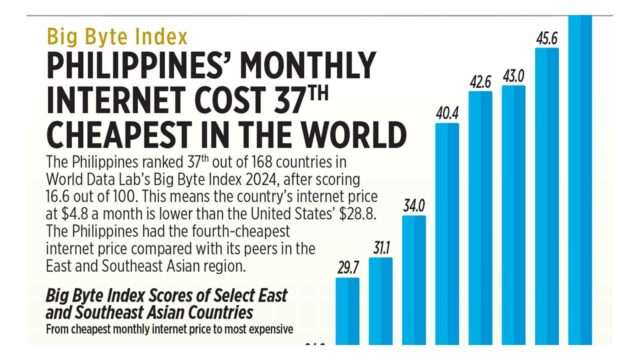
Big Byte Index: Philippines’ monthly internet cost 37th cheapest in the world

The Philippines ranked 37th out of 168 countries in World Data Lab’s Big Byte Index 2024, after scoring 16.6 out of 100. This means the country’s internet price at $4.8 a month is lower than the United States’ $28.8. The Philippines had the fourth-cheapest internet price compared with its peers in the East and Southeast Asian region.

Big Byte Index: philippines’ monthly internet cost 37<sup>th</sup> cheapest in the world

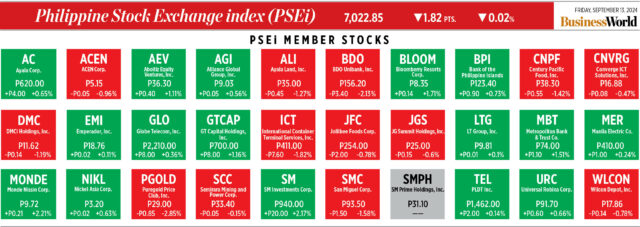
How PSEi member stocks performed — September 13, 2024

Here’s a quick glance at how PSEi stocks fared on Friday, September 13, 2024.


Fed cut anticipation may keep PSEi above 7,000

BW FILE PHOTO

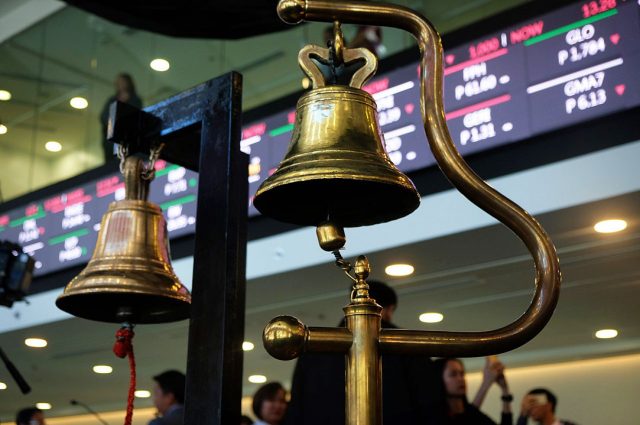
PHILIPPINE SHARES may stay at the 7,000 level this week as the US Federal Reserve is expected to cut rates for the first time in over four years.

On Friday, the Philippine Stock Exchange index (PSEi) inched down by 0.02% or 1.82 points to end at 7,022.85, while the broader all shares index declined by 0.08% or 3.02 points to close at 3,788.63.

Still, week on week, the PSEi ended 86.76 points or 1.25% higher than its 6,936.09 finish on Sept. 6, marking its second straight week of gains.

“Momentum favored local equities ahead of what is likely the Fed’s first rate cut since March 2020. The PSEi closed above the 7,000 level for the first time since February 2023,” online brokerage 2TradeAsia.com said in a market note.

For this week, the expected Fed cut at its Sept. 17-18 meeting is expected to give Philippine shares a lift, Philstocks Financial, Inc. Senior Research Analyst Japhet Louis O. Tantiangco said in a Viber message.

“[This] week, the market may continue to test the validity of its breach of the 7,000 level. Taking the center stage would be the Federal Reserve’s policy decision and outlook. A policy rate cut by the Fed together with hints of further easing moving forward is expected to fuel optimism at the local front since this would give the Bangko Sentral ng Pilipinas more room to ease their policy, too,” Mr. Tantiangco said.

The Federal Reserve is nearly as likely to deliver an outsized interest-rate cut this week as a more-usual-sized reduction, trading in rate-futures contracts suggested on Friday, as financial markets priced in a bigger chance that the Fed will move more aggressively, Reuters reported.

A quarter-point reduction at the Fed’s Sept. 17-18 meeting is still seen as the slightly more likely outcome, but only marginally so.

Futures tied to the Fed’s policy rate now reflect about a 47% chance that the Fed will cut its policy rate, currently in the 5.25%-5.5% range, by a half of a percentage point. That’s up from about 28% on Thursday.

“The local currency’s strengthening against the dollar, if it continues [this] week, is also expected to help the local bourse,” Mr. Tantiangco added. “Chart-wise, if the market holds ground at 7,000, its trading range is seen from 7,000 to 7,150.”

On Friday, the peso ended at P55.995 per dollar, rising by 20.50 centavos from its P56.20 close on Thursday, Bankers Association of the Philippines data showed.

Rizal Commercial Banking Corp. Chief Economist Michael L. Ricafort said the PSEi’s next resistance is its Sept. 10 intraday high of 7,109.75, while its immediate minor support level is at 6,835-6,940.

2TradeAsia.com put the market’s immediate support at 6,900 and resistance at 7,100-7,200.

“With macro and corporate data moving positively along a similar direction, volumes should be aided by institutional funds edging back into risk after consecutive quarters of being harrumphed by either tight capital environment or limited growth play options,” it said. — R.M.D. Ochave with Reuters

Peso to move mostly sideways vs dollar before Fed decision

BW FILE PHOTO

THE PESO could mostly trade sideways against the dollar this week as the market awaits the US Federal Reserve’s policy meeting, where it is expected to cut rates for the first time since March 2020.

On Friday, the local unit closed at P55.995 per dollar, strengthening by 20.5 centavos from its P56.20 finish on Thursday, Bankers Association of the Philippines data showed.

However, week on week, the peso depreciated by nine centavos from its P55.905 finish on Sept. 6.

The peso was supported by a generally weaker dollar on Friday, Rizal Commercial Banking Corp. Chief Economist Michael L. Ricafort said in a Viber message.

“The dollar weakened as mixed US data fueled Fed rate cut bets,” Security Bank Corp. Chief Economist Robert Dan J. Roces added in a Viber message.

“The dollar-peso traded within ranges as slightly better US inflation data, the producer price index (PPI), was weighed down by higher-than-expected jobless claims overnight,” he said.

The PPI for final demand rose 0.2% in August, compared with estimates for 0.1% growth, Reuters reported. The core number, which strips out volatile food and energy prices, rose 0.3%, higher than the 0.2% forecast.

Separately, initial claims for state unemployment benefits stood at 230,000 for the week ended Sept. 7, in line with estimates.

The US dollar fell on Friday to its lowest level in nearly nine months against the Japanese yen after media reports once again fueled speculation the Federal Reserve could deliver a super-sized 50-basis-point (bp) interest rate cut at its policy meeting this week.

Analysts said reports by the Wall Street Journal and Financial Times late on Thursday saying a 50-bp rate reduction is still an option, and comments from a former Fed official arguing for an outsized cut, caused a shift in market expectations.

The US rate futures market has priced in a 51% probability of a 50-bp easing by the Fed at the conclusion of its two-day meeting on Wednesday. Futures traders have also factored in 117 bps of cuts for 2024, up from 107 bps in the previous session.

In late afternoon trading, the dollar was down 0.66% to 140.855 yen, after earlier dropping to 140.285, its lowest level since Dec. 28. On the week, it fell 1%.

The dollar trimmed losses after data showed US consumer sentiment improved in September amid easing inflation.

US economic data last week appeared to support the case for a typical 25-bp cut this week, with the measure of consumer price inflation that strips out volatile food and energy prices rising more than expected in August.

But former New York Fed President Bill Dudley on Friday added to the speculation about a 50-bp Fed rate cut, saying there was a strong case for such a move and that rates were currently 150-200 basis points above the so-called neutral rate for the US economy, where policy is neither restrictive nor accommodative.

For this week, Mr. Roces said the Federal Open Market Committee’s policy meeting will be a major catalyst for the peso’s movement.

Mr. Ricafort sees the peso moving between P55.80 and P56.30 per dollar this week. — AMCS with Reuters

Philippine ship leaves Sabina Shoal after months of pressure from China

"BRP TERESA MAGBANUA”, the largest patrol vessel (97 meters) for the Philippine Coast Guard (PCG)

By Kyle Aristophere T. Atienza, Reporter

THE PHILIPPINES’ biggest coast guard ship left Sabina Shoal on Sept. 14 after five months of being deployed there and amid Chinese pressure to leave the disputed atoll.

BRP Teresa Magbanua left the disputed shoal, which Manila used as a staging ground for resupply missions to Second Thomas Shoal, because it had accomplished its mission, the Philippines’ National Maritime Council said in the statement on Sunday.

“After more than five months at sea, where she carried out her sentinel duties against overwhelming odds, BRP Teresa Magbanua is now sailing back to her homeport with her mission accomplished,” council Chairman and Executive Secretary Lucas P. Bersamin said.

The Chinese Coast Guard confirmed the departure of the ship after lingering there since April in what China viewed as an “illegal action,” according to state-owned Xinhua News Agency.

China took measures against Philippine vessel 9701 in accordance with the law, while repeated Philippine attempts to organize replenishment of the vessel had failed, Xinhua quoted China Coast Guard spokesman Liu Dejun as saying.

The Southeast Asian nation’s sustained presence at the feature, aiming to monitor what it suspects to be China’s small-scale reclamation activities has angered Beijing, turning the shoal into their latest flashpoint in the contested waters.

The pullout of Magbanua was not in compliance with China’s previous demands, National Maritime Council spokesman Alexander Lopez told reporters.

“This a unilateral action of the Philippine Coast Guard (PCG) considering the administration and operational factors mentioned in the National Maritime Council statement,” he said.

Mr. Lopez said the ship left the shoal on Saturday and was expected to arrive in Puerto Princesa, Palawan province by Sunday afternoon.

He added that the country’s presence at the shoal would “be sustained.” “We will keep on monitoring and documenting any or all illegal activities for our strategic purpose.”

“We will maintain our presence in whatever way, and we will continue to monitor and enforce our rights, exercise our rights, sovereign rights, sovereignty and jurisdiction over the area.”

Mr. Bersamin said the 97-meter PCG vessel needs to address the medical needs of some of its crew and undergo needed repairs.

It would also give its crew a furlough so its members could have a reunion with their loved ones, he added.

“After she has been resupplied and repaired, and her crew recharged, she will be in tip-top shape to resume her mission, along with other PCG and Armed Forces of the Philippines assets, as defenders of our sovereignty,” Mr. Bersamin said.

BRP Teresa Magbanua was deployed to Sabina Shoal in mid-April, as Manila accused Beijing of dumping the atoll with dead corals to alter its elevation.

Chinese and Philippine vessels have collided since last month near Sabina, which lies 140 kilometers off the Philippine westernmost island of Palawan.

“During her deployment at Escoda Shoal (Sabina), she challenged an encirclement by a larger flotilla of intruders, battled inclement weather, with her crew surviving on diminished daily provisions,” Mr. Bersamin said.

“What made this possible is the determination and dedication of the men and women on board, who crewed her in the finest tradition of our Philippine Coast Guard sailors, and in honor of the heroine for whom she was named.”

The Philippine Foreign Affairs department this month said it had expressed its displeasure with Beijing over an Aug. 31 collision in which BRP Teresa Magbanua was hit thrice by a Chinese vessel.

The China Coast Guard vessel caused significant damage to the Philippine ship and endangered the lives of its personnel, a Philippine task force said.

The Chinese side made a similar claim, with Mr. Liu saying that the smaller PCG vessel “deliberately” collided with their ship.

Sabina has been a staging ground for Philippine resupply missions to Second Thomas Shoal, where Manila grounded a World War II era ship in 1999 to serve as an outpost for a handful of Filipino soldiers.

Manila and Beijing came up with a resupply deal in July after a June 17 standoff where Chinese forces threatened, using bladed weapons, Filipino troops delivering supplies to the Navy outpost, according to the Philippine military.

SC sides with Crocodile Int’l in Lacoste lawsuit

PIXABAY

THE PHILIPPINE Supreme Court (SC) has favored Singapore-based Crocodile International Pte. Ltd. in a trademark lawsuit filed by French fashion giant Lacoste S.A.

The SC’s Second Division upheld decisions of the Court of Appeals (CA), Intellectual Property Office-Director General (IPO-DG) and Intellectual Property Office-Bureau of Legal Affairs (IPO-BLA), which all found no similarity between the two crocodile logos.

“The court finds no cogent reason to reverse the uniform rulings of the IPO-BLA, the IPO-DG and the CA in denying Lacoste’s opposition to Crocodile’s trademark application No. 4-1996-116672 for the mark ‘Crocodile and Device’ for goods covered by Class 25 of the [Nice Classification],” it said in a 15-page decision written by Justice Antonio T. Kho. The ruling was promulgated in November 2023 and released on Sept. 10.

“Absent of showing fraud and misrepresentation to the public, the court should allow enterprises, such as Crocodile in this case, to enter the Philippine market through, among others, the registration of their trademarks,” it added, citing the need to balance the protection of intellectual property rights and fair competition.

Lacoste filed the lawsuit in 1996 against Crocodile International’s trademark application for its “Crocodile and Device” mark, saying it resembled Lacoste’s emblem.

Crocodile International filed a trademark application for its logo with the Bureau of Patents, Trademarks, and Technology Transfer, the IPO’s predecessor, in 1996, which Lacoste opposed in 2004, citing possible confusion for consumers.

The French fashion brand, a company that has been in the Philippine market since 1963, argued that Crocodile International’s logo would confuse consumers.

The Singaporean brand, established in 1949, started exporting its products to the Philippines in 2002.

Crocodile International said its mark is a left-facing crocodile with the word “Crocodile” stylized above the image, while Lacoste has a right-facing crocodile emblem and the word “Lacoste” below the figure.

It argued that both logos have coexisted peacefully in other countries, such as Japan and Myanmar, where courts also ruled the logos were not confusingly similar.

It cited a Mutual Co-Existence Agreement signed between Lacoste and Crocodile International in 1983, when both parties agreed to coexist in specific markets, but Lacoste said this does not apply in the Philippines.

In 2009, the IPO-BLA rejected Lacoste’s opposition, applying the dominancy test and holistic test to determine whether the differences between the two logos were clear enough to avoid confusion.

The appellate court affirmed its ruling in 2015, saying the logos were visually distinct. — Chloe Mari A. Hufana

Analysts: Guo case not good for PHL bid for UN council

PHILIPPINE STAR/RYAN BALDEMOR

By Chloe Mari A. Hufana, Reporter

THE ESCAPE of a former town mayor accused of having ties with Chinese criminal syndicates could have dented the Philippines’ bid for a seat in the United Nations Security Council (UN SC), a diplomacy expert said.

“The very important implication [of ex-Bamban Mayor Alice L. Guo’s escape] is [that it reveals how] justice works in the Marcos regime,” Josue Raphael J. Cortez, a lecturer at the School of Diplomacy and Governance of De La Salle-College of St. Benilde, told BusinessWorld in a Facebook Messenger chat at the weekend

“We know that through [President Ferdinand R. Marcos, Jr.’s] initiative, we are clamoring for a seat in the Security Council,” he added.

The Philippines is seeking a nonpermanent seat in the council for 2027 to 2028.

“In line with this campaign, the government has been undertaking different projects [that] are reflective of the state of the justice system in the country, highlighting its milestones and how it ascertains the rule of law,” he added.

“Guo’s escape, however, and the extent of it, certainly left a dent and became an antithesis on this campaign.”

Ms. Guo, who is under Senate investigation for her alleged links to an illegal offshore gaming operator in the Philippines, escaped the Philippines in July despite a standing arrest warrant from the chamber.

Indonesian authorities deported her on Sept. 4 after her arrest in Jakarta, raising eyebrows about Philippine law enforcer’s ability to track down suspects.

National Union of Peoples’ Lawyers (NUPL) President Ephraim B. Cortez said her escape had left a “big dent” on Philippine law enforcement authorities’ integrity.

He reiterated Mr. Marcos’ pronouncement about the involvement of Immigration authorities in Ms. Guo’s escape.

“Our law enforcement agencies still cannot provide us with a clear narrative on how she left the country, and the chronology of her travel,” Mr. Cortez told BusinessWorld in a Viber message. “The Senate investigation, the National Bureau of Investigation, and Bureau of Immigration are trying to ferret these out from her,” he added, calling the investigation process “archaic.”

Benilde’s Mr. Cortez said a good strategy to covet a seat in the UN’s most exclusive council is not limited to launching initiatives or creating agencies tailor-fitted for the campaign.

“It would be better to show the world that all the work on their very purposes and mandates, particularly the newly established agencies, because more than opening and launching them, showing how [they] operate to promote peace, justice and security can be a more viable way for us to get the seat we aspire for,” he added.

He noted that one of the newly launched offices include the Office of the Presidential Adviser on the Peace Process geared towards ensuring that peace process strategies of the government will be strengthened. On the other hand, events including the Philippine Drug Policy Summit which was recently held was geared towards showing that the Philippines in addressing issues related to illicit drugs are dealt with in adherence to the rule of law.

Despite this, NUPL’s Mr. Cortez said the chances of the country getting a seat in the council boils down to the effective lobbying process.

“The vote for the seat is more political than anything else,” he said. “It will depend on how the Philippine government effectively lobbies with the permanent members and the members of the General Assembly,” he said.

He noted that the Philippines got a seat in the UN Human Rights council despite its human rights record.

The Security Council has 15 members, five of which are permanent, while 10 serve two-year, nonconsecutive terms. The council is responsible for maintaining international peace and security, according to its website.

In some cases, the council can impose sanctions or authorize the use of force to maintain or restore international peace and security.

The Philippines last held a seat in the council in 2004-2005.

Benilde’s Mr. Cortez said Ms. Guo’s escape showed how influential people could go above the law.

“Thankfully, the efficiency of our coordination with Indonesian authorities — and how swift Guo and her friends’ deportation process was — is in a way the saving grace of it all because it showed that our government is more than willing to collaborate for the sake of ensuring that law and justice will triumph over anything else,” he said.

Philippine authorities in March raided an illegal Philippine Offshore Gaming Operator in Bamban, Tarlac province, allegedly for human trafficking violations and scamming.

Increased social development funding pushed

PHILIPPINE STAR/KRIZ JOHN ROSALES

By Kenneth Christiane L. Basilio, Reporter

THE HOUSE of Representatives should look at increasing funding to agencies responsible for social development under the proposed P6.352-trillion national budget to spur inclusive socioeconomic growth next year, analysts said at the weekend.

The budgets allotted to the Health, Social Welfare, Labor, Agriculture, and Trade and Industry departments are not enough to alleviate economic pressures faced by Filipinos, such as the rising costs of commodities, they added.

“The budgets for agriculture, agrarian reform and irrigation, trade and industry, education, health and social welfare remain seriously underfunded when measured against the magnitude of current problems,” Jose Enrique “Sonny” A. Africa, executive director at think tank IBON Foundation, said in a Viber message.

“Decent standards of living for all Filipinos because of universal social services and an economy with robust Filipino industry and vibrant agriculture are among the foundations for meaningful nation-building. The proposed 2025 budget is unfortunately not oriented toward this,” he added.

The Department of Budget and Management (DBM) in July submitted to the chamber its proposed P6.352-trillion national budget for 2025, which is equivalent to 22.1% of gross domestic product and 10.1% higher than the P5.768-trillion budget this year.

Under the 2025 National Expenditure Program, the DBM slashed the proposed budgets for agriculture, health, and social welfare by 4.7%, 7.6%, and 3.4%, respectively. Allocations for labor were also decreased by 26.1%, with trade and industry receiving a 3.9% cut.

“Most of the key departments that are crucial in boosting economic growth and promoting socio-economic development suffered cuts,” Zy-za Nadine M. Suzara, an independent budget analyst and former executive director of policy think-tank Institute for Leadership, Empowerment, and Democracy, said in a Viber message.

Ms. Suzara said the government was unable to provide bigger allocations to “marginalized sectors” such as agriculture and health for 2025 due to limited fiscal space resulting from bloated unprogrammed appropriations in the previous years.

BLOATED UNPROGRAMMED FUNDS
“The national budgets in the past three fiscal years are defective because the bicameral moved priority projects to unprogrammed appropriations, which are merely stand-by appropriations,” she said. “By placing them there, priority projects have lost guaranteed cash cover.”

Unprogrammed appropriations for 2024 ballooned by more-than-double to P731.45 billion from the proposed P281.91 billion as Congress shifted funding for education and social protection projects into it.

“Priority projects that were reallocated to unprogrammed appropriations in the 2024 budget are the foreign-assisted projects of DoTr (Department of Transportation) and DPWH (Department of Public Works and Highways), as well as portions of funding for education, health and social protection programs such as the Universal Access to Tertiary Education, PUV (Public Utility Vehicle) Service Contracting, various agri-fisheries programs,” she said.

The ballooning of unprogrammed appropriations in the previous budget “is a result of the surreptitious insertion by Congress of pork barrel funds,” Filomeno S. Sta. Ana III, coordinator of Action for Economic Reforms, said in a Viber message.

House Speaker and Leyte Rep. Ferdinand Martin G. Romualdez in August said the unprogrammed appropriations cannot be considered as pork barrel funds, citing differences in their technical definition.

The Priority Development Assistance Fund, colloquially known as pork barrel, is a discretionary lump sum fund to members of Congress meant to finance local projects within their legislative districts. It was discontinued in 2013 following the Philippines’ Supreme Court decision declaring it unconstitutional after state auditors found gross misuse in prior years.

Minority lawmakers from the Makabayan bloc in August called the ballooning of unprogrammed appropriations a new form of pork barrel with Party-list Rep. Raoul Danniel A. Manuel arguing it “bastardizes” the budget process and weakens congressional oversight on the budget.

“As a consequence of prioritizing pork in the previous years’ national budgets, the allocative efficiency of the 2025 proposed budget is compromised,” Ms. Suzara said. “The Marcos government is neither expanding more targeted and strategic socio-economic projects because of chronic inefficiency and underspending of many government agencies.”

Lawmakers should “temper their greed” to make the proposed 2025 national budget more efficiently allocated, according to Ms. Suzara.

PLENARY DEBATES
The House will begin plenary debates on the proposed budget on Monday, with a target of passing the budget bill by Sept. 25, Mr. Romualdez said in a statement on Sunday.

The committee on Tuesday last week finished reviewing the proposed budgets of each government agency, with the panel submitting the 2025 General Appropriations Bill for plenary deliberations on Thursday.

The 2025 GAB mostly retained the proposed expenditures submitted by the Budget department, with reallocations only happening to the Office of the Vice President’s proposed budget.

The House appropriations panel unanimously slashed the OVP’s budget by 64% to P733 million from P2.03 billion due to project redundancies with the Health and Social Welfare departments.

The reallocated amount would be equally split at P646 million between the Social Welfare departments aid program for indigent Filipinos and the Health departments medical assistance initiative.

“This is a reasonable budget reduction as it re-channels these funds toward agencies which can more directly serve Filipino families,” Terry L. Ridon, a public investment analyst and convener of think-tank InfraWatch PH, said in a Viber Message.

Congressmen are likely to augment funding for the Social Welfare and Public Works departments, Ms. Suzara said, noting these are agencies where the budget for their localities’ infrastructure projects and social aids are lodged.

Reallocations to the Department of Public Works and Highways, however, should not come from agencies concerning social development, such as the Health and Social Welfare departments, Leonardo A. Lanzona, an economics professor at the Ateneo de Manila University, said in a Facebook Messenger chat.

Mr. Ridon said lawmakers should also look at boosting state funding to the Department of Information and Communications Technology (DICT) amid hacking incidents to government servers.

The DICT’s proposed 2025 budget rose by 33.6% to P9.2 billion from its 2024 P6.9-billion budget.

“With increasing government digitalization, cybersecurity should become a pillar of funding concern across agencies, led by the DICT,” he said.

There must be a consensus between leaders of both the Senate and the House for reallocations to be successfully augmented, Assistant Minority Leader and Party-list Rep. Marissa P. Magsino said in a Viber message.


ADVERTISEMENT
ADVERTISEMENT