Home Blog Page 267

Indonesia 19% tariff deal with US exempts palm oil, other commodities

REUTERS

JAKARTA — Indonesia and the United States finalized a trade deal to cut US levies to 19% from 32% on goods shipped from Southeast Asia’s biggest economy, with Jakarta securing tariff exemptions for its top export, palm oil, and several other commodities.

The agreement was signed in Washington by Indonesia’s senior economic minister Airlangga Hartarto and US Trade Representative Jamieson Greer after months of negotiations.

“This deal respects the sovereignty of both countries,” Mr. Airlangga said during an online press conference, describing the deal as a “win-win” for both countries.

Palm oil was a particularly important exemption, accounting for around 9% of Indonesia’s overall exports.

Indonesian coffee, cocoa, rubber and spices would also be tariff-free, Mr. Airlangga said.

The 19% rate is on par with US deals with Southeast Asian rivals such as Malaysia, Cambodia, Thailand and the Philippines.

Vietnam, however, has a slightly higher rate of 20%.

Malaysia, another major exporter of palm oil, also has a tariff exemption for that product, as well as for cocoa and rubber.

The deal comes after a rough start to the year for Indonesian markets. Setbacks include last month’s warning from index provider MSCI that the equity market risked a downgrade to “frontier” status over transparency issues, as well as Moody’s cutting of the country’s credit rating outlook two weeks ago that cited reduced predictability in policy making.

Investor confidence in Indonesia could improve if Jakarta uses the US deal as a springboard for further reform, said Yose Rizal Damuri, executive director of CSIS Indonesia.

“If Indonesia could multilateralize some of its commitments to the United States and use them as a basis for deregulation, that would increase trust in Indonesia and that’s something that should be taken advantage of, optimized,” he added.

Under the deal, textile products from Indonesia will be subject to a 0% levy under a quota mechanism that is still to be discussed. The quota will be determined by the quantity of US materials such as cotton and man-made fiber used in textiles.

The US dropped requests to add non-economic provisions to the deal, including those related to nuclear reactor development and the South China Sea, Mr. Airlangga said.

In return, Indonesia will remove tariff barriers on most US products across all sectors and address a range of non-tariff barriers such as local content requirements, according to a White House fact sheet.

It will also accept US product standards on vehicle safety, emissions, medical devices and pharmaceuticals.

The deal also appears to take aim at what analysts have said are concerns in Washington about China’s stranglehold on many critical minerals and the offshoring of Chinese companies’ operations to countries like Indonesia.

Under the agreement, Indonesia will implement restrictions on ‘excess production’ by foreign-owned mineral processing facilities by ensuring production conforms to Indonesian mining quotas. Such minerals include nickel, cobalt, bauxite, copper and manganese.

Jakarta has also agreed to take action against companies owned or controlled by foreign countries operating within its jurisdiction when their practices harm US trade interests.

And Indonesia will facilitate US investment in critical minerals and energy resources as well as cooperate with US companies on expediting development of its rare-earth sector.

The deal is due to take effect 90 days after both sides complete related legal procedures, Mr. Airlangga said, adding that changes could still occur if both sides agree.

President Prabowo Subianto traveled to Washington for the deal and to attend the first leaders’ meeting of President Donald Trump’s Board of Peace.

Mr. Prabowo and Mr. Trump on Friday signed a document titled “Implementtion of the Agreement Toward a NEW GOLDEN AGE for the US-Indonesian Alliance” which the White House said would help both countries to strengthen economic security and growth.

Earlier this week, Indonesian and US companies signed deals worth $38.4 billion. — Reuters

Preparing for longer living in the Philippines

STOCK PHOTO | Image by Lifestylememory from Freepik

People worldwide are living longer, driven by advances in social and economic development as well as improvements in healthcare. At the same time, trends such as urbanization and higher educational attainment have contributed to smaller families and declining birth rates, resulting in fewer children in many countries. Together, these forces are reshaping global demographics.

As a result, the population aged 60 and older is expanding rapidly, in many cases surpassing the number of younger people which is a shift known as population aging.

The World Health Organization (WHO) estimates that by 2030, one in six people globally will be aged 60 years or older. Meanwhile, the number of persons aged 80 years or above is projected to triple between 2020 and 2050, reaching 426 million. While population aging began in high-income countries such as Japan, where nearly 30% of the population is already over 60, low- and middle-income countries (LMICs) are now experiencing significant demographic shifts. By 2050, two-thirds of the world’s population over 60 will live in LMICs.

Longer lifespans create opportunities for individuals to remain active, productive, and engaged. However, the WHO warns that these gains also present challenges unless societies adapt their policies, systems, and institutions across sectors.

The Philippines is no exception.

According to the Philippine Statistics Authority (PSA), there were 10.98 million Filipinos aged 60 years and older in 2025, comprising 9.6% of the country’s 113.7 million population. This places the country just below the 10% threshold commonly used by global institutions such as the World Bank to classify an aging society. At current trends, the PSA projects that the Philippines will cross this threshold within the next few years, with senior citizens accounting for approximately 11% of the population by 2030.

This demographic transition carries profound implications for economic resilience, social protection, and healthcare delivery.

Data presented during a 2019 Senate committee hearing on the National Commission of Senior Citizens Act revealed that 55% of Filipino senior citizens have no pension. Among those with financial support, 23% receive pensions from the private sector, 6% receive government pensions, and 16% rely on a monthly social pension of only P500.

Healthcare capacity presents another major concern.

A Department of Health (DoH) report highlighted a significant deficit in geriatric care, citing the lack of specialized geriatric wards and a severely low ratio of geriatricians relative to the elderly population. Geriatricians are physicians with specialized training in caring for older adults, particularly those with multiple chronic conditions and complex health needs.

Recognizing these challenges, members of the Senate have expressed concern that many older Filipinos, particularly those with limited financial resources, may struggle to access long-term and specialized care.

In response, Senate Bill No. 1302 was filed in September 2025. The bill mandates the establishment of a tertiary specialty hospital under the DoH dedicated to the care, treatment, and rehabilitation of older persons.

If enacted, the existing National Center for Geriatric Health (NCGH) in Manila would be upgraded and renamed the Philippine Geriatric Center (PGC). As the National Specialty Referral Center for geriatric care, the PGC would provide specialized services, promote research, facilitate education and training for healthcare providers, and coordinate a national approach to elderly healthcare.

The bill further mandates the creation of a National Geriatric Health Service Delivery Plan and the establishment of regional geriatric centers to ensure nationwide access. It also proposes a Geriatric Human Resource Development Program aimed at strengthening the country’s capacity through scholarships, incentives, and continuing professional development.

While these structural reforms are essential, addressing the long-term impact of population aging requires more than expanding treatment capacity.

It demands a decisive shift toward prevention.

Rapid population aging intensifies pressure on health systems, largely due to the rising prevalence of noncommunicable diseases (NCDs). Although NCDs affect individuals across all age groups, their incidence increases sharply with advancing age, making them leading contributors to mortality, hospitalization, frailty, and healthcare expenditure.

Prevention therefore becomes central to sustaining both individual well-being and health system resilience.

A comprehensive response must span the full continuum of care, from health promotion and disease prevention to early detection, diagnosis, and timely treatment. The WHO emphasizes that lifelong prevention strategies can significantly reduce the risk of chronic diseases such as heart disease, stroke, and cancer, while also delaying functional decline.

Equally critical is the provision of integrated, person-centered primary healthcare tailored to the needs of older adults. Such an approach enables earlier detection, better management of chronic conditions, and improved quality of life.

Ensuring access to long-term care services including rehabilitation, palliative care, and social support further helps older persons maintain independence and dignity.

At the same time, investments in preventive measures such as adult immunization play a vital role in promoting healthy aging. Vaccination across the lifespan protects older adults from preventable diseases, reduces complications, and eases pressure on healthcare systems.

For aging populations often burdened by multiple chronic conditions and functional decline, protection-oriented strategies are not optional as they are indispensable.

Healthy aging is not achieved by treating disease alone, but by preventing avoidable illness, preserving function, and enabling older Filipinos to live longer, healthier, and more productive lives.


Teodoro B. Padilla is the executive director of Pharmaceutical and Healthcare Association of the Philippines, which represents the biopharmaceutical medicines and vaccines industry in the country. Its members are at the forefront of developing, investing and delivering innovative medicines, vaccines, and diagnostics for Filipinos to live healthier and more productive lives.

MMPC wins service advisor tilt in Tokyo

Carworld, Inc. Service Advisor Raymond Rivera (left) confers with his coach, Mitsubishi Motors Philippines Corp. Non-Technical Training Senior Supervisor Allan Veraque, Jr. — PHOTO FROM MITSUBISHI MOTORS PHILIPPINES CORP.

MITSUBISHI MOTORS Philippines Corp. (MMPC) was declared champion of the Service Advisor category of the Global Service Skills Contest (GSSC) 2025 in December at the Tokyo Ryutsu Center in Tokyo, Japan.

Representing the Philippines was Raymond Rivera of Carworld, Inc. who bested top service advisors from 15 countries around the world. The GSSC is a prestigious competition held by Mitsubishi Motors Corp. where Mitsubishi Motors distributors send representatives to vie for honors.

Mr. Rivera earned the opportunity to compete internationally after emerging as champion at MMPC’s Mitsubishi Skills Olympics in January 2025. His preparation for the global championship officially began last July, backed by months of training under the guidance of his coach, MMPC Non-Technical Training Senior Supervisor Allan Veraque, Jr.

In a release, MMPC said the Global Service Skills Contest “is designed to rigorously assess both technical knowledge and customer-handling skills through two major parts.”

The first tests written and thinking skills, including a matching-type examination and an essay task where participants provide customer recommendations and advice based on realistic scenarios. These take into account customer profiles, preventive maintenance service (PMS) requirements, vehicle condition, and even customer lifestyle.

The second part is a role-play exercise, “simulating the full service advisor process from pre-delivery to vehicle delivery.” Contestants are judged on vehicle verification based on PMS requests, cleanliness, and confirmation of replaced parts. During delivery, service advisors are expected to “clearly explain the service performed, discuss the repair order and bill of materials, conduct a proper vehicle walkaround, and provide safety reminders, vehicle care tips, next PMS schedules, and follow-up guidance — ending with a professional and warm send-off to the customer.”

Emphasis was put on customer care — driving customer satisfaction and fostering long-term loyalty through retention, repeat purchases, and strengthened brand value.

MMPC Aftersales Executive Vice-President Toko Imai expressed his pride in the achievement, saying, “This win reflects the strength of our people and our commitment to customer-first service. With Raymond’s performance, he showed to the world that when technical excellence is combined with genuine care for the customer, Filipino service professionals can truly excel on the global stage.”

“Preparation is really about showing up every day. Regardless of energy or mood, you still show up; that’s what makes the difference. And Raymond did exactly that. By consistently showing up to training for months, he was able to internalize all the lessons,” joined Mr. Veraque.

Yields on BSP bills drop after rate cut

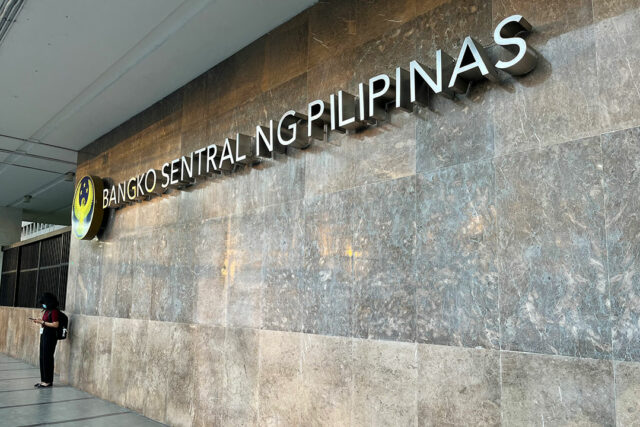
Bangko Sentral ng Pilipinas main office in Manila — BW FILE PHOTO

YIELDS on the Bangko Sentral ng Pilipinas’ (BSP) short-term securities declined further on Friday as it cut benchmark borrowing costs for a sixth straight meeting.

The one-month BSP bills attracted P77.838 billion in bids, exceeding the P70-billion offer but below the P112.904 billion in tenders for the P100 billion placed on the auction block in the prior week.

This was equivalent to a bid-to-cover ratio of 1.112 times, slightly lower than the 1.129 ratio seen a week earlier.

The central bank fully awarded its P70-billion offering.

Accepted yields were from 4.38% to 4.58%, lower and wider than the 4.5% to 4.64% band logged during the previous auction. This caused the average rate of the 28-day papers to drop by 10.4 basis points (bps) to 4.4939% from 4.5979% a week prior.

“At the Feb. 20 auction, the weighted average interest rate for the 28-day BSPB fell by 10.4 basis points week on week following the policy rate cut announced the previous day,” the central bank said in a statement.

On Thursday, the BSP delivered a sixth straight 25-bp cut, bringing the key interest rate to an over three-year low of 4.25%.

The Monetary Board has now lowered borrowing costs by a total of 225 bps since it began its easing cycle in August 2024.

The BSP has not auctioned off the 56-day bills since Nov. 3.

The central bank uses the BSP securities and its term deposit facility to mop up excess liquidity in the financial system and to help guide short-term market yields towards its policy rate.

BSP Deputy Governor Zeno Ronald R. Abenoja earlier said that the central bank has reduced its issuance of short-term papers to enhance monetary policy transmission and encourage banks to better manage their liquidity.

Data from the BSP showed that around 50% of its market operations are done through its short-term securities.

As of mid-November 2025, the central bank’s monetary operations have siphoned off P1.5 trillion in liquidity from the market. Of this, 42.4% was absorbed through BSP securities, 34.6% from overnight reverse repurchase agreements, 17.6% via the overnight deposit facility, and 5.4% through the term deposit facility.

The BSP bills also contribute to improved price discovery for debt instruments while supporting monetary policy transmission.

The central bank began auctioning off short-term securities weekly in 2020, initially offering only a 28-day tenor and adding the 56-day bill in 2023. — Katherine K. Chan

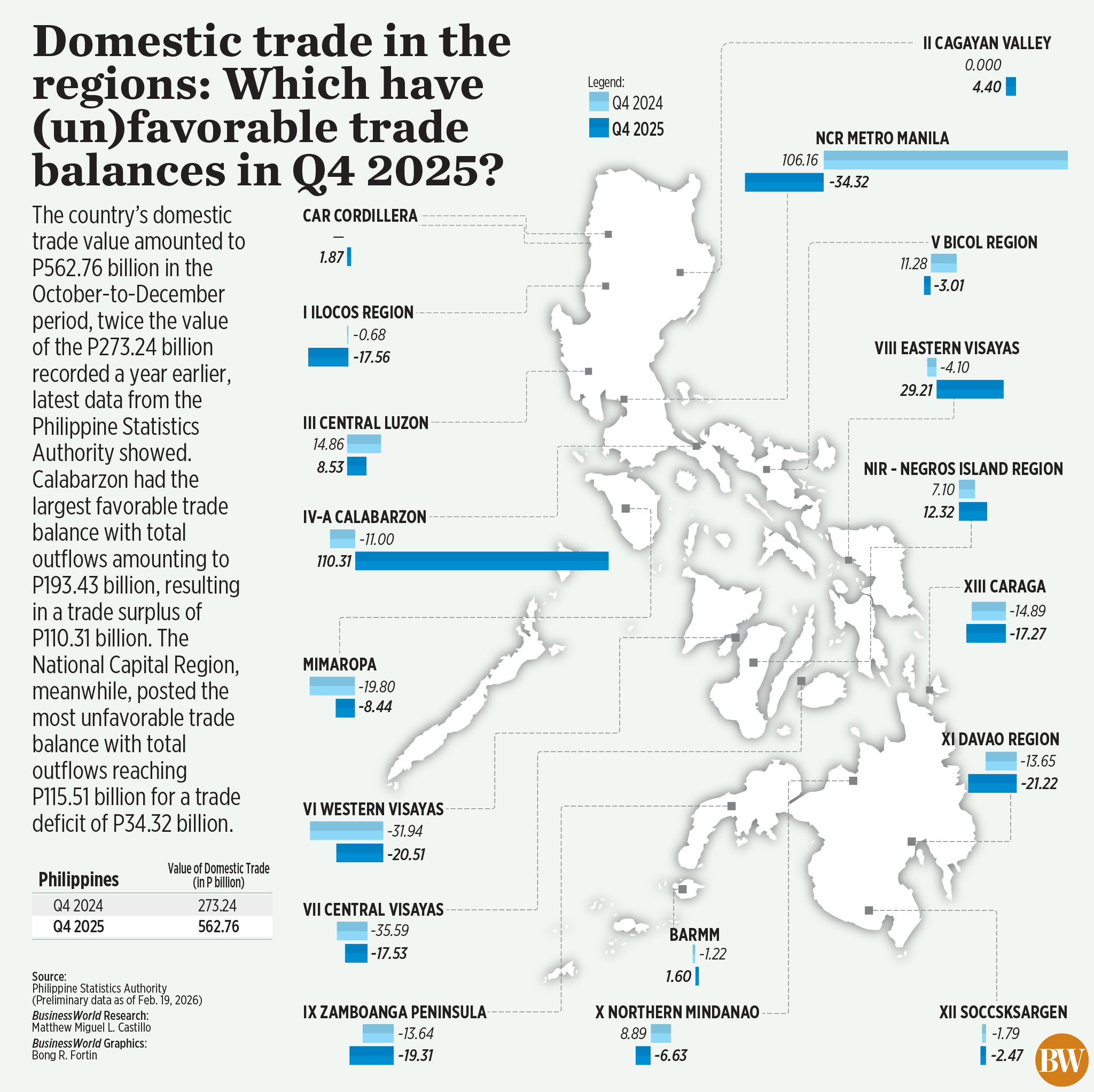
Domestic trade in the regions: Which have (un)favorable trade balances in Q4 2025?

DOMESTIC TRADE in goods amounted to P562.76 billion in the last three months of 2025, the Philippine Statistics Authority (PSA) said in its Commodity Flow in the Philippines report, citing preliminary data. Read the full story.

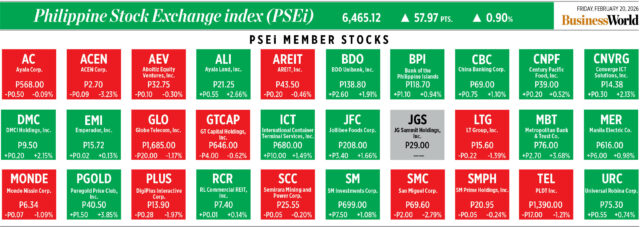
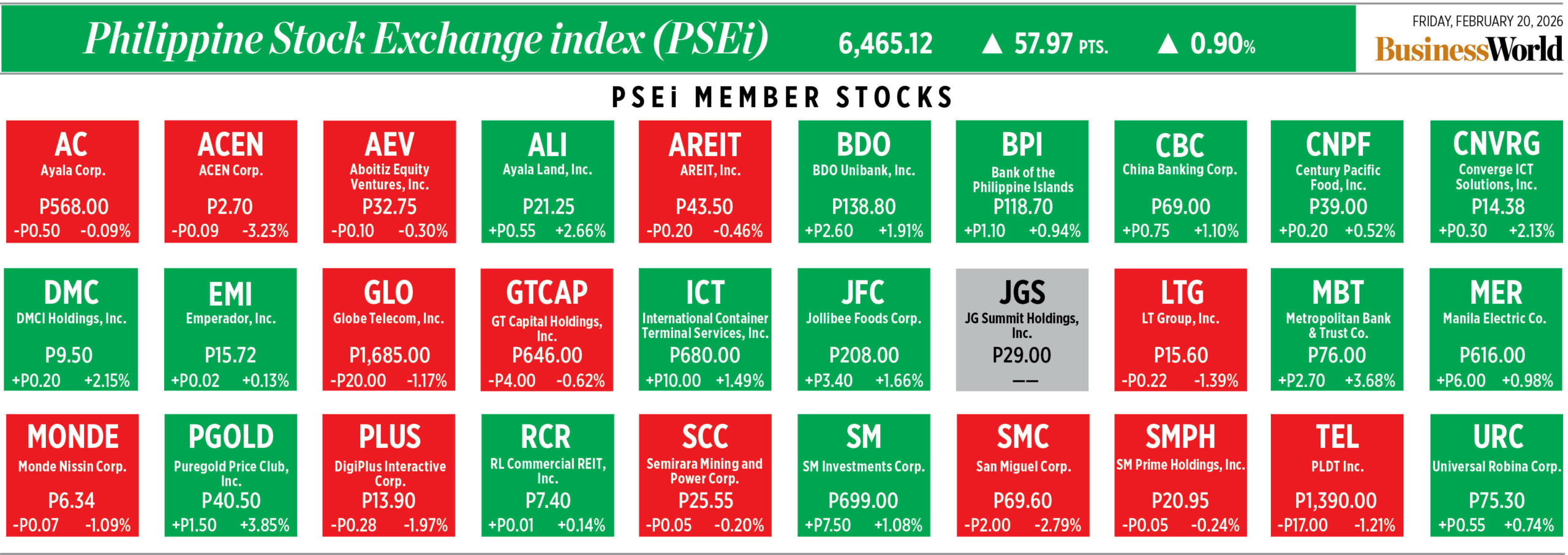
How PSEi member stocks performed — February 20, 2026

Here’s a quick glance at how PSEi stocks fared on Friday, February 20, 2026.


Stocks to move sideways as market seeks leads

BW FILE PHOTO

PHILIPPINE SHARES may move sideways this week as investors await companies’ financial results and developments between the United States and Iran.

On Friday, the Philippine Stock Exchange index (PSEi) rose by 0.9% or 57.97 points to end at 6,465.12, while the broader all shares index went up by 0.65% or 23.36 points to close at 3,570.68.

Week on week, the PSEi climbed by 80.54 points from its Feb. 13 finish of 6,384.58.

“The local bourse reclaimed the 6,400 spot [last] week, buoyed by Bangko Sentral ng Pilipinas’ (BSP) 25-bp (basis point) rate cut, a necessary catalyst to offset lingering growth concerns and cautious risk appetite,” 2TradeAsia.com said in a market note.

“The local market bounced back last week as the BSP’s anticipated rate cut fueled positive sentiment. However, the thin value turnover shows that investors are still keeping a degree of caution amid lingering uncertainties, especially towards the local economy’s outlook,” Philstocks Financial, Inc. Research Manager Japhet Louis O. Tantiangco said in a Viber message.

On Thursday, the BSP’s policy-setting Monetary Board slashed benchmark borrowing costs by 25 bps for a sixth straight meeting, bringing its key rate to an over three-year low of 4.25%, as expected by all 16 analysts in a BusinessWorld poll.

It has now reduced rates by a total of 225 bps since it began its easing cycle in August 2024.

BSP Governor Eli M. Remolona, Jr. said future easing will largely depend on how soon confidence will recover, as weak sentiment has affected demand, making the output gap bigger.

“We’re now in a situation where it’s more conditional on what happens to confidence and growth,” he said in a briefing after Thursday’s meeting. “We support growth, and we do want growth. But at the same time, our main mandate is still inflation. So, to the extent we can support growth without causing inflation, we will support growth.”

On Friday, he said that with inflation under control, they have room to help stimulate domestic demand, although they face a “large element of uncertainty.”

“We are at the point where monetary policy cannot do much more, but things are very uncertain,” the BSP chief said.

For this week, Mr. Tantiangco said investors will wait for leads.

“In particular, investors are expected to look out for upcoming fourth-quarter and full-year 2025 corporate reports. Strong results may help the market in advancing further,” he said. “Investors are also expected to monitor the developments between the US and Iran. An escalation of tensions mainly via military actions by the US is expected to weigh on the market.”

“Chart-wise, the local market has made it past the 6,400 level again. This week, the validity of this breach is expected to be tested. If the market holds ground above 6,400, this will be considered as its new support, while next resistance is seen at 6,550.”

For its part, 2TradeAsia.com placed the PSEi’s immediate support at 6,300, secondary support at 6,100, and resistance at 6,500. — Alexandria Grace C. Magno

UP stuns Ateneo in UAAP Season 88 women’s volleyball thriller

UP FIGHTING MAROONS VS ATENEO BLUE EAGLES — UAAP/NEO GARCIA

Games on Wednesday
(Smart Araneta Coliseum)
9 a.m. – UST vs Ateneo (Men)
11 a.m. – DLSU vs UP (Men)
1 p.m. – UST vs Ateneo (Women)
3 p.m. – DLSU vs UP (Women)

THE souped-up University of the Philippines (UP) rose from the ashes to stay immaculate, ending an eight-year drought against Ateneo de Manila University with a 17-25, 19-25, 25-22, 25-23, 16-14 reverse sweep in the UAAP Season 88 women’s volleyball tournament on Sunday at the Mall of Asia Arena.

The Fighting Maroons, who last won against the Blue Eagles in 2018, finally scored one on their Katipunan rivals thanks to a gutsy resolve from 0-2 down and in the extended decider.

UP, under new coach Fabio Menta of Italy, climbed to 2-0 as one of the early league leaders alongside the mighty and three-peat seeking National University (NU) (3-0).

It’s the first back-to-back wins for the Diliman-based spikers since 2022, ending an 11-game losing skid against Ateneo in the process.

Veteran middle blocker Niña Ytang led the way with 15 points on 11 hits, an ace and three blocks, including the clinching swat on Zey Pacia in the back-and-fourth fifth set.

Irah Jaboneta battled cramps and added 14 points while Nigerian spiker Fina Ali had 13 points highlighted by a thunderous crosscourt hit to break deuce and propel UP to match point, 15-14.

“Finally, we found a way to play our own game,” said Mr. Menta, a former mentor of the defunct pro volleyball team Foton.

“We were worrying too much about what was happening on the other side so when we found that kind of rhythm, that kind of game that we like more. We became more effective from there.”

Like diesel, the Fighting Maroons indeed needed a while to heat up despite a rousing opening win against the University of the East Lady Warriors, 25-12, 25-9, 21-25, 25-19.

After surrendering the first two sets, UP finally got a little going with a gritty third-set win that just snowballed to an 18-9 lead in the fourth to force a rubber match albeit not without a scratch after Ateneo clawed back to tie things up at 23-all.

Two consecutive errors by the Blue Eagles then paved the way to a fifth set, where the Fighting Maroons proved to be the steadier team.

A year after her ACL injury, JLo Delos Santos fired 21 while young guns Ana Hermosura and Donna de Leon chipped in 19 and 15 points, respectively, but Ateneo still remained winless in two matches after a debut defeat to Adamson University.

In the men’s side, University of Santo Tomas avenged its straight-sets debut against five-peat champion NU with a 25-23, 25-22, 15-25, 25-19 win over La Salle for its first win.

Ateneo then beat UP four sets in the first game, 21-25, 25-23, 25-22, 25-18, to create a three-way tie at 1-1 with Santo Tomas and UP. — John Bryan Ulanday

Kai Sotto-less Gilas Pilipinas faces Tall Blacks and Boomers in Asian Qualifiers for FIBA World Cup

TIM CONE — ONE SPORTS/PAOLO DEL ROSARIO

UP AGAINST formidable opponents New Zealand (NZ) and Australia, Gilas Pilipinas is banking on that powerful instinct as it makes its stand to protect our turf.

“I think that is really, really important to them. They want to show out well in the country, in front of their fans,” Gilas coach Tim Cone said in the Power and Play program on Cignal.

“And there’s always a certain pride about playing at home and so that makes this particular window extremely important to these guys. I think they’re really keyed up and ready to go,” he added.

The Nationals face the two titans back-to-back in the second window of the Asian Qualifiers for the FIBA World Cup — the Tall Blacks on Thursday and the Boomers on Sunday.

Both gigs are slated at the SM MOA Arena, giving Mr. Cone’s charges the benefit of having their “Sixth Man” in this acid test that comes after their two-game sweep of lightweight Guam in the opening window of Group A.

The Tall Blacks dropped their first two matches in the Qualifiers against the Aussies, making them motivated to get their bid on track. Moreso, there’s the revenge factor considering Gilas dealt the Tall Blacks an 89-93 stunner the last time they played at the Pasay venue in 2024 at the FIBA Asia Cup Qualifiers.

Even without Kai Sotto, one of the main heroes of that celebrated upset at home, Mr. Cone expressed confidence his crew can go toe-to-toe with their fancied rivals.

“They’re (NZ) no doubt one of the top teams in our region, always have been. We feel we can compete with them. But we, you know, we have to be at the top of our game,” he said.

“You can’t play subpar against them, a team like that, and expect to win. We have to be at the top of our game. And that’s where we’re hoping to be by the end of this week.”

Except for the 7-foot-3 Mr. Sotto, who is expected to be back in harness in the third window in July, and Jamie Malonzo, who is in the US, everybody in Mr. Cone’s 15-man pool is ready for active duty. This includes Quentin Millora-Brown, who finally rejoined the squad on Saturday, and Justine Baltazar, who impressed in his first sessions as newest member of the pool. — Olmin Leyba

PhilCycling honors a junior champion rider

MARK ARVIN ESPAÑA ARMENDEZ (center) during the 2023 Batang Pinoy Nationals in Tagaytay City in 2022. — PHILCYCLING

THE PhilCycling will honor a young champion rider from Pangasinan who died recently when it stages its National Championships for Road 2026 unfurling on Sunday in Tagaytay City.

The race’s men’s juniors category will be named after Mark Arvin España Armendez, a two-time Batang Pinoy gold winner and a former national juniors champion who passed away while fishing back home in Urdaneta last Jan. 22.

He was 18.

The competition, presented by Standard Insurance and the MVP Sports Foundation and backed by Tagaytay City under Mayor Brent Tolentino, will have men and women’s criterium, individual time trial and individual road race in the youth and junior (12-13, 14-15 and 16-17-18), Under-23 and elite.

It will also have a masters’ section for the first time in the event that is expected to draw around 300 cyclists.

“This is grassroots development at work,” said PhilCycling chief and Philippine Olympic Committee President Abraham Tolentino. — Joey Villar

Jalen Duren leads the way in return as Pistons extend Bulls’ skid

JALEN DUREN had 26 points and 13 rebounds, and Cade Cunningham and Tobias Harris scored 18 points apiece to lead the visiting Detroit Pistons to a 126-110 defeat of the skidding Chicago Bulls on Saturday.

Detroit forced 23 Chicago turnovers while sending the Bulls to their season-worst eighth straight loss, surpassing a seven-game skid from Nov. 24-Dec. 7. The Pistons seized their largest lead of the night, 28 points, when Duncan Robinson connected on a trey with 7:16 remaining.

Robinson (17 points) and Paul Reed (15) also scored in double figures for the Pistons, who finished with a 68-38 edge in points in the paint. Cunningham dished 13 assists to go with nine rebounds.

Detroit outscored Chicago 44-26 in the third quarter to pull away. After making just three 3-pointers in the first half, the Pistons went 4-for-6 from deep in the third quarter. — Reuters

NBA plans to add anti-tanking rules next season — Adam Silver

IN response to the persistence and increase in NBA teams allegedly tanking to ensure better draft-lottery odds, commissioner Adam Silver told all 30 general managers that the league will make rule changes to combat the practice starting next season, multiple media outlets reported on Thursday.

The league has owned up to the issue, with Silver saying at a press conference during All-Star weekend that the problem is “worse this year than we’ve seen in recent memory.” A meeting of the NBA’s competition committee in January reportedly also focused on tanking.

The Utah Jazz and Indiana Pacers were fined $500,000 and $100,000, respectively, earlier this month for conduct detrimental to the league related to the player participation policy. Utah, in particular, sat its two best players, Lauri Markkanen and Jaren Jackson, Jr., for the entire fourth quarter of back-to-back games that were both winnable.

ESPN and The Athletic reported that several options were under consideration, including flattening the spread of the odds for all lottery teams; freezing those odds at the trade deadline or another date in-season; and no longer allowing a franchise to pick in the top four in consecutive years, or after consecutive bottom-three finishes.

Extending the lottery to include teams in the play-in spots (Nos. 7-10 in each conference) is also on the list, along with basing lottery odds on teams’ two-year records, which is currently the policy of the WNBA.

As the NBA resumes play on Thursday after the All-Star break, no team is mathematically eliminated from playoff contention, but five teams (Brooklyn, Indiana, New Orleans, Washington, Sacramento) have winning percentages below .290.

Phoenix Suns owner Mat Ishbia said in a social media post earlier in the day that tanking was “losing behavior done by losers” and “much worse than any prop bet scandal.” — Reuters

ADVERTISEMENT
ADVERTISEMENT