Home Blog Page 2640

‘Crucial’ POGO personality bared

PHILIPPINE STAR/RYAN BALDEMOR

A SENATOR leading a probe into criminal syndicates linked to Philippine Offshore Gaming Operations (POGOs) said dismissed Mayor Alice L. Guo confirmed a “crucial personality” behind illegal operations connected to these outfits during an executive session on Tuesday.

“I am not that satisfied with what was said in the executive session, although there was one crucial personality confirmed by Guo Hua Ping,” Senator Ana Theresia “Risa” N. Hontiveros-Baraquel said in mixed English and Filipino in a statement on Wednesday, calling Ms. Guo by the name of a Chinese national who matched her fingerprints.

“This corroborates a theory that the committee shared a month ago.”

During Tuesday’s hearing, Ms. Guo said she was a victim of the POGO issue, rather than a mastermind. She also told senators that she was willing to reveal the international criminal syndicate behind these crimes in a closed-door meeting.

Senate President Pro Tempore Joseph Victor “JV” G. Ejercito on Wednesday told reporters in a Viber message that Ms. Guo is unlikely the one pulling the strings in these operations, but she may be a pawn used by an international syndicate.

“We still can’t discount the possibility that Alice is an agent of China based on her demeanor and her skillful evasion,” he said in mixed English and Filipino.

“Hopefully there will be more information gathered in the next executive sessions,” Mr. Ejercito said.

Ms. Guo is being accused of coddling an illegal offshore gaming company in the town of Bamban, Tarlac, where she ran and won for the first time as mayor in 2022. The illegal hub had been raided by Philippine law enforcement due to links to scamming operations in March.

The ex-mayor was arrested in Jakarta on Sept. 4 after fleeing the country via a yacht amid a Senate arrest order and human trafficking complaints against her. — John Victor D. Ordoñez

Akbayan wins party-list seat

PHILSTAR FILE PHOTO

THE Commission on Elections (Comelec) on Wednesday proclaimed political group Akbayan Citizens’ Action Party as a winner of the 2022 national polls, giving the party-list a seat in the House of Representatives with less than a year before the next elections.

Comelec awarded Akbayan Citizens’ Action Party with a proclamation certificate, giving it a seat at the House after the Supreme Court voided the registration papers of another party-list group due to an election law violation.

“The National Board of Canvassers has issued the Certificate of Proclamation in favor of Akbayan Citizens’ Action Party as having obtained the required percentage of votes under the party-list system,” Comelec chief George Erwin M. Garcia said in a letter addressed to House Secretary-General Reginald S. Velasco on Wednesday.

“We would like to thank Comelec for their swift action in issuing the Certificate of Proclamation to Akbayan acting on Congress’ request to fill in a vacancy in the party-list seats as part of the constitutional mandate to fill in all seats allotted for party-list organizations,” Akbayan Citizens’ Action Party President Rafaela David said in a statement published on Facebook. — Kenneth Christiane L. Basilio

DBM releases P36B for salary hike

BW FILE PHOTO

AROUND P36.45 billion has been released for the salary increase of state employees, the Department of Budget and Management (DBM) said on Wednesday.

“I am happy to announce that the funds allocated for the implementation of the Salary Standardization Law VI (SSL VI) have been fully released to concerned agencies by the DBM,” Budget Secretary Amenah F. Pangandaman said in a statement.

This release will cover the salary hikes of all 308 departments and agencies, according to the department.

“In light of this, I am appealing to the heads of the respective departments/agencies to hastily enforce the salary adjustments by taking necessary steps forward, including the process and issuance of the Notices of Salary Adjustment, so that our government workers may start receiving their differential and salary increases,” Ms. Pangandaman also said.

The Department of Education will receive the highest allocation at P24.63 billion. This is followed by State Universities and Colleges at P2.43 billion, Department of Health at P2.34 billion, the Judiciary at P837.92 million, and the Department of Justice at P769.43 million.

Other top recipients include the Departments of Finance (P549.36 million), Public Works and Highways (P543.63 million), Commission on Audit (P535.25 million), Environment and Natural Resources (P425.96 million), and Interior and Local Government (P424.44 million). — Beatriz Marie D. Cruz

Marawi siege victims to get P1B

A TOTAL of P1 billion will be released to support victims of the Marawi Siege, the Budget department said on Wednesday.

This would provide monetary compensation for 574 beneficiaries or recipients, mainly for structural damages and death claims, the Department of Budget and Management (DBM) said in a statement.

The fund would help affected families return to their normal lives, Budget Secretary Amenah F. Pangandaman said. The tax-free allocation will be managed by the Marawi Compensation Board.

Families of those who died during the siege will also receive compensation, according to the Code of Muslim Personal Laws of the Philippines.

If the original property owner is deceased, legal heirs may claim the compensation, DBM said. Ms. Pangandaman signed the release order on Sept. 24.

The armed conflict between government forces and the Maute group left over a thousand casualties and nearly 200,000 communities displaced. — Beatriz Marie D. Cruz

2 Maranaos dead, 4 hurt in clan war

COTABATO CITY — Two Maranaos were killed while four others were badly hurt in exchanges of gunfire between two feuding clans in Malabang, Lanao del Sur on Tuesday morning.

In separate reports on Wednesday to Brig. Gen. Prexy D. Tanggawohn, director of the Police Regional office-Bangsamoro Autonomous Region, the Malabang Municipal Police Station and the Lanao del Sur Provincial Police Office stated that the slain male Maranaos belonged to one of the two groups locked in a “rido,” or clan war in most Moro vernaculars, that traded shots using assault rifles at the border of Bacayawan and Tubok areas in the municipality.

Officials of the Malabang municipal police force told reporters on Wednesday that the two slain Maranaos were immediately buried by relatives in keeping with their religious tradition of burying the dead within 24 hours from time of death.

Four innocent villagers, two of them Maranaos and the two others both ethnic Maguindanaons, were hurt in the ensuing crossfire.

The four victims, who sustained bullet wounds in different parts of their bodies, are now confined in a hospital. — John Felix M. Unson

More PDEA agents needed in Cordillera

BAGUIO CITY — The Philippine Drug Enforcement Agency (PDEA) Cordillera is hoping its national headquarters will send additional personnel to further enhance its efficiency in illegal drugs war.

PDEA Cordillera spokesperson Roselle Sarmiento said there are less than 300 anti-drug agents in the highland region. This number even includes the administrative personnel.

Ms. Sarmiento also said that the less than 300 PDEA Cordillera personnel are distributed in the six provinces, some municipalities and two cities of the region.

They are expecting additional manpower, Ms. Sarmiento added, with the recent graduation of new drug enforcement officers at the PDEA Academy.

On Sept. 17, 99 new agents are added to the PDEA roster, after they graduated from the Drug Enforcement Officers’ Basic Course.

Ms. Sarmiento said that although their Cordillera regional offices have enough equipment for its operations, they need to be upgraded to be more efficient.   

She added that the agents, especially the operatives, are continuously undergoing training to be more effective in performing their tasks. — Artemio A. Dumlao

Peso advances on bets of further US rate cuts

BW FILE PHOTO

By Aaron Michael C. Sy, Reporter

THE PHILIPPINE PESO appreciated against the dollar on Wednesday amid weaker US consumer confidence and bolstered market expectations of another aggressive rate cut by the US Federal Reserve at its November meeting.

It closed at P55.88 a dollar, 36.5 centavos stronger that its close on Tuesday, Bankers Association of the Philippines data showed.

The peso opened at P55.95 against the dollar, appreciated to as much as P55.83 and weakened to as much as P56 against the greenback. Dollars exchanged fell to $1.54 billion from $1.8 billion a day earlier.

“The dollar-peso closed lower due to the lower consumer confidence data and aggressive Fed cut bets,” a trader said by phone.

US consumer confidence dropped by the most in three years in September amid mounting fears over the labor market, though more households planned to buy a home in the next six months, Reuters reported.

The Conference Board survey on Tuesday also showed consumers expected inflation to quicken in the coming year, clouding their views of the economy before the Nov. 5 presidential election. The US economy could determine the outcome of the vote.

The Conference Board’s consumer confidence index dropped to 98.7 this month from an upwardly revised 105.6 in August. The decline was the largest since August 2021. Economists polled by Reuters had forecast the index rising to 104 from 103.3.

Meanwhile, Federal Reserve Bank of Chicago President Austan Goolsbee on Monday said he expects “many more rate cuts over the next year” as the US central bank seeks a soft landing for the economy, where it controls inflation without crashing the labor market.

Inflation is “way down” from its peak and in recent months has been coming in at the Fed’s 2% target, Mr. Goolsbee said in remarks prepared for delivery to the National Association of State Treasurers annual conference.

“Basically, we would love to freeze both sides of the Fed’s dual mandate right here,” he said. “Yet rates are the highest they’ve been in decades. It makes sense to hold rates like this when you want to cool the economy, not when you want things to stay where they are.”

The Fed last week cut its policy rate to 4.75%-5%, delivering a bigger-than-usual half-of-a-percentage point cut.

“I am comfortable with a starting move like this — the 50-basis-point (bp) cut in the Federal fund rate announced last Wednesday — as a demarcation that we are back to thinking more about both sides of the mandate,” Mr. Goolsbee said. “If we want a soft landing, we can’t be behind the curve.”

The peso also followed the dollar’s recent decline due to the US consumer confidence data, Michael L. Ricafort, chief economist at Rizal Commercial Banking Corp., said in a Viber message.

The dollar index was at 100.3, near its year-to-date lows, weighed by a rising possibility that the Fed will deliver a 50-bp rate cut at its November meeting. Weak US consumer confidence data on Tuesday prompted investors to push up the odds of a rate cut of that size to more than 60%, Reuters reported.

The trader expects the peso to trade at P55.60 to P56 a dollar, while Mr. Ricafort expects it at P55.80 to P56.

PSEi snaps 4-day rally as investors take profits

BW FILE PHOTO

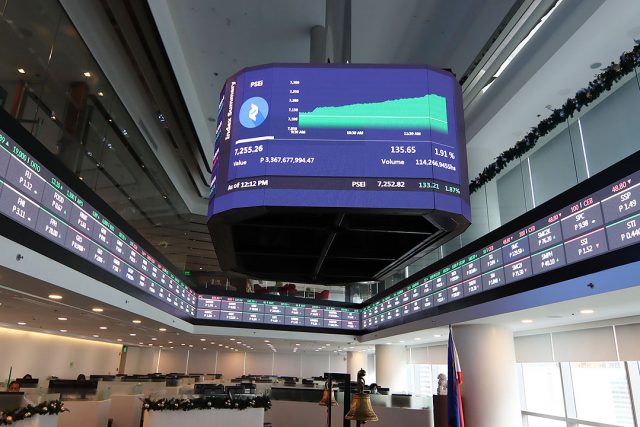
PHILIPPINE STOCKS closed lower on Wednesday as investors took profits after a four-day rally.

The benchmark Philippine Stock Exchange index (PSEi) fell by 0.93% or 69.59 points to close at 7,362.62. The broader all-share index shed 0.6% or 23.86 points to 3,939.64.

“The market pulled back as investors took profits from its recent rallies,” Japhet Louis O. Tantiangco, senior research analyst at Philstocks Financial, Inc., said in a Viber message. “Prior to the decline, the market was on a four-day gaining streak.”

The PSEi reached as high as 7,441.99 intraday before settling at the 7,300 level. The market recently received a boost after the recent policy easing by the US Federal Reserve, which could be matched by the local central bank.

“Profit taking occurred in the local equity market after several days in the oversold region, as traders adopted a cautiously optimistic stance amid expectations that China’s recent policy measures may have stemmed its stock market slump, with hopes for additional fiscal support on the horizon,” Luis A. Limlingan, head of sales at Regina Capital Development Corp., said in a Viber message.

On Tuesday, China’s central bank announced its biggest stimulus since the coronavirus pandemic to bring the country’s economy back toward the government’s growth target.

People’s Bank of China Governor Pan Gongsheng told a news briefing the central bank would in the near future reduce the reserve requirement ratios (RRR) — the amount of cash banks must hold as reserves — by 0.5 percentage point. The move is expected to free up about 1 trillion yuan ($142.4 billion) for new lending.

He also hinted that the RRR could be slashed by 0.25-0.5 percentage point later this year depending on liquidity conditions.

Back home, almost all of the market’s sectoral indices fell. Financials went down by 2.02% or 48 points to 2,324.48, while services shed 0.71% or 16.04 points to 2,234.75. Holding companies lost 0.54% or 34.34 points to 6,261.62, while property shed by 0.42% or 12.56 points to 2,977.40. The industrial index dropped by 0.16% or 16.44 points to 9,739.89.

On the other hand, mining and oil rose by 2.82% or 241.07 points to 8,773.20.

Value turnover reached P8.05 billion covering 1.07 billion shares, lower than P11.79 billion covering 1.02 billion stocks traded on Tuesday.

Decliners beat advancers 99 to 97, while 57 stocks were unchanged.

Net foreign buying decreased to P921.22 million compared with the P2.99 billion worth of net foreign inflows on Tuesday. — Revin Mikhael D. Ochave

ERC acting chairman takes up post as full operations resume

ANDREY METELEV-UNSPLASH

THE Energy Regulatory Commission (ERC) said it has returned to “functional and unhampered” operations with the installation of an acting chairperson.

“Frontline services of the ERC will continue to be fully operational, ensuring that the concerns of consumers are promptly addressed and assistance is readily provided to the public,” the commission said in a statement on Wednesday.

The ERC announced the formal assumption of office of former Justice Undersecretary Jesse Hermogenes T. Andres as the officer-in-charge chairperson and chief executive officer of the commission.

In a memorandum dated Sept. 20, the Office of the Executive Secretary designated Mr. Andres to temporarily lead the ERC.

“I will perform my functions as ERC Officer-in-Charge Chairman with utmost fairness and independence. ERC will act expeditiously on all pending matters with a view to foster competition and ultimately drive down the price of electricity and protect consumers,” Mr. Andres said.

Mr. Andres convened the management committee and impressed upon it the need for expeditious action on all pending ERC matters.

Mr. Andres is a lawyer and holds a bachelor’s degree in economics from the University of the Philippines.

He is a career executive service officer eligible since 2009 and completed his directorship training with the Institute of Corporate Directors.

Mr. Andres took his post more than two weeks after suspended chair Monalisa C. Dimalanta vacated her office.

Ms. Dimalanta said that the OIC appointment is “a welcome development” that will allow the commission to resume the performance of its statutory duties, according to a statement following the announcement from the Presidential Communications Office last week.

The Ombudsman suspended Ms. Dimalanta for six months over a complaint filed by the National Association of Electricity Consumers for Reforms, Inc. regarding the commission’s alleged failure to act on the rate reset of power distributor Manila Electric Co.

Ms. Dimalanta faces investigation for alleged grave misconduct, grave abuse of authority, and gross neglect of duty and conduct prejudicial to the best interest of the service.

Ms. Dimalanta has said she remains hopeful that the Ombudsman will resolve her motion for reconsideration and lift the preventive suspension “at the soonest time possible.”

The ERC is an independent regulatory body performing quasi-judicial, quasi-legislative and administrative functions in overseeing the electric industry. — Sheldeen Joy Talavera

July NFA palay procurement hits 10,045 MT

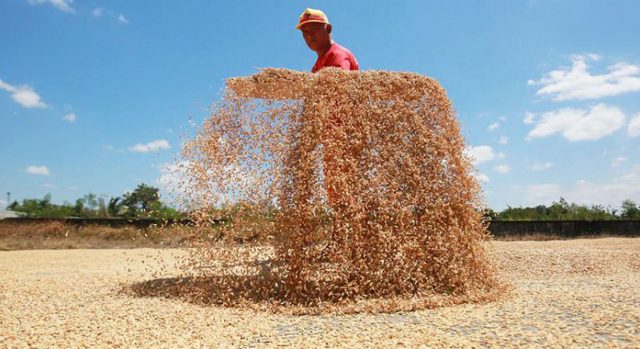
THE National Food Authority (NFA) said on Wednesday that it procured 10,045 metric tons (MT) of palay, or unmilled rice, in July, equivalent to 224,252 bags of 50 kilograms each.

It said farmers were attracted to the high purchase price offered by the NFA, which buys from domestic farmers to maintain an emergency reserve of rice.

The NFA inventory of milled rice was 3,013,048 bags or 150,652 MT in the seven months to July.

“It should be noted that NFA’s inventory is 6.88% of the country’s national rice inventory,” it said.

The NFA Council increased the buying price for palay to P23 to P30 per kilogram (kg) for dry and clean palay and P17 to P23 per kg for fresh palay, depending on location and grade.

“This success is largely attributed to the ongoing PRICERS program, which has effectively encouraged more farmers to deliver and sell their palay harvests to the NFA, particularly in regions experiencing sporadic harvests,” the NFA said in its monthly procurement report.

In April, the NFA changed its procurement strategy to allow it to offer a range of prices depending on the prevailing market price in a given province. The new policy is intended to make the NFA more competitive with private traders in obtaining palay.

The NFA added that the year-earlier procurement for July was only 7,672 bags of palay or about 383 MT.

The July 2024 target had been 200,900 bags.

The NFA is targeting a rice reserve of 495,000 MT by the end of the year. It is required by law to maintain a buffer stock equivalent to about nine days’ demand.

The NFA said it distributed 53,730 bags (2,686.5 MT) of milled rice in July, well below target.

“Sales were calibrated due to the low inventory level of rice,” it added. — Adrian H. Halili

Energy dep’t seeking up to $250M to derisk exploration for geothermal investors

FIRSTGEN.COM.PH

THE PHILIPPINES may need to obtain an initial $250 million to derisk projects for potential geothermal developers, the Department of Energy (DoE) said.

“The de-risking facility is about $250 million,” Energy Assistant Secretary Mylene C. Capongcol said on the sidelines of a conference organized by the National Geothermal Association of the Philippines (NGAP) on Wednesday.

She said that eligible geothermal developers will be entitled to claim 50% of the exploration and drilling costs from the de-risking facility.

“It would be cost shared on the drilling and exploration stage which is the riskiest,” she said.

The DoE has tapped the Asian Development Bank for technical assistance to develop and implement the geothermal de-risking facility.

The funding sources are still being evaluated, with Ms. Capongcol saying the DoE is in talks with the Land Bank of the Philippines, the Philippine Guarantee Corp., and the Department of Finance for potential partnerships.

The DoE has also initiated a meeting with the International Monetary Fund and other international institutions.

“The de-risking facility will surely boost interest in undertaking exploration drilling in the years to come, and eventually lead to the development of more geothermal projects,” NGAP President Jaime Jemuel C. Austria, Jr. said in a speech.

Mr. Austria said the geothermal companies continue to test and commission new geothermal power plants.

Marvin S. Bailon, vice-president and head of the business development group at Energy Development Corp., said that the Philippines could unlock its geothermal resources by streamlining permit processing.

“Being able to apply for permits in parallel help not just the geothermal development but all renewable energy and energy projects,” he said.

Mr. Bailon said that the capital needed for exploration and drilling is about P1.5  billion to P2 billion.

The DoE is planning to hold a third green energy auction this year for geothermal, pump-storage hydro, run-of-river hydro, and impounding hydro with a combined capacity of 4,399 megawatts (MW).

The Philippines’ installed geothermal energy capacity was 1,952 MW in 2023, making the country the third biggest geothermal producer.

As of July, 35 geothermal service contracts are being monitored by the DoE. Among these, 20 are in the pre-development stage and 15 are in the development or commercial stage.

Separately, the DoE added that it is planning to establish an independent nuclear regulatory authority that will oversee the safe and secure development of the nuclear energy program.

“The independent nuclear regulatory commission is expected to be fully operational by 2026 including the determination of the government’s role in policy and/or legislation,” the DoE said in its Philippine Nuclear Energy Program 2024-2050 unveiled on Wednesday.

The accompanying laws on the nuclear legal and regulatory framework are targeted to be in place by 2025, followed by the implementing rules and regulations.

“By 2027, legal framework for the mechanism for power contracting should be established,” the DoE said.

The industry plan seeks to establish safety, security and safeguards and will cover licensing, construction, and operations up to the plant’s decommissioning.

The DoE aims to have commercially  operational nuclear power plants by 2032 with at least 1,200 MW, gradually increasing to 4,800 MW by 2050. — Sheldeen Joy Talavera

Waste-to-energy seen as balancing act between disposal, increased emissions

REUTERS

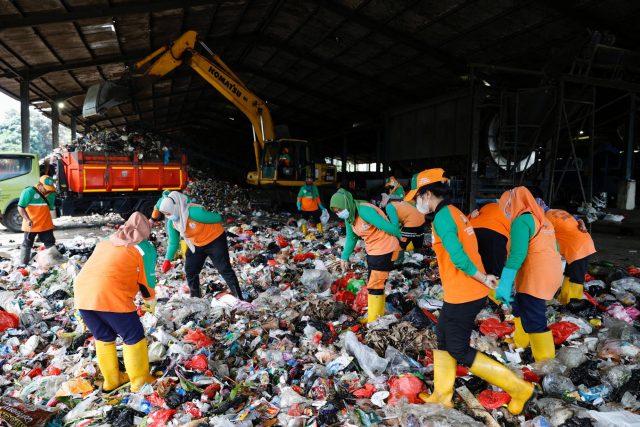
WASTE-TO-ENERGY (WTE) projects involve trade-offs between disposing of waste and raising emissions levels, though the severity of the Philippines’ energy problems means all technologies must be considered, analysts said.

“Any legislation that seeks to increase the number of technologies which can respond to our energy demand needs to be supported,” Terry L. Ridon, a public investment analyst and convenor of InfraWatch PH, said via Viber.

Mr. Ridon said that allowing waste incineration facilities may “impact the country’s commitments to the Paris climate accord,” and is not consistent with the government policy of not allowing new coal-fired power plants.

“Waste incineration facilities produce significant emissions. This contradicts the policy direction of limiting emissions made by coal-fired power plants,” he said.

Gerry C. Arances, convenor of Power for People Coalition, said that WTE is “the wrong way to address the problem of solid waste.

“It encourages more waste for fuel use while ignoring the urgency of improving waste management and reduction,” he said via Viber.

“Pollution from incineration is also concerning, and would be a step backward in the global fight to curb emissions and improve air quality,” he added.

Pedro H. Maniego, senior policy advisor of Institute for Climate and Sustainable Cities, said that the Philippines needs to harness WTE projects “to address the twin problems of garbage and lack of power supply.”

He noted, however, that ”the emissions and pollutants of WTE plants must conform to global standards and not only the current limits” in Republic Act (RA) 8749 or the Clean Air Act of 1999.

Mr. Maniego said RA 9003 or the Ecological Solid Management Act of 2000 was supposed to solve the garbage problem, but most local government units (LGUs) failed to implement the plans and programs called for under the law.

He added that there were several WTE projects that were able to avail of incentives under the RA 9513 or the Renewable Energy Act of 2008 but “many projects did not go ahead due to the ban on incineration imposed” under RA 8749 and “failure to secure approval from LGUs.”

“Biomass is considered a renewable energy source because its inherent energy comes from the sun, and because it can regrow in a relatively short time. Its net GHG (greenhouse gas) emissions is zero compared to when the biomass are allowed to just decay,” he said.

The Department of Energy (DoE) described waste-to-energy as “an energy system with a process of converting WTE feedstock with various technologies, usually the conversion of non-recyclable waste materials into usable heat, electricity, or fuel through a variety of processes.”

A waste-to-energy bill is among the priority bills identified by the Legislative-Executive Development Advisory Council.

In 2023, Senate Bill No. 2267 or the proposed Waste-to-Energy Act reached the Senate plenary.

The DoE supports the objectives of the proposed law and intends to draft a framework by which WTE technologies may be harnessed for energy while generating revenue.

The DoE cited the need to strengthen and provide legislative structure to attract more investors, addressing both the need to manage disposal of municipal solid waste and add to the available sustainable energy sources.

“The DoE encourages the development of WTE technologies, provided that toxic emissions coming from WTE plants are properly addressed through state-of-the-art emission control and capture technologies with continuous emission monitoring system and ensure compliance to relevant environmental laws, rules and regulations set for the establishment and operation of WTE facilities,” the DoE said. — Sheldeen Joy Talavera


This article has been updated to clarify the context in which the source made his remarks.

ADVERTISEMENT
ADVERTISEMENT