Home Blog Page 2625

Style (06/17/24)

Handy Hair Tools

THE FREQUENTLY changing weather is taking a toll on hair: the heat dries it up, then the humidity from the hanging rain clouds frizzes it. A selection of hair tools from well-loved brands can at least give you some weapons to aid in the battle against bad hair days.

Dyson

Dyson’s latest styling tool, the Supersonic Nural hair dryer, comes equipped with a new Scalp protect mode which uses a network of sensors that automatically reduce heat as it nears your head, helping protect the scalp from damage. These sensors also improve the styling experience, enhance hair shine, and prevent heat damage. In this mode, heat is automatically reduced to 55°C, the optimum temperature for scalp comfort and drying speed, as the hair dryer gets closer to hair and scalp. A sensor enables this by projecting an invisible infrared beam to measure the distance between the machine and the user’s hair. “If you’re able to limit heat damage, you can get a healthier scalp; and healthier hair… Innovation only comes from investing in research and development. Our obsession to truly understand the root of the problem continues, as we build up some of the most sophisticated hair laboratories in the world,” said James Dyson, the brand’s founder and Chief Engineer in a statement. The hair drier also has what they call attachment learning which means the machine remembers the user’s styling preferences. It adapts to a user’s go-to styling mode, remembering their last-used heat and airflow settings for each styling attachment, and automatically applying them the next time it is in use. The Dyson Supersonic Nural hair dryer also has a motion-sensing accelerometer which automatically deactivates the heater, decreasing airflow and noise, when in between styling passes. The Supersonic Nural hair dryer is available in the Philippines at dyson.ph and Dyson Demo Stores at the recommended retail price of P32,900 for the Vicna Blue and Topaz edition and at P31,500 for the Ceramic Patina edition.

Babyliss

BaByliss introduces the 1800W High Speed Digital Hair Dryer (P18,950). This hair dryer has a new 100,000 RPM high-speed brushless motor which delivers fast-drying results while minimizing heat exposure. Despite its powerful capabilities, this hair dryer remains compact and lightweight, weighing only 370 grams (excluding the cord), making it an ideal choice for extended styling sessions. Its unique, ergonomic T-shape housing design maintains dynamic balance during use, while the foldable handle allows easy storage. Plus, its low noise emission of 82dBA guarantees surprisingly quiet operation. The hair dryer features an LED digital display that shows the temperature and settings. It offers three heat and three speed options, along with a memory function that recalls previous heat and speed preferences. Additionally, it includes a cool shot feature for drying and styling all hair types, with temperature settings conveniently displayed in increments of 60°C, 80°C, and 100°C. This hair dryer is also equipped with a built-in ionic feature to help control frizz, resulting in smoother, more manageable hair. Its magnetic detachable filter simplifies maintenance, while the nozzle and diffuser attachments provide styling possibilities. BaByliss is exclusively distributed by Rustan Marketing Corp., and is available in-store at Rustan’s, Landmark, SM, Beauty Bar, Mitsukoshi Mall, and online at Rustans.com, Watsons.com, Lazada, Shopee, and Zalora.

VS Sassoon

Just because you’re in the city doesn’t mean you can’t have covetable beach hair. VS Sassoon’s latest offerings, the 32MM and 25MM Beach Wavers, get you closer to the goal. The VS Sassoon 32MM Beach Waver (P6,450) features ceramic coating plates measuring 91mm x 64mm. It is equipped with Ionic technology to provide smooth and shiny hair results. This waver comes with an anti-scald silicone design on the top to protect the user from any scald risk. With four temperature settings of 140°C, 160°C, 180°C, and 200°C, the VS Sassoon 32MM Beach Waver is suitable for all hairstyles. For safety, it has a 30-minute auto shut-off feature and a lock-in switch. The 360° swivel cord further enhances ease of use, while the worldwide voltage compatibility makes it a travel companion. The VS Sassoon 25MM Beach Waver (P6,450) offers slightly tighter waves, with two tourmaline ceramic wave barrels that transfer constant heat. The built-in huge ion generator ensures smooth and shiny hair results, while the safe-touch cover protects from any scald risk. Featuring three temperature settings of 160°C, 180°C, and 200°C, the VS Sassoon 25MM Beach Waver caters to a diverse range of hairstyles and textures. The built-in temperature button helps to avoid mistouching during the styling process, ensuring precise control and consistent results. Like its 32MM counterpart, this waver also boasts a 30-minute auto shut-off feature, a lock-in switch for safety, a 360° swivel cord for ease of use, and worldwide voltage compatibility ranging from 100V to 240V. VS Sassoon is exclusively distributed by Rustan Marketing Corp., and is available in-store at The SM Store, The Landmark, Beauty Bar, Watsons and online stores at Rustans.com, Watsons.com.ph, Lazada, Shopee, and Zalora.
PHL milled rice production seen at 13.3 million MT by 2025 — FAO

REUTERS

PHILIPPINE milled rice production is expected to hit 13.3 million metric tons (MMT) next year, according to the United Nations Food and Agriculture Organization (FAO).

In a report, the FAO said “record crops” are expected for the Philippines in 2025 due to improved climate conditions and government support.

“Within the region, Bangladesh, India, and the Philippines are all seen gathering record crops,” it said.

The Philippines produced about 20.06 million MT of unmilled rice in 2023, equivalent to about 13 million MT in milled rice.

The effects of El Niño lead to a decline in palay production during the first quarter.

Palay output fell to 4.69 MMT for the first quarter, from 4.78 MMT a year earlier, according to the Philippine Statistics Authority.

Agricultural damage due to El Niño was estimated at P9.89 billion, with rice and corn as the most affected crops, the Department of Agriculture reported.

The government weather service, known as PAGASA (Philippine Atmospheric, Geophysical and Astronomical Services Administration), announced the end of El Niño, and estimated the chances of La Niña setting in at 69% between July and September.

The FAO said global milled rice production is expected to increase 0.9% to 534.9 MMT.

“A combination of area expansions and yield improvements are expected to sustain this growth, as attractive paddy prices at the onset of the season could keep plantings at the record extension attained in 2023/24,” the FAO said.

It added that improved growing conditions following the dissipation of El Niño may revive yield growth.

“Asia is expected to account for much of the production expansion envisaged for 2024-25,” it added. — Adrian H. Halili

Globe says network expansion reaches over 500 remote areas 

BW FILE PHOTO

GLOBE Telecom, Inc. said it has invested over P265 billion in expanding its connectivity to over 500 remote areas, aiming to bridge the digital gap.

“At the heart of our mission is connecting the unconnected to build an inclusive, sustainable, and digitally enabled nation,” Globe President and Chief Executive Officer Ernest L. Cu said in a statement on Sunday. 

The company has spent P265 billion for its expansion to geographically isolated and disadvantaged areas (GIDAs) and a total of P236 billion in operational expenses over the last three years to boost Globe’s network capabilities, the company said.

“Bringing connectivity to the entire Philippines, including remote areas across the country, requires collaboration between the private sector and the government,” Mr. Cu said.

The telecommunications company said it is also engaging the government to jointly boost the country’s connectivity infrastructure. 

The newly created connectivity plan task force, which is also headed by Mr. Cu, is working with the Department of Information and Communications Technology on complementing rollout of internet infrastructure in remote areas. 

“Through this Task Force, we hope to synergize our efforts so that every corner of the country is connected, and Filipinos are able to enjoy the benefits of digital connectivity in an equitable way,” Mr. Cu said. — Ashley Erika O. Jose

Changan CS35 Plus now below P1M in ‘mid-year madness’ sale

IMAGE FROM CHANGAN AUTO PHILIPPINES

CHANGAN AUTO PHILIPPINES is offering the five-seater Changan CS35 Plus SUV with hefty discounts for a limited time. The Luxe variant is now priced at P973,000, P286,000 less the original P1.259-million tag. The Hype is now priced at P934,000 — P275,000 less the original tag of P1.209 million. These deals are only applicable to 2023 models and are available from June 13 to Aug. 31.

“The Changan CS35 Plus is undeniably an SUV that its owner can confidently step out from, with exterior aesthetics that combine sportiness with sleek elegance. Both its Hype and Luxe variants are adorned with standard LED headlamps and taillights, panoramic sunroof with anti-pinch, roof rails, roof-mounted spoilers, and 18-inch alloy wheels,” said Changan Auto Philippines in a release.

The CS35 Plus measures 4,330mm in length, 1,825mm in width, and 1,660mm in height, boasting ”generous seating and legroom.” The rear seatbacks can be folded down, which more than doubles the cargo space from 403 liters to 950 liters.

It has a push-to-start button, tilt and telescopic steering column, leather steering wheel, and seven-inch LCD gauge cluster. The engine remote start allows the driver to start the car remotely, cooling the interior before stepping aboard.

Leather seats are standard on both trims, as are features such as automatic climate control, a 10-inch touchscreen infotainment system with Bluetooth and USB connectivity, Smartphone mirroring through CarbitLink, wireless smartphone charging, and a six-speaker sound system. The Changan CS35 Plus also gets Deep-Sea Silence Technology, which prevents noise from the outside from entering the cabin.

The CS35 Plus is powered by a 1.4-liter inline-four turbocharged gasoline engine paired with a seven-speed wet-type dual-clutch transmission. It outputs 158hp and 260Nm of torque.

Driving aids like a 360-degree around-view camera, reverse parking sensors, and blind-spot monitoring are fitted as standard in the CS35 Plus. All of these give the driver “maximum spatial awareness in driving and parking safely.” The vehicle has anti-lock brakes, autonomous emergency braking system, hill hold and descent control, stability control, front collision warning, and adaptive cruise control, as well as Isofix child seat anchors. The vehicle is also equipped with an advanced six air bag system to mitigate serious injuries in the event of an accident.

The Luxe variant offers additional comfort and style features with its power tailgate and two-tone exterior color. The Hype trim offers a sleeker look. “We are driven to challenge, driven to making quality vehicles more accessible to Filipino motorists,” said Changan Auto Philippines General Manager Maricar Parco. The brand is under Inchcape Philippines. “With Changan’s strong research and product development network across the globe, Filipino motorists can expect best-in-class features and reliable technology, all while maintaining exceptional value.” Changan’s commitment to quality vehicles has earned it the top spot in JD Power’s Initial Quality Study (IQS) for five consecutive years, from 2019 to 2023.

For more information, visit www.changan.ph and follow Changan Auto Philippines on Facebook (@ChanganAutoPH).

South Korea aims to raise up to $1.3 billion via dollar bonds

SOUTH KOREA said on Sunday it’s planning to raise as much as $1.3 billion in a dollar bond sale meant to set a stable reference rate for local companies, just as their own issuance climbs near a record.

The government is offering the notes to investors such as other governments and central banks that tend to hold securities longer, providing more stability to secondary market interest rates, according to a statement from the finance ministry.

The comments provide fresh details on the planned deal, after a person familiar with the matter said Friday that the nation was considering offering 5-year dollar bonds. The country is arranging investor meetings in London from June 20 and global calls from June 24.

When a nation issues sovereign debt in international markets, that helps show broader investor demand for exposure to the country. That in turn can help companies venturing overseas for funding to fine tune the terms they offer, potentially allowing them to borrow at cheaper costs. 

There’s a lot at stake in Korea’s case. Issuers including tech giant LG Electronics Inc. have priced about $19 billion of dollar notes so far this year, near a record of almost $20 billion for the same period in 2021. That’s helped drive a broader resurgence in Asian deals, including from Indonesia and the Philippines earlier in the year. The region has joined a global rush for funds, taking advantage of investor demand to lock in yields before any declines.

The South Korean finance ministry said it plans for the offering to attract sovereigns, supranational and agency investors — or SSAs — that avoid frequently trading. South Korea last sold dollar notes in October 2021.

In April this year, the Finance Ministry said it had picked Bank of America Corp., Citigroup Inc., Credit Agricole SA, HSBC Holdings Plc and the Korea Development Bank for a potential sale of offshore bonds.

Those are the banks still working on the planned deal, the person familiar with the matter said Friday. — Bloomberg

Why Ukraine isn’t ready for Putin’s peace talks

WITH three major Ukraine-focused summits this week — in Germany, Italy and Switzerland —, I thought I’d ask a few people who know what they’re talking about whether it’s time to wind down support for the war and encourage Ukraine to strike the best deal with Russia it can. The conversations didn’t go quite as expected.

“Forget about Ukraine,” said Harvard University professor Serhii Plokhy, one of two prominent historians sought out for a wider perspective. “It’s not about Ukraine, it’s about you, it’s about us.”

We need always to remember this is the biggest war in Europe, and by some measures the world, since 1945. Size matters, because very large wars are breaking points whose outcomes define how nations will live for generations. This one will be no different. And judging by the maximalist demands President Vladimir Putin made on Friday for even a temporary ceasefire and the start of peace talks — including Ukraine’s withdrawal from swathes of territory and major cities Russia has so far failed to capture — the conflict will continue for some time yet.

Consider the Westphalian international system that emerged after Europe’s 30 Years’ War which ended in 1648. It governed relations among states for long after the conflict was forgotten, reducing the risk of further religious free-for-alls. World War II, equally, produced a raft of institutions to govern a new world order — at least in areas conquered or liberated by the Western allies. Things turned out quite differently in areas that ended the war under Soviet control — and let’s not even entertain the what-ifs of a Nazi victory.

Yale University’s Timothy Snyder took a different approach, though to a similar end. People often think about Ukraine as a frontier or borderland (in Russian, the country’s name points you in that direction),  and yet it isn’t. “Historically it’s been more of a fulcrum, of central importance to larger systems,” he said.

The 10-year security agreements the US and Japan signed with Ukraine during the G7 meeting in Italy on Wednesday went some way to recognizing that centrality. US President Joe Biden called the deal — coupled with a preliminary agreement to use frozen Russian assets to secure a $50-billion loan for Kyiv — proof that the Kremlin can’t just wait for Western support for Ukraine to crumble. The measures are good if belated steps, but more concrete commitments are needed.

Snyder had just delivered a lecture at Estonia’s Lennart Meri security conference, in which he wanted to counter the narrow claims of Ukraine’s Russian nature by a certain amateur historian in the Kremlin. The story he laid out was infinitely more complex than Putin’s — and, frankly, more plausible.

Archaeologists have in recent years discovered the world’s oldest cities, older than Babylon, on the territory of modern Ukraine, Snyder said. The first people known to ride horses also came from what’s now Ukraine, galloping deep into Europe on the strength of this vast technological advantage, and brought with them the family of Indo-European languages that has dominated the continent ever since.

Athens rose on the back of grain shipped home from a part-Greek, part-Scythian settlement on the Crimean shores of the Kerch Strait. Goths, who settled in Ukraine in the second and third centuries BC, were then driven west by the Huns, from where they later brought down the Roman Empire.

Then came the Vikings, on an eastern salient of a migration that took them everywhere from Greenland to the Black Sea. The kingdom of Rus, which they founded on the Dnipro River at today’s Kyiv, forms Putin’s origin story for Russia, which retrospectively gave Rus’ early Viking princes Slavicized names. Moscow, like Athens, needed the produce of Ukraine’s black earth to sustain its empire, fighting multiple wars to control the territory over centuries. Nazi Germany invaded the then-Soviet Union in part for the same reason.

So if people say the shape of the world order will depend on what happens in Ukraine, don’t dismiss it as hyperbole. “It matters who controls the Dnipro to the Black Sea; it matters who controls the Black Earth; and it matters deeply who controls the Kerch Strait,” says Snyder.

What does all this mean for the reconstruction, funding, and peace under discussion at this week’s summits? Well, everything, so long as both the West and Ukrainians understand the stakes and are willing to do what it takes to prevail. Just talking the talk would cost lives and destruction to no purpose. On the Ukrainian side, at least, that seems understood.

Talk to Vasile Tofan, a senior partner at Kyiv-based Horizon Capital investment fund, which has $1.6 billion of assets under management, primarily in Ukraine. He and his business partners risk losing a fortune from the war’s continuation, yet Tofan is more fearful of a premature peace deal that in the long term would leave Ukraine uninvestable and unable to pursue a European future. It would forever be under threat of attack and destabilization by Russia.

Tofan is frustrated that more foreign investors aren’t already coming to Ukraine, unaware that even with a war on, they’re statistically less likely to suffer a missile strike in Kyiv than a road accident in London. (It’s hard to find comparable data, but at about 100 road deaths and several thousand serious injuries in London a year, the numbers are lot closer than most people would imagine). Like many Ukrainians, he’s disillusioned, too, that so many in the West don’t understand the conflict as a common struggle.

For sure, Ukraine has a very sticky past, including deep issues with corruption. But much of the stereotype is now out of date, and a new business model is likely to emerge from the war, making the country a low-cost back office for Europe. It has one of the continent’s largest pools of software engineers, a third of European lithium deposits, and is again exporting more grain than before the February 2022 invasion, or about 10% of the global trade.  It may be no coincidence that the regions occupied by Russian forces also hold large deposits of rare-earth metals.

Tofan is perhaps congenitally optimistic. He recalls putting together a client presentation in the first, darkest days of the Russian onslaught, which included slides showing Tokyo bombed to destruction in 1945 and thriving just five years later. He proved at least half right.

Tofan’s clients included Rozetka, a cross between Amazon.com, Inc. and Britain’s Argos stores, which saw the Russian troops come within a few hundred meters of its main warehouse, just outside Kyiv, in March 2022. As Tofan was making PowerPoint slides, Rozetka’s monthly revenue fell from 4 billion hryvnia ($136 million at the time), to just 23 million hryvnia ($782,000). Given all we know of the war’s impact — the lost territory, lost power generation, lost consumers in the form of 6 million-plus refugees and decimated workforce — you might expect the retailer still to be deep in the red. Far from it.

Rozetka now has almost 500 physical stores, double the prewar number. Women now make up 75% of staff, filling gaps in the workforce. Revenue is up, and the company is expanding into Poland.

“Of course, I want to live in peace, but I think there is only one way out — to build our military infrastructure, to build up our ability to keep the Russians back and to find an asymmetrical answer to their threat,” says Rozetka’s founder and Chief Executive Officer Vladyslav Chechotkin. “It’s like dealing with criminals, if you show weakness, you will be constantly beaten.”

Aurora Multimarket, a chain of dollar stores tells a similar story, with severe losses quickly followed by expansion from 817 stores before the war to 1368 now. Profit doubled last year, according to founder Lev Zhydenko, and Aurora just moved into Romania. He, too, wants peace only “in such a way that the war ends soon and never restarts.” Most Ukrainians, when polled, say they agree.

Ukraine is in deep trouble. Its military is on the back foot, and President Volodymyr Zelenskiy’s government has lost some of its shine. But when deciding whether it makes sense to continue backing this unfortunate nation’s existential fight with Russia, I’m inclined to be guided by people who actually understand its history or have their own businesses and families at stake. Their answers are as clear as ever.

BLOOMBERG OPINION

Alternergy’s Gerry Magbanua expands focus on sustainability

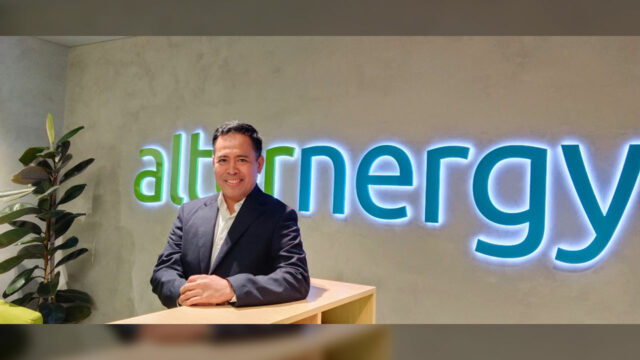
GERRY P. MAGBANUA, president and co-founder of Alternergy Holdings Corp.

By Ashley Erika O. Jose, Reporter

GERRY P. MAGBANUA, the president and co-founder of Alternergy Holdings Corp.,  which he co-founded nearly two decades ago, is hoping to advance the company’s role in supporting the country’s sustainability goals.

With 30 years of experience in the power sector, Mr. Magbanua, who began his career as an auditor for coal-powered companies, initially struggled to find his footing in the renewable energy (RE) sector.

“I have been with the power sector in the last 30 years. I used to be an auditor and most of my clients were all coal-powered companies. That is the beginning of my exposure to power,” he said in an interview with BusinessWorld.

Mr. Magbanua also spent at least nine years working with Intergen, a global power developer, the company behind the 460-megawatt (MW) coal power plant in Mauban, Quezon. 

Founded in 2007 by former Energy Secretary Vicente S. Pérez, Jr., Alternergy was established when the renewable energy sector was still emerging in the Philippines, before the Renewable Energy Law of 2008.

“As a pioneering person, I thought that I was already familiar with the power industry and then now with the new sector, which is the renewable energy, I thought that it was also a good opportunity to now be focusing on a specific sector so I then decided to take a leap and move on with and join in forming Alternergy,” he said.

In 2007, Mr. Magbanua said the company was meant to focus on harnessing power from three technologies such as wind, hydro, and solar, which Alternergy branded as its triple-play portfolio.

“I think we are pretty much in it in terms of where we envision the company would be focusing. I’d say that we are essentially pursuing what we’ve set out to do in the beginning. There have been a lot of challenges along the way but we are staying the course,” he said. 

BRINGING RENEWABLES OUTSIDE THE BOARDROOM
Aside from the goals the company has set out, Mr. Magbanua has also established some personal goals of embodying sustainability outside the company to power his off-grid farm in Tayabas, Quezon. 

“I have installed 9,000 kilowatts for my farm in an off-grid area. For us to be able to have electricity, we have to be reliant on our resources. So, what better way to use the resource than the sun, we have abundant sun,” he said. 

Mr. Magbanua said he started farming at the onset of the pandemic to address food shortages while also helping provide employment. 

In the energy sector, solar power and agriculture have been integrated through a concept called agro-solar. This approach is new in the Philippines, with few companies exploring it.

With his interest in farming and renewables, integrating the concept to the company’s portfolio has already been considered, Mr. Magbanua said.

Agro-solar is co-locating of solar power generation and crop farming on the same land allowing crops to grow below or beside solar panels.

“We know that solar and agriculture do not necessarily have to be exclusive, they can be combined. There is nothing yet that is final or in the works but that is something that is always in the back of our minds. I’m already familiar with both. It is just a matter of putting them together,” he said. 

NAVIGATING UNCHARTED RE SPACE FOR GROWTH
The company is now looking at expanding its projects further as it plans to develop an aquavoltaic project by building solar projects on top of a fish pond, Mr. Magbanua said, describing the initiative as a first of its kind in the Philippines.

Aquavoltaic projects are the development of solar panels atop fish ponds without compromising valuable agricultural land while also ensuring food security.

This provides fish farmers with economic opportunities by increasing fish farm productivity while also helping to promote sustainable energy.

“We hope we can begin the construction of that project by sometime in 2025 already,” Mr. Magbanua said, noting that construction would take about a year. 

The planned project will have a capacity of 80 MW and will be located in Tarlac, he said, adding that for now the project will be solely taken by Alternergy.

“At the moment it is just Alternergy but we are not discounting the possibility of being in partnership with anyone,” he noted.

Currently, the energy company seeks to develop up to 1,370 MW of renewable energy sources such as onshore and offshore wind, solar, and run-of-river hydropower projects.

For the next three years, the company aims to develop up to 474 MW of additional wind, solar, and run-of-river hydropower projects.

“Like anything else, we usually ride along with where the industry is headed. I would say that I am very bullish on the RE industry,” he said.

Mr. Magbanua said the company plans to take advantage of the government’s firm stand towards renewables, citing the Philippines target of 35% share of renewables by 2030 and 50% by 2040.

“That to us signals a clear target, and it’s up to us. That’s how we take advantage of that because, obviously, there’s a lot of opportunities to be made,” he said.

“Things happen the way they are, it is just a matter of taking advantage, of taking opportunities. In the beginning, we were preparing, trying to just lay down the foundation for this industry. Things will be very fast for us, we’re all geared up, fired up to take advantage of that.”

Vivienne Westwood’s clothes and jewels headed for auction

LONDON — Dresses, suits, shoes and jewelry from the personal collection of late British designer Vivienne Westwood will go under the hammer this month in an auction aimed at raising funds for charity.

More than 200 lots are being offered by Christie’s in London for the two-part “Vivienne Westwood: The Personal Collection” auction, made up of a live sale on June 25 and an online auction running June 14-28.

Ms. Westwood, one of British fashion’s biggest names, died in December 2022, aged 81. Her collaborator and widower Andreas Kronthaler has selected looks spanning some 40 years for the auction, with the earliest from Ms. Westwood’s Autumn-Winter 1983-1984 collection.

“These are the things that she chose to wear herself throughout the last 40 years of her life,” Adrian Hume-Sayer, head of sale for the auction, told Reuters at a press preview on Thursday.

“It’s very personal… These are the things you can see her on her bike, riding around London, press interviews, end of the catwalk… just conducting her day-to-day life. But she also lived… as she spoke. And so unlike many people… in her position she wore things repeatedly. She had favorites.”

Ms. Westwood, whose name was synonymous with 1970s punk rebellion, was also known for her activism. Her T-shirts bore slogans against fossil fuel-driven climate change and pollution, as well as her support for WikiLeaks founder Julian Assange.

In addition to clothes and accessories, a set of enlarged prints of a pack of playing cards Ms. Westwood designed in 2017 — focusing on issues such as climate change and inequality — are also being offered for sale with an estimate of £30,000 – £50,000 ($38,292 – $63,820).

Proceeds from the auction will go towards causes and charities Ms. Westwood supported — her own Vivienne Foundation, Greenpeace, Amnesty International and Médecins Sans Frontières, Christie’s said.

An exhibition of the lots will be open to the public at Christie’s London from Friday until June 24. — Reuters

From northwest to east China, parched and baking regions grapple with drought

REUTERS

BEIJING — Weeks of scarce rainfall in parts of China, coupled with sweltering heat, has brought drought to several provinces, prompting alerts and actions from authorities to minimize impacts on agriculture, and water and energy supplies.

Temperatures this week are forecast to scale record highs in parts of China as countries across Asia brace themselves for another summer of extreme weather.

China’s Water Resources Ministry this week launched emergency responses to manage drought on in Gansu, Shaanxi, Shanxi, Henan and Shandong provinces, indicating various regions in the country spanning the northwest to the east are facing parched and scorching conditions.

With dwindling precipitation since May in areas around the Yellow River Basin, in combination with the onset of searing temperatures this month, drought is threatening cultivated land that were being prepared to be sown as well as sown crops, Xinhua reported.

The harsh weather conditions will feature until the end of this week, with drought expected to worsen, the official media said.

In some parts of Hebei, Henan and Shandong provinces, temperatures could reach 44 degrees Celsius (111.2 degrees Fahrenheit), potentially breaking historical records for the month of June, state broadcaster CCTV said.

Surface temperatures could hit 70 degrees Celsius in some localities including in Shanxi and Shaanxi, it added. The emergency management ministry has alerted affected regions including northwestern Shaanxi, northern Hebei and Shanxi, eastern Anhui and Shandong as well as central Henan to protect water and food production.

China’s national forecaster predicted continuous heat wave conditions and warned about the need to prepare for emergency power supplies as well as fire prevention in forest areas, the People’s Daily reported.

Electricity demand typically soars in high temperatures as people crank up the air-conditioning to stay cool.

Rain, not heat, is the threat in southern China. Coastal Fujian’s provincial observatory raised a warning for wet weather and potential disasters after forecasting heavy rainfall until Saturday. — Reuters

Trends in fleet management: Technology, sustainability, and safety solutions for future success

Image by jcomp on Freepik

Over recent years, fleet leasing has grown in popularity due to the convenience it grants to businesses and government agencies alike. With its ability to solve parking challenges in urban areas, access the latest technologies, and be cost-effective, the automotive leasing market has grown in value to more than $25 billion in 2023 and is estimated to register a compounded annual growth rate of 6% from 2024 to 2032, according to consulting firm Global Market Insights.

Alongside the rise in fleet leasing as an option for companies, several trends have emerged in fleet management solutions driven by technological advancements and shifting market demands.

One of the new practices gaining traction in the past months is the use of telematic systems in fleet management solutions. Telematic systems typically refer to mechanisms that combine telecommunications and information processing.

However, in fleet management, telematics can help overcome operational challenges by tracking vehicle location, monitoring vehicle performance, analyzing driver behavior, and facilitating communication through the global positioning system (GPS). This data helps fleet managers optimize routes, improve fuel efficiency, enhance safety, and streamline maintenance schedules.

Fleet management software Wialon indicated on its website that telematic systems are about to receive an upgrade with the emergence of artificial intelligence (AI). The developers suggest that generative AI will revolutionize telematics platforms and provide tailored responses to fleet owners, managers, and dispatchers about their vehicles.

Another trend to look out for in fleet management for 2024 is the strong push towards sustainability with more fleets adopting electric vehicles and hybrids. With the Biden administration and the European Union implementing regulations encouraging the purchasing of EVs and prohibiting the sale of gas vehicles in the near future, companies are gradually transitioning to green fleets in an effort to reduce greenhouse gas emissions and combat climate change.

Several big companies have already started incorporating electric vehicles into their fleets. Delivery giant Amazon partnered with Rivian to integrate 100,000 electric delivery vehicles to their fleet by 2030. Car rental company Hertz also announced in 2021 an initial order of 100,000 electric vehicles from Teslas signaling a shift to sustainable transportation solutions in the industry.

A greater focus on safety features such as collision avoidance systems, driver monitoring, and in-cab video systems has also become trendy in 2024. Fleet management companies have prioritized driver safety to help reduce the risk of accidents and improve their brand reputation.

“The benefits of using advanced safety features in fleet management are significant. By reducing the risk of accidents, companies can protect their drivers and cargo, minimize downtime and repair costs, and maintain a positive reputation for safety,” Volpis, a fleet software management developer, noted on their website.

As these trends of new telematics systems, car models, and safety features continue to revolutionize fleet management, the need to upskill technicians becomes increasingly more important. To ensure that these trends become the new norm, companies have realized that technicians must be trained to handle new technologies and EV maintenance is driven by the industry’s need to reduce repair costs and improve service quality​.

The fleet management industry has grown to be a favorable solution for businesses seeking flexibility and efficiency in managing their vehicle fleets. As fleet management evolves with trends focused on technology, sustainability, and safety, companies that embrace and invest in these developments are well-positioned to achieve operational excellence, cost-efficiency, and environmental stewardship in the years to come. — Jomarc Angelo M. Corpuz

EVAP, CCPIT-Auto to cooperate for EV industry

Electric Vehicle Association of the Philippines (EVAP) Chairman Rommel Juan (second from right) shakes hands with China Council for the Promotion of International Trade Automotive Sub-Council (CCPIT-Auto) Assistant Chairman James Chai at the recent signing of a memorandum of understanding. With them are CCPIT-Auto’s Zhao Yang (left) and EVAP Chairman Emeritus Ferdinand Raquelsantos. — PHOTO FROM EVAP

THE ELECTRIC VEHICLE Association of the Philippines (EVAP) and the China Council for the Promotion of International Trade Automotive Sub-Council (CCPIT-Auto) have signed a memorandum of understanding (MoU) to establish a strategic international partnership.

EVAP Chairman Rommel Juan and CCPIT-Auto Assistant Chairman James Chai formalized the agreement, with EVAP Chairman Emeritus Ferdinand Raquelsantos witnessing the event. The MoU aims to foster collaboration between the Philippines and China in the electric vehicle (EV) industry, encompassing the entire value chain. The signing ceremony took place during the China Auto Chongqing Summit, held last June 6 to 8 in Chongqing, China.

This landmark partnership seeks to leverage the strengths and capabilities of both organizations to accelerate the growth and adoption of electric vehicles. By combining resources and expertise, EVAP and CCPIT-Auto are committed to advancing innovation, technology transfer, and market development in the EV sector.

Chairman Rommel Juan expressed his enthusiasm for the partnership, stating, “This MoU marks a significant milestone for EVAP and the Philippine EV industry. Our collaboration with CCPIT-Auto will open new avenues for knowledge-sharing, investment opportunities, and the development of sustainable transportation solutions.”

Assistant Chairman James Chai echoed these sentiments, highlighting the mutual benefits of the agreement. “China and the Philippines share a common vision for the future of mobility. Through this MoU, we aim to create a robust platform for cooperation that will drive the electric vehicle industry forward, benefiting both nations and contributing to global sustainability goals.”

The MoU outlines several key areas of cooperation: Technology exchange and innovation — facilitating the exchange of technological advancements and best practices in EV manufacturing, battery technology, and charging infrastructure; investment and market development — promoting joint ventures, investments, and market expansion initiatives to enhance the competitiveness of the EV industry in both countries; policy advocacy and support — collaborating on policy recommendations to support the growth of the EV sector and address regulatory challenges; training and capacity-building — organizing training programs, workshops, and seminars to enhance the skills and knowledge of professionals in the EV industry.

Yields mixed on Fed, US inflation reports

YIELDS on government securities (GS) were mixed last week following the Federal Reserve’s latest policy hints and the release of US consumer and producer inflation data.

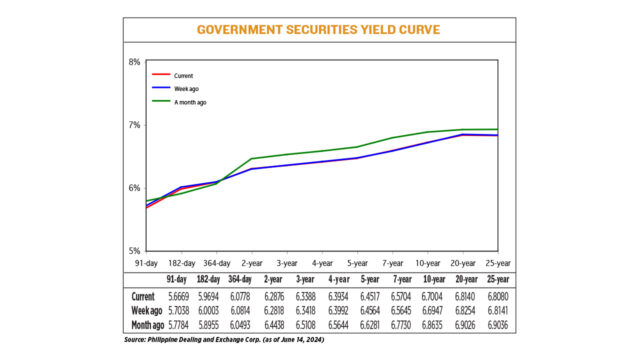
GS yields, which move opposite to prices, inched down by an average of 0.77 basis point (bp) week on week, based on the PHP Bloomberg Valuation Service Reference Rates as of June 14 published on the Philippine Dealing System’s website.

At the short end, yields on the 91-, 182-, and 364-day Treasury bills went down by 3.69 bps, 3.09 bps, and 0.36 bp week on week to 5.6669%, 5.9694%, and 6.0778%, respectively.

At the belly, yield movements were mixed. The rates of the three-, four-, and five-year Treasury bonds (T-bonds) dropped by 0.3 bp (to 6.3388%), 0.58 bp (6.3934%), and 0.47 bp (6.4517%), respectively. Meanwhile, the two- and seven-year T-bonds saw their yields climb by 0.58 bp and 0.59 bp to 6.2876% and 6.5704%, respectively.

At the long end of the curve, yields on the 20- and 25-year T-bonds dropped by 1.14 bps (to 6.814%) and 0.61 bp (6.808%), respectively, while the 10-year paper rose by 0.57 bp to fetch 6.7004% on Friday.

Total GS volume traded reached P28.55 billion on Friday, higher than the P14 billion seen on June 7.

“Local yields initially saw some sell-off [last] week in reaction to the strong nonfarm payrolls in the US. Sentiment improved in the latter part of the week after the release of key data and the latest Federal Open Market Committee meeting result,” Alessandra P. Araullo, chief investment officer at ATRAM Trust Corp., said in a Viber message.

The lower-than-expected US inflation prints and the Fed’s policy comments at the end of their two-day review spurred market optimism towards the end of the week, Ms. Araullo said.

GS rates moved sideways to down due to the Fed’s cautious easing outlook, Jonathan L. Ravelas, senior adviser at Reyes Tacandong & Co., likewise said in a Viber message.

The US central bank on Wednesday kept its benchmark overnight interest rate in the current 5.25%-5.5% range, where it has been since last July, Reuters reported. Fed officials pushed out the start of rate cuts to perhaps as late as December, with policy makers projecting only a single quarter-percentage-point reduction for this year.

The Labor department’s Bureau of Labor Statistics said the producer price index (PPI) for final demand decreased 0.2% in May. That was the biggest drop in the PPI since October and followed an unrevised 0.5% rise in April. Economists had forecast the PPI nudging up 0.1%.

In the 12 months through May, the PPI gained 2.2% after rising 2.3% in April.

The data followed Wednesday’s cooler-than-expected consumer price index (CPI) report. US consumer prices were unchanged in May from April, against market expectations of a 0.1% rise.

The CPI rose at an annual rate of 3.4%, still well above the Fed’s target of 2%.

At home, investors weighed comments from Finance Secretary Ralph G. Recto that the Bangko Sentral ng Pilipinas (BSP) could cut its key interest rate after the Fed begins its policy easing, Ms. Araullo added.

“These factors combined ultimately caused yields to move sideways week on week, with only the front-end bonds being the heavily favored,” she said.

For this week, the leading catalyst for the market activity would be the 15-year bond auction on Tuesday, Ms. Araullo said.

“Investors will try to gauge if the buying momentum will be sustained given that the issuance is a longer-term bond. If decent demand for the bond can be seen, then we may see some follow through buying,” she said.

“Another factor that we will also closely look at is the regular monetary policy meeting by the BSP Monetary Board. The meeting will take place on June 27. Investors will be looking for more concrete guidance from the BSP governor on when the first rate cut for the year will be and their outlook on inflation,” Ms. Araullo said.

GS yields may continue moving sideways this week as investors are expected to stay on the sidelines before the BSP’s next policy meeting, where they expect no adjustments in rates, Mr. Ravelas likewise said.

Anticipation for the release of the Bureau of the Treasury’s borrowing plan for next quarter could also drive market activity this week, Ms. Araullo added.

“This will allow players to reposition accordingly as more bond supply comes in the market,” she said. — Lourdes O. Pilar with Reuters