Home Blog Page 2623

Sixers Big Three

To argue that the Sixers are going all in would be to understate the obvious. In their quest to earn their first National Basketball Association championship since Moses Malone ruled the roost in 1983, they have committed a considerable amount of resources — close to a whopping $600 million — to their Big Three. They got Paul George, who had previously said his heart was with the Clippers, to jump ship for $212 million. They gave Tyrese Maxey the keys to the future for $204 million. And, for good measure, they made sure Joel Embiid stays in the fold through 2029 by adding $192.9 million to his coffers.

To be sure, general manager Daryl Morey isn’t just being a spendthrift. He saw enough potential in their immediate past postseason run to keep his resident stars happy and invest in George as the missing piece to a deep run. And he may well be right. At the very least, the Sixers figure to rub elbows with the league elite when their 2024-25 campaign starts next month. The caveat, of course, is that their anchors need to stay healthy for the long haul — an iffy proposition at best given their history of injury.

This, then, places the onus of success squarely on the shoulders of Sixers head coach Nick Nurse. Given his predilections for playing his most trusted charges heavy minutes, he would need to find ways to make his bench more productive in the understanding that the hardware is attainable only by prepping for a marathon and not a sprint. Whether winning can also come with the changes is up for debate, but there can be no questioning the logic behind preserving his principal playmakers and point producers for the contests that truly count.

Bottom line, the Sixers have the tools to challenge for the hardware. For the most part, their fate is theirs to carve. And, yes, it helps that they’re in the so-called Leastern Conference, which evidently provides more opportunities for them to pace themselves. Whether they actually get close to the Larry O’Brien Trophy, however, is up to them.


Anthony L. Cuaycong has been writing Courtside since BusinessWorld introduced a Sports section in 1994. He is a consultant on strategic planning, operations and human resources management, corporate communications, and business development.

Analysts: US missiles in Manila may deter China but also stoke tensions

US ARMY PACIFIC

By Kenneth Christiane L. Basilio and John Victor D. Ordoñez, Reporters

KEEPING a US missile system in the Philippines could deter Chinese aggression in the South China Sea, but could also fan regional tensions and increase the risk of confrontation at sea, political analysts said at the weekend.

“The purchase of missile technology can be a long, complicated and expensive process,” Raymond M. Powell, a fellow at Stanford University’s Gordian Knot Center for National Security Innovation, said in an X message.

“I think that for now, the presence of US missiles deployed in the Philippines is a good stopgap measure,” he added.

The US has no plan to withdraw its Typhon midrange missile system from the Philippines and is studying the feasibility of its use in a regional conflict, Reuters reported last week.

Manila is open to acquiring the US missile system despite calls from China to withdraw it from the Philippines after the US bringing it in for joint military drills this year, Agusan del Norte Rep. Jose “Joboy” S. Aquino II told the House of Representatives plenary last week.

He said the Philippines has yet to propose to buy it from Washington, but noted that the Defense department aims to acquire more South Korean-made FA-50 light combat military jets and upgrades, as well as weapon systems for Philippine Navy vessels.

Defense agencies will get P256.1 billion under the P6.352-trillion proposed national budget for next year.

“This is effective for deterrence against intruders for external defense and can be used for interoperability during military exercises,” Chester B. Cabalza, founder of Manila-based International Development and Security Cooperation, said in a Facebook Messenger chat.

He said Manila has the right to keep the missiles through its alliance with Washington amid warnings from China and Russia that this could fuel an arms race.

The US Army flew the Typhon, which can launch missiles including SM-6 missiles and Tomahawks with a range exceeding 1,600 kilometers (994 miles), to the Philippines in April in what it called a “historic first” and a “significant step in our partnership with the Philippines.”

Tensions between the Philippines and China have worsened in the past year as Beijing continues to block resupply missions to Second Thomas Shoal, where Manila has a handful of troops stationed at a beached vessel.

Beijing’s Foreign Ministry has said Manila and its allies ganging up on China would only destabilize the region and worsen tensions.

A United Nations-backed tribunal based in the Hague in 2016 voided China’s claim to most of the South China Sea for being illegal. China has rejected the ruling.

RISK OF CONFRONTATIONS
Beijing insists it has sovereignty over most of the South China Sea based on its old maps and has deployed hundreds of coast guard vessels deep into Southeast Asia to assert its claims, disrupting offshore energy and fishing activities of its neighbors including Malaysia and Vietnam.

“I agree that intermediate-range missiles are an important component to the Philippines’ long-term security needs,” Mr. Powell said. “Manila should explore all options to fill this requirement.”

But Josue Raphael J. Cortez, a lecturer at the School of Diplomacy and Governance of De La Salle-College of St. Benilde, said keeping the US missile system could increase the risk of confrontations amid China’s encroachment in the South China Sea.

“The Philippines must put an emphasis on the fact that these weapons were not deployed in the first place to further exacerbate tensions with China,” he said in a Facebook chat.

“Through an exchange in diplomatic correspondence to clear the air on the matter, we can possibly reassure stakeholders that this is not a manifestation of a brewing war but is only an instrument to bolster our military capability through training and sharing of best practices with like-minded nations,” he added.

“Building confidence with China to manage our disputes is more important at this juncture than acquiring the missile system,” Rommel C. Banlaoi, president of the Philippine Society for International Security Studies, said in a Viber message.

“Buying the Typhon midrange missile will definitely irk China, thus making the peaceful resolution of conflicts in the West Philippine Sea difficult,” he added, referring to areas of the South China Sea within the country’s exclusive economic zone.

The plan to keep the missile system in the Philippines “threatens regional countries’ security” and “incites geopolitical confrontation,” Chinese Foreign Ministry spokesperson Lin Jian told a news briefing on Thursday.

“Manila’s range capability is limited,” Joshua Bernard B. Espeña, vice-president of Manila-based think-tank International Development and Security Cooperation, told BusinessWorld in a Facebook Messenger chat.

“Hosting the mid-range capability missile system can offset those limitations since these missiles belong to the US, whose defense industries can produce missiles with a range of more than 300 kilometers,” he said.

“Per the Missile Technology Control Regime, seller countries cannot export missiles with more than a 300 km range,” he added, citing an agreement barring the US from selling to the Philippines cruise missiles that could strike targets up to 450 km and 1,600 km away.

The Missile Technology Control Regime is an informal agreement formed in 1987 by the G7, which includes the US. It was initially meant to curb the proliferation of nuclear armaments but has now shifted to prevent the spread of missile technologies.

It is not a treaty and is not binding to member-states. China is not a party to the agreement, but has introduced export control regulations that are “roughly parallel” to it, according to a 2012 research paper published on the United Kingdom’s Foreign and Commonwealth Office website.

The Philippines should pursue a self-reliant defense industry by linking economic zones to Western armament companies, and encourage research and development in long-range missile development, Mr. Espeña said.

“The long game is for the Philippines to develop its own feet in the ecology of defense industries toward developing indigenous missile capabilities that can go beyond the 300 km range imposed against importing countries,” he added.

Georgi Engelbrecht, a senior analyst at international conflict think tank Crisis Group, said buying the mid-range missile launcher system should be contextualized in the Philippines overall territorial defense strategy.

“Financial means are of course especially important, also since there is an ongoing modernization program,” he said in an X message to BusinessWorld.


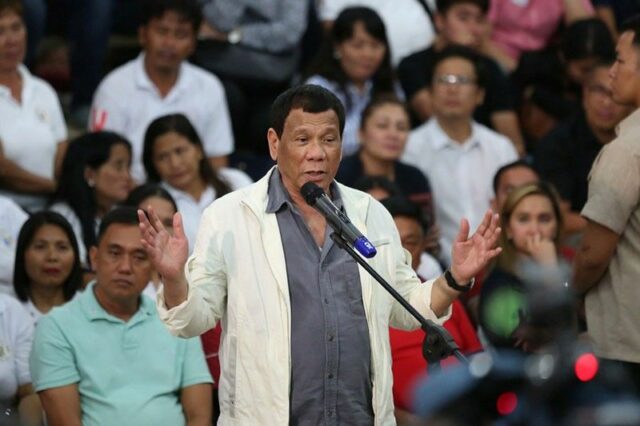
Duterte remains threat to Marcos, analysts say

PRESIDENTIAL FILE PHOTO/ALBERT ALCAIN

By Kyle Aristophere T. Atienza, Reporter

FORMER President Rodrigo R. Duterte’s camp remains the biggest threat to the Marcos-led coalition in the midterm elections next year amid a still fragmented opposition that fought the previous government, political analysts said.

“The elites and traditional politicians are winning the game, while the minority and opposition are far down the line,” Jan Robert Go, a political science professor at the University of the Philippines Diliman, said in an e-mail.

“Of course, social media has been the medium of many politicians, but many have already started their groundwork, especially the incumbents vying for reelection,” he added.

Mr. Go said there is still significant Duterte support across the country, which is bad for the Marcos coalition.

“But remember, our politics is very personal,” he said. “Voters may not necessarily consider the coalition but the specific individuals running for office. Issues can be salient for others, but other factors such as local politics could add another layer.”

Philippine political camps — the Marcos-led coalition, the opposition-posturing movement led by the Dutertes and the older opposition forces that have failed to secure key national seats in recent years — have bared their preparations for the 2025 midterm polls.

Local politicians have been jumping to President Ferdinand R. Marcos, Jr.’s Partido Federal ng Pilipinas (PFP), which has formed an alliance with the Nacionalista Party, Nationalist People’s Coalition and Lakas-CMD in preparation for the 2025 elections.

Meanwhile, Mr. Duterte’s PDP-Laban held a national assembly on Saturday in Davao City, the tough-talking politician’s bailiwick, where it was announced that Senator Robinhood C. Padilla will act as the party’s campaign manager next year. Davao City Mayor Sebastian Z. Duterte will serve as its vice president.

Amid bickering between the Marcos and Duterte groups, the Liberal Party has said ex-Senator Francis Pancratius “Kiko” N. Pangilinan, human rights lawyer Jose Manuel “Chel” I. Diokno and former Senator Paolo Benigno “Bam” A. Aquino IV would run for the Senate.

Mr. Diokno left the Katipunan ng Nagkakaisang Pilipino (KANP), which is headed by Mr. Aquino, to join Senator Ana Theresia “Risa” Hontiveros-Baraquel’s Akbayan Party, whose party-list group is expected to be proclaimed as among the winners of the 2022 elections after the disqualification of another group.

Ms. Hontiveros, the highest-elected official among opposition personalities, has endorsed the three-way tandem of Mr. Diokno, Mr. Aquino and Mr. Pangilinan.

She has gained popularity after starting separate investigations of Philippine Offshore Gaming Operations (POGO), which Mr. Duterte legalized in 2019 despite their reported links to Chinese syndicates and transnational crimes, and televangelist Apolo C. Quiboloy, Mr. Duterte’s spiritual adviser.

Arjan P. Aguirre, a political science professor at the Ateneo de Manila University, said mainstream opposition candidates such as Mr. Pangilinan and Mr. Aquino were not getting the attention that they used to have because they have been out of power for years.

“They are really having a hard time making themselves relevant again,” he said in an e-mail. “It seems that they are being careful in making statements or making a stand on the issues that are really contentious. The rationale here is not to appear too negative or extreme on issues.”

“But they can still do that but not to the point of losing the opportunity to make themselves stand out among the rest by offering an alternative and sensible view or perspective.”

The Makabayan opposition bloc at the House of Representatives has said it would field a 12-man slate for the 2025 elections. It has announced 10 senatorial bets including Party-list Reps. France L. Castro and Arlene G. Brosas .

Anthony Lawrence Borja, who teaches political science at De La Salle University, said the Liberal Party, which suffered major losses under the Duterte government, is in a more “maneuverable position” since it has more in common with the Marcos government than with the Makabayan bloc or Duterte camp.

‘SELF-DESTRUCTION’
There were “flirtations” or efforts to include the liberal opposition in a broader administration bloc, he added. “The administration group is certainly ahead with coalition building,” he said in an e-mail.

Mr. Borja said it is the first time in a long while since leftist coalition Bagong Alyansang Makabayan has fielded its own slate. Including labor leaders Leodegario “Ka Leody” de Guzman and Luke S. Espiritu, Jr. who are both from a different leftist group, would be “a watershed moment for the Filipino Left.”

“If not, then it will end up as another projection of disunity.”

“As for the Marcos camp, its coalition-building is a classic form of catch-all party politics legitimized by the incumbent ‘unity’ narrative,” Mr. Borja said. “Overall, between the Marcos and Duterte camps, the former is in a position to expand its voter base.”

Mr. Aguirre said mishandling political issues could backfire and cause “tremendous harm” on the Marcos camp. “The framing that the Duterte camp is using is simple — this is all politics and that this is meant to betray and deny them the opportunity to run in 2028.”

He said it’s never too late for opposition groups to form a united ticket, which can be pursued by “just sticking to common and basic issues that the general public can easily hold on to.”

Maria Ela L. Atienza, who teaches political science at UP, noted that in a country where political parties are underdeveloped, those who are popular on social media would become “early gainers.”

“Many of these gainers are traditional politicians and those who have invested a lot in media exposure.”

Drawing lessons from the 2022 elections, Ms. Atienza said the coalition supporting the ruling government is likely to “self-destruct” after the midterms since members have “no strong programs or principles” that would bind them.

She urged opposition groups to boost their presence and offer “more viable alternatives” amid the Marcos-Duterte showdown.

“They should stress that the opposition groups were the first to campaign against these issues now hounding the Duterte camp, and which pro-Marcos politicians are suddenly also pushing now that the tides have turned,” she added.

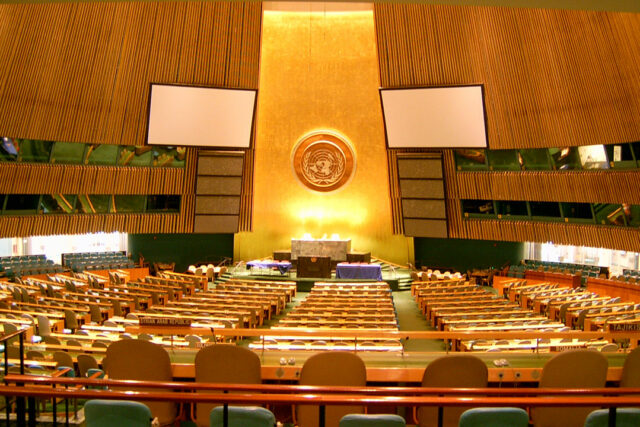
PHL joins UN vote vs Israel’s occupation of Palestine

WIKIPEDIA

THE PHILIPPINES has voted in favor of a United Nations (UN) resolution urging Israel to end its occupation of Palestinian territories within a year.

Manila joined 123 other countries including its Southeast Asian neighbors in supporting the UN General Assembly’s resolution that demanded Israel to bring “to an end without delay its unlawful presence” in the occupied Palestinian territory “no later than 12 months from the adoption of the present resolution.”

China and Japan also voted in favor of the resolution, which also adopted an International Court of Justice (ICJ) advisory opinion reiterating the “illegality” of the Israeli occupation.

The Israeli Embassy in Manila did not immediately reply to a Viber message and e-mail seeking comment.

Only 14 countries voted against the resolution including Israel itself, the US, Argentina, Czechia, Fiji, Hungary, Malawi, Micronesia, Nauru, Palau, Papua New Guinea, Paraguay, Tonga, and Tuvalu.

Forty-three countries abstained including Ukraine, Australia, Germany, Canada, the United Kingdom and India.

Twelve countries did not vote.

The resolution put forward an ICJ advisory opinion in which the court said “all states are under an obligation not to recognize” the Israeli occupation because it’s illegal.

“Israel is not entitled to sovereignty over or to exercise sovereign powers in any part of the Occupied Palestinian Territory on account of its occupation, nor can Israel’s security concerns override the principle of the prohibition of the acquisition of territory by force,” according to the resolution posted on the UN website.

The UN assembly demanded that Israel fulfill its obligations under international law and withdraw all of its military forces from the occupied Palestinian territory including from air and maritime spaces.

Israel should return immovable properties such as land and other assets seized since the 1967 occupation and cease new settlement activity, it added.

The assembly also demanded that Israel allow all displaced Palestinians during the occupation to return to their residence and pay for the damage caused by its occupation.

The Philippines in October last year abstained from voting in a UN General Assembly resolution that called for a humanitarian pause in Gaza, which has been bombarded by Israel following a major attack by Hamas militants on Oct. 7.

But in November, the Southeast Asian nation joined more than 140 UN members in passing a resolution that condemned Israeli settlements in the occupied Palestinian territory. — Kyle Aristophere T. Atienza

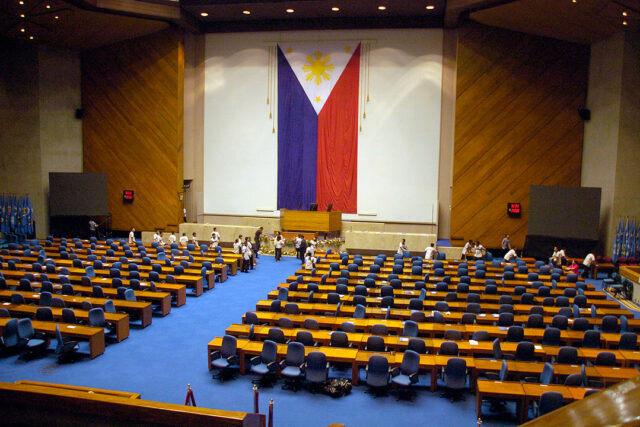
House set to OK proposed P6.352-T national budget on Wednesday

BW FILE PHOTO

By Kenneth Christiane L. Basilio, Reporter

THE House of Representatives is set to approve on Wednesday the proposed P6.352-trillion national budget for next year on third and final reading, House Speaker and Leyte Rep. Ferdinand Martin G. Romualdez said on Sunday, noting the need to expedite the spending plan’s plenary debates to give the Senate sufficient time to scrutinize it.

The 2025 national budget is equivalent to 22.1% of the country’s gross domestic product, and 10.1% higher than the P5.768-trillion budget this year.

The budget proposal increased appropriations for defense by 6.4%, more than doubled the transportation budget and augmented funding for education by less than 1%, while it slashed the allocations for agriculture, health and social welfare for next year.

Philippine President Ferdinand R. Marcos, Jr. is expected to certify as urgent House Bill (HB) No. 10800, the General Appropriations Bill, allowing the approval of the bill on second and third reading on the same day. This will also pave way for the chamber to approve the budget ahead of the congressional break on Sept. 28 to Nov. 3.

Mr. Romualdez said the House is adhering to the approval deadline on Wednesday due to the need to treat the “national spending program with urgency without sacrificing transparency.”

“We have sufficient time to finally agree on the budget before year-end. It is the most important piece of legislation Congress passes every year,” he added.

HB 10800 mostly retained allocations, proposed by the Budget department under the National Expenditure Plan, with changes made only to the Office of the Vice President’s (OVP) budget.

The House appropriations panel unanimously slashed the OVP’s budget by 64% to P733 million from P2.03 billion due to project redundancies with the Health and Social Welfare departments. The P1.3-billion reallocation was equally split to both their financial aid program and medical assistance for indigents.

The proposed national budget would help fund the government’s socioeconomic priority programs, including social protection projects and financial assistance initiatives, according to Mr. Romualdez.

“We hope our people will feel the benefits of growth through the programs intended for them in the national budget,” he said.

“The national budget is one of the most potent tools for the government to intervene and shape the economy, politics and society for the better,” Jose Enrique “Sonny” A. Africa, executive director at think tank IBON Foundation, said in a Viber message.

“Spending P6.4 trillion over just the short period of a year ensures the administration can have an immediate impact… on whatever it decides to prioritize.”

Mr. Africa noted that the collective P67-billion cut in the Labor and Employment, Social Welfare and Development, and Health department’s indigent financial aid programs under the proposed 2025 budget is “grossly inconsistent” with the government’s social agenda as Filipinos grapple with poverty.

The proposed budgets for agriculture, health, and social welfare were reduced by 4.7%, 7.6%, and 3.4%, respectively. Congressmen have expressed willingness to increase their funding during panel deliberations of the House appropriations committee.

“With elections looming through, it is quite possible for emergency assistance programs to be increased or reintroduced during bicameral discussions, as what happened for the 2024 budget when House leaders inserted aid programs,” said Mr. Africa.

The country’s poverty rate fell to 15.5% in 2023 from 18.1% in 2021, the Philippine Statistics Authority (PSA) said in August. The number of poor Filipinos declined by 12.26% to 17.54 million in 2023 from 19.99 million in 2021.

The government is aiming to reduce poverty incidence to 9% by 2028 or the end of the Marcos administration. This will require lifting a total of seven million Filipinos out of poverty in the next four years, or 1.75 million annually, the National Economic Development Authority said.

The proposed budget for the Health department could also be increased if the controversy surrounding Philippine Health Insurance Corp.’s (PhilHealth) remittance of P89.9 billion to the National Government’s coffers would gain further public scrutiny, Mr. Africa said.

“The cut in the health budget similarly diminishes public health services, while pushing impoverished Filipinos towards more expensive private health care that is only very partially mitigated by PhilHealth benefits.”

Budget cuts to the Agriculture sector are also “unexpected” given the government’s priority to promote food security, according to a Congressional Policy and Budget Research Department’s (CPBRD) report on the proposed spending plan.

“The sector needs adequate funds to sustain the implementation of programs and projects that will address the many challenges besetting the sector including low productivity, high prices, rural poverty and climate change,” the CPBRD report noted.

Camarines Sur Rep. Luis Raymund F. Villafuerte in August said Congress should consider increasing the Agriculture department’s budget by at least P88 billion to fund irrigation infrastructure, post-harvest facilities and food distribution initiatives, and support to rice development projects.

The plenary will hear turno en contra remarks of those opposing the allocations under the proposed budget before heading to the measure’s period of amendments. The House is expected to create a “small committee” to resolve proposed amendments to the national budget, Mr. Romualdez said.

The chamber has already approved the proposed funding for the Human Settlements, Labor and Employment, Trade and Industry, National Defense departments, among others.

The floor will take up the proposed budgets of the Health, Agriculture, Education, Public Works, and Social Welfare departments, and other remaining agencies from Sept. 23 to 25.

Manila, Bangkok eye labor ties

PHILIPPINE STAR/ MICHAEL VARCAS

THAILAND’S labor minister has committed to working with his Philippine counterparts to finalize a labor agreement on the protection of overseas Filipino workers and to pursue technical cooperation, according to the Philippine Embassy in Thailand.

In a statement, the embassy said Thai Minister of Labor Phiphat Ratchakitprakarn met with Philippine Ambassador to Thailand Millicent C. Paredes on Sept. 17 to discuss exploring deeper labor ties between both countries.

“Minister Phiphat acknowledged the PH efforts in initiating and proposing a draft labor agreement that has been in the works for several years, toward the protection and promotion of the welfare of Filipino migrant workers in Thailand,” it said.

“Both sides acknowledged the valuable contribution of Filipinos to Thailand’s nation-building, especially in the education and hospitality sectors, which employ many Filipinos.”

In the same meeting, the Minister disclosed their interest to pursue a technical cooperation and the sharing of best practices to strengthen the support networks between the Philippines and Thailand.

The Philippine Senate on Sept. 3 concurred with an International Labor Organization treat that ensures Philippine companies comply with global standards in labor inspections. Philippine President Ferdinand R. Marcos, Jr. ratified the convention in November. — John Victor D. Ordoñez

Improve budget use, DENR told

THE Department of Environment and Natural Resources (DENR) should focus on improving its budget utilization to enhance the monitoring of environmentally critical areas, amid reports of widespread illegal quarrying and logging operations, an official of political group Bayan Muna said on Sunday.

“It is critical that the DENR allocate its resources towards improving monitoring mechanisms, enforcing existing environmental policies, and holding accountable those responsible for violations,” Carlos I. Zarate, executive vice-president of party-list Bayan Muna, said in a statement.

“The agency should explain in its budget plans how it will improve its monitoring systems and ground-level enforcement in environmentally critical areas,” he added.

Severe flooding in Metro Manila during heavy downpour is because of the “lax implementation of environmental standards” in protected areas, particularly in Rizal province, according to Mr. Zarate. — Kenneth Christiane L. Basilio

Science programs get P8.8 billion

BW FILE PHOTO

A TOTAL of P8.8 billion is earmarked under next year’s budget to support state grants for science and technology programs, the Department of Budget and Management (DBM) said.

The funding will support the Department of Science and Technology’s (DoST) Grants-In-Aid (GIA) Program, the DBM said in a statement.

“We shall continue providing necessary support to crucial programs such as GIA to help empower our innovators, researchers, and learners, to make a difference in society through science and technology undertakings,” Budget Secretary Amenah F. Pangandaman was quoted as saying.

The DoST’s Grants-In-Aid Program provides grants for the implementation of DoST-priority programs and projects, as well as science and technology activities mentioned in the General Appropriations Act.

In his budget message, President Ferdinand R. Marcos, Jr. said the GIA Program “aims to spur economic growth through the strategic application of science and technology.”

Under next year’s proposed P6.352-trillion budget, the DoST will receive P28.8-billion in total funding. This is expected to help make the Philippines a regional hub for “smart and sustainable manufacturing, innovation, creativity, and sustainability.” — Beatriz Marie D. Cruz

Basilan peace ties strengthened

COTABATO CITY — The military, police, the United States Institute of Peace, and the Moro Islamic Liberation Front (MILF) in Basilan have strengthened ties to sustain peace in the province.

All 11 towns and the Lamitan City in Basilan, scenes of bloody clashes between Moro secessionist groups and government forces in decades past, had all been cleared from presence of the Abu Sayyaf terrorist group via joint peacebuilding programs of local government units, the police and the military’s Western Mindanao Command.

Radio reports in Cotabato City on Sunday stated that officials of the Army’s 101st Infantry Brigade, the Basilan Provincial Police Office and representatives of the joint Government-MILF Coordinating Committee agreed to continue cooperating on programs complementing the Mindanao peace process during a dialogue in Barangay Matatag in Lamitan City on Friday, Sept. 20.

Haroro J. Ingram, the Philippine country director of the United States Institute of Peace was present in the peace and security conference, where cooperation among key players in keeping the peace now in Basilan was discussed by participants.

Among the attendees were the commander of the Army’s 101st Infantry Brigade, Brig. Gen. Alvin V. Luzon, and Basilan provincial police director, Police Colonel Cerrazid A. Umabong.

Friday’s peace and security conference in Lamitan City reportedly delved partly on the need to maintain cohesion in peacebuilding activities of all sectors in Basilan, including the Government-MILF Coordinating Committee, the 101st Infantry Brigade, the provincial police and its component municipal police stations. — John Felix M. Unson

Kalinga coffee industry gets boost

JULIA FLORCZAK/UNSPLASH

TABUK CITY, KALINGA — Y-Kalinga coffee growers and producers have linked up with the Kalinga provincial government and other government agencies to push the local coffee industry further to progress.

Kalinga Governor and Kalinga Provincial Coffee Council (KPCC) Chairman James S. Edduba said, the people of Kalinga do not greet their visitors with “Good Morning,” but instead offer them with overflowing coffee.   He explained, it is a rich tradition of Kalinga, which the people are proud of.

During the First Kalinga Coffee Summit, themed “Brewing the Future and Sustainability of Kalinga Coffee,” representatives from different sectors led by the KPPC described it as a major milestone in the province’s efforts to propel its coffee industry and ensure its sustainability for future generations.

Summit participants pledged to unite as key stakeholders in their shared goal of promoting and protecting the unique heritage of Kalinga coffee.

Representatives of the different agencies of the government as well as the academe including the Department of Trade and Industry, the Department of Environment and Natural Resources, the Department of Science and Technology, the Department of Agrarian Reform (DAR), the Office of the Provincial Agriculturist, and the Kalinga State University committed to be among the vital partners in boosting efforts to promote Kalinga coffee in the local and international markets.

Mr. Edduba further explained that the focus of this week’s summit is the sustainability of the local coffee industry and the preservation of the rich tradition of Kalinga coffee, while looking forward to address the impacts of climate change, market competition, and the challenges of agricultural innovation. — Artemio A. Dumlao

Hezbollah, Israel exchange heavy fire after deadly Israeli strike

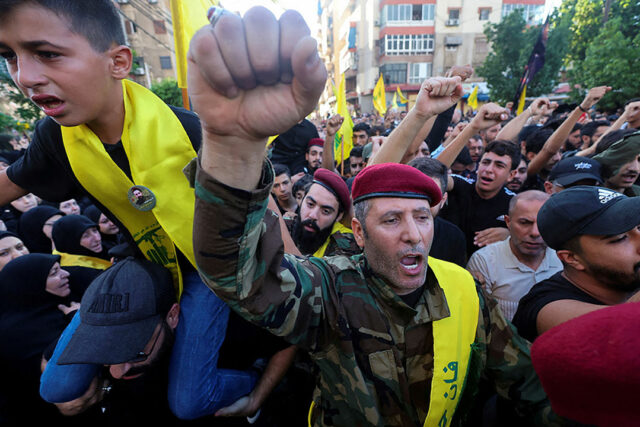
HEZBOLLAH MEMBERS raise their fists on the day of the funeral of three Hezbollah members, who were killed on Friday in an Israeli strike on Beirut’s southern suburbs, Lebanon, Sept. 21, 2024. — REUTERS

BEIRUT/CAIRO — Israel and Lebanon exchanged heavy fire into Sunday, with Israeli warplanes carrying out the most intense bombardment in almost a year of war across Lebanon’s south, while Hezbollah claimed rocket attacks on military targets in Israel’s north.

The Israeli military said it struck around 290 targets on Saturday including thousands of Hezbollah rocket launcher barrels and said it would continue to strike targets of the Iran-backed movement.

Israel closed schools and restricted gatherings in many northern areas of the country and the Israeli-occupied Golan Heights early on Sunday.

Sirens sounded all night as multiple rockets and missiles were fired from Lebanon and Iraq, most of which were intercepted by Israeli aerial defense systems, the military said.

Israeli media reported that a number of buildings were hit directly or by falling missile debris, and ambulance services said they treated some lightly injured people. No serious casualties were reported.

Hezbollah said it targeted the Israeli Ramat David Airbase with dozens of missiles in response to “repeated Israeli attacks on Lebanon,” the group posted on its Telegram channel early on Sunday.

The successive barrages of rocket attacks launched by Hezbollah at Ramat David are the deepest strikes it has claimed since hostilities began.

Iran-backed Iraqi militants in a statement also claimed an explosive drone attack on Israel early on Sunday.

ESCALATING ATTACKS
The escalating attacks come less than 48 hours after an Israeli airstrike targeting Hezbollah commanders killed at least 37 people in a suburb of the Lebanese capital, according to authorities.

Hezbollah, a powerful Iran-backed group, said 16 members including senior leader Ibrahim Aqil and another commander, Ahmed Wahbi, were among those killed on Friday in the deadliest strike in nearly a year of conflict with Israel.

Israel’s army said it hit an underground gathering of Aqil and leaders of Hezbollah’s elite Radwan forces, and had almost completely dismantled its military chain of command.

The attack leveled a multi-story residential building in the crowded suburb and damaged a nursery next door, a security source said. Three children and seven women were among those killed, according to Lebanon’s health ministry.

Friday’s strike sharply escalated the conflict and inflicted another blow on Hezbollah after two days of attacks in which pagers and walkie-talkies used by its members exploded.

The death toll in those attacks, widely believed to have been carried out by Israel, has risen to 39 with more than 3,000 injured. Israel has neither confirmed nor denied involvement.

In what it said was the initial retaliation for the attacks with the exploding devices, Hezbollah on Sunday posted on its Telegram channel that it had launched rockets at Israeli military-industry facilities.

US national security adviser Jake Sullivan said he was worried about escalation but that the Israeli killing of a top Hezbollah leader brought justice to the group, which Washington designates terrorists.

“While the risk of escalation is real, we actually believe there is also a distinct avenue to getting to a cessation of hostilities and a durable solution that makes people on both sides of the border feel secure,” Mr. Sullivan told reporters.

Lebanese Prime Minister Najib Mikati canceled a planned trip to the UN General Assembly in New York.

ISRAEL BRACES FOR RETALIATION
Hezbollah has said it would keep fighting Israel until it agrees to a ceasefire in its war against Hamas in the Palestinian enclave of Gaza — triggered by a Hamas-led rampage in southern Israel on Oct. 7.

US officials say that is unlikely anytime soon. Israel wants Hezbollah to ceasefire and withdraw forces from the border region, adhering to a UN resolution signed with Israel in 2006, irrespective of any Gaza deal.

Anticipating retaliation, the Israeli military restricted gatherings and raised the alert level for residents of northern communities. The alert went as far south as the coastal city of Haifa, signaling Israel thought Hezbollah could strike deeper than it had since the war with Hamas began.

In southern Lebanon on Saturday, people described huge explosions that lit up the night sky and shook the ground as Israel carried out its latest strikes.

Israeli Defense Minister Yoav Gallant, who said last week Israel was launching a new phase of war on the northern border, posted on X: “The sequence of actions in the new phase will continue until our goal is achieved: the safe return of the residents of the north to their homes.”

Tens of thousands of people have left their homes on both sides of the Israel-Lebanon border since Hezbollah began firing rockets at Israel in October in sympathy with Palestinians in Gaza.

A communique from a US summit hosted by President Joseph R. Biden with the leaders of Japan, India and Australia stressed the need to prevent the Gaza war “from escalating and spilling over in the region” but did not specifically mention the Israel-Hezbollah conflict.

With at least 70 people killed in Lebanon over the past week, the conflict toll in the country since October has surpassed 740 during the worst Israel-Hezbollah flare-up since a 2006 war. — Reuters

France unveils a more right-wing government

A FRENCH national flag flies above the entrance of the Elysee Palace in Paris, France, Nov. 13, 2023. — REUTERS

PARIS — France unveiled a new government on Saturday that aims to strike a fine balance between right-wingers and centrists, as Prime Minister Michel Barnier hopes to break political deadlock following snap elections that delivered a hung parliament.

After 2-1/2 months of political uncertainty since centrist President Emmanuel Macron’s surprise decision to call early elections, Barnier has put together a cabinet he hopes will find cross-party support in the fragmented parliament.

With few political heavyweights, his team includes one of the leaders of the conservative party of former President Nicolas Sarkozy, Bruno Retailleau, who negotiated the coveted interior ministry as the price for support in parliament.

However, showing the government’s fragility, the prestigious job of finance minister was given to a little-known 33 year-old, Antoine Armand of Macron’s party, having been turned down by more senior politicians.

The public finances portfolios, shared with new Budget Minister Laurent Saint-Martin, will have the unenviable task of putting together a budget bill before January, at a time France is struggling to contain a spiralling budget deficit.

“We must cut public spending and make it more efficient,” Mr. Armand told the Journal du Dimanche newspaper in an interview published on Saturday. “If the solution was to raise taxes, France would have long been the world’s top superpower.”

‘CONCESSIONS AND MANEUVERING’
But despite the entry of 10 politicians from Mr. Barnier’s conservative Republicans (LR) party in cabinet, Mr. Macron kept a number of outgoing ministers in key posts. Only one left-wing politician joined cabinet, Didier Migaud as justice minister.

Jean-Noel Barrot, the outgoing Europe minister, was promoted to foreign minister.

Sebastien Lecornu will stay on as defence minister.

Mr. Macron named Mr. Barnier, the European Union’s former Brexit negotiator and a 73-year-old veteran politician, as prime minister earlier this month, but the lengthy talks he had to lead to pull together a team were an illustration of the tough tasks ahead.

The centrist and conservative parties managed to join forces, but will depend on others, and in particular Marine Le Pen’s far right National Rally (RN), to stay in power and get bills adopted by a very fractured parliament.

“The centrist government is de facto a minority administration,” Eurointelligence analysts said in a note. Its ministers “will not only have to agree amongst each other but also will need votes from opposition parties for its bills to pass in the assembly. This means offering even more concessions and maneuvering.”

The RN gave tacit support to Barnier’s premiership, but reserved the right to back out at any point if its concerns over immigration, security and other issues were not met.

“I’m angry to see a government that looks set to recycle all the election losers,” Mathilde Panot, who leads the hard-left LFI group of lawmakers, told TF1 television. — Reuters