Home Blog Page 2616

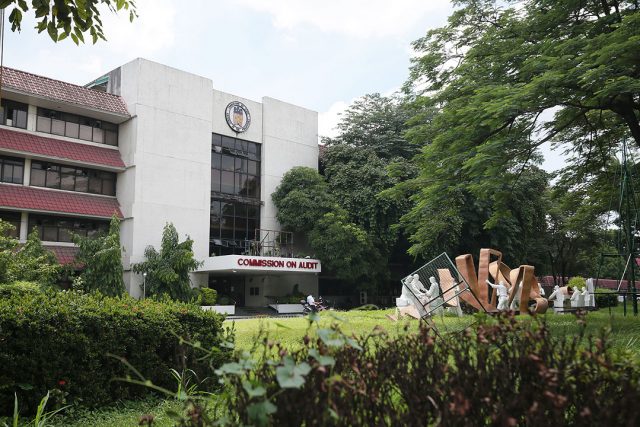
P320-M Baliwag assets flagged

PHILIPPINE STAR/ MICHAEL VARCAS

THE Commission on Audit (CoA) has flagged the city government of Baliwag in Bulacan province for failing to insure P320 million of its assets with the Government Service Insurance System (GSIS), risking massive infrastructure loss due to calamities without indemnity.

State auditors said only P84 million, or 20.8%, of Baliwag city’s assets were insured. This leaves P320 million, or 79.2%, of properties at risk of natural disasters.

This is in violation of the Property Insurance Law of 1951 and a CoA circular, requiring all government assets and properties to be insured by the GSIS, also leaving the local government unit (LGU) without compensation from damages.

The city government of Baliwag did not immediately respond to an e-mail and Facebook Messenger chat requesting comment.

“A total of P320,096,997 or 79.2% of P404,104,347 insurable physical assets of the City were not yet covered by insurance from the Government Service Insurance System General Insurance Fund, thus, exposing the City to the risk of not being indemnified for any damage to or loss of properties arising from fire, earthquake, storm, flood, and other force majeure,” the CoA report read in part. 

About P151 million worth of machinery and equipment owned by the LGU were uninsured, with building assets amounting to P93 million left at risk without financial compensation. State auditors also noted another P75 million worth of transportation equipment without insurance policies. — Kenneth Christiane L. Basilio

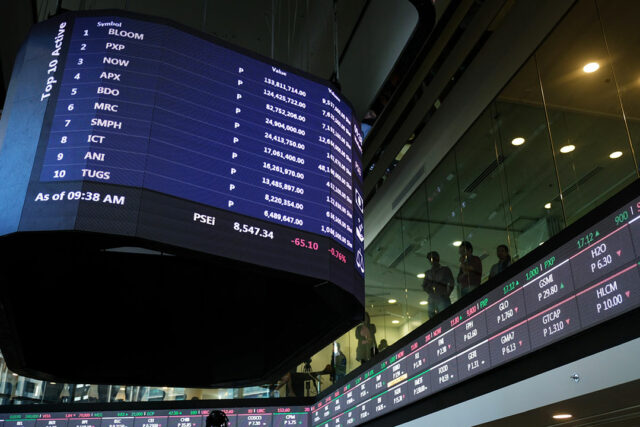
Stocks drop as investors pocket gains from rally

BW FILE PHOTO

PHILIPPINE STOCKS closed lower on Tuesday, snapping their two-day climb, as investors pocketed their gains from Monday’s surge and with weaker sentiment on Wall Street spilling over to the local market.

The Philippine Stock Exchange index (PSEi) declined by 0.23% or 17.43 points to close at 7,537.25 on Tuesday, while the broader all shares index lost 0.13% or 5.56 points to end at 4,077.41.

“The local market pulled back this Tuesday as investors took profits after a two-day rally,” Philstocks Financial, Inc. Senior Research Analyst Japhet Louis O. Tantiangco said in a Viber message.

The PSEi closed at a near five-year high of 7,554.68 on Monday.

“The negative cues from Wall Street driven by the rise in Treasury yields and the weakening of the local currency also weighed on the bourse,” Mr. Tantiangco added.

“Philippine shares slipped as investors faced headwinds with rising oil prices and elevated Treasury yields dampened market sentiment,” Regina Capital Development Corp. Head of Sales Luis A. Limlingan likewise said in a Viber message.

Wall Street’s three major indexes closed down around 1% on Monday while Treasury yields rose, as traders tamped down bets for US Federal Reserve interest rate easing and worried about the Middle East conflict’s impact on oil prices, Reuters reported.

After Friday’s stronger-than-expected jobs report, traders pulled back from bets for a 50-basis-point (bp) rate cut in November. They were pricing in an 86% chance of a 25-bp cut and a roughly 14% chance the central bank would not cut rates at all, according to the CME’s FedWatch tool.

The change in rate cut expectations caused US Treasury yields to rally, with the yield on benchmark 10-year notes exceeding 4% for the first time in two months.

Investors also continue to fret about how Israel would respond to Iran’s missile strikes. On Monday, Lebanon’s armed group Hezbollah fired rockets at Israel’s city of Haifa while Israeli forces looked poised to expand ground raids into south Lebanon.

The Dow Jones Industrial Average fell 398.51 points or 0.94% to 41,954.24; the S&P 500 lost 55.13 points or 0.96% to 5,695.94; and the Nasdaq Composite lost 213.95 points or 1.18% to 17,923.90.

Back home, the majority of sectoral indices ended lower on Tuesday. Property declined by 2.48% or 75.10 points to 2,950.60; mining and oil went down by 0.71% or 64.91 points to 8,977.38; industrials retreated by 0.18% or 19.04 points to 10,035.22; and holding firms dropped by 0.17% or 10.87 points to 6,394.91.

On the other hand, services rose by 0.85% or 20.01 points to 2,357.07; and financials went up by 0.72% or 17.15 points to 2,399.92.

Value turnover fell to P7.39 billion on Tuesday with 1.22 billion shares changing hands from the P7.87 billion with 1.36 billion issues traded on Monday.

Advancers beat decliners, 109 versus 97, while 54 names were unchanged.

Net foreign buying declined to P428.08 million on Tuesday from P1.35 billion on Monday. — Revin Mikhael D. Ochave with Reuters

Magalong seeks third term as Baguio Mayor

BAGUIO CITY — Baguio City Mayor Benjamin B. Magalong on Tuesday, the last day of filing of candidacies, filed his third and final bid as Mayor of Baguio, ending talks on whether he will run for the Senate.

Running under the banner of the Good Governance Alliance, Mr. Magalong is positioning his reelection campaign on the same core values of transparency and service that have defined his previous terms.

His slate includes a mix of seasoned public servants and promising new faces, all committed to upholding excellence and integrity in governance.

The Good Governance Alliance’s lineup of candidates includes incumbent Councilor Isabelo “Poppo” B. Cosalan, Jr. for the congressional seat, while Vice-Mayor Faustino Olowan is seeking reelection.

The alliance is supported by the Nationalist People’s Coalition (NPC), Partido Federal ng Pilipinas (PFP), and the Liberal Party (LP).

Mr. Magalong’s camp said their campaign centers around a comprehensive seven-point agenda, focusing on Environment, Land Use, and Energy; Climate and Disaster Resilience; Urban Regeneration; Youth Empowerment; Economic Recovery and Development; Smart City Management; and Good Governance. — Artemio A. Dumlao

Three drug den operators busted

PHILSTAR FILE PHOTO

COTABATO CITY — Anti-narcotics agents seized P102,000 worth of shabu from three drug den operators, who have reported links to a local terror group, in an entrapment operation in Barangay Poblacion 2 in Cotabato City on Monday.

Gil Cesario P. Castro, director of the Philippine Drug Enforcement Agency-Bangsamoro Autonomous Region in Muslim Mindanao, said on Tuesday that their agents immediately arrested the three drug den operators after selling to them P102,000 worth of shabu in a tradeoff.

Mr. Castro said the entrapment operation was carried out with the help of different units under Brig. Gen. Prexy D. Tanggawohn, director of the Police Regional Office-Bangsamoro Autonomous Region.

Relatives of the now detained suspects, who requested anonymity, told reporters that all three of them had peddled shabu discreetly in far-flung areas where there is presence of the now moribund Dawlah Islamiya.

The allies Dawlah Islamiya and the Bangsamoro Islamic Freedom Fighters, tagged in deadly bombings in Central Mindanao in recent years, are led by violent religious extremists involved in trafficking of shabu and propagation of marijuana. — John Felix M. Unson

BoI touts tax savings for RBEs under CREATE MORE measure

THE passage of the bill amending the Corporate Recovery and Tax Incentives for Enterprises (CREATE) Act will result in registered business enterprises (RBEs) saving on their tax bills, the Board of Investments (BoI) said.

During his presentation at the Philippines-South Korea Business Forum on Monday, Trade Undersecretary and BoI Managing Head Ceferino S. Rodolfo cited simulations that indicated that RBEs could reduce their taxes by as much as 75% under the CREATE to Maximize Opportunities for Reinvigorating the Economy (CREATE MORE) bill.

“The Department of Trade and Industry (DTI) worked with an accounting and auditing firm to simulate the possible impact on a currently registered export manufacturer in the Visayas with about 6,500 workers,” Mr. Rodolfo said.

The simulation assumed the company opted for the special corporate income tax regime under the CREATE law, producing a tax bill of P480 million, he said.

“If CREATE MORE enters into force and the company avails of CREATE MORE’s enhanced deduction regime, this P480 million will go down to P120 million,” he said. 

“So it’s quite substantial, and it could really give some competitive advantage to Philippine companies and South Korean companies located in the Philippines,” he added.

In a separate event last week, Secretary Frederick D. Go said that the information technology and business process management (IT-BPM) sector is among the industries expected to benefit from CREATE MORE.

Mr. Go, who heads the Office of the Special Assistant to the President for Investment and Economic Affairs, said that certain points of the CREATE MORE bill will affect the industry, particularly the restoration of the power of investment promotion agencies (IPAs) to approve projects within a certain threshold.

“It authorizes the IPAs to approve projects within a P15 billion threshold without needing to go up to the Fiscal Incentives Review Board (FIRB) for approval. So this should speed up the process,” he said during his keynote speech at the International IT-BPM Summit.

He said that this specific amendment is necessary despite the adjustment made by the FIRB early this year, as it will make the increased threshold more permanent.

“By law, IPAs can only approve up to P1 billion (worth of investments). With the new law, IPAs can approve up to P15 billion,” he said. 

“While the law was being discussed, FIRB already adjusted it. But that’s temporary. FIRB can always change it back,” he added.

Meanwhile, he said that the introduction of the RBE local tax of not more than 2% of gross income will also address many locator concerns. 

He added that CREATE MORE will also address IT-BPM’s sector concerns about being taxed when donating old computers to the government.

“CREATE MORE liberalizes this by exempting donations of capital equipment, raw materials, spare parts, or accessories from taxes and duties if donated to the government,” he said.

CREATE MORE will also exempt RBEs opting for the 5% special corporate income tax rate from all national and local taxes, fees, and charges and will extend the sunset period for the incentives by more than three years or until December 2034, he added.

Asked to comment, IT and Business Process Association of the Philippines (IBPAP) President and Chief Executive Officer Jack Madrid said CREATE MORE eliminates much of the uncertainty and confusion in interpreting the CREATE law.

We have a lot of local government units, and they occasionally have different interpretations and implementation of taxes, including the issuance of business permits,” Mr. Madrid said on the sidelines of the event. 

“So, I think that is one major headache that investors will now not have because of this clarification,” he added.

However, he said that Mr. Go did not clarify the issue of flexible work arrangements, a particular concern of locators registered with the Philippine Economic Zone Authority.

“Let us just wait for the implementing rules and regulations of CREATE MORE. The good news is, it was approved at the bicameral level,” he said.

“It’s a step in the right direction, and (Mr. Go) is a very, very big supporter,” he added. — Justine Irish D. Tabile

PHL-S. Korea mineral deal seen stabilizing ore, EV supply chain

REUTERS

THE Board of Investments said a strategic cooperation agreement with South Korea is expected to ensure stable supply of critical minerals while generating potential investments.

On the sidelines of the Philippines-Korea Business Forum on Monday, Trade Undersecretary and BoI Managing Head Ceferino S. Rodolfo said the memorandum of understanding (MoU) between the two countries will enable more mineral development.

“The participants will collaborate to discuss and form a strategic partnership for the establishment of critical raw material supply chains and cooperate to ensure a stable supply of critical raw materials,” Mr. Rodolfo told reporters.

He said that the MoU will enhance collaboration in the development, production, processing, and supply of critical materials.

He also expects enhanced research and development and cooperation in exploration, mining, processing, and recycling of critical minerals.

The critical minerals agreement is among the MoUs signed at Malacañang on Monday. The signatories were the BoI, the Department of Environment and Natural Resources (DENR), and South Korea’s Ministry of Trade, Industry, and Energy.

“The MoU is the first of its kind, jointly signed by (the BoI’s parent department, the Department of Trade and Industry) and the DENR, signifying a whole-of-government approach to responsible and sustainable development of the critical minerals sector,” the DTI said.

According to Mr. Rodolfo, South Korea is among the biggest importers of nickel, while the Philippines is the biggest exporter of nickel ore.

“The Philippines accounts for more than 25% of the total global supply of nickel ore exports. Next to us is New Caledonia with 17% and Russia with 11%,” he said.

“Now, more than 98% of our exports go to China, while 1% goes to Japan; South Korea accounts for less than 1%,” he added.

He said South Korea is the world’s third largest importer of nickel ore or concentrate, following China and Canada.

“However, the Philippines’ share of South Korea’s nickel ore or concentrate imports is less than 1%. And if you look at the share of the Philippines in South Korea’s total imports, it’s only 5%,” he said.

“This is small for a country that is the biggest supplier or exporter of nickel ore and concentrate, and for a country that is one of the biggest importers of something that the Philippines supplies,” he added.

Separately, Ferdinand Raquelsantos, chairman emeritus of the Electric Vehicle Association of the Philippines (EVAP), said that the impending free trade agreement (FTA) between South Korea and the Philippines will increase activity in the electric vehicle (EV) industry.

“We had several agreements in place, but once the FTA is out, there will be a tenfold increase,” he said.

“There’s going to be a lot more business interactions not only in automotive but also in agriculture,” he added.

He said EVAP has been pushing for the FTA to facilitate local assembly of EVs in the Philippines.

“We are hoping that South Korea will be the first to do that,” he said.

Two South Korean brands currently have a presence in the Philippines: Hyundai and Kia.

“They are at par, as far as sales is concerned, compared to (Chinese EV maker) BYD. But we are still looking forward for Kia to do local assembly here,” he said.

“Kia and Hyundai are selling very well here in the Philippines in both the internal combustion engine (ICE) and EV segments,” he added.

He said that the Philippines has a niche in manufacturing auto parts, including basic components needed for ICE and electric vehicles.

“We can supply the same things we supply ICE (manufacturers) to EV (manufacturers),” he said.

However, he said that the Philippines still has to expand EV adoption to attract manufacturing activity.

“There is a Taiwan company that has been talking to us for the last 14 years and is just waiting for the volume to go up,” he added. — Justine Irish D. Tabile

NCR office vacancies seen falling as new construction tapers off

LYCS ARCHITECTURE-UNSPLASH

THE Metro Manila office vacancy rate is expected to decline gradually starting in 2025, after having remained steady in recent years, Leechiu Property Consultants, Inc. (LPC) said.

“Starting 2025, the pipeline of buildings will come down. It should help get the market to breathe a bit more and hopefully, vacancy levels will shift downwards gradually,” Mikko Barranda, Commercial Leasing director at Leechiu Property said during an Oct. 8 briefing.

He cited a trend of delaying building launches, which will eventually bring vacancies to single-digit levels by 2028.

“About 66,000 square meters (sq.m.) of newly completed buildings were added to the market, with 345,000 sq.m. expected in the pipeline by the fourth quarter of 2024,” LPC said.

The company said the vacancy rate was flat at 17% in the third quarter, with available supply at 18.4 million sq.m. and 3.1 million sq.m. lying vacant.

POGO DEPARTURE
About 50,000 sq.m. of office space was vacated in the third quarter of 2024 by Philippine Offshore Gaming Operators (POGO), Mr. Barranda said.

In July, President Ferdinand R. Marcos, Jr. ordered the winding down of POGO operations by the end of 2024.

The industry started to downsize in the third quarter, he said.

“Once the exit happens, we’ll see that district like Makati, Bonifacio with their very low exposure to the industry won’t be affected as much,” he said.

Mr. Barranda added that these central business districts (CBDs) will have to make only limited adjustments compared to the so-called “Bay Area” around Manila Bay, where POGOs have a larger footprint.

He estimated that legal POGOs currently occupy 500,000 sq.m. of office space, well off their peak of 45% of the office market in 2020.

Overall, leasing demand declined 16% year on year to 215,000 sq.m. in the third quarter, he said.

POGOs accounted for only 8% of demand in 2024.

In the year to date, office transactions amounted to 900,000 sq.m., up 11%, led by the Information Technology and Business Process Management industry and traditional locators.

“Majority of recorded transactions were due to tenants relocating to newer buildings,” Leechiu said, in contrast to a year earlier when more tenants were downsizing or canceling their leases. — Aubrey Rose A. Inosante

AI regulation should address PHL businesses’ concerns about security, privacy — Snowflake

By Justine Irish D. Tabile, Reporter

THE GOVERNMENT needs to lay down clear regulations on the use of artificial intelligence (AI) to encourage business adoption, due to the need to allay their data security and privacy concerns, US cloud data company Snowflake, Inc. said.

In an interview with BusinessWorld, Satchit Joglekar, Snowflake’s regional director for ASEAN emerging markets, said: “As the use of AI and especially tools like generative AI services out there increases, enterprises, organizations, and even the government should be very well aware of the security and the governance frameworks around that.”

“While the concerns are valid, what we need to ensure at the outset is that when we build the data foundations and aggregate all of the data in an enterprise, we need to ensure that security, privacy, and governance controls are baked in,” he added.

In particular, he said that there is a need to establish who can only see the data, who has the right levels of access control, and what sensitive data needs to be masked, among others.

“That should be the design principle when you are building your data foundations, and then the next principle should be that once that data foundation is laid, secured, and governed, that data ideally should not be leaving the organization’s premises or their cloud instances,” he said.

Ideally, he said that the next generation of AI-driven tools should allow for work to come to enterprises instead of the enterprises’ data going to the AI database.

“That is fundamentally what the current concern is around security, governance, and privacy because … data is moving around between different databases internally or externally, between different tools, or within an organization,” he added.

He said growing concerns about data security and privacy also represent an opportunity for the government to set clear guidelines and guardrails on AI use.

“When the guidelines, guardrails, and regulations are very clear, that is when innovation can truly be unleashed. The problem is when it’s not, when it’s gray, then more often than not, especially large enterprises will not want to put themselves at risk of assuming something because they have the nation’s or the customer’s data with them,” he said.

“This is why having an environment where the government sets clear regulations, guidelines, and guardrails around AI and also setting the guidelines on what kind of data security, privacy, and governance is needed — that’s when enterprises and organizations here will unleash the value of AI,” he added.

He said that although the Data Privacy Act is a step in the right direction, the Philippines should work on creating guidelines as well on AI use.

“There are Data Privacy Acts everywhere, most jurisdictions have that. But I think we shouldn’t just stop at Data Privacy Acts. We should also have Artificial Intelligence Development Acts,” he said.

“Within those guidelines and guardrails, organizations can innovate in a risk-free manner and without fear of breaking any regulations,” he added.

He said the Philippines is not alone in just starting to draft the guidelines on AI use, as most countries are also in the same situation.

“I think AI guidelines are under development in most jurisdictions, so I wouldn’t say the Philippines is behind or anything like that. Because this is a new thing,” he said.

“AI is taking over our lives, and to protect consumers as well as enterprises, I think the government is now beginning to step up to come up with guidelines,” he added.

The company decided to expand in the Philippines because of the growing economy and demand for cloud services, according to Mr. Joglekar.

“The economic indicators are there, the Philippines has one of the fastest rates of growth in terms of gross domestic product in Asia,” he said.

“Philippine companies and enterprises across sectors are also quite open and have already started adopting cloud technologies. And we partnered with the likes of Amazon Web Services … and saw that the Philippines was definitely a country where it was prioritizing investment,” he added.

The company has so far invested in three economies within ASEAN — Singapore, Indonesia, and the Philippines.

“The Philippines is definitely one of the top markets for us in ASEAN, and that is why we have invested here … but we will be expanding into other markets,” he said.

He said that since the company launched in the Philippines two years ago, it has doubled its footprint in terms of staffing.

“We can’t share exact numbers, but the investment is definitely there, and we will continue to invest in the Philippines because we see the potential and we see that the customers are accepting and adopting the Snowflake platform,” he added.


BIR confident digitalization timetable on track

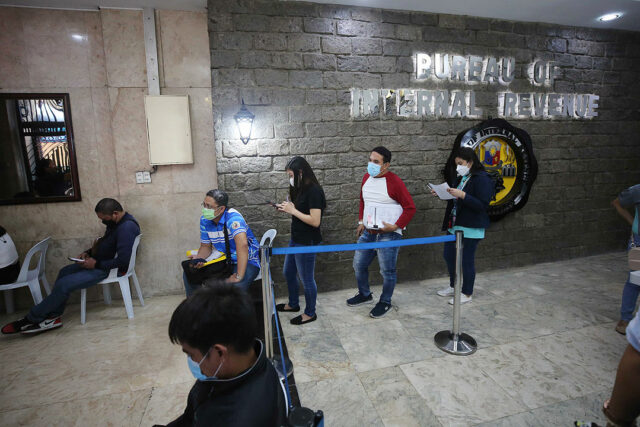
People line up to file their income tax returns at the Bureau of Internal Revenue office in Intramuros, Manila, April 18, 2022. — PHILIPPINE STAR/ RUSSELL A. PALMA

THE Bureau of Internal Revenue (BIR) expressed confidence in meeting its internal deadline for fully digitalizing its services and operations by 2028.

“By 2028, the BIR needs to be fully digitalized. That’s our aspiration. With the ongoing digitalization process, we believe we can attain that by 2028,” BIR Regional Director Renato M. Molina said at a forum on Tuesday.

Mr. Molina said that most of the agency’s processes are currently digitalized, including filing and payment of taxes and submission of reports and documentation.

“Because of the passing of the Ease of Paying Taxes law, all taxpayers can file wherever. You can pay anywhere. With that, we are hopeful we can serve the taxpayers in the coming months and years.”

However, Mr. Molina noted that the BIR will need funding to support its digitalization initiatives.

“First of all, we need a budget… I know the Department of Finance (DoF) is helping here to give us what we need. By doing that, we can accomplish excellent taxpayer service.”

The BIR has been transitioning into digital operations after adopting a 10-year digitalization roadmap in 2019. — Luisa Maria Jacinta C. Jocson

S. Korean agricultural equipment firms setting up shop in Cabanatuan

THE Department of Agriculture (DA) said on Tuesday that it will build an agricultural machinery manufacturing complex in Cabanatuan in partnership with the Korea Agricultural Machinery Industry Cooperative (KAMICO).

“They will be constructing the first agri-machinery manufacturing and assembly line in the Philippines. This is the first in the country for this type,” Agriculture Assistant Secretary and Spokesperson Arnel V. de Mesa told BusinessWorld on the sidelines of a Senate budget hearing.

He added that about 30 South Korean agricultural equipment companies are expected to operate from the Korea Agri Machinery Industry Complex.

The DA said that complex hopes to stimulate manufacturing, enhance crop quality, increase farmer incomes, and produce agricultural machinery tailored to Philippine conditions.

“So… they can also help the Philippines, they have decided to invest here in an assembly plant,” Agriculture Secretary Francisco P. Tiu Laurel, Jr. said.

The DA and the KOICA signed a Memorandum of Understanding to build the facility in Nueva Ecija’s largest city.

“It’s about 20 hectares in Cabanatuan that will house the investments coming from the Korean companies,” Mr. De Mesa said.

The site will also host research and development and training facilities.

Mr. De Mesa said the site will be developed in phases over 10 years.

“This includes the initial assembly line, then manufacturing, and then lastly the research and development to adapt the products to local conditions,” he added.

He said that the facility is expected to start construction before the end of the year.

“We are just fixing the permits, documents, and other arrangements. So, we’re hoping to break ground before the year ends,” he said. — Adrian H. Halili

NFA sets palay buying price at P23-P25 per kilo

PHILIPPINE STAR/MIGUEL DE GUZMAN

THE National Food Authority (NFA) said it set the buying price of palay (unmilled rice) at between P23 and P25 per kilogram for dry and clean grain.

“Our pricing mechanism is a range, so the NFA will implement (a buying price) of about P23 to P25 per kilogram,” NFA acting Administrator Larry R. Lacson told reporters on Tuesday.

Earlier, the NFA Council approved a palay buying price between P23 to P30 per kilo for dry and clean palay and P17 to P23 per kilo for fresh palay.

“It’s not really an abrupt going down in price… In about eight to 10 days the buying price will go down,” he added.

The NFA is tasked with purchasing domestically grown rice and hold it in reserve in the event of shortages or calamities.

“At P23 per kilo, the farmer is still able to profit… So we are managing that we don’t forget our farmers,” Agriculture Secretary Francisco P. Tiu Laurel, Jr. told reporters.

The NFA earlier increased the buying price for palay to compete with prices offered by traders.

“World prices have gone down a bit and the price of rice in the market will not fall if the buying price of traders and the government remains high,” Mr. Laurel said.

Mr. Lacson added that the new pricing is part of the government’s effort to tame the price of palay, possibly leading to a fall in prices charged by millers.

“We have to tame the price of palay to pave the way for cheaper rice,” he said.

He added that the NFA will be able to procure more rice for farmers at the lowered price.

The NFA hopes to purchase up to 8.7 million bags of palay before the end of the year, equivalent to up to 435,000 metric tons (MT) of palay.

In the first half, the NFA paid P5.3 billion to purchase 175,000 MT of palay, equivalent to 3.5 million bags. — Adrian H. Halili

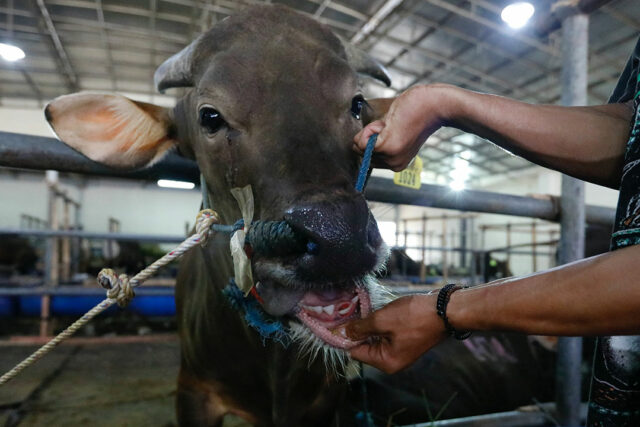
Meat imports from Turkey suspended after foot and mouth disease outbreak

REUTERS

THE Department of Agriculture (DA) said it has temporarily banned meat from Turkey made from animals prone to contracting foot and mouth disease (FMD).

In Memorandum Order No. 42, the DA cited reports of an FMD outbreak in Turkey.

Turkish authorities reported to the World Organisation for Animal Health an outbreak of FMD affecting domestic cattle in September.

FMD is highly transmissible and causes lesions and lameness in cattle, sheep, goats and other cloven-hoofed animals. The disease does not affect humans.

“There is a need to prevent the entry of FMD to protect the health of the local animal population,” the DA added.

It added that all shipments coming from Turkey already in transit, loaded, or accepted at port will be allowed provided that the animals from which the products were derived were slaughtered or produced before Aug. 26.

The DA said that it also suspended the processing, evaluation of the application and issuance of Sanitary and Phytosanitary import clearances of meat from Turkey.

In October 2023, the DA lifted the ban on imports of poultry and its byproducts from Turkey after birds there were declared free of H5N1 Highly Pathogenic Avian Influenza or bird flu. — Adrian H. Halili