Home Blog Page 2529

Manila’s top envoy to tackle regional issues with Malaysian, Thai peers
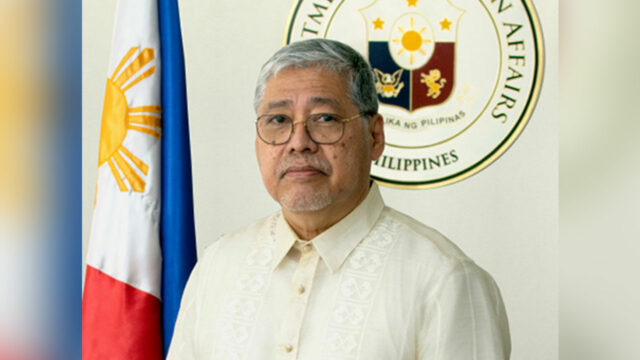
ENRIQUE A. MANALO — DFA.GOV.PH

THE PHILIPPINES’ top envoy will meet with his Malaysian and Thai counterparts this week to discuss regional issues and seek deeper bilateral ties, according to the Department of Foreign Affairs (DFA).

In a statement, the agency said Philippine Foreign Affairs Secretary Enrique A. Manalo and Malaysian Minister of Foreign Affairs Dato Seri Utama Jahi Mohammad Bin Haji Hasan will meet at the Eight Joint Commission Meeting (JCM) in Kuala Lumpur on Wednesday to discuss “matters of mutual interest to both countries and the Southeast Asian region.”

“The reconvening of the JCM manifests the deepening of the friendship between the two countries, as well as the expansion of areas of bilateral cooperation,” DFA said.

The meeting is a consultation and cooperation mechanism used to tackle pressing bilateral and regional issues, it said.

This comes after Philippine President Ferdinand R. Marcos, Jr. urged Southeast Asian leaders and China at a regional summit in Laos on Thursday to speed up talks on a code of conduct for the South China Sea.

The idea of a maritime code was first agreed between China and ASEAN in 2002, but the process of creating it did not start until 2017.

A United Nations-backed tribunal in the Hague in 2016 voided China’s expansive claims in the South China Sea, as it ruled Scarborough Shoal is a traditional fishing ground for Filipino, Chinese and Vietnamese fishermen. China has controlled the shoal since 2012.

The Philippines has been unable to enforce the ruling and has since filed hundreds of protests over what it calls encroachment and harassment by China’s coast guard and its vast fishing fleet.

Meanwhile, Mr. Manalo will also meet with Thai Minister of Foreign Affairs Maris Sangiampongsa in Bangkok on Oct. 18 for a separate dialogue about regional and bilateral issues.

The mechanism would “facilitate cooperation and consultation between the Philippines and Thailand on a wide array of issues of bilateral and regional concern,” DFA said in a separate statement.

During the Thai diplomat’s visit to Manila in July, he said Thailand was ready to help the Philippines and China peacefully resolve their sea dispute and ease tensions in the waterway.

Aside from the Philippines and China, Brunei, Malaysia, Taiwan and Vietnam also have claims to parts of the South China Sea.

The Philippines’ Bureau of Fisheries late Monday said a Chinese maritime militia boat  had deliberately sideswiped one of its two vessels that were conducting routine maritime patrols near Thitu Island on Friday.

US Marines and Filipino troops on Monday kicked off their yearly Kamandag joint military drills that will be held on the main Luzon island, Metro Manila and Palawan province, the US Defense department’s Defense Visual Information Distribution Service said in a statement.

The exercises aim to boost interoperability between the troops through coastal defense, combat medicine and humanitarian assistance drills, it added.

The Philippines is set to take the chairmanship of the Association of Southeast Asian Nations (ASEAN) in 2026, where it seeks to raise its sea row with China.

Last year, Mr. Marcos said Manila would take over the regional bloc’s chairmanship in 2026 as the country aims to “fortify the foundations of our community-building and navigate ASEAN as it embarks on a new chapter.”

“It is regrettable that the overall situation in the South China Sea remains tense and unchanged,” he told Southeast Asian leaders at the Laos summit, based on a statement from his office. “We continue to be subjected to harassment and intimidation.” — John Victor D. Ordoñez


PCG eyes delivery of 10 ships from Japan, France next year

PHILIPPINE COAST GUARD PHOTO

By Chloe Mari A. Hufana, Reporter

THE Philippine Coast Guard (PCG) expects to take delivery of four 97-meter ships and six smaller vessels next year, an official said on Wednesday, amid China’s continued  efforts to block resupply missions at Second Thomas Shoal in the South China Sea.

The ships will come from Japan and France, Vice Admiral Robert N. Patrimonio, who heads the Coast Guard Maritime Security Law Enforcement Command, told BusinessWorld on the sidelines of a marine biodiversity event in Taguig City.

The coast guard has three big vessels and 10 smaller ships, he said. “Only 13 are ready for sea status and available for deployment. These vessels can operate all the way up to the Philippines’ exclusive economic zone (EEZ) in the South China Sea.”

Mr. Patrimonio said building a ship takes about a year.

“We have smaller watercraft, around 12 meters in length. However, they can’t operate beyond certain sea conditions. So, when it comes to patrolling our entire maritime jurisdiction, our floating assets are still very limited,” he added.

During the panel discussion, Mr. Patrimonio said the PCG has older Australian-made vessels, but they are not ready for sea conditions.

Cebu, Davao, and Zamboanga are “three critical areas” in the Philippines that require at least one floating asset to respond to any type of maritime threats or disasters, he added.

“The deployment of our assets is more focused on the West Philippine Sea, leaving some areas without floating assets,” he said, referring to areas of the South China Sea within the country’s EEZ.

Last month, the House of Representatives approved on third and final reading House Bill No. 10841, which seeks to give the PCG P5 billion in yearly funding for its modernization amid growing sea tensions with China.

The bill also allows the agency to receive loans and grants from local or foreign sources to boost modernization efforts.

The coast guard must draft a modernization plan by detailing the assets it needs to improve its operations, according to the measure. The bill also defines coast guard positions and their pay grades.

The Senate has yet to pass a counterpart measure.

China and the Philippines have been at loggerheads over confrontations near disputed features in the South China, with Manila accusing China’s coast guard of aggression and Beijing furious over what it calls repeated provocations and territorial incursions.

The Philippines has also accused China of maintaining a maritime militia to bolster its presence in the South China Sea. Beijing has maintained they are civilian ships.

China claims almost the entire South China Sea, including the Philippine-occupied Thitu, and has rejected a 2016 ruling by the Permanent Court of Arbitration in the Hague that Beijing’s expansive claims have no basis under international law. The case was brought to the court by the Philippines.

PHL eyes incentives for mineral processing amid green transition

REUTERS

By Kyle Aristophere T. Atienza, Reporter

THE PHILIPPINE government wants to incentivize companies that will process critical minerals needed for the country’s green transition, according to the chief of the Department of Environment and Natural Resources (DENR).

At the same time, President Ferdinand R. Marcos, Jr. urged the Senate to pass a bill that seeks to impose margin-based royalties and a windfall profit tax on mining companies, more than a year after it was approved by the House of Representatives.

The Department of Trade and Industry (DTI) is geared “towards incentivizing processing because that’s what will enable us to be a participant in the electric vehicle (EV) market,” Environment Secretary Maria Antonia Yulo-Loyzaga told BusinessWorld on the sidelines of a mining event at the presidential palace on Wednesday.

She said her agency is working with the DTI and several other agencies to harness the potential of the mineral industry, consistent with the country goal of manufacturing EVs and other green technologies.

“We need to establish what is critical to us in order to move the mining industry forward,” Ms. Loyzaga said.

“For the EV push, what do we need and what materials do we have for our own consumption?” she asked, adding that the government also wants to identify the volume of raw minerals that it could export.

At a press briefing later in the day, Ms. Loyzaga said the DENR is working with the DTI in “promoting investments in mineral processing.”

She said potential incentives could cover the processing of nickel which is needed for clean energy technologies, and copper, which is key to making EV batteries. She did not say what types of incentives these will be.

“We always talk about critical minerals, but it’s important that we identify what is critical for us,” she said.

“We must first look at what our needs are, in terms of our energy transition and the other needs in terms of our own infrastructure development to establish what our critical minerals are,” she added.

She said the shift to digitalization is also driving the demand for minerals.

‘SOCIAL GOODS’
The Chamber of Mines of the Philippines expressed support for the incentive plan, but said fundamental problems “that ail our industry should first be solved” before “we take the leap to value-added mineral processing.”

“Only then can we be able to produce enough minerals to feed the mineral processing facilities we aspire to build,” Chairman Michael T. Toledo said in a Viber message.

“We have discussed these problems — among them long-term policy consistency, the long and complex approval process of exploration permits and mineral agreement applications, and tax uncertainties — with our top government officials and given our recommendations,” he said.

“[We are] hopeful that we will see positive developments soon to give the Philippines the opportunity to participate in a significant manner in the production of renewable energy technology products in response to climate change,” he added.

Dante R. Bravo, President of Global Ferronickel Holdings, Inc. (FNI), said the mining sector “really needs clarity in terms of incentives for mineral processing.” “The same should be competitive given the size of investments required,” he said in a Viber message.

“For FNI, those incentives would be encouraging to our potential partners in mineral processing.”

Mr. Marcos cited the need to add value to critical materials through “mineral processing,” noting the surging demand for materials needed as the world transitions to clean energy.

“We want to see more investments in processing plants, creating more jobs and contributing more directly to local economies,” he said in a speech at the mining event.

He urged legislators to support the proposed rationalization of the country’s mining fiscal regime.

Under the House version of the bill, large-scale metallic mining operations within mineral reservations will be subject to a 4% royalty tax on the gross output of minerals or mineral products extracted — lower than the 5% recommended by the Finance department.

“This crucial bill, which I highlighted in my 2023 state of the nation address, is fundamental to creating a fair and equitable mining environment for everyone involved,” Mr. Marcos said.

He also sought new methods of mineral processing to reduce waste and energy consumption.

At the briefing, Ms. Loyzaga said the DENR is streamlining the permitting process for mining activities “while not losing the comprehensive analysis that needs to be done when we take a look at what is being permitted in terms of extraction.”

Ms. Loyzaga noted that while the mining sector only accounts for 0.5% of the country’s economic output, it is critical in achieving its infrastructure and green ambitions.

“We are looking at the potential for what we need as a country in order to be on the kind of infrastructure trajectory that we need to develop,” she said.

“We’re also looking at what sort of minerals are needed for the transition to renewable energy,” she said. “It’s not black or white. You have to contextualize what the country needs in terms of development — how we can mitigate these environmental impacts and how we can deliver the social goods.”

PBEd calls for passage of measures enhancing teacher licensure process

DEPED.GOV.PH

THE PHILIPPINE Business for Education (PBEd) on Wednesday called on the Senate to pass measures to boost teacher performance in licensure exams as the country tries to address gaps in the education sector.

“If we want our students to do better, we need better teachers with enough experience and knowledge in their subject areas,” PBEd Executive Director Justine B. Raagas said in a statement.

“The current teacher licensure process does not adequately reflect the diverse qualifications and experiences of educators, limiting the potential for high-quality instruction.”

Lawmakers have been pushing for measures that aim to provide multiple pathways to license teachers through portfolios, refresher course requirements, and a more effective licensure system that would recognize practical qualifications and experience.

Senate Bills Nos. 2830 and 2840 particularly sought to amend the Philippine Teachers Professionalization Act of 1994 by introducing non-examination methods to register as professional teachers. Both bills remain pending at the committee level.

Senator Sherwin T. Gatchalian, who heads the basic education committee, said the government must come up with a roadmap that ensures public school teachers are well-equipped to teach basic subjects

He said about 62% of high school teachers are assigned to teach subjects they did not major in, citing data from the Second Congressional Commission on Education. 

Ms. Raagas said in the statement that the current licensing process for teachers does not take in to account individuals with relevant industry experience who want to enter the teaching workforce.

“The failure to update the licensure exams and requirements may have contributed to a gap in the quality and relevance of education offered in these specialized tracks, which could explain the skills mismatch observed among our graduates in the job market,” she said.

The Department of Education has said it is looking to hire about 26,000 teachers next year to close the gap in the country’s shortage of 46,000 educators to service 43,000 schools nationwide.

Its proposed P793.177-billion budget next year has an allocation of P3.43 billion to hire employees for nonteaching positions which would ease the administrative load for teachers.

Filipino students were still among the world’s weakest in math, reading, and science, according to the 2022 Program for International Student Assessment, with the Philippines ranking 77th out of 81 countries and performing worse than the global average in all categories.

Under the same report, the Organization for Economic Cooperation and Development said 15-year-old Filipino students also ranked 63rd out of 64 countries in terms of creative thinking.

“Given the evolving needs of our teachers and students, we require these reforms to ensure that our education system is responsive, effective, and capable of preparing both educators and learners for the challenges of the future,” PBEd’s Ms. Raagas said. — John Victor D. Ordoñez

NEDA Board approves P28-B health system upgrade 

STOCK PHOTO | FREEPIK

THE National Economic Development Authority (NEDA) Board chaired by President Ferdinand R. Marcos, Jr. has approved the first phase of a P27.92-billion Department of Health project that seeks to boost local health systems.

“We’re focusing on 17 provinces that need it the most, building up their capacity to handle future pandemics and emergencies,” he said in a statement on Wednesday night. “This is about ensuring that no matter where you live, you can count on your healthcare system when it matters most.”

“It’s a big step toward a healthcare system that’s ready for whatever comes next — so every Filipino can feel secure,” he added.

The five year-project proposed for official development assistance funding aims to strengthen local health systems and make them pandemic-ready.

Mr. Marcos said the Board had also greenlit the Mindanao Transport Connectivity Improvement Project, which seeks to connect Regions 10, 11, and 12. The World Bank in December approved a $456-million loan for the project.

“For farmers and communities in these regions, this means better roads, easier access to markets and more opportunities to grow,” he said.  “It’s about unlocking the full potential of Mindanao and giving everyone the tools to succeed.” — Kyle Aristophere T. Atienza

Marcos backs drug war probe

REUTERS

MALACAÑANG on Tuesday said it supports the plan of the Philippine National Police to reinvestigate high-profile killings under the Duterte administration’s war on drugs.

The move “should indicate that the Marcos administration places the highest importance on the fair dispensation of justice and on the universal observance of the rule of law in the country,” Executive Secretary Lucas P. Bersamin said in a Viber message to reporters.

The Philippine National Police said in a briefing on Tuesday that the Criminal Investigation and Detection Group would look into more key personalities killed at the height of former President Rodrigo R. Duterte’s deadly campaign against narcotics.

This, as CIDG investigates the case of Tanauan City Mayor Antonio Halili following the revelation of a retired police officer in House of Representatives hearings that cops were behind his murder in 2018.

Mr. Halili, known for his “shame campaign” against criminals and drug suspects, was killed by a still unidentified assailant during flag-raising rites at the city hall.

The government estimates that at least 6,117 people were killed in Mr. Duterte’s drug war between July 1, 2016, and May 31, 2022, but human rights groups say the death toll could be as high as 30,000. 

The ICC investigation covers crimes committed in Davao City from November 2011 to June 2016 when Mr. Duterte was still its mayor, as well as cases during his presidency up until March 16, 2019, the day before the Philippines officially withdrew from the court’s Rome Statute.

Mr. Marcos had said the ICC had no jurisdiction over the Philippines, even ordering the government not to collaborate with the court.

The Department of Justice in August said it was willing to conduct a proper investigation with the right evidence.

A series of investigations led by a quad committee at the lower chamber has tagged Mr. Duterte, 79, as the main architect of a vigilante-style drug war.

Mr. Duterte will also be invited by Senator Ronald M. dela Rosa, along with his ex-Cabinet members to answer questions about his administration’s deadly drug war. Mr. Dela Rosa served as a national police chief during Mr. Duterte’s term.

“Yes, we will call him as well as his former Cabinet members who could serve as resource persons,” he told reporters in a phone interview, based on a recording sent via Viber.

He said the former President is likely to attend and feel more comfortable participating in a Senate inquiry over the lower House’s probe.

In a statement, Senate President Pro-Tempore Jose “Jinggoy” P. Estrada, Jr. said Mr. Duterte’s participation in the Senate’s probe is crucial to ensure transparency in the proceedings.

“The testimony of the former president on the issue is crucial in uncovering the truth and ensuring that justice is served for all affected parties,” he said. — Kyle Aristophere T. Atienza and John Victor D. Ordoñez

DSWD, DoH get budget hike

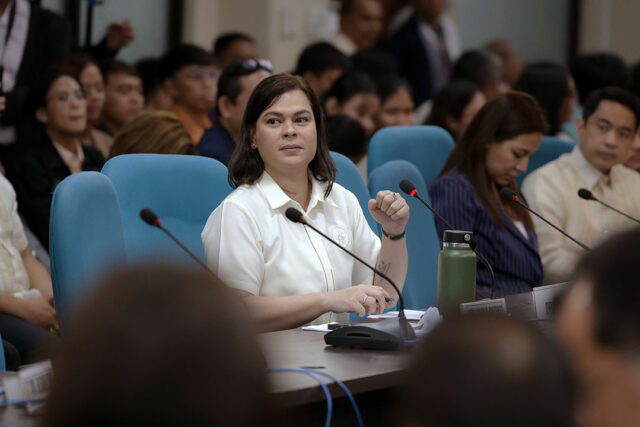
VICE-PRESIDENT Sara Duterte-Carpio, in this Aug. 27, 2024 photo, attended the deliberations on the proposed 2025 budget for the Office of the Vice-President at the House of Representatives in Quezon City. — PHILIPPINE STAR FILE PHOTO/MIGUEL DE GUZMAN

AS the House of Representatives cuts the Office of the Vice President’s (OVP) budget by P1.3 billion, the Department of Social Welfare and Development (DSWD) and the Department of Health (DoH) are set to receive increased funding next year.

In a statement on Wednesday, House Appropriations Committee Chair Elizaldy S. Co said the lower chamber finalized the slashed budget of the OVP and reallocated the funds to the DSWD and DoH.

The House Small Committee tasked to introduce changes to the 2025 General Appropriations Bill had funneled the P1.3 billion to the two agencies: P645.5 million to DWSD’s Assistance to Individuals in Crisis Situations and P646.5 million for DoH’s Medical Assistance for Indigent and Financially Incapacitated Patients program.

Lawmakers from the chamber cited overlapping functions among the OVP, the DWSD, and the DoH, contributing to redundant expenses. This leaves the OVP with P733.198 million in the proposed budget.

The budget cut came after Vice-President Sara Z. Duterte-Carpio refused to answer lawmakers intelligently on her office’s plans for its 2025 budget and her absence in the following hearing.

“The House believes this amount could be more effectively allocated to existing agencies, enabling them to extend their services to the public more efficiently,” Mr. Co added. — Chloe Mari A. Hufana

New mall hours sought

PHILIPPINE STAR/MIGUEL DE GUZMAN

THE Metropolitan Manila Development Authority (MMDA) on Wednesday asked major shopping malls in Metro Manila to adjust their operating hours to lessen traffic brought by the holiday crush

MMDA Chairman Romando S. Artes said the “holiday rush” is already being felt in the capital region with 421,000 vehicles traversing Epifanio de los Santos Avenue (EDSA) daily, as of Sept. 24.

“Most probably [the numbers will go up]. Normally we reach half a million as the Christmas season approaches. We expect before Undas, the traffic would be heavier and after Undas, it would rise steadily until Christmas time,” Mr. Artes said in mixed English and Filipino.

Adjusting mall hours could lessen traffic congestion as past practice showed, he added, but it does not entirely erase traffic. MMDA will talk with the Department of Transportation to adjust EDSA Carousel bus hours and the railway systems.

Major malls said they will post adjusted mall hours on their respective social media pages. — Chloe Mari A. Hufana

TRO on PhilHealth transfer sought

1SAMBAYAN Coalition and others asked the Supreme Court (SC) to stop the transfer of P89.8 billion excess funds from the Philippine Health Insurance Corp. (PhilHealth) to the national treasury as the third tranche of transfer pushed through on Wednesday.

The petitioners asked the top court to issue a temporary restraining order (TRO), writ of preliminary injunction, and/or other injunctive remedies under the 1987 Constitution and Rule 65 of the Rules of Court.

A total of P30 billion has previously been remitted to state coffers, while another P30 billion was remitted today. The last tranche of P29.9 billion will be transferred in November.

A Department of Finance Circular 003-2024 allowed the transfer of P89.9 billion idle PhilHealth funds to the national treasury for other government spending, which former SC Senior Associate Justice Antonio T. Carpio runs against the Constitution.

“The petition is basically grounded on two provisions of the Constitution. First, the Constitution says no law shall be passed authorizing the transfer of appropriations,” Mr. Carpio said in a briefing after the filing.

Article VI, Section 25 (5) of the Constitution stated that “no law shall be passed authorizing any transfer of appropriations” apart from the President, the Senate President, the House Speaker, the Chief Justice, and heads of Constitutional Commissions for their respective offices.

The 2024 General Appropriations Act (GAA) paved the way for Finance Secretary Ralph G. Recto to transfer any excess funds from PhilHealth to the national treasury to help fund the unprogrammed appropriations.

“That is a clear violation because the general is that no law shall be passed authorizing the transfer of appropriations,” Mr. Carpio added, noting the president can authorize the transfer of savings for one item in the budget item but not the finance chief.

“In appropriation, if P1 billion is allocated to build a bridge but only P800 million is used, the P200 million in savings cannot be transferred to another item. However, the 2024 GAA authorizes the Secretary of Finance, who isn’t among the officials authorized to transfer funds, to transfer excess funds, which is a violation,” he added in mixed English and Filipino.

The former top court justice said there are no surplus funds because Universal Healthcare services are not yet fully implemented as many Filipinos still need medicine and there is a shortage of hospitals.

The plaintiffs further argued that since PhilHealth funds are “special funds,” they cannot be transferred unless their purpose has been abandoned or accomplished.

“We’re asking the court to issue a TRO because this situation is irreparable. For PhilHealth alone, they are set to transfer P89.9 billion. Once that amount is spent, it’s irreparable because there is no entity in the government that can reimburse such funds,” Mr. Carpio said. — Chloe Mari A. Hufana

No tax for PCUP donations

THE Bureau of Internal Revenue (BIR) will not tax donations made by private companies to the Presidential Commission for the Urban Poor (PCUP), it said on Wednesday.

The BIR and the PCUP signed a memorandum of agreement for the tax exemptions on Sept. 10, it said.

Under the agreement, the bureau will also provide and orient PCUP focal persons of the policies and guidelines for the exemption granted to donors.

It will also designate a focal person who will coordinate with the PCUP for the implementation and monitoring of the agreement, BIR said.

In September, the BIR collected P161 billion in tax revenues, 12.7% below its P184.46-billion collection target for the month. This year, the BIR is expected to generate P3.05 trillion in revenues. — Beatriz Marie D. Cruz

SM creates jobs for artists, people deprived of liberty 

SMINVESTMENTS.COM

SM Investments Corp. (SMIC) on Wednesday said its SM Green Find’s livelihood project has created nearly 100 jobs for independent artists and people deprived of liberty (PDL) in Quezon City.

In collaboration with social entrepreneur and designer Zarah Juan, the project centers on environmental sustainability by repurposing 34,000 square feet of used tarpaulin into tote bags and pouches, the company said in a statement on Wednesday.

SM Green Finds is a multiyear campaign with a focus on products made from natural, local ingredients to support local communities’ micro, small, and medium enterprises in their green practices.

The PDLs clean and ready the discarded tarpaulins for sewing, while more than 52 skilled artisans from Bulacan follow the design.

Jail Chief Inspector Lourvina Abrazado, Warden at Quezon City Jail said the tarp bag project empowered and upskilled more than 30 female PDLs in Quezon City.

“I designed it for enduring appeal and longevity. It’s a reflection of the bag’s overarching purpose,” Ms. Juan said.

SM Green Finds x Zarah Juan The Tarp Project bags are available at Kultura branches nationwide. Tote bags are priced at P999, while pouch bags are at P499.

Sales from the tote bags will be donated to the SM Foundation’s youth and education initiatives. — Aubrey Rose A. Inosante

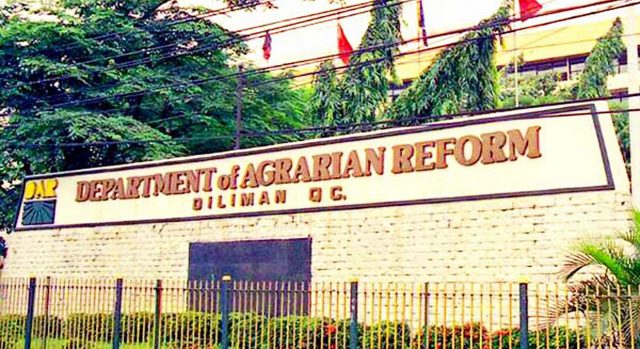
145,000 land titles distributed 

THE DEPARTMENT of Agrarian Reform (DAR) on Wednesday said it has distributed 146,017 land titles to beneficiaries under the administration of President Ferdinand R. Marcos as of last month.

At a Senate finance committee hearing on the agency’s proposed P11.101 billion budget next year, Agrarian Reform Secretary Conrado M. Estrella III said his agency has also condoned about P57.56 billion of debt covering 610,054 beneficiaries debt this year.

“This year, DAR has distributed 54,874 land titles and before the year ends, we are targeting to distribute 101,666 more to our farmers,” he said in mixed English and Filipino.

The DAR chief earlier told congressmen that the agency plans on fast-tracking its digitalization efforts to streamline land reform data by October next year. — John Victor D. Ordoñez

ADVERTISEMENT
ADVERTISEMENT