Home Blog Page 251

Son of slain Hollywood filmmaker Rob Reiner pleads not guilty to murder charges

AMERICAN actor, director, producer, writer, and political activist Rob Reiner and his wife Michele Singer Reiner at the Human Rights Campaign’s 2025 Los Angeles Dinner held at the Fairmont Century Plaza on March 22 in Century City, Los Angeles. — REUTERS FILE PHOTO/XAVIER COLLIN/IMAGE PRESS AGENCY/NURPHOTO

LOS ANGELES — Nick Reiner, the troubled son of slain Hollywood filmmaker Rob Reiner, pleaded not guilty on Monday to murder charges stemming from the fatal stabbing of his parents in their home, one of the most shocking celebrity homicide cases in Los Angeles history.

The 32-year-old was arraigned during a brief proceeding that had been twice rescheduled, most recently last month, when his original attorney abruptly quit without explanation and was replaced by a public defender.

Nick Reiner pleaded not guilty to two counts of first-degree murder in the deadly knife attack on actor-director Rob Reiner, 78, and photographer-producer Michele Reiner, 70. Their bodies were found on December 14 inside their West Los Angeles mansion.

Seated behind a glass partition dressed in brown jail garb, his head shaved and beard closely cropped, Mr. Reiner appeared alert but spoke little during the proceeding except to answer “yes” when asked if he agreed to waive his right to a speedy preliminary hearing.

Los Angeles County Superior Court Judge Theresa McGonigle also set the preliminary hearing, where prosecutors present evidence intended to show probable cause for proceeding to trial. It was set to take place within 30 days of April 29.

Nick Reiner, who has acknowledged a years-long struggle with substance abuse, was also ordered to remain jailed without bond, as he has been since his arrest in the hours after his parents were slain.

The killings stirred an outpouring of grief among Hollywood luminaries for Rob Reiner, who first gained fame by co-starring in the 1970s hit television comedy “All in the Family” and later directed such beloved films as “When Harry Met Sally,” “This is Spinal Tap” and “The Princess Bride.”

VICTIMS MINGLED CELEBRITY WITH POLITICS

Mr. Reiner went on to become a prominent Democratic Party activist and donor. He and his wife, married for nearly 37 years, had planned to attend an evening gathering with former President Barack Obama and Michelle Obama on the day of the murders.

Nick Reiner was widely reported to have quarreled with his parents while the three were attending a holiday party hosted by comedian Conan O’Brien the night before the couple were slain.

The circumstances and celebrity surrounding the Reiner case stirred memories of the 1994 stabbing deaths of former football star O.J. Simpson’s ex-wife Nicole Brown Simpson and her friend Ron Goldman.

O.J. Simpson was acquitted of murder charges in a sensational case hyped in the media as the “trial of the century,” but a civil court jury later found him responsible in a wrongful death lawsuit brought by the victims’ families.

If Nick Reiner is convicted as charged, he would face life in prison without the possibility of parole, or prosecutors could decide to seek the death penalty. Such a determination has yet to be made, District Attorney Nathan Hochman told reporters after Monday’s hearing.

Authorities have disclosed few details about the crime and offered no explanation for what may have precipitated the killings. Autopsies found both victims died of “multiple sharp force injuries.”

High-profile defense lawyer Alan Jackson, initially retained to represent Nick Reiner, suddenly withdrew from the case on January 7, forcing the second of two arraignment postponements in three weeks. A lawyer from the public defender’s office, Kimberly Greene, was assigned to take over for Mr. Jackson on short notice. She was in court with Mr. Reiner on Monday.

Neither of Nick Reiner’s siblings – older brother Jake Reiner, 34, or younger sister Romy, 28, who reportedly was the first to find her father’s body – has been present in court for their brother’s hearings.

Following his initial court appearance in December, the siblings issued a joint statement expressing the “unimaginable pain” they were experiencing following the “horrific and devastating loss of our parents.”

It remained to be seen how Nick Reiner’s history of drug addiction, rehab and periodic homelessness might factor into the murder case. Those struggles inspired the movie “Being Charlie,” which he co-wrote with his father.

The New York Times reported last week that in 2020, Nick Reiner was placed under a court-approved mental health conservatorship that had allowed for involuntary psychiatric treatment, a legal arrangement that ended in 2021.

The Times said both the public defender’s office and the district attorney’s office declined to comment on the matter. — Reuters


DBP senior official cited as ‘Audit Executive of the Year’

An international group of audit practitioners has named a senior executive of state-owned Development Bank of the Philippines (DBP) as “Chief Audit Executive of the Year”, citing his contributions in elevating the internal audit function in the government service.

Senior Vice-President Ryan R. Gabinete, head of DBP’s internal audit group, was recently conferred the honor by the Institute of Internal Auditors (IIA) Philippines, besting various candidates from both the private and public sectors.

“Our honoree has shaped the internal audit profession through decades of excellence, leadership, and innovation,” the IIA said in its introduction of Mr. Gabinete during the awarding ceremonies earlier this month. “His thought leadership spans fraud audit, strategic audit practices, and public sector reform, shared through national forums and professional organizations.”

DBP is the 10th largest bank in the country in terms of assets and provides credit support to four priority sectors of the economy – infrastructure and logistics; micro, small and medium enterprises; the environment; and social services and community development.

IIA Philippines is part of a global network of audit professionals across 170 countries with over 200,000 members from various industries, dedicated to the advancement of internal audit profession. Its annual excellence awards recognizes leaders for their strategic expertise and significant contributions in attaining the highest standards of audit practice.

DBP President and Chief Executive Officer Michael O. de Jesus said IIA’s conferment is reflective of the bank’s steadfast commitment to the highest standards of corporate governance through the optimization of its internal audit operations

He said Mr. Gabinete’s award is a testament to DBP’s resolute thrust to strengthen the Bank’s governance and control framework and enhance its audit methodology, leading to operational efficiency and timely and effective compliance to regulatory standards.

“DBP will continue to explore ways to strengthen its internal audit function, recognizing its critical role in enhancing governance and risk management in the organization, and helping create and sustain value for its clients and stakeholders,” Mr. de Jesus said.

As an IIA awardee, Mr. Gabinete will also be nominated to the prestigious Institute of Internal Auditors Global Excellence Awards – Chief Audit Executive of the Year in 2026.


Spotlight is BusinessWorld’s sponsored section that allows advertisers to amplify their brand and connect with BusinessWorld’s audience by publishing their stories on the BusinessWorld Web site. For more information, send an email to online@bworldonline.com.

Join us on Viber at https://bit.ly/3hv6bLA to get more updates and subscribe to BusinessWorld’s titles and get exclusive content through www.bworld-x.com.

IPO candidates head overseas as Southeast Asian markets lag

A service assistant carries a tray of fries inside a Jollibee Foods Corp. restaurant in Quezon City, Metro Manila, the Philippines, on Tuesday, Feb. 7, 2023. -- Bloomberg

Companies across Southeast Asia are looking overseas to sell shares, as persistent underperformance in some parts of the region weighs on markets at home.

Philippine fast-food group Jollibee Foods Corp.’s international unit and financial-technology firm Maya are eyeing US listings. Indonesia’s PT Merdeka Gold Resources and a unit of the MNC Group conglomerate are considering Hong Kong, as is the restaurant arm of Thai hospitality group Minor International Pcl.

The moves highlight a broader strain across the Philippine, Indonesian and Thai markets, where thin liquidity and weak returns have made it harder to attract capital. All three have trailed the MSCI Asia Pacific Index over the past year, prompting companies to look abroad for higher valuations and more investors.

“The issue for many Southeast Asian markets is the relative lack of capital pools available for public equities and the relative maturity of their public equity ecosystems,” said William Bratton, head of Asia-Pacific cash equity research at BNP Paribas SA.

The challenge is more acute for niche or fast-growing companies, which often see overseas exchanges with more developed ecosystems as a lower-risk route to public capital, he added.

Last month, Jollibee’s chief financial officer said the US offers a deep pool of investors and strong market valuations for food-and-beverage companies. The Philippine Stock Exchange is projecting just four initial public offerings this year, after missing its own targets for 2023, 2024 and 2025.

A similar dynamic is playing out in Thailand, where Minor International is considering Hong Kong as the listing venue for its restaurant business, drawn by the prospect of higher valuations and broader investor base, its chief executive officer said last week. The company is also pursuing a listing of a real estate investment trust worth about $1 billion in Singapore, which — like Hong Kong — has been stepping up efforts to court international issuers.

Domestic conditions remain challenging. A senior Thai stock exchange official said last year the nation’s IPO market was likely to stay subdued as market reforms would take time to stem the drift of companies toward overseas exchanges.

Indonesia, meanwhile, is battling a potential downgrade to frontier-market status by MSCI Inc., which has raised concerns over investability and limited free float. Regulators are bracing for a record amount of share sales to meet tougher free-float rules.

For many companies, listing abroad offers a way to distance themselves from weaknesses at home and signals adherence to international standards, said Liza Camelia Suryanata, head of research at PT Kiwoom Sekuritas Indonesia. “That sends a clear signal: ‘We are comfortable operating under tighter, internationally benchmarked scrutiny,’” she added.

In Hong Kong, the deals will test its appeal to non-Chinese issuers after a bumper recovery in IPOs driven by large mainland Chinese companies. Not all recent listings are winners though: Shares of coconut-water firm IFBH Ltd., which has roots in Thailand, have fallen 47% since their June 2025 debut.

“The success of non-Chinese listings on the exchange has been a bit mixed,” Bratton said. “It may be premature to suggest that this will change, especially as growing capital pools across Asia may increase the relative attractiveness of their domestic exchanges.” — Bloomberg

Nearly 2,200 people have benefitted from Venezuela amnesty law, lawmaker says

A person holds a Venezuelan flag as government supporters gather after US President Donald Trump said the US has struck Venezuela and captured its President Nicolas Maduro, in Caracas, Venezuela, January 3, 2026. — REUTERS/GABY ORAA

NEARLY 2,200 people have been released from Venezuelan jails or had other legal restrictions withdrawn since the start of a new amnesty law, ruling party lawmaker Jorge Arreaza said on Monday.

The law, passed last week, has been critiqued by human rights organizations which say it falls short of offering relief for hundreds of political prisoners. It provides amnesty for involvement in political protests and “violent actions” during specific months between 2002 and 2025, but does not detail the exact crimes that are eligible.

Though the government has always denied holding political prisoners and says those jailed have committed crimes, Interim President Delcy Rodriguez had already released hundreds of people who rights groups classify as political prisoners prior to the passage of the law. The effort is seen as part of a package of deals key to normalizing relations with the US following the capture of President Nicolas Maduro in January.

Venezuela’s opposition and human rights groups have said for years the government uses detentions to stamp out dissent.

“Today we can say that thanks to the law 177 releases have taken place and 2,021 people who were under presentation restrictions have been given full liberations,” said Mr. Arreaza, the president of the legislative commission set up to monitor the implementation of the law, speaking alongside Ms. Rodriguez at the presidential palace.

People released from jail in Venezuela can be held on house arrest or required to regularly report to police or courts for a specific period.

More than 3,000 requests have been made by attorneys and others on behalf of prisoners who want to benefit from the law, Mr. Arreaza added. Tribunals must decide on requests within 15 days, according to the law.

The law does not return seized assets, revoke public office bans given for political reasons or cancel sanctions against media outlets. It also requires those living abroad who are facing charges to appear in person in Venezuela to have their amnesty granted.

The law will only cover “people who have ceased the execution of the actions which constitute crimes,” a specification which may leave out many in the opposition who have continued their activism from other countries.

Meanwhile, Alfredo Romero, the director of legal rights group Foro Penal, said more than 30 people had been released from the Rodeo detention center near Caracas on Monday, joining others released from various facilities over the weekend.

Foro Penal said on Sunday more than 460 people have been freed since January 8, a count which does not include those released from prison but given house arrest or other restrictive measures.

Opposition politicians, dissident members of the security services, journalists and rights activists have long been subject to charges like terrorism and treason, which they, their families and their lawyers say are unjust and arbitrary.

Among the prominent released figures are opposition politician Juan Pablo Guanipa, who was freed, detained again and then later released from a house arrest order, and lawyer Perkins Rocha, who is under house arrest. Both men are close allies of Nobel Peace Prize winner and opposition leader Maria Corina Machado.

Also freed since January are opposition leader Freddy Superlano, who remains under house arrest, Rafael Tudares, the son-in-law of former opposition presidential candidate Edmundo Gonzalez, and Javier Tarazona, the director of an NGO. — Reuters

Mayweather-Pacquiao rematch set for September at Las Vegas Sphere

NETFLIX.COM

FLOYD MAYWEATHER and Manny Pacquiao will face off in a professional rematch at the Sphere in Las Vegas in September, with the bout streaming globally on Netflix, the fighters and promoters announced on Monday.

The fight marks Mr. Mayweather’s return from retirement and will be the first professional boxing match held at the Sphere.

Mr. Mayweather, who holds a perfect 50-0 record with 27 knockouts, defeated Pacquiao in their 2015 encounter dubbed the “Fight of the Century.”

That bout generated a record 4.6 million pay-per-view buys and a $72 million live gate at the MGM Grand Garden Arena.

“I already fought and beat Manny once. This time will be the same result,” Mr. Mayweather said in a statement.

Mr. Pacquiao, whose record stands at 62-8-3 with 39 knockouts, expressed confidence he would hand Mr. Mayweather his first professional loss.

“I want Floyd to live with the one loss on his professional record and always remember who gave it to him,” the Filipino fighter said.

The rematch will stream to Netflix’s more than 325 million subscribers worldwide, continuing the platform’s push into live boxing.

The streaming platform has recently broadcast several high-profile fights, including Jake Paul versus Mike Tyson, which the company said drew 108 million live global viewers. —Reuters

France welcomes Olympic flag as 2030 Winter Games loom

THE OLYMPIC CAULDRON and the Arc de Triomphe after sunset in Paris, France, July 30, 2024. — REUTERS

ALBERTVILLE, France — The Olympic flag returned to French soil on Monday, less than two years after the Paris 2024 Summer Olympics, as preparations began for the 2030 Winter Olympics in the French Alps.

The Auvergne-Rhone-Alpes region and the French National Olympic and Sports Committee (CNOSF) welcomed back their delegation and the flag. The celebration drew a raucous crowd of thousands in Albertville, where the last Winter Olympics in France were held in 1992, following Chamonix 1924 and Grenoble 1968.

“A moment full of enthusiasm, part of the momentum building up to the 2030 Games,” Fabrice Pannekoucke, the president of the Auvergne-Rhone-Alpes regional council, said during last week’s press conference to introduce the celebration.

“We know that the history of the Winter Games in France stopped in Albertville.”

The event followed the ceremonial handover on Sunday, when Mr. Pannekoucke and his Provence-Alpes-Cote d’Azur counterpart Renaud Muselier received the Olympic flag during the 2026 Games closing ceremony in Verona.

France enjoyed their best ever Winter Games haul in Milano-Cortina. Their 23 medals included eight golds.

“Sharing this with all the French fans will be a nice little moment of happiness,” biathlon mass start Olympic champion Oceane Michelon told reporters in Albertville.

Ice dancers Guillaume Cizeron and Laurence Fournier Beaudry won the Olympic title less than a year after forming their partnership.

“The pleasure we shared on the ice was amazing,” Fournier Beaudry said. “We don’t know yet what the future reserves for us but we know that we will keep skating together and we will regroup at the end of the season to see what we want to do.”

Ski mountaineers Thibault Anselmet and Emily Harrop won the inaugural mixed relay title at the Milano Cortina Games but the future of their event within the Olympics remains uncertain.

“We’re not sure yet whether ski mountaineering will be included, but we’re very hopeful and, based on what we’ve experienced here, we’re confident,” Ms. Harrop told reporters.

The celebration, attended by the French Prime Minister Sebastien Lecornu, was held amid a governance crisis in the French Alps organising committee with a wave of resignations and “irreconcilable differences” between Games chief Edgar Grospiron and CEO Cyril Linette, according to an official statement.

“We’re managing, we’re keeping things going. There’s turbulence, we agree, but we’re working,” Mr. Grospiron said on France TV. “When you aim high, it inevitably makes the difficulties greater, but I won’t compromise on our vision.” — Reuters

Australia backs removing Andrew Mountbatten-Windsor from UK line of succession

Britain’s Andrew Mountbatten-Windsor eaves St. Mary the Virgin church in Hillington, near royal Sandringham estate, in Norfolk, Britain Jan. 19, 2020. — REUTERS

LONDON/SYDNEY — Australian Prime Minister Anthony Albanese said he would back plans to remove Andrew Mountbatten-Windsor from the line of succession to the British throne in a letter he sent to UK Prime Minister Keir Starmer’s office.

Last week, a UK official said the British government was considering legislation to ensure that Mr. Mountbatten-Windsor, currently eighth in line to the throne, could never be king following his arrest as part of a police investigation into his ties to disgraced US financier and convicted sex offender Jeffrey Epstein.

King Charles, who last year stripped his brother of his title of prince and forced him out of his Windsor home, is not only the monarch and head of state in Britain, but also in Australia and 13 other countries.

Any changes to the succession to the throne have to be approved not just in Britain but also in the other realms.

In the letter seen by Reuters, Mr. Albanese told Mr. Starmer that in light of the recent events, his government would agree to any proposal to remove King Charles’ younger brother from the line of succession.

“I agree with His Majesty that the law must now take its full course and there must be a full, fair and proper investigation,” his letter said.

Speaking to ABC Radio on Tuesday, Mr. Albanese said Australians did not regard Mr. Mountbatten-Windsor as an appropriate figure to remain in the line of succession to be Australia’s head of state.

“I certainly do (want him removed) and I think Australians will as well. These are very serious allegations,” Mr. Albanese said.

The British monarch is the head of state in Australia, New Zealand and 12 other Commonwealth realms outside the United Kingdom, although the role is largely ceremonial.

In a statement on Tuesday, New Zealand Prime Minister Christopher Luxon’s office said his government would support any proposal to remove Mr. Mountbatten-Windsor from the order of succession.

The last time changes were made to the line of succession came in 2013, when a law was passed to end a 300-year-old system that gave precedence to male heirs.

The British government has said any change would follow the completion of a police investigation. Officers are searching Mr. Mountbatten-Windsor’s former mansion in Windsor as part of an investigation into whether he committed misconduct in a public office during his time as government trade envoy.

Other allegations relating to Mr. Epstein are also being considered by various British police forces. Mr. Mountbatten-Windsor, who has made no public comment since the mass release of documents by the US government linked to Mr. Epstein last month, has always denied any wrongdoing in relation to the late financier. — Reuters

Duterte was ‘pivotal’ in murder of thousands, ICC prosecutors say

PCOO.GOV.PH

THE HAGUE – Former Philippine President Rodrigo Duterte was “pivotal” in the murder of thousands of people during his rule, prosecutors at the International Criminal Court (ICC) said on Monday, as they pushed for his trial to go ahead.

The prosecutors at the Hague-based war crimes court have charged Duterte with three counts of murder as a crime against humanity, involving dozens of victims that accusers say were only a fraction of the real death toll in his clampdown on alleged drug users and criminals.

“Duterte’s so-called war on drugs resulted in the killings of thousands of civilians and many of these victims were children,” prosecutor Mame Niang said at the opening of pre-trial hearings meant to confirm charges.

“Mr Duterte must be held to account and this case should be confirmed for trial,” he added.

Under the ICC rules, judges will have to confirm charges before the case can move to trial.

Duterte’s lawyer Nicholas Kaufman said the charges had been politically motivated, and that Duterte had been misunderstood.

“He maintains his innocence in full,” Kaufman said, as he pleaded for the charges to be dropped. “Duterte’s rhetoric was meant to instill fear and a respect for the law. That was his intent and it was not criminal.”

Duterte served as president of the Philippines from 2016 to 2022 and was arrested and taken to The Hague last March.

According to the prosecutors, Duterte created, funded and armed death squads to target and kill alleged narcotics peddlers and users.

Duterte has long insisted he instructed police to kill only in self-defense and has always defended the crackdown.

OPPONENTS GATHER

Opponents of Duterte gathered outside the court building, chanting “Hold Duterte accountable!” in Tagalog.

“I hope, and I am quite confident, that the charges of murder and attempted murder will be confirmed” and Duterte’s guilt ultimately proven, Cristina Palabay, a worker at the human rights alliance Karapatan, told Reuters outside court.

Duterte, 80, will not be present at the hearings, as his defence said he would not be able to understand proceedings due to his cognitive decline.

Judges last month ruled that Duterte was fit to stand trial.

“For us, it’s cowardice,” said Sheerah Escudero, whose brother was killed during the war on drugs. “We know that Duterte will not be able to escape accountability.”

After the hearings conclude on Friday, judges will take up to 60 days to decide if there is sufficient evidence to move the case to a trial. — Reuters

Bill to scrap travel tax progresses

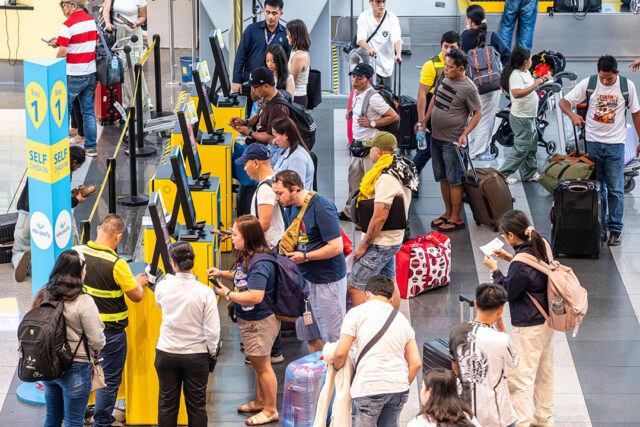
Travelers line up to check in at the Ninoy Aquino International Airport (NAIA) Terminal 3, Pasay City in this file photo. — PHILIPPINE STAR/RYAN BALDEMOR

By Kenneth Christiane L. Basilio, Reporter

A HOUSE of Representatives committee on Monday approved a proposal to abolish the Philippines’ travel tax that critics say is burdensome and adds costs for Filipino overseas travelers.

The House Committee on Tourism has consolidated six bills seeking to scrap the levy collected from air and sea travelers, a tax imposed under a 1977 presidential decree, despite concerns that its removal could cut funding for agencies that rely on the collections to support services.

A consolidated measure proposing the removal of the travel tax will be endorsed to the House Appropriations and Ways and Means committees to iron out provisions on funding and taxes.

“Why is there a travel tax? It was meant to discourage our countrymen from traveling abroad and to instead support domestic tourism,” Mark T. Lapid, chief operating officer of the Tourism Infrastructure and Enterprise Zone Authority (TIEZA), told lawmakers.

“But it evolved in the years that succeeded… Its purpose became to help all the infrastructure needed for tourism, for our scholars and rehabilitating and improving our heritage sites,” he added.

The government collects a travel tax of P1,620 ($28.35) from economy air passengers and P2,700 ($47.24) from first class air passengers, if they are departing to a foreign country.

Exempt from travel tax are overseas Filipino workers, Filipino permanent residents overseas who stayed less than a year in the Philippines, and children aged two years and below.

The levy was first imposed by Republic Act No. 1478 in 1956 and was later amended through Presidential Decree No. 1183 in 1977.

President Ferdinand R. Marcos, Jr. has declared the bill abolishing the travel tax a priority and had urged Congress to pass it before the adjournment in June.

The government could forgo around P8 billion yearly if such a proposal is signed into law by Mr. Marcos, Finance Secretary Frederick D. Go said last week.

Authorities collected about P8.7 billion in travel tax revenue in 2025, according to a position paper from TIEZA that was submitted to the congressional committee and obtained by BusinessWorld. Collections reached P7.8 billion in 2024, P6.3 billion in 2023, P332 million in 2021, P713 million in 2020, and P7.1 billion in 2019.

Under the law, 50% of the proceeds from the travel tax collection go to TIEZA, while 40% go to the Commission on Higher Education (CHED) for tourism-related education programs.

The remaining 10% goes to the National Commission for Culture and the Arts.

The three agencies supported the move to scrap travel tax granted their funding would be secured via the annual budget bill.

“To be honest, what goes to TIEZA is only around 35%,” Mr. Lapid said. “That’s because we are in charge of the administrative fee.”

“We’re spending around P500 million to collect our travel tax,” he said.

In its position paper, TIEZA said 90% of its budget relies on the travel tax, and “any disruption without a viable alternative is critical.”

“The travel tax provides the fiscal agility required for immediate tourism response,” it said, noting that its funding source allows the agency to “urgently address” tourism needs.

TIEZA is also pursuing projects to build tourism facilities such as rest areas, master-plan tourist destinations across the country and boost cruise tourism by supporting cruise port terminal development.

IMPACT ON CHED
“The consequences of abolition are disproportionately borne by the education sector,” the CHED said in a position paper, which was obtained by BusinessWorld. “The removal of the travel tax would immediately eliminate a stable and steady source of funding, impacting its ability to sustain current and planned programs.”

CHED Chairperson Shirley Agrupis said the agency’s education development program is funded largely by travel tax revenues, and scrapping the levy could affect 5.4 million students who rely on it.

“If the travel tax is repealed without a replacement revenue source, we will lose 85.6% of its funding,” she told lawmakers.

The House Appropriations Committee will work to “fine-tune” its funding requirements for the agencies that’ll be affected by its scrapping, its chairwoman, Nueva Ecija Rep. Mikaela Angela B. Suansing, told the panel.

“Given the criticality of the funds, we will work to ensure that those funds remain available for the different government institutions involved,” she said. “We’ll work… to structure it in a way that it would be responsive to the different needs of the agencies.”

Scrapping the Philippines’ travel tax would be positive for the tourism industry, Jonathan L. Ravelas, a senior adviser at Reyes Tacandong & Co., said.

“It lowers the cost of flying, stimulates outbound and inbound travel, and makes the Philippines more competitive as a regional hub,” he said in a Viber message.

“But it’s not a silver bullet. The real gains come only if the lost revenue is replaced by smarter funding for tourism — better airports, smoother visas, and stronger destination marketing,” he added.

PHL foreign debt service bill drops at end-Nov.

US DOLLAR and euro banknotes are seen in this illustration taken on July 17, 2022. — REUTERS/DADO RUVIC/ILLUSTRATION

By Katherine K. Chan, Reporter

THE PHILIPPINES’ external debt service burden fell for a sixth straight month as it continued to record lower principal and interest payments at end-November, preliminary central bank data showed. 

Based on data released by the Bangko Sentral ng Pilipinas (BSP), the country’s debt service bill on foreign loans amounted to $12.018 billion in the 11 months to November, down 22.82% from $15.571 billion a year ago.

“(This was) largely due (to) lower maturities of foreign debt in terms of principal payments vs. year ago levels,” Rizal Commercial Banking Corp. Chief Economist Michael L. Ricafort said in a Viber message.

Broken down, principal payments plunged by 41.87% to $4.77 billion as of end-November from $8.206 billion in the same period last year.

Interest payments likewise declined by 1.59% to $7.248 billion at end-November from $7.365 billion a year earlier, which Mr. Ricafort attributed to the US Federal Reserve’s recent rate cuts.

As of end-November, the Fed has cut the Federal Funds Rate by a total of 150 basis points (bps) following its 25-bp cut in October, which brought its policy rate to the 3.75%-4% range.

Meanwhile, Jonathan L. Ravelas, a senior adviser at Reyes Tacandong & Co., said the country’s lower foreign debt service bill provides some support to the peso and gives the BSP additional policy room.

“The sharp drop in the external debt service burden tells us the Philippines had much less pressure to pay foreign debt in 2025, mainly because big principal repayments were lower,” he said in a Viber message. “That’s good news — it eases demand for dollars, supports the peso, and frees up some policy space.”

However, Mr. Ravelas said the government should not be complacent as interest payments remain elevated, noting that “this looks more like smart debt timing than permanently cheaper debt.”

Mr. Ricafort also noted that the lower share of foreign debt in the National Government’s (NG) total borrowing mix also helped bring down its external debt service bill.

“For the coming months, lower foreign borrowings in the total borrowing mix of the NG to reduce forex (foreign exchange) risk and possible further Fed rate cut/s would further lead to reduced foreign debt servicing bill,” he added.

Under the NG’s P2.6-trillion borrowing plan for 2025, 81% or P2.11 trillion was sourced from domestic lenders, with the remaining 19% from foreign sources. It previously observed a 75:25 borrowing mix in 2024 in favor of local creditors.

“The key next step is to keep borrowing disciplined — favor longer tenors, manage interest costs, and avoid letting future maturities bunch up again,” Mr. Ravelas added.

The debt service bill represents principal and interest payments after rescheduling, according to the BSP.

This includes principal and interest payments on fixed medium- and long-term credits, including International Monetary Fund credits, loans covered by the Paris Club and commercial bank rescheduling, and New Money Facilities.

It also covers interest payments on fixed and revolving short-term liabilities of banks and nonbanks.

However, the debt service data exclude prepayments on future years’ maturities of foreign loans and principal payments on fixed and revolving short-term liabilities of banks and nonbanks.

As of end-September, the debt service burden as a share of gross domestic product stood at 2.9%, down from 3.9% in the prior year. There was no available data for end-November.

Meanwhile, the Philippines’ outstanding external debt rose by 6.77% to an all-time high of $149.093 billion in the third quarter from $139.643 billion in the same period last year, according to latest BSP data.

Quarter on quarter, it climbed by 0.15% to break the previous record of $148.873 billion.

Of the total, $96.298 billion is public sector debt, while $52.796 billion came from the private sector.

The BSP’s external debt data cover borrowings of Philippine residents from nonresident creditors, regardless of sector, maturity, creditor type, debt instruments or currency denomination.

The central bank gathers data on external debt through reports submitted by borrowers, banks, and major foreign creditors.

SEC Chair Lim says governance to drive capital market growth

IN HIS KEYNOTE ADDRESS during BusinessWorld Insights Stock Market Outlook 2026, Securities and Exchange Commission (SEC) Chairperson Francis Ed. Lim highlighted the SEC’s efforts to boost capital market access and to regain the trust of investors. The forum, held at Lanson Place Mall of Asia on Monday, gathered experts to share their market assessments and stock picks for the year. — PHILIPPINE STAR/RUSSELL PALMA

GOOD GOVERNANCE is key to capital market growth and retaining investor confidence, the Securities and Exchange Commission (SEC) said on Monday, as the Philippines faces local and external headwinds this year.

In his keynote address during BusinessWorld Insights Stock Market Outlook 2026, SEC Chairperson Francis Ed. Lim said external risks such as rising global interest rates, geopolitical tensions and commodity shocks may shake markets, but governance will determine if investor confidence is fleeting or endures.

“We cannot control the headlines. What we can control is what capital ultimately prices in. Clear rules, predictable timelines, and firm enforcement,” he said.

For 2026, Mr. Lim said the true test for the capital markets is if confidence remains when conditions turn.

“On governance dividend, the test for 2026 is not whether the market can rally. It is whether confidence can stay when conditions change,” Mr. Lim said.

If governance dividends hold, Mr. Lim said valuations will follow because investors have the trust in the market.

“The most credible bull case is a market where confidence compounds. Your SEC will continue tightening execution, removing unnecessary friction, and enforcing the law to retain investor confidence,” he said.

“Because in the end, governance is not an accessory to growth. It is its foundation.”

A corruption scandal over anomalous flood control projects last year has dampened investor and consumer sentiment and contributed to slower economic growth, household consumption and public spending.

The Philippine Stock Exchange index (PSEi) slumped last year as the flood control mess dampened investor confidence. The PSEi closed at 6,052.92 on Dec. 29 — the last trading day of 2025 — down by 7.29% or 475.87 points from its end-2024 finish of 6,528.79.

The PSEi has since bounced back, closed at 6,448.51 on Monday, up 0.36% from Friday’s close.

Mr. Lim said the SEC’s mandate is to make the capital markets “easier to access, easier to comply with, and easier to trust.”

So far, the SEC has implemented reforms to improve the ease of doing business, focusing on firm timelines, and reduced costs.

“We, for example, expanded our One-Day Submission and Electronic Registration of Companies (OneSEC), our online incorporation of registered assistance for companies, from 33 to 81 industries. What used to take a week or more for incorporating a new company can now be done in under half a day, even as fast as two hours for complete applications,” Mr. Lim said.

In September last year, the SEC expanded its OneSEC Zuper Easy Registration Online facility to let companies with foreign equity register in the Philippines in just one day as part of efforts to further streamline the registration process.

“We reduced costs and matched requirements to risk. We extended the MSME (micro, small and medium enterprises) discounts to 20% of corporate registration and 50% of securities filing. As of December 2025, over 15,000 of our SMEs saved more than P34 million, money that we were able to redeploy to payroll, inventory, and expansion,” Mr. Lim said.

“For the SEC, deeper markets require deeper participation, and participation collapses when compliance is priced out of reach,” he added.

Jesus Mariano P. Ocampo, president and chief operating officer of Investment and Capital Corp. of the Philippines, said these reforms are helping lift investor confidence.

Philstocks Financial, Inc. Research Manager Japhet Louis O. Tantiangco said that the SEC reforms would boost the economy by increasing business activity.

However, investors are continuing to closely monitor developments in the corruption scandal, as high level officials and politicians have not been held to account.

“Maybe what they need to see, aside from reforms… are actual politicians going to jail, make a sample out of them, whoever that is,” BDO Securities Corp. President John Tristan D. Reyes said.

“A big name would probably help boost the sentiment, because it would send a message that the government means business, no special treatment, no allies will be spared, let the axe fall wherever they fall. So, that would help restore confidence in the government,” he added. — AGCM

BIR, industry back unified vape juice tax to curb misdeclaration

Around 450,000 unregistered and illegal vape products were destroyed by the Bureau of Internal Revenue in Quezon City on Dec 15, 2025. — PHILIPPINE STAR/MIGUEL DE GUZMAN

By Kenneth Christiane L. Basilio, Reporter

AUTHORITIES and industry stakeholders on Monday backed a proposal to unify the excise tax structure for electronic vape juices, as lawmakers seek to plug regulatory gaps and boost government revenues amid tapering collections under the current system.

The House of Representatives Committee on Ways and Means is reviewing six bills that seek to simplify the tax system for vape juices.

House Ways and Means Committee Chairman and Marikina Rep. Romero “Miro” S. Quimbo sought the position of tax collection agencies and industry representatives, who supported moves to streamline the current regime that applies two different rates depending on the product.

“A uniform rate would make it easier in terms of tax administration and tax enforcement,” Bureau of Internal Revenue (BIR) Assistant Commissioner James H. Roldan told lawmakers.

The Philippines applies an excise tax rate of P60.20 per milliliter (mL) for salt nicotine while freebase nicotine products are levied with a P6.49 per mL, and both are subject to a 5% increase yearly.

House Senior Deputy Speaker and South Cotabato Rep. Ferdinand L. Hernandez, who authored a proposal seeking a unified P10 per mL tax on all vape juices,

described the current excise regime as “no longer workable, adding it has allowed importers to evade duties by declaring products under the cheaper rate.”

“Two liquids that look and function the same should not be taxed differently,” he told the congressional panel.

Government collections from excise taxes on vape products have diverged sharply, with revenues from conventional freebase nicotine steadily rising as collections from salt nicotine remained sluggish.

Revenues from excise taxes on freebase vape juices have surged to P857.3 million in 2024 from P50.42 million in 2023 and P450,000 in 2022, based on a Finance department presentation to the House committee.

The government has collected P1.85 billion from freebase juices in the January-to-October 2025 period, it showed.

Meanwhile, collections on salt nicotine products fell sharply to P84.72 million from the January-to-May 2024 period, from P173.31 million in 2023 and P137.77 million in 2022.

Finance Undersecretary Karlo Fermin S. Adriano said there were no data on salt nicotine collections since June 2024 after its trading was suspended during the period.

“We are also coordinating with BIR to clean up the data,” he told lawmakers.

Japan Tobacco International supports moves to rationalize and simplify the excise tax structure for vape liquids to curb illicit trade that undercuts legitimate manufacturers, its Fiscal and Regulatory Affairs Director Mario Tan Zinampan said.

“Differentiated tax treatment across similar products creates opportunities for misclassification and regulatory arbitrage, enabling certain products to be declared under lower tax categories,” he told lawmakers.

“Harmonizing the tax treatment of vapor products is, therefore, a necessary measure to prevent tax avoidance and to ensure a level playing field,” he added.

Mr. Zinampan recommended that vape juice tax rates be set equally with heated tobacco products, which currently face a P37.63 tax per pack of 20 units, based on 2026 excise tax rates by the Bureau of Customs.

Nicotine salts contain higher levels of nicotine and are more easily absorbed by the body than freebase vape juices, but both are deadly, pulmonologist and tobacco cessation expert Maricar B. Limpin said. 

“Both are equally harmful,” she told lawmakers.

Anton Ari Israel, president of the Nicotine Consumers Union of the Philippines, said unifying the rates on vape liquids would encourage smokers to switch to vaping products, which were originally intended to help people quit cigarettes.

“This way, confusion can be avoided and the momentum of smokers shifting to alternatives designed to reduce the harm caused by burning tobacco can be maintained,” he said in Filipino. 

ADVERTISEMENT
ADVERTISEMENT