Home Blog Page 2478

Roxaco Land Corp. allocates P500M for phase 3 of Anya Villas in Tagaytay

ANYARESORTS.COM

ROXACO Land Corp., a wholly owned subsidiary of Roxas and Co., Inc., said it will allocate around P500 million to its Anya Villas project in Tagaytay.

“For phase 3 of Anya Villas, we are looking to spend roughly P500 million, and the target completion date is mid-2027 in a total of three years,” Roxaco Land and Anya Hospitality Group Hotels and Resorts President and Chief Executive Officer Santiago “Santi” R. Elizalde said in an e-mailed statement to BusinessWorld on June 24.

Anya Hospitality Group is the leisure unit of Roxaco Land.

This project marks the final phase of the 7.2-hectare Anya Resort Tagaytay and is set to launch within the next two months, Mr. Elizalde said in a separate interview.

The development will feature 17 independent villas, each occupying around 500 square meters.

The resort will offer unit owners the option to either keep their villas private or enroll them in a rental pool to generate a share of the revenues.

Currently, Anya Resort Tagaytay has an occupancy rate of 70%, although it has not yet returned to 2019 levels.

“Between March to about May, our occupancy levels dip a little bit, except for Holy Week. But now, they’re beginning to pick up again,” Mr. Elizalde said, noting that Tagaytay is not a beach destination.

“The residence is just to cater to a different market. Anya has been in existence now, like a resort for seven years, prior to that, the residential area, for about five years prior to the opening of the resort,” he said.

Mr. Elizalde said that feedback from customers indicated a preference for fully furnished villas to avoid the hassle of owning and maintaining a second home. — Aubrey Rose A. Inosante

Hitsujibungaku brings Japanese alt-rock to Manila

JAPANESE band Hitsujibungaku rocks out to “Eien no Blue.” — PHOTO BY BRONTË H. LACSAMANA

By Brontë H. Lacsamana, Reporter

Concert Review
Hitsujibungaku Live in Manila
July 6
Eastside Events Place

MANY people who enjoy Japanese music temper their expectations of ever seeing see their favorite musicians perform live outside Japan. After all, Japan’s music industry has long been self-sufficient, a large one catering to its own citizens and not much to outside fanbases (with the exception of J-pop groups).

What’s more is that the vast majority of people associate the genre with animé, for better or worse. J-rock bands usually get famous enough to perform overseas if they’ve made a song for an animé. It’s how they expand their reach to a global audience, making an Asia (or world) tour more likely.

For Japanese alternative rock band Hitsujibungaku, this exact path led them to hold concerts in Singapore, Malaysia, Hong Kong, and the Philippines this year.

With “Hikaru Toki” as the opening song of The Heike Story in 2022, and “more than words” as an ending theme for Jujutsu Kaisen in 2023 (this was their breakout hit), and the recent “Burning” as an ending theme for Oshi no Ko this year, it’s safe to say the three-piece band is now growing its audience at a rapid pace.

Their performance in the Philippines was held at Eastside Events Place at Sumulong Highway, Marikina, on July 6 — and the crowd was a delightful mix of longtime fans and those excited to hear the three songs plus more.

PREMONITION OF SUCCESS
For this tour, guitarist and vocalist Moeka Shiotsuka and bassist Yurika Kasai were joined by drummer Miku Onuki (from another J-rock band The Peggies), since their usual drummer, Hiroa Fukuda, went on a health break in May.

The three women started the concert with the gritty instrumental of “Yokan” (Premonition), the closing song of Hitsujibungaku’s 2022 album our hope. It’s a great track to encapsulate the band’s brand of nostalgia and shoegaze sensibilities, filled with dreamy vocals and hazy guitar feedback.

Perhaps the biggest highlight of the show was the phenomenal setlist. “Addiction” from their latest album, 12 hugs (like butterflies), kicked the heavy instrumentals into a more upbeat energy.

Then “Sabaku no kimi he” (To you in the desert) presented a more laidback, heartfelt melody, dedicated to those lost in the deserts of their life. A memorable moment is when it intensified into Ms. Shiotsuka and Ms. Kasai rocking out on their guitar and bass.

After the emotive “honestly” and the fun “GO!!!” from their recent album — which audiences sang along to at times — the two Hitsujibungaku members greeted the crowd.

Salamat, Manila (Thank you, Manila)!” was enough to charm Filipinos. Then the soulful “Burning” began, which further excited the crowd.

The first animé song of the night (and the grittiest of the three) saw the venue bathed in red light as Ms. Shiotsuka launched into the high-pitched tune amid heavy guitars.

In a previous interview, the band said that they never expected to gain success from providing music for animé, with those sorts of tie-ups usually requiring a mainstream J-pop sound over more alternative music.

“If anything, I thought we’d be picked up by live-action [shows] or movies instead,” said Ms. Kasai in a 2023 interview with Crunchyroll. “Animé has a lot of cool songs that get the adrenaline pumping. We produce a lot of low- or mid-tempo songs. It’s not something I’d imagined we’d be doing.”

But through their tour, the band would find that they can be celebrated for both their animé tie-ups and their alternative sound.

MORE THAN WORDS
Unbeknownst to many, Hitsujibungaku did a song for an animé film in 2021 called The House of the Lost on the Cape. Unlike anime series, only a handful of films of this genre become popular, but their songs are often wonderful.

“Mayoiga” was this song, and longtime fans in the crowd prompted the band by singing the opening notes while Hitsujibungaku took a short water break.

“Bikkurishita (I’m so surprised),” Ms. Shiotsuka later said, though they obliged and were delighted to play the song for their fans. With soft vocals and steady beats that later grew into a moving chorus, it was easily one of the night’s standouts.

(It was also this writer’s introduction to the band, when the track popped up in a Discover Weekly playlist on an April morning in 2022.)

After that, the band kicked into full gear and churned out fan favorite hit after fan favorite hit. The stage lights switched to a smattering of cool hues, which meant it was time for the powerful track “Eien no Blue” (Eternal Blue), another of this writer’s favorites.

Then came “more than words,” causing a collective gasp and cries of joy from Jujutsu Kaisen fans in the audience. Ms. Shiotsuka and Ms. Kasai were all smiles as they performed their crowd pleaser. It was followed by “Hikaru no toki” (When You Shine), another animé song that kept everyone pumped as the stage lights bobbed along with the upbeat tune.

The set ended with “FOOL,” a more recent, mid-tempo track that made for a great closing song — but everyone knew that wasn’t the end.

FULL OF WONDER
The band returned for an encore, as expected, with the audience hyping them up and cheering for them to come back to the stage.

Ms. Kasai held up a fluffy keychain in the shape of a sheep — one of the band’s merchandise. Hitsujibungaku literally translates to “sheep literature,” in the tradition of rock bands having nonsensical names. The fans have fully embraced the sheep imagery.

She threw the keychain into the crowd, with a lucky fan towards the back catching the prize. Then a few fans jokingly called out for the band to sing their cover of the theme song of children’s show, Shaun the Sheep (they did, in fact, release an official cover a month prior).

Their discography, now large and varied, has more gems to offer for a live show, but it made sense for the band to play more recent stuff.

Aimai de iiyo” (It’s okay to be vague) and “Wonder” were the last two songs of the night. The former, with its beautiful, earnestly sung vocals and tight instrumentals, was this writer’s third favorite of the night. The last song ended the night on a melancholy note, as Hitsujibungaku is wont to do.

The Rest Is Noise PH and Gabi Na Naman Productions are known for giving more indie local and Asian musicians a platform to perform in the Philippines. If this concert is any indication, they’re going in the right direction, pleasing listeners of certain niches, who definitely look forward to more in the future.


PHL, South Korea set 30,000 weekly seats for Manila-Incheon route

AIRASIA

LOCAL AIRLINES are expected to capitalize on the expanding tourism market between the Philippines and South Korea, following the recent bilateral air services agreement.

The deal allows an increase in the seat entitlements for flights between the two countries, the Department of Transportation (DoTr) said in a statement on Monday.

“AirAsia considers this opportunity as a strong indicator that outbound tourism is in its sustaining phase, being backed with the guests’ appetite for travel,” AirAsia Philippines said in a statement to BusinessWorld.

The low-cost airline said it will plan the seat entitlement increase by optimizing its current capacity and integrating it into its future flight expansion plans to South Korea.

To date, the airline operates daily flights to Seoul.

Under the new agreement, the Philippines and South Korea will have an additional 10,000 seats per week to 30,000 from an existing capacity of 20,000, the DoTr said.

“In this recent move to liberalize the exercise of third and fourth freedom traffic, the two countries agreed to set a 30,000 weekly seat capacity exclusively for the Manila to Incheon, vice versa route and to impose no limits on flights from Manila to all other points in Korea,” the department said.

Since 2017, flights between Manila and South Korea have been capped at 20,000 weekly seats each way, according to the DoTr.

The department added that flights between points outside Manila and all destinations in South Korea will remain unrestricted, as per the memorandum of understanding.

South Korea was identified as one of the top tourism markets for the Philippines since the pre-pandemic period. The continued travel recovery continued to boost travel demand with incoming Korean tourists reaching more than half a million or 682,362 in May alone. 

“The increase in capacity will be felt by the market once airlines take advantage of the opportunity to carry more passenger traffic between the capital cities of the two countries,” the DoTr said. 

Further, the DoTr said that the Philippines has proposed an amendment to the bilateral air transport agreement with South Korea, allowing the Philippines to designate its airlines on routes between the two countries.

“Though an agreement on the matter was not reached, the two delegations agreed to further discuss the same, along with Korea’s proposal to allow third country code-sharing arrangements, in the next round of consultations,” DoTr said. 

BusinessWorld requested comments from Cebu Pacific and flag carrier Philippine Airlines, but had not received a response by the deadline.

Meanwhile, Cebu Pacific is set to resume four domestic flights from Clark International Airport to strengthen connectivity for travelers from Luzon.

“This resumption underscores our commitment to offering greater accessibility to travelers from north and central Luzon and provide every Juan with more opportunities to discover the beauty and diversity of the Philippines, one destination at a time,” Cebu Pacific President and Chief Commercial Officer Alexander G. Lao said in a media release on Monday. 

Cebu Pacific said it will resume flights between Clark and Puerto Princesa starting on Oct. 2.

Additionally, flights between Clark and General Santos, and Clark and Iloilo will be reinstated on Oct. 21, while flights between Clark and Davao will commence on Oct. 22.

Upon the resumption of these routes, Cebu Pacific will operate flights to 10 domestic and international destinations from Clark.

The airline said that it also offers direct flights from Clark to Boracay, Cebu, Bangkok, Hong Kong, Narita, and Singapore.

Currently, Cebu Pacific operates flights to 35 domestic and 25 international destinations across Asia, Australia, and the Middle East. — Ashley Erika O. Jose

Philippine Labor Force Situation

THE PHILIPPINE jobless rate climbed to a four-month high in May while the quality of jobs improved to its best level since 2005, the Philippine Statistics Authority (PSA) reported on Monday. Read the full story.

Philippine Labor Force Situation

PSEi member stocks performed — July 8, 2024

Here’s a quick glance at how PSEi stocks fared on Monday, July 8, 2024.


Peso climbs as US data bolster Fed easing view

ANGIE REYES-PEXELS

THE PESO rose to an over one-month high against the dollar on Monday after softer-than-expected US jobs data supported bets of US Federal Reserve rate cuts within the year.

The local unit closed at P58.502 per dollar on Monday, inching up by 2.8 centavos from its P58.53 finish on Friday, Bankers Association of the Philippines data showed.

This was the peso’s strongest finish since its P58.42 close on May 29.

The peso opened Monday’s session slightly weaker at P58.55 against the dollar. Its weakest showing was at P58.60, while its intraday best was at P58.47 versus the greenback.

Dollars exchanged rose to $1.07 billion on Monday from $836 million on Friday.

“The peso strengthened after the softer US employment report bolstered expectations of a US policy rate cut in September,” a trader said in an e-mail.

The dollar was generally weaker following the jobs report, Rizal Commercial Banking Corp. Chief Economist Michael L. Ricafort said in a Viber message.

The dollar remained on the back foot following surprisingly soft US payrolls data on Friday, which boosted bets for the Fed to soon start cutting interest rates, Reuters reported.

The dollar index, which measures the US currency against the euro, sterling, yen and three other major rivals, was flat at 104.95, licking its wounds after a nearly 1% slump last week, exacerbated by Friday’s softer US jobs market reading.

Traders currently set about 76% odds for a rate cut at the Fed’s September meeting, up from 64% a week ago, according to the CME Group’s FedWatch Tool. A subsequent cut is predicted by December.

US employment increased solidly in June, but government and healthcare services hiring made up about three-quarters of the payrolls gain and the unemployment rate hit a 2-1/2-year high of 4.1%, pointing to a slackening labor market that keeps the Federal Reserve on course to start cutting interest rates soon.

Nonfarm payrolls increased by 206,000 jobs last month, lifted by government hiring, the Labor department’s Bureau of Labor Statistics said. Economists polled by Reuters had forecast payrolls would increase by 190,000 last month, with the unemployment rate unchanged at 4%.

The Fed has maintained its benchmark overnight interest rate in the current 5.25%-5.5% range since last July.

For Tuesday, the trader said the peso could weaken due to market caution ahead of Fed Chair Jerome H. Powell’s congressional testimony on July 9-10.

The trader expects the peso to move between P58.35 and P58.60 per dollar, while Mr. Ricafort sees it ranging from P58.40 to P58.60. A second trader said in a phone interview that the local unit could trade from P58.40 to P58.70 versus the greenback. — AMCS with Reuters

Philippine shares rise on August rate cut hopes

BW FILE PHOTO

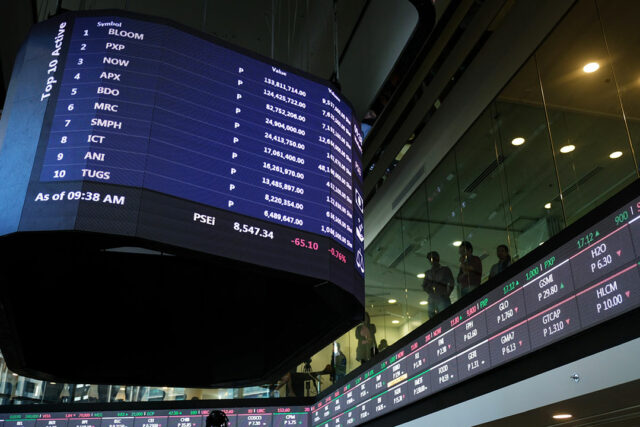
PHILIPPINE SHARES climbed on Monday as slower-than-expected June inflation boosted expectations of a Bangko Sentral ng Pilipinas (BSP) rate cut by next month.

The benchmark Philippine Stock Exchange index (PSEi) climbed by 0.56% or 36.68 points to end at 6,529.43 on Monday, while the broader all shares index rose by 0.44% or 15.43 points to close at 3,524.42.

“The local bourse gained … as hopes for an interest rate cut by August continued to boost sentiment following the easing of the June inflation rate,” Philstocks Financial, Inc. Research Analyst Claire T. Alviar said in a Viber message.

Headline inflation stood at 3.7% in June, the Philippine Statistics Authority reported on Friday, easing from 3.9% in May and 5.4% in the same month a year ago.

This was within the BSP’s 3.4-4.2% forecast for the month and was slightly slower than the 3.9% median estimate in a BusinessWorld poll of 14 analysts.

This also marked the seventh straight month that the consumer price index (CPI) settled within the BSP’s 2-4% target band.

BSP Governor Eli M. Remolona, Jr. has said the Monetary Board is “on track” to deliver its first rate cut in over three years at its Aug. 15 meeting as they expect inflation to continue easing this semester.

“Philippine shares continued their upward trajectory as in the main index closed above 6,500 as investors brace themselves for another week that could give hints on the timing of the US Federal Reserve’s rate cut,” Regina Capital Development Corp. Head of Sales Luis A. Limlingan said in a Viber message.

The market is awaiting Fed Chair Jerome H. Powell’s US congressional testimony on July 9-10, as well as the release of US consumer inflation data on July 11, among others, he said.

The Fed has maintained its target rate at the current 5.25%-5.5% range since July 2023.

Traders currently set about 76% odds for a rate cut at the Fed’s September meeting, up from 64% a week ago, according to the CME Group’s FedWatch Tool, Reuters reported. A subsequent cut is predicted by December.

Sectoral indices ended mixed on Monday. Financials went up by 2.65% or 52.30 points to 2,018.88; industrials rose by 0.59% or 53.66 points to 9,123.48; and mining and oil climbed by 0.57% or 48.78 points to 8,607.99.

Meanwhile, services fell by 0.49% or 10.10 points to 2,018.16; property went down by 0.09% or 2.37 points to 2,549.76; and holding firms dropped by 0.08% or 4.71 points to 5,529.52.

Value turnover climbed to P5.63 billion on Monday with 447.35 million shares changing hands from the P4.24 billion with 454.88 million issues traded on Friday.

Decliners outnumbered advancers, 104 to 95, while 42 names closed unchanged.

Net foreign buying stood at P143.69 million on Monday versus the P11.47 billion in net selling recorded on Friday. — A.E.O. Jose with Reuters

DoF expects rice prices to fall below P50 per kilo by August

FINANCE SECRETARY RALPH G. RECTO — DEPARTMENT OF FINANCE FACEBOOK PAGE

THE LOWER tariff on rice imports is expected to bring rice prices to below P50 per kilogram by August, the Department of Finance (DoF) said.

“By slashing the tariff on imported rice from 35% to 15%, we anticipate an average of 10% reduction in retail prices for the rest of the year,” Finance Secretary Ralph G. Recto said at the Economic Journalists Association of the Philippines-San Miguel Corp. economic forum on Monday.

“This could lower the price of rice by at least P5 per kilo. From an average of P54.40 per kilo last June, prices could go down to below 50 pesos as early as August.”

President Ferdinand R. Marcos, Jr. implemented the tariff reduction via Executive Order (EO) No. 62 last month.

The Department of Agriculture’s price monitors reported that well-milled rice was selling in Metro Manila markets for as much as P55 per kilo.

Mr. Recto said that lower tariffs on rice could reduce full-year inflation by 0.18 percentage points.

Headline inflation eased to 3.7% in June from 3.9% in May. Rice inflation, which accounts for almost half of overall inflation, eased to 22.5% from 23% a month earlier.

Rice prices were likely to have remained above P50 had the government not cut tariffs, Mr. Recto said.

“A sustained high price of rice could continue to drive inflation, delaying the reduction of policy interest rates by the (central bank) and derailing the country’s economic growth trajectory,” he added.

Mr. Recto said that the tariff cut will result in foregone revenue of P9.2 billion this year but noted that “in the bigger picture, this improves the welfare of households, especially the poor.”

He also cited the 27.7% increase to P221.7-billion budget for agriculture sector, much of it going to modernizing farming. Around half of the agriculture budget goes to rice, he added.

“This will enable us to install more irrigation systems, construct farm-to-market roads, procure agri machinery and equipment, and prioritize research and development,” Mr. Recto said.

The DoF said it is working with Congress to ensure an increase in the P10-billion-a-year allocation for the Rice Competitiveness Enhancement Fund (RCEF), which is funded from import tariffs.

Republic Act No. 11203 or the Rice Tariffication Law, the law which creates RCEF, authorizes the fund to distribute machinery, seed, credit, and fertilizer for six years. The RCEF expired last month, but efforts are underway in Congress to extend its term and increase the annual allocation.

Farmer’s groups last week asked the Supreme Court to issue a temporary restraining order freezing EO 62, saying they were not consulted properly prior to its issuance, as the law requires.

“I don’t think there’s a reason for the courts to get involved in that,” Mr. Recto told reporters on the sidelines of the forum. — Beatriz Marie D. Cruz

Manufacturing weakness hinders poverty-reduction effort — NEDA

A WORKER adjusts a machine at a manufacturing facility in Manila, Dec. 10, 2008. — REUTERS

THE National Economic and Development Authority (NEDA) said weak manufacturing is preventing the Philippines from achieving its poverty-reduction goals.

“Given the country’s low level of development, the steady decline of agriculture and manufacturing’s share in GDP (gross domestic product) significantly limits our opportunities for poverty reduction,” NEDA Secretary Arsenio M. Balisacan said during the Economic Journalists Association of the Philippines-San Miguel Corp. economic forum.

The manufacturing sector accounted for 0.9 percentage point (ppt) of the 5.7% GDP growth reported in the first quarter, according to the Philippine Statistics Authority.

In comparison, net exports of goods and services accounted for 1.2 ppts of GDP. Mr. Balisacan said the services sector made up about two-thirds of GDP growth.

“We want growth that delivers prosperity. And so, we need to see those high productivity sectors and those pillars of growth must also come in and augment services,” he added.

He noted that growth in the manufacturing sector was a primary driver of poverty reduction in many Asian economies.

The Philippines’ poverty rate fell to 22.4% in the first half of 2023 from 23.7% two years earlier.

The government aims to slash the poverty rate to 9% by the time it steps down in mid-2028.

“While we continue to buoy consumption and enhanced services, we must reinvigorate the other pillars of economic growth, investments and exports, particularly manufacturing and agribusiness, to sustain growth and make it more resilient in the years and decades to come,” Mr. Balisacan said.

“So that’s why if you look at our efforts, we are so focused on improving the ecosystem for investment,” he added.

The ICT (information and communications technology) and BPM (business process management) industries can serve to strengthen manufacturing, Mr. Balisacan added.

The S&P Global Philippines Manufacturing Purchasing Managers’ Index, which measures factory activity, slowed in the Philippines to 51.3 in June from 51.9 in May due to low demand and reduced worker numbers. — Beatriz Marie D. Cruz

Full electrification expected to require P72 billion in funding

BW FILE PHOTO

ILOILO CITY — The Department of Energy (DoE) said it is seeking P72 billion for its total electrification program, and estimated the economic benefit of providing power to the entire country at P315 billion.

On the first day of the US Embassy’s 16th Media Seminar on Monday, Energy Undersecretary Rowena Cristina L. Guevara said that the estimate for the funds needed to achieve total electrification covers the period to 2028.

“A portion of that budget will be taken out of a loan because we already have a budget allocated for total electrification — around P3 billion to P5 billion per year,” Ms. Guevara said.

“So that’s around P25 billion, and we need P72 billion … so we might need to borrow because we have a deficit and the budget cannot increase suddenly,” she added.

She said that the DoE is in talks with the World Bank and the Asian Development Bank (ADB) for the loan. The program will seek to build distribution lines, electrify remote barangays and sitios, and install home solar systems.

Ms. Guevara said that the department presented the program and its economic benefits to the National Economic and Development Authority and the Department of Finance last week.

“We presented to them our request, and they seem to be happy about the numbers that came out of our study, particularly the economic benefits,” she said.

“Nobody reported (the estimated economic benefits) to them before. So, because of that, we’re thinking of a possible loan from ADB or the World Bank and thinking of government appropriations through the Department of Budget Management (DBM),” she added.

According to the study, giving low-income families access to up to eight hours of electricity a day will boost their income by 17.9%, while their expenditure is expected to increase by 17%.

If access to electricity were increased to eight hours to 16 hours per day, income and expenditure are expected to increase by 33.3% and 33%, respectively.

If low-income families are given access to electricity for 16 to 24 hours a day, their income and expenditure are projected to increase by 49.4% and 52.2%, respectively.

“If we are able to do total electrification, the economic benefit (of) P315 billion… (is equivalent to) 1.8% of our gross domestic product (GDP),” Ms. Guevara said.

“And the total electrification program is just P72 billion. If you invest that but get P315 billion back, wouldn’t that be a win?” she added.

According to Ms. Guevara, more than 2 million households currently have no access to electricity.

The DoE estimates the current household electrification rate at 93.12% at the end of March, while the target for this year is 94.83%.

President Ferdinand R. Marcos, Jr. said in his State of the Nation Address last year that the target is to achieve full household electrification by the end of his term. — Justine Irish D. Tabile

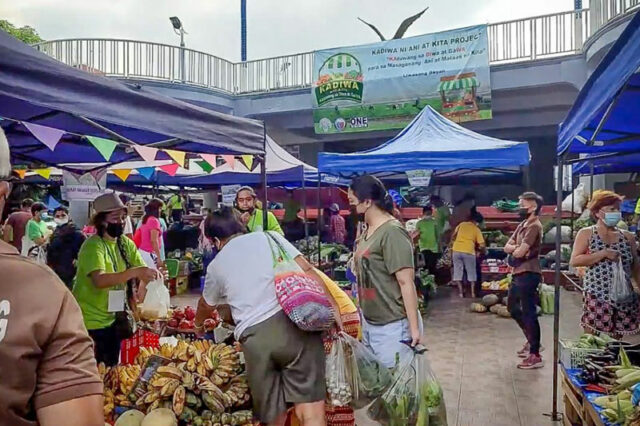
Below-market KADIWA rice to be priced initially at P45-P48 per kilo

DA PHOTO

THE Department of Agriculture said on Monday that it will launch the sale of subsidized rice to the broader public via KADIWA stores, with initial pricing set at P45-P48 per kilogram.

Agriculture Assistant Secretary and Spokesperson Arnel V. de Mesa said that the subsidized rice program will offer well-milled rice, and is separate from another program targeted at vulnerable segments of society for P29.

“Due to the developments which have caused rice prices to fall, most likely, the selling price will also go down,” Mr. De Mesa told reporters.

The price of well-milled rice in Metro Manila markets was between P48 and P55 per kilo as of July 5, according to DA price monitors.

“The program will run parallel with the P29 rice. The participating KADIWA centers will be doubled next week. By August, Visayas and Mindanao will also be included,” he added.

The P29 rice is meant to be sold to persons with disabilities, solo parents, and senior citizens, as well as those below the poverty line, at 10 kilos per month, subject to monitoring via booklets issued to beneficiaries.

Rice sold at P29 will be taken from ageing stocks held by the National Food Authority.

He said that the DA is also studying whether to limit the quantities of rice sold at P45-P48.

The national network of KADIWA stories is at about 300 outlets, along with 119 pop-up stores operating on rotation.

“We want this to be a sustainable and long gestating program. Our target is for it to be implementable until the end of our President’s term,” Mr. De Mesa said. — Adrian H. Halili

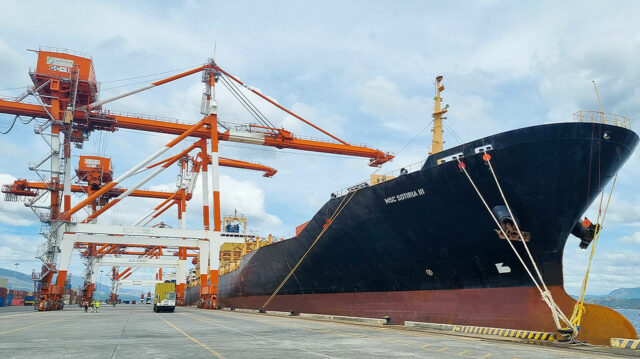
Luzon Economic Corridor rail cost estimated at $7B — Go

ICTSI.COM

THE cost of setting up the rail lines linking the various sites along the Luzon Economic Corridor was estimated at $7 billion by Secretary Frederick D. Go of the Office of the Special Assistant to the President for Investment and Economic Affairs.

Mr. Go made the remarks on the sidelines of the Economic Journalists Association of the Philippines-San Miguel Corp. economic forum on Monday.

Mr. Go said that a number of countries are interested in investing in the US and Japan-backed corridor’s development. “I believe that European countries are now wanting to join in on this project,” he added.

Mr. Go said discussions with interested countries are still at the preliminary stages.

“Say the UK will join, or say for example, a few countries from the European Union (EU) will join, they will encourage companies, both government and private corporations, from their countries to invest in that corridor,” he said.

“When we say invest in that corridor, we’re not just talking about the rail, we’re talking about everything that goes up around it — the infrastructure and businesses.”

The project is being pursued under a trilateral agreement between the Philippines, US and Japan. The proposed corridor seeks to boost connectivity between Manila, Batangas, Subic and Clark via a cargo rail line.

The project will “prioritize strategic investments in high-impact infrastructure projects such as rail, ports, clean energy, data centers, and agri-business centers,” Mr. Go added.

The Philippine Economic Zone Authority (PEZA) has said that many of its locators are expected to benefit from the corridor.

There are about 1,600 PEZA-registered manufacturing, service, and export-oriented companies based in 137 economic zones in Metro Manila, Clark, and Batangas.

The project is being pursued under the US-led G7 Partnership for Global Infrastructure and Investment and is the “first of its kind” in the Indo-Pacific region, according to the US State department.

Meanwhile, Mr. Go said the contract to maintain and operate Laguindingan International Airport in northern Mindanao is expected to be awarded to the private sector soon.

“Moreover, within this quarter, we are also expected to award a concession agreement for the Laguindingan International Airport,” he said.

The Transportation department has said that at least two parties have expressed interest in the upgrade and operations contract for the airport. — Beatriz Marie D. Cruz