Home Blog Page 2432

Highlighting the negative

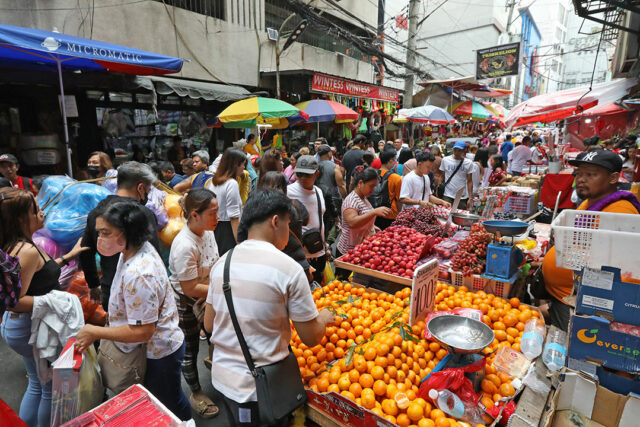
PHILIPPINE STAR/EDD GUMBAN

FIRST-TIME TRAVELERS, even to just the neighboring countries, tend to highlight the advances made by the visited destination. These usually infrequent travelers come home with stories of how things are much better in the countries visited, even when their experiences are limited to sightseeing, not at all subjected to what citizens there undergo in their daily lives.

Is it the transport system, payment methods, or facilities for the elderly? In any chosen field, there is the element of this once backward country now flourishing ahead of the curve, compared to us.

As a national pastime, putting down our own country beyond the bounds of humility has become all too common. Is it an inferiority complex that automatically compares our country unfavorably with any other? Do we dwell on the negative when it comes to home?

Self-deprecatory humor in the form of making fun of oneself and any claimed accomplishments, no matter how awesome, can be an endearing trait. (I was just there at the right time, and the right place.) Paradoxically, this form of belittling one’s status and making fun of the perks being enjoyed work best when one is already perceived as being at the top of one’s game. Winners of international competitions like beauty contests, Olympic events, and billiard tournaments credit their triumphs to luck, prayers of the nation, and the support of others, not necessarily the family.

Politicians use self-deprecation in the campaign trail to great advantage. So, the story of growing up poor and eating leftovers from fast food chains can be overused, even if such an experience probably never even happened. The rags-to-riches story has been overdone. But once in power, the language of the humble civil servant can shift into a confrontational and arrogant tone, especially in a legislative investigation.

A twisted version of self-deprecation is disguised bragging. Anyone prefacing what he is about to say with the phrase “modesty aside” is about to launch into self-aggrandizing statements, trumpeting achievements by packaging them as modest — my winning this prestigious award against other contestants from 40 other countries is testament to the ingenuity of the Filipino (ahem, you’re looking at him).

Is it only the obviously competent and unquestionably accomplished that can comfortably engage in self-deprecatory humor?

The insecure and under-qualified may feel that making fun of himself may invite ready agreement. (Oh Sir, you have every right to be modest.) For self-deprecation to work as it should, a social compact is implicitly entered into between the speaker and his audience. Poking fun at oneself is premised on the desire of avoiding envy and malice. Modesty puts people at ease who would otherwise be intimidated by the speaker’s power, intellect, or wealth — yes, I used to take the public bus to school. (It was a good way to meet girls, although I didn’t meet any who were not asking for my ticket.)

Self-deprecation has to do with humility, or, more crassly, lowering people’s expectations of what one can do. There is an invitation not to be taken seriously, even to be underrated. (Please I am not a threat to your standing in the organization.) An achievement is scaled down (I was just lucky) in order to defuse resentment which induces a desire to see a fall from grace for the high and mighty.

One problem with the tendency to stress the negative and put down one’s own country, almost as a habit to appear subservient and non-threatening, is that it is an invitation to be bullied even by neighbors. How can another country not be encouraged to be more arrogant and forceful when confronted by toadies?

As a default position, self-devaluation shifts our attention to what has held back our progress. It skips over our strong survival instincts and hospitality as a people. Sometimes, it even takes a foreigner on a blog to point out our virtues to the rest of the world.

Intentional depreciation of our character is a way to deflect the lightning from above. Anyway, if nothing else, self-deprecation pre-empts the viciousness of critics who are only too willing to put down those standing on pedestals. This is harder to do when he is already climbing down from it and laughing at himself as if to say — I am not worth the trouble of attracting envy.


Tony Samson is chairman and CEO of TOUCH xda

ar.samson@yahoo.com

Proposed natural gas law to safeguard against high electricity costs — senator

PHILSTAR FILE PHOTO

THE PROPOSED Philippine Natural Gas Industry Development Act will uphold existing market pricing provisions and consumer protection measures, according to its proponent.

“There are strict provisions on market pricing in the service contracts that the DoE (Department of Energy) and ERC (Energy Regulatory Commission) are duty-bound to uphold. They are in place… This bill (Senate Bill  [SB] 2793) essentially maintains the status quo,” Sen. Pilar Juliana “Pia” S. Cayetano said in a statement on Wednesday.

The Senate on Tuesday approved on second reading SB No. 2793, which seeks to promote the production of indigenous natural gas and liquified natural gas.

Under the proposed measure, the DoE will oversee strategies to develop the downstream natural gas industry.

The ERC, on the other hand, will keep track of the government’s share and other revenues related to the production of indigenous natural gas sold to power plants.

Ms. Cayetano said that the DoE and ERC, along with the Philippines Competition Commission, would “ensure transparent negotiations and dealings.”

She said that prioritizing the indigenous natural gas industry means “standing by it with established checks and balances,” including those set the Consumer Welfare Act.

“We encourage the shift to natural gas, whether imported or local, but prioritize indigenous sources for enhanced energy security and price stability,” Ms. Cayetano said.

“We have the potential to explore, to discover and to develop our indigenous natural gas. Why are they (investors) not coming in? Because since the ’70s, we neglected investing and encouraging promotion of indigenous natural gas. After Malampaya was discovered, wala na (nothing followed). Pinabayaan na natin (We neglected it),” she added. — Sheldeen Joy Talavera

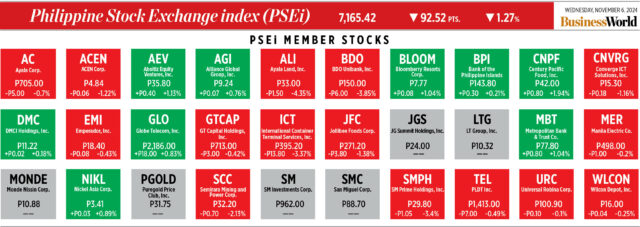
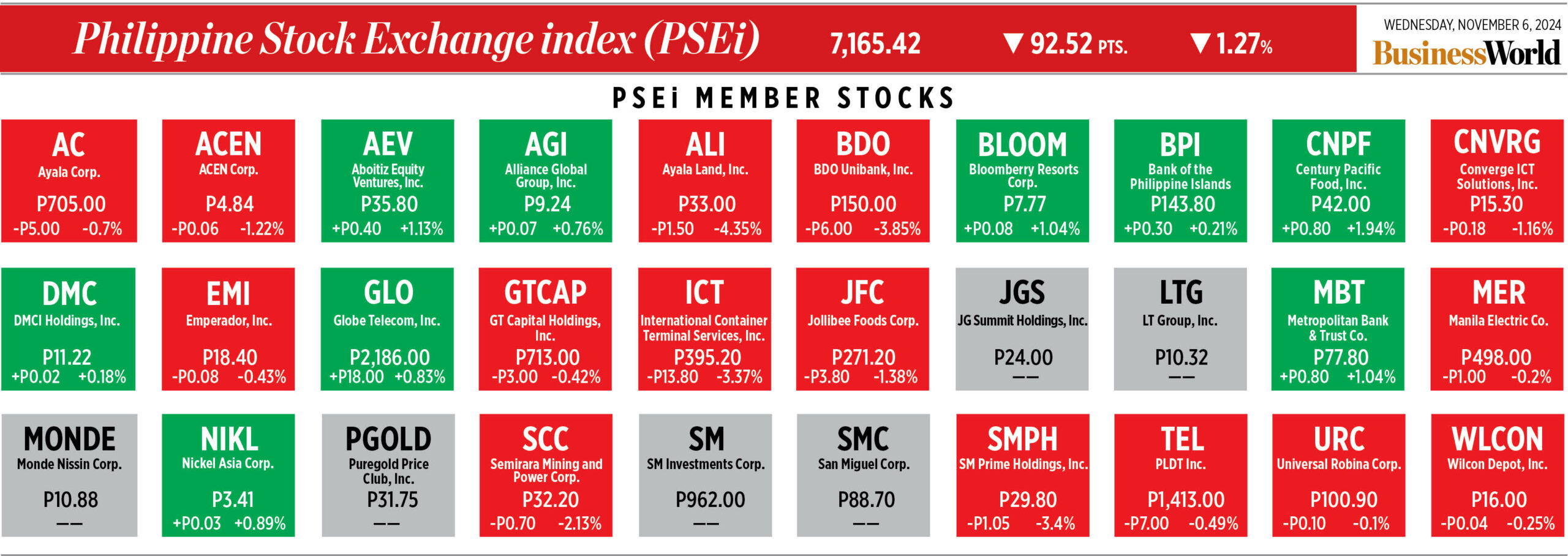
How PSEi member stocks performed — November 6, 2024

Here’s a quick glance at how PSEi stocks fared on Wednesday, November 6, 2024.


Peso tumbles to four-month low vs dollar as early election results point to Trump victory

BW FILE PHOTO

THE PESO declined to a four-month low against the dollar on Wednesday as Donald J. Trump claimed victory in the US presidential election.

The local unit closed at P58.661 per dollar on Wednesday, weakening by 34.6 centavos from its P58.315 finish on Tuesday, Bankers Association of the Philippines data showed.

This was the peso’s lowest close in more than four months or since its P58.725 per dollar finish on July 3.

The peso opened Wednesday’s session weaker at P58.50 against the dollar, which was already its intraday best. Its worst showing was at P58.77 versus the greenback.

Dollars exchanged jumped to $1.91 billion on Wednesday from $1.15 billion on Tuesday.

“The dollar-peso ended higher because of the election with Trump leading,” a trader said by phone.

“The peso weakened after the US presidential election results pointed toward a second Trump term,” another trader said in an e-mail.

Markets have already priced in a possible victory by Mr. Trump, which led to a generally stronger dollar and higher US Treasury yields, Rizal Commercial Banking Corp. Chief Economist Michael L. Ricafort likewise said in a Viber message.

Investors bought dollars, bitcoin and stocks, and sold bonds as Mr. Trump claimed victory in the US presidential election and Republicans took control of at least one chamber of Congress, Reuters reported.

US stock futures hit record highs, the dollar surged and Treasury yields jumped, while bitcoin broke $75,000 for the first time — all moves flagged by investors as likely should Trump win over Democrat Kamala Harris.

The results so far underscore how one of the most unusual presidential elections in modern US history could have far-reaching implications for tax and trade policy as well as US institutions.

The results affect assets globally and will determine the outlook for US debt, the strength of the dollar, and a host of industries that make up the backbone of corporate America.

Leading into Tuesday, polls showed a dead heat between the former president and the current vice president. But by 2 a.m. ET, Mr. Trump had won the swing states of North Carolina and Georgia and was leading in several others, according to Edison Research.

Fox News projected he had won the presidency.

Republicans also won control of the US Senate, ensuring they will dominate at least one chamber of Congress next year.

Assets whose prices could be helped by Mr. Trump’s pledges to raise tariffs, cut taxes and slash regulations shone, while dealers said cash was flowing out of emerging markets and US Treasury bonds tanked in anticipation of a ballooning deficit.

For Thursday, the first trader said the peso may continue to weaken as markets continue to react to the election results and with the US Federal Reserve set to announce its policy decision overnight. The second trader added that potentially slower Philippine gross domestic product (GDP) growth in the third quarter could weigh on the peso. The government will release GDP data on Thursday (Nov. 7).

The first trader sees the peso moving between P58.50 to P59 per dollar, while the second trader expects it to range from P56.55 to P56.80. Mr. Ricafort forecasts the peso to trade between P58.55 and P58.75. — AMCS with Reuters

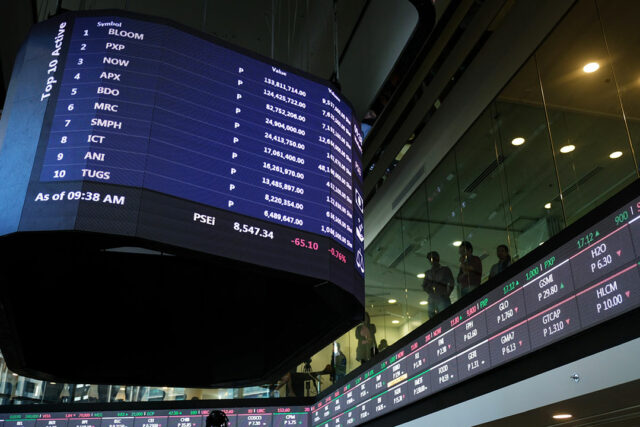
PHL shares sink as Trump poised to win election

BW FILE PHOTO

PHILIPPINE SHARES sank on Wednesday as Republican Donald J. Trump looked poised to win the US presidential election.

The Philippine Stock Exchange index (PSEi) dropped by 1.27% or 92.52 points to close at 7,165.42 on Wednesday, while the broader all shares index fell by 0.58% or 23.54 points to end at 3,969.97.

“The local market dropped this Wednesday… as investors traded cautiously while monitoring the US’ presidential elections,” Japhet Louis O. Tantiangco, senior research analyst at Philstocks Financial, Inc., said in a Viber message.

“Investors are pricing in the possibility of a Trump presidency, which is known to be heavily leaning towards protectionist policies that may have negative implications on the global economy,” he added.

Juan Paolo E. Colet, managing director at Chinabank Capital Corp., likewise said via Viber that the PSEi fell “as investors reacted to US election results pointing to a significant victory for Trump and the Republican Party.”

“Foreign investors turned net sellers by more than P1 billion and many market participants turned cautious in the face of speculation on the economic policy impact of a second Trump administration on emerging markets like the Philippines,” Mr. Colet said.

Net foreign selling increased to P1.12 billion on Wednesday from P58.2 million on Tuesday.

Fox News projected that Mr. Trump has won the US presidency, defeating Democrat Kamala Harris and capping a stunning political comeback four years after he left the White House, Reuters reported. Other media outlets have yet to call the race.

The results so far underscore how one of the most unusual presidential elections in modern US history could have far-reaching implications for tax and trade policy as well as US institutions.

The results affect assets globally and will determine the outlook for US debt, the strength of the dollar, and a host of industries that make up the backbone of corporate America.

Mr. Tantiangco said the peso’s decline also weighed on the stock market. The local unit weakened by 34.6 centavos to close at P58.661 per dollar on Wednesday from P58.315 on Tuesday, data from the Bankers Association of the Philippines showed.

Luis A. Limlingan, head of sales at Regina Capital Development Corp., said the market was also awaiting the US Federal Reserve’s policy decision overnight.

All sectoral indices closed lower on Wednesday. Property dropped by 2.93% or 83.67 points to 2,765.33; services lost 1.93% or 42.62 points to end at 2,162.36; financials went down by 0.83% or 19.56 points 2,331.57; industrials sank by 0.33% or 33.69 points to 9,936.32; mining and oil declined by 0.07% or 6.12 points to 8,482.64; and holding firms inched down by 0.05% or 3.24 points to 6,132.24.

Value turnover increased to P4.66 billion on Wednesday with 1.34 billion shares changing hands from the P4.97 billion with 1.03 billion issues traded on Tuesday.

Decliners outnumbered advancers, 113 versus 86, while 55 names were unchanged. — Sheldeen Joy Talavera

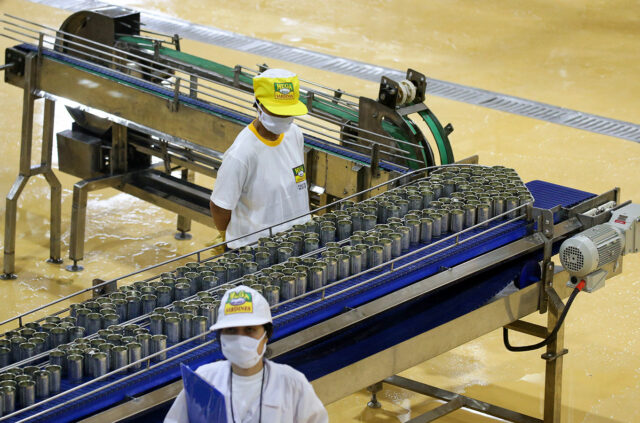
Factory output contracts by 6.3% in September

Workers are seen inside a manufacturing facility in Sto. Tomas, Batangas in this file photo taken on March 1, 2023 — PHILIPPINE STAR/KJ ROSALES

MANUFACTURING OUTPUT contracted by 6.3% in September due to double-digit declines in the production of coke and refined petroleum products as well as in beverages, according to the Philippine Statistics Authority (PSA).

Preliminary results of the PSA’s Monthly Integrated Survey of Selected Industries indicated that factory production, as measured by the volume of production index (VoPI), declined 6.3% in September after having grown 1.2% in August. A year earlier, VoPI grew 9.5%.

Month on month, the manufacturing-sector VoPI fell 3.6% after having declined 0.9% in August.

The average manufacturing output growth for the nine months to September was 1%, slowing from 5.84% a year earlier.

The manufacture of coke and refined petroleum products, with a 12.8% annual decrement from 13.6% in August.

Also contributing to the slow growth in factory activity was the growth slowdown in the manufacture of beverages to 8.5% year on year from 12.4% in August, while basic metals declined 35.1% year on year in September from a decline of 18.4% in August.

Thirteen industry categories posted accelerating year-on-year growth in September, led by electrical equipment (49.4% in September from 32.2% in August); leather and related products, including footwear (28.8% from 22.4%); and furniture (25.3% from 15%).

Meanwhile, six industry categories posted declining growth led by the manufacture of wood, bamboo, cane, rattan articles and related products (-23.8% in September from a 59.7% increase in August). The decline in chemical and chemical products output accelerated to 10.3% in September from a 4.2% decline a month earlier.

September capacity utilization averaged 75.3%, against 75.4% in August. No industry category reported utilization of less than 60% during the month.

The top three industry categories for capacity utilization rates were machinery and equipment except electrical (82.9%), other manufacturing and repair and installation of machinery and equipment (80.8%), and furniture (80.3%).

Rizal Commercial Banking Corp. Chief Economist Michael L. Ricafort said the recent work suspensions due to typhoons disrupted manufacturing and damaged facilities.

“The storms also disrupted supply chains especially in agriculture, which reduced output and, in some cases, increased inflation, especially in hard-hit areas,” he said via Viber.

Factory output is expected to increase in the coming months ahead of the yearend holidays, Mr. Ricafort said.

“The expected signing into law of the CREATE MORE bill will also encourage more foreign direct investment and boost some of the manufacturing industries here that are part of global supply chains.”

Another gauge of manufacturing health, S&P Global’s Philippine Manufacturing Purchasing Managers’ Index (PMI), rose to 53.7 in September from 51.2 in August. It was the strongest PMI reading since the 53.8 posted in June 2022.

A PMI is a forward-looking indicator based on surveys of purchasing managers, who place raw-material orders based on their companies’ reading of near-term demand. A PMI reading above 50 points to expanding manufacturing activity once the raw-material orders arrive, while a reading below 50 indicates an impending contraction. — Beatriz Marie D. Cruz

Q2 GDP growth reading revised upwards to 6.4%

PHILIPPINE STAR/WALTER BOLLOZOS

GROSS DOMESTIC PRODUCT (GDP) growth in the second quarter was upwardly revised to 6.4% from the 6.3% initially reported, the Philippine Statistics Authority (PSA) said on Wednesday.

The PSA said revised estimates for growth in manufacturing (3.9% from 3.6%); accommodation and food service activities (12.1% from 10.4%); and real estate and ownership of dwellings, (7.6% to 7.2%) were behind the upgraded GDP reading.

Gross national income was also revised upward to 8.1% from 7.9%. Meanwhile, the net primary income from the rest of the world for the second quarter was upgraded to 25.7% from 24.7%, the PSA said.

The PSA was due to announce preliminary third-quarter GDP data on Thursday, Nov. 7.

 A BusinessWorld poll of 12 economists and analysts conducted last week yielded a median estimate of 5.7% GDP growth in the three months to September. — Aubrey Rose A. Inosante

PHL rice imports needed to bridge Jan.-Feb. lean period — ex-official

PHILIPPINE STAR/KRIZ JOHN ROSALES

RICE IMPORTS, expected at around 4.2 million metric tons (MMT) this year, are intended to build up reserves which will bridge the lean period at the start of 2025, a former Department of Agriculture (DA) official said.

At the World Rice Conference Summit on Wednesday, former Undersecretary Leocadio S. Sebastian said: “The Philippines imported 3.8 million MT as of Oct. 31; that is the volume that has already arrived, and the DA projects that it will probably reach 4.2 million MT by the end of the year.”

“I think 400,000 MT… would be the minimum. It could be more, but it will depend again on how our traders react to the global market,” he added.

He said palay (unmilled rice) production is well behind the year-earlier pace because of crop damage.

“That is not including the effect of Kristine. Total production this year will be much lower than the 20 million produced last year,” he said.

He said the rice inventory ending balance at the close of 2024 needs to be sufficient to get through the lean periods, the next of which starts in January.

“Lean months are when the production is less than demand. So we are consuming more rice than what we are producing. These periods are July to Sept. 15 as well as January-February,” he said.

“Because of the projected shortfall this year, we may have to bring in more supply, either in December or in January, from my point of view,” he said.

“Next year, I think we really should continue to be a good market for exporters in Vietnam, Thailand, Myanmar, India, and Pakistan,” he added.

The DA has estimated palay production to drop to a four-year low of 19.41 MMT in 2024, dampened by tropical cyclone activity.

The US Department of Agriculture projects Philippine rice imports to hit 4.7 MMT this year. — Justine Irish D. Tabile

National rice inventory up 5.4% as of Oct. 1

PHILSTAR FILE PHOTO

THE national rice inventory rose 5.4% year on year to 2.15 million metric tons (MMT), the Philippine Statistics Authority (PSA) reported, citing preliminary data as of Oct. 1.

The national inventory consisted of 52.6% held by commercial traders, 39.4% by households, and 8% by the National Food Authority (NFA), the PSA said in a report.

Rice held by the NFA increased 290.2% to 172,840 MT, while commercial rice stocks rose 4.7% to 1.08 MMT.

On the other hand, rice held by households amounted to 849,330 MT for the period, down 7.5% from a year earlier. Month on month, their holdings rose 29.8%.

The PSA also said the corn inventory declined 25.3% year on year to 728,230 MT during the period.

Corn held by commercial establishments was 585,390 MT, down 31.1%, while household corn was around 142,840 MT, up 13.7%.

At the World Rice Conference Summit on Wednesday, Agriculture Undersecretary Deogracias Victor B. Savellano, who delivered a speech on behalf of Secretary Francisco P. Tiu Laurel, Jr., described the Philippine rice supply as secure.

“Working closely with President Ferdinand R. Marcos, Jr., we are accelerating harvest and procurement through the NFA, which plays a crucial role in supporting communities affected by severe tropical storm Kristine,” Mr. Savellano said.

“Region 5 and Calabarzon have felt this impact and the NFA’s efforts are critical in these areas,” he added.

He said that the challenges brought about by natural events like El Niño and La Niña are testing the resilience of farmers.

“El Niño has intensified droughts and reduced water availability, while La Niña has led to heavy rains and flooding in some areas. Together, these events underscore the need for more adaptive measures in our rice production,” he said.

To address this, he said that DA is working with the International Rice Research Institute for potential scaling up of new technologies focused on nutritious rice, high-productivity rice, climate-resilient rice, and low-carbon rice.

“These innovations have the power to increase farmers’ yields, improve their incomes, and support the nation’s food and nutrition security,” he added.

At present, the Philippines can meet 79% of its rice demand with domestically grown rice, which the government hopes to increase to 95% by 2028. — Justine Irish D. Tabile

PHL digital economy expected to sustain growth momentum

STOCK PHOTO | Image by andrespradagarcia from Pixabay

THE Philippine digital economy is expected to maintain its growth trajectory, driven by e-commerce and the continued development of digital infrastructure, according to a report issued on Wednesday.

The e-Conomy SEA report by Google, Temasek Holdings and Bain & Co. found that the Philippine digital economy is projected to grow 20% to $31 billion in terms of gross merchandise value (GMV), making it the fastest-growing digital economy in Southeast Asia.

The report also reiterated earlier market-size forecasts for the Philippines of $80 billion and $150 billion in GMV growth by 2030.

E-commerce will be the main driver for digital economy growth, with the segment projected to post $21 billion in GMV this year, up 23%.

Transport and food are expected to deliver $3 billion worth of GMV this year; while online media and online travel were valued at $4 billion and $3 billion, respectively.

“The increase in digital payment volumes is compelling service providers to maintain competitive fees while enhancing security and service reliability,” it said.

Digital payments are projected to post 22% growth in 2024 to $125 billion in gross transaction value (GTV). By 2030, digital payments are projected at between $200 billion and $300 billion in GTV.

GTV for digital payments includes the value of credit, debit, prepaid card, account-to-account, and e-wallet transactions, according to the report.

Google, the Singapore state investment company Temasek, and consulting firm Bain added that the surge in digital payments in the Philippines is keeping fees competitive while forcing providers to enhance security and service reliability.

“As the digital payments landscape matures and adoption becomes more widespread, e-wallet providers are increasing merchant discount rates,” according to the report.

The expansion of Philippine digital infrastructure is also expected to contribute to the overall digital economy’s growth, with broadband poised to connect even in remote areas. — Ashley Erika O. Jose

Saudi Arabia tapped for hydrogen, energy efficiency collaboration

REUTERS

THE Department of Energy (DoE) is hoping to develop a roadmap with the Saudi Arabian Ministry of Energy for collaboration in the areas of petroleum derivatives and native hydrogen, among others.

The two sides will finalize the roadmap early next year, the DoE said in a statement on Wednesday.

“This cooperation, through a well-defined roadmap, underscores the Philippine commitment to energy security, economic growth, and sustainable development, as it benefits from Saudi Arabia’s extensive experience and technological expertise,” the DoE said.

Last month, the DoE announced the signing of a memorandum of understanding (MoU) with the ministry.

The MoU also covers sustainable aviation fuel, digital technology for electrical systems management, and energy efficiency.

President Ferdinand R. Marcos, Jr. participated in the first-ever Association of Southeast Asian Nations-Gulf Cooperation Council Summit in Saudi Arabia in October 2023.

“During that visit, Saudi state-owned companies expressed strong interest in investing in the Philippine energy sector,” Energy Secretary Raphael P.M. Lotilla said.

Mr. Lotilla said Saudi Energy Minister Abdulaziz bin Salman Al Saud expressed interest in the Philippines’ native or naturally occurring hydrogen resources.

“Given Saudi Arabia’s extensive expertise in the exploration and development of upstream sectors, this cooperation holds promising benefits for both countries,” he said.

Earlier this year, two prospect areas in the Zambales Ophiolite Complex, were offered for hydrogen exploration, with awards to winning bidders forthcoming.

“By partnering with Saudi Arabia, the Philippines seeks to adopt cutting-edge energy efficiency technologies and best practices that could lower energy consumption, reduce costs, and contribute to sustainability,” the DoE said. — Justine Irish D. Tabile

BCDA taps NDC for Clark urban dev’t projects

NEW CLARK CITY

THE Bases Conversion and Development Authority (BCDA) said it signed a partnership with the National Development Co. (NDC) to handle high-impact works in New Clark City.

In a statement on Wednesday, BCDA said it signed a memorandum of understanding (MoU) with the state-owned investment firm to carry out urban development projects that will help make New Clark City a smart city.

“We thank the NDC for readily offering to share with BCDA its knowledge and expertise in financing and implementing projects, particularly in urban expansion, industrial development, and energy, among others,” BCDA President and Chief Executive Officer Joshua M. Bingcang said. 

“With more than a hundred years of experience and track record, NDC will surely become instrumental in the transformation of New Clark City into the country’s first smart, sustainable, and future-ready metropolis,” he added.

Under the MoU, NDC and BCDA will explore potential areas of collaboration, such as a feasibility study that may include a review of the current developments within BCDA properties.

NDC General Manager Antonilo DC Mauricio said the partnership hopes to replicate developments like Bonifacio Global City, which like Clark was built on former military-controlled land in Metro Manila.

“We want to leverage our strategic areas with partners who understand city-building, especially the BCDA,” he said.

The NDC pursues commercial, industrial, agricultural, and mining ventures in support of national economic development.

In August, President Ferdinand R. Marcos, Jr. proclaimed a 191,000-square-meter new special economic zone known NDC Industrial Estate, worth P343 million. 

According to the Philippine Economic Zone Authority, the industrial estate is set to welcome three companies producing soap and other detergents, renewable energy, and custom electronics. — Justine Irish D. Tabile

ADVERTISEMENT
ADVERTISEMENT