How PSEi member stocks performed — November 8, 2024

Here’s a quick glance at how PSEi stocks fared on Friday, November 8, 2024.


Here’s a quick glance at how PSEi stocks fared on Friday, November 8, 2024.
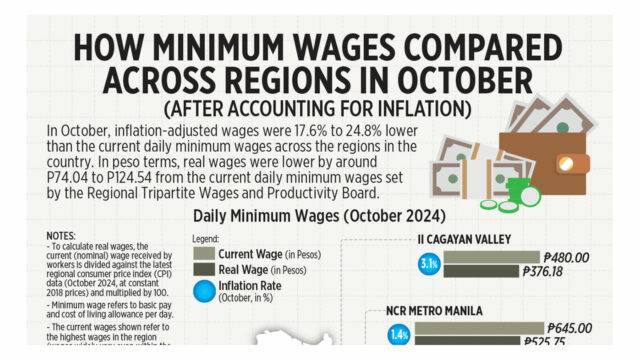
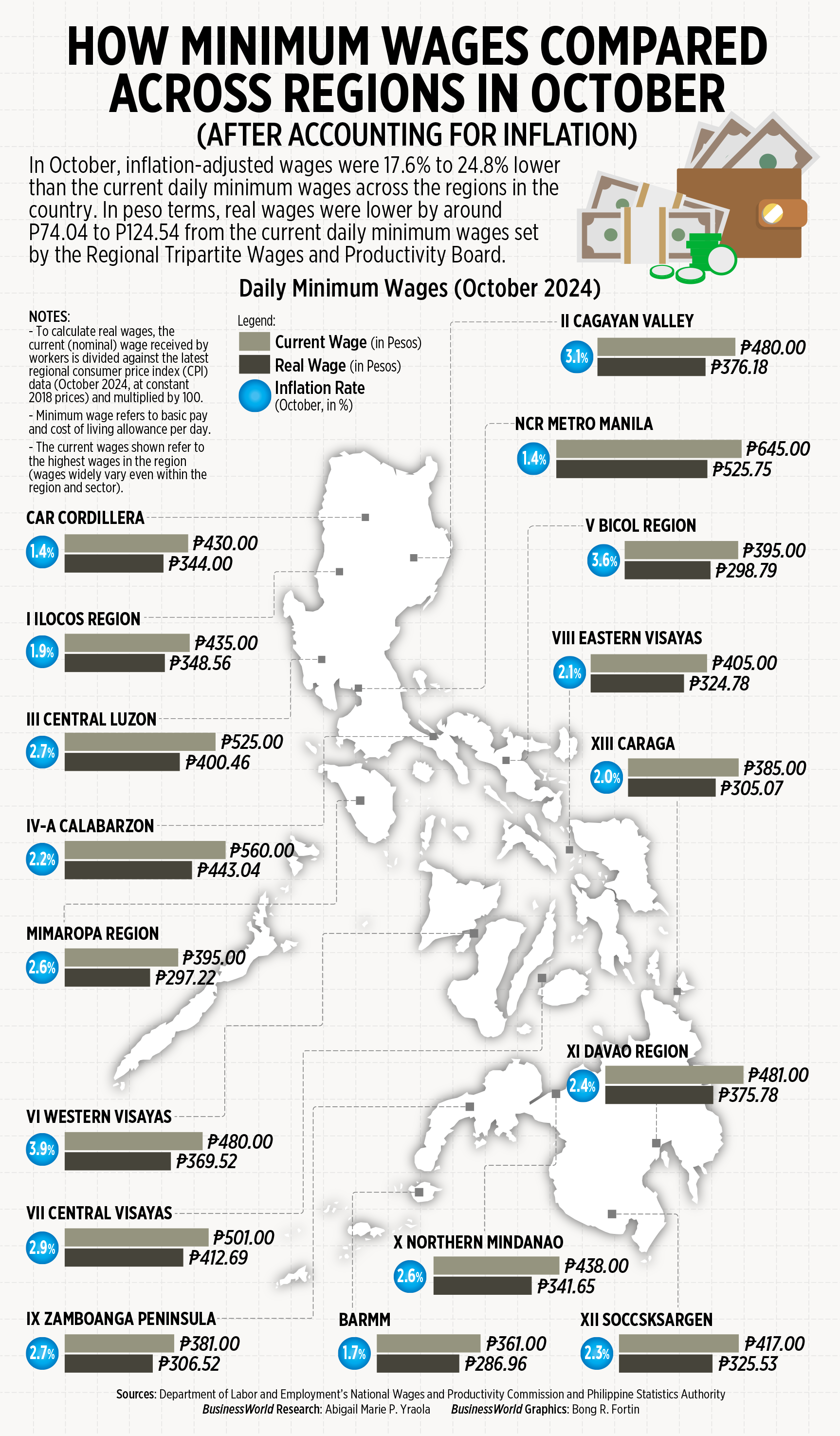
In October, inflation-adjusted wages were 17.6% to 24.8% lower than the current daily minimum wages across the regions in the country. In peso terms, real wages were lower by around P74.04 to P124.54 from the current daily minimum wages set by the Regional Tripartite Wages and Productivity Board.

By John Victor D. Ordoñez, Reporter
THE PHILIPPINE government should fast-track the rules that will enforce a law that defines its territories within its exclusive economic zone amid China’s growing assertiveness in the South China Sea, security analysts said at the weekend.
“Manila has yet to craft the implementing rules and regulations and ask permission from the International Maritime Organization on maritime zones to discredit any overlapping claims with other claimant-states in the West Philippine Sea,” Chester B. Cabalza, founding president of Manila-based International Development and Security Cooperation, said in a Facebook Messenger chat.
The International Maritime Organization is an agency in charge of overseeing the safety and security of maritime vessels, according to its website.
President Ferdinand R. Marcos, Jr. signed the measure into law last week, which aims to assert Manila’s territories in its exclusive economic zone amid harassment from the Chinese Coast Guard.
The law outlines the Southeast Asian nation’s territorial and sovereign boundaries as it tries to enforce a 2016 Permanent Court of Arbitration ruling favoring Manila’s claim over contested waters in the South China Sea.
“It stands in stark relief to China’s ambiguous and constantly shifting claims, under which it sporadically pronounces ‘indisputable sovereignty’ over amorphous zones it labels ‘adjacent’ or ‘relevant’ waters, but which are never clearly defined,” Raymond M. Powell, a fellow at the Stanford University’s Gordian Knot Center for National Security Innovation, said in an X message.
In a statement on Nov. 8, China’s Ministry of Foreign Affairs opposed the new law, which it said illegally includes parts of Chinese territories in the South China Sea.
“Once again, China urges the Philippines to immediately withdraw all its personnel and facilities from the aforementioned islands and reefs and immediately tow away the warship illegally grounded at Ren’ai Jiao (Second Thomas Shoal,” it said.
The Senate has also passed a bill that seeks to set up sea lanes at the Balintang Channel, Celebes and Sulu Seas, among other waterways, to assert Philippine sovereignty.
In 2016, the Permanent Court of Arbitration in The Hague said China’s claims had no legal basis, a decision Beijing has rejected.
China claims as its territory much of the South China Sea, a conduit for roughly $3 trillion in annual ship-borne trade, despite competing claims from Brunei, Malaysia, the Philippines, Taiwan and Vietnam.
Manila and Beijing have repeatedly clashed in the South China Sea, accusing each other of aggressive behavior involving their ships and of damaging the marine environment.
Philippine Coast Guard (PCG) Commandant Admiral Ronnie Gil L. Gavan last week said that the PCG is set to receive 49 new ships by 2028, 40 of which are funded by a French loan worth P25.8 billion and five from Japan, to boost patrols in the waterway.
“The new Maritime Zones law is a positive development establishing the Philippines’ maritime claims as being firmly grounded in accepted international law and giving Manila a path forward toward enshrining its view as the correct one,” Mr. Powell said.

THE PHILIPPINE government should review its education policy under a free college education law to better fit the demands of the labor market instead of merely churning out degree holders, a congressional think tank said.
In a November report, the Congressional Policy and Budget Research Department (CPBRD) said the Philippine labor market does not have the capacity to absorb all college graduates amid a surge in “college-educated labor,” raising concerns about a mismatch in higher education access and employers’ demands.
The government should look at restricting the beneficiaries of the 2017 free college education law to degrees on research and development (R&D) including science, technology, engineering and mathematics (STEM) to produce graduates needed by the job market, the CPBRD said.
“It is strongly advisable to shift the focus of education policy away from increasing the number of college graduates and towards increasing the number of graduates with economically valuable skills,” according to the report written by David Joseph Emmanuel Barua Yap, Jr., Edrei Y. Udaundo and Jubels C. Santos.
“In particular, the courses afforded full benefits by the [Universal Access to Quality Tertiary Education Act] could be restricted to courses that provide skills that are sought after by existing and emerging industries,” it added.
The CPBRD said college programs that do not produce “in-demand skills” could still be supported by free college education, either through a discount system or student loan program.
The government should also consider reducing the number of free college education beneficiaries by putting in place stricter entrance exams and retention requirements, allowing focused support to the “best and brightest” students, it added.
“An analysis of official government data on employment strongly suggests that Republic Act No. 10931 has indeed increased the number of college graduates in the youth labor force,” the CPBRD said.
However, the congressional think tank noted that the policy had eroded the wages of college graduates compared with nondegree holders.
“It can be inferred that the narrowing of the wage gap can be largely attributed to the anemic growth of the mean and median wages of college-educated youths,” it said.
College graduates are also competing for jobs in sectors that should not require college degrees, crowding out nondegree holders, it added.
“Data reveal that the number of [managers, professionals and technician] jobs decreased by 45% from 2016 to 2022,” according to the report. “The share of noncollege-educated youth in [clerical, service and sales worker] jobs declined from 72% in 2016 to 62% in 2022.” — Kenneth Christiane L. Basilio
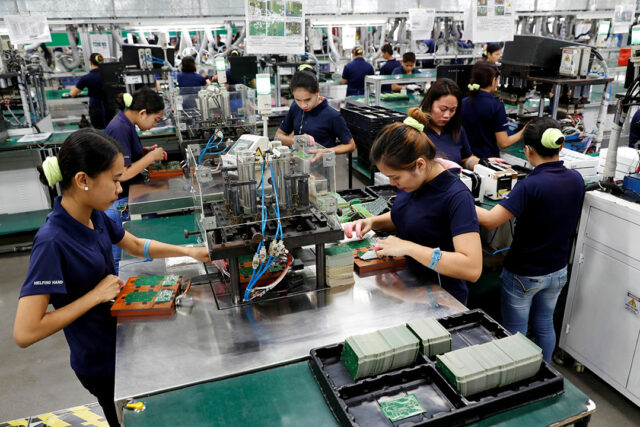
PHILIPPINE Senate President Francis G. Escudero on Sunday said he expects an influx of jobs and investors through the Corporate Recovery and Tax Incentives for Enterprises to Maximize Opportunities for Reinvigorating the Economy (CREATE MORE) measure, which the President is set to sign into law on Monday.
“The bottomline is that it will create a more favorable investment climate that will create more jobs and spur progress without harming our revenue base,” he said in a statement.
CREATE MORE will lower taxes on domestic and foreign companies to 20% from 25%. It also gives registered business enterprises with a capital stock of over P15 billion value-added tax (VAT) zero-rating on local purchases, VAT exemption on imports and duty exemptions on imports of capital equipment, raw materials, spare parts and accessories.
“Hopefully, we’ll also be able to provide needed jobs here in the Philippines and give Filipino workers an option to work here instead of simply exploring options to work abroad,” Mr. Escudero said.
The country’s jobless rate eased to 3.7% in September from 4% in August and 4.5% in September last year, according to the local statistics agency.
The number of underemployed Filipinos — those who want longer work hours or more jobs — increased by 831,000 to 5.94 million from 5.11 million a year ago.
Under the measure, registered enterprises will also be entitled to a 100% deduction on power expenses incurred in a taxable year, from 50%.
It also imposes a cap of 2% on local taxes based on gross income. These companies may also have a work-from-home setup for as much as half of their workforce without losing their incentives.
“This is in line with our commitment for the Senate to make life easier for our people and for those who choose to do business with our people,” Mr. Escudero said. — John Victor D. Ordoñez
By Kyle Aristophere T. Atienza, Reporter
CLIMATE CHANGE and calamities caused by government inaction remain as unpopular electoral issues even as the Philippines continues to top the list of countries most vulnerable to disasters, analysts said as they called for a stronger push among civil society groups, opposition forces, and the academe.
There are academic institutions and nongovernment groups pushing for “credible” climate-related policies but efforts to popularize them at the local and national levels remain weak, said Georgi Engelbrecht, senior analyst for the Philippines at international think tank Crisis Group, in an X message.
“Elevating them to national and local government levels is the biggest challenge.”
As for opposition groups, Mr. Engelbrecht said technical expertise in climate change remains a key challenge.
“Working together at the nexus of United Nations, international NGOs (nongovernmental organizations), local organizations and the academe is key,” he added.
A new low pressure area (LPA) that entered the Philippine area of responsibility on Saturday has developed into a tropical depression, just weeks after the country was battered by Severe Tropical Storm Trami (Local name: Kristine) that caused massive flooding in the Bicol region and Super Typhoon Kong-rey (Leon) that hit the northernmost province of Batanes.
Latest government data showed that the death toll from the combined effects of Trami and Kong-rey had hit 160, while the number of affected Filipinos had climbed to 9.6 million.
This was followed by Typhoon Yinxing (Marce), which heavily hit Cagayan where more than 76,000 families or over 261,000 individuals were affected, based on an 8 a.m. report of the National Disaster Risk Reduction and Management Council (NDRRMC) on Nov. 10.
Maria Ela L. Atienza, a political scientist who has written studies on government responses to disasters, said climate change and DRRM should have been major election issues since the devastation of Super Typhoon Haiyan (Local name: Yolanda), which killed as many as 6,300 Filipinos mostly in the central Philippine province of Leyte in November 2013.
“Remember when Yolanda happened? We have laws related to climate change and DRRM. The problem is that our political parties are weak, and people vote on the basis of personalities,” she said in a Viber message.
Ms. Atienza said in countries where political parties are strong and are forced to act on issues, the green agenda has a chance to be a major election issue.
“However, you need an empowered set of voters and groups such as Green Parties literate on climate change and DRRM issues to lead,” she added.
“Scientists and experts also need to have a stronger voice. A responsible media is also needed.”
A recent survey by polling firm WR Numero showed eight in 10 Filipino millennials — or people aged 28-43 —and Gen Z or people aged 27 and younger were heavily concerned over the changing climate.
The March 2024 survey noted this is compared to 69% of Gen X and 64% of the Baby Boomers and Silent Generation. The figures are also higher than the national average of 74%.
Gen X are people born from 1965 to 1980, while baby boomers are those born from 1946 to 1964. The silent generation, meanwhile, are those born from 1928 to 1945.
WR Numero said 22% of baby boomers and the silent generation, and 18% of Gen X, were unsure about the negative impacts of climate change.
Climate change and DRRM issues could be major points of debate during the elections “if and only if advocates manage to attach it effectively to more pertinent issues for ordinary citizens like employment and corruption,” said Anthony Lawrence A. Borja, who teaches political science at De La Salle University.
“On their own, these issues are subject to being dismissed via romanticizing resilience and simply focusing on post disaster policies and programs,” he said in a Facebook Messenger chat.
“Simply put, comparable to being stewed slowly in our own juices, the Filipino electorate is under an ideology of resilience towards natural disasters that only shared and individual trauma can break.”
A recent Harvard Humanitarian Initiative (HHI) report released before the Philippines marked the 11th anniversary of Yolanda’s devastation on Nov. 8 said the level of self-reported disaster preparedness among Filipinos has increased by 42% “on average over the past seven years.”
Data it collected from 4,608 Filipinos across all regions from February to March 2024 got an average score of 19.2 out of 50 across five objective measures of disaster preparedness: planning, training, material investment, information, and social support.
“This is a significant improvement from an average score of 13.5 out of 50 in a pioneering study conducted by HHI in 2017 using the same methodology and instrument,” it said.
“However, it is not enough for a country with the highest disaster risk in the world.”
In a separate report on Trami’s devastation using the same data, the Initiative said Bicolanos used to experiencing and recovering from disasters “but not necessarily better prepared for them.”
In the survey, Bicolanos said they experienced some of the highest levels of exposure to past disasters (89%), especially typhoons and tropical storms (77%), with 40% reporting high or extreme risk and 65% experiencing impactful disasters in the last five years (65%).
After enduring disasters, Bicolanos identified financial and material losses as the greatest impacts (89%), which 77% of the Filipino population also experienced, the Initiative said.
Bicolanos also cited experiencing mental health impacts (15%), followed by displacement (12%) and physical health impacts (11%).
Local government units are critical for disaster preparedness in the Philippines “as they lead various actions like routine training and drills, investment in evacuation centers, and effective early warning systems,” Patrick Vinck, director of research at the Initiative, said in the report.
Ms. Atienza said there are many laws that put a lot of responsibilities on LGUs, including the Philippine DRRM law and the Local Government Code of 1991. “It is the responsibility of progressive groups, the civil society, the academe, and the media to highlight these responsibilities and help people seek accountability.”
In the aftermath of Trami and Kong-rey, President Ferdinand R. Marcos, Jr. defended the government’s flood control systems, saying they had been overwhelmed.
“They didn’t withstand it (Kristine) because it was the first in Philippine history. We only experienced it now,” he said, noting that the country did not expect it would be hit by a storm as powerful as Kristine, which he said dumped about 700 millimeters of rain — almost double that of Ketsana, which submerged parts of Metro Manila and killed more than 200 people in 2009 as it dumped more than 400 millimeters of rain.
Before Trami, the Philippines in July was hit by Super Typhoon Gaemi (Local name: Carina), killing dozens and submerging parts of the capital region and nearby provinces in floodwaters.
A World Weather Attribution study on Gaemi said human-induced climate change was enhancing conditions conducive to typhoons. It noted that the Philippines and two other countries affected by Gaemi have weak urban plans and flood infrastructure, which cannot withstand climate change-driven floods.
“A serious climate and disaster response cannot simply involve voting people in. It requires constant communal education and local institution building, plus investing in sustainable cities that incentivize less cars and usage of fuels that contribute to greenhouse warming,” said Hansley A. Juliano, who teaches political science at the Ateneo de Manila University.
“The laundry list of local legislation that can be done is actually being done already, and perhaps it would be to the benefit of local legislators and executives to lean on it,” he said via Messenger chat.
“People have experienced the effects of climate change and poor government response. They should use their own experiences to make government and officials accountable, much like COVID-19 response should have been a big election issue in the 2022 and 2023 elections,” Ms. Atienza said.
The Philippines remained the most disaster-prone country for the 16th straight year in the World Risk Index, which assesses the disaster risk for 193 countries using 100 indicators.
A 2024 Green Economy Report for Southeast Asia led by Bain & Company said the Philippines saw a 57% increase in “green” investments to $1.46 billion in 2023, but still falls short of the over $16 billion in required capital investments needed for its green transition.
Mr. Marcos last month said climate change’s damage to the national economy could reach up to 7.6% of the gross domestic product by 2030.

PRESIDENT Ferdinand R. Marcos, Jr. on Sunday vowed to speed up the recovery of the seafood sector in the northernmost province of Cagayan, which was hit by Typhoon Yinxing (Marce).
“I have been worrying about the seafood growers because their beds have been destroyed. That’s what the Department of Agriculture (DA) will look into,” he said. “Not so much into crops, but into fisheries since you are the crab capital of the Philippines.”
Mr. Marcos was speaking at a relief distribution in the province of Cagayan, which experienced howling winds that destroyed schools and government facilities.
He said the DA will help farmers and fishermen once a damage assessment is completed.
Cagayan’s central town of Buguey is considered the crab capital of North Luzon, hosting an annual Crab Festival every October.
Mr. Marcos said the Department of Education will “continue the repairs that are needed in the school buildings.”
Yinxing made landfall in the Philippines on Nov. 7, with the weather bureau warning of potentially life-threatening conditions due to destructive winds, storm surge inundation, and torrential rains.
Malacañang last week said Mr. Marcos will skip the Asia-Pacific Economic Cooperation Leaders’ Summit — scheduled from Nov. 10-16 — to “prioritize domestic concerns, including government responses to calamities.”
The President also visited Ilocos Norte, another Marce-hit province, giving P50 million in financial assistance from the Office of the President to Ilocos Norte Vice Governor Cecillia Araneta-Marcos.
“The President also inspected the seawall and a school damaged by the typhoon,” the Presidential Communications Office (PCO) said in a press release.
He also witnessed the distribution of P20 million through the Tulong Panghanapbuhay sa Ating Disadvantaged/Displaced Workers of the Department of Labor and Employment (DOLE) to local chief executives in Ilocos Norte.
“The aid from DOLE would benefit 3,895 typhoon victims,” the PCO said.
A low-pressure area that entered the Philippine area of responsibility at the weekend became a tropical depression by 8 a.m. on Nov. 9, according to the weather bureau. — Kyle Aristophere T. Atienza

A CONGRESSMAN last week said he’s looking at amending a House bill extending foreign investors’ land lease limits once it’s up for plenary discussion, up to 198 years from the current 99-year proposal.
The House trade and industry committee last week Tuesday approved a bill seeking to extend foreign investors’ land lease limits to 99 years from 75 years as part of state efforts to funnel foreign investments into the country.
House Bill (HB) No. 10755 sought to liberalize land lease terms for foreign investors to boost investments into the country amid an “increasingly competitive market.”
“My proposal is to open [it further], 99 years plus 99 years. If you’re looking at improving [the investment climate]… let’s not limit it at only 99 years,” Iloilo Rep. Ferjenel G. Biron, who heads the House trade and industry committee, said in Filipino during an interview with BusinessWorld.
Mr. Biron said the committee did not adopt his longer land lease limit proposal as he needed to first “consult the wisdom of the authors.” “[But] I’m sure Speaker [Romualdez] is open to my recommendation.”
The 1987 Philippine Constitution prohibited foreigners from owning land in the country, but the 31-year-old Investors’ Lease Act allowed foreign investors to lease private land for an initial period of 50 years, renewable once for a period no longer than 25 years.
The House would likely pass the bill before Congress goes on break in mid-December, according to Mr. Biron. “Since it’s a LEDAC (Legislative Executive Development Advisory Council) bill, it would be given priority.”
Extending the land lease limit for foreign investors could help improve the Philippines’ appeal as an investment destination in Southeast Asia, John Paolo R. Rivera, a senior research fellow at the Philippine Institute for Development Studies, said.
“It could improve the country’s competitive position relative to neighboring economies such as Indonesia and Vietnam as it would offer a more stable long-term horizon for foreign investors,” he said in a Viber message.
Mr. Biron said the proposal to extend the current land lease limit is a “common sentiment” among foreign investors.
Korean Chamber of Commerce Philippines President Joseph Um in October said lifting foreign ownership restrictions on land could help attract more South Korean investors into the country.
“By offering foreign investors a longer lease term, the Philippines could see increased interest in long-term investments, particularly in critical sectors like manufacturing, technology, and tourism. This could drive more job creation, technology transfer, and higher local spending,” Mr. Rivera said.
However, the government should look at addressing other issues hounding foreign investments into the country, such as high-power costs, skilled labor shortage and institutional corruption, Michael Henry Ll. Yusingco, a fellow at the Ateneo de Manila University Policy Center, said in a Facebook Messenger chat.
“The proposal to increase the land lease limit to 99 years really won’t make much difference in making the Philippines more attractive to foreign investment, and certainly won’t mean anything for long-term economic development,” Jose Enrique “Sonny” A. Africa, executive director at think tank IBON Foundation, said in a Viber message.
Lawmakers should look at crafting a “well-designed industrial policy” that would enable foreign investments to trickle down into Filipino-owned firms, improving their domestic capital accumulation and domestic research and development for sustainable economic gains, he added.
“The proposal is a trivial measure and just highlights how the country’s economic development policy is so narrowly obsessed with trying to please foreign investors and is so unable to envision long-term structural transformation,” Mr. Africa said. — Kenneth Christiane L. Basilio

THE CHAIRMEN of a House committee investigating alleged extrajudicial killings (EJK) on Sunday said they are willing to shoulder former President Rodrigo R. Duterte’s expenses just so he could attend the inquiry.
Mr. Duterte at a media briefing last week said financial limitations prevented his attendance to the hearings, citing that he has no “extra money” as he’s living off his “retirement pay.”
“If finances are truly an issue, we’re ready to cover his travel and accommodations ourselves,” Surigao del Sur Rep. Robert Ace S. Barbers, who heads the House quad committee, said in a statement.
Manila Rep. Bienvenido M. Abante, Jr., a co-chairman of the House quad committee, said that they are willing to “chip in” financially, noting that the kin of those killed during his anti-drug campaign “deserve the truth.”
The Philippine government estimates that more than 6,000 died under the campaign, according to a Facebook infographics published in June 2022 by RealNumbersPH, which is operated by the inter-agency Committee on Anti-Illegal Drugs. Human rights groups say the death toll could be as high as 30,000.
The firebrand leader told senators last month that he offered “no apologies, no excuses” for his anti-narcotics campaign, going as far as to claim “full legal and moral responsibility” for it.
“This isn’t about politics, it’s about accountability. We’re willing to cover every expense if that’s what it takes to get answers for the people,” said Mr. Barbers. — Kenneth Christiane L. Basilio

THE Light Rail Transit Authority (LRTA), the operator of Light Rail Transit Line-2 (LRT-2) generated nearly P1-billion revenue in the first three quarters of the year, surpassing pre-pandemic level.
In the nine months to September, the operator of the LRT-2 generated a gross revenue of P934.47 million from fare collection, climbing by 21.34% from the P770.15 million in the same period last year.
This year’s gross revenue collection is 4% higher from the P898.39 million in the comparable period in 2019, data from its website showed.
For the third quarter of the year, LRTA collected a gross revenue of P311.85 million, marking an increase of 6.1% from last year’s P293.95 million.
In the January-to-September period, LRTA said passenger volume jumped to 38.91 million from the 35.91 passengers logged in the same period last year. However, this year’s passenger volume is still below the 47.16 million passengers recorded in the January-to-September period in 2019.
For the third quarter alone, LRTA carried a total of 13.02 million passengers, higher by 2.3% than last year’s 12.73 million passengers.
The operator of LRT-2 is expecting its total revenues for 2024 to hit P1.33 billion this year with about 50.7 million anticipated ridership in 2024.
Earlier, LRTA said it is projecting daily average ridership to reach 140,444 from 136,921 last year. — Ashley Erika O. Jose

BAGUIO CITY — President Ferdinand R. Marcos, Jr. on Sunday led the government aid distribution in Cagayan province after it was hit by Typhoon Yinxing (Local name: Marce).
Mr. Marcos turned over P10 million worth of financial assistance from the Office of the President funds to each of the eight severely affected towns — Aparri, Buguey, Sanchez-Mira, Santa Teresita, Baggao, Gattaran, Gonzaga and Santa Ana.
Underscoring the government’s commitment, the President, together with Department Social Welfare and Development (DSWD) Secretary Rexlon T. Gatchalian, also handed out assistance packages to families in Buguey town.
DSWD distributed 1,500 food packs while the Department of Agriculture (DA) provided P866.33 million worth of aid to distraught farmers that included hybrid rice seeds, fertilizer discounts and poultry assistance with native chickens and ducks to help farmers restart agriculture activities.
The Cagayan provincial government also gave out 300 food packs with a buffer stock of 500 packs ready for further distribution, it said.
Typhoon Yinxing exited the Philippine Area of Responsibility (PAR) after making two landfalls in Cagayan Province on Friday, bringing strong winds and heavy rain, and causing significant damage across Cagayan.
Cagayan is still under a Yellow Rainfall Warning due to Tropical Storm Toraji (Nika) that is expected to bring moderate to heavy rain in a few hours from now.
This added to the recovery challenges for communities still dealing with Typhoon Marce’s aftermath, said Mr. Gatchalian. — Artemio A. Dumlao

DAVAO CITY — Mindanao Development Authority (MinDA) Chair Secretary Leo Tereso A. Magno on Thursday underscored the role of innovation and peace in driving Mindanao’s economic progress.
“Mindanao has evolved from a region beset by conflict into an island of peace, beauty, and abundance—demonstrating the gains brought by stability under Bagong Pilipinas,” Mr. Magno said in his message during the opening of the Innovation Summit 2024 at SM Lanang’s SMX Convention Center on Thursday.
Carrying the theme “Convergent Innovations: Intensifying Gains in the Global Digital Economy,” the summit aims to showcase Mindanao as a hub of opportunity, inviting investors to explore the region’s emerging digital landscape.
Mr. Magno also emphasized the role of innovation in unlocking unprecedented investment prospects in the Davao Region.
“The opportunities before us are limitless, as innovation opens new avenues for expansion and enhancements in all areas of life,” Mr. Magno said.
Mr. Magno added innovation has always been the driving force behind the growth of great economies.
Meanwhile, Department of Information Communications Technology 11 (DICT 11) Information Technology Officer Engr. Albert C. Gabriel said the summit also aims to enhance the knowledge of other provinces in the region on how they can contribute to the information technology industry.
Mr. Gabriel said the summit will be highlighted with a learning session for opportunities related to the ICT industry and development.
Organized by the Davao Chamber of Commerce and Industry, Inc. in collaboration with ICT Davao, the three-day summit is participated by local and international exhibitors showcasing technologies and solutions. — Maya M. Padillo