Home Blog Page 2391

The truth behind Kamala Harris’ election defeat

PHILIPPINE STAR/KJ ROSALES

Doing the usual news interviews on the day of the US elections (Nov. 6 in Manila), the questions proffered to me tended towards the fundamentals: the election results’ effect on trade, security, immigration, and so on. However, one question asked of me that night had me completely stumped.

The query, made during a popular “live” news broadcast was: “Where did Kamala’s campaign go wrong?”

Now, I’d like to think I’m a pretty quick-witted guy but I have to admit my brain short-circuited that moment. Reviewing the clip later, it was palpable.

“What’s wrong with Kamala?”

To be clear, the news hosts were all kind and very smart. But I had to exert every bit of willpower in me not to sputter: “Where do I begin? For a start, she’s a freakin’ inane cackling moron.”

Besides, the show was only for around 45 minutes.

Kamala Harris was so terrible a candidate (and by certain accounts, even as a person) that Democrat operative Lindy Li, who happens to sit on the Democratic National Committee Finance Committee, would admit that the Harris campaign was a “$1 billion disaster.”

That’s right. The Kamala campaign spent $1.37 billion (as compared to Donald Trump’s $345.42 million), ending up $20 million in debt for a result where she lost in all the swing states, had a huge loss in the Electoral College vote, and lost the popular vote by nearly five million votes.

Not only that, Kamala’s campaign was so bad that Trump saw swings in his favor, as follows: Voters under 30: a 12-point shift to Trump; Black voters: a 15-point shift; Hispanic voters: 38 points; and Asian voters: 32 points. Interestingly, Trump’s support amongst Filipino-American’s remained around 30+% since 2020.

The following states, normally considered as “safe blue,” saw the following shifts in Trump’s favor: New York: an 11 point shift to Trump; California: an 11 point shift; New Jersey: 11 points; Massachusetts: nine points; Maryland: nine points; Illinois: eight points.

Remember, this is a political campaign that outspent its rival by three times as much, with on its side 80% of media, 99% of Hollywood, and clearly 100% of federal institutions.

Predictably, the Kamala campaign made much of the fact that it had so many celebrities on its side: from Jimmy Kimmel to Robert De Niro to Mark Ruffalo, from Beyonce to Cardi B, and — of course — Taylor Swift.

Who did Trump have? Hulk Hogan.

Even then, Hulk Hogan was the better draw.

“Despite Swift’s attempt to rally support for Kamala Harris, the YouGov poll, conducted on Sept. 11 and 12, suggests the endorsement has had a limited impact, as per the Yahoo News report. Only 8% of respondents said Swift’s approval would make them “somewhat” or “much more likely” to vote for Harris in the upcoming election.

On the other hand, 20% of those surveyed indicated that they would be less likely to support Harris after hearing about Swift’s endorsement. (“Did Taylor Swift’s endorsement hurt Kamala Harris more than it helped?,” The Economic Times, September 2024).

Also, a poll taken after the “childless cat lady’s” (as Taylor Swift referred to herself) endorsement saw only “8% of voters said Swift’s endorsement would see them ‘somewhat’ or ‘much more likely’ to vote for Harris, while 20% said they would be ‘less likely to vote for her.’” (“Has Taylor Swift’s endorsement damaged Harris’s campaign? New poll reveals all,” Independent, September 2024).

But ultimately the problem is Kamala herself — in the Frasier series episode “The Ski Lodge,” Niles commented on a female character that Frasier was lustily eyeing: “I grant you she’s comely, but don’t you find her a tad — what would the polite euphemism be? — stupid?”

Popular podcaster Kareem Rahma reportedly hoped to get some somewhat reasonable comments from Harris regarding Gaza. The Democratic presidential hopeful ignored this request and instead said: “Bacon is a spice.”

Rahma, a Muslim who obviously does not eat pork, responded skeptically. But Harris would not take the hint:

“‘Think about it, it’s pure flavor,’ Harris continued, talking about the various different dishes that could be enhanced by bacon bits.”

When Rahma wanted to change topic, “Harris decided to declare her love of anchovies on pizza” but only “after conferring with a staffer.”

It was then that Rahma admitted “the interview had gone so badly that he decided not to publish it.” (“TikToker reveals he refused to post ‘boring’ Kamala Harris interview because of her bizarre topics”; Daily Mail, November 2024).

Harris’ vapid nit-wittedness got globally highlighted when she was sent to Europe in February 2022 to warn Russia not to invade Ukraine. Five days later Russia invades Ukraine.

Of course there’s also Harris’ misguided, malignant, utterly incoherent positions in favor of illegal immigration, abortion, identity politics, transgender surgery, and tax increases, and which are anti-religion and anti-police.

But really: Kamala Harris lost not only because she is not all there but also because there is simply nothing there.


Jemy Gatdula is the dean of UA&P Law, as well as a Philippine Judicial Academy law lecturer for constitutional philosophy and jurisprudence.

https://www.facebook.com/jigatdula/

Twitter  @jemygatdula

Discipline rules HR should never ignore

In disciplining workers, what common mistakes do many human resource (HR) people often make, even though they may believe they’re doing a good job following due process? — Red Lady.

On top of my mind is HR’s incapacity to write a solid and substantive formal charge against employees who may have committed violations. In recent months, I’ve seen more than 50 poorly written Notices to Explain (NTE), including those without an incident report summarizing the offense committed in a complete format with the pertinent provisions of the company’s code of conduct (CoC).

These HR people think they’ve already complied giving due process to those concerned when the fact remains that their NTEs are lacking the Bill of Particulars to support management argument. This happens all the time when they simply put up incomplete NTEs in the hope that employees do not notice the error.

For one, how can employees give their full explanation to a charge that lacks specific details? This is a violation of the due process provision accorded to the workers. That’s not all. Another issue is when management refuses to share a print copy of the employment contract and the CoC with all employees.

While it is not exactly illegal, such management action is a clear manifestation that they’re not objective and transparent with their workers.

This happens all the time with unprincipled employers who are not interested in clearly communicating the terms and conditions of employment. If an employer fails to provide an employee with a print copy of their signed contract and the CoC, such omissions may result in complaints of unfair labor practices.

This is proof that an employer is trying to conceal malevolent employment terms from employees and to prevent them from enforcing their rights. Therefore, the only recourse is for the workers to file a case before a labor court, like the National Labor Relations Commission.

NEGLECTED STEPS
Many of us know the unpleasant task of disciplining employees is with the HR department. That’s not exactly correct. Employee discipline is job number one for line executives. It is the duty of every team leader, line supervisor, and department manager to monitor employee issues and prevent them from happening in the first place.

This follows the principle that those who have the final say in hiring must have the same capacity to discipline their workers. That’s because line executives know their workers personally and interact with them daily. They need the authority to discipline people. And it follows they have the first opportunity to discover potential issues.

This doesn’t mean that HR should be completely out of the picture. HR should be there as the company’s internal expert so line executives become discipline experts in their own right. Above all, it’s the responsibility of the HR head to provide formal training in the effective handling of the disciplinary process.

Imagine an incompetent HR head that doesn’t know proper disciplinary procedure or legal requirements. What happens? Surely, HR can’t give what it doesn’t have. The following checklist will be helpful for both HR and line executives:

One, collect accurate and objective data about an incident. Summarize this in an Incident Report duly supported by written statements by a complainant and witnesses. Ideally, these statements must be in the form of a notarized affidavit to strengthen the value of its contents.

The Incident Report and the notarized statements must form part of a clearly worded NTE, which must be easily understood by the employee concerned. It might be better if the NTE is written in Tagalog-English, if the employee’s educational level warrants it.

Two, cite the specific and pertinent provisions of the CoC. Don’t give a broad, hazy, or imaginary explanation of the offense. Mention the title, article, and section of the CoC to make the case. Employees charged with offenses will be double-checking those provisions in the hope of finding certain loopholes and using them in their own defense.

In addition, the NTE may also include applicable Supreme Court decisions to strengthen the case. Further, specific provisions of both the Criminal Code and Civil Code may be highlighted, like for example if the violation is theft or drug use.

Three, allow the employee to explain within five calendar days. I have seen some incompetent HR people demanding that their NTEs be answered within 24 to 48 hours. This alone is a clear manifestation that this type of HR doesn’t know the basic rules, even though it takes less than a minute to verify labor standards on the internet.

Many times, labor jurisprudence allows the extension of the five-calendar-day period for special circumstances.

LAST RESORT
Given all this, terminating an employee should be a last resort. Humanitarian considerations should cause employers to think twice before dismissing an employee. Throwing people out deprives them of the means to support their families, robbing them of their dignity as human beings, and makes it difficult for them to find a new job.

More so if a worker subject to discipline has been in the company for long with no previous adverse record. Bringing matters to a labor court is an expensive and emotional process for the worker and a drag to the integrity of an employer.

In conclusion, it boils down to having line executives being proactive in preventing their people from committing mistakes. This can only happen if an organization has a seasoned HR head.


Bring Rey Elbo’s Superior Subordinate Supervision program to your management team. Contact him on Facebook, LinkedIn, X or e-mail elbonomics@gmail.com or via https://reyelbo.com for details.

British writer Harvey wins Booker Prize for space story Orbital

COMMONS.WIKIMEDIA.ORG

LONDON — Britain’s Samantha Harvey won the 2024 Booker Prize for her novel Orbital, a story about a single day aboard the International Space Station which she wrote during COVID-19 lockdowns.

The novel, Ms. Harvey’s fifth, was the top selling book on the shortlist of six finalists and has sold more copies than the past three Booker Prize winners combined, as readers lapped up her depiction of earth’s beauty as seen from space.

Judges of the prize, now in its 55th year, praised her writing for the “intensity of attention to the precious and precarious world.”

Past winners of the prestigious Booker, which is open to works of fiction written in English, include Margaret Atwood, Salman Rushdie, and Yann Martel.

Ms. Harvey said she wrote the novel while stuck at home during the pandemic watching footage of the earth in low orbit on her screen. She likened the experience of her six characters “trapped in a tin can” to that of lockdown.

Set over 24 hours, the astronauts and cosmonauts of her 136 page-story witness 16 sunrises and 16 sunsets as they circle the globe.

“Everyone and no one is the subject,” said Edmund de Waal, chair of the 2024 judges. “With her language of lyricism and acuity Harvey makes our world strange and new for us.”

Ms. Harvey walks away with a £50,000 prize which she told the BBC she would spend on a new bike. — Reuters

2024 ING FINEX CFO of the Year

Today is a big day! We will know tonight, Nov. 15, at Shangri-La the Fort the 18th ING FINEX CFO of the Year awardee! This chief financial officer (CFO) award is prestigious, long-standing and to my knowledge, the only CFO search in the Philippines.

The CFO of the Year will receive a prized Ramon Orlina glass sculpture. At tonight’s event, the committee has planned a very special program with musical and theatrical performer Armand Ferrer providing entertainment and Quintin Pastrana as host.

As FINEX Liaison Director for the CFO of the Year, I’m sorry that I am unable to attend this significant event as I’m presently in Tokyo for a Nickel Asia board meeting and a nickel plant visit after. I’m sure the event will be a success as preparations by the ING FINEX CFO of the Year Committee, the process for the search, as well as planning for the event started earlier this year, led by its very able chairman, CCT Chemicals Vice-President Brian Trias with ACCRA LAW Partner Atty. Everlene Lee as co-chair. Other hardworking team members are Domingo Go, Sub Chair for the Search and Selection with Arleen May Guevarra, Rommel Latinazo, Paul San Pedro and Grant Cheng, and Iñigo Garcia, sub-chair for Media Relations, and Mailene Bisnar for Events. Close coordination was held with ING Country Head Jun Palanca and Rowena “Weng” Palmiery Bayoneta with the guidance of FINEX President Augusto “Toti” Bengzon.

A very important part of any search is the Board of Judges, all well respected and a diversified group coming from government, business, academe, and a self-regulatory organization. There are seven members of the board, three of whom are permanent members, namely, ING’s Country Head, the FINEX President and the Securities and Exchange Commission, represented by Commissioner Karlo Bello. Other distinguished members of the board are BSP Monetary Board Member Rosalia de Leon, former Chairman and Managing Director of Convergys Philippines Marife Zamora, PSE President Ramon Monzon and De La Salle University President Brother Bernard Oca.

The search has clearly defined qualitative and quantitative criteria designed by the FINEX Foundation and the Ateneo Graduate School of Business, involving a detailed endorsement, a nomination system and a comprehensive set of panel interviews by both the Search Committee and the Board of Judges.

The role of the CFO has evolved to four important roles. From being a STEWARD, where the CFO protects and preserves critical assets of the organization and accurately supports the financial position, the CFO is also an OPERATOR who balances capabilities, talent, cost, and service levels to fulfill the finance organization’s core responsibilities efficiently. The CFO is also a CATALYST who spurs behavior across the organization to execute strategic and financial objectives while maintaining a risk intelligent culture. Finally, the CFO is a STRATEGIST, a partner of the business in providing financial leadership in determining strategic directions in financing and capital markets, all vital to the company’s future performance.

CFO of the Year awardees form an impressive group, and the CFO position is an excellent jumping board to lead the company either as the president, chairman or members of the board. Among the CFOs of the Year who became CEOs or chairmans of their firms are Jose Sio of SM Investments Corp.; Jeffrey Lim of SM Prime Holdings, Inc.; Jaime Ysmael of Ayala Land, Inc.; and Jose Teodoro Limcaoco of Ayala Corp., among others. Out of the 17 CFOs of the Year, there are four lady CFOs, namely, Sherisa “Baby” Nuesa of Manila Water Co., Inc.; Mylene Kasiban of Robinsons Retail Holdings, Inc.; Anabelle Chua of PLDT Inc.; and Corazon Dizon of ACEN Corp.

Congratulations to the 18th ING FINEX CFO of the Year, and thank you to the ING FINEX CFO Team led by Brian!

Meanwhile, last night, Nov. 14, was the culmination of the Mentor program of the Filipina CEO Circle (FCC), with former Vice-President Leni Robredo as the Master Class Speaker. It is truly an important initiative of the FCC to guide younger women in leveling up to be CEOs. Congratulations to the first 16 mentees in this pilot program!

Congratulations as well to Dr. Maria Rosa “Bing” Nieva Carrion who is celebrating her birthday today (Nov. 15) and launching her 47th book Asian Heroes 2024 at the Manila Hotel with Chief Justice Alexander Gesmundo as keynote speaker. Among the featured Asian Heroes 2024 include Senator Mark Villar, PhilExport President Sergio Ortiz, Jr., GSIS President Wick Veloso, former Secretary of Tourism Rafael Alunan, Kyani President Kate Bellosillo, Philanthropist Alice Eduardo among others.

The views expressed herein are her own and do not necessarily reflect the opinion of her office as well as FINEX.


Flor G. Tarriela was former chairman of Philippine National Bank. She is PNB board advisor, independent director of LTG and Nickel Asia. Former undersecretary of Finance and first Filipina vice- president of Citibank N.A. She founded Flor’s Garden in Antipolo.

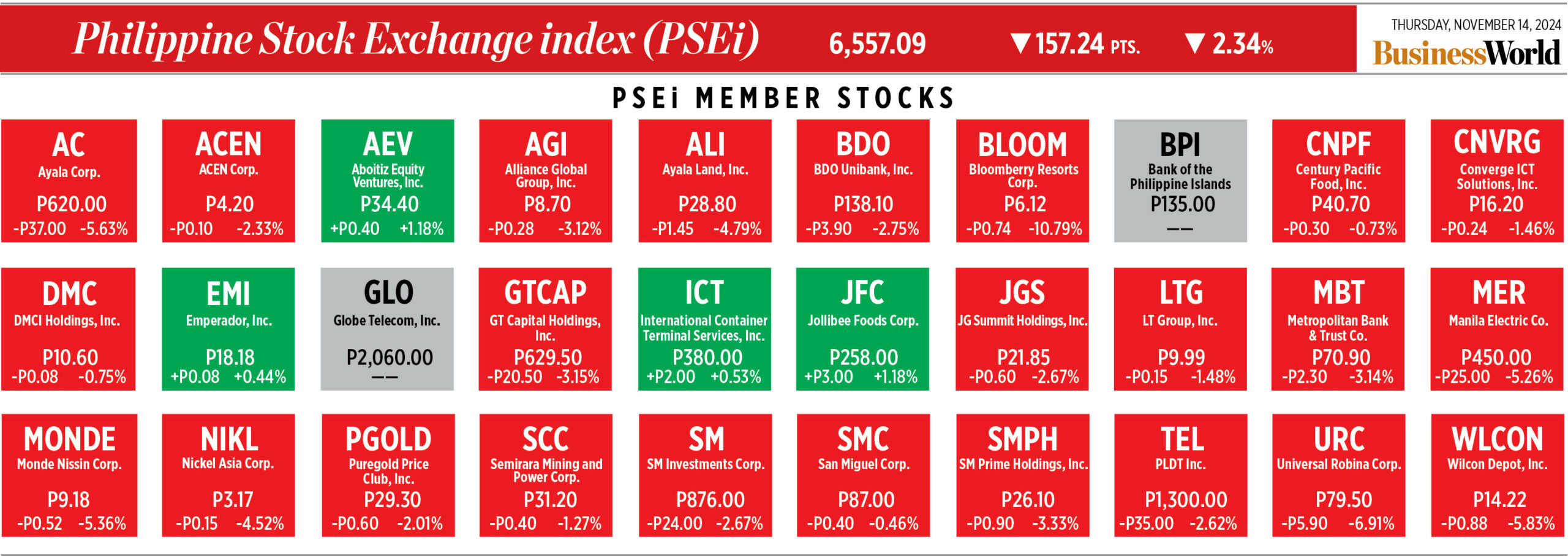
How PSEi member stocks performed — November 14, 2024

Here’s a quick glance at how PSEi stocks fared on Thursday, November 14, 2024.


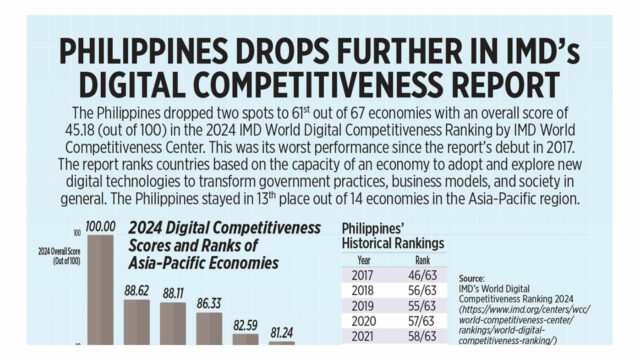
Philippines drops further in IMD’s Digital Competitiveness Report

The Philippines dropped two spots to 61st out of 67 economies with an overall score of 45.18 (out of 100) in the 2024 IMD World Digital Competitiveness Ranking by IMD World Competitiveness Center. This was its worst performance since the report’s debut in 2017. The report ranks countries based on the capacity of an economy to adopt and explore new digital technologies to transform government practices, business models, and society in general. The Philippines stayed in 13th place out of 14 economies in the Asia-Pacific region.

Philippines drops further in IMD’s digital competitiveness report

Green energy auction 3rd round to offer 4,475 MW of RE capacity

BW FILE PHOTO

THE Department of Energy (DoE) said it plans to offer 4,475 megawatts (MW) worth of renewable energy (RE) capacity in the third round of the green energy auction (GEA-3).

The DoE issued the notice of auction and the terms of reference for GEA-3, inviting qualified energy developers to participate in the bidding aimed at facilitating the energy transition.

“By unlocking more capacity for renewable energy, GEA-3 provides a clear pathway to meet our electricity demands in an environmentally sustainable way,” Energy Secretary Raphael P.M. Lotilla said in a statement on Thursday.

The terms of reference state that technologies ineligible for the feed-in tariff (FIT) make up the bulk of the offer, including 4,000 MW of pumped storage hydropower capacity, for delivery between 2028 and 2030.

The DoE will also offer 300 MW of impounding hydropower capacity for 2028-2030 delivery, and 100 MW of geothermal capacity for 2025-2027 delivery.

The FIT-eligible renewable energy technology projects include 75 MW of run-of-river hydro due for delivery between 2027 and 2029.

The GEA program aims to promote renewable energy as a primary source of energy, subject to competitive selection. The government is hoping to increase the share of renewable energy in the power mix to 35% by 2030 and 50% by 2040.

“These projects will play a crucial role in meeting the country’s growing electricity demand while ensuring that future power generation is increasingly sustainable,” the DoE said.

The GEA was first staged in 2022 and resulted in 1,996.93 MW worth of renewables being awarded. GEA-2 was held in 2023, with 3,440.756 MW awarded.

The Energy Regulatory Commission (ERC) will set parameters for each type of renewable energy facility covered in the GEA program via a price determination methodology (PDM).

ERC Chairperson and Chief Executive Officer Monalisa C. Dimalanta said that the commission is hoping to release the PDM early next month. — Sheldeen Joy Talavera

NGCP capex to exceed P600 billion for over 100 transmission projects

BW FILE PHOTO

THE National Grid Corp. of the Philippines (NGCP) said it is allocating more than P600 billion in capital expenditure (capex) for over 100 transmission projects in its pipeline.

“Moving forward, we want to spend over P600 billion,” NGCP Spokesperson Cynthia P. Alabanza told reporters on Thursday.

The grid projects form part of the Transmission Development Plan (TDP) 2024-2050, which are “ready for implementation.”

Major projects include the Balaoan-Laoag 500-kilovolt (kV) Transmission Line, the Western Luzon 500-kV Backbone Stage 2, the Tuy-Dasmariñas 500-kV Line and the Batangas-Mindoro Interconnection.

Visayas projects are the Cebu-Lapu-Lapu 138-kV Line, the Amlan-Dumaguete 138-kV line, the Luzon-Visayas HVDC Bipolar Operation, the Calbayog-Allen 138-kV Line, the Nabas-Caticlan-Boracay 138-kV Line, the Panay-Guimaras 138-kV Line, and the Barotac-Viejo-Unidos 230-kV Line.

The NGCP is also constructing the Laguindingan 230-kV Substation and the Kabacan 138-kV Substation in Mindanao.

The grid operator unveiled its long-term grid development plan which covers 2040-2050. The plan is designed “to address the needs of the power grid, ensuring its reliability and stability to prevent transmission-related outages.”

“Our TDP is a desktop plan that may or may not happen because things can change… It is a horizon planning exercise that will materialize during the regulatory period (RP) process,” Ms. Alabanza said.

The rate reset process is usually a forward-looking exercise that requires the regulated entity to submit forecasted expenditures and proposed projects over a five-year regulatory period for the ERC to review and adjust.

NGCP President and Chief Executive Officer Anthony L. Almeda said he is hoping for a “fair” resolution of its rate reset. 

“(We want it to be) fair for all and just follow the rules of the agreement. At the end of the day, we follow all agreements,” Mr. Almeda.

Last week, the Energy Regulatory Commission (ERC) issued the draft final determination for NGCP’s 4RP, covering the years 2016 to 2022.

In the draft, the ERC is hoping to set allowable revenue for NGCP of P310 billion, against the P522 billion sought by the NGCP.

Asked to comment, Ms. Alabanza said that the NGCP is still studying the draft final determination and is hoping to submit its comments within the month.

“The NGCP is looking at computations and drafting our position on that. We still don’t have a statement, pending the result of our assessment,” she said. — Sheldeen Joy Talavera

German chamber says PHL must deal urgently with bird flu crisis

REUTERS

THE German-Philippine Chamber of Commerce and Industry, Inc. (GPCCI) said preventive measures are urgently needed to address avian influenza (AI), which it called a threat to food security in the Philippines.

“Avian influenza remains a significant challenge for food security and the poultry industry in the Philippines,” GPCCI said in a statement dated Nov. 12.

“Recent avian influenza cases have underscored the urgent need for comprehensive preventive measures, with ongoing government surveillance and biosecurity updates,” it added.

Asked for detailed recommendations, the chamber called for the streamlining of the approval process for avian influenza vaccines “to address the urgent need for effective protection against this disease, as there is no AI vaccine yet that is registered and authorized for use,” it said.

As of Nov. 4, the Bureau of Animal Industry said seven provinces are currently affected by avian influenza.

It also cited is a single ongoing case in San Luis, Pampanga, featuring the avian influenza subtype HSN1.

On Oct. 29, the GPCCI and Boehringer Ingelheim Philippines hosted a roundtable discussion with Philippine agriculture agencies on avian influenza.

“GPCCI is honored to have created this platform for discussion, enabling the alignment of government, industry, and academic communities in addressing a critical and timely issue,” according to Christopher Zimmer, executive director of GPCCI.

“We hope to advance sustainable solutions that protect not only the poultry sector but also public health and the food security of millions,” he added.

Germany is among the Philippines’ top sources of meat, particularly beef. As of August, the Philippines imported 2.4 million kilograms of beef cuts and offal from Germany. — Justine Irish D. Tabile

Fisheries output drops 5% in Q3

PHILSTAR FILE PHOTO

FISHERIES production fell 5.1% year on year in the third quarter, with declines reported across all segments of the industry, according to the Philippine Statistics Authority (PSA).

In its quarterly fisheries report, the PSA said production declined to 965,751 metric tons (MT) during the period.

“Decreases in production were noted in all subsectors, namely, commercial, marine municipal fisheries, inland municipal fisheries, and aquaculture,” the PSA added.

It added aquaculture output fell 2.8% to 512,472 MT. The segment accounted for 53.1% of fisheries production.

Commercial fisheries production declined 8.4% year on year to 210,854 MT. It accounted for 21.8% of overall fisheries output.

Marine municipal fisheries, which accounted for 20.3% of overall output, declined 5.4% to 196,125 MT.

Inland municipal fisheries production declined 12.2% to 46,263 MT. Its output was equivalent to 4.8% of overall fisheries production.

The PSA added that of the 21 major fish species, round scad (galunggong) production fell 17.2%, big-eyed scad (matangbaka) output fell 23.0%, milkfish (bangus) output fell 6.9%, seaweed declined 1.5%, and yellowfin tuna (tambakol) fell 18.6%.

Output grew for skipjack (18.9%), P. Vannamei shrimp (19.4%), bigeye tuna (40.1%), blue crab (9.5%), and threadfin bream (7.2%). — Adrian H. Halili

Groundbreaking for MRT-4 seen as early as first quarter

PHILIPPINE STAR/MIGUEL DE GUZMAN

THE Department of Transportation (DoTr) hopes to break ground on Metro Rail Transit Line 4 (MRT-4) within the first quarter of 2025.

“The groundbreaking will be next year; we are just finalizing the project’s detailed engineering design… Hopefully by the first quarter,” Transportation Secretary Jaime J. Bautista told reporters on Thursday.

Mr. Bautista said the DoTr has obtained funding for MRT-4 from the Asian Development Bank (ADB).

“It has been arranged, the loan is approved,” he added.

The DoTr said in July that it is hoping to obtain a $1.5-billion loan for the construction of MRT-4.

In May, the ADB said it plans to approve a $1-billion loan by next year to fund the construction of the MRT-4. The Beijing-based Asian Infrastructure Investment Bank also said last year that the Philippines is seeking a loan of about $537.4 million.

The MRT-4 will run 12.7 kilometers from the Epifanio de los Santos Avenue (EDSA)-Ortigas Ave. junction to Taytay, Rizal. It will have 10 stations.

Once operational, the MRT-4 is expected to serve more than 400,000 passengers daily, the DoTr has said. — Ashley Erika O. Jose

PCCI sees CREATE MORE yielding sustained growth

President Ferdinand R. Marcos Jr. signs the Corporate Recovery and Tax Incentives for Enterprises to Maximize Opportunities for Reinvigorating the Economy (CREATE MORE) Act into law during a ceremony at Malacañan Palace, Nov. 11, 2024. — NOEL B. PABALATE/PPA POOL

THE Philippine Chamber of Commerce and Industry (PCCI) expects the latest round of tax reforms to support long-term growth of the business sector.

In a statement on Thursday, the PCCI said the Corporate Recovery and Tax Incentives for Enterprises to Maximize Opportunities for Reinvigorating the Economy (CREATE MORE) law’s business-friendly features include simplified tax administration, clearer guidelines for tax incentive applications, and refinements in the tax exemption system, adding that these features add predictability to business operations.

“These provisions significantly improve tax certainty and create a more sustainable incentive framework,” PCCI President Enunina V. Mangio said.

“Under a more favorable and predictable tax environment, businesses can better plan for long-term growth. We can likewise expect to attract more foreign direct investment,” she added.

President Ferdinand R. Marcos, Jr. on Monday signed into law the CREATE MORE Act, which further reduces the corporate income tax to 20% from 25% for registered business enterprises (RBEs).

It also allows RBEs to take a 100% deduction on power expenses in a taxable year, up from 50% allowed by the Tax Code.

“One of the major considerations for investing in energy-intensive industries such as manufacturing and data centers where our country is emerging as a preferred destination is the high cost of power,” Ms. Mangio said.

“The increased deduction on power expenses is one way of addressing such concerns,” she added.

In a statement on Wednesday, the Philippine Exporters Confederation, Inc. (Philexport) also welcomed the new law, noting that it will attract more foreign investment and support business expansion plans.

“The CREATE MORE Act is set to bring transformative benefits by attracting new foreign investors who will now enjoy a more liberalized investment policy environment while supporting local businesses in their expansion plans,” said Philexport President Sergio R. Ortiz-Luis, Jr.

“Given its investor-friendly features, it has the potential to create more jobs and stimulate economic growth through enhancements in the country’s tax incentives regime, making it more competitive and attractive to both domestic and international investors,” he added. — Justine Irish D. Tabile

ADVERTISEMENT
ADVERTISEMENT