Home Blog Page 2367

ANI accuses OpenAI of using content without permission

REUTERS/DADO RUVIC/ILLUSTRATION

NEW DELHI — Indian news agency ANI has sued OpenAI in a New Delhi court, accusing the ChatGPT creator of using its published content without permission to help train the artificial intelligence (AI) chatbot, something that OpenAI says it has stopped doing.

ANI is the latest news organization globally to take OpenAI to court following lawsuits in the US by newspapers including the New York Times and the Chicago Tribune.

The first hearing in the case took place in the New Delhi High Court on Tuesday, where the judge issued a notice to OpenAI to provide a detailed response to ANI’s accusations.

In a statement, ANI said “the court is required to decide the legitimacy of the use of publicly available proprietary content by AI platforms.”

ANI also accused OpenAI’s ChatGPT of attributing fabricated news stories to the publication, according to its court submission dated Monday, a copy of which was reviewed by Reuters.

The court filing contained e-mails sent by OpenAI’s lawyers in India to ANI saying the Indian news agency’s website had been placed on an internal block list since September, ceasing usage of its content in future training of AI models.

ANI, however, argues that its published works are “permanently stored in the memory of ChatGPT” and “there is no programmed deletion.”

Asked about the ANI lawsuit, a spokesperson for OpenAI said in a statement: “We build our AI models using publicly available data, in a manner protected by fair use and related principles, and supported by long-standing and widely accepted legal precedents.”

OpenAI and other tech companies have faced a wave of lawsuits by authors, visual artists, music publishers and other copyright owners for allegedly exploiting their work without permission. OpenAI has denied copyright infringement.

ANI in its filing said that OpenAI had “refused to obtain a lawful license or permission” for the use of original works by ANI.

The media firm is concerned about unfair competition as OpenAI has commercial partnerships with other news organizations to distribute their content, ANI said in its statement. 

The AI firm has entered into licensing arrangements with news organizations such as the Financial Times and Associated Press for similar use of copyrighted content, it said.

A spokesperson for Reuters, which holds a 26% interest in ANI, said it was not involved in ANI’s business practices or operations.

In its statement, OpenAI said that it was engaged in partnerships with many news organizations around the world and was holding talks to explore more, similar opportunities, including in India.

The court is set to next hear the case on Jan. 28. — Reuters

Mass casualty attacks in China put focus on mental health

STOCK PHOTO | Image by kjpargeter from Freepik

SHANGHAI — Two high-profile mass killings and a car crash at a primary school in just over a week are raising questions about how well-equipped China is to deal with the stresses of a slowing economy and related mental health issues.

Since Nov. 11, China has reeled under news of a driver reportedly angry at his divorce settlement killing 35 people by ramming his car into a crowd in Zhuhai; a former student on a stabbing rampage at a vocational college in Wuxi killing eight; and a car ploughing into a crowd of school children and pedestrians in the city of Changde on Tuesday.

In the Changde case, it was not clear if the incident was caused deliberately. However, police said they had arrested the driver and investigations were in progress.

The events have led to a spike in worries about the overall health of society in China, where mass casualty attacks have occurred with alarming regularity throughout 2024.

In the Zhuhai and Wuxi cases, brief statements made public by police about the suspects indicate these attacks were perpetrated by men lashing out against unrelated bystanders after suffering an economic loss.

As the economy slows, employment opportunities are more precarious and fewer people are being lifted up by China’s long-running economic miracle. The repercussions on mental health from such economic pressures are growing, experts say.

George Magnus, associate at Oxford University’s China Centre and the author of Red Flags: Why Xi’s China is in Jeopardy says the spate of mass casualty incidents in China “speak to a pattern, rather than an aberration.”

Research by the Washington-based Center for Strategic and International Studies in July identified a widespread perception in China that lack of success was attributable to unfairness and systemic causes.

“I think this goes a long way in explaining the social and industrial malaise evident in the spate of incidents, and sends out warning signals about the state of society,” Mr. Magnus said.

Xiaojie Qin, a Beijing-based psychotherapist and director at mental health non-profit CandleX, says that a pervasive sense of societal unfairness and disparity can lead in extreme cases to violence against random bystanders.

“Some people who were left behind and socially and economically more marginalized can feel they are not being treated fairly and some people who don’t have enough emotional regulation, they have outbursts, sometimes violent outbursts,” she said.

CENSORSHIP HEIGHTENS CONCERN
China’s official crime statistics show that its rates of violent crime are much lower than global averages.

But the recent spate of incidents has raised questions about public safety in China, where citizens have long been proud of streets safe from violence.

The widespread censorship of discussion around the attacks has also appeared to heighten concerns as more people question the veracity of information they are receiving from official sources, analysts said.

“It can exacerbate societal fears and distrust of the government within China, particularly if seemingly random, large-scale violent incidents persist as they have this year,” said Drew Thompson, a senior fellow at the S. Rajaratnam School of International Studies in Singapore.

Qu Weiguo, a Fudan University professor, said the recent cases of “indiscriminate revenge against society” in China had some common features: Disadvantaged suspects, many with mental health issues, who believed that they had been treated unfairly and who felt they had no other way to be heard.

In an essay posted, then quickly censored, on social media Mr. Qu wrote that while counseling support could ease the problem, better ways of upholding individual rights could also provide an outlet for the aggrieved.

“The lack of access to mental health services is one reason disaffected people resort to violence, but the lack of an independent legal system that protects individuals’ rights over the interests of the party or government results in a lack of trust and faith in the courts,” Mr. Thompson added.

According to Sami Wong, a psychotherapist and managing director of 3Drips Psychology, a research firm, China has responded to higher incidences of psychological distress in recent years — for example stemming from the COVID-19 pandemic — with increased investments in mental health infrastructure.

But while many qualified therapists have emerged in China, people remain reluctant to reach out for help, more than elsewhere in the world, because of what they see as the stigma attached to mental health issues, she said.

“A lot of people still have this social stigma about seeking therapeutic help. So even though the resources are there, they’re very reluctant to use it,” she said. — Reuters

Trump picks Wall Street CEO Lutnick to run Commerce dep’t

HOWARD LUTNICK — EN.WIKIPEDIA.ORG

WASHINGTON — US President-elect Donald J. Trump said on Tuesday he will nominate Wall Street Chief Executive Officer Howard Lutnick to lead his trade and tariff strategy as head of the Commerce Department, the agency that has become the US weapon of choice against China’s tech sector.

Mr. Lutnick, the head of brokerage firm Cantor Fitzgerald, will also have “additional direct responsibility” for the US Trade Representative’s (USTR) office, Mr. Trump said in a statement.

Mr. Trump’s transition team did not respond to requests for clarity on Mr. Lutnick’s responsibilities, including whether he would also serve as US Trade Representative, traditionally the top US trade policy job.

The USTR reports directly to the President and different committees in Congress handle oversight for the two agencies.

With the appointments, Mr. Trump taps a long-time friend who backs the Republican’s vision to bring manufacturing jobs back to the US and promote the adoption of cryptocurrency.

Mr. Lutnick also runs brokerage BGC Group and is chairman of Newmark Group, a commercial real estate services firm, and FMX, a platform owned by some of Wall Street’s biggest banks and traders. Shares of BGC fell 2.6%.

Mr. Lutnick’s appointment was a setback to two other Trump supporters who had vied for the Commerce job, former small business administrator Linda McMahon and ex-USTR Robert Lighthizer.

CNN reported that Ms. McMahon, who along with Mr. Lutnick co-chaired Mr. Trump’s transition team, is expected to be named education secretary, heading a department that Mr. Trump proposed abolishing during his campaign.

Mr. Lighthizer, who also had been considered an early candidate for Treasury secretary, could not be reached for comment.

TRADE WEAPONS
The Commerce Department oversees a sprawling array of functions with nearly 47,000 employees, from the US Census Bureau to weather forecasting, ocean navigation and investment promotion.

Its trade-related functions have grown in importance in recent years. They include authority over export controls on sensitive US technologies, which have put it at the center of trade conflicts with China, as well as investigating anti-dumping and anti-subsidy cases that often result in punitive tariffs to protect domestic industries.

Mr. Trump used Commerce’s authority over the “Section 232” national security trade statute to underpin his 2018 tariffs on steel and aluminum and may invoke it again to impose broad global tariffs on imports, trade experts say.

To rebuild the US manufacturing base, Mr. Trump has vowed to impose new tariffs of at least 60% on Chinese imports and 10%-20% on goods from elsewhere — moves that economists say would upend global trade flows and raise costs.

Fearing Beijing could weaponize American technology to strengthen its military, both the Trump and Biden administrations have used Commerce Department authorities aggressively to impose regulations to halt the flow of US and foreign technology to China – with a special emphasis on semiconductors and the equipment used to make them.

Over the past two years, the US has issued sweeping export controls on advanced chips and chipmaking equipment to China, which has limited its access to cutting-edge chips for artificial intelligence and equipment needed to produce the next generation of semiconductors.

TARIFF BACKER
Unlike other members of Mr. Trump’s inner circle, Mr. Lutnick does not speak about China often. He is a big proponent of tariffs, especially aimed at China. According to the New York Times, the investment banker said in a podcast interview last month: “Don’t tax our people. Make money instead. Put tariffs on China and make $400 billion.”

Cantor Fitzgerald, with offices in Hong Kong, underwrote Chinese biotech firm Adlai Nortye’s Nasdaq initial public offering last year. It was the first Chinese listing since Beijing implemented new rules requiring companies in China to obtain a special filing before going public overseas.

The next commerce secretary will enforce a range of rules put in place to hamper China’s development of artificial intelligence and keep some of its biggest tech firms, including Huawei Technologies and Semiconductor Manufacturing International, several steps behind their global competition in key technologies.

As co-chair of Mr. Trump’s transition team, Mr. Lutnick had been seen for weeks as a possible candidate for a position in the Trump administration, including Treasury secretary.

A native of New York City’s Long Island suburbs with a background in trading and real estate, Mr. Lutnick has been one of Mr. Trump’s top Wall Street advocates, hosting fundraisers and touting his policies in the media. — Reuters

First Asia K-Banker School empowers global leaders in digital finance

Filipino student among participants, talks about PHL’s financial landscape

By Miccel Mendoza
Korea University, Computer Science and Engineering

Yeouido, Seoul — 30 international students from over 20 countries gathered at Kookmin Bank’s new building to participate in Asia K-Banker School, a workshop focused on digital finance and its transformative potential.

The two-day program, held last Nov. 15-16, featured a blend of team-building activities, expert lectures, in-depth discussions, article writing, and networking opportunities. The selection process was rigorous, involving an initial document screening followed by interviews to ensure that the most qualified candidates were chosen to represent their nations.

Among the participants, a Filipino student was selected to showcase the Philippines’ financial landscape and its progress in digital finance.

The workshop commenced with a foundational lecture on the state of Korea’s and the global financial landscape, equipping participants with the context needed for subsequent discussions. A follow-up session delved into the public value and sustainability of finance, exploring how financial systems can drive long-term societal benefits.

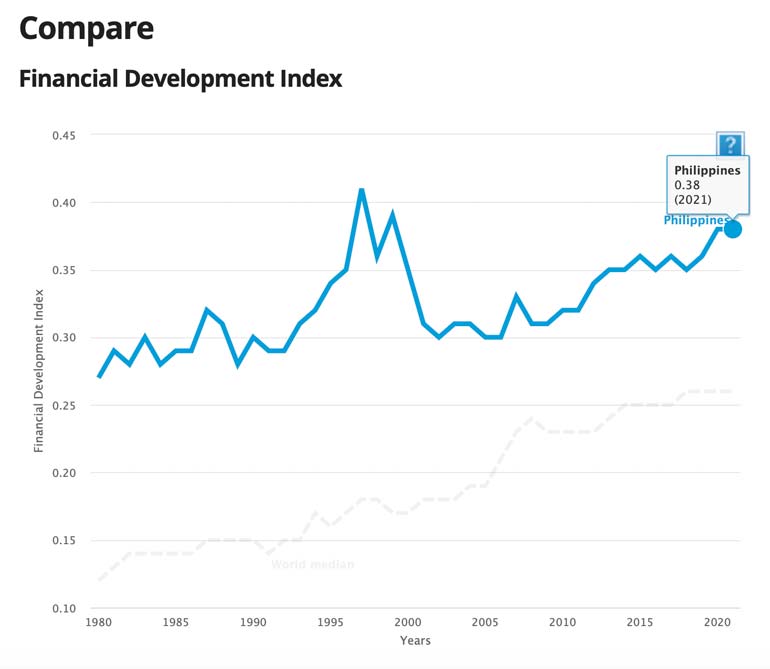
A graph showing the Philippines’ Financial Development Index over the past 30 years, providing more insight into the country’s current financial status — Source: IMF

The Financial Development Index represents a country’s relative ranking in terms of the depth, accessibility, and efficiency of its financial institutions and markets. In the case of the Philippines, which is considered a developing country and often assessed as lagging behind advanced economies in terms of economic development, the index reveals notable trends. According to the International Monetary Fund (IMF), the Philippines’ Financial Development Index rose sharply from 0.29 in 1991 to 0.41 in 1997. It then declined to 0.3 by 2002 before showing a generally steady upward trend, reaching 0.38 again in 2021. While the Philippines has consistently remained above global and regional medians, its scores in recent years suggest room for improvement relative to neighboring countries.

The workshop also included an engaging lecture about the advancement of digital technology and finance. In this talk, the participants acquired knowledge about fintech’s latest cutting-edge technology. Fintech is driven by four key technologies: AI, blockchain, cloud computing, and big data. The world is shifting towards digital finance, and its importance cannot be understated.

Just a few years ago, living without cash in the Philippines was nearly impossible due to the heavy reliance on cash transactions. However, in recent years, cashless transactions have gradually become more common, particularly among the younger generation. Internet banking and mobile banking platforms like BDO Online Banking and the BPI Mobile App have significantly improved access to financial services by offering 24/7 access, transaction tracking, and a variety of comprehensive financial services.

Moreover, the real-time payment system known as the Unified Payments Interface (UPI) is gaining attention in the Philippines. Platforms supporting UPI now enable instant fund transfers between various banks and financial institutions. Digital wallets such as GCash and Maya, which offer similar functionalities to UPI, have become leading platforms in the country. These platforms provide a wide range of financial services, including P2P payments, merchant transactions, QR code-based payments, loans, investments, and cryptocurrency services. They go beyond simple payment platforms, serving as one-stop solutions for users seeking a convenient, cashless way to manage their finances. The ability to offer diverse services within a single app appears to be highly appealing to users.

Additionally, neobanks (digital-only banks) are introducing innovative financial products such as quick onboarding, fee-free accounts, high-yield savings accounts, and instant loans, offering a simplified, user-centric experience. Their fully digital operations allow users to open accounts and access services within minutes. In the Philippines, Tonic Bank has gained significant popularity, especially among younger users who value convenience and accessibility. 

The Philippines has made significant progress but still has a long way to go in the digital finance sector. Digital payment options such as GCash and Maya have to become even more accessible for everyone. Internet connectivity issues and security concerns have to be addressed. Most importantly, support for Filipino citizens who are unable to adjust with the rapid transition to the digital world must be made available. If concerted efforts are made, we could see the Philippines joining the developed countries in leading the digital finance landscape. 

This event was sponsored by Kookmin Bank, providing support and additional scholarships for outstanding participants. The initiative aligns with Kookmin group’s goal to deliver services that bring happiness and well-being to their customers and to the society. 

This milestone event reflects Korea’s commitment in cultivating global leaders all over the world and eagerness in fostering a collaborative approach to shaping the future of digital finance.

Biden approves anti-personnel mines for Ukraine, US official says

REUTERS

President Joe Biden has approved provision of anti-personnel land mines to Ukraine, a U.S. official told Reuters, a step that could help slow Russian advances in its east, especially when used along with other munitions from the United States.

The United States expects Ukraine to use the mines in its own territory, though it has committed not to use them in areas populated with its own civilians, the official said. The Washington Post first reported the development.

The office of Ukraine’s President Volodymyr Zelenskiy, the Ukrainian defense ministry, the Russian defense ministry and the Kremlin did not immediately respond to Reuters’ requests to comment.

The United States has provided Ukraine with anti-tank mines throughout its war with Russia, but the addition of anti-personnel mines aims at blunting the advance of Russian ground troops, the official added, speaking on condition of anonymity.

The U.S. mines differ from Russia’s as they are “non-persistent,” and become inert after a preset period, the official said. They require a battery to detonate, and will not explode once the battery runs out.

On Tuesday, Ukraine used U.S. ATACMS missiles to strike into Russian territory, taking advantage of newly granted permission from Biden’s outgoing administration on the war’s 1,000th day.

Moscow said the use of ATACMS, the longest-range missiles Washington has yet supplied to Ukraine, was a clear signal the West wanted to escalate the conflict.

On Tuesday, Russian President Vladimir Putin lowered the threshold for a nuclear strike in response to a broader range of conventional attacks.

The move followed months of warnings to the West that if Washington allowed Ukraine to fire U.S., British and French missiles deep into Russia, Moscow would consider those NATO members to be directly involved in the war in Ukraine. – Reuters

Skills shortage hobbles India’s clean energy aspirations

MACROVECTOR-FREEPIK

 – India’s ambitious plan to expand domestic manufacturing is coming up short in the solar industry which is grappling with inadequate government funding and a skills shortage, potentially jeopardizing its clean energy targets, industry leaders said.

The hurdles faced by manufacturers of solar panels, cells and storage batteries are raising costs and delaying projects, threatening India’s ability to reduce its carbon footprint and meet international climate commitments, they said.

It also throws into sharp relief the challenges facing Prime Minister Narendra Modi’s “Make in India” program, which seeks to bolster 15 sectors, including renewable energy and electronics, in an effort to turn the South Asian nation into a global manufacturing hub.

Mr. Modi’s government has imposed 40% tariffs on Chinese solar panels and 25% on cells, allocating about $3 billion in production-linked incentives for local manufacturers as part of a plan for net zero carbon emissions by 2070.

However, industry executives say India – the world’s third-largest emitter of greenhouse gases – must significantly step up funding and training programs in the renewables sector to meet its goal of expanding non-fossil fuel capacity by 50 GW annually to 500 GW by 2030.

They caution that the absence of stronger government action could also thwart its broader manufacturing drive that has seen it plough nearly $24 billion in state incentives over a five-year period, with another roughly 20 billion rupees set aside annually for upskilling and training.

A shortage of skilled manpower is a major problem, said Dwipen Boruah, managing director of renewables consultancy firm GSES India, which has trained over 7,000 people in renewable technologies and wants the government to substantially lift subsidies for education and training in the sector.

“Hundreds of private institutes exploit these subsidies but offer subpar training,” he said, adding that small subsidies – often just a few thousand rupees per student – hinder effective education.

Boruah and other industry executives note that while India produces over a million engineering graduates annually, traditional colleges are not equipped to teach solar, wind and other renewable technologies.

Some executives say the government’s current training budget of around 5-6 billion rupees should be ramped up by a factor of 10.

The ministry responsible for skills development didn’t respond to an email seeking comment.

Last week, Pralhad Joshi, India’s minister for renewable energy, announced the formation of a joint panel with industry representation to address key issues, including training, to meet clean energy targets.


A 1.2 MILLION PROBLEM

The renewable industry faces a skill gap of around 1.2 million, with demand expected to rise by 26% creating a need for 1.7 million skilled workers by 2027, according to TeamLease Services, a staffing company, working with industry and government on training.

“The skill gap spans all levels of industry,” especially in emerging technologies like cell manufacturing, battery storage, and advanced grid integration, said Ashwani Sehgal, president, Indian Solar manufacturers Association.

“Industry is facing near 20% attrition of talented workers annually, posing a risk to production plans.”

Earlier this year, the government proposed to step up support for upskilling and relax visa restrictions on Chinese technicians, after many firms said that costly imported machines were lying unused due to lack of skilled workers.

Vaishali Nigam Sinha, co-founder of ReNew, one of India’s largest renewable firms with nearly 10 GW of capacity, said skills shortage is one of the most “underestimated barriers” to energy transition.

“The lack of skilled engineers, technicians, and project managers is pushing up operational costs,” she said, a concern echoed by several industry executives.

This shortage comes as India speeds up plans for 35 GW of solar and wind capacity by March 2025, driven by a projected 7% annual increase in power demand.

Manufacturers say the skills gap could also limit India’s plans to expand solar module exports, touching $1.9 billion last fiscal year, mainly to the U.S. market.

Tata Power, with 6 GW of renewable capacity, has set up 11 training facilities, training 300,000 youth in solar installations, battery management, and other green technologies.

“A skilled workforce is essential for accelerating project deployment, ensuring efficient operations and maintenance and driving technological innovation,” said Himal Tewari, company’s chief human resources officer.


REMOTE CHALLENGE

In Greater Noida, a manufacturing hub on the outskirts of Delhi, companies are scrambling to hire new employees.

Job ads for solar design engineers, technicians, installers and sales managers are flooding job portals, with salaries ranging from 20,000 rupees to 100,000 rupees ($239 to $1200) per month.

Monica Sehgal, director of Alpex Solar, said the company was offering incentives and overseas training in Taiwan and Vietnam to attract talent.

However, retaining workers at remote locations, particularly in Rajasthan and Gujarat, remains challenging as employees often prefer to work in bigger cities.

Kapil Sharma, a 19-years old technician, landed a job with a hefty salary hike at the Alpex factory, on the outskirts of Delhi, after working with a company in the remote Rajasthan desert.

“I had never seen a solar panel during my three-year electrical engineering course, and received all training on the job,” he said while operating a panel manufacturing machine.

Sharma said a job in a panel factory offered higher pay compared to textile or auto factories, allowing him to send 20,000 rupees a month back home.

“I am now waiting for an overseas training and higher increments.” – Reuters

Hong Kong pro-democracy tycoon Lai testifies in national security trial

Photo of Hong Kong tycoon Jimmy Lai by Studio Incendo/CC BY 2.0/Wikimedia Commons

 – Hong Kong pro-democracy tycoon Jimmy Lai on Wednesday testified in court for the first time in his years-long national security legal battle on charges of conspiracy to collude with foreign forces, and publishing seditious materials.

Mr. Lai, a British and Hong Kong citizen and a founder of the now-shuttered pro-democracy newspaper Apple Daily, is considered one of the most high profile political arrestees in Hong Kong under a sweeping China-imposed national security law.

His testimony comes just a day after Hong Kong jailed 45 pro-democracy activists for up to 10 years in a separate national security case.

Mr. Lai told the West Kowloon Magistrates Court how his own guiding principles were aligned through his newspaper and with the people of Hong Kong, namely a belief in the rule of law and freedoms including of speech, religion and assembly.

“We were always in support of movements for freedom,” Mr. Lai, wearing a grey blazer and glasses, told the packed courtroom.

Around 100 people queued in the pouring rain huddled beneath umbrellas to secure a place in the , with hundreds of police deployed around the building.

“Apple Daily was the voice of many Hong Kongers,” said William Wong, 64, a retiree. “It’s my political expression to let him (Lai) know I support him. He’s done a lot for Hong Kong.”

Mr. Lai has pleaded not guilty to two charges of conspiracy to collude with foreign forces and a charge of conspiracy to publish seditious material.

Six others had earlier pleaded guilty, including senior staffers of Apple Daily and its parent company Next Digital, to conspiring with Lai to request a foreign country or organization “to impose sanctions or blockade, or engage in other hostile activities” against the Hong Kong and Chinese governments.

Beijing imposed the national security law in July 2020 after months of sometimes violent pro-democracy protests in the Asian financial hub the year before.

Mr. Lai had been held in pre-trial detention for over 1,400 days, before his trial kicked off last December. He is already serving a five year, nine month jail term for a fraud conviction over a lease dispute for his newspaper.

Diplomats from the U.S., U.K., Germany, France, Australia, Switzerland and Ireland were present at the hearing on Wednesday.

The U.S. government has condemned Mr. Lai’s prosecution and called for his immediate release.

If convicted, the 76-year-old could be jailed for life, and his plight could emerge as a friction point between the U.S. and China in the new Trump administration.

When asked last month whether he would speak to Chinese President Xi Jinping to get Mr. Lai out of China if he won the election, President-elect Donald Trump told conservative political commentator Hugh Hewitt in a podcast: “100%”.

“I’ll get him out. He’ll be easy to get out,” Mr. Trump said. – Reuters

Los Angeles passes ‘sanctuary city’ ordinance to protect migrants

STOCK PHOTO | Image by xiSerge from Pixabay

 – The Los Angeles City Council on Tuesday unanimously passed a “sanctuary city” ordinance to protect immigrants living in the city, a policy that would prohibit the use of city resources and personnel to carry out federal immigration enforcement.

The move by the Southern California city, the second most populated city in the U.S. after New York City, follows President-elect Donald Trump’s vow to carry out mass deportations of immigrants.

The ordinance codifies the protection of migrants in municipal law. Council member Paul Krekorian said the measure addresses “the need to ensure that our immigrant community here in Los Angeles understands that we understand their fear.”

Pro-immigrant protesters spoke on the steps of Los Angeles City Hall before the vote, holding up signs saying “Los Angeles Sanctuary City Now!” They chanted in Spanish “What do we want? Sanctuary. When do we want it? Now.”

The city is home to 1.3 million migrants, council members said, without specifying how many entered the country legally.

“We are extremely concerned, given that this is a city where about a third of the population is immigrants,” Shiu-Ming Cheer said at the rally. She is deputy director of immigrant and racial justice at the California Immigration Policy Center.

People were “afraid that the National Guard or other people are going to be forced to execute Trump’s mass deportation plans,” she said. “But, you know, we’re also organized.”

Eleven states have, to varying degrees, taken steps towards reducing cooperation with federal immigration enforcement, according to the non-profit Immigrant Legal Resource Center. Trump, winner of the Nov. 5 election, takes office on Jan. 20.

The Trump transition team did not respond to a request for comment. – Reuters

Bitcoin breaches $94,000 for the first time

PIXABAY

 – Bitcoin rose to a record high above $94,000 as a report that Donald Trump’s social media company was in talks to buy crypto trading firm Bakkt added to hopes of a cryptocurrency-friendly regime under the incoming Trump administration.

Bitcoin, the world’s biggest and best-known cryptocurrency, has more than doubled this year. It was last at $92,104 in Asian hours on Wednesday, having touched a record high $94,078 just toward the end of the previous session.

The Financial Times, citing two people with knowledge, said Trump Media and Technology Group, which operates Truth Social, is close to an all-stock acquisition of Bakkt, which is backed by NYSE-owner Intercontinental Exchange.

Tony Sycamore, market analyst at IG, said bitcoin’s rise to a record high was supported by the Trump deal talk report as well as traders taking advantage of the first day of options trading on the Nasdaq over BlackRock’s Bitcoin ETF.

Cryptocurrencies have soared since the Nov. 5 U.S. election as traders bet President-elect Trump’s promised support for digital assets would lead to a less restrictive regulatory regime and inject some life back into bitcoin after a listless few months.

The growing excitement has taken the global cryptocurrency market’s value above $3 trillion to a record high, based on analytics and data aggregator CoinGecko.

Chris Weston, head of research at Australian online broker Pepperstone, said there is real underlying buying pressure for bitcoin, and “another kick higher should bring in a fresh chase from those who like to buy what’s strong”. – Reuters

Australia critical infrastructure faces cyber threats, report says

FLATART-FREEPIK

 – Australia said it was concerned that one in ten cybersecurity incidents last year involved critical infrastructure, with state-sponsored actors targeting the country’s government, infrastructure and businesses using evolving tradecraft.

The Australian Signals Directorate said in a report on Wednesday over 11% of cyber security incidents last year related to critical infrastructure, including electricity, gas, water, education and transport services.

Of these, a quarter were phishing incidents, 21% were exploitation of a public-facing interface, and 15% brute-force activities.

“We are worryingly seeing an increased focus by both cyber criminals and state actors on our critical infrastructure,” Defence Minister Richard Marles said in a radio interview with the Australian Broadcasting Corporation.

Australia had joined international partners in attributing cyber incidents over the year to ChinaRussia and Iran, he added.

China was evolving cyber techniques, with the choice of targets and behavior “consistent with pre-positioning for disruptive effects rather than traditional cyber espionage operations”, the report said.

Beijing has repeatedly denied claims by the U.S. and Australian governments that it has used hackers to break into foreign computer systems. – Reuters

Philippines to repatriate Filipina drug convict from Indonesia

PHILSTAR FILE PHOTO

MANILA – A Filipina spared from execution on drug trafficking charges in Indonesia in 2015 will be transferred to the Philippines after years of negotiations between the two Southeast Asian neighbors, President Ferdinand Marcos Jr said on Wednesday.

“After over a decade of diplomacy and consultations with the Indonesian government, we managed to delay her execution long enough to reach an agreement to finally bring her back to the Philippines,” Mr. Marcos said in a statement.

Mary Jane Veloso, a domestic helper and mother of two, was arrested in the city of Yogyakarta, for carrying 2.6 kilograms (5.73 pounds) of heroin hidden in her suitcase in 2010.

She was spared from firing squad at the last minute in 2015 after Philippine officials asked then Indonesian President Joko Widodo to allow her to testify against members of a human and drug-smuggling ring.

The execution of eight other drug convicts went ahead, and at the time Widodo described Ms. Veloso’s reprieve as a postponement. Widodo’s term as president ended last month.

“This outcome is a reflection of the depth of our nation’s partnership with Indonesia-united in a shared commitment to justice and compassion,” Mr. Marcos said. “We look forward to welcoming Mary Jane home.” – Reuters

Easing cycle still underway — BSP

BW FILE PHOTO

By Luisa Maria Jacinta C. Jocson, Reporter

CEBU — The Philippine central bank’s easing cycle is still underway though it may opt to keep rates steady at its December meeting, its top official said.

“We’re still in the easing cycle. Either we cut in December, or we cut in the next meeting, but gradually,” Bangko Sentral ng Pilipinas (BSP) Governor Eli M. Remolona, Jr. told reporters on the sidelines of the BSP-International Monetary Fund (IMF) Systemic Risk Dialogue in Mactan, Cebu on Tuesday.

Asked if the central bank could keep interest rates steady at its December meeting, Mr. Remolona said in mixed English and Filipino: “Yes, of course. It depends on the data. We are still not sure about December.”

Mr. Remolona reiterated that the central bank will continue to make rate cuts in 25-basis-point (bp) increments.

He earlier said the BSP may not necessarily reduce rates at every quarter or every meeting.

Since it began its easing cycle in August, the BSP has reduced borrowing costs by a total of 50 bps so far.

The Monetary Board has delivered a 25-bp cut at its meetings in August and October, bringing the benchmark to 6%.

Mr. Remolona had earlier signaled the possibility of a 25-bp cut on Dec. 19, the Monetary Board’s final policy meeting this year.

Meanwhile, he said the weak gross domestic product (GDP) growth in the third quarter was likely an “aberration” and that growth would likely recover in the fourth quarter.

The Philippine economy grew by a weaker-than-expected 5.2% in the third quarter, its slowest growth in five quarters.

This brought GDP growth in the nine-month period to 5.8%. The economy needs to grow by at least 6.5% in the fourth quarter to ensure it can hit the low end of the government’s 6-7% full-year target.

Instead, the central bank is monitoring closely the latest inflation data, Mr. Remolona said.

“The next number to expect is the November inflation number, we’ll see what that is. Our expectation is that it will still be within the target band.”

Headline inflation picked up to 2.3% in October, bringing the 10-month average to 3.3%. This was still within the BSP’s 2-4% target range.

For 2025, the BSP chief said that the Monetary Board could likely deliver rate cuts at the 100-bp range.

“That’s not exact. It could be more, could be less, but that’s in the ballpark,” he added.

PESO PERFORMANCE
Meanwhile, the BSP governor said he is not worried about the peso’s recent performance.

“It’s below P59. We don’t worry so much about whether the peso depreciates, appreciates. We worry about the pass-through effect. Right now, it’s still okay,” Mr. Remolona said.

The peso closed at P58.81 per dollar on Tuesday, depreciating by 13 centavos from its P58.68 finish on Monday, Bankers Association of the Philippines data showed.

Markets are keeping an eye out for whether the peso will sink to the P59-per-dollar level. The peso fell to the record low of P59 per dollar in October 2022.

However, he said the central bank has been intervening in “small amounts.” “A little bit just so it won’t (depreciate sharply against the dollar),” he said.

“We leave it to the guys in the financial markets area, but if it depreciates very sharply, then we talk. If it’s not too sharp, it doesn’t become inflationary. It’s inflationary if it’s sharp and persistent.”

He said the recent peso weakness was expected after Donald J. Trump was elected US president. The US dollar has been on the rise amid market expectations Mr. Trump would implement higher tariffs that could fuel inflation and slow the Federal Reserve’s planned rate cuts.

“We monitor the swings that take place over a few months, not day by day. It is usually expected that the night before, this kind of news will put pressure on the peso.”

ADVERTISEMENT
ADVERTISEMENT