Home Blog Page 2347

Entertainment News (08/27/24)



‘B★VERSE Manila’ exhibition extended

THE IMMERSIVE exhibition “B★VERSE Manila” has been extended until Sept. 1 to accommodate more ARMYs, K-pop fans, and curious individuals who want a glimpse of the BTS experience. The exhibition was extended in time for the birthday of one of its members, Jung Kook. The B★VERSE Pass can also be used as a cinema ticket or availed with a meal at Gateway Mall 1 or 2. For more details on these promos and the extension until Sept. 1, visit this link: https://bit.ly/3AuedA5.


Ace Banzuelo releases new single

FILIPINO singer-songwriter and producer Ace Banzuelo is marking the beginning of a new era with the release of “minsan” (translation: “sometimes,”) a melancholic ballad that merges R&B with dream pop influences. Inspired by personal and common experiences with friends, the song expresses his bouts with betrayal and heartbreak. “Talking about it with friends really helped me heal from what I went through. I think the music can speak for itself,” Mr. Banzuelo said in a statement. “minsan” serves as his first single since 2023’s “Pag-ibig (Meron Ba).” The release of the track highlights a new pivot in Ace’s musical direction to the dream pop genre with non-conventional experimental soundscapes. It is now out on all digital music platforms via Sony Music Entertainment.


Blumhouse thriller Speak No Evil to screen in Philippine cinemas

PRODUCER Jason Blum got a call from an executive who saw a thriller that got under his skin — the 2022 Danish film, Gaesterne. The screenplay went on to be the inspiration for the latest Blumhouse thriller Speak No Evil. The film follows an American family who befriends a British family, and subsequently gets invited to a vacation on their idyllic British farmhouse, a dream getaway that quickly turns into a nightmare. Helmed by horror writer-director James Watkins, Speak No Evil will arrive in Philippine cinemas on Sept. 11 via Universal Pictures International.


Beetlejuice Beetlejuice in Philippine cinemas in September

AS A sequel to the 1988 horror-comedy classic Beetlejuice by Tim Burton, the upcoming Beetlejuice Beetlejuice is set to continue the story of Lydia Deetz, a role reprised by Winona Ryder. This time, the lead is Astrid, her daughter, played by Jenna Ortega, supported by her grandmother Delia, played again by Catherine O’Hara. The three generations of Deetzes must face the return of the franchise’s eponymous creature, brought to life once again by Michael Keaton. “It was such a privilege, and I don’t know what I did to be in this position or be on this project, but it felt like I was thanking my lucky stars for it every day, because it was like a dream come true,” said Ms. Ortega in a statement on joining the Beetlejuice franchise. The sequel will be out in Philippine cinemas on Sept. 4.


Barbie Almalbis drops new single

FOLLOWING the critically acclaimed comeback single “Desperate Hours” last month, singer-songwriter Barbie Almalbis makes her return to the music scene by releasing a second single, “homeostasis.” The title is derived from a biological term that illustrates the body’s way of regulating and adjusting to changing external conditions. The song was born from a challenging phase in Ms. Almalbis’ life, which she channeled into music. “Homeostasis gives me hope that everyday my body is going to adapt and I’d feel less and less terrible in time, because it has that built-in function,” she explained. Nick Lazaro of Eclectic Kiss arranged and produced the song, with Ms. Almalbis penning the material on guitarlele and brother/bandmate Karel Honasan writing the instrumental parts. “homeostasis” is out now on all digital music platforms nationwide.


Transformers One set to arrive in Philippine cinemas

ON Sept. 18, Transformers One will hit cinema screens all over the Philippines. The film is the untold origin story of Optimus Prime and Megatron, better known as sworn enemies, but once-friends, bonded like brothers, and changed the fate of Cybertron forever. It is the first-ever fully CG-animated Transformers movie, directed by Josh Cooley. The star-studded voice cast includes Chris Hemsworth, Brian Tyree Henry, Scarlett Johansson, Keegan-Michael Key, Steve Buscemi, Laurence Fishburne, and Jon Hamm.


Tina Turner tribute comes to Newport World Resorts

THE GROWLING pop sensation Tina Turner will be honored in a tribute concert featuring Chicago-native singer Redd. The cover artist’s ‘rock soul’ energy and live performances echoes Turner’s original signature. She first rose to popularity in the American reality talent competition, The Voice, in 2011, and immediately became a fan favorite for her viral four-chair turn audition. Since then, her talents have taken her all over the world, opening for hip-hop and R&B artists including Miquel, 50 Cent, and Chaka Khan. Her upcoming concert at Newport World Resorts will see her recreate Turner’s hits such as “Simply the Best,” “What’s Love Got to Do With It,” “River Deep Mountain High,” and “Proud Mary.” The two-night concert will be on Sept. 20 and 21 at 8 p.m. Tickets, priced from P1,200 to P9,000, are available via TicketWorld.


Korean series The Judge From Hell to debut on Disney+

THE 14-episode romantic Korean crime drama The Judge From Hell, starring Park Shinhye as a possessed judge sent to earth to bring criminals back to hell, will be debuting on Sept. 21 on Disney+. Ms. Park plays Bitna, a problematic judge known for dishing out light sentences to defendants; now possessed by a demon. Things take a turn when she begins to develop feelings for detective Daon, played by Kim Jaeyeong. Written by Jo Isu and directed by Park Jinpyo, the series beings streaming on Disney+ starting Sept. 21.


Ena Mori to celebrate birthday with Ena Matsuri show

LAST year saw the inaugural edition of Japanese-Filipino indie pop soloist Ena Mori’s birthday show, Ena Matsuri. This year, the second rendition promises a more club-leaning, endorphin-inducing experience at Justin Bella Alonte Photography Studio in Makati City on Sept. 21, 6 p.m. There will be an all-electro/rave/hyper-pop/dance/rhythmic lineup, with dance, art, and interactive elements creating an immersive environment that celebrates modern pop, youth, and online culture. “I wanted to focus on more electronic and rave-y elements, which correlate to what I’ve been listening to lately,” Ms. Mori said in a statement. She herself is co-producing, curating, and conceptualizing Ena Matsuri, with assistance from Offshore Music and GNN Entertainment Productions. Early bird tickets are available at P500 until Aug. 31 only, via https://enamatsuritwo.helixpay.ph/.


J-pop singer-songwriter Fujii Kaze in Manila for Asia tour

THE JAPANESE musician Fujii Kaze has announced that he will be taking the Best of Fujii Kaze 2020-2024 Asia Tour to Asian cities by the end of this year. Compared to his previous tour, it will be scaled up to arena venues and expanded to hit eight cities in the region. The Manila leg of the tour is set for Dec. 10, 8 p.m., at the Mall of Asia arena. Promoted by Ovation Productions and AEG Presents Asia, tickets for the concert are priced from P3,800 to P8,800, on-sale starting Aug. 30 via smtickets.com.
PhilHealth’s idle funds and health spending in Asia

The arguments against the transfer of idle funds of PhilHealth to finance some unprogrammed appropriations are becoming more predictable, repetitive and unconvincing. I summarize below those major arguments.

No. 1, if those unprogrammed appropriations are indeed important, they should have been included in the regular programmed appropriations so they can get regular and not standby funding.

No. 2, much of the congressional “pork” budget was inserted in programmed appropriations, bumping off certain unprogrammed fund projects so that unprogrammed allocations increased to P731 billion from P282 billion in 2024.

No. 3, PhilHealth is a social health insurance fund and not a bank, and people’s premiums cannot be tapped for other government spending, and PhilHealth should not call the unused fund “savings.”

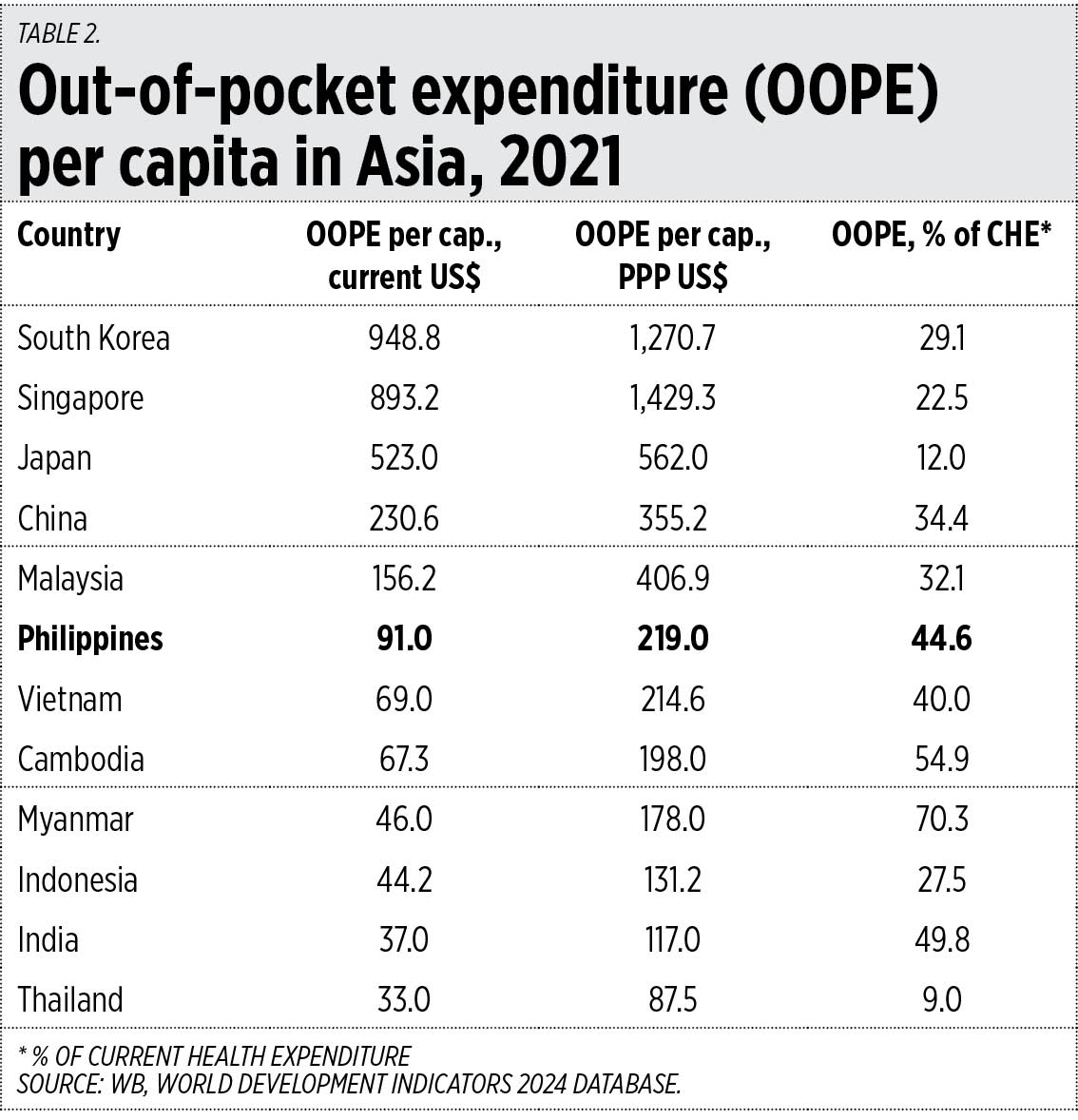
No. 4, high out-of-pocket expenditures (OOPE) in the Philippines, 46% of which are health expenditures, are the third highest in Southeast Asia and only lower than Cambodia and Myanmar.

Since those arguments are repetitive and bordering on being emotional, they are easy to rebut. In this column last month, “On unprogrammed appropriations and Secretary Ralph Recto” (July 30), I already provided some answers to the above claims. I wrote the following:

On No. 1, “The programmed appropriations, our expenditures, are so many that current and future revenues will not be able to catch up resulting in a huge budget deficit… huge interest payments that add more pressure on expenditures, in the first half of 2024 our interest payment was already P377 billion, likely to reach P750 billion in the full year 2024… The budget deficit for 2024 and 2025 would be at the 2023 level of P1.5 trillion.”

On No. 2, “out of the P731 billion in unprogrammed appropriations for 2024, the potential congressional pork barrel fund would be P225 billion on “strengthening assistance for government infrastructure and social programs.” The rest, or P506 billion, is earmarked for foreign-assisted projects (FAP), the Philippines’ counterpart funds, social programs for health and education, etc.”

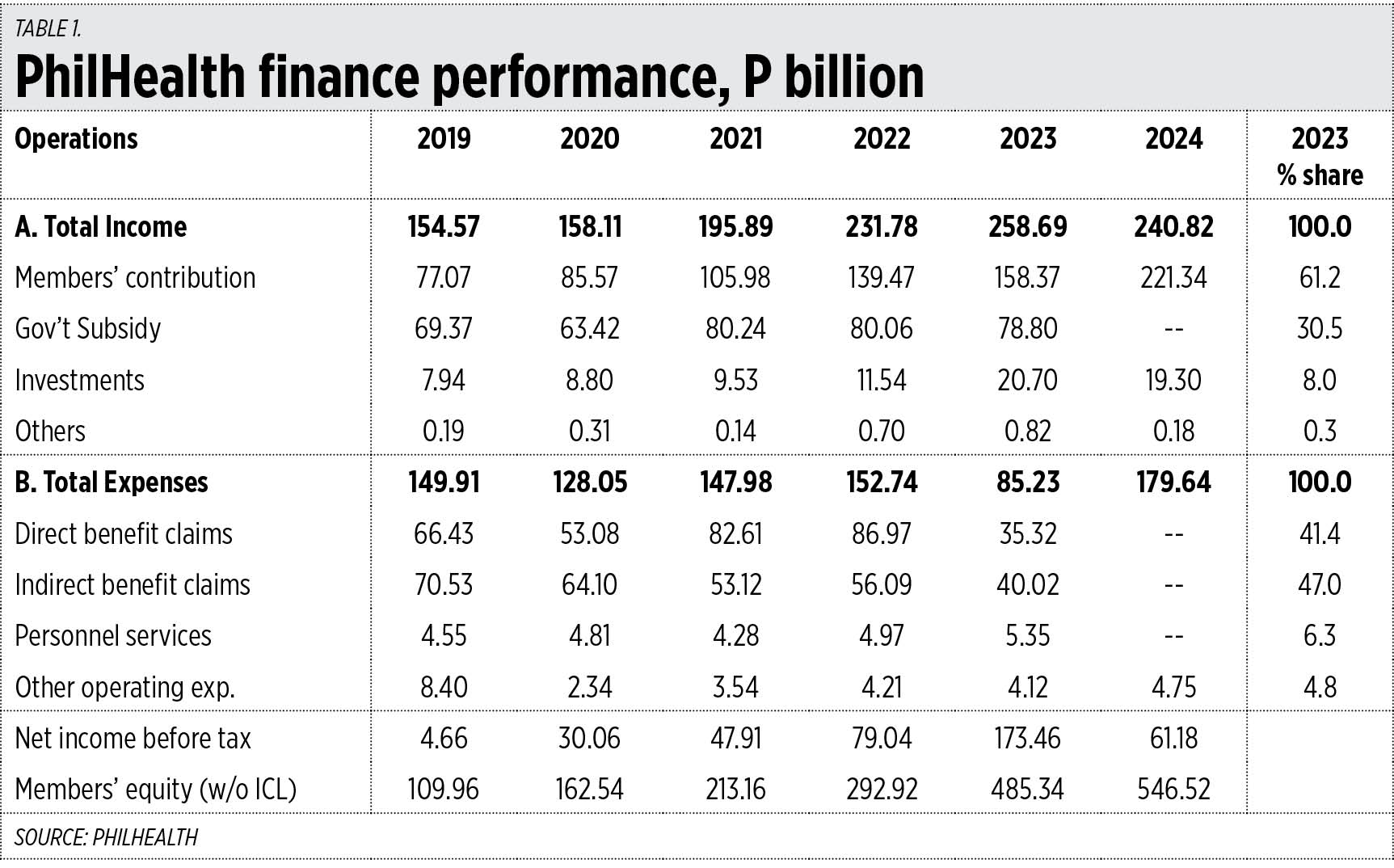
On No. 3, people’s premium payment will not be used. Members’ contributions from 2021 to 2023 ranged from P106 billion to P158 billion. And the members get benefit claims from P85 billion to P153 billion over the same period. It is not members’ money that will be tapped by the Department of Finance (DoF) for unprogrammed appropriations, but money from gamblers and bettors (PAGCOR and PCSO), money from drinkers and smokers of legal products (alcohol and tobacco tax revenues), the average P80 billion/year over the same period (see Table 1).

On No. 4, out-of-pocket expenditures per capita in the Philippines of $91 per person in 2021 was actually higher than those in Vietnam, Cambodia, Myanmar, Indonesia, India and Thailand. Valued in purchasing power parity (PPP) also in 2021, the OOPE per capita in the Philippines of $219 is again higher than those six countries.

I think those numbers on OOPE per capita refer only to National Government health spending (DoH, PhilHealth, UP-PGH, hospitals for AFP, PNP, Veterans, etc.). It’s possible that health spending by local government units is not included yet in the World Bank data. I refer to big hospitals owned and funded by cities and big municipalities.

Consider also this fact: Manila City has the greatest number of public hospitals per square kilometer of land. There are four big DoH hospitals (Jose Fabella, Jose R. Reyes, San Lazaro, Tondo Medical), the lone UP-Philippine General Hospital (PGH) and five or six city-owned hospitals.

Following the hypothesis or narrative that “more public health spending equals better health outcome,” can we argue and state with strong confidence that Manila City residents have the best health outcome, possibly the healthiest people in the Philippines? I doubt it.

The DoF is correct in tapping those idle funds of PhilHealth, especially money from gamblers, drinkers and smokers, to fund some unprogrammed fund projects. It is correct in avoiding to borrow another P90 billion, which when contracted at 6.4% interest rate (average for 10-year government bonds) would mean P5.76 billion in yearly interest payments alone, plus yearly principal amortization.

The detractors have spoken repeatedly, and they have presented no new arguments that will help the country reduce the deficit, reduce borrowings or reduce interest payments.

Onwards, the DoF should not stop tapping the idle funds of government corporations to reduce the deficit. In the long term, it should privatize some or many government assets, lands and corporations. Big-ticket items like NAIA land itself of 636 hectares and New Bilibid Prison land of 447 hectares since the DoJ is building big regional jails and abandoning the national penitentiary.

Privatization revenues should be used entirely to reduce the public debt stock, not earmarked for any department or public programs and projects.


Bienvenido S. Oplas, Jr. is the president of Bienvenido S. Oplas, Jr. Research Consultancy Services, and Minimal Government Thinkers. He is an international fellow of the Tholos Foundation.

minimalgovernment@gmail.com

P350-M Wave Residences in Nasugbu to finish by 2027

THE WAVE RESIDENCES, a 2.6-hectare development in Nasugbu, Batangas is expected to be completed by 2027, housing developer Pocket Communities Corp. said.

The company broke ground on the P350-million project, which will include 122 housing units, on Aug. 2.

“The construction of The Wave Residences is currently underway. The target completion date for the model house is December 2024, and the overall development is expected to be completed within the next three years,” Red J. Rosales, chief operating officer of Pocket Communities, told BusinessWorld via an e-mail on Aug. 13.

“Pocket Communities primarily targets starting families, returning residents or rural migrants, retirees, or simply individuals seeking an upgraded living experience,” he added.

Amenities at The Wave Residences include parks and playgrounds for outdoor recreation, a clubhouse with gazebos, and a swimming pool.

Additionally, the project offers spaces such as a zen garden and a meditation park.

Sustainability is also a key feature, with solar-powered infrastructure and a radio-frequency identification entrance system ensuring security and eco-friendly living, he said.

Mr. Rosales said the location of The Wave Residences is the only remaining residential lot within Nasugbu that offers residents proximity to essential amenities, business centers, and beach access.

He added that the project benefits from infrastructure developments such as the Nasugbu-Bauan and Cavite-Tagaytay-Batangas expressways and is set to become a prime residential hub.

“The community is designed with a focus on exclusivity and privacy. This combination of accessibility, sustainability, and thoughtful design gives it a significant edge over other developments in the affordable housing market,” he said.

Mr. Rosales said that over the coming years, The Wave Residences will likely see substantial appreciation in value, establishing itself as a “high-value property investment and a sought-after community” for those looking to upgrade their living experience in a coastal setting. — Aubrey Rose A. Inosante

SM group hotel arm invests in food waste conversion technology

BW FILE PHOTO

SM HOTELS and Conventions Corp. (SMHCC), the hotel arm of the SM group, recently introduced technology that converts food waste into filtered wastewater under 24 hours.

This technology is called the organic refuse conversion alternative (ORCA) biodigester, which is currently used at Taal Vista Hotel in Pasay City.

In a media release, SMHCC said that since the installation of the ORCA at Taal Vista, it has diverted over 40,013 kilograms of food waste, which is equivalent to 20,406.63 tons of carbon dioxide emissions saved.

“With the adoption of the ORCA biodigester, we have transformed our food waste management process from a weeks-long process to a streamlined, green-friendly one-day cycle, significantly enhancing operational efficiency and our environmental impact,” Leah Magallanes, SMHCC vice-president for Quality and Sustainability, said on Aug. 22.

Citing a recent report by the United Nations Environment Programme, SM Hotels said household food waste amounts to 2.95 million tons annually in the Philippines.

The hotel industry often faces significant waste issues due to the challenge of managing inventory and excess food, particularly with the large number of customers served daily, the company said.

SMHCC said similar food waste reduction initiatives, such as bokashi composting, are underway across its hotel portfolio.

Bokashi composting uses specialized kits where food waste is layered with activators, or biological additives, to produce compost, which allows it to ferment for 10 to 15 days. The resulting liquid can be collected as natural fertilizer, while the solid residue can be composted or buried.

SMHCC said that since introducing bokashi composting techniques across five properties — Taal Vista Hotel, Pico Sands Hotel, Park Inn Bacolod, Park Inn Iloilo, and SMX Manila — it has diverted over 198,640 kilograms of food waste, equivalent to 101,306 tons of carbon dioxide emissions saved.

“Our combined efforts support our gardens and foster community-driven, eco-friendly practices through partnerships with local farmers and producers,” Ms. Magallanes added. — Aubrey Rose A. Inosante

AI giants can learn a thing or two from Mark Zuckerberg

ANTHROPIC

MARK ZUCKERBERG may have a history of copying others’ ideas, but when it comes to navigating the generative artificial intelligence (AI) hype cycle, he’s the one forging a smarter path.

In the year to date, Meta Platforms, Inc.’s shares have significantly outperformed its tech giant peers, rising 54% while the likes of Alphabet, Inc.’s Google and Microsoft Corp. have gone up 18.5% and 12% respectively. Why? Investors have become more skeptical in recent months about how quickly new AI models will economically benefit the customers of cloud giants, and their enthusiasm for Microsoft, Google and Amazon.com, Inc. has waned.

Zuckerberg’s company is different. Instead of merely pitching artificial intelligence as an economic boon, it has actually demonstrated how AI has made Meta’s own ad systems more effective and ultimately profitable. Zuckerberg’s clarity on those details in earnings calls has won him praise from analysts, and likely contributed to the stock bump. The lesson he’s offering his peers on AI is an oldie but a goodie: Show, don’t tell.

Zuckerberg, of course, is in a different position to Amazon, Microsoft and Google, in that he doesn’t sell AI tools as part of a market-dominating cloud service like they do. But that doesn’t mean the so-called hyperscalers can’t learn from his approach. One of the biggest factors currently weighing on sentiment about artificial intelligence is around utility. Cutting-edge AI models from OpenAI, Anthropic and Google can conjure humanlike prose, computer code and photorealistic images — but figuring out how to plug that into business processes is taking longer than many in the market would like.

Anthropic, a leading maker of generative AI models, told me that the three most popular use cases for its technology were chatbots, text summarization and coding. But it and other companies selling AI services haven’t been able to articulate more concrete examples of their technology’s return on investment.

Zuckerberg has, particularly in Meta’s last quarterly earnings call. “It was his best earnings call as a public CEO,” according to Gene Munster, managing partner of Deepwater Asset Management. “He explained the near-term benefits of AI, the long-term benefits and the timing of how all this is going to play out. And he did it in a compelling way.”

According to Meta’s latest earnings report, the company’s artificial intelligence tools and large-language-model technology boosted content personalization on Instagram and Reels, driving daily active users up by 6%, the most in the past eight quarters. Daily watch time across all videos including Reels went up 25%, and the short-videos feature is now expected to bring in $10 billion in revenue for 2024, which would be more than three times what it was three quarters ago, something analysts are attributing to the AI systems powering its recommendation feeds. Zuckerberg also said that Meta’s AI technology helped increase time spent on Instagram by 24% and led to more effective ad targeting.

All of this gives Zuckerberg the permission he needs to build out highly expensive AI technology, according to JPMorgan Chase & Co. equity analyst Doug Anmuth. Meta “continues to earn the right to spend big on genAI,” he said.

Spending on AI is a touchy subject for Big Tech at the moment. In the quarter ending in June 2024, Apple, Inc., Microsoft, Alphabet, Amazon and Meta spent a combined $55 billion, a capex figure that’s 55% than the previous year, according to data compiled by Bloomberg, numbers that have rattled investors.

Google’s explanation for why it should keep spending on AI hasn’t helped by being vague: “The risk of under-investing is dramatically greater than the risk of over-investing,” Alphabet CEO Sundar Pichai has said.

In his latest earnings call for the second quarter, Pichai highlighted how Google’s revenue for search and YouTube had grown by 14% and 13% year over year, respectively, but he didn’t explicitly attribute that growth to the use of AI to improve their financial performance, for instance, by enhancing recommendation feeds or making ad targeting more effective. Pichai should consider offering more concrete examples of how Google is eating its own dog food, and demonstrate with specifics from his own business about how AI can improve a company’s financial performance.

Zuckerberg learned all this the hard way, thanks to his disastrously expensive bet on the metaverse — Meta’s Reality Labs division lost $16 billion in 2023 — a business that shows little sign of paying off any time soon. He knows that to get backing for his latest gamble on generative AI, he needs to articulate how it is benefiting his own business. So far, he seems to be doing a better job at that than his peers.

BLOOMBERG OPINION

Pakistani singles defy tradition, search for spouses in person

DOZENS of young singles gathered this week to meet potential marriage partners in Pakistan’s eastern city of Lahore, the first attempt by a United Kingdom-based matrimonial app to help people find spouses in person in the conservative Islamic country.

Typically, marriages in Pakistan are arranged by parents who look for suitable matches for their children from within their communities or the extended family. Dating apps are generally stigmatized and gender segregation socially and at work remains common in the country of 240 million people.

The Lahore event was organized by Muzz, formerly Muzzmatch, which says its app is based on Islamic etiquette. The app is restricted to Muslim users, and, in a nod to traditional values, gives the option of blurring pictures except for specific matches and allows for chaperones to oversee meetings.

Other smaller events are also emerging in the country to challenge traditional matchmaking norms.

Despite criticism online in the past for the app, the Muzz event was attended by about 100 people.

Aimen, a 31-year-old woman who did not want to be further identified, said she used the app on the recommendation of her US-based brother.

“I used the app for two weeks, but then I saw an ad for this event and thought, why not meet people in person?” she told Reuters.

She said that her mother would have accompanied her as a chaperone but couldn’t attend because of ill-health.

Muzz, launched in 2015 in the Britain, which also has a sizeable Muslim population, has over 1.5 million users in Pakistan, its second-largest market after Morocco.

Moaz, a 27-year-old man, said he has been using Muzz for a year and that he was hopeful of finding a wife through the app.

“I do get matches, but they have different priorities,” he said adding that girls on the app expect him to involve his parents from the beginning.

“That is not (immediately) possible,” he said, stressing the need of getting to know someone before taking the next big step.

Annie’s Matchmaking Party, another Lahore event last week, used an algorithm to match 20 young professionals after a selection process and invited them to the meet.

Noor ul Ain Choudhary, the 30-year-old organizer, faced criticism online that her event promoted a “hookup culture.” She countered that it aimed to provide a safe space for singles to meet and connect.

“In Pakistan, we’ve had two options: biased arranged marriages or time-consuming dating apps with no guarantees. Safety during meetings is also a concern,” she said.

Abdullah Ahmed, 22, was bullish about in person events and said he was convinced he may have found his perfect match at the Muzz gathering.

“The highlight was meeting an amazing girl,” he said, beaming with excitement, adding that they instantly clicked and swapped social media handles.

“We’re both Marvel fans! We’re already planning to catch the new Deadpool & Wolverine together,” he said. — Reuters

Bank of Japan shows how action matters more than hawkish signs

THE JAPANESE national flag is hoisted atop the headquarters of Bank of Japan in Tokyo, Japan Sept. 20, 2023. — REUTERS

JACKSON HOLE, Wyoming — For academics and policy makers gathered at the US Federal Reserve’s annual Jackson Hole economic conference to debate how central banks can affect market perceptions on the course of monetary policy, the Bank of Japan (BoJ) might appear to have gotten it right in July when it raised rates for a second time.

In March the BoJ managed at last to end eight years of negative interest rates. The next month it began dropping hints it would kick off steady interest rate hikes if inflation remained on track to meet its forecasts.

The message went ignored by markets, until last month. That’s when the BoJ backed hawkish signaling with action: It lifted short-term rates to 0.25% from 0-0.1% in a surprise move that triggered a global unwinding of carry trades that for the better part of a decade had been funded with ultra-cheap Japanese yen.

The subsequent market rout forced the BoJ to backtrack and offer reassurance it won’t hike again until markets stabilize. And yet, it showed how central bank communication has maximum impact when words are matched with action.

The BoJ’s experience dovetails with findings in a new research presented at this year’s Jackson Hole conference, where global central bank policy makers discussed ways to enhance their communication with markets.

The paper — “Changing Perceptions and Post-Pandemic Monetary Policy” — showed how it took substantial rate hikes by the Fed for the public and markets to fully grasp how committed policy makers were to ensuring inflation returned to the US central bank’s 2% target.

“Policy rate actions contribute to, and may even be necessary for, the effectiveness of communication, particularly when uncertainty about the monetary policy framework is high,” the authors wrote. “As our evidence shows, a timely policy rate response to inflation matters not only for influencing immediate financial conditions, but also for signaling that policy makers are serious about responding to future inflation news.”

To be sure, the highest Japan’s inflation rose was to 4.2% in January 2023, well below the 7.1% peak US rate that pushed the Fed into rate hike overdrive in June 2022. Japanese inflation in July was 2.7% and has held above the BoJ’s 2% target for more than two years, with broadening wage hikes starting to push up services prices.

In current projections made in July, the BoJ expects core consumer inflation to stay around its target through the year ending in March 2027. It has also warned that yen depreciation could fan inflationary risks that warrant steady rate hikes.

“We’re expecting that as inflation expectations remain stable at their new level close to 2%, the BoJ will start normalizing policy rates,” IMF Chief Economist Pierre-Olivier Gourinchas told Reuters on Friday.

“Certainly in our assessment, there is scope for further normalization of monetary policy going forward, and policy rates to increase gradually for some time,” he said.

CLEARER GUIDANCE NEEDED
The BoJ has said it was clear on what would trigger rate hikes and that its policy decisions were more data-driven.

But the fact it took an actual rate hike to get its hawkish message across highlights the communication challenge facing BoJ officials, including BoJ Governor Kazuo Ueda.

The key complaint among analysts was that despite stressing it would be “data-dependent” in deciding when to raise rates, the BoJ pulled the trigger before there were clearer signs that consumption would emerge from the doldrums.

That led them to believe the BoJ’s July hike was driven by a desire to support a nose-diving yen rather than by strong economic data.

“The fundamental problem with the BoJ’s communication is that it needed to offer hawkish guidance to stem yen falls, even though many measurements of the economy were weak,” said Shigeto Nagai, head of Japan economics at Oxford Economics.

In an about-face from the hawkish July communication, BoJ Deputy Governor Shinichi Uchida reassured jittery markets this month that it won’t hike rates while markets remained unstable.

With a measure of calm now restored, though, Mr. Ueda returned again to hawkish jawboning, telling parliament on Friday the BoJ will keep hiking rates to levels seen as neutral — neither stimulating nor restricting the economy.

To avoid confusing markets, the BoJ needs a medium-term framework with clearer guidance on its long-term rate hike path, some analysts say.

While the BoJ issues quarterly long-term growth and inflation forecasts, it does not have a Fed-style dot plot of policy maker rate projections nor an estimate of the neutral rate.

Mr. Ueda said on Friday there was not enough data to come up with a credible estimate on Japan’s neutral rate, though he added the BoJ would keep trying.

“The primary task for the BoJ is to pull the market’s focus away from the next meeting or the next hike, and guide it more toward where rates will go over the medium term,” said Jeffrey Young, chief executive officer of US research firm DeepMacro.

“That’s something that we don’t really have a lot of guidance on.” — Reuters

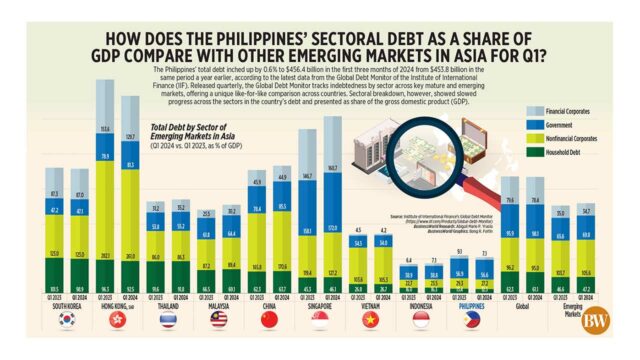
How does the Philippines’ sectoral debt as a share of GDP compare with other emerging markets in Asia for Q1?

The Philippines’ total debt inched up by 0.6% to $456.4 billion in the first three months of 2024 from $453.8 billion in the same period a year earlier, according to the latest data from the Global Debt Monitor of the Institute of International Finance (IIF). Released quarterly, the Global Debt Monitor tracks indebtedness by sector across key mature and emerging markets, offering a unique like-for-like comparison across countries. Sectoral breakdown, however, showed slowed progress across the sectors in the country’s debt and presented as share of the gross domestic product (GDP).

How does the Philippines’ sectoral debt as a share of GDP compare with other emerging markets in Asia for Q1?

PSE index to retest 7,000 as Fed rate cuts loom

PHILIPPINE STAR/KRIZ JOHN ROSALES

PHILIPPINE SHARES could continue to rise when trading resumes after a four-day break after the US Federal Reserve signaled that they could begin cutting rates as early as next month.

The Philippine Stock Exchange index (PSEi) closed at 6,961.96 on Thursday, rising by 1.67% or 114.59 points from its 6,847.37 finish on Aug. 16 and marking its third consecutive weekly gain.

Philippine financial markets were closed on Aug. 23 (Friday) in observance of Ninoy Aquino Day and on Aug. 26 (Monday) for National Heroes Day.

“[This] week, the local market could still move with an upward bias. The monetary policy easing cues from the Federal Reserve in the Jackson Hole Economic Symposium are expected to drive positive sentiment,” Philstocks Financial, Inc. Senior Research Analyst Japhet Louis O. Tantiangco said in a Viber message.

“This is as Fed rate cuts are seen to give more room to the BSP (Bangko Sentral ng Pilipinas) to cut their policy rates too, thereby increasing the likelihood that they will continue with their monetary policy easing,” he said.

BSP Governor Eli M. Remolona, Jr. has said they could cut rates again within the year after the Philippine central bank this month slashed borrowing costs by 25 basis points, marking its first easing move in almost four years.

US Federal Reserve Chair Jerome H. Powell on Friday endorsed an imminent start to interest rate cuts, saying further cooling in the job market would be unwelcome and expressing confidence that inflation is within reach of the US central bank’s 2% target, Reuters reported.

“The time has come for policy to adjust,” Mr. Powell said in a highly anticipated speech to the Kansas City Fed’s annual economic conference in Jackson Hole, Wyoming. “The direction of travel is clear, and the timing and pace of rate cuts will depend on incoming data, the evolving outlook, and the balance of risks.”

With its policy rate currently in the 5.25%-5.5% range, the Fed has “ample room” to reduce borrowing costs to cushion the economy, Mr. Powell said.

“The strengthening of the local currency, if it continues, is also expected to give the market a boost,” Mr. Tantiangco added.

The PSEi may continue to test the 7,000 resistance level this week, he said. “If the market gets past and sustains ground above the said level, next resistance is seen at 7,100. Currently, major support is seen at the 6,700 to 6,800 range.”

For its part, online brokerage firm 2TradeAsia.com said in a market note that the market’s immediate support is at 6,800 and resistance is at 7,000-7,500.

“After dropping as low as 184 points (2.79%) for the month, the PSEi is up 7.94% year to date. This quarter’s MSCI rebalancing might cause friction in the near term, but the overall dovish shift in global rates should help sustain the PSEi’s ambition to breach 7,000,” it said.

“Everything is a cycle goes a quote, and markets are likely at the edge of a new one that resembles pre-pandemic conditions,” it added. — Revin Mikhael D. Ochave with Reuters

Obiena takes 5th place at Polish meet

EJ OBIENA — REUTERS

THE ROAD back to Olympic glory continued to be bumpy and treacherous for pole-vault star EJ Obiena after he missed out on a podium finish in the Kamila Skolimowska Memorial in Chorzow, Poland over the weekend.

The World No. 3’s best clearance was 5.82 meters, which was good enough for fifth place in the event that was expectedly won by the greatest pole-vaulter on the planet — Swedish dynamo Armand Duplantis.

Mr. Duplantis blew away Mr. Obiena and the field with a record-breaking performance, an astonishing 6.26m that eclipsed the old mark of 6.25m the former set on his way to the Paris Olympic gold medal.

American Sam Kendricks and Greek sensation Emmanouil Karalis each cleared 6m but the Paris silver winner edged the Olympic bronze medalist via count back to take the runner-up finish.

The Asian champion from Tondo did attempt 6m once after a pair of failed tries at 5.92m.

But his attempt failed, leaving him with his second non-podium finish in three events since his heartbreaking fourth-place finish in the quadrennial meet in the French capital.

He did take a bronze that he shared with several foes at a meet in Lausanne, Switzerland though. — Joey Villar

PLDT seeks semis spot in showdown with Chery

PLDT HIGH SPEED HITTERS — FACEBOOK.COM/PLDTHIGHSPEEDHITTERS

Games Today
(Filoil EcoOil Arena)
4 p.m. — PLDT vs Chery Tiggo
6 p.m. — Creamline vs Petro Gazz

PLDT hopes to join sister team Cignal in the semifinals as it clashes with dangerous Chery Tiggo even as Creamline and Petro Gazz renew their rivalry today in the other half of the Premier Volleyball League Reinforced Conference quarterfinals at the Filoil EcoOil Arena.

Although the High Speed Hitters will come in with the better elimination-round record, having finished with a 6-2 mark against the Crossovers’ 5-3 slate when they clash at 4 p.m., the latter owned the former following a 25-19, 20-25, 25-0, 21-25, 15-10 win in the second round on Aug. 3.

Bawi kami sa next game,” said PLDT coach Rald Ricafort.

Russian Elena Sampoilenko also vowed to give it her best to get the victory.

“Every game we want to win,” she said.

The winner of the PLDT-Chery Tiggo showdown will battle Akari, which eliminated Farm Fresh, 17-25, 25-18, 25-22, 25-23, to advance to the semis.

There is also much more on the line for Creamline, which is seeking to extend its tradition of claiming a podium finish for the 15th straight conference in a span that saw it claim eight championships.

It would also be extra special for the Cool Smashers as they are going for their first three-peat feat in franchise and league history.

It won’t be a walk in the park though as Creamline will face a Petro Gazz squad that has always found ways to beating them in this conference, which the latter won in 2019 and 2022.

The Angels also bested the Cool Smashers, 25-23, 25-19, 20-25, 23-25, 15-12, on Aug. 13, a mental edge that should come in handy when the two tangle at 6 p.m.

The winner will battle Cignal Thursday at the PhilSports Arena in yet another knockout affair. — Joey Villar

NZ Olympic champion Ko wins British Open

LYDIA KO — SCREENSHOT FROM OLYMPICS.COM

OLYMPIC champion Lydia Ko won the women’s British Open by two shots in a tense final round Sunday, capping a memorable three weeks where she won gold in Paris and was also inducted into the LPGA Hall of Fame.

Ms. Ko, world number one Nelly Korda, defending champion Lilia Vu and overnight leader Shin Ji-yai were all on six-under overall at one point as they made their way through the back nine on the blustery Old Course at St Andrews.

In the end it was New Zealand’s (NZ) Ms. Ko who took home the $1,425,000 cheque — the highest amount in the event’s 48-year history — as she won her third major and her first since 2016.

Ms. Ko set the clubhouse target at seven under and after Ms. Shin and Ms. Korda fell by the wayside, Vu needed a birdie putt to force a playoff. But the American underhit her putt on the 18th to give Ms. Ko a famous win at the home of golf.

“It’s pretty surreal. Winning the gold medal in Paris was almost too good to be true. Heading into the weekend I was in contention and I thought, ‘How is it possible for me to win the AIG Women’s Open?’,” Ms. Ko said.

“I’ve had the most Cinderella-like story these past couple of weeks and it’s almost too good to be true.

“Of all the major championships, this one I’ve had the least amount of confidence, because I’ve had the least amount of experience on links… So to be holding this trophy right now, I can’t believe it.”

Overnight leader Ms. Shin is nicknamed the ‘Final-round Queen’ but the South Korean was the first to crack when she lost her outright lead with a three-putt bogey on the par-four third, bringing Ms. Vu alongside her at the top. Ms. Korda was on par for four holes while Ms. Ko birdied the fourth to put herself within one shot of the leaders, meaning the top four were separated by a single stroke as the Open headed for a tense finish.

However, Ms. Korda was on a mission to regain her lead and she sank four birdies over the next six holes to take the outright lead while she also saved par after finding the bunker on the 11th to leave Ms. Ko and Ms. Shin two shots behind.

But Ms. Ko also slowly climbed up to top spot with three birdies before a bogey on the 15th saw all four sharing the lead at six-under overall.

Ms. Ko then put the pressure on Ms. Vu and Ms. Korda when she finished with a birdie on the 18th for a final round of 69 to set the clubhouse target.

Ms. Korda’s chance of clinching a second major this year went up in smoke when she bogeyed the 17th and made par on the 18th to finish two shots behind Ko, the American rubbing the side of her head in disappointment as she walked off the greens.

After Ms. Shin double-bogeyed the 17th, it was up to Ms. Vu to force a playoff but her putt fell short and Ms. Ko broke down in tears when victory was confirmed. In her disappointment, Ms. Vu also missed her putt for par and had to share second spot with Ms. Shin, Ms. Korda and China’s Yin Ruoning at five under.

“I said before I retire, whenever that is, that I would love to win another major championship,” Ms. Ko added. “That was the goal I set with my coaches and here I am as a three-time major champion.” Reuters