Home Blog Page 2222

Millions of new polymer bills to be circulated in 2025

President Ferdinand R. Marcos, Jr. received the “First Philippine Polymer Banknote Series” in Malacañang, Dec. 19. The series highlights the Philippines’ biodiversity and cultural heritage with designs featuring native species and traditional weaves. — YUMMIE DINGDING/PPA POOL

THE Bangko Sentral ng Pilipinas (BSP) plans to issue 70 million to 90 million pieces of the new polymer bills per denomination.

“Since this is an initial launch of the polymer banknote series, we will have limited quantities in about 70 [million] to 90 million per denomination for the P500, P100, and the P50,” BSP Assistant Governor Mary Anne P. Lim said at a briefing on Friday.

Last week, the BSP presented the “First Philippine Polymer Banknote Series” to President Ferdinand R. Marcos, Jr. in a ceremony in Malacañang.

The polymer series includes new denominations of P50, P100 and P500. The polymer version of the P1,000 bill was first introduced in April 2022.

“In the coming years, especially in 2025, we will have more quantities of the P500, P100, and P50 and we will issue them also next year,” Ms. Lim said.

The new polymer bills are set to be circulated in limited quantities in the Greater Manila Area starting Monday (Dec. 23).

“The new denominations of the polymer series initially may be withdrawn over the counter in banks and later the P500 and the P100 polymer banknotes will also be available through automated teller machines or ATMs,” Ms. Lim added.

Latest data from the BSP showed that 661 million pieces of the P1,000 polymer are already in circulation, equivalent to around 33% of the overall circulation of P1,000 bills.

Ms. Lim clarified that the paper banknotes featuring national heroes will still be produced and circulated.

The polymer series features native and protected species in the country. The new P500 note features the Visayan spotted deer, a creature found only in the rainforests of Panay and in Negros, and the orchid called Acanthophippium mantinianum.

Meanwhile, the new P100 note features the Palawan peacock-pheasant and the orchid called Ceratocentron fesselii, while the P50 polymer showcases the Visayan leopard cat and flower called Vidal’s lanutan.

“Our paper banknotes featuring our Philippine heroes will still be there. And they will continue to be still used by the public. They will co-circulate together,” Ms Lim said.

Several groups raised concerns over the decision to feature natural resources over national heroes.

“It has always been the position of BSP that both featuring the national heroes and the rich biodiversity of the Philippines, which are flora and fauna, are both equally important and deserve to be recognized,” Ms. Lim said.

“And for public awareness as well, we want to promote more public awareness and environmental responsibility for flora and fauna.”

Ms. Lim also noted central banks typically change currencies’ design series or substrate every 10 years.

The polymer banknotes are printed through a collaboration with Note Printing Australia, the Reserve Bank of Australia’s printing arm. The BSP is currently in the process of building its capacity to be able to eventually print its own polymer notes.

“Eventually, we will have the capability to print it here in the Philippines,” she said.

Ms. Lim also noted that printing polymer is more expensive, but these notes are more resilient compared with paper, which often needs to be replaced as these get mutilated easily.

“It is more expensive because the substrate is different. This is a plastic substrate that we have at the moment. In the long run, it is more cost-effective because it has a longer lifespan.”

The polymer banknotes are also cleaner, more durable and include more security features to make it harder to counterfeit.

The bills also have tactile dots to help the visually impaired identify the bills. Luisa Maria Jacinta C. Jocson

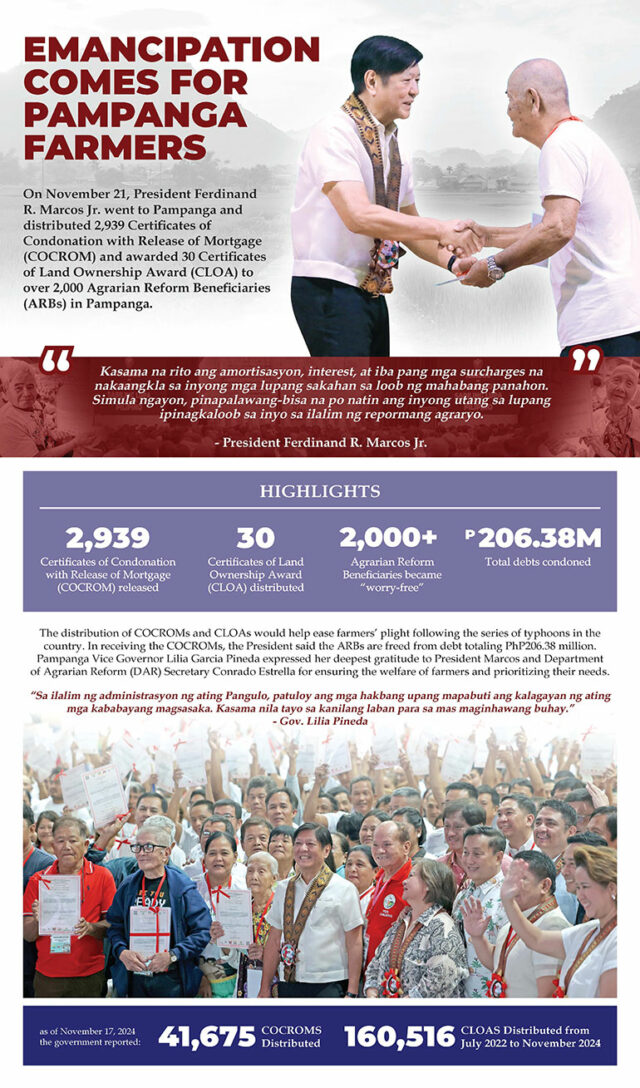
Emancipation comes for Pampanga farmers

On Nov. 21, President Ferdinand R. Marcos, Jr. went to Pampanga and distributed 2,939 Certificates of Condonation with Release of Mortgage (COCROM) and awarded 30 Certificates of Land Ownership Award (CLOA) to over 2,000 Agrarian Reform Beneficiaries (ARBs) in Pampanga.

The distribution of COCROMs and CLOAs would help ease farmers’ plight following the series of typhoons in the country. In receiving the COCROMs, the President said the ARBs are freed from debt totaling P206.38 million. Pampanga Vice-Governor Lilia Garcia Pineda expressed her deepest gratitude to President Marcos and Department of Agrarian Reform (DAR) Secretary Conrado Estrella for ensuring the welfare of farmers and prioritizing their needs.


Spotlight is BusinessWorld’s sponsored section that allows advertisers to amplify their brand and connect with BusinessWorld’s audience by publishing their stories on the BusinessWorld Web site. For more information, send an email to online@bworldonline.com.

Join us on Viber at https://bit.ly/3hv6bLA to get more updates and subscribe to BusinessWorld’s titles and get exclusive content through www.bworld-x.com.

Belen-making competition to boost Tarlac’s tourism, economy

A COMPETITION REVOLVING around the nativity scene or belen is helping boost the economy and tourism of the province of Tarlac, the Tarlac Heritage Foundation, Inc. said.

“Belenismo sa Tarlac has boosted Tarlac’s tourism and economy, establishing the province as a renowned tourist destination,” the foundation told BusinessWorld in an e-mail.

“During the festival, thousands of visitors, both local and international, flock to Tarlac to witness the breathtaking creativity displayed in the various belen exhibits,” it added.

Tarlac, known as the “Belen Capital” of the Philippines, has hosted a province-wide competition called Belenismo sa Tarlac since 2007 to showcase the talent of Tarlaqueños when it comes to the creation of nativity scenes. The competition was founded by Isabel Cojuangco Suntay and her daughter, Isa Cojuangco Suntay.

“This festival has brought about a profound sense of unity and pride among the people of Tarlac,” the foundation said.

In the Department of Tourism’s Regional Distribution of Overnight Travelers report released last May, Tarlac recorded 88,365 tourists in 2023, of whom 3,343 were foreign travelers, 284 were overseas Filipinos, and 84,738 were domestic travelers.

The rise in the number of visitors underscored the direct and positive impacts of the festival on micro, small, and medium-sized enterprises (MSMEs) and other local businesses.

“The influx of tourists translates to increased customers for shops, restaurants, and service providers, creating economic opportunities and stimulating local commerce,” the foundation said.

Based on the data provided by the foundation, there are more participants this year — 61 — compared to last year’s 54 contestants.

There are several categories in the Belenismo contest: community, which has 16 entries this year; church with 13 entries; monumental with 14; grand non-municipal with six; and grand municipal with 12 entries.

Apart from fostering community participation and engagement, Belenismo also promotes sustainable practices among participants.

“Belenismo emphasizes environmental stewardship by requiring the use of recycled materials for belen displays, thus promoting sustainability,” the foundation said. “This celebration not only inspires hope and joy during Christmas but also strengthens Tarlac’s identity as a hub of creativity, faith, and environmental consciousness.”

In 2025, the Tarlac Heritage Foundation hopes to organize its belen routes better and improve the electricity supply, a vital part of the belen displays, in certain parts of the province.

“By gathering communities to create and showcase elaborate belen displays, the event fosters collaboration and harmony while turning the province into a lively, festive destination during the holiday season,” it said. — Almira Louise S. Martinez

SEC eyes registration of crypto service providers

BW FILE PHOTO

THE Securities and Exchange Commission (SEC) plans to require the registration of cryptocurrency asset service providers to boost investor protection.

Under draft rules issued on Dec. 20, applicants must be a SEC-registered stock corporation, have at least four staff members living in the Philippines and meet the minimum capital requirements.

The corporate regulator also proposed that crypto asset securities must not be sold without an approved registration statement.

“The SEC shall have the power to order the removal of a crypto asset in a crypto asset exchange in the interest of investor protection,” according to the draft rules.

“Unless allowed by the commission, crypto asset service providers should not conduct any offering, trading, or dealing activities of futures contracts or related derivatives involving crypto assets, as well as offer margin trading,” it added.

The SEC defines a crypto asset as a “cryptographically secured digital representation of a value or right that relies on a cryptographically secured distributed ledger or a similar technology to validate and secure transactions that can be transferred, stored, or traded electronically.”

“The Philippines is experiencing a widespread adoption of crypto assets,” the SEC said. “According to various studies, the Philippines ranks high in cryptocurrency adoption compared with other jurisdictions. This new class of assets has various characteristics and use cases, one of which is as an investment product.”

Under the SEC draft rules, service providers must be able to prevent and detect market abuse. The rules prohibit market manipulation, insider trading and disclosure of material and nonpublic information.

The draft rules also empower the SEC to stop illegal acts of service providers and revoke their licenses.

“In alignment with international standards, the SEC is establishing an affirmative legal framework to provide protection against consumer harms and systemic risks and to afford consumers the choice of engaging in crypto asset activity with licensed and authorized intermediaries,” the SEC said.

“The continued growth and development of new crypto-asset markets, services and business models rely on clear, proportionate and robust regulatory frameworks, which can ensure that markets are fair, efficient, and transparent,” it added.

Service providers must adopt a cybersecurity framework in line with the most recent iteration of the government’s national cybersecurity plan and other global best practices. They will also be subject to audit and review.

“Consistent with the objectives of the Philippine Development Plan 2023-2028, rapid technological advancements and evolving market needs have spurred the development and adoption of innovative financial products and services,” the SEC said.

The Securities Regulation Code mandates the corporate regulator to encourage market competitiveness by enforcing licensing and registration rules of other trading markets including “innovative securities and technology-based ventures.”

The Financial Products and Services Consumer Protection Act also empowers the SEC to formulate rules and standards for specific financial products or services.

In April, the SEC requested the removal of Binance from the app markets of Apple and Google in the Philippines for operating in the country without a license.

Binance claims to be the largest cryptocurrency exchange in terms of trading volume.

A survey by blockchain software company Consensys earlier this month showed that 96% of Filipino respondents said they were familiar with cryptocurrencies.

However, only 46% said they fully understood how cryptocurrencies work. The survey talked to 18,000 people aged 18-65 in 18 countries, including the Philippines.

Comments on the draft rules may be submitted until Jan. 18, 2025, the SEC said. — Revin Mikhael D. Ochave

What to watch elsewhere in Southeast Asia

FREEPIK

Philippine politics will, over the next few weeks, gradually transition from the political battle between the administration and Vice-President Sara Duterte to the May 2025 midterm elections — which is also a mini-proxy war between the two sides for senate seats, but it is less pronounced and virulent. Expectations of better governance from the midterms are low, since candidates win based on popularity and political machinery, not platforms, programs, or party ideologies.

The administration will have to again cobble together majority coalitions in the house and senate after the vote because we lack an effective party system. Much of what happens after May is therefore still up in the air, because the post-election environment will not be about fulfilling election promises but in dispensing patronage, bargaining for choice committees and privileges, and positioning for the 2028 elections. Meanwhile, the outcome of the senate elections could lead to some early handicapping of prospective presidential candidates, although previous election cycles have proven that three years out from the next presidential vote is generally “too early to tell” in terms of the likely winner.

Several other countries in the region will be interesting to watch. Often, we focus too much on our country, neglecting how our neighbors have undergone, or are undergoing, the same challenges. Their experiences could serve as either examples or cautionary tales, or sometimes even both, over time.

Arguably the most interesting country to watch will be Vietnam. Its export-led industrialization drive has attracted attention globally, and specifically as it built its credibility as a destination for electronics and semiconductor manufacturing. But what could be interesting next year is the Communist Party of Vietnam’s (CPV) plan to “right-size” the government by cutting the number of ministries and reducing tens, or even hundreds of thousands, of government jobs. It would be the most radical restructuring of the political system in decades. CPV general secretary To Lam wants to raise the economic growth rate but believes that the parallel power structure where the “party leads, but the state manages” has created inefficiencies because overlapping roles, contradictory decision-making, and second-guessing by bureaucrats of the CPV’s intent. His goal is to simplify the governance structure to make it easier for foreign investors. If successful (and that is still a significant “if”), it could measurably raise the long-term growth outlook for Vietnam.

Decades ago, we considered Thailand to be our peer, until it left us behind sometime in the 1990s or early 2000s. The fear of many Filipinos is that Vietnam might at some point similarly overtake us. We now aspire to win some of the investment that Vietnam has successfully attracted in manufacturing. It is a common anecdote that Vietnamese agricultural scientists and bureaucrats traveled to the Philippines decades ago to learn how to improve their agriculture and rice production. Now, the shoe is on the other foot. We will have to start learning from Vietnam if we really want to build an industrial manufacturing base.

Myanmar is also high on the list. The internal conflict since the 2021 coup has led to thousands of deaths, hundreds of thousands displaced internally (or over the border in neighboring countries), and an economic crisis. The generals in control in Yangon have a plan to call elections early next year, but its legitimacy will be challenged because election rules approved in 2023 make it less than free and fair. Some Philippine companies are invested in Myanmar. But our interest in what happens there is not so much economic, but in the functioning of ASEAN when it has to deal with serious instability and suffering in one of its member countries because of political strife.

After the Asian financial crisis almost three decades ago, ASEAN increased its cooperation to deal with future economic crises. However, ASEAN’s individual countries believe in the policy of non-interference in each other’s domestic political affairs, which is why the region is divided over how much pressure to impose on the junta — which makes the current scale of suffering and violence a test for the regional grouping and for our own foreign policy. In the meantime, the generals’ goal of seeking legitimacy for the planned elections could cause them to seek political cover from Beijing and Moscow, turning Southeast Asia’s western side into another geopolitical battleground.

Indonesia will see the first full year of Prabowo Subianto as president. His previous political campaigns had generated apprehension because of his perceived nationalist and populist tendencies, as well as tendency to disparage democratic processes. But his uncontroversial stint as defense minister and promise that he would continue with many of the policies of his predecessor, President Joko Widodo, have tempered these fears. Prabowo’s decision to reappoint several of Widodo’s cabinet ministers, including the widely respected finance minister Sri Mulyani Indrawati, has reinforced the notion that he is a more moderate politician today, compared to the firebrand of the previous decade. Next year could prove if that assessment is true, and whether his alliance with former president Widodo will hold.

Among Prabowo’s promises is a national program to provide mothers and school age children with free nutritious meals, with the goal of reducing stunting. It is an expensive effort, which could run up to $28 billion annually. With a budget of about $1 or slightly more per day per beneficiary, Indonesia aims to provide vegetables, rice, milk, and a protein to around 82 million recipients within five years. We have a similar — if not worse — problem of childhood stunting and could look to Indonesia’s efforts to find ways to implement a national program consistently.

Indonesia is also attempting to insert itself into the global value chain for electric vehicles, particularly in battery production with its abundant mineral resources. We have smaller reserves than Indonesia in nickel and copper, but they may be of sufficient scale for us to be similarly considered as an alternative supplier. But integrating ourselves into these supply chains will also mean improving a lot of our domestic infrastructure and designing policies to encourage investment in these sectors.

It will, in short, require us to evolve industrial policy, for us to be able to win investments for the production of batteries, semiconductors, and electronics. But that is the way large segments of the world are now evolving, and it is the future we face.


Bob Herrera-Lim is a managing director at Teneo, a New-York based consulting firm that advises companies and investors globally. He covers all of Southeast Asia for the firm’s clients. He is also a fellow of the Foundation for Economic Freedom.

A guide to the Metro Manila Film Festival 2024

ACTION, comedy, drama, fantasy, horror, musical, romance, and thriller are just some of the many genres offered at this year’s Metro Manila Film Festival (MMFF). Organized by the Metropolitan Manila Development Authority (MMDA), it runs from Dec. 25 to Jan. 7, 2025.

The film festival celebrates its 50th year with the theme of “Sinesigla sa Singkwenta” (Film enthusiasm on the 50th).

“As we move forward to another 50 years, let us support and promote the MMFF and our local film industry, encouraging Filipino filmmakers to create meaningful, impactful films that resonate with audiences both locally and globally,” MMDA acting chairman and MMFF chair Don Artes said in a press release.

The festival’s Gabi ng Parangal or awards ceremony will be held at the Solaire Resort Ballroom on Dec. 27.

Established in 1975, the Metro Manila Film Festival aims to promote and enhance Philippine cinema. During its run, no non-festival film, local or foreign, can be screened in regular theaters.

Here are the 10 official entries to the MMFF 2024 in alphabetical order:

AND THE BREADWINNER IS…
(produced by Star Cinema, The IdeaFirst Company)
Directed by Jun Robles Lana

This is a family comedy-drama that is an homage to breadwinners. It charts the struggles of Bambi Salvador, who works as an overseas Filipino worker (OFW) in Taiwan and returns home to find that her remittances were not used by her family as intended. It stars Vice Ganda, with an ensemble cast that includes Eugene Domingo, Gladys Reyes, Jhong Hilario, Maris Racal, and Anthony Jennings.

MTRCB Rating: PG

ESPANTAHO
(produced by Quantum Films, Cineko Productions, Purple Bunny Productions)
Directed by Chito S. Roño

This is a horror film that follows a woman named Monet and her mother Rosa, who must deal with a series of uncanny events and uncover dark secrets following the family patriarch’s death. The malevolent plot unfolds over the course of the nine days of mourning called pasiyam. The film stars Judy Ann Santos and Lorna Tolentino.

MTRCB Rating: PG

GREEN BONES
(produced by GMA Pictures)
Directed by Zig Dulay

This morality drama tells the parallel stories of prison guard Xavier Gonzaga and reformed murder convict Domingo Zamora, with the former being extremely distrusting of the latter. When Gonzaga resolves to keep Zamora behind bars forever, he gradually discovers the truth behind the notorious criminal’s past. The film stars Dennis Trillo and Ruru Madrid.

MTRCB Rating: PG

HOLD ME CLOSE
(produced by Viva Films, Ninuno Media)
Directed by Jason Paul Laxamana

This romantic fantasy tells the story of a man named Woody, who travels the world in search of a place to settle down. When his trip to Japan puts him in the path of a unique woman named Lynlyn, who has the ability to determine if a person will bring her happiness or harm, his life turns upside down. The film stars Carlo Aquino and Julia Barretto.

MTRCB Rating: PG

ISANG HIMALA
(produced by Kapitol Films, UXS)
Directed by Pepe Diokno

This musical film is based on the 2003 stage musical of the same name which was adapted from the 1982 film Himala, written by National Artist Ricky Lee and directed by National Artist Ishmael Bernal. It follows a young woman, Elsa, a faith healer whose miracles draw the attention of both residents of the small town of Cupang and travelers from afar that seek to capitalize on the phenomenon. It stars Aicelle Santos and Bituin Escalante.

MTRCB Rating: PG

THE KINGDOM
(produced by APT Entertainment, Mzet Productions, MediaQuest)
Directed by Michael Tuviera

This action-adventure drama presents the political hierarchy of the Kingdom of Kalayaan, a reimagining of the Philippines as a group of islands that was never colonized. At its center is Lakan Makisig, the king whose favored daughter among three children is kidnapped in light of a succession crisis. The film stars Vic Sotto and Piolo Pascual.

MTRCB Rating: PG

MY FUTURE YOU
(produced by Regal Entertainment)
Directed by Crisanto Aquino

This romance film follows Lex, a young man living in 2009, who stumbles upon a mysterious app that links him to Karen, a woman living in 2024, in an odd twist of time travel. In the development of their relationship, the film explores the complexities of human connection. The film stars on-screen love team Francine Diaz and Seth Fedelin.

MTRCB Rating: G

STRANGE FREQUENCIES: TAIWAN KILLER HOSPITAL
(produced by Reality MM Studios)
Directed by Kerwin Go

This found-footage horror film is inspired by the 2018 Korean horror film Gonjiam: Haunted Asylum. In it, a group of online celebrities and aspiring amateur ghost hunters visit a haunted medical facility for one night. Its mysteries unravel in this meta narrative featuring an ensemble cast. The stars include Enrique Gil, Jane de Leon, Alexa Miro, and Rob Gomez, among other influencers.

MTRCB Rating: R-13

TOPAKK
(produced by Nathan Studios, Strawdog Studios, FUSEE)

Directed by Richard Somes

This action thriller is about an ex-Special Forces security guard who attempts to save the life of a woman being hunted by a corrupt police death squad working for a drug cartel. Through this adventure, the film puts the spotlight on post-traumatic stress disorder (PTSD). The film stars Arjo Atayde and Julia Montes.

MTRCB Rating: R-16 (but some cinemas will play an R-18 version)

UNINVITED
(produced by Mentorque Productions, Project 8 Projects)
Directed by Dan Villegas

This revenge thriller follows Lilia, a grieving mother who sets out to avenge the murder of her daughter at the hands of a billionaire. To do this, she infiltrates an exclusive circle of elites under the persona of Eva, uncovering the truth and carrying out her revenge over the course of a party. The film stars Vilma Santos, Nadine Lustre, and Aga Muhlach.

MTRCB Rating: R-16

Brontë H. Lacsamana

New ASF zoning rules to be issued by January

PHILSTAR FILE PHOTO

THE Department of Agriculture (DA) said it will issue new zoning rules for areas affected by outbreaks of African Swine Fever (ASF) by January.

“Our direction is that we will change our coding system. Previously it was color codes,” Agriculture Secretary Francisco P. Tiu Laurel, Jr. told reporters, referring to the color designations for areas deemed hot zones for the disease.

The current system designates as red zones areas with confirmed ASF cases. Pink zones are near infected areas or are ASF-free areas in infected provinces. Yellow zones are deemed high-risk areas; light green zones have no cases but are near yellow zones, and dark green zones are ASF free.

Mr. Laurel said that the new mapping system will only indicate whether areas have active cases of ASF or not.

“That it will be easier, because now there is a stigma. Farmers have not been reporting disease because they do not want to be categorized as being in red zones,” he added.

He added that the policy is also expected to facilitate the transport of uninfected hogs to and from ASF-affected areas.

He said that the restricted movement of hogs within ASF-hit areas has created imbalances in the supply of pork.

“That will basically stabilize the market for pork. This should lower the average price of pork because there is an influx of (supply),” Mr. Laurel added.

According to the DA price monitors as of Dec. 19, a kilogram of pork shoulder cost P300 to P380 per kilo in public markets, with pork belly fetching P340 to P410.

ASF was first detected in the Philippines in 2019.

As of Dec. 6, 88 municipalities across 19 provinces had active ASF cases, according to the Bureau of Animal Industry. — Adrian H. Halili

ACEN sets P70-B capex for 2025

ACEN CORP. is earmarking about  P70 billion for its capital expenditure (capex) budget next year.

“In 2025, we expect to spend roughly P70 billion,” ACEN President and Chief Executive Officer Eric T. Francia told reporters last week.

Ayala Corp.’s listed energy unit set a capex budget of P72 billion this year covering international operations and energy projects in the Philippines. The company expects to spend P50 billion “across all geographies” for the year.

For next year, ACEN expects to operationalize power projects with a combined capacity of about 1.2 gigawatts (GW) located in and outside the Philippines.

This pipeline of projects forms part of the company’s 6.8-GW portfolio of attributable renewable capacity in operation, under construction and committed projects.

The company operates across a diverse range of markets including the Philippines, Australia, Vietnam, India, Indonesia, Laos, and the US.

ACEN’s renewable capacity has grown to almost seven GW, in line with the strong momentum behind the energy transition in the region, Mr. Francia said in November. The company continues to focus on execution, especially for projects in construction and under development, he added.

The company expects to hit its target of 20 GW of renewable capacity by 2030.

ACEN’s attributable net income fell 20.6% year on year to P1.85 billion in the third quarter amid lower nonoperating earnings.

Gross revenue, on the other hand, rose 6.8% to P8.74 billion, which was offset by lower gross expenses. — Sheldeen Joy Talavera

A bad budget: The President’s options

BW FILE PHOTO

The proposed 2025 budget is drawing flak. Healthcare advocates are particularly riled, claiming that the budget is illegally siphoning money away from the Universal Health Care (UHC) Act, established under Republic Act No. 11223 and funneled to dole-out programs that promote patronage politics. Incredibly, the proposed 2025 General Appropriations Act (GAA) provides no subsidy for Philippine Health Insurance Corp. or PhilHealth at all — contrary to law.

The President has so far postponed the signing of the budget ostensibly to address the outrage it generated.

But what can the President do when poised to sign a bad budget?

Article VI, Section 27 (2) of the Constitution provides that “The President shall have the power to veto any particular item or items in an appropriation, revenue, or tariff bill, but the veto shall not affect the item or items to which he does not object.”

(The table shows what the budget provides.)

The question is whether this portion of the budget — one that assigns no money to PhilHealth — can be vetoed.

Even if the President does veto this provision, the veto will not restore the missing subsidy for PhilHealth. An appropriation is the setting apart by law of a certain sum from the public revenue for a specified purpose. (Bengzon v. Secretary of Justice, 1936). Appropriation is a function of Congress, not the President. Under the Constitution, the spending power or “the power of the purse,” belongs to Congress, subject only to the veto power of the President. The President may propose the budget, but still the final say on the matter of appropriations is lodged in the Congress. (Philippine Constitution Association v. Enriquez, 1994).

Similarly, deductions made by Congress on the budgets of various government agencies cannot be restored by a veto. Again, the President can delete (veto) parts of the proposed budget but he does not have the power to make appropriations he believes are consistent with the Constitution.

The President is left with two options.

The first option is to veto the entire bill. This would trigger Article VI, Section 25 of the Constitution which provides that:

If, by the end of any fiscal year, the Congress shall have failed to pass the general appropriations bill for the ensuing fiscal year, the general appropriations law for the preceding fiscal year shall be deemed reenacted and shall remain in force and effect until the general appropriations bill is passed by the Congress.

In other words, the government will operate under a budget exactly like the GAA for 2024 — until Congress enacts another GAA.

The second option is for the President to prevail upon the leaders of both Houses of Congress to recall the proposed budget so Congress can make changes to appease critics and to align the proposed budget with the strictures of the Constitution. The President cannot convene the bicameral conference committee himself because Congress is a separate, co-equal branch of government. The President has no power over Congress.

The second option is not without precedent.

The Magna Carta of Filipino Seafarers (Republic Act No. 12021 [2024]) took a wild route to enactment. The bicameral conference committee report was first submitted and ratified by Congress on Dec. 5, 2023 but it was withdrawn after it was enrolled for the President’s signature. On May 22, 2024, the bicameral conference committee report was again ratified by both the House of the Representatives and the Senate but again did not reach Malacañang for signature. Sen. Raffy Tulfo submitted, for the third time, its bicameral conference committee report on July 31, 2024. Tulfo explained that there has been a complaint “from some of the sectors” when the harmonized version of the bill was due for signing by the President.

There is no legal impediment to this course of action. An enrolled bill is a declaration by the two Houses, through their presiding officers, to the President that a bill has received in due form the sanction of the legislative branch of the government, and that it is delivered to him in obedience to the constitutional requirement that all bills which pass Congress shall be presented to him (Arroyo v. De Venecia, 1997).

The enrolled bill theory is based mainly on “the respect due to coequal and independent departments,” which requires the judicial department “to accept, as having passed Congress, all bills authenticated in the manner stated.” (Astorga v. Villegas, 1974). The doctrine is directed at the courts to accept the manner in which a bill was passed into law; it does not prevent Congress from recalling its own work.

The proposed budget for 2025 is in a similar position — it has been enrolled and is up for the President’s signature. There are complaints from various sectors of society that demand to be addressed. If the President signs the proposed budget into law, then it is a statement that he is endorsing the unconstitutional acts that are embedded in the bill.

A President’s duty, under these circumstances, is to stand by the Constitution and the laws of the Republic, and refuse to sign the proposed budget for 2025. By refusing to sign it, he will challenge Congress to step up and to enact a budget that addresses the concerns of every Filipino and not one that finances patronage politics.


Dante Gatmaytan is a professor of Law at the University of the Philippines, Diliman. He has authored books on Constitutional Law, Legal Method Essentials, and Local Government Law and Jurisprudence. He is also a fellow of Action for Economic Reforms.

JBL ends the year by launching hi-tech earbuds

JBL PARTYBOX 320

JBL’S year-end gathering, the Unleash & Grand Thanksgiving Party on Dec. 10 at the EDSA Shangri-la, also served as JBL’s last product launch this year.

Larry Secreto, country manager for Harman Philippines said in a mix of English and Filipino, “There are people asking me: ‘it’s the end of the year, but we’re still launching new products. We’re almost done with this year.’ I said, ‘well, we never stopped innovating products.’ We always have much better products.”

Harman is the parent company of JBL, and since 2017 has been operating as a subsidiary of Samsung Electronics. Sister brands under Harman include Dbx, AKG, and Infinity Systems, among others; mostly centered around sound systems and electronic equipment.

Some of these products include the JBL Tune Series, to which the JBL Tune Beam 2, Tune Buds 2, and Tune Flex 2 belong. The true wireless earbuds are designed to deliver pure bass and zero noise. All three models feature Adaptive Noise Cancelling, Smart Ambient technology, and up to 48 hours of playtime. Each come with JBL’s signature ergonomic, water- and dust-resistant design, plus customizable sound through Personi-Fi 3.0 technology accessible through the JBL Headphones app.

The JBL Wave Flex 2, Wave Beam 2, and Wave Buds 2 have JBL Pure Bass Sound, up to 40 hours of battery life, and Smart Ambient technology across the series. The Wave Buds 2 and Wave Beam 2 also feature Active Noise Cancelling. Designed for comfort all day thanks to its ergonomic fit, the Wave series ensures hands-free, crystal-clear calls with just a tap.

They even have a line for kids: The JBL Junior 320BT, Junior 320, and Junior 470NC headphones ensure safe listening with an 85dB (decibel) volume limit. The Junior 320BT and Junior 320 are wireless on-ear models, while the Junior 470NC adds Active Noise Cancelling in a wireless over-ear design. Its features include up to 50 hours of playtime, oversized controls, comfy fit, playful colors, and sticker sets for personalization. Parents can use the JBL Headphones app to set volume limits, track habits, and get reports, while the built-in mic keeps kids connected with family, friends, or teachers.

For fitness fans and adventurers, the JBL Endurance Race 2 earbuds have an IP68 waterproof and dustproof rating, and up to 48 hours of battery life. Designed for comfort all day long, its superior fit ensures optimum sealing and stability. Powerful 6.8 mm (millimeter) dynamic drivers deliver JBL Pure Bass sound, while Active Noise Cancelling keeps the user’s focus sharp, and Smart Ambient technology helps the user stay aware of their surroundings.

Just in time for the holiday party season, they’ve come up with more features and colorways for their PartyBox: JBL’s PartyBox 120 and PartyBox 320, now in sleek white. These speakers deliver JBL Pro Sound, synchronized lightshows, and portability — featuring a folding handle on the PartyBox 120 (12 hours playtime) and sturdy wheels with a telescopic handle on the PartyBox 320 (18 hours playtime). Both include a replaceable battery. They can be paired with any Bluetooth device, or take center stage with mic and guitar inputs. For even bigger celebrations, wirelessly connect multiple JBL Auracast-enabled speakers or sync effortlessly with the JBL PartyBox app.

“We’re maybe one step, or two steps ahead of our competitors,” said Mr. Secreto. “Rest assured, next year, we will have a lot more.”

JBL’s Holiday Wishes promo is also running until Dec. 31. One hundred people will win prizes, with 10 winners for each prize. These include a Vespa Primavera 150 scooter; a JBL Authentics 500 speaker; a JBL PartyBox Stage 320 speaker; a JBL Spinner BT turntable; a JBL Tour Pro 3 earbuds; a Samsung Galaxy Z Flip 6 phone; a three-day, two-night staycation for two at the EDSA Shangri-La Hotel; a three-day, two-night trip for two to Coron, Palawan; a three-day, two-night trip for two to Boracay; and a trip of the same length for two to the winner’s chosen destination (Thailand, Singapore, or Hong Kong). To join, purchase any participating JBL product from authorized stores then register the proof of purchase at www.jblpromo.com.ph.

Peso may retest record low on hawkish Fed, BSP

BW FILE PHOTO

THE PESO could slide to the P59-per-dollar level anew this week amid signals of fewer rate cuts from both the Bangko Sentral ng Pilipinas (BSP) and the US Federal Reserve.

The peso closed at P58.81 versus the dollar on Friday, strengthening by 19 centavos from its record-low P59 finish on Thursday, according to Bankers Association of the Philippines data posted on its website.

Week on week, however, the peso weakened by 34 centavos from its P58.47-per-dollar close on Dec. 13.

The peso depreciated against the dollar on Friday as the BSP signaled less rate cuts in the year ahead due to inflation risks, a trader said by phone.

“The US dollar-peso exchange rate corrected lower after the latest signals from BSP governor about being open to another rate cut in its first rate-setting meeting in 2025, as rates are still somewhat restrictive, considered an insurance amid risks that inflation might rise again,” Michael L. Ricafort, chief economist at Rizal Commercial Banking Corp., likewise said in a Viber message.

The Monetary Board on Thursday delivered a third straight rate cut, slashing its policy rate by 25 basis points (bps) to 5.75% from 6%.

The central bank has now reduced benchmark borrowing costs by a total of 75 bps this year since it began its easing cycle in August.

BSP Governor Eli M. Remolona, Jr. said delivering 100 bps worth of cuts next year may be “too much.”

He earlier said they could reduce rates by around 100 bps in 2025, though not necessarily at every meeting or every quarter.

“Even with the 75 bps, from all our estimates, we’re still somewhat on the tight side. That for us is a kind of insurance. The reason we’re cutting in baby steps is because we’re not absolutely sure about inflation,” Mr. Remolona said on Thursday.

“We still worry that inflation might start to rise again. By cutting in baby steps, at this point, we’re still somewhat tight. That’s kind of insurance against a possible increase in inflation.”

On Friday, he said the BSP is open to delivering another rate cut in its first monetary policy meeting next year.

For this week, the trader said the peso could continue to weaken and even retest its all-time low amid hawkish guidance from both the BSP and US Federal Reserve.

The US central bank cut interest rates on Wednesday, as expected, but Federal Reserve Chair Jerome H. Powell said more reductions in borrowing costs now hinge on further progress in lowering stubbornly high inflation, remarks that showed policy makers are starting to reckon with the prospects for sweeping economic changes under a Trump administration, Reuters reported.

“I think we’re in a good place, but I think from here it’s a new phase and we’re going to be cautious about further cuts,” Mr. Powell said at a press conference after the central bank’s policy-setting Federal Open Market Committee cut its benchmark interest rate by a quarter of a percentage point at the end of a two-day meeting.

While he said the Fed remained confident price pressures would continue to ease, he also acknowledged central bank staff and policy makers were beginning to at least preliminarily think through how President-elect Donald J. Trump’s promises of higher tariffs, tax cuts and tougher immigration policy will change the outlook.

The Fed, which hiked rates aggressively in 2022 and 2023 to combat a surge in inflation, began its easing cycle in September with a half-percentage-point cut in borrowing costs, and followed up with a quarter-percentage-point cut last month.

Rates will fall again once inflation shows it is making more progress, “with the extent and timing of additional adjustments to the target range” depending on “incoming data, the evolving outlook, and the balance of risks,” the Fed said in new language that sets up a likely pause to the rate cuts beginning at the Jan. 28-29 meeting.

US central bankers now project they will make just two quarter-percentage-point rate reductions by the end of 2025.

That is half a percentage point less in policy easing next year than officials anticipated as of September, with Fed projections of inflation for the first year of the new Trump administration jumping from 2.1% in their prior projections to 2.5% in the current ones.

Still, the peso could be supported by the seasonal increase in overseas Filipino workers’ remittances “amid the Christmas shopping rush that could culminate with a week before Christmas,” Mr. Ricafort said.

The trader expects the peso to move from P58.50 to P59 against the dollar this week, while Mr. Ricafort sees it ranging between P58.60 and P59. — Luisa Maria Jacinta C. Jocson with Reuters

PHL food services industry growth seen at 12% in 2025, USDA says

REUTERS

THE Philippine food services industry is projected to grow 12% next year as store networks and foot traffic expand, according to the US Department of Agriculture’s (USDA) Foreign Agricultural Service (FAS).

“Reaching pre-pandemic levels in 2025, FAS Manila sees continued food service sales growth at 12% with the expansion of stores and customer queues in restaurants,” the USDA said in a report.

It added that more customers are dining out due to the opening of new restaurants, cafés, kiosks, and bars, as more franchise international restaurants enter the Philippines.

Increased tourism and the resumption of public events are also expected to bolster the recovery in food services.

The USDA said that sales in full-service restaurants are expected to grow 10% next year due to store expansion. Full-service restaurants account for 17% of the industry.

“As restaurant chains expand, new stores will open in other cities and rural areas through expansion and investment from franchisors,” it added.

Café and bar sales are estimated to expand 15%, also driven by new outlets.

The USDA said street stall and kiosk sales are expected to rise 12% next year as consumer mobility continues to improve.

“With increased consumer mobility in 2024, FAS Manila sees further sales growth in 2025 due to the convenience provided by street stalls and kiosks to commuters amidst increased traffic,” it added.

The USDA said that the growing number of international brands opening in the Philippines presents an opportunity for the entry of US products. — Adrian H. Halili