Home Blog Page 2181

Debt service bill surges in Nov.

BW FILE PHOTO

THE NATIONAL Government’s (NG) debt service bill surged year on year in November as both interest and amortization payments rose, data from the Bureau of the Treasury (BTr) showed.

The NG’s debt service bill soared by 65.3% to P93.704 billion in November from P56.674 billion in the same month a year ago.

Month on month, debt servicing fell by 56.8% from P216.85 billion in October.

The debt service refers to payments made by the National Government on its domestic and foreign debt.

Interest payments accounted for the bulk or 71% of debt payments in November.

Data from the BTr showed interest payments jumped by 37.3% to P66.653 billion in November from P48.548 billion in the previous year.

Interest paid on local debt spiked by 38.8% to P48.929 billion in November from P35.257 billion in the same month in 2023.

Domestic interest payments were composed of P29.512 billion in fixed-rate Treasury bonds, P16.872 billion in retail Treasury bonds and P2.017 billion in Treasury bills (T-bills).

Interest paid to foreign creditors rose by 33.4% year on year to P17.724 billion in November from P13.291 billion.

Treasury data showed amortization payments more than tripled (232.9%) to P27.051 billion in November from P8.126 billion in the same month last year.

Principal payments on domestic debt skyrocketed to P18.297 billion from P96 million in the year prior.

On the other hand, principal payments on external debt increased by 9% to P8.754 billion from P8.03 billion in 2023.

11-MONTH DEBT SERVICE
In the January-November period, the NG debt service bill jumped by 27.3% to P1.95 trillion from P1.53 trillion in the same period last year.

Amortization payments climbed by 29.2% to P1.25 trillion as of end-November from P967.09 billion a year ago. It accounted for 63.9% of the overall debt service bill.

Broken down, principal payments on domestic debt stood at P1.02 trillion, while external payments were recorded at P230.973 billion.

Meanwhile, interest payments rose by 24.3% to P705.334 billion in the 11-month period from P567.655 billion a year ago.

Interest payments on domestic debt amounted to P502.389 billion, while those on external debt stood at P202.945 billion.

“The sharp year-on-year increase in the NG’s debt servicing bill could be attributed to higher debt maturities,” Rizal Commercial Banking Corp. Chief Economist Michael L. Ricafort said in a Viber message.

He also cited relatively elevated interest rates and a weaker peso that drove up foreign debt payments.

The peso closed at P58.62 against the greenback at the end of November, depreciating by 52 centavos from its P58.1 finish as of end-October.

The local unit also fell to the record low P59-a-dollar level twice during the month, on Nov. 21 and 26.

“This also reflected the wider NG budget deficit for the period that required more NG borrowings, especially some short-term borrowings such as Treasury bills,” he added.

Separate BTr data showed the budget gap more than doubled to P213 billion in November from P93.3 billion a year ago.

This brought the 11-month fiscal deficit to P1.18 trillion, wider than the P1.11-billion shortfall last year. It also represented 79.29% of the P1.5-trillion deficit ceiling for 2024.

“NG debt increased sharply since the COVID-19 (coronavirus disease 2019) pandemic since 2020 and some of which already started to mature, thereby leading to higher debt servicing costs,” Mr. Ricafort added.

Latest data from the BTr showed the NG’s outstanding debt rose to a fresh high of P16.09 trillion as of end-November.

The debt stock is expected to have reached P16.06 trillion at the end of 2024 and to P17.35 trillion for this year. — Luisa Maria Jacinta C. Jocson

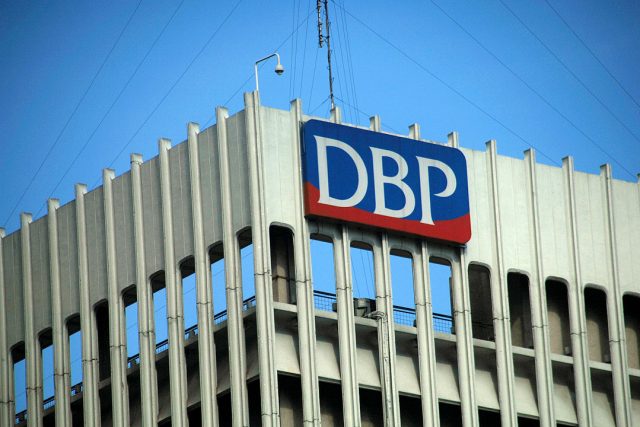
DBP says it will seek regulatory relief this year

BW FILE PHOTO

THE DEVELOPMENT Bank of the Philippines (DBP) will again request for regulatory relief this year as it seeks to boost its capital position.

“Just for comfort, we will seek regulatory relief. The same regulatory relief we sought last year,” DBP President and Chief Executive Officer Michael O. de Jesus told reporters late on Friday.

“Even though I said we will meet all the capital ratios, we still would seek comfort.”

The DBP is currently working with the Bangko Sentral ng Pilipinas (BSP) on this request, he added.

The DBP and Land Bank of the Philippines (LANDBANK) had sought regulatory relief from the central bank following their contributions to the Maharlika Investment Corp. (MIC).

DBP and LANDBANK were mandated to contribute P25 billion and P50 billion, respectively, as the initial seed capital for the MIC. The state lenders remitted their contributions in September 2023.

“It’s annual. Some ratios are for four years, some are every year. There are like three, so the annual, we will seek relief for that, the capital adequacy ratio (CAR), I think,” Mr. De Jesus said.

In a recent report, the International Monetary Fund (IMF) called for the restoration of capital for the two state banks after their contributions to the Maharlika fund.

The IMF noted the importance of capital restoration and exiting regulatory relief “as soon as possible.”

However, Mr. De Jesus assured that the bank will meet its capital requirements and book a higher net income for 2024 compared to the year prior.

“This year, you will see, we will meet all the minimum capital ratios based on the results of 2024. Having said that, we need to increase our capital. There’s no question.”

“That’s why we’re working with the Congress now on the amendment to the DBP charter,” he added.

The Senate bill seeking to amend the DBP’s charter was approved on final reading in September, while the House version is still up for second reading approval. Under the measure, the bank’s authorized capital stock will be raised to P300 billion from P35 billion.

“We will meet the minimum, but of course we don’t just want to meet the minimum, we want to exceed it, so we need to increase our capital. I’m not saying it has to be done this year, but over time,” he added.

“Increasing the authorized capital is good. The charter hasn’t been amended in more than 30 years. This would be very good for the institution, so we can fulfill our mandate of developmental banking.”

The new charter would also allow the state bank to conduct an initial public offering (IPO). However, Mr. De Jesus said DBP is unlikely to go for an IPO this year. 

“Definitely not this year. Before you tap the markets, you want to increase the value, make sure it’s run well.”

The DBP will also be requesting for dividend relief this year, Mr. De Jesus said.

“We’ll also seek that for this year. Every year. We’ve been doing that dividend relief for the past, I think six, seven years so we can build our capital. We seek that from Malacañang.”

In 2023, President Ferdinand R. Marcos, Jr. signed an executive order exempting both banks from their dividend obligations as compensation for providing seed capital to the MIC.

LANDBANK: NO NEED FOR EXTENSION
Meanwhile, LANDBANK said it is not planning to request for an extension of regulatory relief.

“We have had a discussion before that the regulatory relief was actually good for two or three years and that was really viewed from our perspective as a buffer,” LANDBANK President and Chief Executive Officer Lynette V. Ortiz told reporters on Friday.

She said there is “no need” for the relief extension amid the bank’s sound financials.

“We have no need for that, and this is despite the P32 billion of dividends that we remitted to the government just last year. All of that was taken into consideration — P50 billion of Maharlika, P30 billion of dividends. And if you see the financials, of course, you still meet our Common Equity Tier 1 and CAR.”

She also noted that the state bank made “decent” income this year.

“This year, we’ve also done a lot of assessments around risks, risk management. Our balance sheet is very prudent and so we’ve had to ensure that our risks, our provisions, are done well and sufficient.” 

“The numbers relative to the year before are slightly lower. But if you look at it line by line, our loans, our investments, remain very strong.”

The bank is also looking to tap into the debt markets this year, with a special focus on sustainability.

“What we’d like actually is to really further grow our green portfolio, our sustainability portfolio, and we want to match it with bonds that are either green, blue, or sustainable,” she added. — Luisa Maria Jacinta C. Jocson

Philippine-US ties likely to steady as Trump ups ante on China

Donald J. Trump is set to assume the US presidency on Jan. 20. This file photo shows Mr. Trump wearing a traditional Barong Tagalog during his visit to Manila, Philippines on Nov. 12, 2017. — REUTERS

PHILIPPINE PRESIDENT Ferdinand R. Marcos, Jr. might need to persuade US President-elect Donald J. Trump about the wisdom of continuing to deepen trade ties between the two nations amid the threat of higher US tariffs, according to analysts. 

“President Marcos, who seems to have a good relationship with President Trump, will want to develop a clear narrative about how trade with the Philippines benefits the US,” Raymond M. Powell, a fellow at Stanford University’s Gordian Knot Center for National Security Innovation, said in an X message. “Donald Trump is known to listen to compelling arguments from friends he trusts.” 

He noted that Mr. Trump was elected in part due to dissatisfaction with recent inflation trends, “so some of his advisors will likely counsel caution in making tariffs so broad-based that they drive up prices for average US consumers.”

Mr. Trump broached the idea of a “free and open” Indo-Pacific region when he first became president in 2017 at the Asia-Pacific Economic Forum in Manila. 

His successor, Joseph R. Biden, also supported the concept, launching the Indo-Pacific Economic Framework for Prosperity in 2022 with Australia, Brunei, Fiji, India, Indonesia, Japan, South Korea, Malaysia, New Zealand, the Philippines, Singapore, Thailand and Vietnam. 

“I am cautiously optimistic that the Trump administration policy toward the Philippines on both security and economics will be consistent with the Biden administration’s,” said Gregory B. Poling, a fellow of the Southeast Asia program at the Center for Strategic and International Studies. 

He noted that the first Trump government deepened the alliance and US commitment to a free South China Sea, and that a number of Republican members of Congress close to Mr. Trump had helped push major funding commitments to the Philippines in 2024. 

“Trump’s pledge to impose universal tariffs on other countries will of course raise costs for US imports from the Philippines, but if those tariffs are imposed on every country, then it won’t harm the Philippines’ competitive advantage,” he added.

Mr. Poling said the US would likely remain committed to key priorities of a proposed Luzon Economic Corridor that include developing the Subic Freeport zone in Zambales province north of the Philippine capital. He added that it was the Trump government that had helped rescue the Hanjin Shipyard at the former site of a US military base when it went bankrupt.

The shipyard, owned by Hanjin Heavy Industries and Construction Philippines, was acquired by US private equity firm Cerberus Capital Management for $300 million in March 2022 after exclusive talks launched by a consortium of US and Australian companies in 2019 amid China’s interest in the shipyard.

“President-elect Trump is also clearly interested in reducing US vulnerability to Chinese market manipulations that he considers cheating,” Mr. Powell said.

“President Marcos will want to develop recommendations on how the Philippines, as a staunch friend of America, is a place that can help replace China as a trustworthy source of materials and components that can help reinvigorate the US manufacturing sector,” he added.

‘NOT JUST A TAKER’
The stability of the South China Sea and the wider Indo-Pacific region amid China’s growing assertiveness at sea has been a cornerstone of Philippine-US relations.

Washington, which has a Mutual Defense Treaty with Manila, has always condemned the Chinese Coast Guard’s frequent use of water cannons to block Philippine resupply missions to Second Thomas Shoal where it has a handful of soldiers, and to Filipino fishermen near Scarborough Shoal.

Mr. Marcos, speaking before the Australian Parliament earlier in 2024, said his country was on the frontline of a battle for regional peace.

“Of course, President Marcos can also explain how the Philippines stands alone among the Southeast Asian nations in resisting China’s aggression in the region, and is therefore not just a ‘taker,’ but is actually a bold and determined ally in holding back Beijing’s plan to push the US out of Asia,” Mr. Powell said.

The Philippines under Mr. Marcos has pursued closer economic and defense ties with the US amid growing tensions with China.

The return to power of Mr. Trump, who has announced protectionist policies including higher tariffs after his presidential win, has raised questions for America’s Indo-Pacific allies including the Philippines, which has been a major beneficiary of Washington’s pivot to the region.

During the campaign, the populist leader said he wanted to impose 60% or higher tariffs on all Chinese goods and a 10% universal tariff.

The White House under Mr. Biden announced key economic projects for its former colony, including a commitment from its Department of Commerce and private sector to double the number of Philippine semiconductor plants as part of efforts to diversify American supply chains.

After a trilateral meeting among Mr. Marcos, Mr. Biden and former Japanese Prime Minister Fumio Kishida, the US bared a plan to put up an economic corridor on the main Philippine island of Luzon.

The so-called Luzon Economic Corridor seeks to boost connectivity between the capital Manila, Batangas province and Subic, Zambales and Clark, Pampanga — the site of two former US military bases.

The economic corridor, which is under the Indo-Pacific Economic Framework for Prosperity, also aims for other “high-impact” infrastructure projects such as ports and strategic investments in semiconductors, clean energy and supply chains. 

Frederick D. Go, Mr. Marcos’ investment and economic adviser, in November said the Asian Development Bank was finalizing the terms of the project’s feasibility study. “It’s all systems go. Right now, it’s for the Subic-Clark-Manila-Batangas Rail,” he said.

He added that trilateral partners that include the US and Japan had promised to pursue the Luzon Economic Corridor even under Mr. Trump. Other countries want to join the corridor, and the Philippines was in talks to make it “more inclusive to the other countries.”

‘STABLE AND GROWING’
Manila was set to submit proposed trade agreements to the US, Mr. Go said. “We certainly want to bring forward to the new Trump administration our various requests,” he said. “We have of course a few trade agreement requests that the Philippines would like to push that will enhance trade between the Philippines and the US.”

The US is the biggest destination of Philippine-made goods in November, with exports valued at $969.09 million or 17% of the total export sales. It was followed by Japan with $916.12 million (16.1% share) and China with $786.35 million (13.8%).

“US investments in the Philippines continue to be stable and growing,” Tereso O. Panga, director-general at the Philippine Economic Zone Authority (PEZA), said in a Viber message. “At the onset of the current administration, the Philippines made sure to renew and reinvigorate ties with the US.”

The early years of ex-President Rodrigo R. Duterte were marked by his anti-American rhetoric as he started a pivot to China away from the Philippines’ traditional western allies in 2016.

The tough-talking leader threatened on several occasions to terminate a US-Philippines visiting forces agreement as he accused Washington of failing to deliver on its military aid commitments.

Mr. Panga said the Marcos government is “consistently engaging” with the US International Trade Administration, an agency under the US Department of Commerce, to “further the presence of US businesses in the Philippines.”

He said many PEZA-registered US companies are long-term investors and are continually expanding in the Philippines. “A second Trump administration will continue with their policy as part of their thrust in ally-shoring.”

There are more than 300 US companies in the Philippines, 247 of which are in the information technology and business process outsourcing sectors and 70 in manufacturing, Mr. Panga said.

“PEZA remains the home of premier US locators and foresees this to continue onwards under President-elect Donald Trump.”

In his congratulatory message for Mr. Trump, Mr. Marcos cited “unshakable” Philippine-US ties that have been “tested in war and peace.”

“It is clear from his past actions and statements that Donald Trump favors protectionist tariffs as a key element in his program to restore the American industry and reduce trade imbalances,” Mr. Powell said. “There will be discussion about the imposition of tariffs on US trading partners, especially those which, like the Philippines, have a trade surplus with America.” — Kyle Aristophere T. Atienza

Wadhwani Foundation launches AI-powered skilling platform to bridge education-employment gap

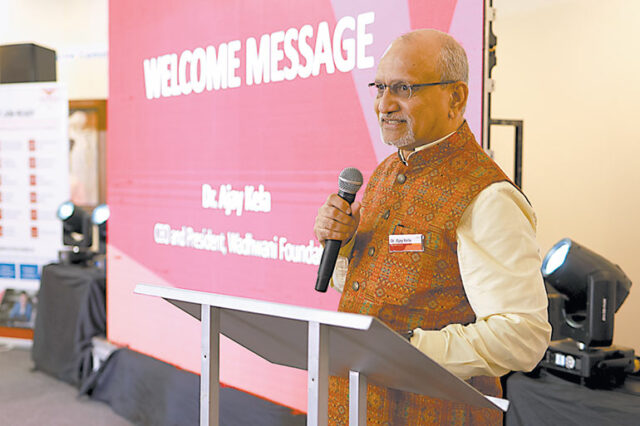
At the Wadhwani Foundation Welcome Reception held at Yuchengco Museum, Makati City, President & CEO Dr. Ajay Kela shared that their free AI-powered platform equips Filipino learners with in-demand job skills and trains educators in AI-driven career counseling.

Wadhwani Foundation, a private philanthropic institution, offers a 24/7 mobile-first AI-powered skilling platform called Wadhwani GenieAI that includes multiple AI Co-Pilots to bridge critical gaps between education and employment in the Philippines.

The platform provides free career counseling tools and teacher training. The Foundation also offers grants of up to $1 million annually to organizations, supporting sustainable job creation and workforce upskilling.

A survey recently conducted by the Foundation revealed that only 10% of K-12 graduates immediately enter the job market. While 83% pursue university education, only 25% of these university enrollees graduate from higher education institutions.

The survey further showed that the remaining 75% who leave university without completing their degrees eventually join the workforce. Meanwhile, 1.5% of the graduates venture into entrepreneurship, while 5.5% fall into the category of “Not in Education, Employment, or Training.” These factors contribute to job instability and low wages.

“Our free AI-powered platform provides access to in-demand job skills that address the gaps in the school-to-work journey of K-12 students in the Philippines,” said Dr. Ajay Kela, president & CEO of Wadhwani Foundation. “We are excited to collaborate in the Philippines to leverage AI-driven solutions that empower students, improve public services, and generate jobs.”

The Foundation currently collaborates with over 60 partners across the Philippines, reaching 22,000 students through AI Co-Pilots. It helps students build in-demand job skills and make informed career choices, while also providing training for educators to deliver AI-driven career counseling.

Boosting Job Creation in PHL

To boost job creation in the Philippines, the Wadhwani Foundation, through its grant-making arm, Wadhwani Charitable Foundation (WCF), also offers grants up to $1 million annually to high-impact organizations.

“We are looking for nonprofit organizations, enterprises, and academic institutions that share our vision to boost job creation for the 21st-century workforce,” said Angela Chen-Delantar, vice-president for Skilling of Wadhwani Foundation.

“Our funding will help them expand impact, enabling us to reach 1 million lives by 2030 and providing more Filipinos with job opportunities for a better future.”

WCF seeks organizations in the country focused on job fulfillment or creation, with a proven track record of scaling impact. Ideal partners operate within a $1-million to $5-million budget, demonstrating strong leadership in their sector.

Aside from the annual funding, WCF provides comprehensive support to partner organizations including access to the GenieAI platform for job creation, skilling and placement, and opportunities to collaborate with the Foundation’s global network, leveraging expertise in program management and impact measurement.

The funding initiative is also offered in other emerging economies with large and growing youth populations such as Mexico, Brazil, and Indonesia.

The Wadhwani Foundation, a nonprofit tech organization founded in 2001 by Silicon Valley entrepreneur Dr. Romesh Wadhwani, is dedicated to accelerating job growth and improving lives across Asia, Africa, and Latin America.

Organizations can learn more about Wadhwani GenieAI at web.opportunity.wfglobal.org and apply for the grant via the Foundation’s website at www.wadhwanifoundation.org.

UP students board Holcim’s Circular Explorer for sustainable design fieldwork

Students of the Institute of Civil Engineering of the University of the Philippines Diliman experience what it’s like on-board the Circular Explorer and attend a further discussion about circular economy.

Engineering students from the University of the Philippines (UP) recently boarded the Circular Explorer, the solar-powered research and recycling vessel by Holcim currently making its rounds along coastal areas in the Philippines.

Held in partnership with One Earth-One Ocean and Asia Society for Social Improvement and Sustainable Transformation (ASSIST), the field activity is part of the elective course on Sustainable Design and Construction offered by the UP Diliman College of Engineering, in partnership with Holcim Philippines, Inc.

The course teaches aspiring engineers about sustainable practices in design and construction that balances economic, environmental, and social interests — the goal of Circular Economy, a primary advocacy of Holcim Philippines.

Louis Vincent Lee, a student from the Institute of Civil Engineering of the University of the Philippines Diliman, shared about his experience on the Circular Explorer, saying, “It was an eye-opening and eye-catching experience to see all these sustainable technologies being incorporated in solving a big problem like plastic pollution in an area as infamous as Manila Bay. I hope to incorporate these things in my own field in the construction of sustainable homes and sustainable infrastructure.”

Meanwhile, Assistant Professor John Christian Quero of the University of the Philippines Institute of Engineering shared his gratitude to Holcim Philippines and One Earth-One Ocean for giving the opportunity to experience its revolutionary facility, saying, “the Circular Explorer gave us an idea that science can be used to solve these problems and help elevate the lifestyle and the state of living of our fellow Filipinos.”

A true testament to Holcim Philippines’ commitment to circular economy is the Circular Explorer, the first-of-its-kind 100% solar-powered catamaran that recovers up to four tons of plastic waste per day to preserve vital marine ecosystems in a sustainable way. Using data collected through built-in sensors, Holcim also provides vital ocean data to support research programs of the UP Marine Science Institute (UPMSI), the Department of Science and Technology, and their global counterparts.

Aside from the field trip to the Circular Explorer, students of the course have also recently completed presenting their respective final projects on sustainable infrastructure using Holcim’s Sustainable Construction pillars — Healthy Planet, Thriving Communities, Viable Economics, and Uplifting Places.

Bitget Builders reaches over 5,000 members, plans expansion in the Philippines

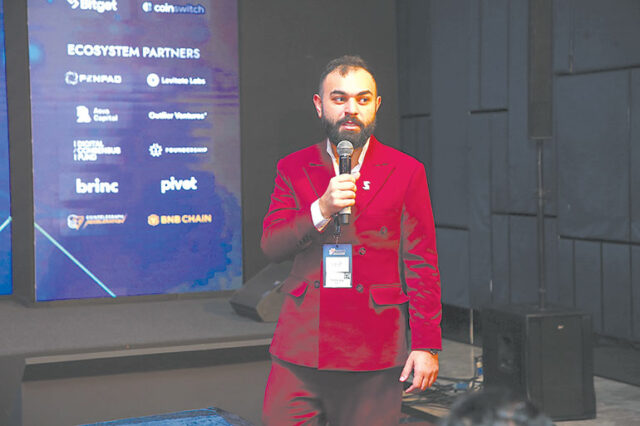
Vugar Usi Zade, COO at Bitget, shares how they plan to bring crypto and Web3 to Filipinos.

Bitget, a cryptocurrency exchange platform and Web3 company, is taking its ‘Bitget Builders Program’ to soaring heights as it celebrates reaching 5,000 connections and aims to expand its global recruitment initiative to more places like the Philippines.

Launched in June 2023, the Bitget Builders Program fosters a network of individuals passionate about the drive of cryptocurrency adoption and has already amassed a network of over 5,000 participants from 55 countries, with 1,300 actively contributing to Bitget’s success.

With the expansion, the program aims to engage with Filipino crypto enthusiasts, influencers, and community leaders to lead the charge in spreading blockchain innovation.

The program offers participants tailored incentives, exclusive rewards, and access to tools that enable them to grow professionally while contributing to Bitget’s global expansion. Outstanding participants will also have opportunities to engage in global and regional events, having a platform for local crypto enthusiasts to showcase their knowledge and represent the country on the world stage.

“The awareness for crypto and blockchain is increasing daily. We’re growing at a fast pace to keep up with the market’s demands,” Vugar Usi Zade, COO at Bitget, said. “We see this as an opportunity to leverage our platform to accelerate mainstream adoption and support people who want to do the same. By engaging with our communities, we aim to create an army of supporters that share the same vision as Bitget — bringing crypto to all.”

This initiative is spearheaded by Bitget’s Blockchain4Youth, an initiative that aims to empower young talents and foster innovation within the crypto space. Launched in May 2023, this initiative aligns with Bitget’s vision of nurturing a new generation of leaders who can drive global adoption of blockchain technology to anchor young talents onto the crypto space.

In its next phase, the program plans to include offline meetups and regional tours, bringing both global and local advocates together. These initiatives will allow Filipino builders more opportunities to collaborate, share ideas, and deepen their understanding of blockchain technology in a more personal and impactful way. Bitget hopes to promote community-building and empower builders to contribute to the program’s growth and innovation.

Filipinos who want to join the program can visit https://www.bitget.com/incubation-program.

Benilde introduces new course to encourage technology in business

Business Solutions and Applications Program Chairperson Henry DV. Castro, Ph.D., along with the students

De La Salle-College of Saint Benilde (DLS-CSB) has launched a new degree program, the Bachelor of Science in Business Administration Major in Business Solutions and Applications (BSBA-BSAA), aimed at equipping students with advanced technology skills to address operational challenges in the digital age.

The program merges business management with technology solutions and educational discipline to prepare graduates to become adept in organization-specific IT systems to streamline business operations and improve productivity.

This low-code or no-code business course is ideal for aspiring professionals without going through the complexities of software development.

The roster of faculty members of BSBA-BSAA, composed of seasoned practitioners and academicians, mentor students to evaluate business requirements and implement tech management solutions, as well as enhance their business management skills for different industries.

The core courses cover managerial accounting, business economics strategic, business laws, business finance, applied statistics, business and income taxation, management and business policy professional, and quality and business process improvement. Computer applications final project, international business agreement, and social entrepreneurship, responsibility and sustainability are also essential subjects.

Major courses are also retained in the curriculum, which consists of advanced office applications, business accounting, introduction to business processes, and enterprise inventory management. It will likewise include enterprise logistics and distribution, fundamentals of business analytics, lean sigma, business case development — business process, and project management.

Another milestone of BSAA is the addition of the FinTech elective, which involves the use of newly developed technology to digitize and automate traditional financial services and products.

Other new offerings include leadership, blue ocean strategy, business continuity planning, scrum project management framework, and operations.

The students are also expected to go on academic immersions with co-curricular activities in collaboration with local and international institutions.

The nine-trimester course under the School of Management and Information Technology allows its graduates to tread various professions, such as entrepreneur, business growth analyst, systems analyst, report author or developer, project manager, IT consultant, IT manager, and solutions architect.

New mining reporting rules in effect

Companies are directed to provide technical reports on exploration results, exploration targets, mineral resources, mineral reserves, and metallurgical assessment and design. — PHILSTAR FILE PHOTO

NEW mineral reporting rules take effect today, Jan. 13, requiring mining companies to submit exploration results both quarterly and annually, according to the Philippine Stock Exchange (PSE).

The PSE said in a notice dated Jan. 8 that the Securities and Exchange Commission (SEC) had approved the implementing rules and regulations (IRR) of the Philippine Mineral Reporting Code 2020 (PMRC 2020).

The IRR, which takes effect on Jan. 13, states that annual reports from mining companies must include exploration results, exploration targets, mineral resources, and mineral reserves.

The rules also say that quarterly reports must include any exploration results from that period.

“Only public reports that comply with the reporting standards under the PMRC 2020 and the guidelines under the PMRC 2020 IRR shall be accepted by the exchange for listing and/or disclosure purposes,” the PSE notice said.

The IRR also mandates the disclosure of environmental, social, and governance considerations, which may be voluntarily included in the companies’ technical reports until they are required to report using a reporting framework in accordance with international financial reporting standards (IFRS) S1, IFRS S2, and any future sustainability standards to be adopted by the SEC.

Meanwhile, the PSE said all public reports of covered entities submitted on or after Jan. 13 should comply with PMRC 2020 and its IRR.

The market operator added that there is a two-year transitory period for the submission of technical reports of all covered entities.

Companies are directed to provide technical reports on exploration results, exploration targets, mineral resources, mineral reserves, and metallurgical assessment and design to the PSE relevant to their mineral property within two years from the date of the IRR’s effectivity.

However, the PSE said the two-year transitory period is not applicable to companies with capital-raising activities through the bourse.

“For these companies, technical reports that are fully compliant with the provisions of the PMRC 2020 IRR must be submitted to the exchange upon filing of the relevant listing application,” the PSE said.

The value of the country’s metallic mineral production for the first nine months of 2024 climbed by 3.17% to P195.92 billion, data from Mines and Geosciences Bureau showed.

“We fully support the PSE’s mandate to uphold transparency and accountability among listed mining companies,” Global Ferronickel Holdings, Inc. (FNI) President Dante R. Bravo said in a Viber message.

“Since FNI became public in 2014, we have ensured timely and comprehensive disclosure of exploration results, exploration targets, mineral resources, and mineral reserves as it aligns with our commitment to good governance, investor confidence, and responsible mining,” he added. — Revin Mikhael D. Ochave

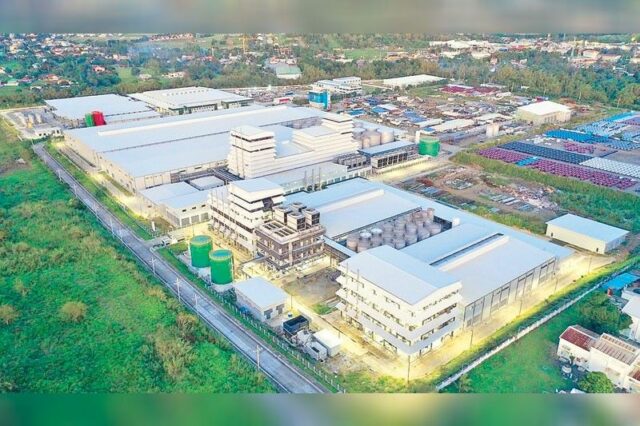
D&L sees growth with easing inflation, election spending

PHILSTAR FILE PHOTO

D&L INDUSTRIES, Inc., a listed producer of specialty food ingredients and oleochemicals, sees a positive financial performance this year, citing easing inflation and increased spending due to the midterm elections.

“Looking forward, it’s making us more optimistic this year with inflation much lower. Costs are much lower. There is more breathing room now for consumers. Hopefully, it means more money to spend and a better economy,” D&L President Alvin D. Lao told reporters last week.

“Spending in the economy during a presidential election is much higher compared to a midterm election, but there is still an increase. As long as the economy is doing well, then we are a beneficiary,” he added.

Full-year inflation averaged 3.2% in 2024, slower than the 6% in 2023. This marked the first time that full-year inflation fell within the central bank’s 2-4% target since 2021.

In December, Philippine inflation accelerated to 2.9% from 2.5% in November. The Philippines will have its midterm elections on May 12.

Mr. Lao said D&L’s profitability has been challenged by high inflation, which tempered consumer spending.

“If you look at how prices went up so much, especially during the pandemic, everything was very expensive. For consumers, their pockets were hurt. Rice prices really went up in the last two years,” he said.

Mr. Lao said D&L could also benefit from the expected recovery of the country’s tourism sector.

Department of Tourism (DoT) data showed that the country logged 5.9 million foreign arrivals in 2024, missing the government’s target of 7.7 million, but higher than the 5.45 million in 2023.

Despite the lower foreign arrivals, the DoT reached a new high of P760.5 billion in tourism receipts last year.

Mr. Lao also said D&L is looking at the possibility of converting some of its other operations to meet the surging demand for biodiesel.

“The demand is quite strong,” he said.

In October last year, the biodiesel fuel blend was raised to 3% on order of the Department of Energy. The blend will further increase to 4% by Oct. this year and to 5% a year after.

With the scheduled blend increase in October, Mr. Lao said orders from oil companies are expected to start increasing around two months before implementation.

D&L shares were last traded on Jan. 10 at P6 apiece. — Revin Mikhael D. Ochave

Do you want to live strong to 100?

ONE OF GAIA’S private villas with pool — PHOTO BY VICTORIA FRITZ AND HOUSE OF GAIA

By Victoria Fritz

MIKE CHAN, a licensed fitness coach, got married at the age of 46. He became a first-time father at 47. Knowing the serious and lengthy responsibilities of fatherhood, his wife encouraged him to have a check-up.

Being a fitness coach and following a generally healthy diet (including lean meat and brown rice), Mr. Chan expected outstanding results from his comprehensive check-up.

He was shocked to find out he was diabetic, with borderline high cholesterol.

That was seven years ago.

After exhaustive consultations with doctors, nutritionists, and other health experts, he adopted a program tailormade for his specific body type and composition. Sharing that program’s details here is not useful because it is not designed for anyone else. Suffice it to say, the regimen is holistic. Beyond the usual diet and exercise program, it also included life coaching for mental wellbeing.

After two years, Mr. Chan had another checkup.

This time, he achieved the excellent numbers he was looking for – all on the low end of normal parameters. His body’ physical age was 20 years younger than he really was.

FIRST OF ITS KIND
This inspired him to spread the message and help more people achieve sustainable good health. With several partners of like mind, he established the first Longevity Medicine Center in the country and is now its chief executive officer.

Situated in Sto. Toribio, Lipa, Batangas, House of GAIA is really “a hospital masquerading as a luxury resort,” in the words of its CEO and founder.

Accommodations are limited to villas with their own private pools. There aren’t even hotel room options.

The Canopy House, at P25,000 a night, is good for a maximum of four people. The most expensive villa, at P65,000 a night, can house a maximum of six people. 

Keep in mind the place is a serious holistic wellness center, designed to lower your stress levels and provide a good night’s sleep. There is no internet in the villas.

The amounts are quite steep. But even if you can afford it, The House of GAIA is not easily accessible.

LONG-TERM COMMITMENT
Mr. Chan carefully screens his clients. “This is not a weekend detox program,” he emphasized. That is why the offering comes in the form of a membership program. He has had to decline potential clients in the past who failed to show a commitment to long-term wellness.   

According to its website, the “Gaia Longevity Program offers customized plans ranging from one year to lifetime commitments. There are currently three membership programs: Gold, P350,000; Gold Premium P350,000 + RMB 50,000; and, Platinum, P3.5 million.
It isn’t clearly stated what those membership plans include. That depends on your diagnosis. But they do include free stays at the villas.

STATE OF THE ART TECHNOLOGY
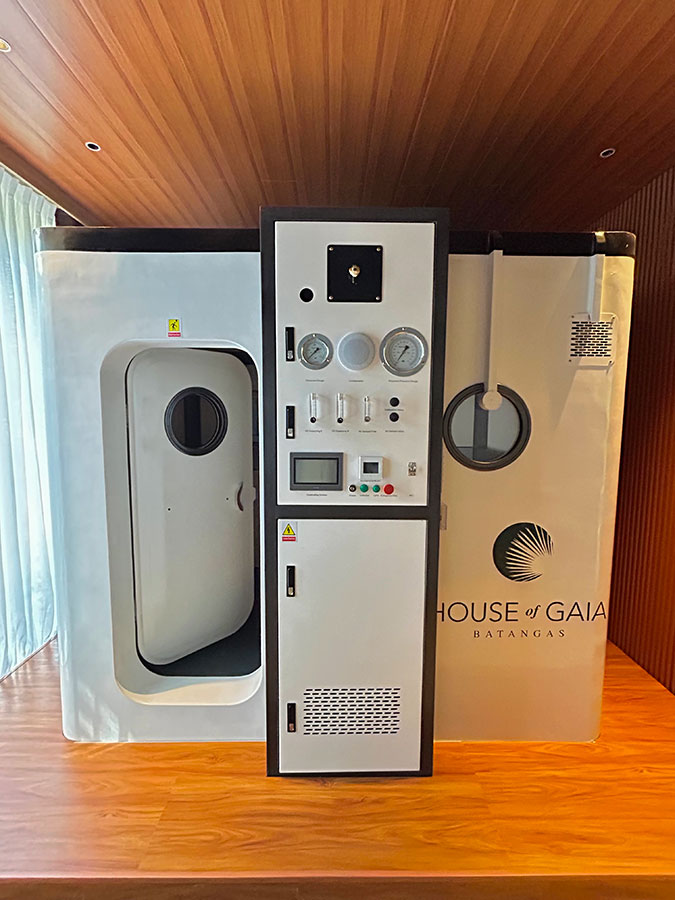
Among the technology that guests can use, according to the information sheet, is the “hyperoxic-hypoxic” chamber. This “is a controlled environment that alternates between high-oxygen (hyperoxic) and low oxygen (hypoxic) conditions. It is designed to enhance oxygen delivery and utilization in the body, stimulating various physiological responses.” The chamber cycles between hyperoxic and hypoxic levels to help optimize the body’s adaptation to different oxygen environments.

It claims to improve brain function, enhance athletic performance, and stimulate internal stem cell production.  In the area of therapy and rehabilitation, it is said to help stroke patients and those with brain injuries recover, slow down aging-related cognitive decline, and address other health issues where oxygen therapy is beneficial.

In Israel, stroke patients use the chamber for hour a day, five days a week for up to three months (depending on the severity of their condition).

The facility also has a photo biomodulation cocoon.

YOU ARE WHAT YOU EAT
Food is the single most important determining factor of your state of health.

I had a meal at Gaia’s in-house restaurant, Cibus, and will give an honest assessment of the dishes I tried. The Smoked Tomato Soup had a clean yet flavorful taste.  The problem was with my main, the Seafood Marinara. The whole-wheat pasta and the seafood tomato sauce had good texture that gave a pleasant feeling in the mouth. However, the dish lacked taste. Not wanting to live to 100 myself, I salted it generously (thankfully, the kitchen still had a supply of salt). The chef of the day, the legendary Gene Gonzales, explained that due to the health requirements, he had a very limited range of ingredients to use.

I’ve heard that if you want to live long, go for tasteless food. It does make sense. Too much salt causes so many ailments.

Let me add though, my companions had chicken satay and a beef wrap, and they swore by those dishes. These were no holds barred veteran lifestyle writers, so I know it was true. Flavor can come from healthier ingredients. There are several delectable main dishes here. Just ask for the diners’ favorites.

The dessert was also divine — toasted rice milk panna cotta.  My drink, a mango and dragon fruit slush, was very refreshing with just the right amount of sweetness.

What I can assure you of is that I felt great after the meal. Light and energetic. None of those lethargic aftereffects of lechon or blueberry cheesecake.

THE ROAD TO LONGEVITY
The road to longevity isn’t a one-lane road. Many factors are involved. Some may surprise you.

Diet is key of course. (Throw away that saltshaker!) Regular exercise and a good night’s sleep are part of it. Being able to recall your dream is a sign of restful sleep. Those factors are common knowledge. The others may be new to some people.

A mindfulness or spiritual practice that allows us to let go of stress and clear our minds is growing in reputation. But people who practice mindfulness remain few. At House of GAIA, a life coach will guide you to a practice that suits you. He or she will also serve as a guide in the areas mentioned previously. Group meditation and yoga are on offer at the GAIA grounds. For those with more serious mental health issues, the coach will refer you to an expert in the field.

Finally, a life’s purpose ties it all together. Why are you here? What gets you up in the morning? Though it may not be clear at first, it can emerge along the way.

So, the question to ask yourself is – do you want to live strong to 100?

Upper Middle-Income Status: On a wing and a prayer?

PHILIPPINE STAR/ MIGUEL DE GUZMAN

For 2025, I wish my friend and erstwhile colleague at the University of the Philippines Diliman School of Economics (UPSE) and currently at National Academy of Science and Technology, Philippines (NAST Phil.), the Secretary Arsenio Balisacan, a realization, a most cherished hope: the attainment of the upper middle-income status for the Philippines. Reaching the $4,516/capita GDP to cap the year just passed 2024, is a cherished wish of the Planning Secretary and of the whole nation. The upper middle-income standard ranges from $4,516 to $14,005 per capita. For us seniors where I belong, the middle-income range starts at $10,000 and ends at $15,000/capita, but that is now old school.

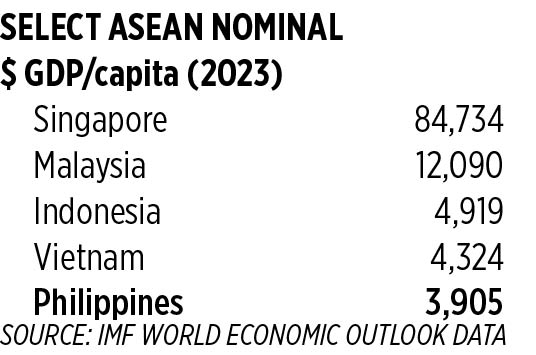
A table on the Asean nominal GDP per capita for select Asean countries in 2023 accompanies this piece for context.

The Philippines’ GDP/capita remains below $4,000/capita and below upper middle-income country standard in this list. We used to have Indonesia and Vietnam in our rear-view mirror.

Our per capita income in 2023 being $3,905/capita by IMF reckoning is a standout for the wrong reason. The Philippine Statistics Authority (PSA) estimate is higher at $4,230/capita. By PSA reckoning, the Philippine economy needs to grow only 6.7% for all of 2024 to reach $4,516 per capita at the start of 2025. A cakewalk you say? But by the IMF estimate, the GDP growth rate required to graduate from the lower middle-income level is 15.6%, and will take two or three years to attain. But, even the growth rate of 6.7% seems an already difficult attainment.

The GDP growth rate was only 5.6% in 2023 after the disappearance of the pandemic-related low base effect; this was down from the post-pandemic low base effect growth bubble of 7.6% in 2022. This low base effect may still figure in 2024 and may result in growth in the vicinity of 5%, especially after the climate disturbances and floods in H1 2024 are accounted for. Portent of this is the growth in Q3 2024 being only 5.2% and below the 6% growth in Q3 2023.

By the IMF reckoning, we may need to wait to 2025 or 2026 for the Rubicon to be crossed. We have, however, a long history of turning great growth prospects into muck. This happened in 1986-1990 and in 1997-2000. And now in early 2025, political storm clouds are stealthily gathering once more with the bad (nay, vicious) blood in the wake of the breakup of the dominant political coalition and the decidedly subversive language being hurled from the Southern faction. The military’s highest leadership has had to reaffirm its loyalty to the constitution on Jan. 4 in the wake of the restructuring of the National Security Council. This is a sign that there is potential trouble to be quelled. The economic team, and the nation with them, hope and pray that the military remains true to the constitutional authority. Otherwise, all bets are off.

If the graduation miraculously comes to pass in 2024-2025, it will do so with the Philippine economy hobbling with the same age-old problems: food insecurity will still threaten food inflation (tomatoes as of January are selling at P200/kilo); malnutrition and stunting among our young remains largely unaddressed; food importation remains the order on the policy front; we will still go begging in the international credit market to fill our import and other spending needs. Our investment rate (GDCF/GDPx100) will still be lowest in the ASEAN region, and our Government Capital Outlay still remains south of 8% of GDP standard among our fast-growing ASEAN neighbors. The Manufacturing sector still plays second fiddle to the buoyant Non-traded Goods sector. Our share in FDI relocating from Mainland China has budged little if at all while the whole global investment community is flocking to the new darling, Vietnam. None of these problems will resolve with our graduation to the upper middle-income country level.

I was in Jagna, Bohol, a port town, for a short traditional family Christmas reunion. The conversation is clearly about politics: the hearings in Congress are stirring new alliances, although local politics still leaning in favor of the southern faction dominates. Jagna Mayor Joseph Rañola declined to pursue his last term — a pity because while he succeeded in finding resources to backstop many worthwhile economic projects, rumor has that his disciplined governance has not endeared him to the voters who favor traditional back-slapping politicians who recall everyone’s name and who show up at every funeral. An instance perhaps of our thesis that in the Philippines, good politics trumps good economics!

Meanwhile, new cars and SUVs increasingly clog the narrow Jagna streets. SM Corp. finally broke ground on its mall in Tagbilaran City after being kept at bay by local politics and their local business alliance, led by the owners and operators of the sole Bohol Island City Mall. Jagna now has three formal banking branches: LANDBANK, Banco de Oro, and Metrobank. A 24-hour convenience shop has opened. But traditional retail (mercado) business in Jagna and small urban areas are barely surviving the competition from the digital outfits — Shopee and Lazada are taking over the market of upper income households with command of the 4G gadgets.

Whence is the local economic buoyancy? The upgrade of public school teacher wages and that of other government employees, thanks to the tail end of the salary standardization law, is contributive. The proceeds of the Mandanas-Garcia law are also contributive to the LGU’s project financing, though the LGUs are complaining that only 31% of their proper share of indirect taxes is being handed over. Another source of artificial prosperity is the ayuda (assistance) fund called AKAP or Ayuda sa Kapos ang Kita Program, sold as pro-poor but in reality, political payola amounting to P731 billion in 2023. All of these are, however, only reallocations of current resources and not the harvest of new investment.

The upward adjustment of public school teacher salaries has a worrying negative effect on private education in the country: many private secondary education establishments in the country are closing down because of their inability to match the salaries of teachers in public schools. This is true also of Bohol. The possible effect is the lowering of education standards, since private education institutions generally have higher standards having to compete with other schools for tuition-paying students. Despite the salary upgrade, the Department of Education is still unable or unwilling to release the results of national secondary school aptitude exams to ferret out the wheat from the chaff in secondary education.

The private education support of junior and senior high school students is what’s keeping the Central Visayas Institute Foundation (CVIF) viable by enabling it to compensate its teachers with salaries comparable to that of public teachers. CVIF is a very highly motivated secondary high school and is the pride of Jagna town, which has attracted many visitors from all over the country eager to learn its novel learning-by-doing pedagogy called the Dynamic Learning Program (DLP). Here is a solution to our learning poverty which was long-ignored by the national educational authorities saddled by business-as-usual practices. Other private institutions are unable to match the salaries of public school teachers and thus have had to close down.

To keep private secondary schools viable, the voucher system to support private enrollment must be expanded. But where to get the money? The government fiscal position seems precarious. A fiscal crisis may even be looming: the government debt has passed P15 trillion and the government is looking to borrow more. The government is scrambling to replenish the unprogrammed budget; the latter is easy to redirect for political purposes (such as the 50% reduction in the Philippine Deposit Insurance Corp. or PDIC reserve fund and the shortchanging in the share of LGUs in the Mandanas-Garcia fund). The government has allowed the siphoning off of P117 billion (50%) from the reserve of the PDIC, which is required to support the deposits in our banking system. The use of unprogrammed funds (P731 billion for ayuda in 2023) for political ends has been exposed as fraudulent.

Remarkable in its non-pursuit is one potential bright spot. The reform in the military pension which, by a Government Service Insurance System (GSIS) study, would reduce the unfunded liabilities to P2 trillion from P9 trillion per year for 20 years is one potential bright spot provided indexation is replaced by a 1.5% increase in retired military and uniformed personnel (MUP) pensions, a 21% increase in mandatory contributions by regular MUP, and compulsory retirement at 60 years old. This would reduce the fiscal burn from P848.4 billion to P208 billion annually for 20 years, but is still being kicked down the road. It will continue to disembowel our long-term fiscal stability. This is no longer viable as legislation with the military being asked by ex-president DU30 (Duterte) to save the nation from PBBM (President Ferdinand “Bongbong” Marcos, Jr.).

So, shall the upbeat New Year’s prognostication of Secretary Arsenio Balisacan of the country finally entering the ranks of the upper middle-income come to pass in 2025? I hope and pray that it does. But the signs are not auspicious. Agriculture met a “perfect storm” in 2024 — droughts, pests and floods — according to the Agriculture Secretary. The investment rate remains below the 25% of GDP standard. The government capital outlay remains less than the 8% standard.

In other words, if we do cross the threshold, it will be on the strength of a wing and a prayer. But as an old song goes, “Miracles do come true, it can happen to you.”


Raul V. Fabella is a retired professor at the UP School of Economics, a member of the National Academy of Science and Technology, and an honorary professor at the Asian Institute of Management. He gets his dopamine fix from bicycling, assiduously if with little success courting the guitar, and tending lowers with his wife Teena.

Media companies set for rebound this year — analysts

PHILIPPINE STAR/MICHAEL VARCAS

LISTED local media companies are expected to rebound this year, fueled by investments in digital assets and anticipated revenue growth ahead of the 2025 midterm elections.

“The continued growth in online platforms and content consumption allows media companies to reach younger, tech-savvy audiences; investments in digital assets could drive long-term growth,” Globalinks Securities and Stocks, Inc. Head of Sales Trading Toby Allan C. Arce said in a Viber message.

Media companies are projected to see a surge in political advertising ahead of the May elections, he noted.

“Political coverage and election-related programming often lead to higher viewership and engagement,” he added.

“Midterm elections in May 2025 would lead to election-related spending on advertisements for various candidates, in all forms of media,” Rizal Commercial Banking Corp. Chief Economist Michael L. Ricafort said in a Viber message.

For the first nine months of 2024, ABS-CBN Corp. trimmed its attributable net loss to P2.41 billion from a loss of P3.15 billion in the same period a year earlier.

ABS-CBN recorded a 10.4% drop in consolidated revenue for the period to P12.12 billion due to lower cable TV and broadband revenues.

Meanwhile, GMA Network, Inc.’s attributable net income for the January-to-September period in 2024 declined to P1.41 billion, marking a decrease of 42.9% from the P2.47 billion previously.

The company saw its gross revenue fall by 9.5% to P12.46 billion for the first nine months of 2024 from P13.77 billion in the comparable period a year ago.

Just last week, shares of ABS-CBN surged after a bill seeking to grant the media company a franchise was filed in the House of Representatives.

On Friday, shares in the company closed 2.23% higher at P5.97 each. The company’s shares traded as high as P6.15 apiece intraday. According to BDO Capital and Investment Corp. President Eduardo V. Francisco, the filing of the bill to grant ABS-CBN a franchise would be good for the company’s stock price.

“But I defer to regulators on requirements for renewal and if ABS-CBN still meets it as they are now much smaller in viewership and offerings,” Mr. Francisco added.

However, Mr. Arce noted that the shifting consumer preference toward digital and streaming platforms could pose a significant challenge to media companies’ growth.

“Companies that adapt to digital ad platforms may thrive, while those relying on traditional TV ads could face challenges. The need for high-quality, localized, and engaging content will grow, requiring significant investments,” he said. — Ashley Erika O. Jose

ADVERTISEMENT
ADVERTISEMENT