
How PSEi member stocks performed — February 4, 2025

Here’s a quick glance at how PSEi stocks fared on Tuesday, February 4, 2025.


Here’s a quick glance at how PSEi stocks fared on Tuesday, February 4, 2025.

By John Victor D. Ordoñez and Chloe Mari A. Hufana, Reporters
PHILIPPINE President Ferdinand R. Marcos, Jr. has named a US-trained orthopedic surgeon as the president and chief executive officer (CEO) of Philippine Health Insurance Corp. (PhilHealth), according to the Presidential Communications Office (PCO).
In a statement, the PCO said Edwin M. Mercado took his oath as head of the state-owned insurer before the President at the presidential palace on Tuesday.
“Mercado has dedicated his work to ensuring equitable access to quality medical care and leveraging technology to strengthen health systems, particularly in financial management and primary care programs,” it added.
Mr. Mercado, who has been vice chairman of Mercado General Hospital since 2021, replaced Emmanuel R. Ledesma, Jr., who faced criticism for failing to increase benefits for members even after the agency declared excess funds worth P90 billion.
In a statement, PhilHealth welcomed the surgeon’s appointment, saying his management experience would help the agency carry out its healthcare programs.
“We are confident that through his leadership, PhilHealth will continue to successfully carry out the mandate of the National Health Insurance program and fulfill the aspirations of universal healthcare for the benefit of all 115 million Filipinos,” it said.
Mr. Mercado got his medical degree from the University of the Philippines in 1987 and a master’s degree in medical sciences at Harvard Medical School in 2023.
He was also a lecturer at the Ateneo School of Medicine and Public Health on medical research methods and implementation science.
The surgeon is also a fellow at the Brigham and Women’s Hospital Division of Global Health Equity since July 2023, where he is studying the use of artificial intelligence as a tool for community health workers.
Lawmakers in December stripped PhilHealth of P74 billion in subsidy this year, citing its nearly P90-billion reserve funds that could be used to increase members’ benefits.
In October, the Supreme Court (SC) blocked the transfer of P29.9 billion — the last tranche of PhilHealth’s P89.9 billion in excess funds — to the national Treasury.
The excess PhilHealth funds would have been used to support unprogrammed appropriations worth P203.1 billion, which would support state health, infrastructure and social service programs, critics have said.
In August last year, the Senate passed on final reading a bill that seeks to cut PhilHealth premiums to 3.25% this year from 5% last year under the Universal Health Care Act.
The measure sets PhilHealth premium contributions at 3.25% for those with a monthly income of P10,000 to P50,000, with incremental increases of 0.25% each year
In a statement, Senator Mary Grace Natividad S. Poe-Llamanzares said the agency’s new CEO faces a “gargantuan task” in ensuring reliable and accessible healthcare services to all Filipinos.
“PhilHealth members who now cough up higher premium contributions must feel the benefits of the healthcare system, or at least have peace of mind that they can rely on it in case of need,” she said.
“The new PhilHealth management should also settle its remaining deficiencies to health workers, hospitals and other institutions,” she added.
Meanwhile, Solicitor General Menardo I. Guevarra said the transfer of P89.9-billion PhilHealth funds to the Treasury is a temporary measure to address fund availability for key state programs.
There is “no dark or sinister plan” in the transfer of the excess funds to the national Treasury, he told a Supreme Court hearing of a lawsuit questioning the transaction.
“I assure the honorable court and the people that contrary to what has been portrayed by some critics, there was no dark or sinister plan behind the transfer of the P60-billion fund balance from PhilHealth to the Treasury,” he said.
“The Executive branch determines the government budgetary priorities and activities in line with the available revenues and borrowing limits,” the chief government lawyer said. “Congress, in turn, deliberates and acts on the budget proposals of the President,” he added, citing jurisprudence.
He added that it is the Department of Finance’s job to generate and manage financial resources to help attain the state’s development objectives.
“As luck would have it, however, the money needed to provide these essential services does not come easy on our side of the world,” Mr. Guevarra said. “But as they say, scarcity breeds creativity. And oftentimes, creative and innovative solutions are born out of something as common as common sense.”
COURT HEARING
Meanwhile, Zy-za Nadine N. Suzara, executive director at the Institute for Leadership, Empowerment and Democracy, noted that almost 20% of the national budgets from 2022 to 2024 have consisted of pork barrel or discretionary funds used by lawmakers for local projects that are often linked to patronage politics.
“My analysis of the 2022 to 2024 national budgets reveals that pork barrel now constitutes nearly 20% of the total national budget,” she told the hearing as a friend of the court.
“If left unchecked, politicians will continue to mangle the annual national budgets and divert any available funds of agencies or government-owned and -controlled corporations deemed inefficient,” she added.
Also speaking as a friend of the court, doctor Beverly Lorraine C. Ho said PhilHealth had made progress over the years in providing “incremental” and “piecemeal” healthcare to Filipinos.
“For example, covered inpatient diseases are generally broad, but only 40% on average of total hospital bills are covered by PhilHealth,” she said. She added that of the 9,000 case rate packages of PhilHealth, only 17 disease conditions have been upgraded to Z benefits — a package of services that help cover the costs of catastrophic illnesses for Filipinos.
The rest of the case rate packages — a fixed amount that PhilHealth pays a healthcare provider for treating a patient with a specific condition — are paid by patients out of pocket, she pointed out.
“For the first time in history, we actually have the necessary legal instruments and financial resources, not only to provide insurance coverage to every Filipino, but to expand benefits to a level necessary to finance and provide healthcare that Filipinos deserve,” Ms. Ho said, referring to the Universal Health Care Act of 2019.

THE AIR FORCES of the Philippines and the US held joint patrols over the South China Sea on Tuesday, a move that angered China, which also conducted a “routine patrol” over the disputed Scarborough Shoal.
The Philippines and the US have boosted security arrangements under President Ferdinand R. Marcos, Jr. amid rising tension between Manila and Beijing due to overlapping claims in the waterway.
The one-day exercise by the treaty allies took place in the West Philippine Sea, Philippine Air Force spokesperson Maria Consuelo Castillo said, using Manila’s term for waters in the South China Sea that fall within its exclusive economic zone.
“The exercise aimed to enhance operational coordination, improve air domain awareness and reinforce agile combat employment capabilities between the two air forces,” she said in a statement.
Ms. Castillo said three Philippine FA-50 fighter aircraft and two US B1-B bombers participated in the exercise, which included flying over Scarborough Shoal, where the Chinese air force also carried out what it called a routine patrol.
China has controlled the shoal since 2012.
In a statement, China’s military accused the Philippines of joining patrols that it said were organized by foreign countries to “undermine peace and stability” in the South China Sea.
China’s air force units would keep a “high degree of alert, resolutely defend China’s territorial sovereignty and maritime rights and interests, and control any military activities that disrupt the South China Sea,” the People’s Liberation Army’s (PLA) Southern Theater Command added.
China claims almost the entire South China Sea, including parts claimed by the Philippines, Brunei, Malaysia, Taiwan and Vietnam. It asserts its sovereignty claim through an armada of coast guard ships, despite a United Nations-backed court ruling in 2016 that voided its claim for being illegal.
At a briefing on Tuesday, the Philippine Navy said it was “closely monitoring” three Chinese navy vessels within Manila’s maritime zones, including a Jiangkai-class guided missile frigate.
“The presence of the People’s Liberation Army-Navy reflects the People’s Republic of China’s complete disregard for international law and undermines the peace and stability in the region,” navy spokesman John Percie Alcos said.
On Monday, state news agency Xinhua said the passage of the Chinese fleet was consistent with international law, quoting a spokesperson of the PLA’s Southern Theater Command.
The US and its allies should limit China’s access to technology and data to curb its expansionist ambitions in the South China Sea through coordinated military deterrence, Matthew Forbes Pottinger, a former deputy national security adviser of US President Donald J. Trump, told a security forum in Manila on Monday.
The Philippines has contested China’s sweeping claim in the waterway through diplomatic channels by filing more than 190 diplomatic protests since Mr. Marcos took office in 2022.
“Gratuitous efforts to flatter and reassure Beijing are likely to be taken as signs of weakness,” Mr. Pottinger said.
Countries should also consider banning Chinese-made apps such as TikTok and WeChat to prevent Beijing from conducting what he described as “information warfare” and weaken its “discourse power.”
“All we need to do is prevent Beijing’s platforms from manipulating our discourse at home, while making it easier for Chinese citizens to communicate safely with one another and with the outside world,” he added. — Reuters
By Kenneth Christiane L. Basilio, Reporter
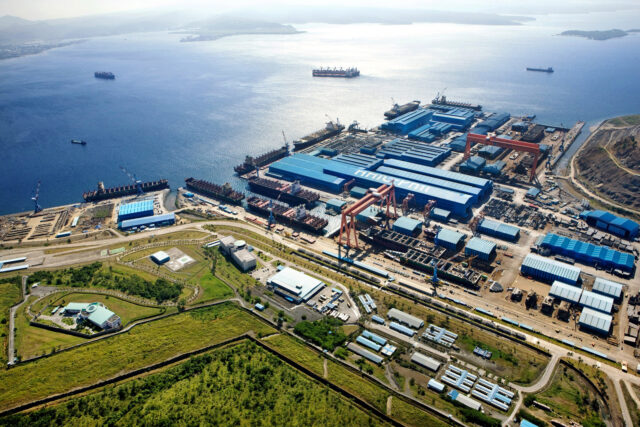
THE PHILIPPINES could benefit from US President Donald J. Trump’s trade policies, including his push to revitalize Washington’s shipbuilding industries and improve gas exportation reach, according to the US-based Heritage Foundation.
The US could partner with other countries including the Southeast Asian nation to help decouple its reliance on Beijing’s battery technologies, Brent Droste Sadler, a senior research fellow at the foundation, told a security forum in Manila on Tuesday.
“One of [Mr. Trump’s] top priorities is the maritime industry, [including the] shipbuilding and shipping sectors,” he said. “That’s an opportunity for partnering and working with countries like the Philippines, a merchant mariner powerhouse in the global stage.”
The US commercial shipbuilding sector has weakened in the past decades, with Washington now only able to build fewer than five ships a year from 70 in 1975, according to former US Trade Representative Katherine Chi Tai. Beijing can build about 1,700 ships yearly.
Mr. Sadler said he expects Mr. Trump to issue executive orders that would help kickstart Washington’s revitalization efforts for its shipbuilding industry, which he described as “strategically important” for the country.
The Trump administration would likely push the quick approval of the Ships for America Act, a bipartisan bill touted to improve the US commercial maritime industry, he said.
The Philippines could also benefit from Washington’s push to develop liquefied natural gas (LNG) facilities to aid its gas exports, said Lucian Pugliaresi, president at Energy Policy Research Foundation.
“It’s an enormous opportunity for Asia,” he told the same forum. “The US has an opportunity, particularly in the Philippines… for the development of new LNG supplies.”
The US is the world’s largest LNG exporter, shipping 88.3 million tons of the cooled gas last year alone. Mr. Trump lifted an LNG export moratorium signed by his predecessor as part of efforts to increase US energy output.
Former US President Joseph R. Biden put a stop on the processing of LNG export permits in early 2024, citing the need to study its environmental and economic effects.
Washington should help improve Manila’s energy prospects by developing LNG structures in the Southeast Asian nation to help ensure continuous shipments of the super-chilled gas in case conflict in the South China Sea erupts, according to a 2024 Center for Strategic and International Studies report.
The Philippines could also benefit from the efforts of western countries to cut their reliance on Chinese batteries, said Dave McMurtry, a board member of the US National Battery Association.
“Countries like the US, the European Union, Japan and others must ramp up investment in lithium battery manufacturing and mining operations,” he told the forum, citing the need to build large battery factories and improve mineral extracting and refining capabilities.
“I’ve toured the Subic Bay Freeport zone, and I think it’s an excellent candidate for multilateral investment in battery capacity,” he added.
Beijing has a foothold over the battery supply chain, controlling at least 85% of its global production. The extraction and processing of critical minerals such as lithium is also “highly concentrated” in China, according to the International Energy Agency.
“Over-reliance on China for lithium-ion battery supply chains could have three big impacts,” said Mr. McMurtry, noting how it could affect the green energy transition and risk supply chain disruptions and market manipulation.
“As nations, we cannot afford to leave this critical supply chain in the hands of a single player, especially one with strategic interests that may not align with our own,” he added.
China on Tuesday announced export restrictions on five metals used across defense, clean energy and other industries minutes after an additional 10% tariff on Chinese goods imposed by Mr. Trump came into effect.
The restrictions are the latest attempt by China since 2023 to leverage its dominance in the mining and processing of critical minerals used in everything from smartphones and electric car batteries to infrared missiles and ammunition.
However, the new rules stop short of outright export bans, which China has previously used against the US, in a continuation of Beijing’s more measured response to the latest round of trade tensions with Washington. — with Reuters

PHILIPPINE lawmakers should consider crafting laws that would penalize public relations and advertising agencies engaged in peddling disinformation, rather than individuals engaged in troll farms, experts said on Tuesday.
“[We should] penalize masterminds, especially black PR (public relations) firms engaged in disinformation. There has to be a way to penalize the masterminds rather than individual trolls,” Rachel E. Khan, a journalism professor at the University of the Philippines, told lawmakers during a House of Representatives hearing.
“We won’t achieve anything if we go after individuals rather than those who brought them or those who pay them,” she added in Filipino.
Ms. Khan was speaking before the House joint committee on public safety, public information and communications technology, which launched an inquiry into the prevalence of disinformation in social media platforms, described as a “national security threat.”
“Our goal is to develop a code of conduct for content creators, ensuring accountability and ethical responsibility in this rapidly evolving digital space,” Surigao del Norte Rep. Robert Ace S. Barbers said in the same hearing, according to a statement.
“We need to hold accountable the people at the top, the elites in the advertising and PR industries…. we should not only go after the low-level workers,” said Jonathan Corpus Ong, professor of global digital media at the University of Massachusetts Amherst.
“We should also focus on ‘big tech’ corporations,” he added.
Lawmakers should also consider “different kinds of legislation,” focusing not only on penalizing social media users who spread false information.
A proposal against online disinformation should include “compliance measures” for social media platforms to participate in transparency mechanisms with researchers.
“If the law is not specific and not transparent, a ‘top-down’ regulation can actually do more harm than good,” said Mr. Ong.
Ms. Khan said congressmen should consider legislating a mechanism allowing fact-checkers to counter disinformation through a “rapid response mechanism,” just like in Taiwan.
“This approach has been effective in addressing false information quickly. We can replicate it if there is collaboration among and support from fact-checking organizations,” she said in Filipino. — Kenneth Christiane L. Basilio
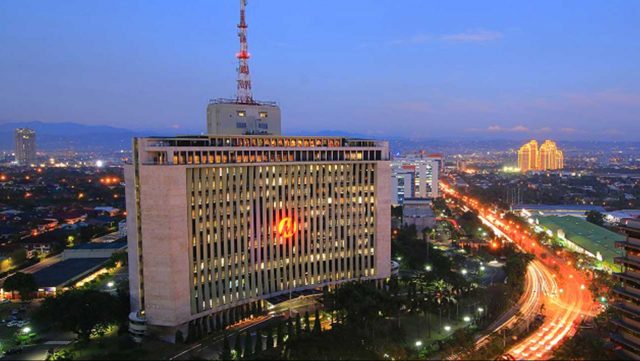
THE House of Representatives on Tuesday evening adopted the Senate’s changes to a bill, extending Manila Electric Co.’s (Meralco) franchise for another 25 years, allowing the chamber to send it straight to Malacaсang for President Ferdinand R. Marcos, Jr.’s signature.
Senators on Monday approved on final reading House Bill No. 10926, which seeks to grant Meralco the franchise to construct, operate, and maintain its electric distribution systems in the greater Metro Manila area, including Bulacan, Cavite, Rizal, and parts of Batangas, Quezon, Laguna, and Pampanga.
Meralco is the main power distributor for the National Capital Region and nearby areas, covering 39 cities and 72 municipalities, delivering electricity to at least 7.6 million Filipinos. It provides power to a region responsible for half of the country’s gross domestic product output.
“The Senate passed with amendments House Bill No. 10926, renewing for another 25 years the franchise granted to Meralco,” Cagayan Rep. Ramon C. Nolasco, Jr. told the House floor.
“We have been informed that the committee on legislative franchises, which sponsored the aforementioned bill, as well as the authors, has no objections with the Senate to the said measure,” he added.
Bills seeking to provide a legislative franchise to companies first originate at the House, undergoing the same legislative process as regular bills, according to the Energy department.
Congressmen gave their final nod to the bill in November, approving it four years ahead of its initial concession’s expiry.
Meralco’s controlling stakeholder, Beacon Electric Asset Holdings, Inc., is partly owned by PLDT, Inc. Hastings Holdings, Inc., a unit of PLDT Beneficial Trust Fund subsidiary MediaQuest Holdings, Inc., has an interest in BusinessWorld through the Philippine Star Group, which it controls. — Kenneth Christiane L. Basilio

THE Supreme Court (SC) on Tuesday ordered the Philippine government to comment on a lawsuit filed by a former presidential spokesman challenging the 2025 national budget.
The high court en banc directed both houses of Congress and Executive Secretary Lucas P. Bersamin to comment on the petition filed by Victor D. Rodriguez last week within a non-extendible period of ten days from receipt of notice.
On Jan. 27, Mr. Rodriguez asked the high court to declare the General Appropriations Act (GAA) illegal for failing to include mandatory funding for the Philippine Health Insurance Corp. (PhilHealth), illegally increasing appropriations over the President’s recommendations, and giving the most budget to infrastructure over education.
The petition added the 2025 national budget is illegal as the Bicameral Committee Report on the General Appropriations Bill had blank items.
“You don’t pass an unenrolled bill blank,” he said, claiming that the 2025 GAA “violated Article VI, Section 27 of the 1987 Constitution of the Philippines when the members of the Bicameral Conference Committee signed and submitted a Report on the 2025 General Appropriations Bill with blanks.” — Chloe Mari A. Hufana

THE House of Representatives on Tuesday approved on second reading a bill establishing a carbon pricing framework for Philippine companies in a bid to meet the country’s climate targets amid climate change concerns.
In a voice vote, lawmakers approved House Bill No. 11375, which mandates Philippine enterprises to offset its operational carbon footprint by reducing its carbon emissions, investing in low-carbon ventures or through carbon credits.
“The measure creates a carbon pricing framework that requires companies exceeding government-set emission targets to spend or invest in environmental sustainability projects to offset their carbon footprint,” Bohol Rep. Edgar M. Chatto, who heads the House climate change committee, told the House floor.
The Philippines ratified in 2017 a United Nations agreement to keep global temperatures rise below 2°C this century.
Medium and large-sized enterprises would be required to partake in the government’s decarbonization efforts, complying with a carbon threshold to be set by the Climate Change Commission.
Covered companies are required to submit a yearly compliance report to the Environment department’s, which should contain greenhouse gases emission levels and its “reduction activities” to lessen their carbon footprint. — Kenneth Christiane L. Basilio
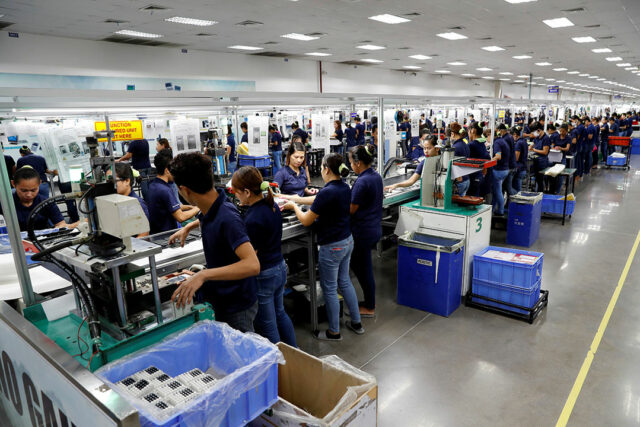
THE Asian Development Bank (ADB) and the Philippine government have launched the second phase of SkillsUpNet Philippines, which offers grants to employers to train their workers.
The ADB, Department of Trade and Industry and Technical Education and Skills Development Authority on Tuesday signed a memorandum of agreement (MoA) for the second phase of SkillsUpNet Philippines.
The project will be allocated $1 million, the ADB said.
SkillsUpNet is an “employer-led skills development funding scheme that offers competitive grants to networks of employers for skills training of workers.”
“This MoA strengthens the partnership between the government and ADB, and it will drive meaningful reforms and help ensure that the Philippines remains competitive in what we know to be an increasingly skills-driven global economy,” ADB Director of the Human and Social Development Sector Office Karin Schelzig said.
The project seeks to address skills mismatch through short-term training, improve skills competencies of employees, raise performance and productivity and broaden income opportunities.
“We want to further evaluate the training impact on workers and enterprises for a potential national rollout later, and we’re looking to promote inclusive skills development for women, youth, and informal workers,” Ms. Schelzig said.
“By aligning training investments with industry needs, we enhance employability, we support business growth, we boost productivity and ultimately drive national economic resilience.”
The second phase will take place from February this year to November 2026. The first phase of the project was from January 2022 to December 2023.
Under the first phase, sectors covered include IT animation, tourism, construction, agribusiness and women-led enterprises.
It also disbursed $310,000 in grants and was able to train a total of 671 workers.
The second phase plans to extend the regions covered and as well as sectors, now including renewable energy and logistics and supply chains.

A PHILIPPINE senator has filed a resolution that seeks to probe the spike in cases of online sexual abuse and exploitation of children and the use of chat platforms and electronic wallets in soliciting these illegal services.
Senate Resolution No. 1307, which Senator Ana Theresia N. Hontiveros filed on Feb. 3, urges the committee on women, children, family relations and gender equality to look into the use of digital financial systems for transactions linked to online sexual abuse of children.
Citing a 2022 study by the International Justice Mission, nearly half a million Filipino children were trafficked to produce child sexual exploitation material for profit.
“The rise of end-to-end encryption, while providing privacy and security to regular conversations, has led to the impunity of sexual predators, whose illegal activities can fly under the radar and below law enforcement security,” based on a copy of the resolution.
In a separate 2022 study, the United Nations Children’s Fund (UNICEF) said about 20% of children aged 12-17 were prone to online sexual abuse and exploitation, with 23% of children not telling anyone of the harm they experienced.
The Anti-Online Sexual Abuse and Exploitation of Children Act, which established the National Coordination Center against Online Sexual Abuse Against Children, lapsed into law in July 2022.
Its implementing rules and regulations were released in May 2023, which mandates the creation of an online sexual offenders registry for foreigners and Filipinos.
“While the passage of the law has provided many additional policy tools for law enforcement agencies to investigate online sexual abuse of children related offenses the advent of emerging technologies… has proven challenging for even the most committed law enforcer,” Ms. Hontiveros said. — John Victor D. Ordoñez

PHILIPPINE President Ferdinand R. Marcos, Jr. on Tuesday named retired major general Isagani Nerez as director general of the Philippine Drug Enforcement Agency (PDEA), according to the Presidential Communications Office.
In a statement, the agency said the retired general will replace former Special Actions Forces chief Moro Virgilio Lazo, who served in his post since Oct. 2022.
Mr. Nerez took his oath before Executive Secretary Lucas P. Bersamin on Tuesday.
The new PDEA chief is a lawyer and law enforcer who previously served as Baguio City police chief and a member of the Presidential Anti-Organized Crime Task Force and Philippine National Police Anti-Kidnapping Group.
The government estimates that at least 6,117 people were killed in the previous administration’s deadly drug war between July 1, 2016, and May 31, 2022, but human rights groups say the death toll could be as high as 30,000. — John Victor D. Ordoñez

THE Philippine Chief Justice swore in a newly appointed justice in the anti-graft court on Feb. 3, 2025, the top court said on Tuesday.
Chief Justice Alexander G. Gesmundo has sworn in newly appointed Sandiganbayan Justice Lord A. Villanueva in a formal ceremony held at the Supreme Court Dignitaries’ Lounge last Monday, replacing Justice Rafael R. Lagos, Chairperson of the Fifth Division, who retired last Dec. 22, 2024.
Mr. Villanueva brings experience in private legal practice and government service. Before his appointment to the anti-graft court, he served as Undersecretary for Operations at the Department of the Interior and Local Government (DILG).
Before that, he worked as the Assistant City Administrator for General Affairs in Quezon City, following 16 years in private law practice.
An alumnus of the University of the Philippines (UP) College of Law, Mr. Villanueva was awarded the UP Law Dean’s Medal for Academic Excellence and was a member of the Order of the Purple Feather Honor Society.
The Sandiganbayan, a special appellate collegial court, is responsible for handling corruption cases involving public officials. — Chloe Mari A. Hufana
