Home Blog Page 2034

Aboitiz, House of Investments partner for Tarlac Economic Estate

In an agreement signed on Oct. 9, in Makati City, the Yuchengco Group’s nonbank holding company House of Investments, Inc. (HI) and Aboitiz InfraCapital, Inc., the infrastructure arm of the Aboitiz Group, will be incorporating HI’s 184-hectare property as part of AIC’s expanded TARI Estate in Tarlac, adding mixed-use components that will complement TARI Estate’s industrial and business offerings. Leading the signing were Lorenzo V. Tan, HI president and chief executive officer and Cosette V. Canilao, AIC president and chief executive officer.

ABOITIZ InfraCapital, Inc. has partnered with Yuchengco-led House of Investments, Inc. (HI) to develop and expand its Tarlac Economic Estate.

“This partnership builds on the strong momentum we’ve already achieved, further enhancing investor interest and confidence in TARI Estate,” Aboitiz InfraCapital Head of Economic Estates Rafael P. Fernandez de Mesa said in a statement released on Thursday by parent firm Aboitiz Equity Ventures, Inc.

In separate stock exchange disclosures, the companies said the partnership will be through a joint venture under House of Investments’ Tarlac Terra Ventures Inc.

The tie-up, which is still awaiting corporate and regulatory approvals and the finalization of a definitive agreement, aims to expand Aboitiz InfraCapital’s TARI Estate.

The infrastructure arm of the Aboitiz group said the collaboration for the joint development of its Tarlac Economic Estate through Tarlac Terra Ventures will incorporate House of Investments’ 184-hectare property adjacent to its estate’s ongoing development.

Tarlac Terra Ventures, the owner of the 184-hectare property, is owned by House of Investments. Under its newly formed agreement, House of Investments will retain a 51% stake, while Aboitiz InfraCapital will hold the remaining 49%.

Aboitiz InfraCapital said the development will also utilize mixed-use components to complement its industrial and business offerings.

“Together, the two companies plan to develop and market the land for various mixed-use purposes, enhancing the overall ecosystem within the expanded TARI Estate. The project is aligned with Aboitiz InfraCapital’s long-term vision of creating a smart and sustainable community hub in Central Luzon,” it said.

Aboitiz InfraCapital also said the collaboration aims to boost the regional economy by generating more jobs and attracting both local and foreign investors.

“This joint venture will be an expansion of HI’s business interests into land development, diversifying our property portfolio. We aim to provide long-term value through flexible, sustainable, and forward-thinking real estate solutions,” House of Investments President and Chief Executive Officer Lorenzo V. Tan said.

Aboitiz InfraCapital’s TARI Estate has an initial 200-hectare development, the company said, adding that the integration of House of Investments’ mixed-use property will transform the property into a “range of opportunities for industrial, commercial, and business activities within the estate.”

At the stock exchange on Thursday, shares in Aboitiz Equity Ventures closed five centavos, or 0.13% higher, at P37.25 apiece, while shares in House of Investments closed unchanged at P3.50 per share. — Ashley Erika O. Jose

Central bank approves BPI sale of stake in GoTyme Bank

THE BANGKO SENTRAL ng Pilipinas (BSP) has approved Bank of the Philippine Islands’ (BPI) sale of its shares in GoTyme Bank, which it gained from its merger with Robinsons Bank Corp. (RBC).

“Please be advised that in its Resolution No. 1145 dated Oct. 3, the (BSP) approved the sale of BPI’s shareholdings in GoTyme Bank Corp. in favor of GoTyme Financial Pte. Ltd. and Giga Investment Holdings Pte. Ltd.,” the Ayala-led lender said in a stock exchange filing.

BPI’s board of directors approved the sale on March 20. The bank’s representatives on April 1 then signed the deeds for absolute sale.

Gokongwei-led JG Summit Capital Services Corp. and Tyme Group earlier said their board of directors had also approved plans to buy out BPI’s minority stake in the digital lender.

BPI earlier said it sold its stake in GoTyme Bank “to address any potential conflict of interest created by the significant overlap in and similarity of product offerings of GoTyme Bank and BPI.”

Under the transaction, BPI sold 752.06 million common shares in GoTyme Bank at P1.20 per share, or P902.47 million in cash.

It said 744.1 million common shares in GoTyme were sold to Gokongwei-led GoTyme Financial, while 7.96 million common shares went to Giga Investment.

The shares sold by BPI accounted for 15% of the outstanding capital stock of GoTyme Bank.

The merger between BPI and Robinsons Bank took effect on Jan. 1, with BPI as the surviving entity.

GoTyme Bank is a partnership between the Gokongwei and Tyme groups. It is one of the six digital banks licensed by the BSP to operate in the country.

The online lender began commercial operations in October 2022 and is targeting 5 million customers by yearend from about 3 million now. It also expects to turn a profit within the next three years.

BPI’s net income grew by 17.5% to P15.3 billion in the second quarter on faster revenue growth. This brought its first-half earnings to P30.56 billion, up by 21.51% year on year.

Its shares closed at P141 on Thursday, down by a peso from the previous day’s finish. — Aaron Michael C. Sy

DoLE estimates POGO job losses at 30,000

PHILSTAR FILE PHOTO

THE Department of Labor and Employment (DoLE) said about 30,000 workers in the Philippine Offshore Gaming Operator (POGO) industry are expected to lose their jobs once their employers shut down.

POGOs, which are now officially known as Internet Gaming Licensees (IGLs), were ordered shut down by the end of the year after the president announced a ban in July.

Earlier this week, at he Labor Inspection Summit in Pasay City, Labor Secretary Bienvenido E. Laguesma told BusinessWorld that IGLs based in Metro Manila have finished profiling the workers set to lose their jobs.

A total of 51 companies in the National Capital Region (NCR), including IGLs, accredited providers, and a special class of business process outsourcing (BPO) firms have finished profiling workers, he said.

Region 4-A (Cavite, Laguna, Batangas, Rizal, Quezon) will finish profiling this month.

“What we are seeing in Region 4, for example, is around 6,000 to 7,000 (are still yet to be profiled). So, the total could reach more or less 30,000 plus,” Mr. Laguesma said.

“We are still looking into those who will be indirectly affected because even though the program is currently focused on those directly affected or the employees of IGLs, we cannot overlook that there will be those indirectly affected by the closure,” he added.

President Ferdinand R. Marcos, Jr., in his State of the Nation Address in July, ordered IGLs banned, citing the criminal activity connected with the industry.

“In Region 4A, which also has four or five IGLs, we are waiting for the completion of their profiling, and according to our regional director, they will also be done within this month,” Mr. Laguesma said.

“We need to finish this early so we can prepare for the interventions DoLE plans to undertake. It’s not just about employment facilitation through job fairs, but we can also help through livelihood projects,” he added.

“Likewise, we can assist in the upskilling or reskilling of workers, as many of them have knowledge of IT and BPO. We are somewhat optimistic that we can help. If not all, then a large portion of the workers. But the President’s directive is to help all those affected,” he added.

Job fairs for IGL workers kicked off Thursday in two Ayala Malls in Metro Manila, Mr. Laguesma said.

Last month, the Philippine Amusement and Gaming Corp. (PAGCOR), the industry’s regulator, said as many as 42,000 Filipino workers would be affected by the ban.

Catalino B. Alano, Jr., PAGCOR’s external communications and corporate communications assistant vice-president, earlier told BusinessWorld the number is composed of IGL workers, service providers, and special BPOs.

He added that as of July 1, only 41 registered IGLs remain, in the NCR, Laguna, and Cavite. Special BPOs number 14 and accredited providers 20. — Chloe Mari A. Hufana

Sustainable Finance: Greening the banking sector

FREEPIK

The banking industry has been undergoing a significant transformation in recent years. Once perceived as a sector primarily concerned with profit maximization, the banking industry is fast recognizing the importance of climate change, social inequality, and environmental degradation in the way it does business.

Thus, more and more banks are adopting sustainable practices. Evidently, this transformation is driven by a number of factors — from regulatory pressures and customer expectations, to the industry’s recognition and acceptance that sustainability can be and is now a competitive advantage.

As currently practiced abroad and in the Philippines, sustainability initiatives in the banking sector range from environmental stewardship to social responsibility and ethical governance. For example, Philippines banks have now integrated environmental, social, and governance (ESG) factors into business operations, investment decisions, and risk management. By embracing sustainability, banks are embracing their role in societal resilience while also enhancing reputation and financial performance.

Today, one of the most critical focus areas for sustainable banking is climate change. Filipino banks are recognizing that they have a significant role in moving the needle towards a transition to a low-carbon economy by financing “green” projects.

It is not unusual these days to read in the news that some major banks are developing and providing loan packages and investment proposals for renewable energy projects, energy efficiency initiatives, and sustainable transportation. We are also seeing several banks manifesting support for climate adaptation initiatives by financing infrastructure projects that build resilience to climate-related risks.

From the current base of initiatives, another focus of sustainable banking is the industry’s commitment to social responsibility. We see banks contributing to social development by providing financial services to underserved communities, promoting financial inclusion, and supporting initiatives that address poverty, inequality, and unemployment. By investing in human capital and creating shared value, Filipino banks are helping build stronger relationships with their customers and communities.

Indeed, sustainability in the banking sector is essential for several reasons. They are as follows:

Risk Management: Because banks take into consideration ESG factors, they are now able to better manage risks associated with environmental disasters, social unrest, and governance failures.

Reputation and Trust-building: Adoption of sustainable practices promote bank’s reputation and help build trust and credibility with customers, investors, and regulators.

Regulatory Compliance: Increasingly, governments and regulatory bodies are mandating sustainability reporting and practices.

Market Opportunities: There is growing demand for green finance products and services, providing banks with new business opportunities.

Long-term Profitability: Sustainable practices can lead to cost savings, improved operational efficiencies, and long-term profitability.

By looking at the current landscape, we can readily see that banks are employing several strategies in promoting sustainability in the financial sector. By incorporating ESG criteria into their lending and investment processes, they ensure that the projects and companies they finance are aligned with sustainable practices. Assessing the environmental impact, social implications, and governance practices of potential borrowers and investees is becoming a regular practice in the banking industry.

Offering green financial products, such as green bonds, sustainability linked loans, and green mortgages, allows banks to support environmentally friendly projects and businesses. These products can help finance renewable energy projects, energy-efficient buildings, and sustainable agriculture.

Banks are also improving their internal operations by adopting energy-efficient technologies, reducing waste, and promoting sustainable practices among employees. These efforts are further complemented by implementing other initiatives such as paperless banking, use of renewable energy sources, and eco-friendly transportation.

Supporting community development and social initiatives is another way banks can contribute to sustainability. This involves funding education programs, healthcare services, affordable housing projects, and other initiatives that improve the well-being of communities. Regularly publishing sustainability reports and setting clear sustainability targets are also common staples. These help banks demonstrate their commitment to sustainability and hold themselves accountable.

Several Filipino banks have emerged as leaders in sustainable banking. These institutions have demonstrated a strong commitment to environmental, social, and governance principles, and their initiatives serve as examples for the industry.

Here are some exemplary sustainable practices in Philippine banks:

The Bank of the Philippine Islands (BPI) has been at the forefront of sustainability in the Philippine banking sector. BPI’s sustainable practices include:

Sustainable Energy Finance (SEF) Program: Launched in partnership with the International Finance Corp. (IFC), the SEF program provides financing for renewable energy and energy efficiency projects. This initiative has helped reduce greenhouse gas emissions and promote the use of clean energy.

Green Building Initiatives: BPI has implemented green building standards in its branches, focusing on energy efficiency, water conservation, and waste reduction. The bank has also invested in solar power systems for several of its branches.

Rizal Commercial Banking Corp. (RCBC) has also made significant strides in sustainability:

Sustainable Financing Framework: RCBC has developed a Sustainable Financing Framework, under which it issues green and sustainability bonds. These bonds finance projects that contribute to environmental and social sustainability, such as renewable energy, green buildings, and social housing.

Environmental and Social Risk Management System (ESRMS): RCBC has implemented an ESRMS to integrate environmental and social risk considerations into its credit decision-making process. This system helps the bank identify and mitigate potential ESG risks associated with its lending activities.

LANDBANK has a strong focus on sustainable development, particularly in supporting agriculture and rural communities:

Green Climate Fund (GCF) Accreditation: LANDBANK is accredited by the Green Climate Fund, allowing it to access funding for climate mitigation and adaptation projects. This enables the bank to support initiatives such as reforestation, climate-resilient agriculture, and renewable energy.

Sustainable Development Assistance Programs: LANDBANK offers various financial products and services aimed at promoting sustainable agriculture, rural development, and environmental protection. These programs include loans for organic farming, eco-friendly aquaculture, and sustainable fisheries.

The Development Bank of the Philippines (DBP) has a long-standing commitment to sustainability:

Environmental Management Program (EMP): DBP’s EMP focuses on promoting environmental protection and sustainability through its financing activities. The bank provides loans for projects that support clean energy, pollution control, and sustainable resource management.

Green Financing Program: DBP offers a Green Financing Program that provides financial support for projects that contribute to environmental sustainability, such as renewable energy, energy efficiency, and waste management. This program aligns with the bank’s goal of promoting sustainable development in the Philippines.

Metropolitan Bank & Trust Co. (Metrobank) has integrated sustainability into its core operations:

Green Bond Issuance: Metrobank has issued green bonds to finance environmentally sustainable projects. The proceeds from these bonds are used to fund initiatives such as renewable energy, green buildings, and sustainable water management.

Sustainable Operations: Metrobank has implemented various initiatives to reduce its environmental footprint, including energy-efficient lighting, water conservation measures, and waste reduction programs. The bank also promotes sustainable practices among its employees through awareness campaigns and training programs.

Union Bank of the Philippines has demonstrated a commitment to sustainability through various initiatives and product offerings that align with ESG principles:

Green Financing and Sustainable Investments: UnionBank offers sustainable financing products to support businesses that engage in environmentally friendly practices. This includes providing loans for renewable energy projects, energy efficiency initiatives, and other eco-friendly ventures that help reduce carbon footprints.

Digital Transformation for Sustainability: By championing digital banking, UnionBank significantly reduces the need for paper, travel, and physical bank visits. The promotion of e-banking solutions, mobile apps, and digital payments contributes to environmental conservation by reducing the carbon footprint associated with traditional banking activities.

Indeed, sustainability practices in the banking industry are crucial for managing risks, enhancing reputation, complying with regulations, capturing market opportunities, and ensuring long-term profitability. Banks play a vital role in promoting sustainable development by integrating ESG criteria into their operations, developing green financial products, enhancing internal sustainability practices, engaging in community initiatives, and maintaining transparent reporting.

The examples of Philippine banks demonstrate that sustainability is becoming an integral part of the banking sector in the country. These banks have implemented various sustainable practices, including financing renewable energy projects, supporting sustainable agriculture, issuing green bonds, and improving their internal operations. By continuing to innovate and prioritize sustainability, banks can contribute significantly to the global effort to build a more sustainable future.

Sustainability is no longer an option for the banking industry but a necessity. By integrating ESG considerations into their business models, banks can create long-term value for shareholders, customers, and communities. The Philippine banking industry has made significant progress in this area, and with continued efforts, the country can become a leader in sustainable finance in the region.


Dr. Ron F. Jabal, APR, is the CEO of PAGEONE Group (www.pageonegroup.ph) and founder of Advocacy Partners Asia (www.advocacy.ph).

ron.jabal@pageone.ph

rfjabal@gmail.com

Director Steve McQueen’s Blitz opens 2024 London Film Festival

IMDB
IMDB

LONDON — Oscar-winning director Steve McQueen kicked off the London Film Festival on Wednesday with his gripping World War Two drama Blitz.

“Where we’re standing right now, bombs were dropped,” the 12 Years a Slave and Hunger filmmaker said on the red carpet at the capital’s Royal Festival Hall. “So, to be in London showing a movie about London in 1940, I mean, where else can I show this picture?”

Blitz stars Saoirse Ronan as Rita, a London mother who sends her young son George, played by newcomer Elliott Heffernan, to safety in the countryside during the war. But George is determined to return home despite the many dangers ahead.

Like his character, Mr. Heffernan, whose previous acting experience consisted of playing Aladdin in a school play, embarked on a transformative journey with the movie.

“It was a massive adventure, just for one kid who did a school play to being on the red carpet and knowing exactly how a film works. I think I’ve come a very long way,” the 11-year-old said, adding he had not told his friends about his star turn.

“Maybe they’ll find out, maybe they won’t. I might not tell them. I mean, I want to keep it normal,” he said.

Dubbed “the Blitz” by the locals, the intense aerial bombing of the United Kingdom from September 1940 to May 1941 by the German Luftwaffe was officially called Blitzkrieg, or “Lightning War.” It saw Londoners huddling together in underground shelters, battling blazes caused by the bombings and rescuing people from the rubble of their homes.

“It (the film) is about community coming together against all odds and kind of honoring that part of our humanity that needs to find lightness and levity no matter how bad the world is around us,” Ms. Ronan said.

Written and directed by Mr. McQueen, Blitz also stars Harris Dickinson, Paul Weller, Stephen Graham, and Benjamin Clementine.

It is one of 255 titles from 80 countries screening at the 68th edition of the London Film Festival.

Blitz is out in select cinemas on Nov. 1 and will stream on Apple TV+ from Nov. 22. — Reuters

Accenture opens sustainability hub in Mandaluyong

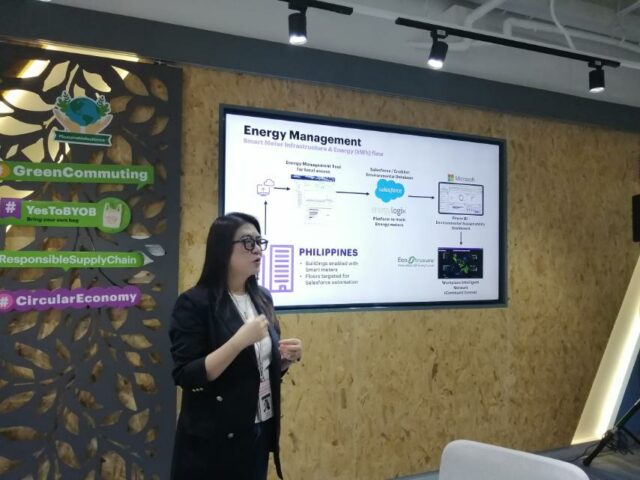
ACCENTURE, Inc., a global professional services company, has opened a sustainability hub in Mandaluyong City as part of its environmental, social, and governance (ESG) efforts.

“Our goal here is to have a one-stop shop of all of our ESG-related actions,” Amabel P. Gatmaitan, corporate services and sustainability lead at Accenture Philippines, said during a press briefing on Thursday.

“We partner with a client, regardless of where they are, regardless of what industry they are in, we always make it a point that sustainability is part of the conversation as well. That’s why we’re very proud of our sustainability by design,” Ms. Gatmaitan said.

In a 2024 study by Accenture, which looked into ESG compliance and reporting as a competitive advantage in business reinvention strategies, companies with strong ESG capabilities already consider sustainability as a significant value driver for their organizations.

The firm said that by embedding sustainability in everything it does and works with, Accenture is able to create both business value and sustainable impact, “enabled by technology and human ingenuity.”

Within the sustainability hub is the Workplace Intelligent Network or command center, which started in 2018. This center receives information from buildings enabled with smart meters.

“Through the automated meter reading implementation (AMI), we are aligning with our clients’ objectives to reduce carbon emissions by 80% in 2030 and achieve 100% carbon-free electricity by 2050,” Ms. Gatmaitan said.

She also said the center can monitor and predict in real-time the fuel of the generator set of Accenture locations across regions as part of its business resiliency.

At the Accenture Advanced Technology Centers in the Philippines, Accenture partnered with clients on their net zero journey.

In a study by Accenture and United Nations Global Impact, it urged private sectors to lead with using technology such as generative artificial intelligence to accelerate their sustainability development targets.

The company has 26,000 eco-champions or employees involved in sustainability-related activities such as tree planting, eco-fund runs, and more, Accenture said. — Aubrey Rose A. Inosante

Philippine HMOs expected to bounce back after rampant insurance fraud

MEDICARE PLUS, Inc. expects the health maintenance organization (HMO) industry to continue its recovery in the coming quarters as companies continue to consolidate.

“In the last two years, there was a huge decline,” Medicare Plus Chief Executive Officer Maria Jesusa “Jayjay” Viray told reporters on Thursday. “That’s a wake-up call to all our partners in the industry. Of course, it’s also going to help if we cooperate with our member-hospitals and clinics and understand their situation.”

“We cannot just be working independently,” she said, adding that she expects the sector to bounce back and grow.

The HMO industry posted a net income of P636.6 million in the second quarter, data from the Insurance Commission showed. This was a turnaround from the P1.19-billion net loss a year earlier, according to the unaudited financial statements of 25 HMOs.

Before this, the HMO industry had quarterly net losses from September 2022 to December 2023.

“As a member of the industry, we have to rethink how we do things, how we serve our clients,” Ms. Viray said. “For some time, I think we’ve been locked in and not fulfilling contracts and coverages… That’s something that we have to revisit.”

She attributed the industry’s decline to rampant fraud.

“So as a provider, we have to do our part in keeping this industry aligned,” she said. “If we don’t rethink how we do things, then it will just continue to decline and there will be more losses.”

Ms. Viray noted that from 30 companies, they have gone down to 25 in just two years.

The Insurance Commission has been shutting down HMOs for failing to meet minimum capital requirements.

In July, the regulator issued an advisory seeking industry comments on a possible increase in HMOs’ minimum paid-up capital, which will be enforced over 10 years.

Under the proposal, existing HMOs must have at least P50 million in paid-up capital by end-2024 from P10 million now, while new HMOs must put up at least P100 million in capital.

By end-2025, all HMOs should have at least P100 million in paid-up capital. This will be increased to P200 million by end-2028, to P350 million by end-2031 and to P500 million by end-2034.

Ms. Viray said she hopes more HMOs would come in since the sector remains largely untapped.

“Only seven million are enrolled in an HMO plan,” she said. “What happened to the rest of the country? The plans are not expensive. Everybody can afford to get a plan. But we have to do our part as providers.”

She said Medicare Plus is expanding and buying clinics since it has managed to meet the minimum capital requirement for HMOs. “We are in expansion mode. We’ve just bought several clinics and we are going to get more,” she added.

As of end-June, Medicare Plus’ capital stock was P50 million.

Ms. Viray said they are waiting for the Securities and Exchange Commission’s (SEC) approval of another P70 million in capital, which will bring the company’s total capital stock to P120 million.

Medicare Plus raised its capital due to its strong revenue, she added.

The company on Thursday signed a memorandum of understanding with the Public Safety Mutual Benefit Fund, Inc. to provide its members with healthcare services.

The Philippine National Police’s (PNP) mutual benefit fund will begin with a pilot program, providing healthcare services first to 16,000 members who have been in the service for 20 to 24 years until the first quarter of 2025, when it will have expanded to more members.

The fund has 200,000 members.

Medicare Plus’ services will add to the PNP’s own hospitalization program, fund trustee Emmanuel B. Peralta said.

The fund will pay P60 million each year in the next five years, for a total of P300 million. This translates to about P40,000 worth of health service coverage per member.

Medicare Plus posted a net income of P545,135 in the second quarter. — Aaron Michael C. Sy

Spanish truckers to stage series of job walkouts over retirement rules

REUTERS

MADRID — Spain’s truck and bus drivers will start a series of strikes on Oct. 28 to demand earlier retirement on better conditions, union leaders said.

Truck drivers will walk out on Oct. 28, Nov. 11, Nov. 28, Nov. 29, Dec. 5, Dec. 9, and will begin an indefinite strike on Dec. 23 if their demands are not met, representatives of the country’s two main unions, the CCOO and UGT, announced.

The unions demand that drivers’ employment conditions such as the retirement age, now at 67, and the right to partial retirement be improved and adjusted to the conditions of other categories of workers who face similar risks as drivers.

“Age is a determining factor in motor skills, sensory and cognitive loss and constitutes a risk not only for the worker but also for the rest of the people,” said Diego Buenestado, UGT’s secretary for road and urban transportation.

A month-long strike by truckers in 2022 brought Spanish supply chains to a halt, caused food shortages, triggered a bout of inflation and hit economic growth. — Reuters

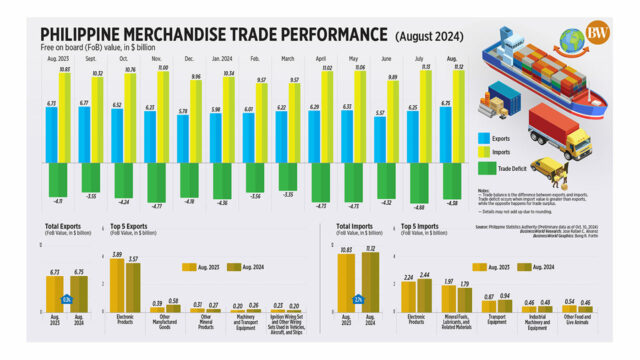
Philippine Merchandise Trade Performance (August 2024)

THE PHILIPPINES’ trade gap widened year on year in August as growth in imports still outpaced the increase in exports, even as the value of outbound shipments was the highest in 11 months, the government reported on Thursday. Read the full story.

Philippine Merchandise Trade Performance (August 2024)

The unbearable dullness of the sensitive woke

JAMES BALDWIN-UNSPLASH

There was a scene in the Stephen Frears film Dangerous Liaisons in which John Malkovich, as Valmont, says of the so far fruitless efforts of Chevalier Danceny (played by a hapless Keanu Reeves): “He doesn’t need help. He needs hindrances.”

I was reminded of this because I’d been recently told that I was mean, even (*gasp!) harsh, at a public forum — some young people were even traumatized by me, my views, leading them to hold private discussion sessions with the forum organizers to “process” the harshness that is me.

Which is really idiotic. Never mind that I have 25 years of work and study in international law, studied in the best University for it, studied under and drank with the best teachers and practitioners (the people that students cite as authorities), worked on some of the great landmark cases of the country, co-wrote a book on international law with one of the greatest constitutional minds ever — forget all that.

Apparently, I was offensive for simply being honest — with no profanity, insult, or raised voice — in expressing what my years of experience and study have given me.

How is it possible for these young people to function? How can they not whither and shrivel up if their reaction to any opposing thought or (the horror!) for not being praised for their “brilliance” is to rant, take it personally, complain to their peers or teachers, and act like some baby on cheap meth?

I had a professional colleague tell me of an instance when she showed a civics class a short video on poverty and there was this young adult woman who came to her shaking, begging to be allowed to go out the room, as the video was giving her so much anxiety. She went to the toilet trembling and splashed water on her face to calm herself down.

Simply because of a video that showed people eating on the floor with their hands and children playing on a dusty street.

Jeebus, I really hope Trump wins.

And all this time I thought that freedom of expression and academic freedom was for the purpose of enabling and ensuring that one hears a contrary, even offensive, idea.

Instead, all this progressive wokeness is just causing society to regress: “Dissent, in primitive societies, was normally punishable by death. The upshot of this was that a society’s core body of knowledge and doctrine tended to remain almost static, especially if inscribed in writings that were regarded as holy. It was against this historical background that the pre-Socratic philosophers of ancient Greece introduced something wholly new and revolutionary: they institutionalized criticism. From Thales onwards each of them encouraged his pupils to discuss, debate, criticize — and to produce a better argument or theory if he could. Such, according to [Karl] Popper, were the historical beginnings of rationality and scientific method, and they were directly responsible for that galloping growth of human knowledge.” (Bryan Magee, Confessions of a philosopher).

Because that is how one matures, arrives at truth, constitutes a truly dynamic society, where citizens achieve individual human flourishing.

Instead, what matters is that everything bow down to inclusion, equity, diversity, social justice, and the liberal notion of “charity.” That truth must bow down to feelings and for the sake of unity.

And we continue to double down in coddling our kids to the point of brittleness. Reason Magazine (“The Fragile Generation,” Lenore Skenazy and Jonathan Haidt, December 2017) points to the evolution of “safe spaces,” which our Congress unfortunately institutionalized, as causative of the youth’s weird fragility.

“The principle here is simple: This generation of kids must be protected like none other. They can’t use tools, they can’t play on grass, and they certainly can’t be expected to work through a spat with a friend. And this, it could be argued, is why we have “safe spaces” on college campuses and millennials missing adult milestones today. We told a generation of kids that they can never be too safe — and they believed us,” wrote Skenazy and Haidt.

“For a variety of reasons — including shifts in parenting norms, new academic expectations, increased regulation, technological advances, and especially a heightened fear of abduction (missing kids on milk cartons made it feel as if this exceedingly rare crime was rampant) — children largely lost the experience of having large swaths of unsupervised time to play, explore, and resolve conflicts on their own. This has left them more fragile, more easily offended, and more reliant on others,” they wrote.

All “this poses a threat to the kind of open-mindedness and flexibility young people need to thrive at college and beyond. If they arrive at school or start careers unaccustomed to frustration and misunderstandings, we can expect them to be hypersensitive. And if they don’t develop the resources to work through obstacles, molehills come to look like mountains.”

Unfortunately, it will be society and future generations that will have to pay dearly for the fragility of today’s youth.


Jemy Gatdula is the dean of UA&P Law, as well as a Philippine Judicial Academy law lecturer for constitutional philosophy and jurisprudence.

https://www.facebook.com/jigatdula/

Twitter  @jemygatdula

Secrets and speedy thumbs as Blanchett and Cuaron team up for Disclaimer TV series

IMDB
IMDB

LONDON — Oscar winners Alfonso Cuaron and Cate Blanchett say their new television show Disclaimer is woven around characters that challenge audiences to suspend their judgment.

The seven-part psychological thriller is based on Renee Knight’s 2015 novel of the same name and created, written, directed and produced by Gravity and Roma director Mr. Cuaron.

Viewers meet Ms. Blanchett’s character Catherine Ravenscroft, a respected documentary-maker, in a moment of crisis, when she is sent a book detailing dark secrets from her past.

Catherine tracks down the novel’s author, retired teacher Stephen, played by Kevin Kline, and discovers he is bent on sharing her story and his truth with the world, with potentially ruinous effects on her reputation and relationships.

The twisty tale, that also stars Sacha Baron Cohen as Catherine’s husband, Lesley Manville as Stephen’s late wife, Louis Partridge as their son, and Leila George as the young Catherine, combines narratives and timelines.

“My character is, people transplant their own judgement upon her. In a way she’s a glass of water, she seems relatively passive,” said Ms. Blanchett.

“I found there was a lot that I was confronted by from my very first read of the script. I had a profound judgement of the characters in a way that I was quite shocked by,” she said.

The opportunity to explore and juxtapose the different narratives was what prompted Mr. Cuaron to adapt Knight’s novel.

“I was intrigued about what was happening internally with each one of these characters and how that was creating a completely free interpretation of everything,” said Mr. Cuaron.

In addition to taking on the lead role, Ms. Blanchett boarded the project as an executive producer and quizzed Mr. Cuaron about character motivations and plot details.

“Cate’s involvement is the one that triggered all the important questions. It triggered a whole rewrite of the whole script,” said Mr. Cuaron.

“Your thumbs must be really athletic,” he said, referring to Ms. Blanchett. “I’d never received so many text messages!”

Disclaimer starts streaming on Apple TV+ on Oct. 11. — Reuters

NAIA operator sets new VIP service fees, protocols

REUTERS

SAN MIGUEL-LED New NAIA Infrastructure Corp. (NNIC) has introduced new fee hikes at the country’s main gateway, along with new protocols for handling courtesies and accommodations.

In a statement on Thursday, NNIC said a new set of guidelines is in place for very important persons (VIPs), important persons, and passengers requesting VIP treatment at the Ninoy Aquino International Airport (NAIA).

Currently, meet and assist service fees or VIP privileges can be enjoyed at P800 only. NNIC will hike it by tenfold to around P8,000.

“The new protocol, which replaces all previous arrangements effective immediately, is expected to curb misuse of VIP courtesies extended at the airport,” NNIC said.

According to NNIC, VIP privileges were only intended for dignitaries and other important individuals, but it was easily accessible in the past.

“For that amount, any passenger could bypass regular airport procedures,” NNIC said, adding that the low fees previously imposed also created security vulnerabilities and operational inefficiencies.

NNIC is composed of San Miguel Corp. (SMC), one of the Philippines’ largest and most diversified conglomerates; RMM Asian Logistics, Inc.; RLW Aviation Development, Inc.; and Incheon International Airport Corp., the operator of South Korea’s main international airport.

The airport operator also justified the fee hike, saying its goal is to create seamless and efficient operations, eliminating the need for VIP treatment.

NNIC also said that beyond addressing current issues, the hike in fees is also designed to enhance security, reduce disruption to passengers, personnel, and other airport users, and optimize logistics.

For now, VIP courtesies and accommodations will solely be handled by NNIC’s VIP assistance personnel, while non-passengers can no longer enjoy VIP privileges.

It will also limit VIP entourages to essential personnel to ensure efficient processing while also reducing disruptions.

NNIC said access and annual passes that have been issued in the past will be evaluated anew on a per-case basis and will be replaced.

“To discourage nonessential use and manage demand, NNIC will introduce tailored fees for passengers not classified as VIPs or IPs but seeking similar services such as international performers and other high-profile passengers,” NNIC added.

Further, NNIC said that it will continue to extend VIP courtesies to high-ranking officials, dignitaries, and foreign representatives.

This month alone, NNIC has already imposed several changes in fees collected at the airport.

Starting Oct. 1, NNIC imposed higher parking fees, which increased by around 25% for standard parking rates and 300% for overnight parking.

Landing and takeoff fees, a charge collected from airlines for using airport facilities and services, were also hiked. A higher passenger service charge is also set to be implemented next year.

According to NNIC, all fee adjustments are part of its concession agreement, which is agreed upon and set by the government.

Meanwhile, the Manila International Airport Authority (MIAA) said that a total of 844 plantilla positions were abolished as MIAA transitioned to its sole regulator function following the turnover of NAIA operations and maintenance to the private operator.

NNIC took over the operations of NAIA on Sept. 14 after offering to allocate 82.1% of NAIA revenues to the government.

MIAA General Manager Eric Jose C. Ines said that the positions were abolished due to redundancy.

“These 844 positions were actually abolished because this group belongs to the operations group. Their functions were absorbed by the NNIC,” Mr. Ines said by phone.

He said that the 844 positions were actually not filled, noting that no employees were actually affected. — Ashley Erika O. Jose