Home Blog Page 2031

The Imaginal Life

JARED RICE-UNSPLASH

“If ever there was a time and a place to reconnect with Imagination, that place is here, and that time is now. Humanity stands at a crossroads, one direction leading to worse destruction, the other to the endless possible.”

— Dr. Stephen Aizenstat, The Imagination Matrix

Discussing the importance of imagination, Rose Marie Yenko, clinical psychologist, OD Consultant and Chair Emeritus of the Carl Jung Center Circle, shared with me this impromptu response.

“Fruits of imagination abound in our world. One can think of Steve Jobs and his early creations — the candy-colored computers and their beautiful keyboard icon designs. The small and sleek iPod. And the invention of the mind-blowing iPhone then. One can think of Hanunuo Mangyan’s ambahan, and this lyrical seven syllable poetry written on bamboo tubes and placed along nature trails for one’s beloved serenade.

“One can think of pop-up books that awe children… One can think of a simple hymn, ‘Amazing Grace,’ that moves one to weep. One can think of a major city transformation, like Iloilo City that was moved by a concerted collective, purposive, and intentional commitment to a vision that was started. In another country, Dubai has shown us what imagination can create — a flourishing of a lifestyle and an economy that is limited only by what can be imagined,” Ms. Yenko explained.

“My imagination has always set me free. It has made me create scenarios that have propelled me into action. The images in my head have sustained visions of what is possible and have tended dreams one small step at a time until they become realities. My country home design came from a home featured in a ’90s magazine, heightened in imagination by magazine clippings and photos. And now my country home has become a reality, with a particular look and feel as desired.”

Ms. Yenko recalled a wonderful trip to Istanbul that was prompted by watching an old movie featuring a heist of the Topkapi Palace.

The importance of imagination is the focus of the work of the esteemed educator, psychotherapist Dr. Stephen Aizenstat. He is an author, a consultant to leaders and movers, and the Founding President of Pacifica Graduate Institute, Santa Barbara, California, an institute that is well-known for its graduate programs in the field of Depth Psychology, Mythology, and the Humanities. He is a specialist in working with images and imagination. His work on images builds on the pioneering work on dreams by Carl Jung. He works with Hollywood film writers.

Dr. Aizenstat’s major book, Dream Tending, gives the individual who dreams an attitude and a way of working with images in his dreams. This book has impacted thousands of students and individuals. The evolution of his work has progressed to images and imagination.

Another one of his major books, The Imagination Matrix: How to Access the Greatest Power You Have for Creativity, Connection, and Purpose, is the focus of his lecture-workshop on Tuesday, Feb. 10.

“An Imaginal Life: the Masterclass” (a face-to-face session) is ideal for leaders and influential individuals who want to transform society, the community, and institutions that need to adapt to a new world. It will encourage the shift of one’s “rational consciousness to another pathway of generative solutions.”

It will present actual cases, with engaging discussions and an experiential activity to appreciate the nature and power of imagination and deepen understanding and skills for using imaginal intelligence.

“This trailblazing pathway has been carved by the imagination-based curriculum that Harvard Business School instituted in 2011, the creativity incubators embedded in many corporations, the image-centered psychological treatment programs, the application of imaginal thinking applications of the infusion of imagination in business and other endeavors,” Ms. Yenko said.

“There is a global emphasis on growing our imaginal capacities to pull human evolution into its abundant future on a collective and individual level.

“The Imagination Matrix is a discipline, one of cultivation of the imagination. It is a guide, a template to heighten one’s imagination strengths and resources,” she said.

Key topics and activities during the lecture-workshop include: 1.) Inner preparation: activating the curious mind, and one’s archetypal allies; 2.) The Imagination Matrix: Presentation of its Four Grids and the Principle Confluence with an experiential activity to immerse oneself in the Matrix; and, 3.) Reflections on applying the Matrix to one’s organization.

This event is meaningful to many of us who dream big and have active imaginations. It is significant to those who wish to learn to deepen their understanding of others and the world and enrich their inner and professional lives.

“An Imaginal Life: the Masterclass” with Stephen Aizenstat, Ph.D. will be held on Feb. 10, 1-4:30 p.m., at the function room of the Park Terraces Condominium, West St. corner Arnaiz Ave., Makati. For details visit https//jung circlecenter.com, or contact Rose (rosemarie_yenko@yahoo.com) or Oliver (0922-887-8757).


Maria Victoria Rufino is an artist, writer and businesswoman. She is president and executive producer of Maverick Productions.

mavrufino@gmail.com

Radius opens DDoS scrubbing center in Hong Kong

RADIUS Telecoms, Inc., a wholly owned subsidiary of Manila Electric Co. (Meralco), has launched a specialized facility to strengthen its cybersecurity measures against growing threats in Hong Kong.

In a media release on Thursday, Radius announced the opening of its new distributed denial of service (DDoS) scrubbing center at its international point-of-presence in Hong Kong.

This new initiative is designed to bolster security for its business-to-business (B2B) direct internet access service, ensuring enhanced protection against increasing cyberattacks.

“This new investment enables us to block DDoS attacks in real-time, which also helps optimize latency in our traffic routing. The availability of scrubbing centers within our network guarantees the high reliability of our internet service and protects our low-latency commitment to our enterprise customers,” said Radius Officer-in-Charge and Chief Operating Officer Alfredo B. Solis in a statement.

Radius is a local telecom company and subsidiary of utility giant Meralco. It provides connectivity and security solutions to top corporations in the Philippines, utilizing a full pure fiber network that spans business districts in Metro Manila and economic zones in Central Luzon, Clark, and Cebu.

Meralco’s controlling stakeholder, Beacon Electric Asset Holdings, Inc., is partly owned by PLDT, Inc. Hastings Holdings, Inc., a unit of PLDT Beneficial Trust Fund subsidiary MediaQuest Holdings, Inc., has an interest in BusinessWorld through the Philippine Star Group, which it controls. — Ashley Erika O. Jose

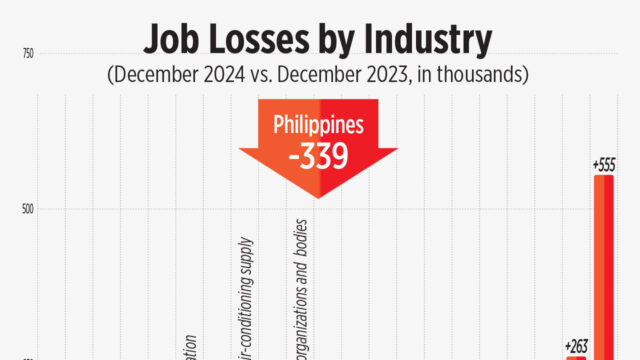
Job Losses by Industry (December 2024 vs December 2023)

PHILIPPINE UNEMPLOYMENT eased to 3.1% in December amid a surge in hiring in the transport and storage sector, bringing the full-year average to a record-low of 3.8%, according to the statistics agency. Read the full story.

Untitled

Film September 5 offers new perspective on Olympic tragedy

A scene from September 5.

LONDON — Drama thriller September 5 takes a new approach to tell the true story of the 1972 Munich Olympic massacre.

Directed by Swiss filmmaker Tim Fehlbaum and boasting an accomplished ensemble cast including Peter Sarsgaard, John Magaro, Ben Chaplin, and Leonie Benesch, the film follows the ABC Sports broadcasting team as they pivot from Olympics programming to covering the developing news story.

On Sept. 5, 1972, members of the Israeli Olympic team were taken hostage at the poorly secured athletes’ village by Palestinian gunmen from the Black September group.

Within 24 hours, 11 Israelis, five Palestinians, and a German policeman were dead after a stand-off and subsequent rescue effort erupted into gunfire.

For the first time ever, the coverage of the attack, and the Games which continued as the events unfolded, played out live on television, watched by millions of people. One rescue attempt had to be called off when police officers realized it was being shown live and watched by the attackers.

“We’re living in this hyper-sensationalized media atmosphere, and this was kind of the beginning of it. These were people who were just doing their job, not realizing that they were changing the way we consume news forever,” said Magaro, who plays Geoffrey Mason, the real-life head of the ABC Munich control room, at the film’s London premiere on Tuesday.

September 5 is almost entirely set in the ABC control room, with outside events playing on its multiple monitors. The film team wove in real footage and assembled still functioning studio equipment of the day to ensure an authentic look.

“Some of these scenes in the Olympic Village we recreated, also out of respect, because we didn’t want to show anyone who lost their life on that day, and then we mixed all of this together,” said Mr. Fehlbaum.

“Tim was absolutely passionate about it being as accurate as possible because it was a true story. Everything worked. They built the studio on ABC’s original blueprints,” said Mr. Chaplin.

The movie also depicts the moral dilemmas the team faced as the crisis deepened.

“All the questions like, what do we show, is there such a thing as a neutral standpoint, is it helpful to watch potential violence live, the film raises all of these questions,” Benesch said.

“The questions they had to ask themselves are still very relevant for any journalist and also for all of us,” said screenwriter Mortiz Binder. “Most of us have a smartphone, have social media, so all these ethical questions are questions for everybody.”

September 5 is produced by Hollywood star Sean Penn and its writers Binder, Fehlbaum, and Alex David are up for a best original screenplay Oscar at next month’s Academy Awards. — Reuters

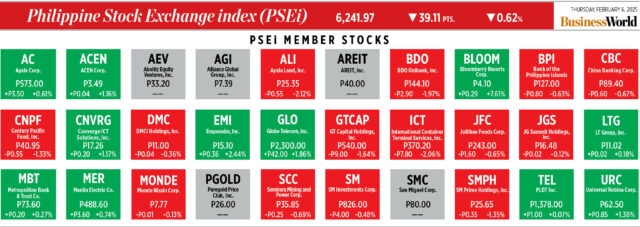
How PSEi member stocks performed — February 6, 2025

Here’s a quick glance at how PSEi stocks fared on Thursday, February 6, 2025.


Low onion inventories trigger import order for 4,000 MT

PHILIPPINE STAR/MIGUEL DE GUZMAN

THE Department of Agriculture (DA) said it approved imports of 4,000 metric tons (MT) worth of onions to ensure stable prices with stocks running low.

In a statement, Agriculture Secretary Francisco P. Tiu Laurel, Jr. said that the DA will permit shipments of 3,000 MT of red onions and 1,000 MT of white onions for delivery within two weeks.

He added that the imports will plug the supply gap until the domestic harvest comes in.

“We will not risk a potential shortage that traders could exploit to drive up prices, as we saw in the past. We do not want a repeat of the 2022 crisis,” Mr. Laurel said.

In 2022, onion prices surged to as much as of P700 per kilo due to a shortage of domestic supply and delayed imports.

Last year, the DA allowed white onion imports totaling 17,000 MT, after delaying imports until August due to a bumper harvest.

The DA has said that the inventory of red onions from last year was expected to last until February, when the harvest starts.

According to Bureau of Plant Industry (BPI), the red onion inventory was 2,325.86 MT, with white onion stocks at 70,161 MT as of Jan. 31.

Monthly consumption of red onions was estimated at 17,000 MT and white onions 4,000 MT, the BPI said.

“While we were assured during our consultative meetings that there is still ample supply of onions, the BPI recommended minimal imports to prevent major price spikes,” BPI Director Gerald Glenn F. Panganiban said.

“Also, due to the typhoons that hit late last year and prevalence of pests and disease, these imports are meant to be a buffer for possible supply gaps. This move is a preemptive measure,” Mr. Panganiban added.

He said that the agency is projecting the onion harvest to reach 33,000 MT by March.

In 2024, onion production rose 4.7% to 264,322 MT, according to the Philippine Statistics Authority. — Adrian H. Halili

Meat traders push to distribute MAV quotas

PHILIPPINE STAR/ EDD GUMBAN

MEAT IMPORTERS are calling on the Department of Agriculture (DA) to allocate the pork and poultry quotas for the minimum access volume (MAV), which should have been released during the first week of January.

The Meat Importers and Traders Association (MITA) said in a letter to the DA: “the quotas for the MAV year 2025 have not been distributed. This is the second time this has happened.”

The group added that since the start of the quota year on Feb. 1, the Systematic Distribution Process (SDP) has not been conducted.

“The SDP had been scheduled, rescheduled and then canceled until further notice,” it added in its letter to Agriculture Secretary Francisco P. Tiu Laurel, Jr.

It said that the delay in SDP may disrupt the meat trade as happened last year, when MAV allocations were also delayed.

“Importers are concerned about a repeat of last year, and orders will be put on hold, delayed or canceled,” MITA added.

Last year, the DA also postponed the distribution of MAV allocations.

“MITA strongly urges DA to allow MAV Secretariat (MAVSEC) to proceed with the distribution of the Beginning Year Pool,” it said.

“In the meantime, MAVSEC should be instructed to issue Provisional MAVICs (MAV import clearances) to ensure continuity of trade,” MITA added.

MAV grants trading partners guaranteed market access, subject to volume quotas. The MAV system is a feature of the World Trade Organization’s trading system.

The Philippines has committed to admit imports of 54,210 metric tons (MT) of pork and 23,500 MT of  chicken. — Adrian H. Halili

Seizures of counterfeit goods hit P41 billion in 2024 led by apparel, shoes, bags

NBI EXEC. OFFICER Intellectual Property Rights Division Rodolfo Ignacio serves a subpoena to Chinese seller of Jiangsu Huihong Machinery Manufacturing Co., Ltd. who is allegedly exhibiting and selling counterfeit auto parts at a car show in Pasay City on July 6, 2024. — PHILIPPINE STAR/ EDD GUMBAN

THE National Committee on Intellectual Property Rights (NCIPR) seized P40.99 billion worth of counterfeit products in 2024, the Intellectual Property Office of the Philippines (IPOPHL) said.

“It is increasing year by year, and I would like to attribute it to the efforts of law enforcement agencies,” IPOPHL Deputy Director General Nathaniel S. Arevalo told reporters on the sidelines of the Japan External Trade Organization (JETRO) Seminar on Thursday.

“It’s an all-time high, (involving) our usual items like apparel, shoes, bags, food supplements, and toys. But most of them are apparel and shoes,” he added.

According to IPOPHL, the estimated value is 52% higher than the P26.99 billion worth of counterfeit products seized in 2023.

“Last year’s haul from the Bureau of Customs (BoC) accounted for the lion’s share, totaling P34.70 billion,” it added.

Two of the biggest operations of the BoC were a raid in Binondo which yielded P11 billion worth of counterfeit luxury goods, and an operation at a Divisoria mall, which resulted in the confiscation of counterfeits valued at P7 billion.

“BoC’s haul was followed by seizures by the National Bureau of Investigation and Philippine National Police estimated at P3.42 billion and P2.83 billion, respectively,” IPOPHL said.

“Meanwhile, the Food and Drug Administration seized P30.20 million worth of counterfeit drugs and health-related products,” it added.

Mr. Arevalo said the agency is looking to further educate the public on IP issues and will seek amendments to the Intellectual Property Code.

“(We will continue) educating the public about the dangers of counterfeiting because it is not just an issue of fake goods, but also the dangers to public safety of counterfeit health supplements, medicines, and devices,” he said.

He said the proposed IP Code amendments would give the agency “more teeth in the fight against piracy and counterfeiting.”

On Monday, the IPOPHL, together with other members of the NCIPR, attended the JETRO Seminar for law enforcement agencies.

“This event is meant to enhance the competence and skills of the law enforcement agencies as far as the identification of the fake products,” he said.

“That’s why the brand owners from Japan are here, because they are the experts,” he added. — Justine Irish D. Tabile

Full budget transparency seen taking time

BW FILE PHOTO

THE PHILIPPINES is working on initiatives like procurement reform to achieve budget transparency, but it will take time to mainstream these initiatives, Budget Secretary Amenah F. Pangandaman said.

Ms. Pangandaman, who also chairs the Philippine Open Government Partnership (OGP) Steering Committee, said: “It’s a long way to go before we can actually mainstream this across all National Government agencies.”

OGP is a global initiative to make governments more transparent, accountable, and responsive to citizens. It is staging its regional convention in Manila this week.

The Philippines amended a decades-old procurement law via the New Government Procurement Act, which sets up an online marketplace where agencies can directly procure supplies and equipment from vetted suppliers.

“We have a medium like this for us to be able to push forward our commitment to open government,” she said.

In the Philippines, six local government units including South Cotabato, Baguio City, Quezon City, Tagbilaran City, Borongan City and the Municipality of Larena, Siquijor actively participate in the OGP Local Program.

South Cotabato Governor Reynaldo S. Tamayo, Jr.  said two pilot OGP projects are open contracting and open monitoring.

“In open contracting, we involve civil society organizations in the bidding process. They are part of the Bids and Awards Committee. They observe the process of bidding online,” Mr. Tamayo said.

He also noted that the province created a Monitoring Committee, of 11 members, with a chairman and half of the committee belonging to civil society organizations.

“They are the ones who scrutinize, and monitor the project, and if the contractor has a 15 negative slippage or above, they cannot bid for another project for a year. They will be banned in our province,” Mr. Tamayo said.

President Ferdinand R. Marcos, Jr., who was attending the OGP event, said that the country can only truly participate in governance if they have access to information.

“This access is made possible by government transparency, digitalization, and the institutionalization of the Freedom of Information (FoI) through legislation, which is a constitutionally recognized principle,” Mr. Marcos said.

He also said that the FoI is one of the many ways that the Philippines has been keeping its commitments to OGP.

Hosted by the Philippine Open Government Partnership chaired by the DBM, the 2025 OGP Asia and the Pacific Regional is taking place between Feb. 5 and 7. — Aubrey Rose A. Inosante

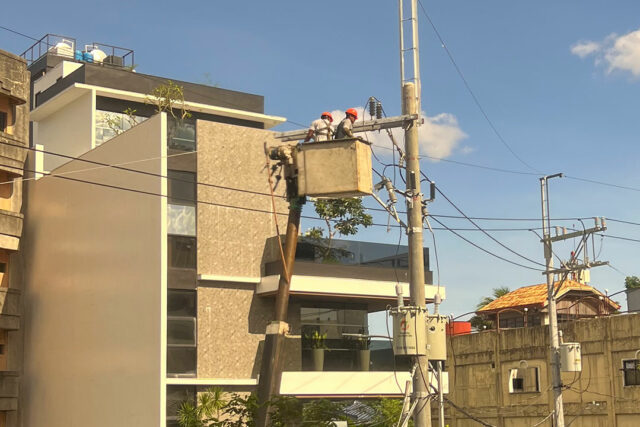
Full electrification by 2028 goal under review on funding doubts

BW FILE PHOTO

THE Department of Energy (DoE) said it will review its target of achieving total electrification by 2028 amid concerns about the availability of funding.

“Since the President is approaching the middle of his term, it is a good time to review how realistic our targets and the funding available are and whether we can think of ways to hasten or to make them more realistic,” Energy Secretary Raphael P.M. Lotilla told reporters on the sidelines of an event on Wednesday.

Mr. Lotilla said that the DoE will discuss the total electrification program and the challenges in meeting the target during the next cabinet sector meeting with President Ferdinand R. Marcos, Jr.

The 2023-2032 National Total Electrification Roadmap (NTER) sets a 100% electrification target by 2028 by focusing on household electrification, distribution line extension, stand-alone home systems, and microgrid systems.

However, Mr. Lotilla said the Philippines will need at least P85 billion to P100 billion in order to achieve the electrification goal at the household level.

The estimated amount is intended not only to finance the household electrification, but also to improve backbone lines, especially in off-grid areas, Mr. Lotilla said.

NTER estimates the current household electrification level at 91.1% as of June 2023, with 25.3 million households served out of a potential 27.727 million, based on the 2020 Census on Population and Housing.

For the rest of 2023, the estimated number of underserved households total 2.454 million.

“If the funds are available, it would take an average of around P25 billion a year to finish electrification,” Mr. Lotilla said. “Congress appropriates on a yearly basis so we don’t know if there will be sufficient funds.”

Energy Undersecretary Rowena Cristina L. Guevara has said that about P100 billion is needed for total electrification, with P75 billion going to the electric cooperatives supervised by the National Electrification Administration and about P25 billion to the National Power Corp.

“As of the midpoint of the administration, the average budget has only been between P2 billion to P3 billion a year and therefore we have a long way to go before we can achieve that goal. So we are looking at ways and means to achieve the total electrification goal,” Mr. Lotilla said.

The DoE is also preparing to ensure energy resiliency during the upcoming mid-term elections.

With the official campaign period set to begin next week, the department has activated Task Force Election to ensure uninterrupted power for the campaign period and voting.

The DoE said it is working with the Commission on Elections and the Department of National Defense to safeguard the integrity and smooth conduct of the elections “through strategic energy sector preparedness before, during, and after the electoral process.”

“Ensuring uninterrupted power during elections is crucial to upholding the integrity of the electoral process and maintaining public confidence. By prioritizing energy resiliency, Task Force Election plays a vital role in guaranteeing smooth and credible elections, free from power-related disruptions,” Energy Undersecretary Felix William B. Fuentebella said.

The DoE said that the task force will remain on standby throughout the election period at a command hub to monitor and address potential power issues in real time.

The DoE is also collaborating with the Department of Interior and Local Government to ensure the availability of critical backup resources, including generator sets and emergency lamps at key locations.

The DoE added that it will release the terms of reference this month for the fourth round of the green energy auction program (GEA-4), which will cover integrated renewable energy and energy storage systems.

The Terms of Reference outlines the auction design, bond requirements, instructions to bidders, bidding data, forms and templates, and post-auction requirements.

The draft GEA-4 terms of reference will be subject to public consultations.

The government hopes to expand the share of renewable energy capacity in the energy mix to 35% by 2030. — Sheldeen Joy Talavera

Balisacan backs anti-trust legislation for agriculture to boost food security

BW FILE PHOTO

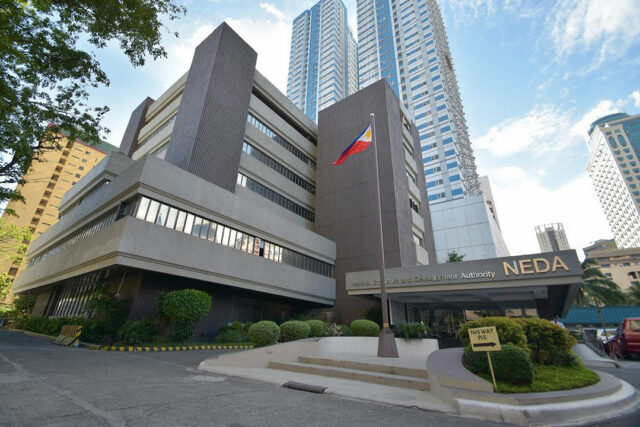
NATIONAL ECONOMIC and Development Authority (NEDA) Secretary Arsenio M. Balisacan said anti-trust legislation will be crucial in ensuring food security.

“We must complement antitrust tools with strategies to address structural issues that shape firm behavior in the agriculture sector and related industries,” Mr. Balisacan, a former competition commissioner, said in his speech at the 2025 Manila Forum on Competition in Developing Countries.

“Pro-competitive legislation, policies, regulations, and programs or projects can contribute toward safeguarding consumers and producers from uncompetitive and unfair conduct,” he added.

However, Mr. Balisacan said competition policy is not a universal solution, though it can promote efficiency and resilience.

He also cited recent government efforts to control food inflation, such as lowering the rice tariffs and removing non-tariff barriers “encourage market players to augment the food supply.”

The Philippine Statistics Authority (PSA) reported that headline inflation rose 2.9% year on year in January, matching the December print.

Food inflation accelerated to 4% from 3.5% in December and 3.3% in 2024.

The PSA said tomato price growth accelerated to 155.7% from 120.8% a month earlier.

“Together, let us work for fairer markets and amplify the pivotal role of competition in this important sector as we collectively aspire for food security and shared prosperity for all,” Mr. Balisacan said. — Aubrey Rose A. Inosante

UN-funded program hoping to digitize 15,000 PHL small firms

REUTERS

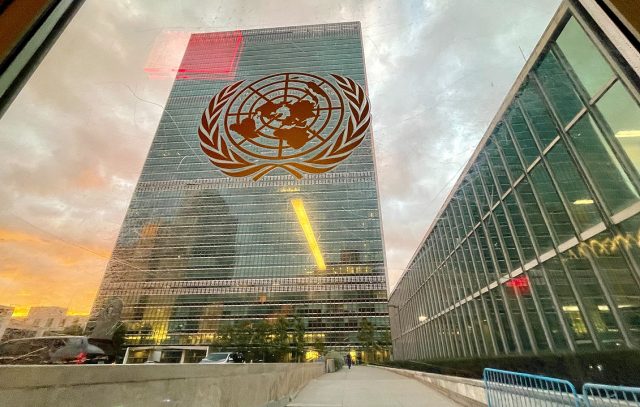
A PROGRAM funded by the United Nations is seeking to provide digital tools and training to at least 15,000 small businesses in the Philippines, the United Nations Development Programme (UNDP) said.

The United Nations Joint Programme on Inclusive, Competitive, and Responsible Digital Philippines (Digital PINAS) hopes to build a digital ecosystem for micro, small and medium enterprises in remote regions who are currently facing barriers to connectivity.

In a statement on Feb. 3, the UNDP said the initiative was jointly implemented with two UN entities — the International Trade Centre (ITC), and the International Labour Organization.

The government is represented in the program by  the Department of Information and Communications Technology, while potential private-sector partners will be enlisted.

Information and Communications Secretary Ivan John E. Uy said despite advances in connectivity and digital adoption, millions remain without such access, especially vulnerable communities.

“With a total budget of $5 million, the joint program will address policy, regulatory and systemic barriers to digital inclusion,” the UNDP said.

The UNDP said the program includes supporting the establishment of Digital Transformation Hubs in at least 30 remote and underserved areas.

Digital PINAS is funded through the UN’s Joint SDG Fund, which is supported by the European Union, which pledged an initial 30 million euros for digital transformation efforts across the developing world.

Other supporters of the Fund include Belgium, Denmark, Germany, Ireland, Italy, and South Korea.

“To complement the program’s investment, a key component of the initiative involves the mobilization of an anticipated $21 million in local government and private sector investment in digital products,” the UNDP said. — Aubrey Rose A. Inosante

ADVERTISEMENT
ADVERTISEMENT