Home Blog Page 1943

ADB trims developing Asia’s growth forecast, flags US policy risks

STOCK PHOTO | Image Dmitry Berdnyk from Unsplash

MANILA – Developing Asia is likely to grow more slowly than previously thought this year and next, and the outlook could worsen if President-elect Donald Trump makes swift changes to U.S. trade policy, the Asian Development Bank said on Wednesday.

Developing Asia, which includes 46 Asia-Pacific countries stretching from Georgia to Samoa – and excludes Japan, Australia and New Zealand – is projected to grow 4.9% this year and 4.8% next year, slightly lower than the ADB’s forecasts of 5.0% and 4.9% in September.

The downgraded growth estimates reflect lackluster economic performance in some economies during the third quarter and a weaker outlook for consumption, the bank said.

Growth forecasts for China remain unchanged at 4.8% for 2024 and 4.5% for 2025, but the ADB lowered its projections for India to 6.5% for 2024 from 7.0% previously, and to 7.0% for next year from 7.2%.

“Changes to U.S. trade, fiscal, and immigration policies could dent growth and boost inflation in developing Asia,” the ADB said in its Asian Development Outlook report, though it noted most effects were likely to manifest beyond the 2024-2025 forecast horizon.

Trump, who takes office on Jan. 20, has threatened to impose tariffs in excess of 60% on U.S. imports of Chinese goods, crackdown on illegal migrants, and extend tax cuts.

“Downside risks persist and include faster and larger U.S. policy shifts than currently envisioned, a worsening of geopolitical tensions, and an even weaker PRC (People’s Republic of China) property market,” the ADB said.

The ADB lowered its inflation forecasts for 2024 and 2025 to 2.7% and 2.6%, respectively, from 2.8% and 2.9% previously, due to softening global commodity prices. — Reuters

FDI inflows sink to over 4-year low

EURO, Hong Kong dollar, US dollar, Japanese yen, pound and Chinese 100 yuan banknotes are seen in this picture illustration, Jan. 21, 2016. — REUTERS

By Luisa Maria Jacinta C. Jocson, Reporter

NET INFLOWS of foreign direct investments (FDI) fell to their lowest level in over four years in September, data from the Bangko Sentral ng Pilipinas (BSP) showed.

The central bank on Tuesday reported FDI net inflows slumped by 36.2% to $368 million in September from $577 million in the same month a year ago.

This was also the lowest monthly FDI inflow in 53 months or since the $314 million recorded in April 2020. To recall, strict lockdowns to curb the spread of the coronavirus disease 2019 (COVID-19) were in effect in April 2020.

Net Foreign Direct Investments

Month on month, net inflows likewise plunged by 54.8% from $815 million.

“The downturn in FDI net inflows in September 2024 was due largely to the decline in nonresidents’ net investments in debt instruments,” the BSP said.

Nonresidents’ net investments in debt instruments of local affiliates dropped by 32.8% to $277 million in September from $413 million a year prior.

Net investments in equity capital other than reinvestment of earnings plummeted by 91.2% to $7 million in September from $83 million a year earlier.

Equity capital placements slid by 53.4% year on year to $82 million, while withdrawals dropped by 19.7% to $75 million.

By source, equity placements were mainly from Japan (60%), followed by the United States (25%), and Singapore (8%).

These were invested mostly in manufacturing (58%), real estate (19%), information and communication (8%), and wholesale and retail trade (5%).

Meanwhile, investments in equity and investment fund shares stood at $91 million in September, down by 44.6% from $164 million a year ago.

On the other hand, reinvestment of earnings went up by 3.6% to $84 million in September from $81 million last year.

NINE-MONTH FDI
For the first nine months of the year, FDI net inflows rose by 3.8% to $6.66 billion from $6.42 billion in the similar period a year ago.

Investments in equity and investment fund shares jumped by 20.4% to $2.3 billion in the period ending September from $1.91 billion a year ago.

Net foreign investments in equity capital surged by 46.9% to $1.36 billion as of end-September from $923 million a year ago.

This as equity capital placements climbed by 28.1% to $1.79 billion, while withdrawals dipped by 8.5% to $434 million.

In the nine-month period, these placements mostly came from the United Kingdom (43%), Japan (37%), the United States (9%), and Singapore (4%).

Meanwhile, foreign investments in debt instruments decreased by 3.3% to $4.35 billion in the January-September period from $4.5 billion.

Reinvestment of earnings dipped by 4.2% to $949 million as of end-September from $991 million a year ago.

“The relatively lower FDI inflows could be largely brought about by a wait-and-see stance by some foreign investors while waiting for the CREATE MORE to be passed into law,” Rizal Commercial Banking Corp. Chief Economist Michael L. Ricafort said in a Viber message.

In November, President Ferdinand R. Marcos, Jr. signed the Corporate Recovery and Tax Incentives for Enterprises to Maximize Opportunities for Reinvigorating the Economy (CREATE MORE) Act, which expands fiscal incentives and lowers corporate income tax on certain foreign enterprises.

Mr. Ricafort also noted the “still relatively high” interest rates, which may have weighed on foreign investments.

The BSP embarked on its rate-cutting cycle in August this year with a 25-basis-point (bp) rate cut. It later delivered another 25-bp cut in October, bringing the key rate to 6%.

“Persistently high global interest rates, led by the US Fed have made emerging market investments like the Philippines less attractive,” John Paolo R. Rivera, a senior research fellow at the Philippine Institute for Development Studies, said.

“Investors often prefer safe-haven assets in advanced economies under these conditions,” he added.

The US Federal Reserve kicked off its easing cycle with a 50-bp cut in mid-September.

Mr. Rivera also noted “heightened geopolitical tensions and economic uncertainties may have also further dampened investor confidence globally.”

“Likewise, slowing economic growth could have raised concerns among foreign investors. Economic growth was slightly weaker than anticipated in the third quarter of 2024, which may have influenced investment sentiment,” he added.

The Philippine economy grew by weaker-than-expected 5.2% in the July-to-September period, its slowest growth in five quarters or since the 4.3% expansion in the second quarter of 2023.

“For the coming months, the CREATE MORE law would now make international investors more decisive to locate in the country with better incentives that could compete better with other Asian countries,” Mr. Ricafort said.

Further rate cuts by the BSP and Fed would also increase demand for loans and attract more FDIs moving forward, he added.

The Monetary Board is set to have its final policy review on Dec. 19. BSP Governor Eli M. Remolona, Jr. has signaled the possibility of reducing or keeping rates steady.

Meanwhile, Reuters reported that traders are pricing in an 86% chance of another quarter-percentage-point rate cut from the Fed at its Dec. 17-18 meeting.

On the other hand, Mr. Ricafort flagged US President-elect Donald J. Trump’s protectionist trade policies.

“More protectionist policies by a Trump presidency starting in 2025 would discourage some US companies from investing and creating more jobs outside the US, as well as a potential trade war between the US and China or other countries that could slow down the world economy and global trade,” he added.

Mr. Trump has pledged to slap an additional 10% tariff on Chinese goods in a bid to force Beijing to do more to stop the trafficking of chemicals used to make fentanyl, Reuters reported.

Mr. Trump has previously said he would introduce tariffs in excess of 60% on Chinese goods.

The BSP expects to record FDI net inflows of $10 billion this year.

October trade gap widest in over two years

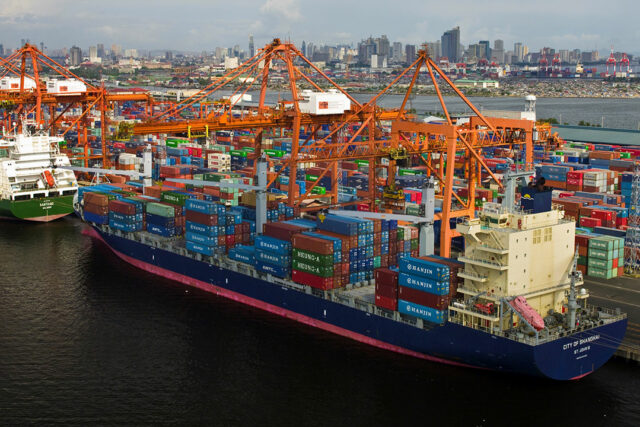
A view of the Manila International Container Terminal. — COURTESY OF ICTSI

By Karis Kasarinlan Paolo D. Mendoza, Researcher

THE PHILIPPINES’ trade-in-goods deficit ballooned to nearly $6 billion in October, the biggest trade gap in over two years, as exports continued to decline while imports grew at its fastest pace in six months, the Philippine Statistics Authority (PSA) reported on Tuesday.

Preliminary data from the PSA showed the country’s trade-in-goods balance — the difference between exports and imports — stood at a deficit of $5.8 billion in October, up 36.8% from the $4.24-billion deficit in October last year.

Month on month, the trade gap widened by 13.8% from the revised $5.1 billion in September.

Philippine Merchandise Trade Performance

October saw the widest trade deficit in 26 months or since the $5.99-billion gap in August 2022.

For the first 10 months, the trade deficit widened by 3.6% to $45.22 billion from the $43.64-billion gap a year ago.

The value of exports declined for the second straight month in October, falling by 5.5% year on year to $6.16 billion from $6.52 billion a year ago. In September, exports dropped by a revised 7.6%.

October’s export haul was the lowest level since $5.57 billion in June this year.

For the first 10 months, exports reached $61.83 billion, inching up by 0.4% from $61.6 billion in the same period a year ago.

On the other hand, merchandise imports rose by 11.2% to $11.96 billion in October from $10.76 billion last year. This marked the fourth straight month of imports growth and was the fastest pace since 13% in April.

The import value in October was the highest level in 25 months or since $12.01 billion in September 2022.

Year to date, imports went up 1.7% to $107.05 billion.

Slower global export markets coupled with a strong demand for imports ahead of the holiday season explained the larger deficit in October, University of Asia and the Pacific Senior Economist Cid L. Terosa said in an e-mail interview.

“Exports declined because of lethargic global export markets. Imports grew further because of strengthening demand for production goods needed to produce more goods and services for the holidays,” he said.

Mr. Terosa also noted the value of imports went up due to the peso’s weakness.

The peso closed at P58.1 per dollar at end-October, weakening from the P56.03 finish at end-September.

“The stronger peso exchange rate versus the dollar in October made exports more expensive for international buyers; while also making imports cheaper from the point of view of local buyers that also partly increased demand for imports,” Rizal Commercial Banking Corp. Chief Economist Michael L. Ricafort said in a Viber message.

This year, the Development Budget Coordination Committee (DBCC) expects 4% and 2% growth in exports and imports, respectively.

EXPORTS SLUMP
Manufactured goods, which made up the bulk of the country’s exports, fell by 11.2% to $4.72 billion in October from $5.31 billion in the same month last year.

On the other hand, exports of mineral products expanded by 9.7% to $681.57 million while exports of agro-based products jumped by 41.3% to $591.98 million.

By commodity group, electronic products, which accounted for over half of exported manufactured goods, dropped by 23.3% annually to $2.87 billion.

Semiconductors, which accounted for the bulk of outgoing electronic products, slumped by 33.8% to $1.95 billion.

Exports of other manufactured goods increased by 57.9% to $510.58 million, while other mineral products fell by 6.4% to $297.87 million in October.

The United States remained the top destination for Philippine-made goods, with exports valued at $995.26 million accounting for 16.2% of the total.

It was followed by Japan with $940.98 million (15.3% share), China with $853.52 million (13.9%), Hong Kong with $592.23 million (9.6%), and Thailand with $304.96 million (4.9%).

IMPORTS
Meanwhile, imports of raw materials and intermediate goods grew by 5.5% to $4.17 billion in October.

Imports of capital goods climbed by 21% to $3.46 billion, while consumer goods increased by 29% to $2.6 billion.

By commodity group, electronic products had the highest import value at $2.67 billion, up 21% in October from $2.21 billion a year ago.

Imports of semiconductors, which accounted for the bulk of electronic products, went up by 18.1% to $1.81 billion.

Imports of mineral fuels, lubricants and related materials, on the other hand, fell by 10.4% year on year to $1.69 billion, while transport equipment jumped by 37.4% to $1.22 billion.

China was the biggest source of imports in October with $3.07 billion worth of goods, accounting for 25.6% of the total import bill.

It was followed by Indonesia with $1.01 billion (8.5% share), South Korea with $989.72 million (8.3%), Japan with $926.8 million (7.7%), and the United States with $754.16 million (6.3%).

Mr. Terosa said he expects imports to increase further as the holiday season approaches while exports will continue to face “sleepy global markets” due to geopolitical instability around the world, further widening the deficit in November and December.

In a note, Chinabank Research said weakness in exports could persist until next year.

“Potentially muted demand for electronics next year could keep export growth restrained… Combined with rising import demand, this could result in wider trade deficits. On the other hand, increasing demand for both consumer goods and production inputs bodes well for consumption and business activities,” it added.

World Bank trims Philippine GDP growth outlook to 5.9%

People arrive at a bus station in Pasay City. — PHILIPPINE STAR/RYAN BALDEMOR

THE WORLD BANK has trimmed its growth forecast for the Philippines for this year but still expects strong growth in the medium term.

At the same time, the multilateral lender flagged possible trade disruption and geopolitical conflict risks ahead.

“The growth forecast for 2024 was revised downwards from 6% to 5.9%, reflecting the impact of adverse weather events that led to lower-than-expected growth in the third quarter of 2024,” Gonzalo J. Varela, World Bank lead economist and program leader of the equitable growth, finance and institutions practice group for Brunei, Malaysia, the Philippines, and Thailand, told reporters on Tuesday.

The Philippine economy, particularly the agriculture sector, felt the impact of climate-related events such as the El Niño and La Niña this year. Economic managers last week tweaked the growth target to 6-6.5% for this year from 6-7% previously.

Despite the slightly lower growth outlook, the World Bank said the medium-term outlook “remains strong.

The multilateral lender kept its gross domestic product (GDP) growth forecast for 2025 at 6.1% and gave a 6% growth outlook for 2026.

This is within the government’s 6-8% GDP growth target for 2025 through 2028.

“The economy is projected to grow at an average of 6% annually from 2024 to 2026, supported by robust domestic demand, sustained public investment, and a dynamic services sector,” the World Bank said.

The outlook will depend on improving conditions for domestic demand, such as “easing inflation, more accommodative monetary policy, and the government’s commitment to sustained public investment.”

“Altogether, these are expected to maintain investment rates at relatively high levels, increasing potential output,” it said.

The Bangko Sentral ng Pilipinas (BSP) began its easing cycle in August amid easing inflation. It cut rates by 25 basis points (bps) in August, and by another 25 bps in October, bringing the benchmark rate to 6%.

The Monetary Board is set to have its final policy-setting meeting for the year on Dec. 19.

The World Bank said private consumption growth is projected to grow 5% in 2024, amid elevated inflation and tight financial conditions.

“Private consumption… is expected to remain the main engine of economic activity until 2026, fueled by low and stable inflation, steady inflows of remittances from overseas Filipino workers, and a dynamic labor market,” Mr. Varela said.

It expects private spending growth to quicken to an average of 5.6% in 2025 and 2026, due to steady remittance inflows, low and stable inflation, and strong labor market conditions.

The World Bank also said more private investments are expected to “firm up” due to recent economic reforms that opened up several sectors to foreign ownership.

RISKS AHEAD
The World Bank noted the balance of risks to the Philippine outlook remains tilted to the downside, “led by increased uncertainty surrounding the external environment.”

“There is an increase in uncertainty with respect to trade distortive measures by large economies that may affect global trade and dampen the global outlook. Additional external risks include slower growth in China, and an intensification of conflict and geopolitical tensions that could disrupt trade and commodity markets further,” it said.

The long-running trade war between the US and China is expected to escalate when US President-elect Donald J. Trump assumes office in January. Mr. Trump has vowed to slap tariffs of as much as 60% on US imports of Chinese goods.

World Bank Senior Economist Jaffar Al-Rikabi said the Philippines could find opportunities when global trade patterns change amid US-China tensions.

“Our message is the Philippines should focus on this as a time of opportunity. If it can get its regulations right, if it can invest in its people if it can be open for trade and investment, there are opportunities in what’s coming, as opposed to being concerned about some of the risks,” Mr. Al-Rikabi added.

Mr. Al-Rikabi said heightened tensions in the Middle East could affect commodity prices, such as oil, which may have inflationary effects on food and fuel prices in the Philippines.

“If inflation ends up proving to be more persistent and more sticky, then the result would of course have to be that the BSP has to maintain high policy rates which could dampen private domestic demand,” he said.

On the domestic front, Mr. Varela said risks arise from adverse weather conditions that hurt agricultural production, which then drive up food prices.

“Domestically, persistent inflationary pressures, delays in monetary policy easing, and the implementation of investment reforms could weaken private consumption and investment growth,” the World Bank said.

In the same report, the World Bank said poverty reduction is expected to accelerate, with the poverty rate seen to further drop until 2026.

“Poverty incidence (based on the lower middle-income country poverty line of US$3.65/day) is projected to decrease from 15.5% in 2023 to 13.6% and to 11.3% by 2026. This reduction is projected to be supported by robust economic growth, rising real household incomes,” it said.

However, climate-related shocks and inflationary pressures on food prices may derail poverty alleviation efforts.

“Addressing vulnerabilities through social protection and disaster risk management will be critical to sustaining progress,” it said. — A.R.A.Inosante

Most Filipinos expect inflation to continue to rise — survey

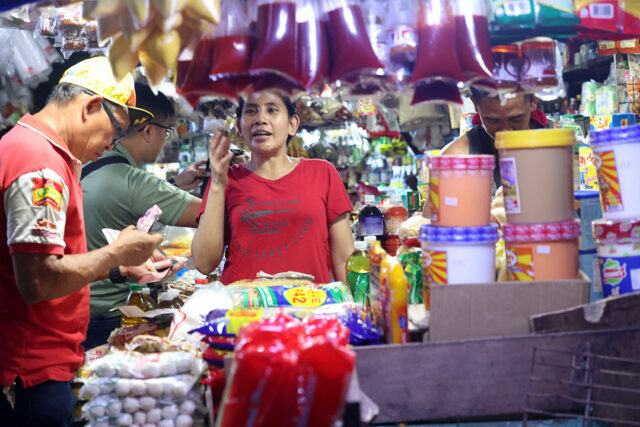
People buy food items at a market in Quezon City, Nov. 22, 2024. — PHILIPPINE STAR/MIGUEL DE GUZMAN

MOST FILIPINOS see inflation rising over the next year and do not expect the pace of price increases to normalize anytime soon, according to a survey by Ipsos.

In its latest Cost of Living Monitor, Ipsos found that 80% of Filipinos see the rate of inflation to rise in the next year.

“While economists point out that inflation — and interest rates — have fallen in many countries, you might assume that consumers should be feeling more positive by now about their own financial situation and more optimistic about where their country’s economy is headed in 2025,” Ipsos Chief Executive Officer Ben Page said.

“In fact, they are the opposite. The legacy of high inflation over the past few years is that an expectation of price rises is now hard-wired into the public consciousness,” he added.

The Philippines’ outcome is also much higher than the 65% overall average across 32 countries.

“This is something that is felt across the board. In 21 of the 32 countries surveyed people are more likely to think prices will rise at a faster rate than they did earlier this year,” Ipsos said.

Most Filipinos think that inflation has yet to normalize, the survey showed, with 28% expecting inflation to never return to normal. On the other hand, 27% see prices normalizing after next year, within the next year (26%), within the next six months (5%), and within the next three months (7%).

Only 6% of respondents said that inflation had already normalized.

Inflation quickened to 2.5% in November from 2.3% in October as food prices rose after a series of typhoons hit the country. In the 11-month period, headline inflation averaged 3.2%.

This year so far, inflation has settled within the 2-4% range, except for the 4.4% spike in July.

The central bank expects inflation to settle at 3.1% this year, 3.2% in 2025 and 3.4% in 2026. However, the Bangko Sentral ng Pilipinas (BSP) has said that the risks to the inflation outlook for next year until 2026 have shifted to the upside.

“While inflation rates are going down, people are not feeling it in the way policy makers and central banks would have hoped,” Ipsos said. “People expect price rises across all areas of spending, from utilities to food.”

Globally, 70% of respondents attribute the state of the global economy as the biggest contributor to the rising cost of living. This is followed by government policies (69%), interest rates (66%), businesses making excessive profits (62%) and the Russia-Ukraine war (58%).

Meanwhile, 75% of Filipinos expect interest rates to rise over the next year.

The BSP began its easing cycle in August this year, delivering a total of 50 basis points (bps) worth of rate cuts so far. This brought the benchmark to 6%.

The Monetary Board could deliver another 25-bp cut at its final policy review of the year on Dec. 19.

“There is often a time lag between inflation rates subsiding and consumer confidence returning. But this time things feel rather different. What we are now seeing in many countries is a rise in the number of people who say they are financially struggling,” according to Ipsos.

The survey also showed that 10% of Filipinos expect their own standard of living to fall over the next 12 months.

In terms of financial management, only 37% of Filipinos are “doing alright.” This is compared to the respondents that said they are “just about getting by” (26%), “finding it quite difficult” (20%), “finding it very difficult” (9%), and “living comfortably” (9%).

Meanwhile, 48% of Filipinos see the economy as being currently in a recession, as far as they are aware. On the other hand, 28% say the opposite while 23% do not know.

TAX CUTS
“Across 32 countries people say they prefer tax cuts even if it means less money for public services, over spending more and paying greater taxes,” Ipsos said.

“However, this masks big differences across countries. Türkiye, Romania and the Philippines back tax cuts, while Indonesia and Sweden want better public services.”

The survey found more than half (52%) of Filipinos prefer that their personal taxes be cut even if it means there will be less government spending on public services.

The survey also found 70% of Filipinos expect the taxes that they pay to rise over the next year.

The Department of Finance  has said it does not plan to introduce new taxes this year and potentially until the end of the Marcos administration, apart from those already pending in Congress.

The department’s priority tax measures include the value-added tax on digital service providers, excise taxes on single-use plastics and pickup trucks, the rationalization of the mining fiscal regime, and the motor vehicle road user’s charge, among others. — Luisa Maria Jacinta C. Jocson

A vital safety net for a lifetime

No matter how young or old one is, it is important to keep an individual equipped for the inevitable. Life insurance is a powerful financial tool that makes this possible for anyone as this helps them achieve financial security not only for themselves but also for their loved ones for whom they earn a living. A life insurance plan that suits the one’s needs, as well as those of his or her household, can lend them a helping hand with everyday living costs or, especially, critical financial or medical crises.

Numerous insurance plans and policies are available in the market, providing a wide range of benefits seeking to align with the financial needs and goals of individuals. Understanding how a life insurance plan works, especially in providing protection and ensuring stability to one’s life, can thus help them build a better and more secure future.

At its core, life insurance is about financially protecting oneself and loved ones when unexpected events occur. Recovering from an illness or accident or, worse, coping with the loss of a loved one can become a challenging time for anyone, especially when hospital bills and other related expenses are concerned. Getting insured, nonetheless, could lighten the burden off the injured or aggrieved family members.

With the financial stability it brings to individuals and their families, a life insurance plan gives an extra layer of comfort as it assures that their loved ones will be taken care of financially when the inevitable occurs. Typically, life insurance coverage includes death benefits that can cover financial expenses like medical bills and funeral costs. An insured’s beneficiaries can also receive a lump sum payment that can be used for other sudden yet essential expenses. Another financial pressure that an insurance plan can take off beneficiaries is debt, which either occur from medical and funeral expenses or accumulating over time and left unpaid.

For employees, protecting their income is first and foremost important, and insurance plans are a great way to protect their incomes. When they see themselves facing a medical issue, like an accident, illness, or disability, then the insurance company steps in to provide medical benefits, ultimately protecting their income. Having life insurance coverage helps these employees navigate life’s uncertainties, ensuring they have the financial means during difficult times.

For breadwinners, a life insurance plan is like income replacement for them and their families when illnesses or emergencies hinder them from work. No matter if it’s a corporate job or managing a business, their income plays a big role in helping meet the family’s daily needs. During unfortunate events, the life insurance benefit can help protect their family by giving financial support to manage their expenses, such as housing, food, clothing, utilities, and children’s education, among others. This support would help their families fill the financial void, maintain their current lifestyle, and help them get back on their feet.

On top of protecting their income, life insurance is also a smart way to protect their wealth. Even those in a good financial position can hit rock bottom once emergencies strike. As a result, many people turn to insurance plans for backup and help them avoid such scenarios down the line. As a matter of fact, it keeps their investments and assets secure, allowing them to keep their financial wealth stable without the need to sell off anything when money is tight. Certainly, life insurance is also about wealth protection, shielding individuals from any financial setbacks.

Adequate health coverage for Filipinos

Over the years, the Philippines showed significant growth when it comes to insurance coverage yet remains relatively low. According to data by the Insurance Commission (IC), the country’s insurance penetration rate sits at 1.73% in the third quarter of the present year, higher from the same quarter last year. Even with such progress, more improvement is still needed to enhance insurance coverage in the country.

For its part, the Philippine Health Insurance Corp. (PhilHealth) continues its efforts in providing affordable and accessible health coverage that protect Filipinos from financial turmoil and expensive healthcare. PhilHealth has committed to providing exceptional healthcare services and benefits to Filipinos, focusing on their financial and medical needs. Fundamentally, the main goal is to provide medical assistance, which covers in-patient services, outpatient services, Z benefit packages for life-threatening conditions, SDG-related illnesses, and mental health benefits.

“Much like the nation’s resurgence from COVID-19 pandemic, PhilHealth programs, benefits, and services thrive and continue to prosper owing to deliberate strategies, effective execution of processes, and a workforce that has the heart and relentless drive for excellent service,” Emmanuel R. Ledesma, Jr., president and chief executive officer of PhilHealth, shared in the state insurer’s Annual Report for 2022.

“The pandemic has taught us a lot, especially in the aspect of health. Now, Filipinos are provided with an opportunity to avail of preventive health services that can help them address illnesses at their early stages, if not altogether avoid them.”

“The path to Universal Health Care (UHC) has once been arduous and challenging. Thanks to the commitment of the entire PhilHealth workforce, and the support of stakeholders, health partners, and the government at all levels, the route now teems with clarity, assurance, and purpose,” he added.

More recently, PhilHealth is looking at establishing new benefit packages. According to the Department of Health, one of these packages that the PhilHealth-Benefits Committee previously discussed intends to pay for the assessment of children for errors of refraction, including a pair of prescription glasses if needed.

The other one concerns emergency care, seeking to pay for emergency department services, including ambulance coverage.

The board of directors of PhilHealth also approved a package covering preventive oral health services, which include mouth examination or oral screening, oral prophylaxis or cleaning, and fluoride varnish application. A maximum P1,000 is set to be allotted for each patient per year.

As the new year approaches, PhilHealth also assured members that it has sufficient funds next year for all its benefit package payments, as well as its planned expansion of package rates. — Angela Kiara S. Brillantes

Tailoring protection to every life stage

Photo from rawpixel.com | FREEPIK

Life is inherently unpredictable. Unexpected medical emergencies, sudden income loss, or unforeseen damages can quickly disrupt the stability people worked so hard to build.

Take health emergencies, for instance. According to the Philippine Statistics Authority (PSA), out-of-pocket health expenses accounted for 44.4% of total health expenditures in 2023, which is a heavy financial burden for the average Filipino, especially when medical treatment can easily run into the thousands.

This kind of situation exemplifies how insurance acts as a financial safety net, protecting individuals from unforeseen risks and providing stability during adversity. In turn, health insurance covers a significant portion of medical costs. Instead of depleting their savings or relying on loans, individuals can receive the necessary treatment without the overwhelming expenses.

But insurance is much more than just protection against health-related risks, as policies also help individuals save and plan for future milestones like education, marriage, and retirement.

Despite the low insurance penetration rate in the Philippines, the insurance industry saw substantial growth in the first half of 2024, with net income hitting P28 billion, a 24% increase compared to the previous year.

The same report from the Insurance Commission revealed a 14% increase in insurance density, with average individual spending on insurance rising to P1,907.19 from P1,667.50.

Yet, the surge in spending has not translated into broader coverage for Filipinos. For the majority of Filipinos, insurance is still perceived as a non-essential expense rather than a financial safety net.

Insurance as a safety net

As individuals progress through different phases of life, their insurance needs necessitate a tailored approach to coverage.

In the early stages of adulthood, many are just starting their careers and may not yet have significant financial responsibilities. However, this is the ideal time to lock in life insurance rates while they are still low. According to Investopedia, purchasing life insurance early can save people money in the long run, as premiums typically rise with age and increased health risks.

Marriage often brings shared financial obligations, making insurance even more important. According to Bankrate, married couples should consider life insurance essential for protecting their spouse’s financial future. They have the option of obtaining separate life insurance policies or a joint life insurance policy. Along with life insurance, critical illness insurance can provide additional support if one partner faces a severe health crisis while health insurance helps couples avoid the financial strain of medical bills.

Meanwhile, parents naturally begin to think about their children’s future, and life insurance becomes a tool for ensuring that their educational and upbringing needs are met — should the worst happen. Research shows that parents often feel underinsured, which is why increasing life insurance coverage is critical for them.

Under the Philippine Health Insurance Corp., also known as PhilHealth, solo parents and their children are now entitled to free insurance coverage under the National Health Insurance Program.

By midlife, many are facing peak financial responsibilities: mortgages, college expenses, and retirement planning. Adults in this age group often fail to regularly review their insurance policies, which can result in inadequate coverage when life demands the most. This is the perfect time for people at this age to reassess their needs and consider supplemental plans as healthcare costs rise. Retirement planning also becomes a top priority, with many turning to retirement accounts to secure a stable financial future.

When retirement finally arrives, income often decreases, so annuities can offer a steady income stream during this stage. With age, healthcare needs also increase, making comprehensive health insurance essential for managing medical expenses in retirement. — Mhicole A. Moral

Meralco rates climb in December

HOUSEHOLDS CONSUMING 200 kWh will see their monthly electricity bill go up by P21. — PHILIPPINE STAR/KJ ROSALES

By Sheldeen Joy Talavera, Reporter

TYPICAL households in areas served by Manila Electric Co. (Meralco) will have to tighten their belts this month, as the power distributor has announced an increase in electricity rates.

The overall rate will climb by P0.1048 per kilowatt-hour (kWh) to P11.9617 per kWh in December from P11.8569 in November, Meralco said in a statement on Tuesday.

Households consuming 200 kWh will see their monthly electricity bill go up by P21. Those consuming 300 kWh, 400 kWh, and 500 kWh will have to pay an additional P31, P42, P52, respectively.

“This month’s increase was largely due to higher generation charge, which goes to our power suppliers,” said Joe R. Zaldarriaga, Meralco’s vice-president and head of corporate communications.

Generation charge rose by P0.1839 per kWh brought by the increased costs from the Wholesale Electricity Spot Market (WESM) and power supply agreements (PSAs).

WESM charges climbed by P0.2531 per kWh due to the tighter supply conditions in the Luzon grid as average capacity on outage increased by around 396 megawatts.

Charges from PSAs went up by P0.1050 per kWh due to weakening of the peso, which affected 51% of the costs, and lower average PSA dispatch.

The peso closed at P58.62 a dollar on Nov. 29, weakening by P0.52 from its P58.10 finish on Oct. 31.

Despite the impact of peso depreciation, which affected around 98% of the costs of independent power producers (IPPs), charges declined by P0.0410 per kWh as mitigated by higher IPP dispatch.

WESM, PSAs, and IPPs accounted for 31.4%, 40.2%, and 28.3%, respectively, of the company’s total energy requirement for the period.

On other components, transmission charge dropped by P0.0940 per kWh due to lower ancillary service charges from the reserve market, the avenue to procure power reserves from the WESM.

Taxes and other charges, on the other hand, increased by P0.0149 per kWh.

“Pass-through charges for generation and transmission are paid to the power suppliers and the grid operator, respectively, while taxes, universal charges, and Feed-in Tariff Allowance (FIT-All) are all remitted to the government,” the company said.

Meralco’s distribution charge has remained unchanged at P0.0360 per kWh since August 2022.

RECOVERY FOR RESERVE MARKET SUPPLIERS
At a briefing, Mr. Zaldarriaga said that the company will wait for the order from the Energy Regulatory Commission (ERC) to implement the collection of the remaining amount to be recovered by reserve market suppliers.

“Once we get the order, we will include that in our power bills. Whatever the rates will be, it’s going to be a pass-through charge, and the costs will go to the grid operator, which in turn will be paid to the generators,” he said.

In a statement last week, the ERC announced that it had allowed the collection of the remaining P3.05 billion to be recovered by power generators that supplied the power reserve market in February and March.

The collection of the said amount will be collected starting in the billing period of January next year over a staggered period.

“Hopefully, kahit mayroong additional increase in transmission…bumaba naman ’yung generation charge, sana ma-mitigate ’yung impact (Hopefully, even with the additional increase in transmission, the generation charge will go down, and the impact will be mitigated),” Mr. Zaldarriaga said.

Meralco’s controlling stakeholder, Beacon Electric Asset Holdings, Inc., is partly owned by PLDT Inc. Hastings Holdings, Inc., a unit of PLDT Beneficial Trust Fund subsidiary MediaQuest Holdings, Inc., has an interest in BusinessWorld through the Philippine Star Group, which it controls.

PLDT seeks site for second South Luzon data center

EPLDT.COM

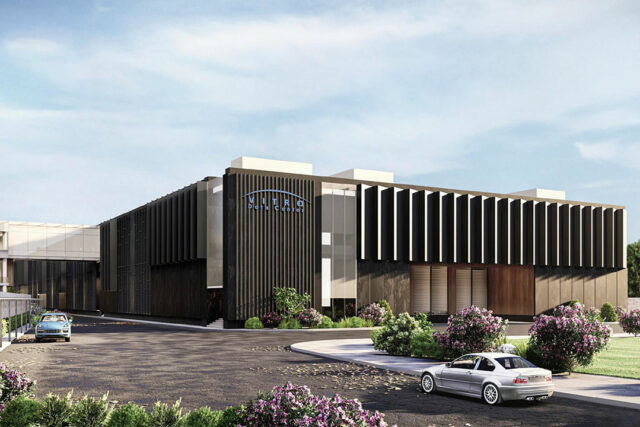
PLDT Inc., through its unit ePLDT, Inc., is planning to build its next data center in South Luzon to position VITRO Sta. Rosa as a data center hub and maintain a strong market presence in the data center business, according to the company’s president.

“Hopefully, we can already get another lot to build our next data center. It will be no less than 100 megawatts (MW),” ePLDT President and Chief Executive Officer Victor S. Genuino said during a media briefing on Tuesday.

“That’s how bullish we are on the data center industry,” he added.

This followed the announcement of VITRO Sta. Rosa, the company’s 11th data center, now being live.

In July, the company completed the structure of its 50-MW hyperscale VITRO Sta. Rosa, its largest data center to date.

ePLDT now accounts for at least 60% of the market share in the data center business, Mr. Genuino said, adding that the company is planning to build more to retain its market dominance.

“I think our next data center will have to be in Luzon, the reason for that is it has to be South Luzon because we envision VITRO Sta. Rosa to be the hub. We expect other data centers to be built around it,” he said.

He said the company is negotiating with potential real estate providers for its planned data center site.

Hastings Holdings, Inc., a unit of the PLDT Beneficial Trust Fund subsidiary MediaQuest Holdings, Inc., has a majority stake in BusinessWorld through the Philippine Star Group, which it controls. — Ashley Erika O. Jose

What happened to the parol makers of Granada Street?

Edg Adrian A. Eva

IN THE bustling street of Granada in Barangay Valencia, Quezon City (a short stretch connecting Ortigas Ave. and Gilmore St.), vibrant lights brighten the night. These are the lights of the parols, the traditional lanterns that have illuminated the area for generations. Through the years, the area has been known for the small parol stores lining the street during the long Christmas season, displaying an array of colorful handcrafted lanterns made of capiz shells.

However, the colorful parols along Granada could soon become a memory, much like a burnt-out bulb in one of the lanterns. From the bustling days when 10 to 20 vendors lined the street, only two remain today, a local parol vendor said.

Weng, the co-owner of the Sato Laxa store, one of the two remaining parol stores, said that the number of vendors started to dwindle in 2023, after the COVID lockdowns. She explained that their permits were no longer renewed by the barangay.

Marami talaga dito simula ng lockdown from 2020 to 2022. At pagka-start ng 2023 wala na po sila dito dahil sila binigyan ng permiso [There were really many here from the lockdown starting in 2020 until 2022. But at the start of 2023, they were no longer here because they were not given permission anymore],” Weng — who did not want to give her last name — said in an interview.

Weng told BusinessWorld that she was saddened by the sudden disappearance of the vendors, as Granada has long been known for its iconic parols.

Hindi naman kami katulad ng iba na sasabihin buti walang ng ganon (competitor). Mas gusto namin na meron kasi para malaman ng madlang people na may mga nagbebenta, dudumugin kami [We’re not like others who would say it’s good that there are no competitors. We actually prefer having competitors because if the general public would know that there are sellers, more people will come to us here],” Weng said.

With the disappearance of many parol vendors, Weng is concerned that their store may face the same fate if permits are not renewed and renovations force them out without a nearby relocation option.

Wala pa kami sa ganon pero nalulungkot na kami. Next year 2025, na ire-renovate itong lugar na to… Sa makatuwid iilang taon na lang kaming meron dito [We’re not at that point yet, but we are already sad. In 2025, this place will be renovated… We may not have much more time here],” Weng said.

At the nearby Nenstar Lantern store, Yan Galicia, one of its parol makers, told BusinessWorld that permits were not renewed for vendors selling on the bridge that take up part of Gilmore, due to concerns about cleanliness. Vendors who were not operating on the bridge were allowed to stay, while those displaced either relocated to other areas or chose not to return to the business.

For the 37-year-old Nenstar Lantern store, the lack of competitors has turned out to be advantageous.

Pabor sa amin ’yun kasi noong nandito pa sila, pababaan ng price, mahirap makabenta. So ngayon dalawa na lang kami. Wala ng choice ’yung ibang pupunta kundi bumili na lang dito [It’s favorable for us because when they were still here, it was hard to sell because of price competition. Now that it’s just the two of us, people have no choice but to just buy here],” Ms. Galicia said.

Nenstar Lantern store’s sales are recently stable, and the store is recovering from a slow start earlier in the “’ber” months, which was attributable to the consecutive typhoons that hit the country, according to Michael Galicia, another one of the store’s parol makers.

Just as parols cast a warm glow in the dark, Weng believes there is still a spark of hope for the lantern industry of Granada. She believes the parol industry could brighten if the government establishes a one-stop location, similar to the Tutuban Center in Manila’s Divisoria, where vendors can operate legally.

She continues to pray that they won’t be forced to leave, holding on to the hope of preserving the parol legacy started by her husband and his mother. — Edg Adrian A. Eva

ALI raises P2.8B via placement of AREIT shares

GARDENCOURT RESIDENCES at Arca South by Ayala Land Premier — AYALALANDPREMIER.COM

LISTED property developer Ayala Land, Inc. (ALI) has raised P2.78 billion by selling 75 million shares of AREIT, Inc., its real estate investment trust, at P37 per share.

The sale was made through a placement agreement with BPI Capital Corp., the investment banking arm of Bank of the Philippine Islands, and UBS AG Singapore Branch, a global financial services company.

“The transaction was upsized on the back of strong participation from local long only and international investors, and was multiple times oversubscribed,” ALI said in a disclosure on Tuesday.

The offer shares were sold both inside and outside the United States to qualified institutional buyers, according to the company.

“The offer shares were also offered and sold in the Philippines in transactions that do not require registration under the Philippine Securities Regulation Code (SRC),” it said.

“The sale of the offer shares is exempt from the registration requirements of the SRC, and was not registered with the Philippine Securities and Exchange Commission under the SRC,” the company added.

The company said the proceeds from the block sale will be settled on Dec. 12, subject to the terms and conditions of the placement agreement.

“ALI and its subsidiary will submit the required Reinvestment Plan detailing the use of proceeds obtained from the block sale in due course,” it also said.

At the local bourse on Tuesday, shares in the company closed unchanged at P28.15 apiece. — Ashley Erika O. Jose

Painting with precision and peace

PLAZA DE TOROS (Madrid Series) by Arnold Lalongisip, 30x40 inches, 2024.

Arnold Lalongisip unveils The Madrid Collection

FOR Arnold Lalongisip, his first visit to Madrid earlier this year was a huge opportunity to do something new as a painter.

Known for his poetic distillation of nature in monochrome, he now focused his brush on the symphony of lines, roads, structures, calm waters, and birds in flight that caught his attention in Spain’s capital. At Art Underground, 12 of Mr. Lalongisip’s works have been put together in an exhibit titled The Madrid Collection for guests to peruse and purchase.

In the last exhibit for 2024 at Art Underground, the paintings on display offer glimpses of Madrid’s historic architecture and serene landscapes in black and white.

The trip, which took place in May, culminated in an album of hundreds of photos — but Mr. Lalongisip did not take the photos as any regular tourist would. Choosing certain images that he thought would be interesting to paint, he sets out to combine their elements, be it a bird on the ground at a park or the cobblestone location of a historic site.

“I don’t use just one reference photo,” he told BusinessWorld in an interview. “For example, the birds. I can have five to 10 photos of the same bird from different angles in my tablet. Para maaralan ko kung paano atakihin ang light at shadows niya (So that I can study how to paint its light and shadows),” he explained.

“Even the boats. I study the different kinds of boats there and choose which one to use. The one I ended up using is made of an acrylic material.”

Mr. Lalongisip removes the people in the photos, his paintings instead depicting the various places as calm venues for reflection, populated only by the occasional bird.

Precision is key for this artist, whose distinctive viewpoint shines even without color. He experiments with form and texture through every stroke and gradient, exploring the interplay of shadow and light to highlight the grandeur of landmarks like Plaza Mayor and the spires of Madrid’s cathedrals.

His Plaza de Toros, for example, seems straightforward until one leans in and sees every line forming the meticulous details on the walls, windows, and gates, the eyes also drawn to the three birds in flight up in the sky. His Monumento Alfonso paintings bring out different aspects of the structure, the one with a boat on calm water reflecting the trees around proving to be the most serene of the grandiose series.

“I’m very simple, very practical. I like it when you can just stare at a painting and focus on the different elements in it,” said Mr. Lalongisip. “Parang ganoon pakiramdam ko noong ginagawa ko (That’s how I feel while making them).”

“I like to think that’s also how people feel when they see my works.”

The Madrid Collection is on view at Art Underground, 180 Mabini St., San Juan City, until Dec. 23. — Brontë H. Lacsamana