Home Blog Page 182

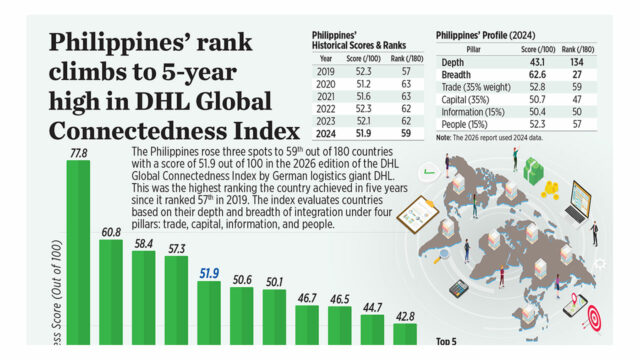
Philippines’ rank climbs to 5-year high in DHL Global Connectedness Index

HANOI — The Philippines improved three spots to 59th in the DHL Global Connectedness Report 2026, placing it in the middle among its Southeast Asian neighbors. Read the full story.

RCBC renewable energy loans reach P60B

BW FILE PHOTO

RIZAL COMMERCIAL Banking Corp. (RCBC) saw its renewable energy (RE) portfolio grow to breach P60 billion last year, helping add over 2,000 megawatts of installed clean energy capacity for the Philippines.

This was up from the P53 billion in 2024, with RE loans now making up half of RCBC’s total sustainable portfolio, the bank said in a statement on Tuesday.

RCBC Chief Sustainability Officer Armi M. Lamberte said the funds were channeled to 27 renewable energy initiatives on solar, wind, hydropower, and geothermal projects.

“For over six years, renewable energy has been the driving force behind RCBC’s eligible sustainable portfolio,” she said. 

RCBC added that it remains on track to fully phase out its exposure to coal borrowers by 2031, as it committed in 2020.

As of 2025, the bank’s RE exposure is almost three times larger than its coal-related exposures, it said.

RCBC’s net income rose by 11% to P10.6 billion last year.

Its shares closed unchanged at P24 each on Tuesday. — A.M.C. Sy

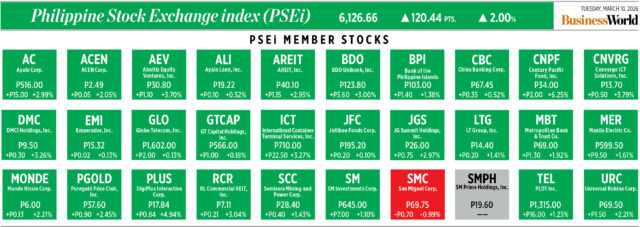
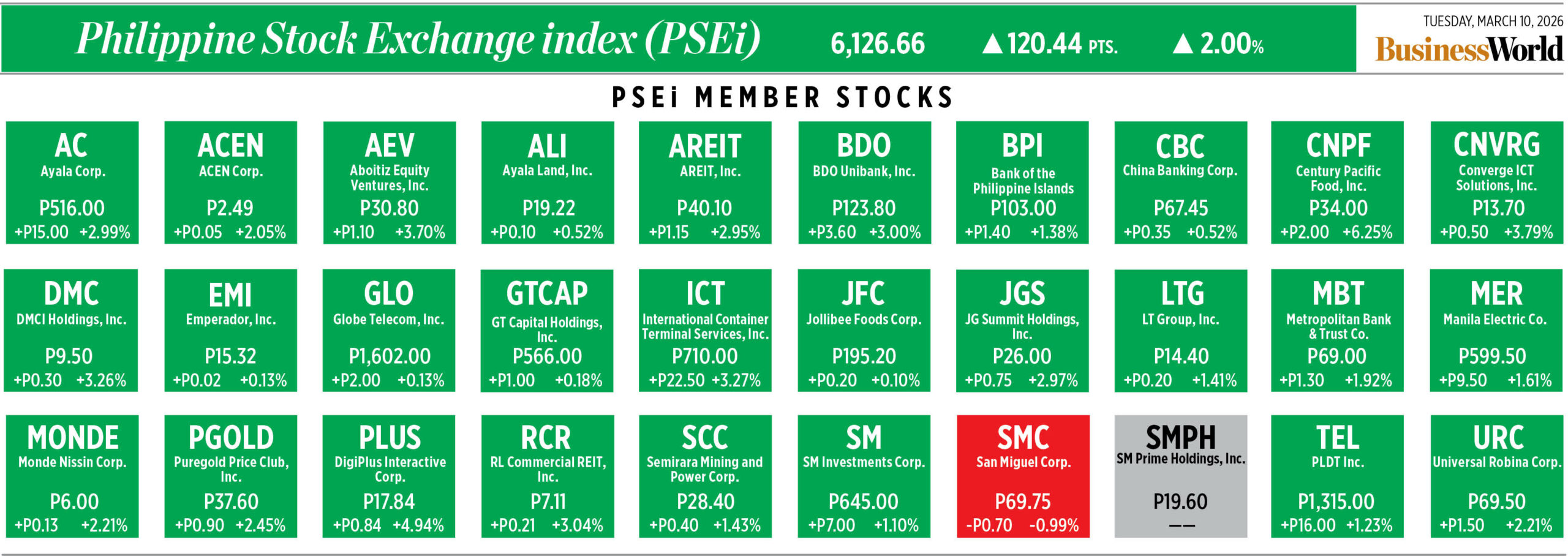
How PSEi member stocks performed — March 10, 2026

Here’s a quick glance at how PSEi stocks fared on Tuesday, March 10, 2026.


VAT reductions seen viable with exemption crackdown

PHILIPPINE STAR/MIGUEL DE GUZMAN

By Justine Irish D. Tabile, Reporter

THE GOVERNMENT will have to expand the tax base to make the proposed reductions in value-added tax (VAT) sustainable, and may need to resort to a crackdown on transactions currently exempt from VAT, analysts said.

Raymond A. Abrea, founding chairman and chief executive officer of the Asian Consulting Group (ACG), said the proposed reduction of the VAT rate from 12% — the highest rate in Southeast Asia — to 10% will help ease the burden on consumers.

“The Philippines currently has the highest VAT rate in ASEAN, yet our collection efficiency is only around 35-40%, far below the global average of about 57%,” Mr. Abrea told BusinessWorld via Viber.

“This clearly shows that the real problem is not the tax rate — it is inefficiency and leakages in the system,” he added.

ACG said the ASEAN average VAT rate is 10%, with Thailand imposing the lowest at 7%.

Indonesia imposes 11%, Cambodia and Laos 10%, and Vietnam and Singapore 8%.

Collection efficiency was highest in Thailand at 71%-79%, followed by Singapore at 71%, Vietnam 70%, Cambodia 66%, and Indonesia 45%-50%.

This puts average ASEAN collection efficiency at 57%.

As such, many members of the Philippine Congress have filed bills aiming to reduce the domestic VAT rate to 10%, including Senator Mark A. Villar with Senate Bill 1916.

Currently in committee, the bill says a VAT rate reduction could expand disposable income in the average household by P8,000 a year.

Former Finance Secretary Ralph G. Recto warned last year that reducing the VAT rate could cost the government P339 billion in revenue per annum.

“While (foregone revenue) of P339 billion annually is a legitimate concern, this can be mitigated by rationalizing more than 30 existing VAT-exempt transactions,” Mr. Abrea said.

“Many of these exemptions are non-refundable, compliance-heavy, and vulnerable to abuse, contributing to an estimated P539 billion in foregone revenue according to the World Bank,” he added.

He said exemptions granted to senior citizens and persons with disabilities should be looked at.

“(These) are poorly targeted, often benefitting those with higher spending capacity rather than the most vulnerable,” he said.

“Direct support mechanisms — such as target coupons, cash transfers, or a universal pension — would deliver assistance more efficiently and equitably,” he added.

Foundation for Economic Freedom President Calixto V. Chikiamco said that the tax base should be expanded to compensate for a lower VAT rate.

“(This can be done by) removing the tax exemptions on some products, such as sales by cooperatives,” he said via Viber.

Cielo D. Magno, associate professor at the UP School of Economics and a former Finance undersecretary, said at tax forum:

“If you really want to reduce VAT from 12% to 10% to 8%, it is actually possible. But we have to block the leakages and remove the other exemptions. We have to broaden the tax base with respect to VAT.”

ACG’s Mr. Abrea said that the government should also strengthen VAT administration through electronic invoicing, digital monitoring, and stricter enforcement.

“The path forward is clear: broaden the VAT base, rationalize exemptions, and modernize tax administration,” he said.

“Fiscal integrity does not come from imposing the highest tax rate in ASEAN, but from a fair, efficient, and technology-driven tax system that actually works,” he added.

Shipping firms allowed to collect fuel surcharge

@2GOTRAVEL

THE Maritime Industry Authority (MARINA) said it has authorized ship operators to collect a fuel surcharge of up to 20% of base fares, among other measures to promote the efficient use of fuel.

It urged shipping companies and related industries to ensure uninterrupted movement of passengers and essential goods while fuel prices fluctuate in the wake of the fighting in the Persian Gulf.

In an advisory on Monday, the regulator said it is also  allowing shipping companies to adjust their operations by consolidating or reducing trips to optimize vessel use in the interest of cutting fuel consumption, subject to MARINA approval.

MARINA also ordered all operators to prioritize the movement of essential commodities.

MARINA is also considering waiving the 2026 Annual Tonnage Fee, as well as offering discounts on ship document and certificate fees, and suspending new fees and charges.

“Once the crisis subsides, operators must remove any fuel surcharge and revert to pre-crisis rates,” it said, adding that surcharges exceeding 20% are subject to approval.

On Monday, three regional shipping lines raised passenger and cargo rates by up to 25% following a surge in fuel costs after global crude benchmarks exceeded $100 per barrel.

Starlite Ferries, Inc., a unit of Chelsea Logistics and Infrastructure Corp., said it is increasing passenger and cargo rates by up to 25% starting March 10.

Montenegro Shipping Lines, Inc. will implement a 10% to 20% increase in passenger and vehicle rates across its routes starting March 23.

FastCat, Inc. operated by Archipelago Philippine Ferries Corp., revised its fare matrix upward for both passengers and vehicles beginning March 6. — Ashley Erika O. Jose

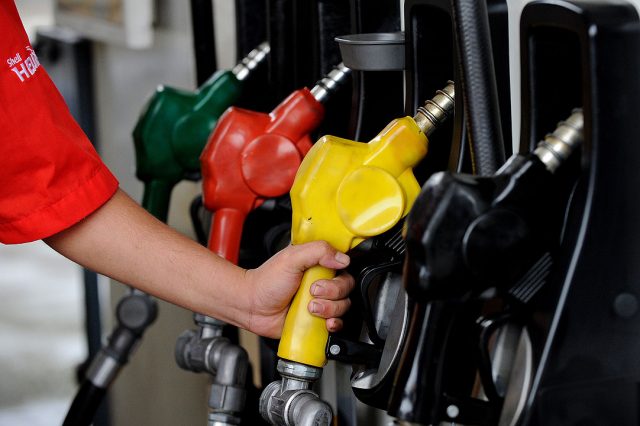
Oil Deregulation Law comes in for scrutiny after fuel prices spike due to Iran crisis

PHILSTAR FILE PHOTO

By Sheldeen Joy Talavera, Reporter

THE 28-year-old law that liberalized the downstream oil industry needs to be looked at again to strengthen energy security and protect consumers, an analyst said.

“Revisiting the Oil Deregulation Law is necessary to address current vulnerabilities while maintaining a competitive and investment-friendly oil market,” Jose M. Layug, Jr., executive board member of the Philippine Energy Research & Policy Institute, said in a statement.

“The priority is to strengthen transparency, improve crisis response, and protect consumers without undermining the gains of market liberalization,” he added.

Signed in 1998, Republic Act No. 8479, or the Downstream Oil Industry Deregulation Act, authorizes pump price adjustments without need for government approval in response to global oil price movements.

Moves to revise or amend the law have been floated in response to the attacks on Iran, which threatens to choke off supply from the Middle East, much of which needs to transit the Strait of Hormuz near the site of some of the fighting.

Philippine energy needs are primarily serviced by Middle East crude and fuel products derived from it.

On March 10, fuel retailers began a gradual increase in pump prices as the authorities worked to temper any one-time price hikes that could total up to P38.50 per liter if imposed all at once.

Gasoline prices were set to increase by P7 to P13 per liter, diesel prices by P17.50 to P24.25  and kerosene by P32 to P38.50 in the latest round of adjustments.

The Department of Energy (DoE) has ruled out a cap on fuel prices, which it said would violate the deregulation law.

“If there’s a change (in the law…) we will be able to scrutinize how prices are computed and whether we should limit (movements) or (resort to) uniform pricing,” Energy Secretary Sharon S. Garin said at a recent briefing.

Various measures are being considered in Congress focusing on making pricing schemes more transparent.

Mr. Layug said that while key objectives of the law have been achieved, such as liberalizing the industry, opening the market to independent entrants, and supporting private investment in fuel infrastructure, the Philippines remains highly exposed to international oil price fluctuations and supply disruptions.

He said domestic fuel prices largely reflect international market movements and that oil company profits “were not consistently excessive.”

“But as long as we continue to rely on imported fuels, this dilemma will never end until the Philippines becomes energy independent,” he said.

IBON Foundation Executive Director Jose Enrique A. Africa said that revisiting the law is “immensely justified,” saying the key context remains the Philippines’ overdependence on imported energy.

“The very premise of deregulation of such a strategic commodity with such far-reaching impact has to be overturned, the law repealed, and a new law regulating the oil industry enacted,” he told BusinessWorld.

Mr. Africa said the government needs price stabilization mechanisms, including “regulated pricing bands, authority to smooth pricing, a petroleum price stabilization fund learning from past errors, and a real strategic petroleum reserve beyond firm-level inventories.”

A strong state-owned oil firm would be effective in regulating the industry and insulating it from adverse market price movements, he said.

“The crisis today can be an important push to fixing the 30-year error of oil industry deregulation,” he said.

Noel M. Baga, co-convenor of the Center for Energy Research and Policy think tank, said any action could start with a State of Calamity declaration, under which the government can impose price caps.

He said the authority to cap is governed by the Disaster Risk Reduction and Management Act and the Price Act.

Over the long term, Mr. Baga said the Philippine National Oil Co. (PNOC) should establish a strategic petroleum reserve, a stockpile from which consumers can draw from at subsidized prices during crises.

“A strengthened PNOC should serve as a secure, reliable oil source for government agencies and the public alike,” he said.


PCCI backs emergency powers to curb drastic swings in fuel prices

THE Philippine Chamber of Commerce and Industry (PCCI) said it supports granting President Ferdinand R. Marcos, Jr. the authority to stabilize fuel prices and reduce the burden on consumers.

In a statement on Tuesday, PCCI President Ferdinand A. Ferrer said the private sector is asking the government to temporarily mitigate the impact of higher fuel prices, citing the likely follow-on impact on goods and logistics prices as well as fares.

President Ferdinand R. Marcos, Jr. last week said he plans to ask Congress to grant him emergency powers to reduce excise taxes on petroleum products if fighting in the Middle East keeps oil prices higher for much longer.

The Philippines imposes excise taxes to boost revenue. Excise taxes on petroleum products were increased in three tranches from Jan. 1, 2018 to Jan. 1, 2020 by the Tax Reform for Acceleration and Inclusion (TRAIN) law.

Between 2018 and 2020, the biggest excise tax increases were applied to diesel, liquefied petroleum gas and bunker, with rates rising from P2.50 to P6 per liter.

Mr. Ferrer said: “We support whatever means — whether reducing excise tax, VAT (value-added tax), or tapping other funding sources — because we are in a crisis.”

Oil firms will increase gasoline prices by between P7 and P13 per liter, diesel prices by P17.50-P24.25, and kerosene by P32 to P38.50 per liter, the Department of Energy said on Tuesday.

The hikes will result in pump prices ranging from P53.10-P73.40 per liter for gasoline, P63-P87.44 per liter for diesel, and P92.17-P125.17 per liter for kerosene.

“When fuel prices increase, the cost of moving goods increases immediately, and so do the prices of transporting goods,” Mr. Ferrer said.

He added “that the private sector has started implementing cost-saving measures — like carpooling, work-from-home arrangements, adjusting air-conditioning settings, a greater resort to bulk purchasing, and investing in renewables. Beatriz Marie D. Cruz

Extra P50 million sought for farmer, fisherfolk fuel subsidy

PHILIPPINE STAR/ RYAN BALDEMOR

THE Department of Agriculture (DA) said it will request the immediate release of an additional P50 million to supplement its fuel subsidy fund after crude oil prices spiked to nearly $120 per barrel before falling back on Monday.

Agriculture Assistant Secretary Arnel de Mesa said the release of the funds would allow the DA to deploy P150 million allocated for fuel assistance to farmers and fisherfolk amid rising global energy prices due to the fighting in Iran.

“The P50 million is ready for implementation in the coming days. The P100 million has already been released to the DA,” Mr. De Mesa told reporters late Monday.

He said that based on advice from the Department of Budget and Management, the remaining funds may be requested once the initial tranche is depleted.

Meanwhile, Mr. De Mesa said the implementing agencies — the Bureau of Fisheries and Aquatic Resources and the Bureau of Agricultural and Fisheries Engineering have been directed to accelerate the disbursement of the initial P100-million tranche.

The fuel subsidy program is intended to cushion farmers and fisherfolk from rising production costs caused by elevated fuel prices, which affect farm machinery operations and fishing activities.

The program allocates P75 million for farmers and an equal amount for fisherfolk, benefiting nearly 15,000 farmers and 24,000 fisherfolk.

To qualify for the subsidy, farmers must be enrolled in the Registry System for Basic Sectors in Agriculture  and must either own or rent farm machinery that uses fuel, such as tractors, harvesters, or irrigation pumps.

Fisherfolk beneficiaries must own or operate fishing boats with a capacity of three gross tons or below, while using fishing gear that complies with fisheries regulations.

The subsidy will be distributed through the Interventions Monitoring Card (IMC) issued to qualified beneficiaries. The card allows farmers and fisherfolk to withdraw their fuel assistance at accredited fuel stations.

For beneficiaries located in remote or far-flung areas where IMC transactions may not be accessible, the DA said fuel vouchers will be issued instead, which can be redeemed at participating fuel outlets. — Vonn Andrei E. Villamiel

PCIC to seek P7.5-B budget in 2027, extension of charter

THE Philippine Crop Insurance Corp. (PCIC) said it is seeking a P7.5-billion budget for next year to expand insurance coverage for farmers, and an extension of its charter, which is set to expire in 2028.

PCIC President Jovy C. Bernabe said the proposed budget represents a P1-billion increase from the current P6.5 billion, which would allow the state insurer to cover an additional 500,000 farmers.

“For every P1 billion in additional funding, we can cover around 450,000 to 500,000 more farmers across various sectors,” he told reporters.

Mr. Bernabe said any additional coverage will be allocated 60% to rice, 20% to corn, and 10% to high-value crops.

“Most subsistence farmers really (cultivate) rice and corn, so that’s where we concentrate — on the marginalized,” he added.

The PCIC received an additional P2 billion in funding this year, allowing it to raise the indemnity for farmers that suffer total crop losses.

“With the increase in budget for this year, the usual P20,000 per hectare for rice and corn that we pay for total loss (was) raised it to P25,000 to increase the indemnity for our farmers. That’s a 25% increase,” Mr. Bernabe said.

Meanwhile, the PCIC said it is optimistic that Congress will approve the extension of its charter, which is set to expire in 2028.

“We’re being supported by many legislators in both the House and the Senate. They have filed bills for the extension of the PCIC charter, and we are hopeful that it will be extended,” Mr. Bernabe said.

PCIC was created by Presidential Decree No. 1467 in 1978, which initially set the state insurer’s corporate life at 50 years.

Mr. Bernabe said legislators are considering granting PCIC a perpetual charter, which would not only extend the agency’s mandate indefinitely but also include provisions to strengthen its operations.

He said the proposed changes call for the digitalization of PCIC services and encourage partnerships with private insurance companies.

“The PCIC will also be encouraged to collaborate with private insurance companies so they can also participate in agricultural insurance,” Mr. Bernabe added. — Vonn Andrei E. Villamiel

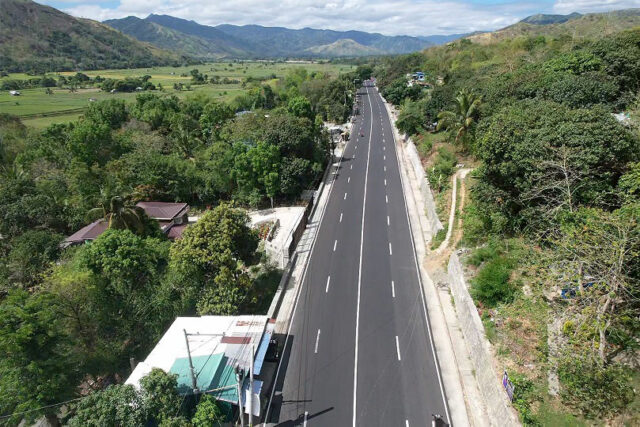
Maharlika Highway initial repairs targeted for early April completion

DPWH.GOV.PH

THE Department of Public Works and Highways (DPWH) said it hopes to finish initial repairs on the Maharlika Highway project before early April in anticipation of the Easter travel season.

“We need to finish this before Holy Week. The highway from Quezon all the way to Leyte must be passable by then,” Public Works Secretary Vivencio B. Dizon said in a statement on  Tuesday.

Easter Sunday falls on April 5 this year. The week of Easter is typically marked by extensive use of the roads by travelers heading to and from their home provinces, and by vacationers.

The DPWH is also planning to start the bidding process for more extensive rehabilitation work on the highway in April or May, with construction due to start by June.

The Maharlika Highway starts in northern Luzon and terminates in Zamboanga, linked by ferry crossings between Bicol and Samar as well as Leyte and Surigao.

The DPWH said it will suspend one-way traffic schemes on the highway next week. The lane closures were effected to allow for the temporary repairs, Mr. Dizon said.

Last month, the DPWH said the temporary repairs  include patching stretches of uneven road.

The DPWH has said it engaged foreign consultants to help draft the rehabilitation plan to allow for suitable new technologies to be incorporated in the build, in order to bring the repaired road up to international standards. — Ashley Erika O. Jose

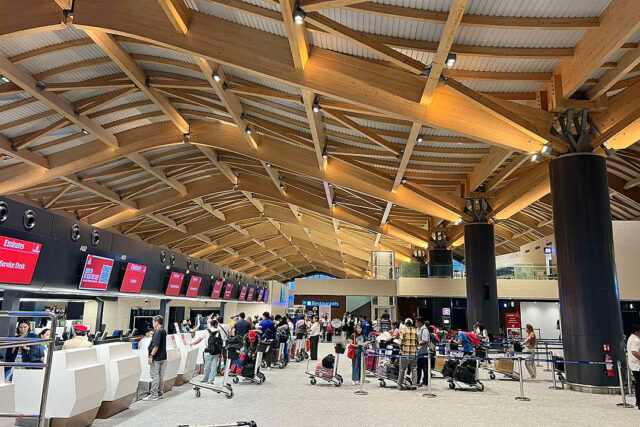
DoF urges Senate to find other means to fund agencies supported by travel tax

CLARK INTERNATIONAL AIRPORT

THE Department of Finance (DoF) asked the Senate to find alternative sources of funding for programs that could be affected by the removal of the travel tax.

“The department fully supports the complete abolition of the travel tax. It is important to ensure that any reform is carefully assessed between fiscal and development context,” Undersecretary Karlo Fermin S. Adriano said at a Senate hearing on Tuesday.

Collections from travel tax fund the Tourism Infrastructure and Enterprise Zone Authority (TIEZA), which receives about 50% of the proceeds, followed by the Commission on Higher Education (CHED), which receives 40%, and the National Commission for Culture and the Arts 10%.

“The proposal needs to consider how these programs can be sustainably funded,” he added.

Mr. Adriano said TIEZA could be funded by the General Appropriations Act.

The DoF estimates  revenue to be foregone with the abolition of travel tax at between P6.28 billion and P9.34 billion, Mr. Adriano said.

The tax is P1,620 for economy class air passengers and P2,700 from first class passengers flying internationally.

The Senate Ways and Means Committee is considering a number of measures on the future of the travel tax.

Suspending the travel tax was designated as priority legislation for the 20th Congress.

Senator Pilar Juliana S. Cayetano, who heads the panel, said the committee is considering five bills seeking to abolish the travel tax, five bills to exempt Filipinos and ASEAN nationals, and two bills exempting Filipinos traveling in economy class. One bill proposes a senior citizen discount and another would exempt travel vloggers.

“Our work here must strike a balance between removing barriers to mobility and protecting sustainable funds for programs currently supported by this tax,” she said.

Senator Joel J. Villanueva noted that the Philippines is bound by the ASEAN Tourism Agreement for the phasing out of travel levies and travel taxes on nationals of ASEAN Member States traveling to other ASEAN Member States.

“The ASEAN Tourism Strategic Plan likewise emphasizes making cross-border travel more seamless and cost-competitive, and strengthening travel facilitation across the region,” he said at the hearing.

Mr. Villanueva said programs currently funded by the travel tax may be supported via the national budget. — Adrian H. Halili

Building materials retail price growth in Metro Manila steady in Feb.

WILCON DEPOT/BW FILE PHOTO

THE RETAIL price growth of construction materials in the National Capital Region was steady in February with an acceleration in electrical materials prices offset by a slowdown in painting materials and related compounds, the Philippine Statistics Authority (PSA) reported on Tuesday.

Citing preliminary data, it said year-on-year growth in the construction materials retail price index (CMRPI) for Metro Manila remained at 1.2% in February, in line with the average in the year to date.

The February reading exceeded the 1.1% year-earlier level.

Compared to January readings, growth accelerated in the subindices of electrical materials (2.1% in February from 1.9% a month earlier), masonry materials (1.1% from 1%), plumbing materials (0.8% from 0.7%), and miscellaneous construction materials (1.1% from 0.9%).

Meanwhile, the PSA said slower price growth compared to a year earlier was noted in the indices for painting materials and related compounds (1.8% from 2.1%) and tinsmithry materials (1.9% from 2%).

The CMRPI is based on 2012 constant prices. — Matthew Miguel L. Castillo