Home Blog Page 1807

BW’s Forecast 2025 forum and MUP pension reform
The BusinessWorld Economic Forum today has a theme “Forecast 2025” and among the keynote speakers is Department of Finance (DoF) Undersecretary and Chief Economist Domini S. Velasquez. I have high regard for DoF’s economists in terms of fiscal and macroeconomic forecasting.

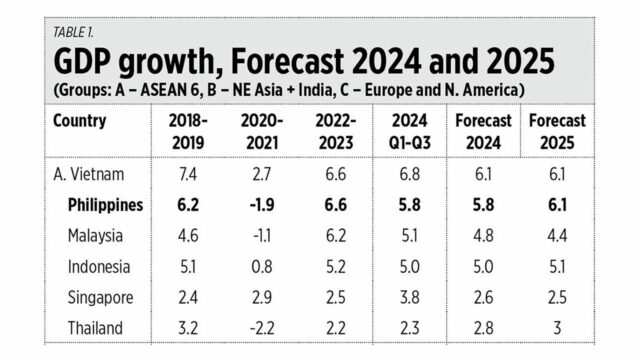
So far, the Philippines has had an average growth of 5.8% in the first three quarters (Q1 to Q3) of 2024. This is third highest among the major economies of Asia after India and Vietnam, and much higher than the average growth of countries in North America and Europe. The International Monetary Fund’s (IMF) forecast for the Philippines in 2025 is 6.1% growth — fair enough (see Table 1).

I saw two pieces of good news last week that I think will help the Philippines attain a growth rate of 6% or higher next year. These reports in BusinessWorld (BW) were: “Canada sending 300-member biz delegation to PHL in December” and “PEZA approvals hit P186B as of mid-Nov.” (Both came out on Nov. 21.)

Senior Trade Commissioner Guy Boileau of the Canadian Embassy in Manila was quoted saying that: “This is the biggest Team Canada Trade Mission that we have done. It is bigger than the delegations sent to Japan and Korea.”

Mr. Boileau also mentioned that among the standout reforms and new laws that helped many Canadian investors to consider the Philippines were: the amendment to the Public Service Act, Public-Private Partnership Code, and the Corporate Recovery and Tax Incentives for Enterprises to Maximize Opportunities for Reinvigorating the Economy (CREATE MORE).

DoF Secretary Ralph G. Recto used a lot of his political capital in pushing the CREATE MORE bill into a law, which was signed by the President on Nov. 11. The reduction in the corporate income tax rate from 25% to 20% is among the big reforms in the CREATE MORE law. I think it is a beautiful law because it responds to tax competition in East Asia, among other reasons.

The Philippine Economic Zone Authority (PEZA) reported that investment approvals in 2023 came to P140.88 billion, and now it is already P186 billion, and the year is not over yet. Cool.

MUP PENSION REFORM
Another piece of good news that was reported in BusinessWorld is this: “Military pension reform ‘not dead’ — DBM chief” (Nov. 25). It quoted Department of Budget and Management (DBM) Secretary Amenah F. Pangandaman and Undersecretary and Principal Economist Joselito R. Basilio.

Ms. Pangandaman said that a different version is being worked out and it is “different from what Secretary Ben [Diokno] has intended from the very beginning.” Mr. Basilio said that “Discussions are still ongoing, there will be updating.”

The pension of the Military and Uniformed Personnel (MUP) in the government’s annual budget should be zero — that is if the MUPs had not been pampered by previous administrations, especially the Ramos administration. Instead, active personnel contribute nothing to their own personal pensions, plus the pensions of retired MUP are indexed to the salaries of active personnel.

The pension comes out to about P130 billion/year on average. The share of pension to basic pay is 68% to 72% (see Table 2).
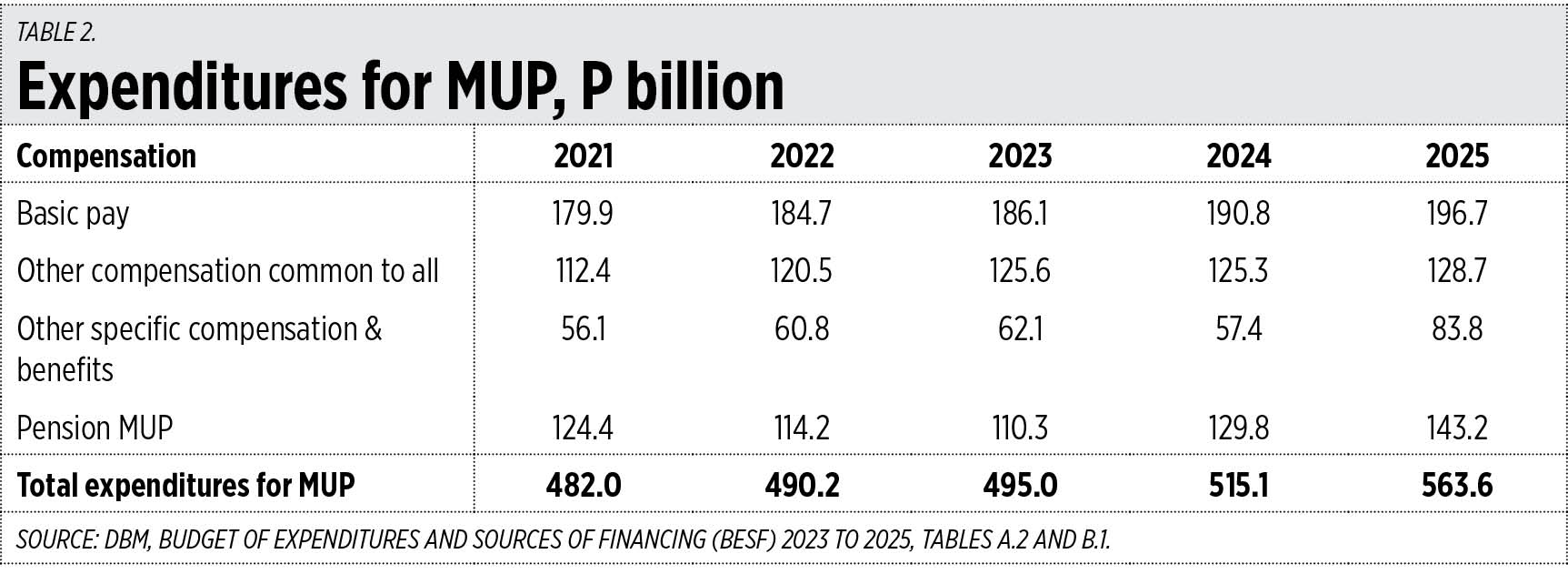
There are bills to remedy this oddity, and compared to the House version, I like the provisions in the Senate version, SB 2501, better. It says members of the military should contribute 7% of their base monthly salary to a pension system and the National Government will contribute 14%; indexation is removed and the pension is limited to 50% of the base pay for the last position held by retired MUPs. The ideal, according to Mr. Basilio, is 9% and 11%.

If indexation is retained, as is being lobbied by the Defense department and other agencies, another option is that the pension should be subject to tax, around 25%. This way, pensioners who did not contribute to their pensions during their active days would now be helping contribute to their own pension.

Every year the DBM and DoF come under pressure from so many agencies wanting higher budgets while taxes and other revenues are not able to keep up, leading to a high annual budget deficit and high borrowings. It is time to reduce and cut the subsidies and freebies, both to the public and certain government personnel.


Bienvenido S. Oplas, Jr. is the president of Bienvenido S. Oplas, Jr. Research Consultancy Services, and Minimal Government Thinkers. He is an international fellow of the Tholos Foundation.

minimalgovernment@gmail.com

Star Wars: Skeleton Crew series felt ‘like going home,’ Jude Law says

Jude Law in a scene from Star Wars: Skeleton Crew. — IMDB

LONDON — The latest addition to the Star Wars franchise introduces a new sense of playfulness into the universe by turning children into the protagonists, actor Jude Law says.

Star Wars: Skeleton Crew is an eight-episode live-action series following four youngsters who go on a thrilling and terrifying adventure after getting lost in a treacherous galaxy. Looking for a way back home, the foursome run into Mr. Law’s mysterious character Jod Na Nawood, who proposes a partnership.

“I love the concept. I loved the idea of making kids the protagonists because it sort of drew on the innocence and added a little bit of playfulness back into the experience,” said Mr. Law at a launch event in London’s Trafalgar Square on Thursday.

Stepping into the Star Wars world felt “oddly familiar,” the British actor, 51, said.

“It’s been in my life since I was an infant and so the galaxy, for all its vastness, was weirdly like going home. I was like ‘I know this place, I know these creatures,’” said Mr. Law.

Like their characters, the show’s young cast embarked on an exciting journey of their own, shooting the series on technologically advanced sets, including the Volume, a circular soundstage with LED panel screens.

“The sets were really realistic, especially the Volume. It felt like I was really in the Star Wars galaxy,” said Kyriana Kratter, who portrays KB. “It was an actor’s dream.”

The series’ creators, Jon Watts and Christopher Ford, drew inspiration from cult 1980s movies they grew up watching. Adding new elements to the Star Wars universe was both an honor and scary, they said.

“It’s a massive opportunity. I think what we were excited about was the ability to show the same Star Wars galaxy that we already know and love, but through a new perspective, which is through the eyes of four 10-year-old kids,” said Mr. Watts, director of three Spider-Man movies.

“It’s the perfect on-ramp for a new generation,” actress Ryan Kiera Armstrong, 14, added.

Star Wars: Skeleton Crew starts streaming on Disney+ on Dec. 3. — Reuters

UnionBank says new financing packages to speed up Tesla buys

PHILIPPINE STAR/KRIZ JOHN ROSALES

UNION BANK of the Philippines, Inc. (UnionBank) is set to offer financing packages to expedite the purchase of Tesla vehicles.

“As one of Tesla’s preferred financial providers in the Philippines, UnionBank is making it easier for more Filipinos to unlock the future of electric driving through tailored financing packages, competitive rates, and premium services,” the bank said in a statement on Monday.

UnionBank said it will offer a faster approval process to allow customers to easily secure financing.

“With competitive interest rates and a streamlined application process, UnionBank is dedicated to providing a seamless experience for those looking to make the move to electric driving.”

The first batch of deliveries is slated for the first quarter of 2025.

The bank will also offer a test drive to interested customers, it added.

Tesla’s electric mid-size SUV Model Y and sedan Model 3 are available for preview in Uptown Parade, Bonifacio Global City.

“UnionBank is honored to support Tesla’s mission to accelerate the world’s transition to sustainable energy, making the electric vehicle dream a reality for Filipinos who are eager to lead the change into a high-tech, eco-conscious future,” UnionBank Cards and Consumer Loans Head Mukul Sukhani said.

“Through our offerings, UnionBank believes that Tesla’s groundbreaking electric vehicles will become more accessible to those ready to embrace the future of driving,” he added. — Luisa Maria Jacinta C. Jocson

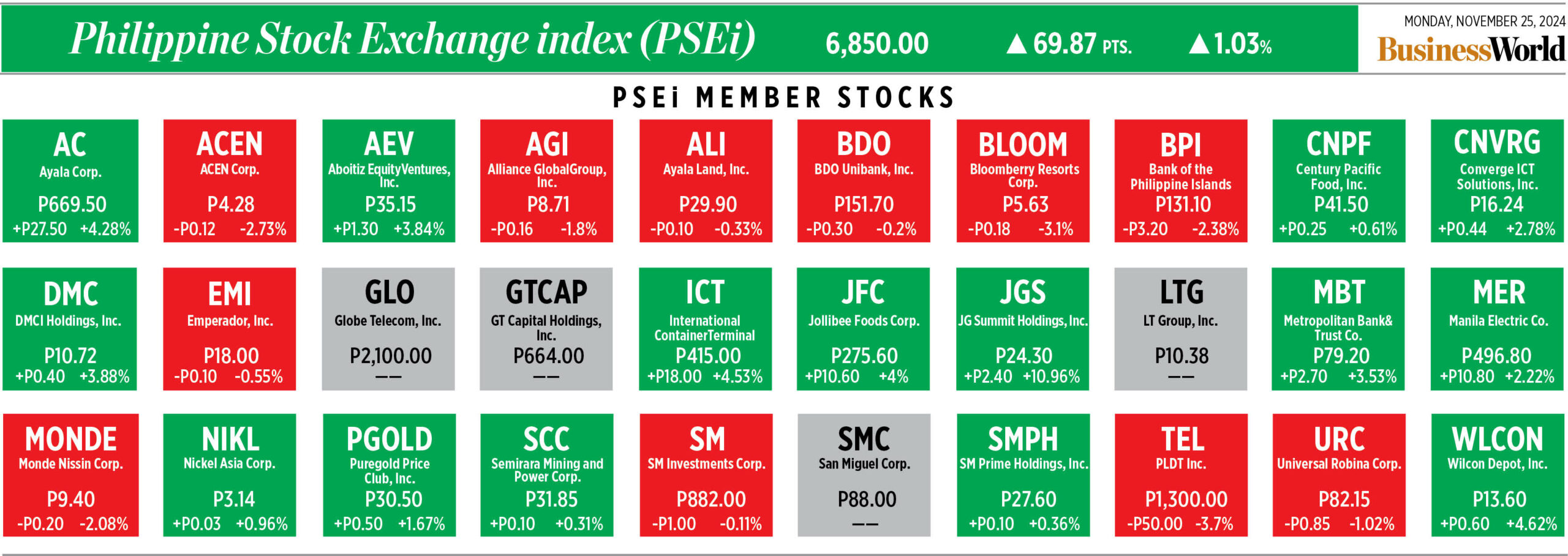
How PSEi member stocks performed — November 25, 2024

Here’s a quick glance at how PSEi stocks fared on Monday, November 25, 2024.


Tax Justice Network: Philippines’ annual tax losses hit 1.8% of GDP

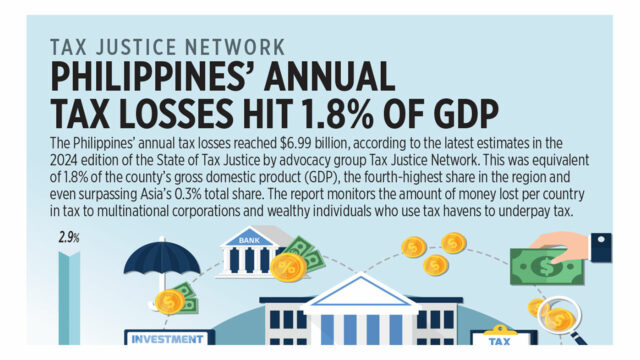
The Philippines’ annual tax losses reached $6.99 billion, according to the latest estimates in the 2024 edition of the State of Tax Justice by advocacy group Tax Justice Network. This was equivalent of 1.8% of the county’s gross domestic product (GDP), the fourth-highest share in the region and even surpassing Asia’s 0.3% total share. The report monitors the amount of money lost per country in tax to multinational corporations and wealthy individuals who use tax havens to underpay tax.

Tax Justice Network: Philippines’ annual tax losses hit 1.8% of GDP

Peso weakens anew vs dollar amid escalating Russia-Ukraine conflict

BW FILE PHOTO

THE PESO depreciated anew against the dollar on Monday amid the worsening conflict between Russia and Ukraine.

The local unit closed at P58.99 per dollar on Monday, weakening by 12 centavos from its P58.87 finish on Friday, Bankers Association of the Philippines data showed.

The peso opened Monday’s session slightly stronger at P58.85 against the dollar. Its intraday best was at P58.80, while its worst showing was its record low of P59 versus the greenback.

The local unit had closed at the P59-per-dollar level on Thursday to match the all-time low last hit on Oct. 17, 2022 before rebounding on Friday.

Dollars traded declined to $1.06 billion on Monday from $1.07 billion on Friday.

“The US dollar/peso exchange rate was higher recently amid some geopolitical risks related to the Russia-Ukraine war since last week on the potential escalation of the conflict,” Rizal Commercial Banking Corp. Chief Economist Michael L. Ricafort said in a Viber message.

“Going forward, the performance of the peso would be partly a function of intervention as consistently seen over the past two years, amid the need to better manage inflation and inflation expectations to fulfill the price stability mandate that would also require stability in the peso exchange rate,” Mr. Ricafort added.

The peso declined versus the dollar on expectations of potential strong US economic reports due later this week, a trader said in an e-mail. October US personal consumption expenditures data will be released on Nov. 27 (Wednesday).

For Tuesday, both the trader and Mr. Ricafort expect the peso to range from P58.80 to P59 versus the dollar.

“Lingering pressures on the greenback and profit-takers might keep the local currency sideways,” the trader said.

Russian forces attacked energy infrastructure in Ukraine’s southern region of Mykolaiv and industrial facilities in the southeastern Zaporizhzhia region overnight, Ukrainian authorities said on Monday, Reuters reported.

Engineers had restored power to most of the consumers facing power cuts in the attack’s aftermath as of the morning, Mykolaiv governor Vitaliy Kim said via the Telegram messaging app.

The governor reported no casualties and said the air defense downed two drones over the region.

Russia also launched “tens of drones” to attack Zaporizhzhia overnight, regional governor Ivan Fedorov said on national television.

Ukrainian President Volodymyr Zelensky said on Sunday that Russia used around 460 drones and over 20 missiles to attack Ukraine in the past week.

Meanwhile, the dollar relinquished a little of its recent gains on Monday as the pick for US Treasury secretary seemed to reassure the bond market and pulled yields lower, shaving some of the currency’s rate advantage.

Yields on 10-year Treasuries slipped to 4.351%, from 4.412% late Friday, as President-elect Donald Trump’s choice of fund manager Scott Bessent was welcomed by the bond market as an old Wall Street hand and a fiscal conservative.

However, Mr. Bessent has also been openly in favor of a strong dollar and has supported tariffs, suggesting any pullback in the currency might be fleeting.

The dollar was likely due some consolidation having risen for eight weeks in a row for only the third time this century and many technical indicators were flashing overbought.

The index was last down 0.5% at 106.950, having hit a two-year peak of 108.090 on Friday. The dollar dipped 0.4% on the Japanese yen to 154.11, and further away from its recent peak of 156.76. — Luisa Maria Jacinta C. Jocson with Reuters

Philippine shares rebound on bargain hunting

BW FILE PHOTO

PHILIPPINE SHARES rebounded on Monday as investors picked up bargains following the index’s two-day decline and as positive sentiment on Wall Street spilled over to the local market.

The bellwether Philippine Stock Exchange index (PSEi) climbed by 1.03% or 69.87 points to end at 6,850 on Monday, while the broader all shares index rose by 0.62% or 23.53 points to close at 3,811.74.

“The local market bounced back as investors hunted for bargains at the 6,700 to 6,800 support range following two straight days of decline,” Philstocks Financial, Inc. Senior Research Analyst Japhet Louis O. Tantiangco said in a Viber message.

“The positive cues from Wall Street’s performance last Friday also helped in the market’s rise,” he added.

Wall Street closed higher on Friday, with all three major indexes posting weekly gains, as investors took comfort from data pointing to robust economic activity in the world’s biggest economy, Reuters reported.

A measure of business activity raced to a 31-month high in November, boosted by hopes for lower interest rates and more business-friendly policies from President-elect Donald J. Trump’s administration next year.

The Dow Jones Industrial Average rose 426.16 points or 0.97% to 44,296.51; the S&P 500 gained 20.63 points or 0.35% to 5,969.34; and the Nasdaq Composite gained 31.23 points or 0.16% to 19,003.65.

“Philippine shares bounced back to start the week after previous sessions in the red as investor followed the latest MSCI rebalancing which came into effect this afternoon,” Regina Capital Development Corp. Head of Sales Luis A. Limlingan said in a Viber message on Monday.

“Key economic data releases in the United States this week include the durable goods report and core personal consumption expenditures inflation, both scheduled for Wednesday. Additionally, the minutes from the November Federal Open Market Committee meeting will be released on Tuesday. Notably, no speeches from Fed officials are expected this week,” he added.

All sectoral indices closed higher on Monday. Services surged by 2.05% or 43.25 points to 2,144.36; holding firms went up by 1.83% or 104.15 points to 5,777.29; industrials jumped by 0.76% or 71.77 points to 9,467.15; mining and oil rose by 0.14% or 11.32 points to 7,672.81; financials climbed 0.06% or 1.53 points to 2,278.16; and property inched up by 0.02% or 0.61 point to 2,583.22.

“JG Summit Holdings, Inc. was the top index gainer, surging 10.96% to P24.30. PLDT, Inc. was the worst index performer, dropping 3.7% to P1,300,” Mr. Tantiangco said.

Value turnover increased to P9.98 billion on Monday with 701.36 million shares exchanged from the P3.15 billion with 604.62 million issues traded on Friday.

Advancers narrowly beat decliners, 94 versus 91, while 64 names closed unchanged.

Net foreign selling declined to P308.74 million on Monday from P584.49 million on Friday. — Revin Mikhael D. Ochave with Reuters

Maharlika technical positions last missing piece of org chart

THE Maharlika Investment Corp.’s (MIC) organizational structure has not yet been finalized, the Governance Commission for Government-owned and -controlled corporations (GCG) said. “The interim staffing pattern has been approved by the President with respect to non-highly technical positions, plus their compensation,” GCG Chairman Marius P. Corpus told reporters on the sidelines of an event on Monday.

“What we are trying to finalize now (are) the guidelines for the highly technical positions and their compensation,” he added.

He said President Ferdinand R. Marcos, Jr. ordered the GCG to work with Maharlika to finalize the guidelines.

“If I’m not mistaken, there are now 42 positions, non-highly technical positions that have been approved. We can hire already,” he added.

The guidelines may be finalized early next year, he said, adding, “I’m not saying that’s definite, because the discussions are ongoing. Anything can come up.”

“We have to define first what are highly technical positions. Especially with respect to investments, we need to hire experts to take charge of the various investments.”

He also said the MIC does not need to have a complete staffing to make its first investment.

“They can (invest) right now. There are already negotiations. The president and CEO is there, the board of directors are also there, they can approve the contract or the investment.”

The sovereign wealth fund has yet to make its first official investment since Republic Act No. 11954, which created the Maharlika Investment Fund, was signed into law in 2023.

MIC Chief Executive Officer (CEO) Rafael D. Consing, Jr. has said he expects operations to be in full swing by next year, with “significant” funds committed to its priority investment areas, such as energy.

In July, the MIC obtained membership in the International Forum of Sovereign Wealth Funds. It also completed its investment and risk management framework.

Separately, Mr. Corpus said the GCG is still pushing amendments to its charter.

“We’re supposed to be the regulatory arm for GOCCs and we feel that we need some more incentives for the GOCCs,” he said.

Last year, the GCG floated proposals to strengthen its power to sanction the GOCCs that it oversees.

Republic Act No. 10149, which created the GCG, does not give the commission power to investigate and sanction underperforming GOCCs and their officials.

“All we do is rate them and then on the basis of their rating, if they get a rating of 90% in their performance evaluation scorecard, then they’re entitled to a performance-based bonus.”

“As of now, that’s the only ‘carrot’ we have for them. We need more functions or powers or authority to be able to uplift the GOCC sector, not just the performance rating.”

Mr. Corpus said the GCG has submitted its proposal to the Congress.

“We’ll still pursue it, even if it’s not passed before the 19th Congress adjourns. We can still pursue it (in the next Congress).”

The Department of Finance reported that 52 GOCCs remitted P95.9 billion in dividends as of October, up 51% from a year earlier. — Luisa Maria Jacinta C. Jocson

Trump could stall ‘green’ transition by making investors more wary — analysts

REUTERS

By Sheldeen Joy Talavera, Reporter

INVESTORS in the energy market could be given pause by Donald J. Trump’s return to power and are watching for any shifts in energy policy, analysts said.

“Philippine and Southeast Asian investors can expect greater unpredictability in energy markets because of these major shifts in US energy policy under the incoming Trump administration, especially amid domestic and global opposition from climate change interests,” Sonny Africa, executive director at think tank IBON Foundation, said via Viber.

“The availability and cost of energy in the country and the region could be affected by how US policies can significantly sway market dynamics,” he added.

Mr. Africa said decisions made by President-elect Trump, who has “constantly questioned climate change,” will have “enormous adverse implications” on the energy transition initiatives of countries such as the Philippines.

The government is aiming to increase the share of renewable energy in the power generation mix to 35% by 2030 and to 50% by 2040.

“His aggressiveness in expanding fossil fuel use for the US to have the cheapest electricity in the world as a pillar of renewed US industrialization will be a major setback for climate efforts not just in the US but around the world,” Mr. Africa said.

While the direct impact of Trump’s win on global growth is likely to be limited next year, as policy change takes time to be implemented in the US, the uncertainty will inspire caution, Oxford Economics said in an e-mail response to BusinessWorld.

“Beyond the short term, uncertainty over the extent and magnitude of future tariffs, tighter financial conditions, and heightened geopolitical risk will lead non-US firms to adopt a more cautious approach towards investment and hiring plans,” it said.

Mr. Trump has promised to impose 60% tariffs on US imports of Chinese goods, as well as up to 20% tariffs on all imports.

Sam Reynolds, research lead at Institute for Energy Economics and Financial Analysis, said that Mr. Trump’s planned tariffs could worsen the oversupply of solar panels in Southeast Asia from China, possibly lowering costs.

“Overall, President-elect Trump’s victory — as well as Republican control of both houses of Congress — should not change the economics of the energy transition or the trajectory of clean energy technologies versus fossil fuels,” Mr. Reynolds said in an e-mail.

He said that the costs of renewable energy technologies like solar, wind, and battery storage, “continue to fall.”

Meanwhile, fossil fuels like coal and liquefied natural gas remain elevated due to “geopolitical uncertainty, seasonal price swings, supply outages, trade route disruptions,” among others.

“Although Trump’s victory may not change the long-term economic trajectory of the energy transition, there will likely be a renewed political push for fossil fuels in the Philippines and Southeast Asia, as well as depressed support for global climate efforts more broadly,” Mr. Reynolds said.

Analysts expect the Trump administration to once more withdraw the US from the Paris Agreement, as it did during his first term.

“If this happens and the US disengages from its climate commitments, his government should expect opposition from the most vulnerable regions and populations,” Gerry C. Arances, executive director at think tank Center for Energy, Ecology, and Development, said in a Viber message.

In November 2019, former Secretary of State Michael R. Pompeo said Mr. Trump made the decision to withdraw from the agreement due to the “unfair economic burden imposed on American workers, businesses, and taxpayers by US pledges made under the agreement.”

The US officially rejoined the Paris Agreement in 2021 under President Joseph R. Biden, Jr.

The Paris agreement is a global treaty that aims to keep the global temperatures rise below 2°Celsius. The Philippines is one of the signatories to the treaty.

Job generation could stall if workers not upskilled — MAP

PHILSTAR FILE PHOTO

THE workforce needs to be provided the appropriate training to ensure they can get good jobs in step with developments in technology, the Management Association of the Philippines (MAP) said.

On the sidelines of the MAP General Membership Meeting on Monday, MAP President Rene D. Almendras said that the private sector is concerned about job generation as demands evolve.

“The world is changing fast. Artificial intelligence is there; technology is there,” Mr. Almendras told reporters.

“If we do not upskill the workforce and do not provide the appropriate training, even at the basic education level, then they will not find good and productive jobs in the future,” he added.

He added that the Philippines, along with other countries, is waiting on how the new US President conducts trade and foreign policy.

“I think there will be many questions as to whether we are going to see a trade war (or how severe it might be),” he said.

“We need to exist in the community of nations, and we need to be a participant in the global economy one way or the other. So we will be affected by any geopolitical developments or changes, and a different leadership perspective is significant,” he added.

OTHER CONCERNS
Aside from job generation, he said that MAP members are also mainly concerned with ease of doing business (EoDB), corruption, and consistency.

“In last year’s survey, EoDB was the number two concern, while in this year’s survey, EoDB is number six. So although corruption is number one, at least in terms of EoDB, we saw some improvement,” Mr. Almendras said.

Asked about how political issues are affecting business sentiment, he said that the country’s competitiveness is also determined by its image and reputation.

“Most important to business is consistency and regularity of policy. I am hoping that that will continue to be emphasized as we go through these politically challenging times,” he said.

“We need to show the world that we are still consistent, and we still have the regular business as usual situation,” he added.

He said that competitiveness does not only rely on skill sets and technology but also on the environment it provides for investments.

“I am not talking about just investments from abroad, but even investments by local businessmen. You cannot separate sentiment into domestic and international,” he said.

“If there is a group of people that needs to have a positive sentiment about our country, it should be us. Because the foreigners look at us before they make investments here,” he added. — Justine Irish D. Tabile 

IT ecozone proclaimed in Antipolo

XENTROMALLS.COM

THE GOVERNMENT said it proclaimed an information technology (IT)-focused special economic zone in Antipolo City, known as Xentro Antipolo.

Proclamation No. 752 covers a 27,622 square-meter building on a 10,898 square-meter site along Sumulong Highway.

Special economic zones are areas with the potential to be developed into agro-industrial, industrial, tourist/recreational, commercial, banking, investment and financial centers, the Palace said in a statement.

The development of new ecozones is a feature of the five-year Philippine Development Plan (PDP), with the aim of promoting industrial dispersion away from metropolitan areas, integrate ecozones into local economies, and boost open trade between zone locators and companies outside the zones.

Under the medium-term plan, the Philippine Economic Zone Authority (PEZA) was tasked with expanding the types of special economic zones.

PEZA earlier this month said it had registered three locators in three economic zones, including Tsuneishi Green Energy Philippines, Inc., which invested P61.06 million in a roof-mounted solar facility at West Cebu Industrial Park in Balamban, Cebu.

Also on the list are Tractebel Red, Inc., which will invest P24.37 million in an export knowledge and computer-enabled services project in Makati City, and Wenshan Electronics Philippines Corp., which will manufacture high-tech chip power inductors at the Light Industry and Science Park II in Santo Tomas, Batangas. — Kyle Aristophere T. Atienza

KADIWA to tap more farm-cooperative suppliers

DA PHOTO

THE Department of Agriculture (DA) said on Monday that it is seeking to encourage more farmer cooperative and associations (FCA) to supply products to its flagship KADIWA ng Pangulo program.

Assistant Secretary for Consumer and Legislative Affairs Genevieve E. Velicaria-Guevarra said that the DA will organize an expo to encourage more FCAs to join the program.

“Through this event, we will encourage many more farmer cooperatives to join us or become suppliers or sellers in our KADIWA ng Pangulo program,” she added.

She added that the DA is looking to partner with other government agencies like the Philippine Postal Corp. (PhilPost) for its Kadiwa expansion plans due to PhilPost’s presence in numerous municipalities.

“Logistics-wise they are in the best position to help us transport all these goods in various areas in the country,” she added.

The DA is looking to expand its KADIWA network to 1,500 locations by 2028. it is expecting to open 179 KADIWA Centers by the end of the year.

Ms. Velicaria-Guevarra said that the DA is hoping to open 300 locations by the middle of next year.

Products sold in KADIWA locations are basic and prime commodities priced at about 20% less than those charged in public markets.

KADIWA Centers also sell rice at P42 per kilogram and subsidized rice for low-income individuals at P29 per kilo.

She added that the DA is looking to expand its products to include meat.

The Kadiwa ng Pangulo Expo is scheduled for Nov. 26-28 at the Philippine International Convention Center.

The event seeks to showcase over 100 farmer exhibitors and include model hubs, centers, stores, model trucks, and carts. — Adrian H. Halili