Home Blog Page 1804

Congress puts DoF in a bind and having to dip into PhilHealth and GOCCs: The case of PDIC
(Part 2)

What is the basis for taking P107 billion from the Philippine Deposit Insurance Corp. (PDIC)?

As in the PhilHealth (Philippine Health Insurance Corp.) matter, the justification for getting the funds from PDIC is reportedly the legal opinion issued by Office of Government Corporate Counsel (OGCC). This column calls for PDIC to release to the public the content of the OGCC legal opinion. It should clarify whether the amount is taken as “dividends,” or as a temporary borrowing (in which case the National Government should issue the equivalent promissory note to the PDIC).

With all due respect to whatever the OGCC legal opinion contains, this writer takes the position that — based on a reading of the PDIC charter provision on dividends — the basis for taking the PDIC funds is weak. Should the matter be taken to the Supreme Court similar to the PhilHealth case, it would be interesting to see the same arguments play out. This writer expects the Government Corporate Counsel (GCC) and the Solicitor General to be placed in the same very uncomfortable spot of defending the government position from the incisive and probing questions of Supreme Court Justices Amy Lazaro-Javier and Antonio Kho, Jr.

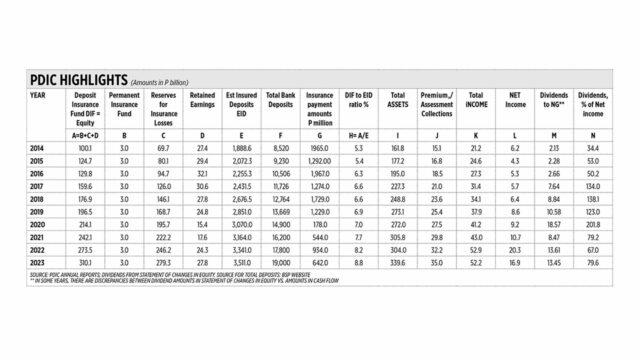
Under RA 7656, the PDIC, as a government-owned and -controlled corporation (GOCC), is required to declare at least 50% of its net income as dividends. However, the PDIC charter RA 10846 (May 23, 2015, amending RA 3591) specifically excludes premiums or “assessment collections” received from banks from the definition of income that can be declared as dividends. RA 10846 Sec 31 inserts a new Section 18 into RA 3591 which reads:

“DIVIDEND DECLARATION. Consistent with the policy of the state …. The Corporation shall build up and maintain the DIF (Deposit Insurance Fund) at the target level set by the PDIC Board of Directors. Such target level shall be subject to periodic review and may be adjusted as necessary.

“The Corporation (PDIC) is exempt from RA 7656; instead [PDIC] shall remit dividends to the National Government only if the target DIF level for the applicable year has been reached. For purposes of computing the amount of dividends to be declared and remitted to the National Government, all assessment collections shall not be considered as income. The dividend rate shall be at least fifty percent (50%) of the income from other sources only.”

Key Point: If the premiums or assessment collections that built up the DIF were exempt from the computation of dividends to the National Government, how much more the cumulative DIF itself? Common sense dictates that the DIF itself — the accumulated total of all these premiums over the years — will be equally, if not even more, protected/exempt from any dividend computation.

While the DIF cannot be touched, no such restriction applies on the National Government taking steps to reduce, or even zero out, the retained earnings (see Column D of the table). This reduction has actually happened in the past, with the retained earnings reduced from a high of P32.1 billion in 2016 to P15.4 billion in 2020 but recovered to P27.8 billion in 2023.

WHOSE MONEY?
Granting that there was a surplus, whose money is it anyway?

A former PDIC senior officer aptly put it, “PDIC is penalized for being efficient while PhilHealth was penalized for being inefficient.”

The two key arguments that the government has the right to take the PDIC’s “excess funds” are:

1. For private insurance companies, the premiums paid by the insuring public (such as for fire insurance for houses or for damage or theft of vehicles) form part of the income of the insurance company. The moment the insured party makes the payment, it is no longer his money. The company’s stockholders are entitled to get part of it as dividends from the company, since such income become part of retained earnings.

2. The government is the ultimate guarantor of the PDIC and  in the event of a real major crisis, it has to “bail out” the PDIC by way of direct assistance or by recapitalizing it. Case in point is the substantial amount infused to cover the United Coconut Planters Bank (UCPB) rescue. Note that the Land Bank of the Philippines’ absorption of UCPB involved it buying the UCPB shares “owned” by PDIC. Therefore, “National Government giveth, National Government taketh away.”

However, the same International Association of Deposit Insurers (IADI) report* showed that giving back money to the government is a very low priority item, with the top “policy responses to address a surplus” (IADI 2018, Fig 11, page 28) are:

1. Reduction of premium rates 45% (20)

2. Suspension of premium collections 36% (16)

3. Refund/rebates to member banks 5% (2)

4. Pay back government seed funding 2% (1)

The top responses are consistent with the view that the money in the DIF belongs to the banks and the depositors. In the insurance industry, clients with a good payment history and good record of no-claims are given rebates or granted premium holidays.

On Feb. 28 the PDIC announced an increase in the insurance coverage for deposits from P500,000 to P1 million effective March 15. The indication that this increase in deposit coverage is a belated rear-guard action:

1. This P1 million maximum coverage amount is actually less than the P500,000 limit in 2009 when adjusted for average inflation of 4.5%, which should be P1,150,000. RA 9302, signed by President Gloria Macapagal Arroyo, increased the coverage from P100,000 to P250,000 in 2004. It was increased further to P500,000 in 2009.

2. It took 16 years for the PDIC to increase the deposit coverage and only AFTER it received criticism about the drastic reduction in the Deposit Insurance Fund, despite its mandate to review the adequacy of the DIF every three years, and there had been no indication in its prior annual reports that PDIC DIF was already in excess.

The past several annual reports had cited the need to support the national government’s need to fund important national priority projects as the reason for rising dividends — using the same phraseology used in justifying taking P89 billion from PhilHealth. The wholesale withdrawal of P107 billion was done with the same justification.

THE REAL REASON FOR THE TRANSFER OF FUNDS
Public finance specialist Zy-za Nadine Suzara, who has been monitoring the budget process for years, summed it up best during her appearance as amicus curia in the Supreme Court oral arguments session (Day 1, February 2025).

“In conclusion, the controversial transfer of PhilHealth to the Treasury operationalized through DoF (Department of Finance) Circular 003-2024 is a consequence of a larger and more serious problem. The new scheme of funding pork barrel, despite the Supreme Court declaring PDAF (Priority Development Assistance Fund) as unconstitutional. Circumventing this earlier ruling, legislators have been deliberately defunding development programs and projects in the programmed appropriations and transferring them to the unprogrammed appropriations resulting in an excessive level of stand-by appropriations. This way of massively funding patronage-driven projects distorts the integrity of the budget and the budget process itself. My analysis of the 2022 to 2024 budget reveals that pork barrel now constitutes nearly 20% of the total national budget.”

In short, Congress defunded the development projects (as indicated in the National Expenditures Program or NEP) so much to fund what can only be considered “pork barrel.” The DoF had to scrounge for resources to fill the gap — hence, P89 billion from PhilHealth, P107 billion from PDIC.

In the oral arguments before the Supreme Court, Solicitor General Menardo Guevara could only reply to the SC Justices on why the reallocation happened thus, “We can only defer to the wisdom of Congress.” This writer would really love to hear a representative of Congress, especially members of the bicameral committee, defend the wisdom of their moves.

(Read Part 1 here: https://tinyurl.com/26a5s9bq )

*“Deposit Insurance Fund Target Ratio,” a research paper by the International Association of Deposit Insurers, published in July 2018.


Alexander C. Escucha is the president of the Institute for Development and Econometric Analysis, Inc., and chairman of the UP Visayas Foundation, Inc. He is a fellow of the Foundation for Economic Freedom and a past president of the Philippine Economic Society. He is an international resource director of The Asian Banker (Singapore).

alex.escucha@gmail.com

ALI eyes growth in Palawan with new direct flights from Clark to El Nido

SEDA LIO PALAWAN — SEDAHOTELS.COM

AYALA LAND, Inc. (ALI) said the launch of direct flights from Clark International Airport to El Nido Airport in Palawan via boutique airline AirSWIFT Transport, Inc. on March 30 will provide a growth boost to its properties in Palawan.

“This new flight route is a game-changer for El Nido,” Ayala Land Leisure Estates Head Cris M. Zuluaga said in an e-mail statement on Thursday.

“With these new flights, we look forward to welcoming travelers who seek immersive, nature-focused experiences that will help drive local economic growth while ensuring that El Nido remains preserved for generations to come,” she added.

Some of ALI’s properties in El Nido include the Seda Lio resort hotel and Huni Lio resort.

To accommodate the surge in visitors, ALI said there are ongoing initiatives to increase the capacity of El Nido Airport.

“Visitors staying at ALI’s resorts and Lio Estate will especially benefit from the improved accessibility,” the real estate developer said.

In October last year, the Gokongwei-led budget carrier Cebu Pacific acquired AirSWIFT Transport, Inc. from ALI for P1.75 billion.

Even with the recently launched Clark-to-El Nido route, AirSWIFT continues to operate flights from Manila.

ALI shares fell by 0.63% or 15 centavos to P23.75 per share on Thursday. — Revin Mikhael D. Ochave

Cinema group pushes for movies to stay in theaters longer

SAMUEL REGAN ASANTE-UNSPLASH

LAS VEGAS — Movie theater owners are making a new push to keep films in cinemas for a longer period before they are available for audiences to watch at home.

Cinema United, a trade organization formerly known as the National Association of Theater Owners, called on Tuesday for a minimum 45-day window of exclusivity for all films to help boost box offices still hovering below pre-pandemic levels.

“Shorter windows reduce the number of people that head to the theater in the opening weeks of a release,” Michael O’Leary, president and chief executive officer (CEO) of Cinema United, said at the industry’s annual CinemaCon convention in Las Vegas.

“It hits the bottom line, and in many cases, undermines the ability of medium- or smaller-budget movies to build an audience or even get off the ground,” he added.

The issue has caused friction between theater owners and media companies in the past.

It used to be standard practice that movies played only in theaters for 90 days or more.

The rise of streaming and the pandemic led media conglomerates to reduce that period. Today, a film can become available to stream at home — for a fee — as soon as 17 days. The time period varies for each title.

In 2024, US and Canadian box office receipts totaled $8.6 billion, 25% below the pre-pandemic heights of $11.4 billion in 2019.

Theater operators said their business would benefit from a consistent timeline, and they want studios to stop advertising the date a movie will be accessible at home while it is on the big screen.

“One of the most important things is to not announce the streaming date while we’re still playing the movie,” said Bob Bagby, president and CEO of the B&B Theatres chain. “That confuses consumers.”

Hollywood studios have shortened theatrical windows to make money with at-home streaming rentals. They argue that many films have collected most of their box office dollars within a few weeks. Streaming service Netflix puts only a small number of its films in theaters for a short period.

On Monday, Sony film executive Tom Rothman told the CinemaCon crowd that “Sony will work with you” on setting windows and on pricing flexibility, though he offered no specifics.

“If theaters and studios manage for the long term and do the right thing, the future will be grand,” said Mr. Rothman, the chairman and CEO of Sony Pictures Entertainment’s Motion Picture Group. — Reuters

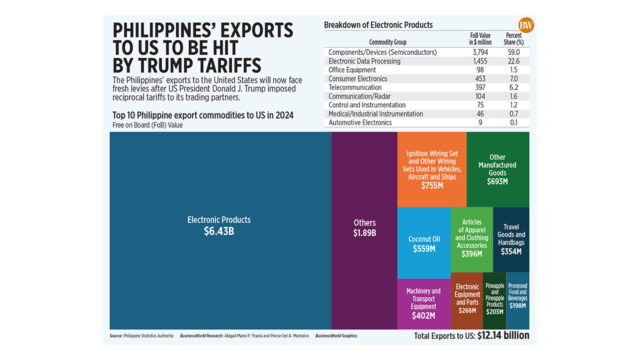
Philippines’ exports to US to be hit by Trump tariffs

US PRESIDENT Donald J. Trump is imposing a bigger-than-expected tariff on Philippine exports to the United States, as part of a broader reciprocal tariff plan that will apply to all its trading partners. Read the full story.

Philippines’ exports to US to be hit by Trump tariffs

US Supreme Court to hear Catholic group’s bid for Wisconsin unemployment tax exemption

REUTERS

WASHINGTON — The US Supreme Court is hearing a bid by an arm of a Catholic diocese in Wisconsin for a religious exemption from the state’s unemployment insurance tax in the latest religious rights case to reach the justices.

The Catholic Charities Bureau — a nonprofit corporation operating as the social ministry arm of the Catholic diocese in the city of Superior — and four entities that the bureau oversees have appealed a lower court’s decision rejecting their tax exemption bid.

At issue is whether the denial of the tax exemption violated the US Constitution’s First Amendment guarantee of free exercise of religion, as well as its separation of church and state.

The Supreme Court, with its 6-3 conservative majority, has taken an expansive view of religious rights in a series of rulings in recent years. President Donald Trump’s administration is supporting the Catholic Charities Bureau and the other challengers in the appeal.

During the Great Depression, Wisconsin in 1932 became the first US state to enact an unemployment compensation law, which collects taxes from employers and provides a temporary source of income to jobless workers.

Three years later, Democratic President Franklin Roosevelt signed into law the landmark Social Security Act of 1935 that established, among other programs, a cooperative federal-state unemployment insurance plan that would eventually lead to all US states enacting their own unemployment relief programs.

The federal government and all states exempt certain religious entities from having to pay into unemployment insurance programs. Most of these laws, including Wisconsin’s, require that organizations be “operated primarily for religious purposes” to be eligible for a religious exemption.

The Catholic Charities Bureau since 1917, it said on its website, has provided “services to the poor, the disadvantaged, the disabled, the elderly and children with special needs as an expression of the social ministry of the Catholic Church in the Diocese of Superior.”

Wisconsin state officials in 1972 determined that the group was subject to the state’s unemployment insurance tax. But after a subsidiary of the Catholic Charities Bureau in a separate case was deemed by a state court to be tax exempt, the bureau and four of its other subsidiaries in 2016 also sought religious exemptions.

Among the subsidiary groups involved in the case before the Supreme Court are organizations that provide services to people with disabilities including job placements and training, as well as daily living services and home visitation, according to court papers. The Catholic Charities Bureau and these subsidiary groups do not require their employees to be of any particular religion, nor do they seek to instill Catholic beliefs in those who benefit from their services.

The Wisconsin Supreme Court in 2024 rejected the tax exemption bid, finding that although the groups “assert a religious motivation behind their work,” their activities were “primarily charitable and secular” and thus were not “operated primarily for religious purposes.”

The challengers have argued that the Wisconsin Supreme Court’s ruling violates the First Amendment “by favoring some religions over others, entangling courts in religious questions, and interfering with church autonomy.”

Secular advocacy groups told the Supreme Court that a win for Catholic Charities Bureau would be far-reaching.

The legal rationale offered by the Catholic Charities Bureau “would allow all religiously affiliated organizations, including six of the 10 largest health systems in the US, to exempt themselves from unemployment insurance and numerous other government regulations,” the Freedom from Religion Foundation said in a written brief.

That would put hundreds of thousands of employees “at risk of losing their unemployment benefits overnight,” it added.

A ruling in the case is expected by the end of June.

The Supreme Court on April 30 is due to hear another case involving Catholic interests. The justices will consider the legality of a bid led by two Catholic dioceses to establish in Oklahoma the nation’s first taxpayer-funded religious charter school in a case testing the separation of church and state. — Reuters

FWD Philippines launches new unit-linked plan

FWD Life Insurance Corp. (FWD Life Philippines) has launched an investment-linked life insurance plan with benefits for milestones hit by policyholders.

The Set for Life Plus unit-linked insurance plan guarantees life protection and has a start-up account value bonus of up to 25% of the basic annual premium, the life insurer said in a statement on Thursday.

It also comes a one-time guaranteed milestone increase, which can be activated once the policyholder hits “major life goals” like marriage, having a baby, graduation, buying property, or retirement.

“As the insurer of the next generation that’s committed to nation-building, FWD recognizes the ever-evolving goals and aspirations of Filipinos. We want to help them celebrate living while building their best future. With Set for Life Plus, they can embrace every opportunity in life and fulfill their goals while having reliable life protection and financial growth,” FWD Life Philippines President and Chief Executive Officer Antonio Manuel G. De Rosas said.

Set for Life Plus policyholders will also receive a loyalty bonus of 1% of their average monthly account value once the plan hits its 10th anniversary and every five years afterwards.

A premium extension bonus of 2% will be invested into the account when premium payments are continued after the required period.

The insurance plan’s benefits include accidental death coverage and waiver of premium.

“Policyholders can also customize according to their needs and add coverage such as additional life protection, hospital cash benefit, and critical illness protection,” the life insurer added.

The payment term for the product is five or 10 years and the plan covers an insured person until age 100.

Clients can also choose from various peso investment funds offered by FWD Life Philippines, depending on their risk appetite.

FWD Life Philippines booked a premium income of P39.85 billion last year, data from the Insurance Commission showed. Its net income stood at P848.5 million. — A.M.C. Sy

The UK wants to screen Netflix’s Adolescence in schools. Should you watch it with your child?

OWEN COOPER and Stephen Graham in Adolescence

Netflix’s Adolescence has ignited global debate.

The series traces the disturbing journey of 13-year-old Jamie Miller, whose exposure to misogynistic online communities may have contributed to him to killing a female classmate. Its graphic portrayal has captivated audiences, with more than 66 million views.

This week, British Prime Minister Keir Starmer said he wants to see it shown in high schools, framing it as a cautionary educational tool against the toxic “manosphere.”

His office said showing Adolescence would help students better understand the impact of misogyny, dangers of online radicalization, and the importance of healthy relationships.

Should parents be watching the series with their kids?

Before you turn on the TV, remember Adolescence is not a documentary. It is a drama series. And the issues it raises require care and nuance.

The manosphere is a collection of digital spaces such as forums, influencers, and content creators, that promote extremist sexist views under the guise of male empowerment.

While initially focused on fathers’ rights, controversial content creators like Andrew Tate have shifted its focus toward pushing extremist beliefs to boys and young men. Core beliefs include:

• men and women have strict and opposing roles they must follow;

• women manipulate men through sex and their appearance;

• men are either winners (dominant and attractive), or losers (weak failures), pressuring boys to obsess over power or resign themselves to failure.

A growing body of research is showing some young people are being influenced by these views.

So it is hugely important to address misogyny and gender-based violence in our community. But we need to approach young people with care.

Many boys are now growing up in a culture where masculinity itself can be framed as toxic.

Adolescence fits into this framing, dramatizing an extreme case of a boy radicalized into violence. But presenting it without nuance risks implying all males are innately aggressors.

This could alienate young men who might already be hesitant to discuss their struggles.

Research shows boys often avoid seeking help for depression or anxiety because it makes them seem vulnerable and not masculine. They can be taught from an early age crying or admitting fear risks ridicule.

So this presents a challenge. We need to be able to confront harmful behaviors without making boys feel “inherently broken.”

We also need to be careful not reinforcing any feelings of shame that might prevent boys from seeking help.

Meanwhile, we need to understand the power of online worlds and social media. Adolescence (ages 10–14) is a time of vulnerability. As puberty reshapes their bodies and brains, teens become hyper-sensitive to social judgement and peer approval. For insecure teens, social media can function as a “super peer” — shaping attitudes and behaviors, much like a big brother or sister.

Extremist content preys on insecurity by offering dangerously simplistic answers to complex questions about who they are and how they should behave:

• simplistic rules (“This is how you should act”)

• belonging (“We understand you”)

•scapegoats (“Your pain is their fault”).

Platforms like Instagram and TikTok also use algorithms which promote the content that triggers strong reactions. We see this in manosphere content, and content that focuses on other areas of vulnerability, such as physical appearance, relationships, and life goals.

So teens need help to navigate this digital landscape in an informed and balanced way.

Adolescence can serve as one potential starting point for crucial discussions about gender, identity, and online influences.

As a dramatic series rather than a documentary, it’s value lies in its ability to provoke questions and start conversations, rather than provide answers.

If you are watching it with your child you could talk about:

• why certain ideas about masculinity and femininity appeal to them and to others;

• how social media shapes their sense of identity;

• what healthy self-expression and relationships really look like;

• what voices are missing from the series (such as the perspective of the girl killed and her family);

• what support teens would find meaningful from parents and teachers.

The series succeeds if it makes viewers more thoughtful about the content they consume and the identities they choose to embrace, but we shouldn’t mistake it for a comprehensive solution.

And if it’s not right for your child or household, Adolescence should not be seen as mandatory viewing. The most important thing is to create spaces where adults and teens can critically examine how they use social media, identity, and relationships.

Good discussions can start anywhere, from a Netflix drama, to a news article, or a student’s personal experience. What matters most is that we’re having them – and we keep having them as children and young people grow up.

THE CONVERSATION VIA REUTERS CONNECT


Joanne Orlando is a researcher on Digital Literacy and Digital Wellbeing at the Western Sydney University. She receives funding from NSW Department of Education and previously from Office of eSafety Commissioner.

Spot market prices rise in March on lower supply, higher demand

ANDREY METELEV-UNSPLASH

THE AVERAGE price of electricity at the Wholesale Electricity Spot Market (WESM) increased in March, as demand rose while supply decreased due to forced outages, the Independent Electricity Market Operator of the Philippines (IEMOP) said.

Data from IEMOP showed that the WESM price increased by 95.5% to P5.34 per kilowatt-hour (kWh) in March, from P2.73 per kWh in February.

From February 26 to March 25, the available supply declined by 4.4% to 19,611 megawatts (MW), attributed to forced outages and deration of some power plants.

Demand, on the other hand, rose by 5.9% to 13,670 MW, driven by extreme heat during the first week of March.

For Luzon, prices surged by 102.7% to P5.50 per kWh from P2.71 per kWh.

Supply decreased by 6.5% to 13,530 MW, while demand grew by 7.1% to 9,713 MW.

The WESM rate in the Visayas increased by 95.5% to P5.48 per kWh from P2.81 per kWh.

Supply in the grid decreased by 1.3% to 2,365 MW, while demand rose by 2% to 1,913 MW.

The Mindanao average price last month climbed by 61.3% to P4.39 per kWh from P2.72 per kWh.

While supply improved by 2.1% to 3,716 MW, demand also increased by 4.5% to 2,044 MW.

IEMOP operates the WESM, where energy companies can purchase power when their long-term contracted power supply is insufficient for customer needs.

In February, the market operator anticipated an increase in spot prices during the dry season due to the expected higher demand. — Sheldeen Joy Talavera

Sony reveals cast for 4 ‘bingeable’ Beatles movies

AMAZON

LOS ANGELES — Sony Pictures said its big-screen story about The Beatles will be told through four films released in April 2028, each from the perspective of one of the Fab Four.

Director Sam Mendes also revealed the cast for the films on Monday at the CinemaCon industry convention in Las Vegas.

Paul Mescal will play Paul McCartney, Harris Dickinson will play John Lennon, Barry Keoghan will play Ringo Starr and Joseph Quinn will play George Harrison.

While the groundbreaking British band’s rise to fame has been well-chronicled, “I can assure you there is still plenty left to explore,” Mr. Mendes said on stage to an audience of theater owners.

The four films will be released “in proximity” to each other in April 2028, Mr. Mendes said, adding that Sony executive Tom Rothman described it as “the first bingeable theatrical experience.”

“Frankly, we need big cinematic events to get people out of the house,” said Mr. Mendes, who won an Oscar for directing American Beauty.

Mr. Mescal starred in Gladiator II and All of Us Strangers and was nominated for an Oscar for Aftersun. Mr. Keoghan received an Oscar nomination for The Banshees of Inisherin.

Mr. Dickinson starred in Babygirl, and Mr. Quinn appeared in Gladiator II and Netflix hit Stranger Things.

The four actors appeared briefly on stage dressed in all black and bowed in unison, a hallmark of Beatles performances.

Sony titled the movies The Beatles: A Four-Film Cinematic Event.

“We are going to dominate the culture that month,” said Mr. Rothman, the chief executive officer and chairman of Sony Pictures Entertainment’s Motion Picture Group. — Reuters

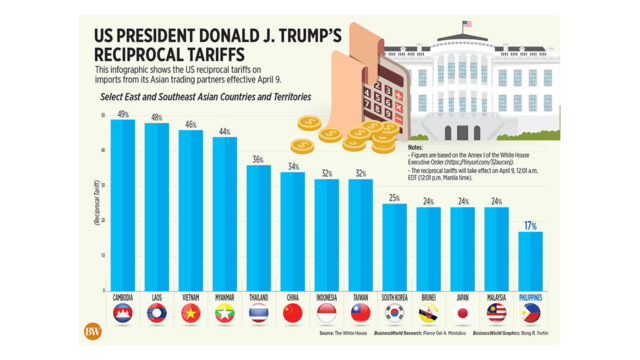
US President Donald J. Trump’s Reciprocal Tariffs

US PRESIDENT Donald J. Trump is imposing a bigger-than-expected tariff on Philippine exports to the United States, as part of a broader reciprocal tariff plan that will apply to all its trading partners. Read the full story.

US President Donald J. Trump’s Reciprocal Tariffs

Dealing with ‘suspicious’ commendation letters

Two of our valuable customers sent separate letters to our chief executive officer commending the work of our sales representative. The person being commended is a headache for us, having failed to achieve his monthly quota for the past three months. In fact, we’ve just started placing him on a Performance Improvement Plan (PIP). We suspect that the letter may have been solicited from the sales agent’s friendly customers. How do we manage the situation? — Boiling Point.

​It’s not easy. Your challenge is reconciling the worker’s performance with the commendation letters. If they can’t be reconciled, tackle them separately with the following questions: How truthful are these commendation letters? Unfortunately, only the letter sender can affirm that.

On the other hand, how does the commendation translate to actual sales performance? The evidence must be weighed against the sales agent’s failure to achieve his quota. Also a consideration is maintaining your company’s relationship with customers.

​Indeed, it’s difficult to verify the authenticity and validity of the commendation letters. They’re valid because they depend solely on the “testimony” of the letter-writers, who may have experienced a positive experience with the worker being commended. Take the letters at face value.

​One thing to consider is whether the letter-senders hold a low-ranking position. This is not to belittle their job or anything, but only to assign a value to their letters. Look into whether the letters were written by a team leader, supervisor, or even a manager from those companies, who may not have the authority to represent their organization.

If the letters were indeed worth writing, the best thing that they could have done was to have those letters co-signed by their department heads. This gives credibility to the process, especially if the letters contain detailed accomplishments of the sales agent. In addition, the letters must contain specific statements on how the worker’s actions greatly benefited their respective organizations.

If their commendation letters are bereft of details other than plain recognition or words of appreciation, then you may be right to suspect that they were solicited by your sales agent to protect him from the adverse effects of his poor work performance.

APPROACHES
Act like a professional manager in managing this issue. Be objective. Make it appear that everything is in order when dealing with the customers who sent the commendation letters. Do your best to get by with their bare facts. It should help you make a better decision. Besides, mere suspicion is worthless.

Now, here are approaches that you can explore to manage the situation.

One, acknowledge the letter-senders. Do it right away. Make your reply short and simple. There’s no need to challenge the customers’ intent by bringing up the worker’s actual poor performance. Use objective language. Express your sincere gratitude for their kind words.

Two, acknowledge the letters right away. Any delay may telegraph your suspicions, especially if they know that their “commendation” was solicited by your sales agent. If the commendation letter was done the old-fashioned way, meaning through a formal letter, then follow the same route.

Three, give your sales agent the benefit of the doubt. Inform him that you’ve received the customers’ letters. Don’t talk to him about your doubts. Treat it as a separate issue from his actual poor performance. Stick to the facts. Proceed with the PIP. Closely monitor the salesperson’s progress and give advice as soon as cracks become evident.

Four, correlate the commendation with actual performance. It will be tempting to find a connection between the commendation letters and the sales agent’s performance. Whatever the result of your investigation, don’t bother raising the issue with the sales agent to avoid unnecessary conflict.

PERFORMANCE MANAGEMENT
Organizations seeking to maintain and improve their competitive advantage must be able to manage the behavior of their employees. At times, you must consider other extraneous factors such as customer behavior when the sales agent performs the requirements of their job.

​You may be distracted by external factors that may have or may not have anything to do with the workers’ performance. That’s why organizations, regardless of their size and nature of business, must link their mission, vision, and value statements to work performance standards.

​Your sales agent is a key ingredient in the success and growth of the company. Therefore, managing his performance should be the central focus of your control. It’s the systematic process by which an organization requires the active involvement of its employees, as individuals and as members of a group.


Bring Rey Elbo’s 15-hour (three half-days) leadership program called “Superior Subordinate Supervision” to your management team. Learn from an effective training methodology designed to keep the lessons stuck to its core. E-mail elbonomics@gmail.com or via https://reyelbo.com.

EastWest Bank, Puregold launch co-branded credit card

EAST WEST Banking Corp. (EastWest Bank) has launched a new credit card co-branded with Puregold Price Club, Inc., which offers rewards points that can be converted into shopping credits.

The bank on Thursday launched the EastWest Puregold Always Panalo Visa credit card, which offers a conversion rate of one reward point for every P30 spent at Puregold. For other purchases, every P100 spent is equivalent to one reward point.

Cardholders can also accumulate up to P3,000 in their Puregold P-wallet monthly when they convert their rewards points.

“This card is a collaboration between EastWest and Puregold that delivers practical, real-world benefits. It turns regular grocery runs into opportunities to earn cash rebates, which can then be converted into Puregold P-Wallet credits. This helps cardholders stretch their budget while enjoying the ease of cashless payments,” EastWest Bank Chief Executive Officer Jerry G. Ngo said at the event.

The new offering is meant to attract new customers to boost its credit card business, he said. EastWest Bank’s credit cards in force reached 1.4 million last year.

“At the same time, we want to welcome our new EastWest customers who may be applying for their very first credit card. There’s a lot of new-to-card customers in the Philippines. I’m very excited to expand that penetration rate to provide that flexibility to everyone. This collaboration with Puregold builds on that strong momentum that we’ve seen in our credit card business at EastWest Bank,” he said.

“This partnership is rooted in the shared goal… of serving the Filipino household, something that Puregold has done for years by being a dependable part of their everyday lives,” Mr. Ngo said.

EastWest Bank’s net income rose by 25% to an all-time high of P7.6 billion in 2024.

Its shares closed unchanged at P10.10 apiece on Thursday. — A.M.C. Sy