Home Blog Page 18

Rising subsidies and the danger of debt explosion
These are recent reports about rising subsidies — which can be dangerous to both short- and long-term fiscal discipline and consolidation — as reported in BusinessWorld: “Gov’t eyes P60-billion EV incentives” (April 10), “DEPDev wary of deficit impact if supplemental budget passes” (April 13), “Agri dep’t considering P10 per kilo subsidy for users of gov’t fishports” (April 13), and, “DBCC opposes suspension of excise tax on gas, diesel” (April 15).

The Department of Trade and Industry (DTI) is wrong to propose a revenue cut of P60 billion from electric vehicles (EV) fiscal incentives when the government now needs more revenue because of its ongoing and planned subsidies to help the public cope with the high prices of energy, transportation, fertilizers, other consumer goods.

Since the dictatorial lockdowns of 2020-2021, our budget deficit has plateaued at around P1.6 trillion/year from 2020-2026. There were too many subsidies and freebies even if there had been no more economic or virus crisis in 2022 to 2025.

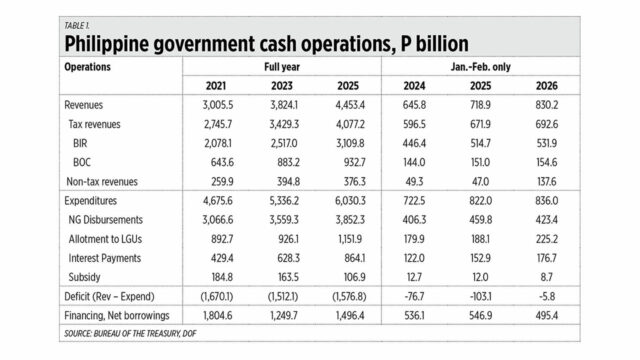
In the first two months of 2026, the budget deficit had been miraculously controlled to only P6 billion due to high revenues from the Bureau of the Treasury in February, reflected in “non-tax revenues.” But our interest payments are now jumping like a kangaroo, P177 billion in January-February alone or an average of P3 billion/day, every day (see Table 1).
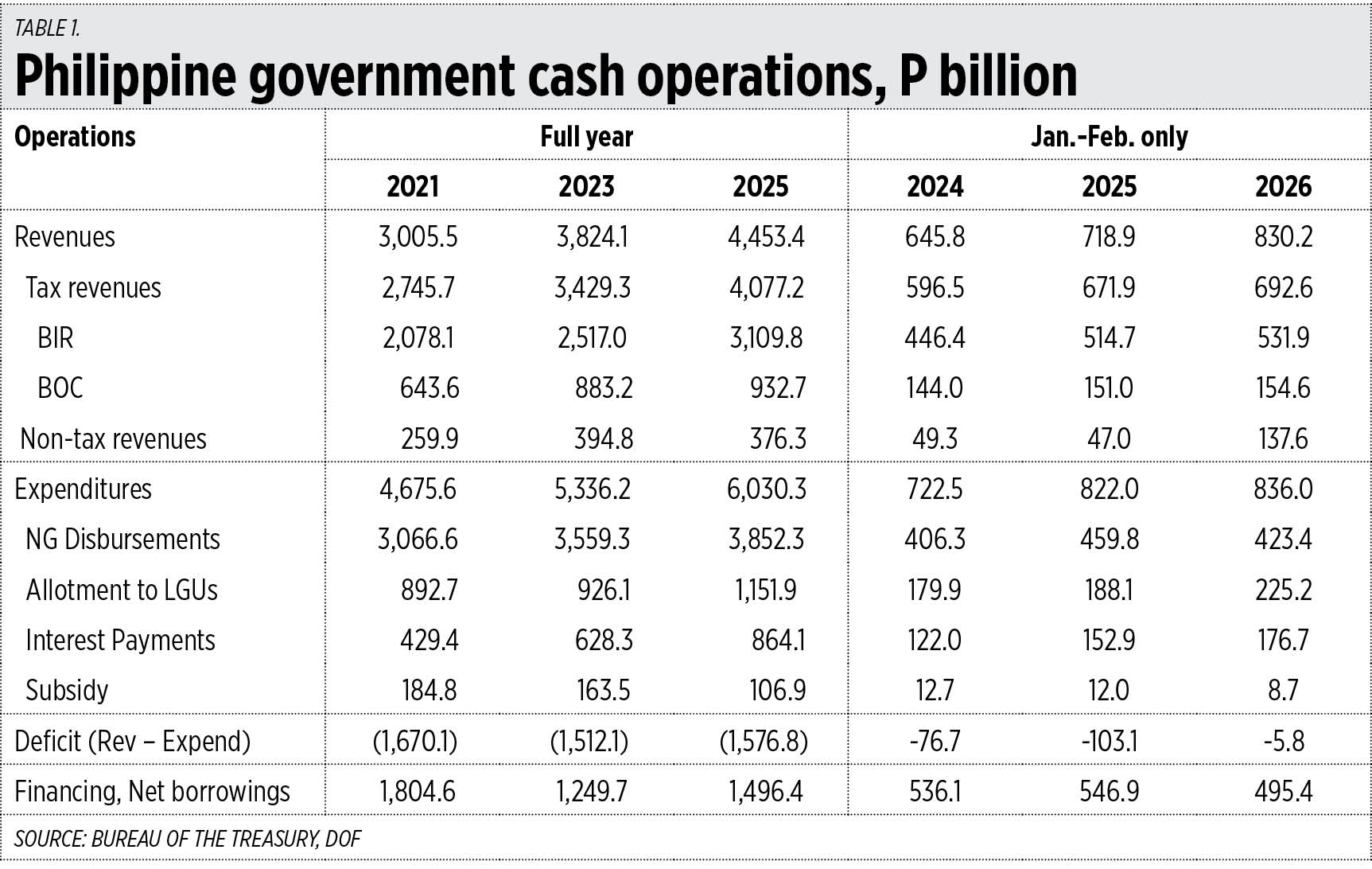
The high public debt stock of P18.2 trillion as of February plus high interest rates mean high interest payments, which will require more borrowing to serve past and current deficits. That is why the government should avoid creating new subsidies without first shrinking or abolishing old subsidies.

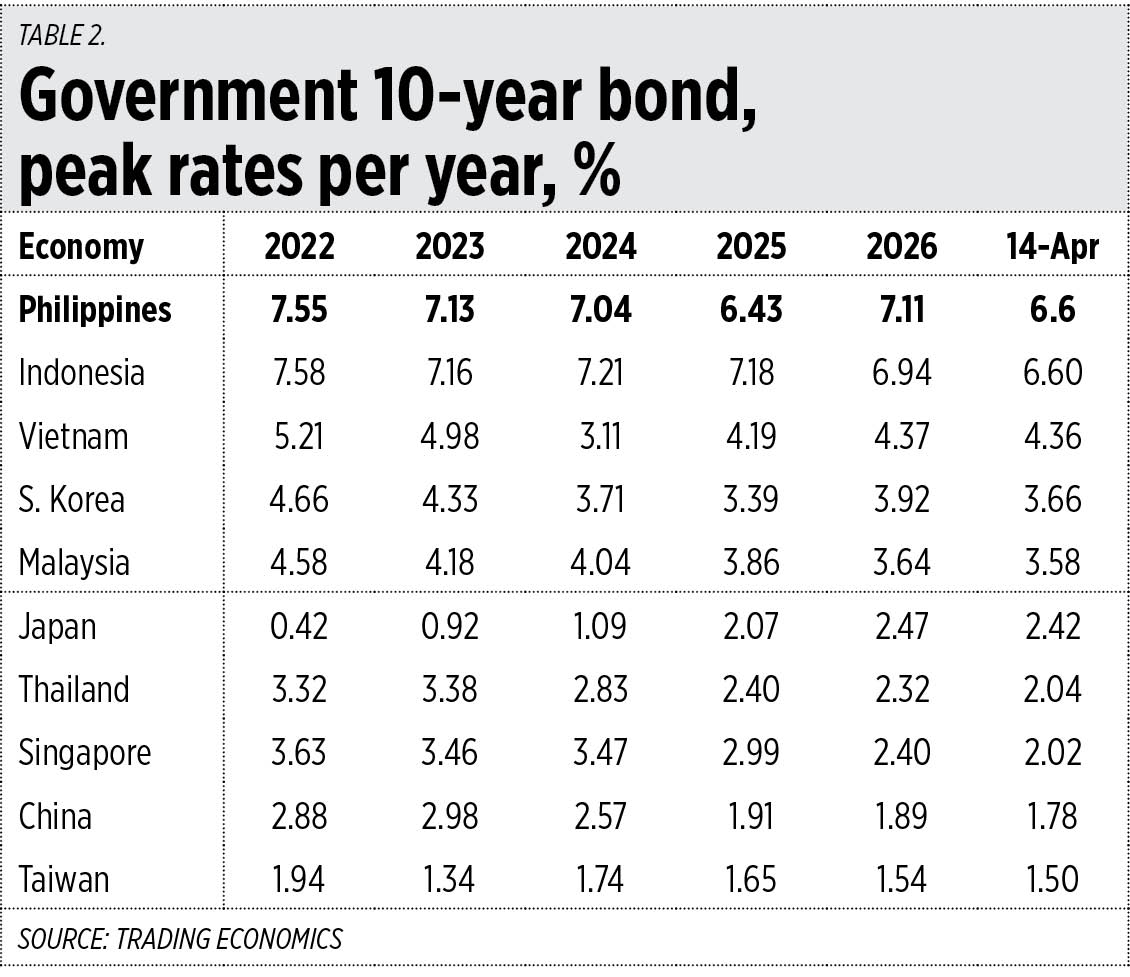
I checked the 10-year bond rates of East Asian economies and saw that the Philippines and Indonesia have the highest interest rates, 6.6% as of April 14. This is even higher than the peak rate of 6.43% in 2025 (see Table 2).
We need to cut oil taxes, especially that on diesel because this fuel is being used by tractors, trucks, harvesters, irrigation pumps, fishing boats, and buses. Estimates from trucking and logistics companies show that diesel alone accounts for up to 70% of their operating costs. Diesel also makes up to 70% of the cost of fishing boats operations from the previous 40-50%, according to Agriculture Secretary Francis Tiu Laurel, Jr.

Government should not give selective subsidies to, say, public transportation only — it should cover all vehicles. The suspension of oil taxes, especially on diesel, should have been prioritized.

Many SMEs are now searching for ways to survive and cope with limited spending by their consumers. A friend of a friend, Artel Sebastian, who owns a coffee shop, Adelle’s Food Services, in Malolos, Bulacan, asked me who in the Department of Trade and Industry (DTI) can help them avail of a loans program. I gave the name of DTI Undersecretary Jean Pacheco who patiently answered the concerns and questions of the entrepreneur.

I got this heartwarming feedback from Mr. Sebastian. He said, “As a small business owner, I am grateful for the guidance and support extended by Usec. Mary Jean Pacheco. Through her assistance, I was able to better understand and navigate the process of applying for the government-extended business loan through SBCorp. aimed at helping enterprises weather the current crisis. Her initiative made the program more accessible to small entrepreneurs like me, bridging the gap between government support and the real needs of businesses on the ground. This kind of leadership provides clarity, confidence, and hope for small food businesses that continue to operate despite challenging conditions. I can genuinely feel the presence and support of our government — something that many small business owners like myself have long hoped for. The assistance is timely and much needed by our sector, which strives to pay honest taxes, provide employment, and contribute to strengthening the economy.”

Thanks to Ms. Pacheco, there is one less confused SME owner who has been assisted by the DTI. Congrats!

Aside from the possible suspension of the diesel excise tax, the government can further ease the cost of doing business. During the government-business meeting on April 8, two proposals among others from the business sector stood out — address port congestion and revisit the duration of truck ban hours.

On the issue of port congestion, Executive Secretary Ralph G. Recto said that he referred the proposal to open container yards outside Metro Manila to the Bureau of Customs “for immediate action.” The issue on truck ban hours has been referred to the Metro Manila Development Authority for “urgent review and action.” And businesses’ appeal for lower fees charged by local governments “will be fast tracked.”

Good moves to cut bureaucracy, Mr. Recto.

Other measures that the government should consider are the following.

1. Cut the Military and Uniformed Personnel (MUP) pension, now reaching P250 billion a year, because the retired personnel contributed nothing to their own pensions during their active service, and because of an irrational provision of “indexing” the current pay to their old pay before they retired.

2. Cut the subsidies to state universities and colleges (SUCs) that keep expanding the number of campuses per province.

3. Control corruption, especially at the Department of Public Works and Highways.


Bienvenido S. Oplas, Jr. is the president of Bienvenido S. Oplas, Jr. Research Consultancy Services, and Minimal Government Thinkers. He is an international fellow of the Tholos Foundation.

minimalgovernment@gmail.com

GMA Network income rises 6.28% to P2.2B on higher ad revenues

BW FILE PHOTO

GMA Network, Inc. reported a 6.28% increase in attributable net income for 2025 to P2.2 billion from a year earlier.

In a regulatory filing on Wednesday, the company said total revenues rose 3.19% to P18.12 billion from P17.56 billion in 2024.

Advertising revenues increased to P16.57 billion from P16.24 billion, while consumer sales rose to P1.55 billion from P1.32 billion.

The company said revenues from free-to-air television and radio, online, and international operations accounted for the majority of total revenues for the year.

“Election-related placements in both periods provided the much-needed boost. Minus the extraordinary inflows in between years, consolidated revenues from all platforms fell short by 5% from regular and recurring sources,” its annual report said.

Operating expenses increased by 4.71% to P15.54 billion from P14.84 billion, driven mainly by higher production and direct costs.

Shares in GMA Network, Inc. rose by two centavos, or 0.34%, to close at P5.97 each on Wednesday. — Ashley Erika O. Jose

ICTSI completes sale of China terminal stake

ICTSI.COM

INTERNATIONAL Container Terminal Services, Inc. (ICTSI) said its unit has completed the sale of its stake in Yantai International Container Terminals Ltd. (YICTL).

In a statement on Wednesday, ICTSI said its wholly owned subsidiary, ICTSI Hong Kong Ltd., confirmed on April 6 that the parties completed the transaction on March 31.

Last month, ICTSI said its unit signed an agreement with Yantai Port Holdings Co. Ltd. for the sale of its 51% equity interest in YICTL for 773.21 million renminbi, or about P6.77 billion.

YICTL is a joint venture in which ICTSI Hong Kong held a 51% majority stake. The company operates a port terminal in Shandong province, China.

The remaining ownership in YICTL was held by Yantai Port Holdings at 36.5% and DP World China Ltd. at 12.5%.

ICTSI said DP World China also entered into an equity interest transfer agreement covering its stake, adding that upon completion of the transaction, Yantai Port Holdings will own 100% of YICTL.

“After a successful 20 years in Yantai, ICTSI deems the sale of YICTL in keeping with the ICTSI Group’s long-term strategy of focusing on concession contracts where ICTSI has control over critical aspects of the business, particularly with regards to long-term development and commercial activities, among others,” ICTSI said.

The company said it is rationalizing its portfolio and reallocating resources to existing projects and those in the pipeline.

ICTSI reported a 23% increase in attributable net income for 2025 to $1.05 billion, driven by higher cargo volumes across its port operations.

Gross revenue rose 17.88% to $3.23 billion in 2025 from $2.74 billion a year earlier.

For 2026, ICTSI has set aside an estimated $740 million, primarily for expansion, equipment acquisition, and upgrades.

Shares in ICTSI rose by P15, or 2.08%, to close at P735 each on Wednesday. — Ashley Erika O. Jose

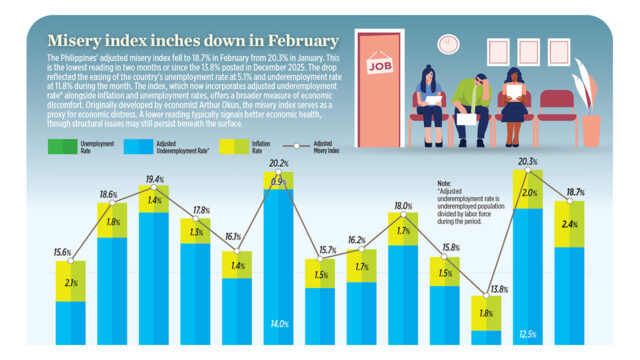
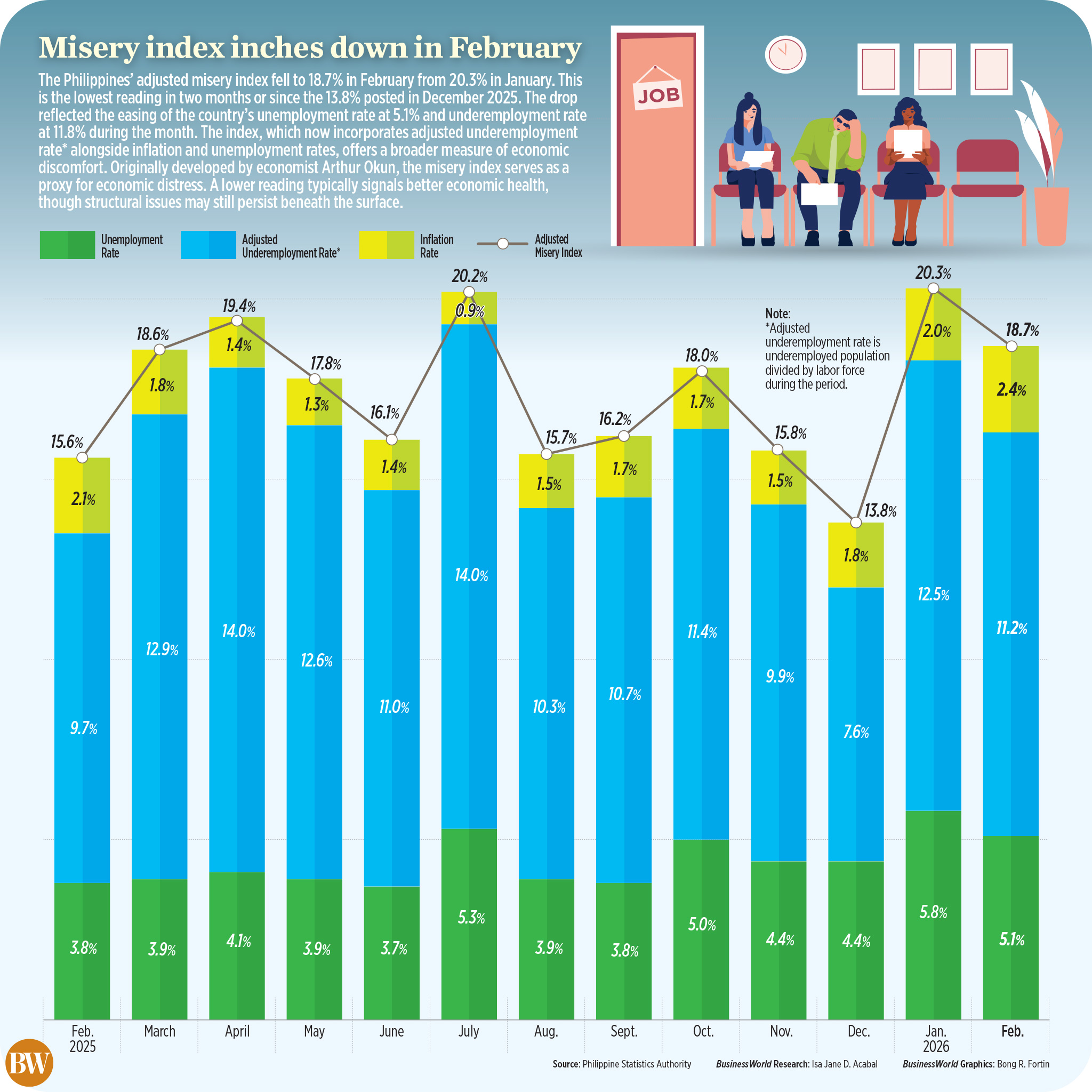
Misery index inches down in February

The Philippines’ adjusted misery index fell to 18.7% in February from 20.3% in January. This is the lowest reading in two months or since the 13.8% posted in December 2025. The drop reflected the easing of the country’s unemployment rate at 5.1% and underemployment rate at 11.8% during the month. The index, which now incorporates adjusted underemployment rate* alongside inflation and unemployment rates, offers a broader measure of economic discomfort. Originally developed by economist Arthur Okun, the misery index serves as a proxy for economic distress. A lower reading typically signals better economic health, though structural issues may still persist beneath the surface.

ABS-CBN says majority of board rejected shutdown proposal

PHILIPPINE STAR/BOY SANTOS

ABS-CBN Corp. said a proposal to shut down the company was raised at the board level, but most directors opposed it and pushed for continued operations.

“Records show that one of our directors proposed shutting down ABS-CBN without so much as discussing how it would meet its obligations to its people. Records also show that the majority of the directors strongly argued for continued financial support for ABS-CBN rather than liquidation to address the welfare of the company’s employees and retirees, as well as its other stakeholders,” the company said in a media release on Wednesday.

The company said the matter arose amid what it described as continued “PR attacks” linked to a family dispute over the company’s future.

ABS-CBN said the decline in its pension fund resulted from payouts to more than 6,000 employees affected by the loss of its franchise. It rejected claims that the board had considered shutting down the company without addressing obligations to workers and retirees.

“These continued public PR attacks against ABS-CBN are a disservice to the employees who have fought so hard to keep ABS-CBN alive, and to the public that has supported ABS-CBN throughout all its trials,” it said.

The company also denied allegations that 68 individuals received preferential treatment in retirement benefit payouts, calling the claims “repeated lies” meant to create intrigue among employees.

It said most of those cited were retirees who have received only partial or no benefits and have agreed to defer full payment until the company’s financial position improves.

ABS-CBN also rejected claims of a supposed P2-billion capital infusion linked to the payouts, calling them false.

“These public PR attacks on ABS-CBN’s pension fund, its business performance, and its leadership prove that the individual/s behind these releases do not have the best interests of the company at heart,” it said.

Last month, ABS-CBN said it was not a party to a dispute involving the Lopez family and described reports of a proposed P2-billion capital infusion and alleged executive payouts as baseless.

The statement followed reports of a dispute involving businessman Federico R. Lopez, who filed a lawsuit over his ouster as president and chief executive officer of Lopez, Inc., whose units include ABS-CBN, First Philippine Holdings Corp., and First Gen Corp. — Ashley Erika O. Jose

Philippine Business Bank’s 2025 net profit up 6.4%

BW FILE PHOTO

PHILIPPINE Business Bank, Inc. (PBB) saw its 2025 net profit climb by 6.4% on higher revenues and improved asset quality.

The bank’s net income went up to P1.896 billion last year from P1.782 billion in 2024, it said in a disclosure to the stock exchange on Wednesday.

This translated to a return on assets of 1.12% and a return on equity of 8.96%.

“This was achieved despite a challenging operating environment marked by weaker business sentiment, domestic issues that weighed on market confidence, and broader global uncertainties,” PBB Vice Chairman, President, and Chief Executive Officer Rolando R. Avante said.

Net interest income rose by 8.81% to P7.25 billion from P6.66 billion. This came as interest income increased by 7.59% to P11.44 billion from P10.63 billion, while interest expense went up by 5.55% to P4.19 billion from P3.97 billion.

As a result, its net interest margin improved to 4.5% last year from 4.3% in 2024.

Other income went up by 1.78% year on year to P1 billion from P849.16 million, driven mainly by a 65.35% jump in service charges, fees, and commissions to P508.3 million and trading gains worth P83.99 million.

Meanwhile, the bank’s other expenses increased by 12.18% to P4.71 billion last year from P4.16 billion a year earlier.

PBB’s net loans inched down by 0.48% to P127.66 billion from P128.27 billion as economic volatility weighed on the operating environment and as the bank “further enhanced its focus on credit and asset quality, deliberately directing efforts more towards margin expansion rather than asset-base expansion.”

As a result, PBB’s nonperforming loan ratio went down to 4.21% from 5.67%.

On the funding side, total deposits declined by 2.98% to P134.95 billion from P139.09 billion. Of the total, P64.4 billion were current account and savings account deposits, while P70.6 billion were time deposits.

This resulted in a loan-to-deposit ratio of 94.6% in 2025, up from 92.22% in the prior year.

PBB’s assets stood at P168.86 billion last year, up by 0.52% from P167.99 billion in 2024.

Total equity was at P21.17 billion, higher by 9.34% from P19.36 billion.

Its capital adequacy ratio was at 13.1%, while its liquidity ratio was at 24.1%.

Mr. Avante said they expect the operating environment to be challenging in the coming months as risks to elevated oil prices, global uncertainties, and still-fragile business sentiment continue which will weigh on economic activity.

“These conditions could place added pressure on borrowers and make competition across the banking sector even tighter. Even so, the bank remains confident in the strength of the client relationships it has built over the years and will continue to support both existing and prospective clients through a more responsive and hands-on approach to service, while further strengthening the tools, discipline, and capabilities needed to navigate the months ahead,” he said.

“PBB will likewise continue to prioritize profitability over balance sheet growth through a three-pronged strategy of strengthening client relationship depth and quality, enhancing operational capabilities and efficiency, and selectively growing its higher-margin business in chosen consumer loan segments. This strategy is expected to position the bank for sustainable growth and profitability in the periods ahead,” Mr. Avante added.

The bank’s shares rose by 10 centavos or 1.43% to close at P7.10 each on Wednesday. — Aaron Michael C. Sy

Frenchman scoops up €1-million Picasso painting in Paris raffle

PABLO PICASSO’S Tête de femme (1941) — © PICASSO ESTATE, PARIS, 2025/1PICASSO100EUROS.COM

PARIS — A Frenchman won a Picasso painting worth €1 million ($1.18 million) in a non-profit raffle on Tuesday.

The winner, Ari Hodara, a 59-year-old software engineer from Paris, was selected at random at Christie’s auction house in Paris from 120,000 tickets sold at €100 apiece. The raffle’s proceeds will fund Alzheimer’s disease research.

“I was surprised, that’s it,” Mr. Hodara said during a phone call with organizers shortly after the draw. “When you bet on this, you don’t expect to win.”

Launched in 2013, the “1 Picasso for €100” raffle aims to support charities by giving participants a chance to win an original work by the famed Spanish artist. This was the third edition.

This year’s prize was Tête de Femme (Head of a Woman), a gouache-on-paper portrait painted by Pablo Picasso in 1941.

Rendered in his signature style, the grey, white, and cream composition reflects the somber mood of the era while also suggesting hope, Picasso’s grandson Olivier Widmaier Picasso has said.

For the first time in the raffle’s history, all 120,000 tickets were sold, organizers said. One million euros from the sales will go to international gallery chain Opera Gallery, the painting’s current owner, they said.

The remaining proceeds of approximately €11 million will be donated to France’s Fondation Recherche Alzheimer, a leading funder of research into the neurodegenerative disease.

The raffle’s first edition in 2013 raised €4.8 million and awarded Picasso’s The Man in the Opera Hat to then 25-year-old American Jeffrey Gonano. Proceeds went to the preservation of the Lebanese city of Tyre, a UNESCO World Heritage Site.

For the second edition, in 2020, an Italian woman won Picasso’s still life Nature Morte with a ticket she had received as a Christmas gift from her son. Proceeds were donated to sanitation projects in schools and villages in Cameroon, Madagascar and Morocco. — Reuters

AI-boosted hacks with Anthropic’s Mythos could have dire consequences for banks

REUTERS

ANTHROPIC’S MYTHOS, a new artificial intelligence (AI) model the company and cybersecurity experts warn could supercharge complex cyberattacks, poses significant challenges to the banking industry with its legacy technology systems, experts said in the days following the model’s announcement.

The model, announced April 7, is the company’s “most capable yet for coding and agentic tasks,” the company said in a blog post, referring to the model’s ability to act autonomously.

Its capabilities to code at a high level have given it a potentially unprecedented ability to identify cybersecurity vulnerabilities and devise ways to exploit them, experts said.

That’s a particular problem for banks and other financial institutions, which run technology stacks that integrate state-of-the-art tools with decades-old software, potentially opening a large number of vulnerabilities, according to TJ Marlin, the chief executive of enterprise AI security firm Guardrail Technologies.

Mr. Marlin said Mythos Preview can “look across a very complex architecture, including this legacy infrastructure where, frankly, these undiscovered vulnerabilities and complexities are now accessible and threat factors.”

The banking industry is also closely connected, with many companies operating the same narrow set of software to onboard customers, perform know-your-customer checks, and handle transactions.

“Because it’s a very specialized industry and heavily regulated, there’s a lot of IT interconnections,” said Naresh Raheja, a San Francisco-based consultant who previously worked at the Office of the Comptroller of the Currency. “Many banks use the same vendors and the same solutions.”

Mr. Marlin said that could act as a force multiplier for breaches, making any AI-powered exploits “potentially catastrophic at scale.”

Government officials in at least three countries — the US, Canada and Britain — have met with top banking officials to discuss the threats posed by Claude Mythos Preview.

The US Treasury said that Donald Trump’s administration was pushing financial institutions “to understand and anticipate a wide range of market developments” and that further meetings around the issue were planned. Anthropic declined to comment beyond its April 7 announcement.

Anthropic has said Claude Mythos Preview will not be made generally available. Instead, the company announced Project Glasswing, in which it invited major tech companies, cybersecurity vendors and JPMorgan Chase, along with several dozen other organizations, to privately evaluate the model and prepare defenses accordingly.

IDENTIFYING VULNERABILITIES
Claude Mythos Preview is capable of identifying and exploiting previously undiscovered vulnerabilities in every major computer operating system and every major web browser, the company said in announcing Project Glasswing.

In a technical blog released alongside the main announcement, Anthropic researchers describe how Mythos Preview identified “thousands” of high and critical-severity vulnerabilities, meaning that targets could suffer grave impacts as a result, including data and operational compromise.

The researchers described how the model identified a 16-year-old vulnerability in the widely used FFmpeg software library, an open-source program used for processing audio and video files, and how it identified a bug in an unnamed virtual machine monitor program, which allows users to create segregated virtual computers within their own in ways that are supposed to protect the host system.

A Cloud Security Alliance coalition of cybersecurity executives and former senior US government officials warned in an April 12 strategy briefing that Mythos represents “a step change” in the trajectory of capable AI models that “lowers the cost and skill floor for discovering and exploiting vulnerabilities faster than organizations can patch them.”

Costin Raiu, a longtime security researcher and co-founder of cybersecurity firm TLPBLACK, said in an interview that the banking industry has key legacy technology systems initially released decades ago that have been updated many times over the years, pointing to products produced by firms including IBM, as an example.

“A model like Mythos would have a field day finding exploits” in certain IBM systems, Mr. Raiu said, pointing to examples of IBM-related vulnerability research. “And it’s just one example of ancient technologies powering the financial industry.”

In an April 9 blog post, IBM said that Mythos is “forcing enterprise security teams to rethink their defenses from the ground up,” and called for more of an open-source approach, where more companies and researchers have access to the model to make everyone more secure. The company did not respond to requests for comment.

JPMorgan Chase said in a statement last week that it was part of a group of leading companies that were privately evaluating Mythos, something it called “a unique, early-stage opportunity to evaluate next-generation AI tools for defensive cybersecurity across critical infrastructure.” The company did not return a message.

Wells Fargo also didn’t respond to a message. FS-ISAC, the nonprofit that works to boost the cybersecurity of the global financial system, did not respond to written questions.

Bank of America, Citibank, the American Bankers Association and the Consumer Bankers Association declined comment. — Reuters

What surveys really say

STOCK PHOTO | Image by Mamewmy from Freepik

CAN THERE BE any political discussion without any mention of what surveys are saying? Why are these statistical tools always part of any conversation? Are they even to be taken seriously? Can the credibility of surveys depend on who paid for them? It’s not always independent think-tanks and advocacy groups that have long established their bona fides that announce their statistical findings.

Surveys rest on the belief that a small demographically representative sample can represent a much bigger group. The “universe” here can refer to the voting population or the target market for a product or service. What the small sample size thinks and feels is projected to the larger counterpart.

Surveys can be conducted by media which then come out with approval ratings of public personalities. The latest reading is compared to previous numbers to show if a leader is gaining traction or falling down the stairs of public opinion. (There he goes again. Down the chute.)

But what is the meaning of an approval rating?

The number expressed in percentages is a net statistic. The number is based on the responses of a sample, maybe a thousand respondents, theoretically a demographic cross-section to represent the population of over a hundred million. The approval number (each time she opens her mouth, I swoon) is subtracted from the level of disapproval (my breakfast ends up on my lap when I see her face). The net approval rating can be a negative number.

This indicator of approval or disapproval is seldom based on any personal encounter with a leader or even his lieutenants. It is an evaluation based on conversations with neighbors, social posts in online media, and relatives and friends. (Has she been taking many trips abroad on government funds?)

Surveys have their uses even in the corporate field. Products are pre-tested for acceptability in a focus group using a controlled launch. The results provide feedback on the size of the market and the attributes that need to be tweaked like pricing and distribution to gain market share.

Do companies also need to conduct approval surveys on their leaders? This may not be necessary as ratings of leadership here are not based on mere perception but on quantified targets like market share, revenue growth, and profitability. Even a popular leader who greets everyone in the elevator may be ineffective as a CEO as far as the other stakeholders are concerned.

Corporate executives have certain target metrics like earnings per share, gross margins, and dividend payouts that go beyond qualitative factors — he has a nice haircut. If targets are met or exceeded, fine. If they are not, explanations need to be given. (We’ll try harder next year. If there are no further questions, the meeting is adjourned.)

Besides, corporate leadership qualities are instantly captured with a small enough base of employees (especially direct reports). These don’t need to join a survey as anonymous letters on management styles are quickly communicated — “He’s a sexual predator with his cringe-inducing jokes.”

If CEOs of large corporations are subjected to quarterly approval ratings by their “stakeholders” like employees, suppliers, shareholders, and customers (a better-informed constituency than the sampled respondents in political surveys) one wonders how they would fare. And what practical use will such an “approval rating” provide?

Perception is what drives survey respondents. It is not just the leader’s video posts that sway this view. There are also “influencers” on the net that post their opinions on what is going on.

Media can influence approval ratings. Even though the macroeconomic numbers are good in terms of Gross International Reserves, inflation, and steady GDP growth, approval ratings do not always consider these as relevant.

Political pundits are already looking at an election that is two years away. Is the now seemingly embattled personality feared for her bullying style of leadership really too “popular” to ignore? Are the surveys on her growing strength reliable in their methodology?

Kissinger famously stated that “perception is reality.” This is one reason why politicians employ masters of illusion that can transform sulking into a leadership trait. And their surveys will agree… given the right incentives.


Tony Samson is chairman and CEO of TOUCH xda.

ar.samson@yahoo.com

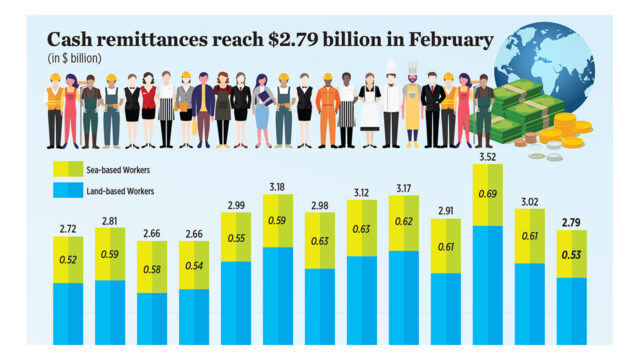
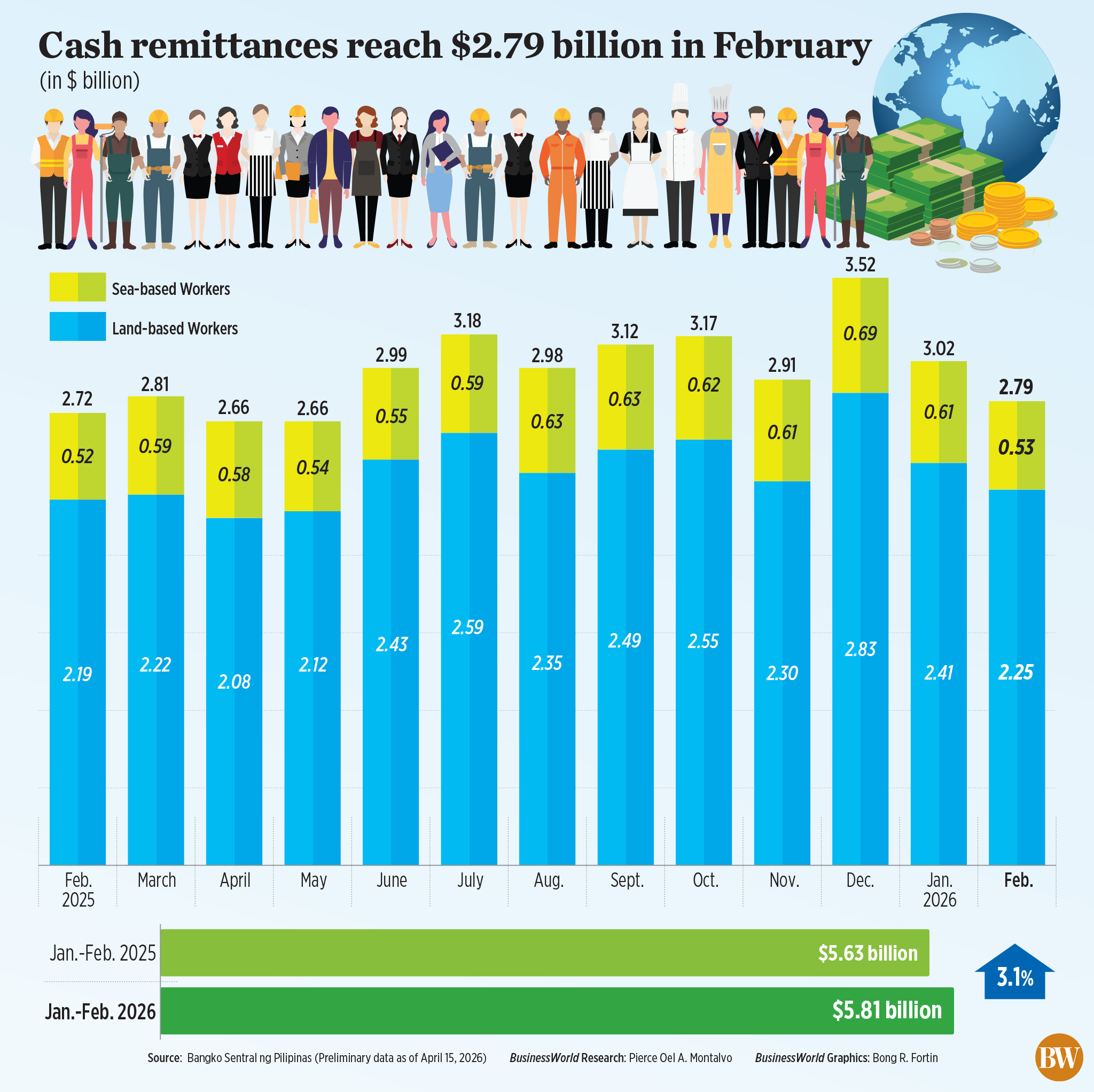
Cash remittances reach $2.79 billion in February

MONEY SENT HOME by overseas Filipino workers (OFWs) fell to its lowest level in nine months in February, the Bangko Sentral ng Pilipinas (BSP) reported. Read the full story.

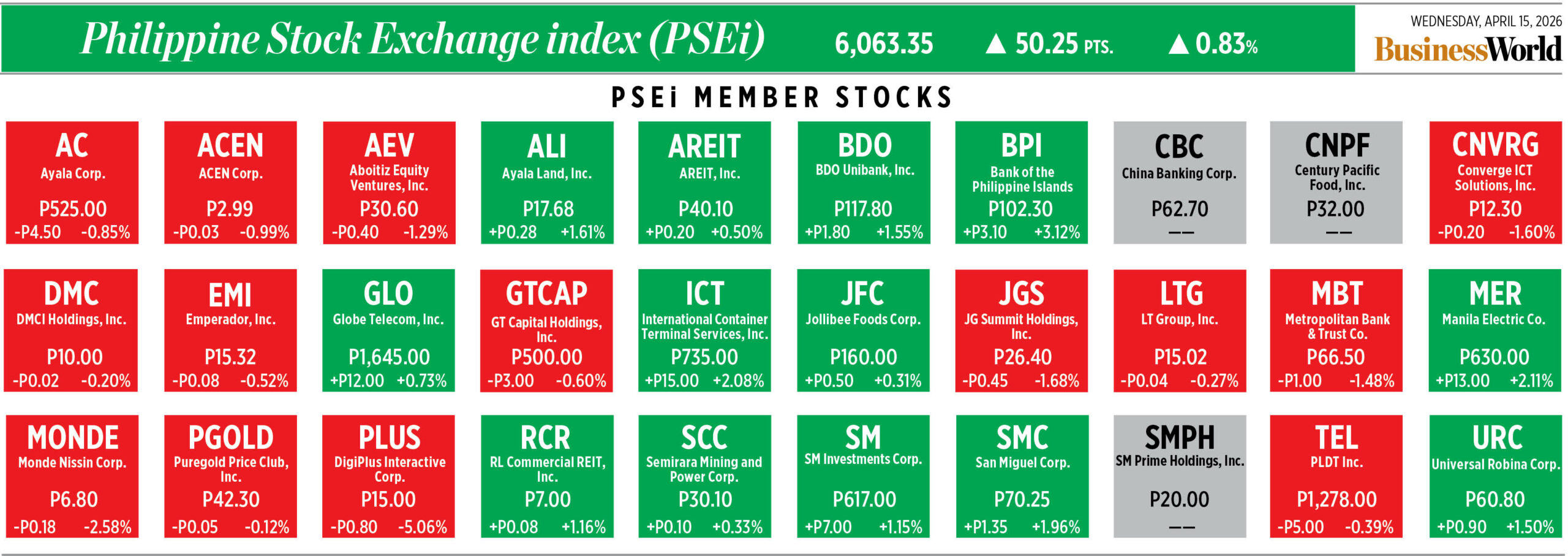
How PSEi member stocks performed — April 15, 2026

Here’s a quick glance at how PSEi stocks fared on Wednesday, April 15, 2026.


House eyes May 4 vote to scrap VAT on fuel amid Executive resistance

A woman shops for canned goods at a supermarket in Mandaluyong, Aug. 10, 2023. — PHILIPPINE STAR/MIGUEL DE GUZMAN

THE House of Representatives is targeting a May 4 vote on a proposal to remove the value-added tax (VAT) on petroleum products, as lawmakers push broader relief from rising fuel costs despite opposition from the government’s economic team.

“The members of Congress are ready to vote to lower the VAT,” Batangas Rep. Leandro Antonio L. Leviste said during a Legislative Energy Action and Development Council hearing on Wednesday, adding that the chamber has sufficient support to move forward with the measure.

Mr. Leviste said lawmakers are prepared to bypass resistance from the economic team and proceed with legislation that would suspend the 12% VAT on petroleum products.

“Our countrymen can expect Congress to open again on May 4 when we will vote to remove the value-added tax,” he said.

The proposal, covered under House Bills 4302 and 8838, seeks to ease the burden of elevated fuel prices on households, transport workers and other sectors.

Lawmakers backing the measure said removing VAT would provide immediate and visible relief compared with targeted subsidies.

The push comes amid mounting frustration among legislators, who accused the Executive branch and its economic managers of delaying action on fuel costs.

Mr. Leviste said continued inaction could erode public trust, adding that Congress must respond to the needs of Filipinos even amid differing views within the Cabinet.

However, some lawmakers urged caution, citing the need for a clearer policy basis before proceeding to a vote.

“There cannot be a vote now… We will wait for the consolidation of all of this,” Marikina Rep. Romero Federico “Miro” S. Quimbo told the hearing in Filipino, referring to discussions among committees.

“We will listen to the different sectors so that our decision will be right and we will not regret it,” he added, stressing that any measure should consider long-term implications rather than short-term relief.

Mr. Quimbo said deliberations would continue once Congress reconvenes, with the joint committee working to finalize a consolidated position.

The proposal has drawn opposition from the economic team and Executive Secretary Ralph G. Recto, who has cautioned against suspending VAT due to its impact on government revenues.

The Executive branch has instead backed targeted interventions. President Ferdinand R. Marcos, Jr. on Monday said he approved the suspension of excise taxes on liquefied petroleum gas and kerosene while keeping levies on gasoline and diesel unchanged.

Economic managers through the Development Budget Coordination Committee (DBCC), said across-the-board tax cuts such as VAT removal tend to benefit higher-income households that consume more fuel, while offering less targeted support to vulnerable groups.

Finance Undersecretary Karlo Fermin S. Adriano has said the DBCC has not recommended suspending VAT on diesel and gasoline, citing significant fiscal risks.

He said a full suspension could result in revenue losses exceeding P120 billion over eight months, adding to existing budget pressures.

Mr. Adriano also noted that VAT differs structurally from excise taxes, making it more complex to suspend.

He said the effective VAT rate on fuel is closer to 5% due to input-output mechanisms, and removing it could lead companies to pass on unrecoverable input VAT costs to consumers, potentially muting the expected price reductions.

Amid these concerns, the House committee has required the DBCC, Department of Finance and the Department of Budget and Management to submit detailed data supporting their positions.

Lawmakers said the requested documents would help clarify the fiscal impact of proposed tax measures, including foregone revenues and underlying assumptions, as Congress weighs its next steps on fuel tax policy. — Erika Mae P. Sinaking

ADVERTISEMENT
ADVERTISEMENT