
Rising subsidies and the danger of debt explosion
These are recent reports about rising subsidies — which can be dangerous to both short- and long-term fiscal discipline and consolidation — as reported in BusinessWorld: “Gov’t eyes P60-billion EV incentives” (April 10), “DEPDev wary of deficit impact if supplemental budget passes” (April 13), “Agri dep’t considering P10 per kilo subsidy for users of gov’t fishports” (April 13), and, “DBCC opposes suspension of excise tax on gas, diesel” (April 15).
The Department of Trade and Industry (DTI) is wrong to propose a revenue cut of P60 billion from electric vehicles (EV) fiscal incentives when the government now needs more revenue because of its ongoing and planned subsidies to help the public cope with the high prices of energy, transportation, fertilizers, other consumer goods.
Since the dictatorial lockdowns of 2020-2021, our budget deficit has plateaued at around P1.6 trillion/year from 2020-2026. There were too many subsidies and freebies even if there had been no more economic or virus crisis in 2022 to 2025.
In the first two months of 2026, the budget deficit had been miraculously controlled to only P6 billion due to high revenues from the Bureau of the Treasury in February, reflected in “non-tax revenues.” But our interest payments are now jumping like a kangaroo, P177 billion in January-February alone or an average of P3 billion/day, every day (see Table 1).
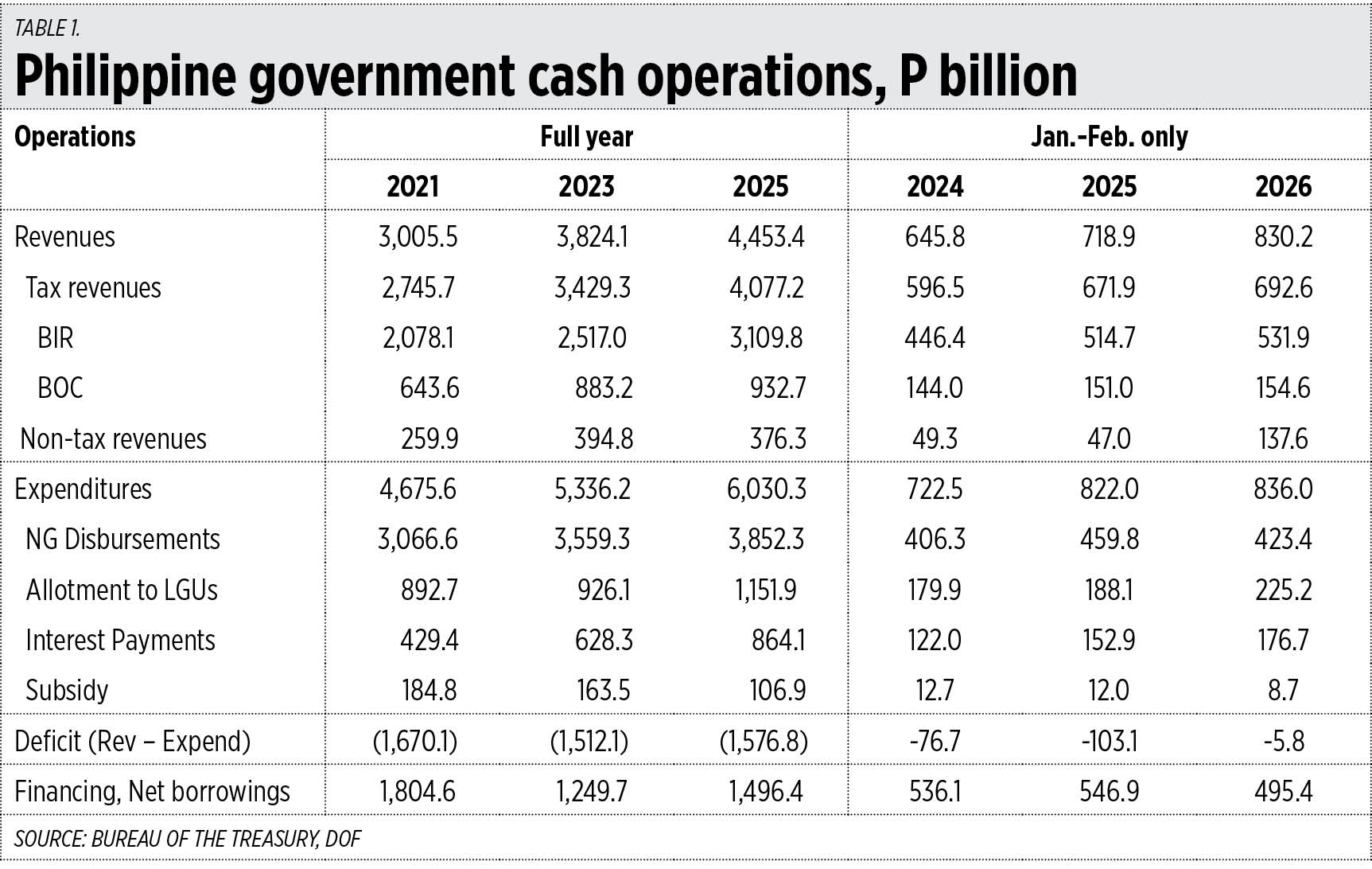
The high public debt stock of P18.2 trillion as of February plus high interest rates mean high interest payments, which will require more borrowing to serve past and current deficits. That is why the government should avoid creating new subsidies without first shrinking or abolishing old subsidies.
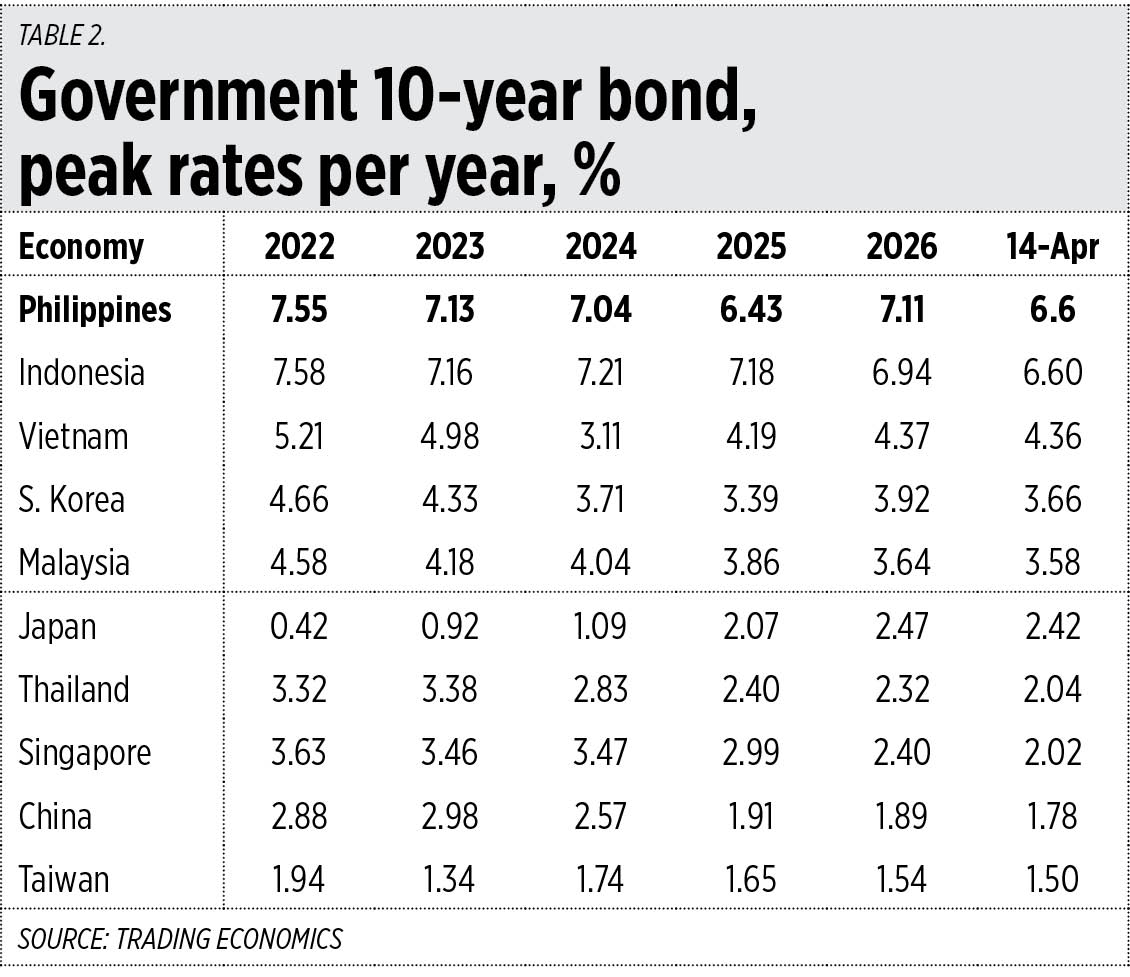
I checked the 10-year bond rates of East Asian economies and saw that the Philippines and Indonesia have the highest interest rates, 6.6% as of April 14. This is even higher than the peak rate of 6.43% in 2025 (see Table 2).
We need to cut oil taxes, especially that on diesel because this fuel is being used by tractors, trucks, harvesters, irrigation pumps, fishing boats, and buses. Estimates from trucking and logistics companies show that diesel alone accounts for up to 70% of their operating costs. Diesel also makes up to 70% of the cost of fishing boats operations from the previous 40-50%, according to Agriculture Secretary Francis Tiu Laurel, Jr.
Government should not give selective subsidies to, say, public transportation only — it should cover all vehicles. The suspension of oil taxes, especially on diesel, should have been prioritized.
Many SMEs are now searching for ways to survive and cope with limited spending by their consumers. A friend of a friend, Artel Sebastian, who owns a coffee shop, Adelle’s Food Services, in Malolos, Bulacan, asked me who in the Department of Trade and Industry (DTI) can help them avail of a loans program. I gave the name of DTI Undersecretary Jean Pacheco who patiently answered the concerns and questions of the entrepreneur.
I got this heartwarming feedback from Mr. Sebastian. He said, “As a small business owner, I am grateful for the guidance and support extended by Usec. Mary Jean Pacheco. Through her assistance, I was able to better understand and navigate the process of applying for the government-extended business loan through SBCorp. aimed at helping enterprises weather the current crisis. Her initiative made the program more accessible to small entrepreneurs like me, bridging the gap between government support and the real needs of businesses on the ground. This kind of leadership provides clarity, confidence, and hope for small food businesses that continue to operate despite challenging conditions. I can genuinely feel the presence and support of our government — something that many small business owners like myself have long hoped for. The assistance is timely and much needed by our sector, which strives to pay honest taxes, provide employment, and contribute to strengthening the economy.”
Thanks to Ms. Pacheco, there is one less confused SME owner who has been assisted by the DTI. Congrats!
Aside from the possible suspension of the diesel excise tax, the government can further ease the cost of doing business. During the government-business meeting on April 8, two proposals among others from the business sector stood out — address port congestion and revisit the duration of truck ban hours.
On the issue of port congestion, Executive Secretary Ralph G. Recto said that he referred the proposal to open container yards outside Metro Manila to the Bureau of Customs “for immediate action.” The issue on truck ban hours has been referred to the Metro Manila Development Authority for “urgent review and action.” And businesses’ appeal for lower fees charged by local governments “will be fast tracked.”
Good moves to cut bureaucracy, Mr. Recto.
Other measures that the government should consider are the following.
1. Cut the Military and Uniformed Personnel (MUP) pension, now reaching P250 billion a year, because the retired personnel contributed nothing to their own pensions during their active service, and because of an irrational provision of “indexing” the current pay to their old pay before they retired.
2. Cut the subsidies to state universities and colleges (SUCs) that keep expanding the number of campuses per province.
3. Control corruption, especially at the Department of Public Works and Highways.
Bienvenido S. Oplas, Jr. is the president of Bienvenido S. Oplas, Jr. Research Consultancy Services, and Minimal Government Thinkers. He is an international fellow of the Tholos Foundation.