Uncertainty over war drags down peso
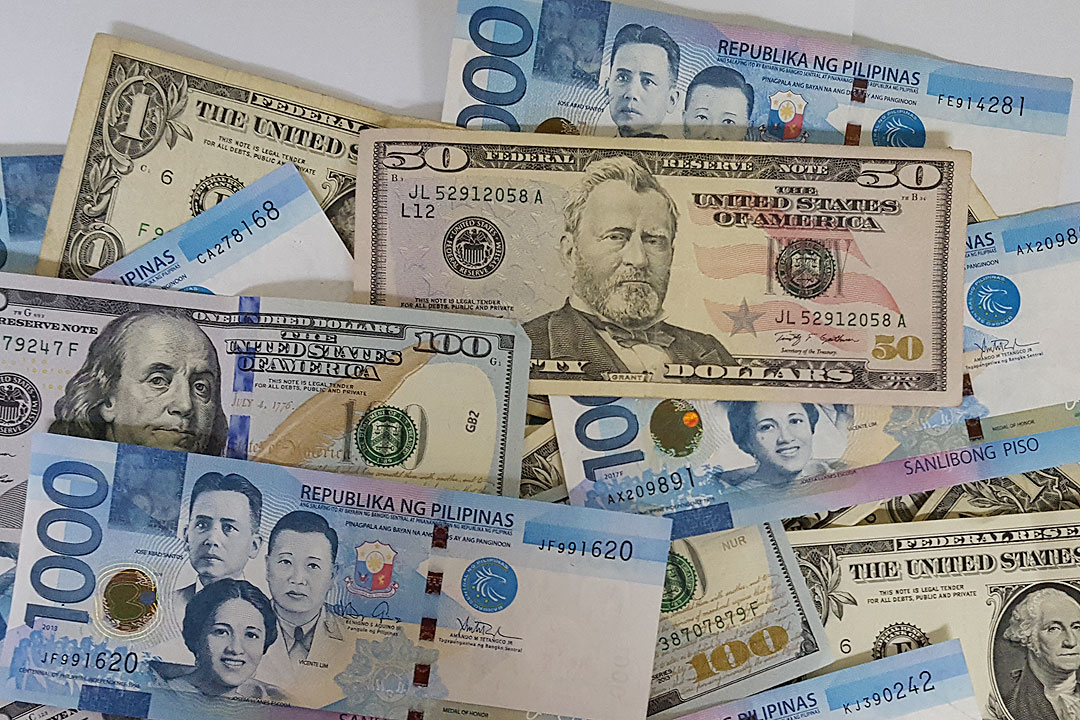
THE PESO slid back to the P60-a-dollar level on Wednesday due to uncertainty over the fate of the fragile ceasefire between the United States and Iran and darkening Philippine economic prospects.
The local unit fell by 24.5 centavos to close at P60.115 against the greenback from its P59.87 finish on Tuesday, data from the Bankers Association of the Philippines showed.
The currency opened Wednesday’s session stronger at P59.75 per dollar and logged an intraday best of P59.69. However, it was unable to hold on to its early gains, ending the day near its weakest showing of P60.13 against the greenback.
Dollars traded went down to $1.73 billion from $2.007 billion on Tuesday.
“The dollar-peso closed higher amid uncertainties surrounding the US-Iran deal while the Strait of Hormuz remains closed with the presence of US forces, which killed optimism on the ceasefire,” a trader said in a phone interview.
Market sentiment turned negative as more institutions downgraded their growth forecasts for the Philippines as they expect the war in the Middle East to stoke inflation and affect economic activity, Rizal Commercial Banking Corp. Chief Economist Michael L. Ricafort said in a Viber message.
The International Monetary Fund (IMF) slashed its 2026 Philippine gross domestic product (GDP) growth forecast to 4.1% from 5.6% previously, below the government’s 5%-6% target and the 4.4% print in 2025.
For its part, Moody’s Ratings cut its projection to 4.9% from 5.5%, likewise below the government’s goal.
For Thursday, the trader said the peso could move between P59.50 and P60.20 per dollar amid lingering uncertainty over the US-Iran war.
Meanwhile, Mr. Ricafort expects the currency to range from P59.95 to P60.20 against the greenback.
The US dollar skimmed six-week lows on Wednesday, having surrendered almost all the gains made since the Iran war erupted, as signs of another round of talks between Washington and Tehran lifted risk appetite, Reuters reported.
Tehran has effectively shut the Strait of Hormuz, a crucial waterway for a fifth of global oil and gas shipments, since the US-Israel war with Iran began on Feb. 28, sending oil prices surging and igniting concerns about the hit to global growth and inflation.
Washington imposed a blockade on Iranian ports after the collapse of weekend negotiations, but US President Donald J. Trump said on Tuesday talks to end the war could resume in Pakistan in the coming days. This helped shore up investor confidence enough to cut demand for dollars as a safe haven.
The dollar index, which measures the US currency against six others, is back to where it was when the war broke out on Feb. 28, having risen by as much as 3% at one point in early March.
Although talks in Islamabad last weekend failed to produce a breakthrough — raising doubts over the durability of a two-week ceasefire that still has a week to run — investors are clinging to hopes that diplomacy could yet deliver a resolution.
Investor focus is squarely on the extent of the damage to the global economy from the energy shock, not least as prices for physical crude are above $140 a barrel, even as futures are below $100 again. The International Monetary Fund cut its growth outlook due to the war-driven energy price spikes but said the world was already drifting toward a more adverse scenario with much-weaker growth.
Under the IMF’s worst-case outlook, the global economy teeters on the brink of recession, with oil prices averaging $110 a barrel in 2026 and $125 in 2027. — A.M.C. Sy with Reuters