Home Blog Page 1751

Beijing unveils plans to boost driverless vehicle use in capital

Self-driving Car | Adobe Stock Photo

BEIJING — China’s capital Beijing passed new regulations on Tuesday to encourage autonomous driving technology in the city, with authorities planning to eventually allow driverless public buses and taxis.

Autonomous vehicles that pass road testing and safety assessments will be allowed to apply for road trials, the state-backed Beijing Daily newspaper reported, which said the new regulations take effect from April 1.

The city supports the use of autonomous vehicles for private cars, urban buses, trams and taxis, it said, adding that it wants to encourage the construction of intelligent road infrastructure to support such transport.

In a separate notice published on Monday, the central Chinese city of Wuhan also said it had approved regulations to promote the development of intelligent connected vehicles.

Chinese authorities have been aggressively greenlighting trials for self-driving technology with at least 19 cities conducting robotaxi and robobus tests, Reuters reported in August.

Companies with large robotaxi fleets in use in China include Apollo Go, a subsidiary of technology giant Baidu, which planned to deploy 1,000 robotaxis in Wuhan by end-2024.

Pony.ai, which floated in the US market in November, plans to expand its robotaxi fleet nationwide to over 1,000 by 2026 from 250 in 2024.

Other firms exploring robotaxi opportunities in the world’s largest auto market include WeRide, AutoX and SAIC Motor.

US electronic vehicle giant Tesla also aims to bring full self-driving (FSD) to China in the first quarter of 2025, pending regulatory approval, and has said it will start producing its own robotaxi in 2026. — Reuters

Citigroup, BofA join other US lenders in exiting Net-Zero Banking Alliance

US BANKS Citigroup and Bank of America (BofA) said on Tuesday they are exiting the Net-Zero Banking Alliance (NZBA), a group of global banks that have pledged to curb greenhouse gas emissions.

They follow Wells Fargo and Goldman Sachs, which both left the alliance earlier in December.

Financial firms, historically criticized for their connections to the fossil fuel industry, have made efforts to incorporate net-zero standards more prominently into their operations.

However, they have begun scaling back on some initiatives to avoid irking Republican policy makers who are opposed to limiting the financing of fossil fuels.

Citi said it had made progress toward its own net-zero goals and decided to leave the NZBA.

BofA, in an e-mailed statement to Reuters, said: “We will continue to work with clients on this issue and meet their needs.”

The NZBA aims to bring down carbon emissions from the lending and investment portfolios of its members to zero on a net basis by 2050.

Last month, BlackRock, Vanguard and State Street were sued by Texas and 10 other Republican-led states, which said the large asset managers violated antitrust law through climate activism that reduced coal production and boosted energy prices. — Reuters

Aboitiz completes 5 warehouses for FAST Logistics

ABOITIZ Construction recently finished the construction of five warehouses in Cebu in Central Philippines for FAST Logistics Group, it said in a statement on Wednesday.

The project, spanning a total construction floor area of 17,315 square meters, was delivered in less than a year, it said.

The company used pre-engineered building steel materials and a steel formwork system, an innovative approach to delivering durable and efficient construction solutions.

“The warehouse complex marks a significant milestone in FAST Logistics Group’s expansion efforts,” Aboitiz Construction said. “As one of the Philippines’ leading logistics and distribution solution providers, FAST continues to diversify its footprint to meet growing market demands.”

Aboitiz Construction employed about 300 workers for the project, with 80% of hired workers based in Cebu. It also recorded more than 800,000 safe man-hours, showing the company’s commitment to community development, economic growth, as well as safety and quality, it said.

The project was completed in partnership with property developer MVC Development Corp. and Hearn & Hearn Consulting.

Aboitiz Construction will continue expanding its portfolio in the light industry sector through quality warehouses to support the growth of the country’s logistics industry, the company said. — Beatriz Marie D. Cruz

Empty desks and tears mark five colleagues killed in South Korean plane crash

THE LOGO of Jeju Air is seen at its office near Gimpo Airport in Seoul, South Korea, Aug. 21, 2017. — REUTERS

EMPTY DESKS and a calendar marking days off after Christmas sit in a South Korean office where five co-workers once planned a holiday to Thailand which ended in tragedy on Sunday when their return Jeju Air flight crashed.

The five female colleagues, who flew to Bangkok to celebrate promotions, were among the 179 people killed when flight 7C2216 crashed at the Muan International Airport in the deadliest air disaster on South Korean soil.

Still in shock at the loss of their co-workers and friends, colleagues wearing black ribbons cried at their desks in the public education office on Tuesday, as they watched over a victim’s empty desk.

White chrysanthemums had been placed on the desk in mourning, while boxes with books and stationery awaited another victim who was supposed to move desks in the new year.

“It doesn’t feel real,” said Lee Dae-keun, an official at the Jeollanamdo Office of Education who worked in the same department as one victim.

“She is still lingering in my eyes. Whenever seeing flowers on that empty desk, ah, sadness rushes in.”

Reuters is not naming the victims at the request of colleagues who asked for privacy.

The dead employees were an old group of work friends who had been looking forward to their long-awaited trip, said their co-workers.

“As a colleague, she was really hard-working and nice, a kind colleague to others,” Mr. Lee said with a sigh. “She always told me to stay happy and positive.”

Mr. Lee said he had gone to the airport with other co-workers to provide food or charge phones for their colleagues’ bereaving families who were camping out.

At the office, officials set up an altar where colleagues and neighbors came to pay condolences.

Bowing in tears at the altar, Lee Kwi-sun, a school chef, vividly remembered her last moment of holding hands with another victim.

“Our names are similar. We were like lost siblings that just met now. So we said to meet again, and held each other’s hands and laughed and parted ways,” she recalled.

“I talked to her a lot personally and professionally, so this just breaks my heart,” she said. — Reuters

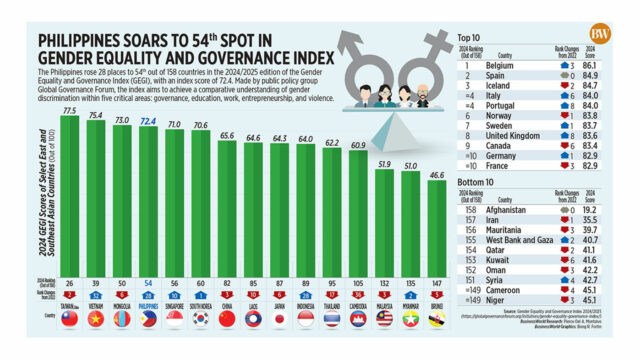
Philippines soars to 54th spot in Gender Equality and Governance Index

The Philippines rose 28 places to 54th out of 158 countries in the 2024/2025 edition of the Gender Equality and Governance Index (GEGI), with an index score of 72.4. Made by public policy group Global Governance Forum, the index aims to achieve a comparative understanding of gender discrimination within five critical areas: governance, education, work, entrepreneurship, and violence.

Philippines soars to 54<sup>th</sup> spot in Gender Equality and Governance Index

Trump 2.0, monetary policy to drive PHL stocks

BW FILE PHOTO

By Revin Mikhael D. Ochave, Reporter

THE Philippine Stock Exchange index (PSEi) could trade at 7,000-8,000 this year, with the start of US President-elect Donald J. Trump’s second term, the direction of global monetary policy, and the midterm elections in the Philippines to dictate the market’s movement.

The PSEi closed 2024 at 6,528.79, rising by 1.2% or 78.75 points from its end-2023 finish of 6,450.04. This marked the first time since 2019 that the index posted a year-on-year increase.

The local stock barometer could peak at just 7,600 this year amid market caution as Mr. Trump begins his second term as US President, China Bank Capital Corp. Managing Director Juan Paolo E. Colet said in a Viber message.

“[This] year presents a complicated picture. While we remain positive about the growth prospects of the Philippine economy and the earnings strength of many listed companies, we approach 2025 with caution as there is a lot of uncertainty around Trump 2.0. Just like his first term, we expect that Trump’s social media posts will again move markets, so investors should be ready to manage that volatility,” Mr. Colet said.

The upcoming Philippine midterm elections and geopolitical issues could bring additional uncertainties, he added.

“We are wary of the impact of potential natural disasters and geopolitical stress on our country’s economy. Investors will likewise keep a close eye on the midterm elections as the outcome thereof could either ensure stability or create uncertainty.”

BDO Capital & Investment Corp. President Eduardo V. Francisco said in an interview that the market could trade between 7,000 to 7,500 this year.

“Even if the US announces a rate cut, it is not necessarily good. Also, when the peso depreciates, the foreign investors will get hurt because the hot money wants the peso to be strong and stable,” he said.

AP Securities, Inc. Research Head Alfred Benjamin R. Garcia held a “cautiously optimistic outlook” for Philippine stocks for this year, citing the market’s potential despite headwinds.

“We think that the fundamentals are there to lift the market higher, but we do acknowledge that we face numerous headwinds like shallower rate cuts and the probability of another global trade war,” he said in a Viber message.

“Despite concerns about both international and local factors – such as macroeconomics, geopolitical situations, and the new United States president — the numbers and valuations of PSEi present a positive outlook,” Luna Securities, Inc. Research Officer and Market Strategist Annika Gabrielle S. Angeles said in a market report.

Ms. Angeles said under their baseline scenario, the PSEi could trade between 7,030 and 8,080 this year.

COL Financial Group, Inc. Chief Equity Strategist April Lynn C. Lee-Tan said market drivers for 2025 include lower inflation and interest rates, as well as the midterm elections.

She added that the market’s “attractive valuations” and the recently signed Corporate Recovery and Tax Incentives for Enterprises to Maximize Opportunities for Reinvigorating the Economy Act could provide an investment boost.

However, Ms. Tan said the US market’s volatility is a potential risk as this could spill over to the Philippines.

“The Philippines suffers from contagion when it comes to the volatile US market,” she said.

“Any improvement in local and external market conditions, especially if the PSEi goes up to 7,000-8,000 levels, would help encourage more fundraising activities in local stock markets such as initial public offerings, follow-on offerings, preferred shares offerings, stock rights offerings, private placements, among others,” Rizal Commercial Banking Corp. Chief Economist Michael L. Ricafort said in a Viber message.

Reluctance to integrate AI leaves BPO workers even more vulnerable

SIXELEVEN GLOBAL SERVICES

By Chloe Mari A. Hufana, Reporter

THE ADOPTION of artificial intelligence (AI) in the Philippines’ business process outsourcing (BPO) and business process management sectors is still in early stages as managements show reluctance to upskill workers, leaving them more vulnerable to job insecurity.

This prompted labor groups to sound alarms over insufficient legislative safeguards for workers, calling on Congress to implement measures that ensure job security and provide upskilling opportunities.

“Right now, AI isn’t yet disruptive [in the sector],” Emmanuel D. David, co-convener of the Alliance of Call Center Workers (ACW), said in a videoconferencing call with BusinessWorld, highlighting growing apprehensions about AIs potential to disrupt job security.

Mr. David noted current AI tools used in the industry include call monitoring systems and a summarizer that automates the documentation of interaction. Despite these advancements, he said workers’ workloads have not decreased as much as anticipated.

“Ideally, what’s going to happen is we no longer need to document our calls. We just copy-paste and that’s it. Because, of course, documenting calls still takes time.”

“But the thing is, since the call summarizer is not yet optimized, management doesn’t want us to copy-paste yet. They still want us to make our own notes. So, there’s something contradictory there.”

He said that while AI tools are continuously emerging, companies are falling short in helping workers prepare and adapt for AI integration. As the industry is fast-paced, management does not often pull workers out for training, “unless it’s really important.”

“Since it’s an industry that focuses on the productivity of workers, they usually do not pull us out because they want us on the phone taking in calls,” he noted, leaving workers unprepared to adapt to evolving technologies.

Upskilling workers amid the AI age has been declining over the years as companies train their workers on new technology less and less, Mr. David said.

“I’ve noticed the changes [that] previously they used to regularly pull agents out for training, for updates. But as the years go by, these happen less and less because the focus is on taking in more calls, which means more money for the company,” he added.

Ronald C. dela Cruz, the national president of the Congress of Independent Organizations, said companies do not talk about transitioning to AI but its effects are felt as seen in the case of a BPO firm based in Bacolod, a southern province in the Philippines, which downsized the company by firing 120 workers as AI takes over their job.

“Management doesn’t talk about AI. They don’t really say that they will transition into AI. It is not discussed, but it can be felt,” he told BusinessWorld in a telephone call, noting the main reason for this is they don’t want to portray themselves as promoting AI at the expense of human work.

BRING YOUR OWN AI
As an effort to adapt to the rise of AI, workers are enrolling themselves in AI training courses and bootcamps. Instead of their management helping them transition, these workers pay for their own training from their own pockets.

“We believe that AI and humans can work hand in hand. AI should increase the efficiency of what humans do. But it should not replace humans,” he added.

There are 2,205 firms in the country comprising the industry, according to the Philippine Statistics Authority’s (PSA) 2021 Annual Survey of Philippine Business and Industry – Information Technology – Business Process Management (IT-BPM) Industries published on Nov. 21, 2023.

Approximately 849,000 individuals are employed in the sector, with each company averaging about 385 employees. These workers earn an estimated annual income of P440,000.

PSA data showed the companies make about P848 billion in annual revenue, while sales in e-commerce transactions made over P23 billion. Total revenues made from transactions outside the Philippines reached over P314 billion.

PSA defined BPO as the “delegation of one or more Information Technology-intensive business processes to an external provider that, in turn, owns, administers, and manages the selected process or processes based on defined and measurable performance metrics.”

While IT-BPM services, in general, refer to the provision of a bundled service package that combines information technology-intensive services with labor (manual or professional depending on the solution).

In June, Labor Secretary Bienvenido E. Laguesma admitted Filipino workers have been losing jobs since the boom of AI. He said the Department of Labor and Employment and other stakeholders are working on initiatives to prepare workers.

Despite the job losses, the labor chief noted AI also presents new job opportunities, such as data curation.

The 2024 Work Trend Index, jointly released by Microsoft and LinkedIn in May 2024, underscored the growing integration of AI into workplaces and its implications for workers and employers globally, including in the Philippines. According to the study, AI proficiency is becoming a decisive factor in hiring decisions, with a marked increase in professionals globally adding AI-related skills like ChatGPT and Copilot to their profiles. Despite this, only a small fraction of employees receives formal AI training, prompting many to upskill independently.

Employees are increasingly adopting AI tools, even without organizational support, a phenomenon dubbed the “bring your own AI” trend. While AI power users — those extensively using AI at work — report significant time savings and improved productivity, businesses face challenges in developing cohesive strategies for AI adoption.

Microsoft and LinkedIn stressed the importance of structured AI integration and training to address concerns about job displacement and skill gaps. The findings highlighted the need for companies and governments to invest in AI training programs, align workforce strategies, and foster a culture of innovation to remain competitive in an AI-driven future.

FUTURE-PROOFING WORKERS
As industry workers worry about possible job loss due to AI, Mr. Dela Cruz urged the legislature to pass measures to strengthen job security amid AI’s speedy rise, specifically forging a just and humane transition.

“It’s very important to have a legal framework because right now, only organized workers, workers with unions and collective bargaining can influence policies to address the influx of AI in the world,” he said, noting that there are no organized groups in the industry.

Despite the lack of specific legislation protecting workers from AI-driven job loss, Mr. Dela Cruz said Article 238 of the 1974 Philippine Labor Code still serves as a safety net for them, albeit outdated.

“Employers may terminate an employee due to the installation of labor-saving devices… to prevent losses or the closing… of operation,” the provision read, as Mr. Dela Cruz cited.

Mr. Dela Cruz, who has been working with industry workers since 2014, called the rise of AI the fourth industrial revolution that cannot be stopped.

“Congress should step in because if it is not written by law, management would still do what is convenient for them economically and operationally.”

Meanwhile, for Mr. David, the government should invest in training programs to equip workers with the necessary skills and knowledge to adapt to the changes brought about by the rise of AI.

“If at the end of the day, AI is going to take over our jobs, the government should do a massive training program so that the workers, not just in the business processing industry, would have the skills in order for them to keep their jobs even with AI,” he said.

He noted the government must also equip students with AI knowledge before they enter the workforce by adjusting educational curricula.   

The rise of artificial intelligence in the business processing industry is not just a technological evolution — it is a call to action. It challenges stakeholders to reimagine the workplace, where humans and AI collaborate rather than compete. For this vision to flourish, Congress must lay the groundwork for a future where workers are protected, empowered and prepared to thrive alongside these innovations.

With bold policies, dynamic training programs, and an education system that embraces the AI era, the Philippines can transform uncertainty into opportunity. The story of AI in the business processing industry is still being written, and with thoughtful leadership, it can become one of resilience, growth, and shared success.


Philippine economy on cusp of growth amid tech advancements, sustainability focus — Laguesma

PAIRS OF HIGH-QUALITY SHOES made in Marikina City are shown to members of the media during a tour of C Point Manufacturing’s shoe factory in Barangay Concepcion Uno on Aug. 7, 2019. — PHILIPPINE STAR / BOY SANTOS

THE PHILIPPINES is on the cusp of a significant economic growth in 2025, which will be driven mainly by technological advancements, as well as the heightened focus on sustainability and wellness, according to its labor chief.

“The Philippines is on the transition of a substantial economic expansion, fueled by technological breakthroughs, heightened environmental consciousness and a growing emphasis on healthcare and wellbeing,” Labor Secretary Bienvenido E. Laguesma told BusinessWorld in a Viber message.

On this note, he said emerging sectors, such as the digital economy, green economy, blue economy, and care economy, are “projected to experience significant growth.”

Federation of Free Workers President Jose Sonny G. Matula likewise expects growth in tech-driven industries as the Philippines is rapidly becoming a global player in technology due to its skilled workforce and supportive business ecosystem.

“In-demand roles include software developers proficient in programming languages like Python, Java, and C#, and data scientists who extract actionable insights to guide business decisions,” he told BusinessWorld in a Viber chat.

As a way to cope with this emerging sector, workers must be equipped with advanced technology skills, he added.

“Proficiency in digital fluency, business and data storytelling, data visualization, cybersecurity, robotics, and telemedicine will be crucial,” he said.

He also said it is critical for workers to have the ability to quickly learn and adapt to new technologies to catch up on the rapidly evolving job market.

The union leader added demand for healthcare workers would further rise this year as global health challenges underscored the need for more robust healthcare systems, increasing the need for professionals. 

“However, the sector faces hurdles such as brain drain, as skilled workers seek opportunities abroad,” he noted.

Moreover, Mr. Laguesma noted the transition to a more technology-driven economy poses challenges for certain industries.

Roles in administration, traditional security, manufacturing, and commerce are projected to decline due to automation and digitalization, he said.

Jobs requiring technical support, sales, and clerical work are particularly vulnerable, as they face the highest risk of displacement by automation.

“In fine, jobs that provide technical support, sales and clerical works stand the highest exposure to automation,” he said.

Mr. Matula said urged the government to strategically plan, invest in human capital, and commit to continuous learning and adaptability to capture opportunities in emerging industries. — Chloe Mari A. Hufana

Mandating digital payment systems could boost economy, analysts say

STOCK PHOTO | Image by David Dvořáček from Unsplash

By Kenneth Christiane L. Basilio, Reporter

MANDATING BUSINESSES to adopt digital payment solutions for transactions could help promote financial inclusion and stoke economic activity as it could stimulate consumer spending, analysts said on Tuesday.

“Mandating the adoption of digital payment services in government and merchant transactions has strong potential to promote financial inclusion in Philippines,” John Paolo R. Rivera, a senior research fellow at the Philippine Institute for Development Studies, said in a Viber message.

“Digital payment systems streamline processes, reducing the time, cost, and inefficiencies associated with cash-based transactions… [and] enables seamless transactions, encouraging consumer spending,” Mr. Rivera said.

The government of President Ferdinand R. Marcos, Jr. has made digitalization a cornerstone of his administration’s agenda under the Philippine Development Plan 2023-2028, including the adoption of digital payment systems.

The Bangko Sentral ng Pilipinas (BSP) is looking to digitalize at least 60% of all retail payments by 2028, in line with the government’s agenda.

A 2023 report by the BSP showed that only 56% of Filipinos have formal bank accounts, while 76% of Filipinos have internet access and own mobile phones.

Measures seeking to boost the adoption of digital payment systems are pending in the Philippine Congress. House Bill No. 8262 is awaiting second reading approval, while its counterpart Senate bills remain pending at the Senate committee on banks.

“The measure could significantly promote financial inclusion by making financial services more accessible to underserved and unbanked populations, enabling them to participate in the digital economy,” Jonathan L. Ravelas, senior adviser at professional service firm Reyes Tacandong & Co., said in a Viber message.

However, lawmakers should ensure the country’s digital payment infrastructure is “robust, secure and accessible” to help achieve the proposed law’s goal of boosting the adoption of digital payment schemes, Mr. Rivera said.

“[It’s] equally important to ensure greater telecommunications or data coverage to more areas around the country, especially in rural areas that have no or weak signals, thereby helping boost more online business transactions,” Rizal Commercial Banking Corp. Chief Economist Michael L. Ricafort said in a Viber message.

Public awareness campaigns regarding the benefits of adopting digital payment systems for merchants and consumers alike would help improve the bills’ effectiveness, said Mr. Rivera. “The success of this measure hinges on the ability of citizens, merchants, and government employees to understand and use digital payment systems.”

Speaker Romualdez asked to reveal state aid beneficiaries

PHILSTAR FILE PHOTO

HOUSE OF REPRESENTATIVES Speaker Ferdinand Martin G. Romualdez should disclose the beneficiary list of a state financial aid program to open its implementation and impact to public scrutiny, a former Finance department official said on Wednesday.

Ex-Finance Undersecretary Cielo D. Magno issued the challenge to Mr. Romualdez amid scathing public criticism for the Ayuda para sa Kapos ang Kita Program (AKAP), a social welfare scheme providing cash assistance to low-income workers.

The office of Mr. Romualdez did not immediately respond to a Viber message seeking comment.

“As taxpayers, we should know who these beneficiaries are, how much they actually received from the program, and who were targeted to receive assistance,” she said in a Facebook Messenger chat.

“There has to be a clear evaluation on the first year of implementation of the project since the President decided to keep the funding for it,” said Ms. Magno.

AKAP was formulated in 2023 by Mr. Romualdez and Party-list Rep. Elizaldy S. Co, who heads the House appropriations panel. It was meant as a stop-gap measure for Filipinos with limited income.

President Ferdinand R. Marcos, Jr. has included AKAP in the 2025 national budget despite concerns that it could be exploited for vote-buying and fuel patronage politics as the midterm election approaches.

“There is potential for misuse here since the government has admitted that there is no clear framework or structure for its implementation,” Ms. Magno said. “We’ve also seen politicians… going around the country distributing AKAP.” 

Meanwhile, a bill seeking to institutionalize the cash aid program was filed last month, a move that Southern Leyte Rep. Christopherson M. Yap said could make the country’s social welfare system more responsive during times of crisis.

The proposal “represents a significant step forward in the government’s efforts to alleviate poverty and promote social justice,” Mr. Yap said in House Bill (HB) No. 11176, which he filed on Dec. 5, 2024.

The bill empowers the Social Welfare department and local government units (LGUs) to be the implementation agencies of AKAP.

Mr. Marcos has placed AKAP under “conditional implementation” for 2025, with the aid program to be implemented by the Social Welfare and Labor departments, and socioeconomic planning agency, according to a Dec. 30 statement by the Presidential Palace.

The proposed law stated that “low-income individuals” could avail of “outright cash assistance” under the Department of Social Welfare and Development (DSWD) for food, medical, funeral, and financial relief needs.

“Financial assistance may be in the form of outright cash ranging from P1,000 to P15,000 subject to the assessment of the DSWD social worker. For assistance above P15,000 a Guarantee Letter approved by the DSWD Secretary or his representative shall be given,” the bill stated.

In its current form, AKAP provides one-time cash assistance worth between P3,000 and P5,000 to workers whose income falls below the poverty threshold.

Meanwhile, the bill authorized LGUs to provide cash assistance specifically designated for the purchase of rice for eligible beneficiaries.

“The amount of rice assistance that can be given to qualified beneficiaries shall be equivalent to half of the cost of 25 kilograms of rice based on the suggested retail price from the Department of Agriculture,” the bill added.

The Marcos administration should instead look at “focusing on solutions that will directly manage inflation” instead of implementing more dole-out programs, said Ms. Magno. “Distributing aid will not help address the problems brought about by inflation.”

The government should rationalize its social protection programs instead of institutionalizing AKAP, she added, taking note of the existence of Pantawid Pamilyang Pilipino Program (4Ps), a national poverty reduction program.

“The question really is we have a working program like 4Ps, what is the need for another one like AKAP?” — Kenneth Christiane L. Basilio

Adopt growth mindset — Marcos

A FIREWORK display can be seen from a building in Kalaw, Manila in celebration of the New Year. — PHILIPPINE STAR/WALTER BOLLOZOS

PRESIDENT Ferdinand R. Marcos, Jr. on Wednesday urged Filipinos to adopt a growth-focused mindset as they welcomed a new year.

He said the year 2025 is an opportunity “to learn from the lessons of the past and apply the wisdom gained to better oneself.”

“It is our desire for our citizens to embrace this outlook and adopt an introspective and growth-focused mindset that balances the realities of yesterday and the promises of tomorrow,” he said in a statement.

Mr. Marcos claimed that Filipinos showed “resilience” in the face of challenges in the previous months.

“Reflecting on the resilience we have shown in overcoming them, it is crucial for our progress to esteem such moments as hallmarks of the extraordinary strength we gain through solidarity and perseverance,” he said.

“Let us draw inspiration from the innumerable acts of courage, compassion, and bayanihan that we have witnessed in the face of adversity,” he added.

“Only then can we fortify the bonds that connect us, truly rebuild what has been lost, and realize a Bagong Pilipinas where dreams flourish and every Filipino thrives.”

Vice-President Sara Z. Duterte-Carpio, in her New Year statement, described 2024 as a year that challenged the nation’s resiliency.

“The year 2024 tested our resilience and shaped us as a people who stand for justice and progress,” she said in a video statement.

She urged Filipinos this year to face various challenges “as a nation that continues to trust in God” and that “works together for the progress and well-being of our families.” — Kyle Aristophere T. Atienza

DoH logs over 140 firework injuries

IAN SCHNEIDER-UNSPLASH

THE PHILIPPINE Health department on Wednesday said it had recorded over 140 fireworks-related injuries after the New Year celebration, bringing the total cases during the holiday season to over 300.

The number of cases from Dec. 22, 2024 to Jan. 1, 2025 declined by 34% to 340, from 519 a year earlier, the Department of Health (DoH) said in a statement.

The 141 fireworks-related injuries booked on Jan. 1 were 64% lower compared to last year, it added.

The majority, or 239, of the cases were aged 19 and below, while 100 were aged 20 and above, DoH said.

It said 202, or 59%, of the cases used illegal firecrackers such as boga or a PVC cannon, 5-star, and piccolo.

DoH said 299 patients with firecracker injuries were male, while 41 were female.

Using firecrackers could lead to amputation of body parts, hearing loss, blindness, poisoning, burns, permanent lung damage, and even death from severe injuries, according to the health agency.

DoH has said boga, 5-Star, and piccolo were the leading causes of fireworks-related injuries. — Kyle Aristophere T. Atienza