Home Blog Page 171

Trade dep’t sees tax deal with Cambodia boosting service exporters’ competitiveness

REUTERS/CINDY LIU/FILE PHOTO

THE Department of Trade and Industry (DTI) said a tax treaty with Cambodia is expected to boost the competitiveness of the service sector by removing the burden double taxation.

“This agreement establishes a stable, rules-based framework that encourages market entry and strengthens business confidence abroad,” Bianca Pearl R. Sykimte, the export marketing bureau director, told a Senate hearing.

The Senate Foreign Relations Committee is evaluating the Philippines and Cambodia Double Taxation Agreement (DTA), which seeks to eliminate double taxation on income, ease tax burdens, and increase investment.

“This makes our service fees and contracts more affordable, boosting the competitiveness of our service providers,” she added.

Senator Erwin T. Tulfo, who heads the committee, said the chamber must first determine the potential benefits for the agreement before sponsoring the treaty at the Senate Plenary level.

“I want to know, what exactly, we get out of this,” he said.

Ms. Sykimte said the agreement means Philippine information technology outsourcing companies providing software support to Cambodian clients will now have to pay only a 10% withholding tax on technical services.

She added that engineering and construction companies will not be considered a taxable permanent establishment unless the project lasts for more than six months, “reducing tax exposure for short-term projects.”

Creative industries and franchises licensing or expanding to Cambodia would have to pay only 15% on their royalties.

(This will make) our intellectual property licensing and brand expansion more financially viable,” Ms. Sykimte added.

Finance Assistant Secretary Euvimil Nina R. Asuncion said the agreement will also ease the income tax burden of overseas Filipino workers stationed in Cambodia.

“Instead of Cambodia taxing them up to 20%, they can now only tax them up to 10%,” she added noting that tax breaks also include Filipinos rendering technical services.

There are about 7,000 Filipino workers in Cambodia, and at least 13 companies operating there.

Manila and Phnom Penh signed the agreement in February last year to reduce fiscal barriers and stimulate bilateral trade and investment. — Adrian H. Halili
Palay farmgate price rises 10.4% in February

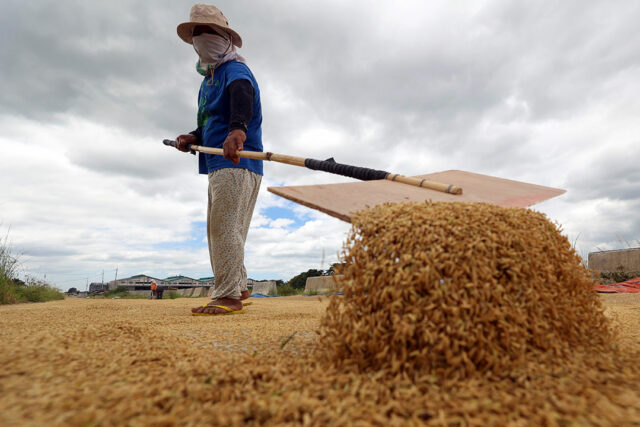
PHILIPPINE STAR/ KJ ROSALES

THE farmgate price of dry palay (unmilled rice) rose 10.4% year on year in February to a national average of P22.47 per kilo, according to the Philippine Statistics Authority (PSA), citing preliminary data.

The highest farmgate price for dry palay in February was reported in the Cagayan Valley at P28.12 per kilo, up 44.3% from a year earlier. The year-on-year growth in palay prices in the region was also the fastest on record for February.

The lowest average farmgate price in February was recorded in the Caraga region at P17.96, down 13.2% from a year earlier. The decline in the region’s average palay price was the fastest on record for the month.

In Central Luzon, the country’s top rice-producing region, the average farmgate price of dry palay was P25.86 per kilo, up 32.9% from a year earlier.

In a separate report, the PSA said palay production is projected to fall 7.1% year-on-year to 4.36 million metric tons (MT) in the first quarter, based on standing crops as of Feb. 1.

This projection for palay would represent a 1.9% downgrade from its January estimate of 4.45 million MT.

Corn output is also projected to decrease 3.4% year on year to 2.32 million MT in the first quarter, based on standing crops as of Feb. 1.

The corn projection is a 1.7% downgrade from the January estimate of 2.36 million MT. — Vonn Andrei E. Villamiel

Fisherfolk enrollment in parametric insurance scheme tops 11,000 across 5 provinces

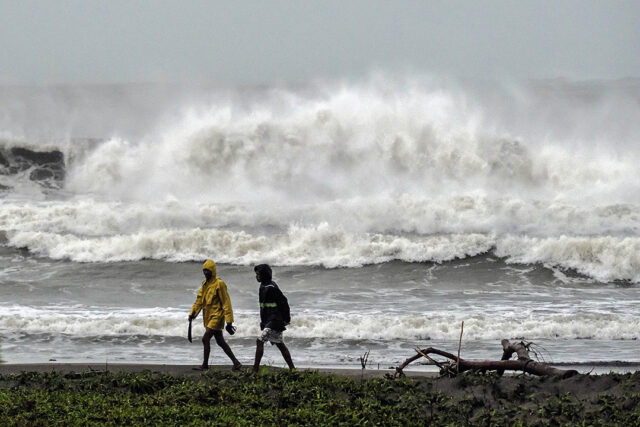
LARGE WAVES can be seen at Bagasbas Beach in Daet, Camarines Norte, due to Super Typhoon Pepito, Nov. 17, 2024. — PHILIPPINE STAR/RYAN BALDEMOR

THE Philippine Crop Insurance Corp. (PCIC) said it enrolled more than 11,000 municipal fisherfolk in its weather index-based parametric insurance program and is looking to expand the initiative to more coastal communities after its first year.

The program, launched in November in partnership with the Bureau of Fisheries and Aquatic Resources (BFAR) and Rare Philippines, provides insurance protection to small-scale fishers whose livelihoods are often disrupted by hazardous weather conditions.

Parametric insurance releases payouts to policyholders once weather indicators reach agreed-upon triggers, with claims not delayed by the traditional damage inspection process.

Arvin Jasper R. Adan, acting manager of PCIC’s Actuarial Research and Product Valuation Department, said the program’s initial rollout has a target of 14,000 sign-ups.

“The policyholders are between 11,000 and 12,000 fisherfolk registered under BFAR’s FishR system,” Mr. Adan told reporters. “The program is currently available in Occidental Mindoro, Antique, Cebu, Surigao del Norte, and Negros Oriental.”

The PCIC said insurance premiums are paid for by BFAR, making the coverage effectively free for participating fisherfolk. Mr. Adan said the bureau allocated around P10 million for the program.

“Each insured fisher is entitled to an indemnity of about $100, or roughly P5,000, per policy cycle. The coverage period for the insurance is one year,” he said.

“For the project, we have three parameters — wind speed, wave height, and rainfall. It was determined using 30 years of historical data,” Mr. Adan said.

PCIC said the parametric design enables faster and more transparent compensation when hazardous weather prevents sea voyages.

“Payments are released to digital wallets or checks, allowing immediate relief without lengthy claims investigations,” the PCIC has said.

It said no payouts have been triggered since the program’s launch, as recent weather events have not met the thresholds required for indemnity.

“All three parameters must reach the trigger level. It cannot be just high waves — the payout requires a combination of all three indicators. That is why, as of now, there have still been no payouts,” Mr. Adan said.

The PCIC said the program has only been running for a few months, and severe storms have yet to occur during the period.

The PCIC also said it is open to reviewing and possibly adjusting the trigger levels based on the results of the program’s initial run. — Vonn Andrei E. Villamiel

Philippine activists plan civilian mission to contested South China Sea island

AN AERIAL photo of Philippine-occupied Thitu Island, locally known as Pag-asa, in the contested Spratly Islands. — REUTERS

By Kenneth Christiane L. Basilio, Reporter

A COALITION of Philippine activist groups plans to sail to Thitu Island in the disputed South China Sea to deliver food and fuel to residents, part of a campaign to assert Manila’s presence amid rising Chinese activity in the region.

The Atin Ito (This Is Ours) coalition is finalizing plans for an April trip, with volunteers expected to stay on Thitu Island, also called Pag-asa by the Philippines, for a day before returning to the mainland.

“This sail is a response to a major crisis we are facing,” Rafaela David, co-convener of the South China Sea interest group, told reporters in Filipino.

Thitu is the biggest of the Philippine-occupied islands in the Spratlys and the only one with a permanent civilian population.

It lies roughly 12 nautical miles (22 kilometers) from China’s Subi Reef, a militarized outpost with an airstrip and naval facilities.

Edicio dela Torre, another Atin Ito co-convener, said the mission aims to reinforce the Philippines’ claim over the Kalayaan Island Group.

“Our mission will firmly assert to the world, and especially to China and its local enablers, that the Kalayaan Island Group is an integral part of the Philippines,” he told the same briefing in Filipino.

The Chinese Embassy in Manila did not immediately reply to a Viber message seeking comment.

China claims nearly the entire South China Sea under its nine-dash line, overlapping the exclusive economic zones of the Philippines, Vietnam and Malaysia despite a 2016 ruling by the Permanent Court of Arbitration in The Hague that voided those claims.

The upcoming sail will be Atin Ito’s fourth to Thitu since 2023 and is part of a broader effort to “civilianize” the waters, Mr. dela Torre said.

“This is one of the most powerful ways to respond to China’s militarization of the area,” he said.

Frequent encounters between Philippine and Chinese vessels have included water cannon use and sideswiping maneuvers.

Beijing has built man-made islands across the Spratlys with runways, ports and radar systems to extend its naval reach in the resource-rich waterway.

Ms. David told BusinessWorld the group is coordinating with “relevant agencies” to ensure safety during the voyage.

“Those who need to know about the mission are well aware, and they can also prepare safety measures to ensure our volunteers can peacefully reach the destination,” she said.

The mission will carry fuel and food packs for local fishermen living on Thitu Island.

The group said the trip is a statement of support for residents who face isolation and logistical challenges amid regional tensions.

The South China Sea, a vital global trade route, remains a flashpoint as competing claims and military developments heighten regional risks.

Civilian-led efforts like Atin Ito’s sail are unusual but reflect growing public concern in the Philippines about maintaining a presence in contested areas and supporting local communities.

PHL funds fuel relief; no borrowing planned yet

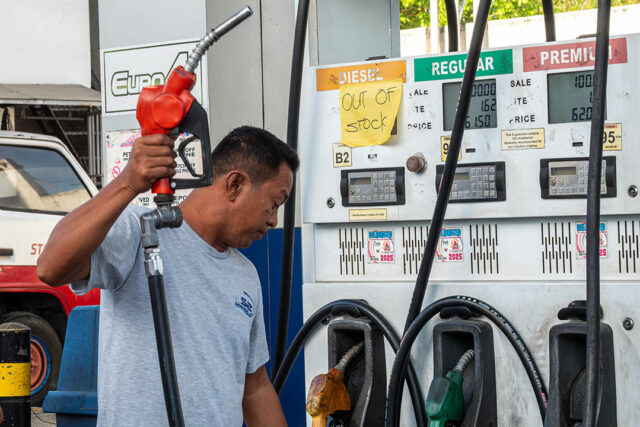
MOTORISTS queue at a gasoline station along Norzagaray Road in San Jose del Monte on March 8, 2026. — PHILIPPINE STAR/RYAN BALDEMOR

THE Philippine government has sufficient funds to support its economic response to the Middle East war and has no immediate plans to borrow from international lenders, the Presidential Palace said on Thursday.

“As of now, there are no plans yet [to borrow],” Palace Press Officer Clarissa A. Castro told a news briefing, citing Finance Secretary Frederick D. Go.

The conflict, now approaching two weeks, has sharply increased oil prices after Tehran halted shipments through the Strait of Hormuz, a crucial route handling about a fifth of global oil and gas supplies. Fuel prices in the Philippines, a net oil importer, have risen by as much as P38.50 per liter.

To ease the impact, the government is deploying targeted subsidies. The Department of Transportation has allotted P3.5 billion to fund free rides for commuters and cover fuel costs for public utility vehicles.

The Department of Agriculture is exploring additional funding to expand fuel subsidies for farmers and fisherfolk.

Agriculture Undersecretary Drusila Esther E. Bayate said the agency would prioritize fifth-class municipalities and coordinate with the Department of Budget and Management to tap unused funds from last year’s program.

About P150 million is available, while the P10-billion Presidential Assistance for Farmers and Fisherfolk program could be tapped if prices remain high.

The Bureau of Fisheries and Aquatic Resources (BFAR) has earmarked P50 million for fuel subsidies targeting roughly 200,000 fishers with motorized boats.

BFAR Assistant Director Zaldy P. Perez said an additional request for P25 million could raise support per fisher to P5,000.

Fishermen are losing P500 daily due to surging diesel prices.

Surging diesel prices have hit fishermen hard, said Jayson H. Cainglet, executive director of the Samahang Industriya ng Agrikultura.

Diesel prices jumped P24 per liter in one week, with daily losses reaching P500 per fisher, threatening to halt some fishing activities, he told senators.

In the capital region, the Department of Social Welfare and Development will roll out P5,000 fuel subsidies for public utility drivers starting on March 17.

Tricycle operators will receive payments first, followed by jeepney, taxi and transport network vehicle service drivers.

The program will draw on P30 billion from the P60-billion fund for people in crisis situations.

The conflict began on Feb. 28 when the US and Israel launched coordinated airstrikes on Tehran’s military infrastructure, causing thousands of casualties and widespread regional disruption.

About 300 Filipino workers have been repatriated so far, with additional chartered flights planned in the coming days.

President Ferdinand R. Marcos, Jr. said the government is actively exploring alternative oil suppliers while monitoring logistics to prevent shortages.

Analysts warn that continued instability around the Strait of Hormuz could drive prices even higher, worsening inflation, eroding household purchasing power and straining transport, industrial and consumer sectors. — Chloe Mari A. Hufana and Adrian H. Halili

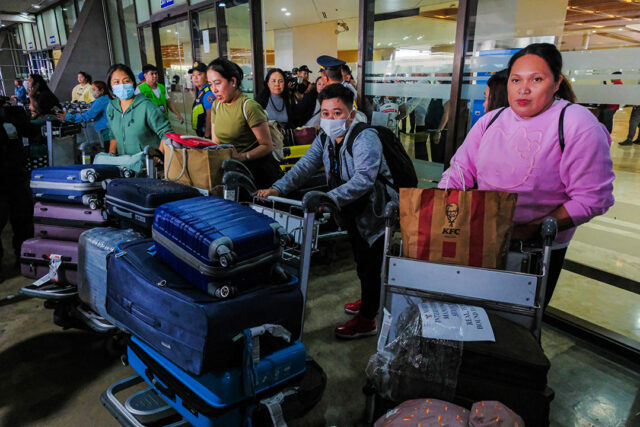
25 more OFWs arrive from Dubai as Middle East war rages

DMW.GOV.PH

TWENTY-FIVE overseas Filipino workers (OFWs) and one dependent arrived in the Philippines from Dubai on Wednesday evening, the Department of Migrant Workers (DMW) said, as rising regional tensions prompt more repatriations.

The group landed on Emirates flight EK 334 at 9:20 p.m. at the Ninoy Aquino International Airport (NAIA) Terminal 3 in Pasay City, the agency said in a statement on Thursday.

They received accommodation, food, transportation, financial support and medical and psychosocial assistance from the DMW, Overseas Workers Welfare Authority, Department of Social Welfare and Development and medical staff from New NAIA Infra Corp., in line with directives from President Ferdinand R. Marcos, Jr.

The Philippine government repatriated the first group of OFWs from Iran and was preparing two chartered flights to bring home more workers from the Middle East, the President said on Wednesday.

The first flight will operate out of Riyadh for Filipinos in Saudi Arabia, Kuwait and Bahrain. The second will depart from Fujairah in the United Arab Emirates (UAE) to transport workers from Dubai, he added.

The Fujairah flight was scheduled for March 13, with an expected arrival in Manila later that evening or early on March 14. Mr. Marcos said the decision to charter these flights follows a slight improvement in regional safety.

Earlier this month, nine Filipinos were repatriated from Iran on March 10 and 11, the first group evacuated amid heightened regional instability following US and Israeli strikes on Iranian targets and Tehran’s retaliatory attacks.

The strikes were meant to curb Iran’s nuclear program and pursue regime change, and reportedly resulted in the death of Iranian leader Ayatollah Ali Khamenei.

In retaliation, Iran launched missile and drone attacks against US and Israeli bases across Gulf states, including Iraq, the UAE, Kuwait, Bahrain, Qatar and Saudi Arabia.

The DMW said it is coordinating closely with relevant agencies to ensure the safe return of citizens and provide immediate support.

The repatriation flights are part of the government’s broader effort to safeguard millions of Filipinos working in the Middle East, offering emergency assistance and logistical support amid the war. — Kaela Patricia B. Gabriel

OFWs value fast state action over policies

Overseas Filipino workers (OFWs) arrive at the Ninoy Aquino International Airport (NAIA) Terminal 1, June 16, 2025. — PHILIPPINE STAR/RYAN BALDEMOR

OVERSEAS Filipino workers (OFWs) are more likely to trust the government when it provides fast, visible help rather than introducing fresh policies, a study by research firm Fourth Wall found.

OFWs’ confidence depends on practical services such as quick processing of documents, simplified transactions, responsive hotlines, emergency assistance, and other forms of direct support, it said.

“OFWs are not looking for policy mandates, but a clear, visible, and decisive presence from their government,” John Brylle L. Bae, research director at Fourth Wall, said in a separate statement. “They often look for credible champions — leaders who can mobilize institutions quickly and visibly when workers face risk abroad.”

The research analyzed national labor patterns, migrant worker programs and social media discussions on platforms including Facebook, X and Reddit from 2016 to 2026.

It found that Filipino workers overseas notice government care when assistance is timely, procedures are easy, support measures are clearly communicated, livelihood programs are offered and authorities directly engage with worker concerns.

The study found that migrant workers often credit the National Government for assistance, rather than the specific agencies handling the programs, such as the Department of Migrant Workers or the Overseas Workers Welfare Administration.

This influences how OFWs perceive the administration’s compassion and effectiveness.

The research suggests that during times of geopolitical risk, such as war in the Middle East, OFWs prioritize action over rules.

Quick emergency responses, clear communication, and visible support were far more valued than expanding policy frameworks or creating new mandates.

“Migrants evaluate governance not through policy design but through outcomes,” according to a copy of the study. “Reliable services, visible assistance, clear communication, and responsive intervention are what shape confidence in the system.” — Kaela Patricia B. Gabriel

Marcos certifies fuel excise tax bill

A gas attendant is at work at a gasoline station in Manila in this file photo. — PHILIPPINE STAR/NOEL PABALATE

PRESIDENT Ferdinand R. Marcos, Jr. certified as urgent a measure allowing him to suspend or reduce excise taxes on petroleum products during national emergencies as the Philippines grapples with soaring fuel prices amid the Middle East war.

According to documents from the Office of the Executive Secretary, Mr. Marcos certified the “necessity of the immediate enactment” of House Bill No. 8418, which was approved on second reading on Wednesday.

“[This would] allow the government to respond promptly to extraordinary fuel price volatility and stabilize domestic fuel prices during the period of severe economic disruptions,” the letter, addressed to House Speaker Faustino G. Dy III and signed by Mr. Marcos, read.

The Middle East war, almost in its second week, pushed oil prices higher after Iran disrupted energy shipments from the Middle East passing through the Strait of Hormuz, a crucial chokepoint where about a fifth of global oil and gas supply passes through.

As a net oil importer, the Philippines remains highly vulnerable to sharp swings in global fuel prices.

The measure allows the President to suspend or reduce excise taxes on petroleum products if the average Dubai crude price, based on the Mean of Platts Singapore benchmark, reaches or exceeds $80 per barrel for the month preceding the issuance of such an order.

Under the 2017 Tax Reform for Acceleration and Inclusion law, the Philippines imposes an excise tax of P10 per liter on gasoline, P6 per liter on diesel and P5 per liter on kerosene.

Department of Economy, Planning, and Development Secretary Arsenio M. Balisacan told lawmakers on March 10 that suspending fuel excise taxes could help curb the inflationary impact of rising global oil prices, warning that higher pump prices would feed through to the cost of nearly all goods and services, eroding Filipinos’ purchasing power and weighing on economic activity. — Chloe Mari A. Hufana

Frasco removed from DoT post

CHRISTINA GARCIA FRASCO — PHILIPPINE STAR/RYAN BALDEMOR

PRESIDENT Ferdinand R. Marcos, Jr. on Thursday removed Secretary Ma. Christina G. Frasco from the helm of the Department of Tourism (DoT), reassigning her as the Presidential Adviser for Sustainable and Resilient Communities.

He appointed Tourism Undersecretary Verna Esmeralda C. Buensuceso as the officer-in-charge of the department, according to a statement from Palace Press Officer Clarissa A. Castro.

The Cabinet change comes as tourism rates in the Philippines lagged behind its Southeast Asian peers.

Ms. Castro clarified Ms. Frasco did not step down from her post.

In a news briefing earlier that day, Ms. Castro said Ms. Frasco still enjoys Mr. Marcos’ trust and confidence amid issues hounding the Tourism department.

Ms. Frasco has been under fire for allegedly self-promoting rather than highlighting the country’s tourist destinations amid falling tourism rates. — Chloe Mari A. Hufana

March 20 declared regular holiday

THE Palace on Thursday declared March 20, Friday, a regular holiday in observance of Eid-al Fitr or the end of Ramadan.

President Ferdinand R. Marcos, Jr. made the announcement at the Grand Iftar in Malacañang, reaffirming his government’s respect for traditions.

“The declaration recognizes the significance of Eid’l Fitr, which marks the end of the holy month of Ramadan, a period devoted to prayer, reflection, and fasting,” a statement from Palace Press Officer Clarissa A. Castro read.

Mr. Marcos said rising tensions in the Middle East underscore the importance of sustaining peace and stability at home.

The developments in the Middle East, a region significant to Muslims worldwide, have prompted concern about their broader impact on people, economies, and families, he said.

The President also expressed concern over the growing human toll of the conflict, noting that many Muslim communities should be observing the holy month of Ramadan in peace.

The Philippine government remains focused on strengthening the foundations of peace domestically, particularly in the Bangsamoro region, he said, adding that the administration continues to back a “people-centered governance system” in the autonomous area.

Mr. Marcos pointed to the progress of the Bangsamoro Autonomous Region in Muslim Mindanao as central to the country’s long-running effort to secure lasting peace in Mindanao.

The path toward self-governance requires patience, dialogue, and a commitment to reconciliation, he said.

Officials from the regional government led by Abdulraof A. Macacua attended the gathering alongside members of the diplomatic corps, Cabinet officials and lawmakers.

The annual iftar gathering brought together Muslim and non-Muslim leaders in government, which Mr. Marcos said symbolizes the Philippines’ tradition of religious tolerance and unity.

“As we recognize the sacredness of each other’s traditions, we strengthen the quiet foundation of our nation,” he said. — Chloe Mari A. Hufana

PHL worried by possible CA attacks

US, Israel and Iran flags are seen in this illustration taken June 18, 2025. — REUTERS/DADO RUVIC/ILLUSTRATION

POSSIBLE retaliatory attacks by Iran in California (CA) must not be taken lightly due to the large number of Filipinos in the area, the Palace said on Thursday, after American federal officers warned of unverified claims of potential drone strikes.

Palace Press Officer Clarissa A. Castro said the government needs to remain vigilant and prepare measures to protect Filipinos abroad following an alert issued by the Federal Bureau of Investigation (FBI).

“When there are pieces of information like that, our country also needs to prepare for our compatriots,” she said in Filipino during a briefing. “This cannot simply be ignored or taken lightly. We must stay alert to whatever might happen to our fellow Filipinos in California.”

According to a May 2025 Pew Research article, 1.6 million Filipinos live in California, the largest in all states.

The Palace’s statement comes as the FBI warned US law enforcement agencies last month that Iran could retaliate for potential American strikes by launching surprise drone attacks against targets in California, according to Reuters.

The alert, issued before the outbreak of the current Middle East war that began with US and Israeli bombardments of Iran on Feb. 28, suggested unmanned aerial vehicles could be launched from sea vessels toward the US West Coast.

President Donald J. Trump downplayed concerns about Iranian retaliation on US soil, while California Governor Gavin Newsom said authorities were unaware of any imminent threat but had heightened security as the conflict escalates across the region. — Chloe Mari A. Hufana

Comelec tightens party-list rules

PHILSTAR FILE PHOTO

THE Commission on Elections (Comelec) on Thursday released new rules for registering and accrediting political groups, aiming to professionalize the party-list system and purge inactive organizations ahead of the 2028 elections.

Comelec Resolution No. 11204, promulgated on March 11 by the Comelec en banc, sets a deadline for new groups to register by Dec. 18, 2026, or nearly two years before the general election. The rules streamline oversight of national, regional, and sectoral parties, often criticized as opaque or dominated by political dynasties.

All registered parties must now submit a Sworn Information Update Statement and an audited financial statement every August, according to the poll body. Groups that skip the last two elections or fail to win a seat face delisting, ensuring only active organizations remain on the ballot.

The commission also tightened rules on party names and identity. Acronyms cannot exceed 20 characters and cannot use government project names, public figures, or social media platforms, preventing groups from exploiting brand or celebrity associations.

The party-list system “is a mechanism of proportional representation,” the resolution says, adding that sectoral organizations must identify and “represent only one clearly defined physical attribute or characteristic, employment, interest, or concern.”

“Petitions filed not in accordance with these Rules shall not be docketed and shall be outrightly dismissed,” the Comelec added. — Erika Mae P. Sinaking

ADVERTISEMENT
ADVERTISEMENT