Home Blog Page 1626

Los Angeles utility sued for Palisades Fire water shortage, court filing shows

A woman reacts as she evacuates following powerful winds fueling devastating wildfires in the Los Angeles area, at the Eaton Fire in Altadena, California, U.S. Jan. 8, 2025. — REUTERS

The Los Angeles Department of Water and Power was sued on Monday on claims that it failed to properly manage water supplies critical to fighting the deadly Palisades Fire, a court filing showed.

The lawsuit, filed on behalf of residents and others affected by the historic blaze that destroyed the west Los Angeles community of Pacific Palisades, says LADWP should have maintained water in a nearby reservoir, which was dry at the time the fire first erupted last Tuesday.

That reservoir, the Santa Ynez, had capacity to hold 117 million gallons (443 million liters) of water but had been out of commission since February 2024, the lawsuit said. The LADWP sought bids for its repair in April 2024 costing up to $89,000, the complaint said, but entered into a contract in November to complete those repairs for roughly $130,000.

“The Palisades Fire has been a traumatic event for its victims, who through no fault of their own, went from homeowners to homeless in a matter of hours,” according to the complaint, filed by law firm Robertson & Associates in Los Angeles Superior Court.

The Palisades fire, which has already killed at least eight people and destroyed thousands of structures, was still a threat on Monday, having burned some 23,713 acres (96 square km).

Governor Gavin Newsom last week called for an investigation into the handling of water resources by LADWP, which is the largest U.S. municipal utility.

A spokesperson for the LADWP did not immediately respond to a request for comment on the lawsuit.

LADWP CEO Janisse Quinones last week said the demand to fight water at lower elevations was impeding the ability of the city to refill water tanks at higher elevations. LADWP said it had filled all available water tanks in the city ahead of the windstorm that perpetuated the rapid spread of the fires.

Three water storage tanks were exhausted within a day of the fires starting, Quinones said last week in a press briefing. – Reuters

China’s deployment of ‘monster ship’ alarming, says Philippine security official

CHINA COAST GUARD VESSEL 5901, nicknamed the “monster ship,” off the coast of Capones Island, Zambales on Jan. 4, 2025. — PHILIPPINE COAST GUARD

MANILA – The Philippines said China’s deployment of its largest coast guard vessel inside Manila’s exclusive economic zone (EEZ) was alarming and clearly meant to intimidate fishermen operating around a contested shoal in the South China Sea.

“We were surprised about the increasing aggression being showed by the People’s Republic of China in deploying the monster ship,” National Security Council spokesperson Jonathan Malaya said in a press conference on Tuesday.

Manila has lodged a protest over the presence of the 165 m (541 ft) long vessel Chinese coast guard vessel 5901, which was spotted 77 nautical miles off the coast of Zambales province, and demanded its withdrawal from the EEZ, Mr. Malaya said.

“It is an escalation and provocative,” Mr. Malaya said, saying the presence the vessel was “illegal” and “unacceptable”.

The Philippine Coast Guard said it had deployed two of its largest vessels to drive away the Chinese vessel.

Chinese foreign ministry spokesperson Guo Jiakun said on Monday that its coast guard’s “patrol and law enforcement activities” were “reasonable, lawful and beyond reproach”.

Tensions between the Philippines, a U.S. treaty ally, and Beijing have escalated over the past two years due to overlapping claims in the South China Sea.

In 2016, an international tribunal ruled China’s claims to large swathes of the disputed waterway had no basis, a decision Beijing rejects.

China’s expansive claims overlap with the EEZs of Brunei, Indonesia, Malaysia, the Philippines and Vietnam. The disputed waterway is a strategic shipping route through which about $3 trillion of annual commerce moves. – Reuters

US lawmakers urge Biden to extend TikTok Jan. 19 ban deadline

REUTERS

WASHINGTON – Two Democratic lawmakers on Monday urged Congress and President Joe Biden to extend a Jan. 19 deadline for China-based ByteDance to sell the U.S. assets of TikTok or face a U.S. ban.

The Supreme Court held arguments Friday on Tiktok and ByteDance’s challenge to the law. A lawyer for the companies, Noel Francisco, said it would be impossible to complete a sale by next week’s deadline.

He said if banned, the the short video app used by 170 million Americans would quickly go dark and “essentially the platform shuts down.”

Mr. Biden could extend the deadline by 90 days if he certifies ByteDance is making substantial progress toward a divestiture but it is unlikely ByteDance could meet that standard.

Senator Edward Markey said he planned to introduce legislation to delay the deadline by which ByteDance must sell TikTok or face a ban by an additional 270 days.

“A ban would dismantle a one-of-a-kind informational and cultural ecosystem, silencing millions in the process,” Mr. Markey said Monday.

“A TikTok ban would impose serious consequences on millions of Americans who depend on the app for social connections and their economic livelihood. We cannot allow that to happen.”

President-elect Donald Trump has asked the court to delay implementation of the law, arguing he should have time after taking office on Jan. 20 to pursue a “political resolution” to the issue.

Representative Ro Khanna, a Democrat, on Monday urged Biden and Trump “to put a pause on this ban so 170 million Americans don’t lose their free speech. Millions of Americans’ livelihood will be ended if this ban takes place.”

If the court does not block the law by Sunday, new downloads of TikTok on Apple or Google app stores would be banned but existing users could continue to access the app for some period. Services would degrade and eventually stop working as companies will be barred from providing support.

The White House did not immediately comment. – Reuters

Traffic falls in New York City after $9 congestion fee introduced

THE shadow of the Central Park Tower stretches over the west side of Manhattan as seen from the window of the building in New York, US, Sept. 17, 2019. — REUTERS/LUCAS JACKSON

WASHINGTON – Traffic in Manhattan’s central business district fell by 7.5% last week and 273,000 fewer cars entered the borough’s central business district after the first congestion pricing fee in the U.S. took effect on Jan. 5, New York City transit officials said on Monday.

The fee is designed to reduce traffic and raise billions for mass transit, with most of the revenue generated targeted to upgrade the city’s subway and bus systems.

“The early data backs up what New Yorkers have been telling us all week – traffic is down, the streets feel safer, and buses are moving faster,” said Janno Lieber, head of the Metropolitan Transportation Authority. Overall travel times are 30-40% faster on inbound river crossings into Manhattan, which has the most congested traffic in the United States.

Under the program, passenger vehicles are charged $9 during peak periods in Manhattan south of 60th Street. Trucks and buses pay up to $21.60. The fee is reduced by 75% at night.

The fee went into effect after neighboring New Jersey failed to convince a judge to halt it. The city rushed to implement the charge before President-elect Donald Trump’s inauguration on Jan. 20. Trump, who has a Manhattan residence, opposes the fee and said he would seek to block it.

The MTA said less traffic means faster bus speeds, especially in the morning peak period.

Charged via electronic license plate readers, private cars pay once a day regardless of how many trips they make into the central business district. Taxis pay 75 cents per trip and ride-share vehicles reserved by apps like Uber and Lyft pay $1.50 per trip.

A few other cities around the world already have congestion pricing systems. London, which implemented its system in 2003, now charges 15 pounds ($18.33). Singapore and Sweden also have congestion pricing plans.

The MTA has said the program will eventually result in 80,000 fewer cars a day, about an 11% reduction. Before the fee, the MTA said more than 700,000 vehicles entered the Manhattan central business district daily, slowing traffic to around 7 mph (11 kph) on average, which is 23% slower than in 2010.

The city estimates the congestion charge will bring in $500 million in its first year. New York Governor Kathy Hochul said the money would underpin $15 billion in debt financing for mass transit capital improvements, with 80% of the money to be spent on the subway and bus system, and the other 20% spent on the MTA’s two commuter rail systems. – Reuters

South Korea’s leadership crisis in hands of Constitutional Court

A PROTESTER was waving a national flag at an anti-Japan rally during the celebration of Independence Movement Day on March 1, 2004 in Seoul, South Korea. — BLOOMBERG

SEOUL – South Korea’s leadership crisis will play out in the Constitutional Court, which will decide the fates of President Yoon Suk Yeol and Prime Minister Han Duck-soo, both impeached and suspended from power over a short-lived martial law.

Han, who was impeached last month, had taken over as acting president from Yoon, impeached on Dec. 14. Finance Minister Choi Sang-mok is currently acting president.

On Tuesday, the court is due to hear first arguments in a case to decide whether to reinstate Yoon or remove him permanently from power, although the session may adjourn early if Yoon does not attend.

WHAT NEXT?

After being impeached on Dec. 14, Yoon’s presidential powers have been suspended but he remains in office, retaining his immunity from most charges except insurrection or treason.

The Constitutional Court must decide within 180 days whether to remove him from office or reject the impeachment and restore his powers. If it removes Yoon or he resigns, a presidential election must be held within 60 days.

Opposition Democratic Party lawmaker Jung Chung-rae, the head of parliament’s Legislation and Judiciary Committee, is leading the case for removing Yoon.

Yoon’s legal counsel include former Constitutional Court spokesperson Bae Bo-yoon and former prosecutor Yoon Kab-keun.

The court also began proceedings on Monday in the trial on whether to remove Han from office or restore him to his role.

HURDLES TO A COURT RULING?

South Korea’s constitution requires six justices to agree on the ouster of an impeached president. The nine-member court has one remaining vacancy, after Choi appointed two new justices last month.

Choi has said that he will fill the last remaining vacancy if the ruling and opposition parties can agree on the nomination. But with eight out of nine justices’ seats filled, the court is not expected to have any procedural hurdles in ruling on Yoon’s fate.

WHAT HAPPENS IN COURT?

In South Korea’s only previous presidential removal by impeachment, the court took three months to oust Park in 2017.

This time, the terms of two court justices expire in April, and legal experts predict it may seek to rule before that to minimise uncertainty.

Justice Cheong Hyung-sik of the Constitutional Court said last month it would move swiftly in the case, considering its gravity.

As part of the push to speed up proceedings, the court has already set times of some future sessions to twice a week, including one on Thursday.

In the past, academics say, the justices have not voted predictably by political leaning but have decided case by case, going by their interpretation of the constitution.

Attempts by conservatives to rally popular support for Yoon are not expected to affect the court’s ruling, as Park was removed from office despite continued rallies to keep her in power, warring with candlelight protests seeking her removal.

In the case of Park, who like Yoon was from a centre-right party, the court voted unanimously to remove her, including some justices viewed as conservative and two Park appointees.

Yoon also faces criminal investigations related to the martial law decision.

Seok Dong-hyeon, a lawyer advising Yoon, said on Monday that Yoon’s lawyers have asked investigating authorities to suspend the execution of an arrest warrant against Yoon so he can participate in trial proceedings at the Constitutional Court.

In 2004, then-President Roh Moo-hyun, from a centre-left party, was impeached for falling short of the political neutrality required of a high public official, but finished his five-year term after the court rejected the motion within two months. – Reuters

Meralco lowers power rates for Jan.

A lineman inspects electric meters in Tondo, Manila. Manila Electric Co. on Monday announced power rates will go down in January. — PHILIPPINE STAR/RYAN BALDEMOR

By Sheldeen Joy Talavera, Reporter

RESIDENTIAL CUSTOMERS in areas served by Manila Electric Co. (Meralco) will see a reduction in their electricity bills this month, mainly due to lower generation charges for the period.

The overall rate will go down by P0.2189 per kilowatt-hour (kWh) to P11.7428 per kWh in January from P11.9617 per kWh in December, the power distributor said in a statement on Monday.

This will translate to a downward adjustment of around P44 in the total electricity bill of residential customers consuming 200 kWh. Those consuming 300 kWh, 400 kWh, and 500 kWh will see a reduction of P66, P89, and P112, respectively, in this month’s bills.

Meralco said it slashed power rates after the generation charge declined by P0.1313 per kWh to P6.8358 per kWh primarily due to lower costs from the Wholesale Electricity Spot Market (WESM) and independent power producers (IPPs). 

WESM charges decreased by P0.8840 per kWh due to the improved supply situation in the Luzon grid as both average peak demand and average capacity on outage went down.

Charges from IPPs declined by P0.1593 per kWh because of the peso appreciation, which affected 97% of the costs that were dollar denominated. The lower cost of fuel and higher dispatch of the First Gas-Sta. Rita plant also contributed to the decrease.

The peso closed at P57.845 on Dec. 27, appreciating by P0.775 from its P58.62 finish on Nov. 29.

“These reductions tempered the P0.5638 per kWh increase in charges from power supply agreements (PSAs) due to lower plant dispatch,” the company said.

WESM, IPPs, and PSAs accounted for 34%, 30%, and 36%, respectively, of Meralco’s total energy requirement for the period.

On other components, transmission and other charges dropped by P0.0876 per kWh.

Pass-through charges for generation and transmission are paid to the power suppliers and the grid operator, respectively. Taxes, universal charges, and Feed-in Tariff Allowance are all remitted to the government.

Meralco’s distribution charge has remained unchanged at P0.0360 per kWh since August 2022.

“While electricity rates decreased this month, we would like to remind our customers to continue practicing energy efficiency as a way of life especially with the dry season is fast approaching,” said Joe R. Zaldarriaga, Meralco’s vice-president and head of corporate communications.

Meanwhile, Meralco customers may expect a slight reduction in their power bills in February as the Energy Regulatory Commission (ERC) earlier directed distribution utilities to refund all collected and unutilized regulatory reset expert costs. All future collection of these costs was also stopped.

“For Meralco, this means a one-time refund of 22.6 centavos per kWh plus another refund that will be reflected as a separate line item in the bill of P0.0023 per kWh. So, this will be reflected in the February bills of customers,” Lawrence S. Fernandez, Meralco’s vice-president and head of utility economics, said at a briefing.

To recall, the ERC has also allowed the recovery of the remaining P3.277 billion for power generators that supplied the reserve market in February and March 2024.

The approved amount will be billed to the consumers in Luzon over a period of three months, adding P0.12 per kWh in the transmission charge starting February.

The reserve market allows the system operator to procure power reserves from the WESM to meet the reserve requirements of the energy system. Its full commercial operations commenced in January last year.

Meralco’s controlling stakeholder, Beacon Electric Asset Holdings, Inc., is partly owned by PLDT Inc. Hastings Holdings, Inc., a unit of PLDT Beneficial Trust Fund subsidiary MediaQuest Holdings, Inc., has an interest in BusinessWorld through the Philippine Star Group, which it controls.

Filipinos battle addiction amid online gambling boom

KEYBOARD, cards, chips, dice and “Online Gambling” words are seen in this illustration picture, June 5, 2020. — REUTERS ILLUSTRATION

By Aubrey Rose A. Inosante, Reporter

MARK (name has been changed), a 38-year-old finance executive, is counting losses in personal relationships and still paying off debts worth P5 million after going on an online casino spree in 2020.

What started as a casual pastime during the coronavirus pandemic quickly spiraled into a high-stakes habit, in which he wagered as much as half-a-million pesos on a single card game.

“I started playing at online casinos when the pandemic hit in 2020,” he told BusinessWorld. “Back then, local operators weren’t available yet, so I had to use online casinos from offshore operators in countries such as Cyprus, Malta and Curacao.”

With a convenient work-from-home setup, he could play all day.

His gambling problem started five years earlier, in 2015, when he dabbled with physical casinos, burning P5,000 every Friday after a taxing week at work. 

“My online casino bets started to get higher and higher as I got more addicted,” he said. “At the peak of my addiction, I would spend as much as P200,000 a day.”

He would wager as much as P500,000 when he was winning in card games, and P5,000 per spin on a slot machine.

Despite the exit of Philippine Offshore Gaming Operators (POGO) and a ban on online cockfighting, state revenue from online gambling continues to grow.

The sector has been posting “triple-digit growth almost every month,” the state-controlled Philippine Amusement and Gaming Corp. (PAGCOR) said in an e-mailed reply to questions.

In September alone, PAGCOR breached its P100-billion gross gaming revenue target for the e-gamer and e-bingo sector for 2024, it said.

“This remarkable achievement gives us confidence that we can easily meet our P150-billion gross gaming revenue target for electronic and online games by 2025,” the government-owned company said.

PAGCOR Chairman and Chief Executive Officer Alejandro H. Tengco earlier said the POGO ban would not affect the country’s gross gaming revenue, adding that he expects electronic gaming to make up for it.

Mr. Tengco expects the revenue to have exceeded P350 billion last year, while PAGCOR’s net income likely rose to around P12 billion-P15 billion in 2024 from P6.81 billion in 2023. 

There are 59 accredited service providers and registered domains and 12 approved online gaming platforms for licensed casinos as of Dec. 18, according to the PAGCOR website. 

“Societal costs extend far beyond pesos and centavos, encompassing negative spillovers into areas such as morality and crime,” George N. Manzano, who teaches trade at the University of Asia and the Pacific, said in a Viber message.

Gambling undermines social values, strain community well-being, and burdens the justice system, he pointed out. Mr. Manzano also cited the risk of a slippery slope from gambling to crimes.

“Ultimately, the decision hinges on political considerations. How much does society value the social ills associated with gambling compared with the revenue it generates?” he asked. 

Mark, mentioned at the outset, lost more than P20 million from his online gambling spree in 2021 after taking loans from credit cards, banks, loan sharks and even people he knew. His addiction spilled over to his marriage and family.

He tried counseling and was prescribed medications that only worked for a couple of months. He tried to take his own life twice before being admitted to a rehabilitation facility. 

“My wife eventually decided to give up on me, and while I was admitted at a rehabilitation facility, she decided to let go and move on without me in the picture,” he said. She later filed for annulment.

Mark stayed at the facility for 15 months and never looked back. He has been sober for three years, and his sister has been managing his finances.

Looking back, Mark said what made online gambling addictive was the convenience of playing online and making deposits. “Everything is at your fingertips. You practically play 24/7 while doing something else, plus easy cash in with e-wallets, credit cards, debit cards or through online banking.”

Reagan P. Praferosa, international recovery coach and founding chairman at Recovering Gamblers of the Philippines, said most of the calls to their support hotline are from online gamblers.

“Out of 10 callers, only one is a [physical] casino player,” he told BusinessWorld by telephone, adding that most of the gamblers who reach out to them use e-wallet platforms such as GCash and Maya and food and transportation platform Grab.

E-wallet platforms typically have links to several gaming platforms such as BingoPlus, ArenaPlus and PeryaGame.

Myla, 34, stumbled upon BingoPlus while exploring an e-wallet platform in July 2024. She bet P1,400 from her e-wallet and won P50,000. She kept betting until she lost all her winnings along with her savings.

“Unlike physical casinos that are far away, online gambling is available wherever you are. The temptation is always there,” she told BusinessWorld via Zoom.

NTC BAN
She recently decided to stop her online gambling addiction, finding solace in online support groups. She also requested to be banned from BingoPlus twice, but there was no action yet.

Mr. Praferosa urged PAGCOR to set up an office within the National Telecommunications Commission (NTC) that would ban players from certain gambling websites when requested by either the gamblers or their families.

“They can implement massive bans,” he said. “The NTC can also ban the IP address of a gambler’s cellphone.”

This should be easy, he said, noting that the government under ex-President Rodrigo R. Duterte banned several pornographic websites in 2017. The NTC was ordered to block the websites under the Anti-Child Pornography Law.

“The NTC is very powerful. All our cellphones have NTC stickers. NTC provides the phone, the serial number, IP address and every chip. They can block all gambling sites,” Mr. Praferosa said.

He added that blocking individual players is easier than banning an entire gambling website.

To address the negative effects of online gambling especially on the youth, PAGCOR said it’s enforcing a code of practice within its own gambling outfits and gambling entities it regulates.

“One of the key features of the code is the player exclusion program, which allows players or their families to voluntarily exclude themselves from gaming activities if they recognize signs of gambling addiction,” it said.

PAGCOR has also partnered with Bridges of Hope and Life Change Recovery Center, Inc., which both provide life coaching, counseling, psychological support, alternative wellness programs and treatment for gambling addicts and their families.

It’s “fully aware of the social costs associated with the growing online and electronic gaming sector,” it said. “However, gambling cannot be entirely eradicated, as it stems from a basic human impulse for entertainment and amusement.”

This year, PAGCOR plans to further cut remittance rates for online and on-site betting platforms to encourage more investments in the gambling sector and push illegal gaming operators to join the mainstream.

“This move should help operators reduce operational costs, improve profitability and encourage reinvestment in better technology and services, ultimately enhancing the gaming experience for players,” it said.

Dylan, a 29-year-old former e-sports bettor, said Filipinos, especially the poor, are being lured by ads on various online gambling platforms that promise huge returns.

“Many of us are seeking financial stability, so we’re easily tempted by promises of big returns,” he said in a Zoom interview. “But what people don’t realize is that you have to stake so much.”

Dylan, who started using sports betting apps like Rivalry, 1XBET and 747 in 2023, is still paying back his six-digit debt. He has tried stopping his gambling addiction and has had many relapses, he said.

Senator Robinhood Ferdinand “Robin” C. Padilla has filed a bill that seeks to prohibit the online publication and promotion of gambling-related content. The bill is currently pending in the committee.

Violators can get a jail term of six months to a year and a fine of P300,000 to P500,000.

“The maximum penalty of three years imprisonment and a fine of P500,000 shall likewise be imposed if the offender has linked the prohibited content to an online gambling site or has received any form of remuneration or commissions for publishing the prohibited content,” according to a copy of the Senate bill.


Trump policies may force central banks to keep rates elevated

FEDERALRESERVE.GOV

By Luisa Maria Jacinta C. Jocson, Reporter

INTEREST RATES may need to be kept higher for longer as US President-elect Donald J. Trump’s policies could delay the US Federal Reserve’s rate cuts and forcing other central banks to do the same, analysts said.

“The inflation problem in the US is likely to last a little longer and be persistent, therefore really the Fed cannot lower interest rates as quickly as Mr. Trump would like it to,” University of the Philippines (UP) School of Economics Professor Maria Socorro Gochoco-Bautista said at a forum on Monday.

“(This) means that all the rest of us also have to more or less toe the line and keep interest rates high,” she added.

Economies around the world are bracing for potential inflationary pressures arising from Mr. Trump’s proposals of import tariffs, tax cuts and tighter immigration measures. He is set to assume the presidency on Jan. 20.

“The dominance of the United States and the US dollar may be threatened by increased uncertainty, perceived erosion of the rule of law and credibility of institutions, an anticipated larger budget deficit and expected higher inflation that will necessitate higher interest rates,” Asian Financial Regulatory Committee Chair Martin Young said at the same event.

The US central bank began its rate-cutting cycle in September, slashing rates by a cumulative 100 basis points (bps) last year.

The Bangko Sentral ng Pilipinas (BSP), which cut ahead of the Fed in August, delivered a total of 75 bps worth of rate cuts last year.

The Monetary Board cut rates for three straight meetings, bringing the benchmark to 5.75%. BSP Governor Eli M. Remolona, Jr. has said the current policy rate is still in “restrictive territory.”

“As we can see, the dollar is appreciating. Studies have shown that whenever the US dollar appreciates, there are negative effects on the rest of the world,” Ms. Gochoco-Bautista said.

Ms. Gochoco-Bautista also noted the impact of currency depreciation on inflationary pressures and effects on output growth.

“The dollar isn’t just used as a means of transactions — it’s actually an asset, so in a world where there is so much uncertainty, there is already a natural tendency for countries to want to hold and acquire dollar assets,” she said.

“That also in and of itself, contributes to the strength of the US dollar independently of the fact that interest rates remain high in the US and somehow have to maintain the usual interest rate differential to prevent very large depreciations in our currency, which would compromise the inflation targets,” she added.

The peso closed at P58.70 per dollar on Monday, weakening by 34 centavos from its P58.36 finish on Friday.

This was its weakest finish in more than three weeks or since its P58.81-per-dollar close on Dec. 20.

“The market euphoria in the US following Trump’s election and persistent high inflation will likely keep interest rates high and the US dollar strong. As other currencies weaken, inflationary pressures will rise and hinder economic growth in those countries,” Mr. Young said.

Philippine headline inflation averaged 3.2% last year, settling within the 2-4% target band.

However, the central bank has warned that risks remain tilted to the upside for the inflation outlook from 2025 to 2026.

Meanwhile, Ms. Gochoco-Bautista said that Asian countries were individually affected by the first Trump administration.

“The welfare losses in terms of inflation, output growth, and tariff revenues, were negative in almost all Asian countries except Singapore,” she said.

Among Mr. Trump’s proposals are a 60% tariff on Chinese goods and a 10% universal tariff.

“Using blanket and higher tariffs to contain China could harm it but may not significantly benefit the US. It will also impact other countries, especially in Asia,” Mr. Young said.

He said the proposed tariff on Chinese imports “could disrupt global supply chains and increase US inflation.”

“These tariffs will affect other Asian nations directly and indirectly,” he added.

The United States is the Philippines’ top destination for exports, typically accounting for around 17% of overall export goods.

“It’s going to be harder to have a united ASEAN (Association of Southeast Asian Nations) response to the tariffs because the effects on individual countries also vary to a great degree. There are winners and losers,” Ms. Gochoco-Bautista said.

“But in general, we know countries grew by being open economies, open to trade and investment. And anytime you have policies that restrict trade, in the end, nobody gains.”

Philippine bond bourse to start forward contracts in reform push

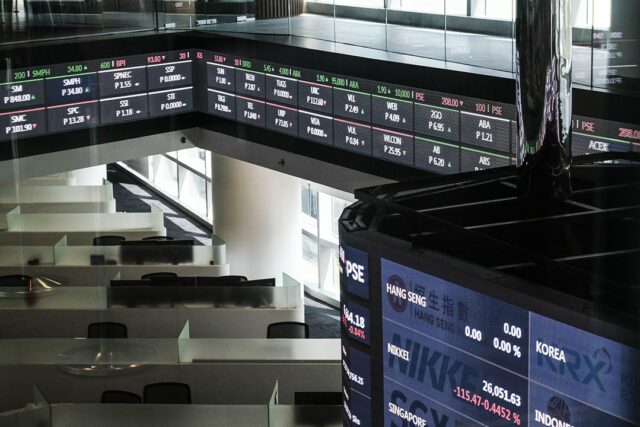
PHILIPPINE STOCK EXCHANGE — BLOOMBERG

PHILIPPINE REGULATORS have given the green light for market structure services firm PDS Group to offer trading of government bond forward contracts as the nation works to deepen its capital market.

A market framework and infrastructure for the instruments was approved by the country’s Securities and Exchange Commission on Jan. 2, said Antonino A. Nakpil, president of Philippine Dealing & Exchange Corp. (PDEx).

PDEx, the trading-services arm of PDS, operates Manila’s bond exchange and will run the new mechanism.

The bond forward contracts — which set a fixed price for a debt security on a future date and allow market participants to hedge interest rate risks — will be traded, cleared and settled through the PDEx fixed-income market. The forward buyer and seller may choose to settle obligations by offsetting their purchase and sales contracts.

“We made it non-deliverable so you can just keep rolling,” Mr. Nakpil said in an interview at a central bank event on Friday.

He said the mechanism will use a bilateral netting system — a legally enforceable arrangement between a bank and counterparty — rather than central clearing the way the US and some other markets do.

This will be the first Philippine peso interest rate hedge that mimics bond futures contracts, which trade on exchanges and are settled daily, Mr. Nakpil said. PDS is looking to launch it next month, he added, and trading will be in lots of P50 million ($853,000).

The Philippines is looking to bolster its capital market, preparing for increased demand in an economy posting one of Asia’s fastest growth rates. Bangko Sentral ng Pilipinas (BSP) last year expanded the list of derivatives products that banks may transact in to include forward contracts and any financial derivatives traded in an organized market.

The launch of the bond forward contracts will come just months after the Bankers Association of the Philippines, backed by the BSP, introduced a peso interest rate swap facility. Bond forwards will complement those to help firms manage rate risks, Mr. Nakpil said.

“The pieces of the puzzle are in place” for the capital market to develop, he said. — Bloomberg

DoF still pushing for key tax reform measures

PHILIPPINE STAR/KRIZ JOHN ROSALES

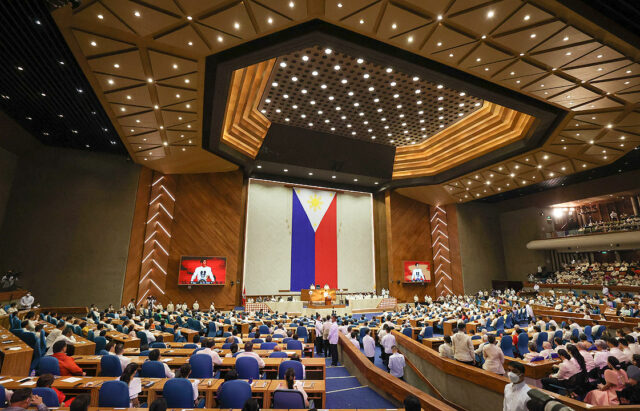
THE DEPARTMENT of Finance (DoF) is hoping several tax reform measures will be approved by Congress this year despite the upcoming midterm elections.

“The legislators have the option to do public hearings during the break. We can do the work then do just one committee meeting during the resumption to pass the committee report,” DoF Revenue Operations Group Director Euvimil Nina R. Asuncion told reporters on the sidelines of an event on Jan. 8.

“We will continue working with the leadership of the House and the Senate to pass the measures.”

The 19th Congress resumes session on Jan. 14, but will adjourn on Feb. 8 as lawmakers prepare for the start of campaign period. The campaign period for national elective posts starts on Feb. 11, while the campaign for local posts starts on March 28. The elections are scheduled for May 12.

Lawmakers will resume session on June 2 and will adjourn sine die on June 13, formally closing the 19th Congress.

Ms. Asuncion said the DoF is pushing for the approval of the excise tax on single-use plastics (SUPs), the proposed Government Revenues Optimization through Wealth Tax Harmonization (GROWTH) bill, and reforms for the fiscal regime for the mining industry.

“Instead of doing the CMEPA (Capital Markets Efficiency Promotion Act), we want the GROWTH bill [passed] instead since it covers both capital markets and financial intermediates. Actually, all of the items that are in CMEPA are also in the GROWTH bill. The GROWTH bill is the new Passive Income and Financial Intermediary Taxation Act (PIFITA), basically,” she added.

Ms. Asuncion also said the DoF hopes Congress will approve the bill imposing an excise tax on single-use plastics.

“We’re pushing for that as well. Not just because of revenues, but we really have to start looking at our commitments on climate change… We really see it as causing plastic pollution, especially in our cities. We really have to push for a revenue measure that will really discourage the use,” she said.

The House of Representatives approved its version of the bill in November 2022, while a similar measure is pending with a Senate committee.

Ms. Asuncion said these measures should have been approved last year, and could be deliberated on by the 20th Congress, which will open on July 28.

“That’s a new Congress again. We will have to explain the measures again and convince different people, depending on who wins in the elections,” DoF’s Ms. Asuncion said.

Albay Rep. Jose Maria Clemente “Joey” S. Salceda, who chairs the House Ways and Means Committee, said in a Viber message that tax reforms would not be delayed by the elections.

“I am not that worried about the elections. We were able to pass significant reforms during the lame duck session last time,” he said.

He noted the CMEPA bill is “well on the way,” while the proposed mining fiscal regime reform bill has a “strong chance” of getting passed before the 19th Congress ends.

“My preference is we get the Motor Vehicle Road User’s Charge done before the 19th Congress ends. The rates have not been updated since 2004, and it could yield substantial revenues of up to 52 billion for public transport, road projects, and other transport improvements,” Mr. Salceda said.

TAX AMNESTY
Meanwhile, DoF’s Ms. Asuncion said the department is looking to introduce a general tax amnesty measure.

“So right now, the estate tax amnesty is still effective. The delinquencies are down. But this is what we will look at if we were to have general tax amnesty,” she said.

“Hopefully we get to introduce it this year. Whether this Congress or the next, that is the question,” she added.

In 2019, then President Rodrigo R. Duterte signed Republic Act 11213 or the Tax Amnesty Act but vetoed the provision for a general tax amnesty due to loopholes. Mr. Duterte only retained the provisions for estate tax amnesty.

“Tax amnesty is but a one-off measure but can result in tax decline in the long run as taxpayers would think they could always avail themselves of amnesty in the future,” Action for Economic Reforms Coordinator Filomeno S. Sta. Ana III said in a Viber message. — AMCS 

Listed companies must disclose external auditor fees — SEC

ALL COVERED companies should present fee-related information in a two-year comparative format as a supplement to their annual financial statements. — BW FILE PHOTO

THE SECURITIES and Exchange Commission (SEC) is requiring publicly listed companies (PLCs) and other public interest entities to disclose fees paid to their external auditors to improve transparency.

The corporate regulator issued Memorandum Circular No. 18 on Dec. 26 last year. This circular includes rules on disclosing fee-related information of external auditors, the SEC said in an e-mailed statement on Monday.

“To enhance transparency relevant to external auditors’ independence and align with the commission’s rules on fee disclosure requirements with the Code of Ethics for Professional Accountants duly adopted in the Philippines, the commission resolved to issue these guidelines,” the SEC said.

The guidelines will apply to the annual financial statements (AFS) of covered entities for the period ending Dec. 31, 2024, onwards.

Entities covered by the guidelines include PLCs, issuers that have sold a class of securities pursuant to a registration under Republic Act No. 8799 or the Securities Regulation Code (SRC), and public companies or firms with assets of at least P50 million and 200 or more holders of at least 100 shares of a class of equity securities each.

The rules also apply to companies filing their financial statements for the issuance of any class of instruments in a public market; holders of secondary licenses issued by the SEC, Bangko Sentral ng Pilipinas, and Insurance Commission; and other corporations that the SEC may consider in the future as public interest entities.

Under the guidelines, all covered companies should present fee-related information in a two-year comparative format as a supplement to their AFS.

“The required disclosure covers fees paid or payable to, or as agreed with, the external auditor/audit firm and network firms for the audit of financial statements on which the external auditor expresses an opinion,” the SEC said.

Fees charged to the company and its controlled entities, consolidated in the financial statements, will be presented in a two-year comparative format.

The new disclosure guidelines also cover fees charged to any other related entities directly or indirectly controlled by a covered company for services by the external auditor/audit firm or a network firm.

If applicable, the guidelines also state that total fees received by the external auditor/audit firm from the covered company that represent over 15% of the total fees received by the external auditor for two consecutive years, and the year this situation first arose, should also be disclosed in the two-year comparative format.

Meanwhile, the SEC said covered companies are not required to adhere to the guidelines if the information relates to a parent entity or an entity directly or indirectly wholly owned by another public interest entity that is also preparing consolidated financial statements which already include the supplementary schedule.

The SEC warned that those who fail to comply with the guidelines will face penalties as prescribed under the Revised SRC Rule 68 and the commission’s consolidated scale of fines and penalties.

“This is a commendable measure to enable regulators and the investing public to better assess the independence of external auditors,” China Bank Capital Corp. Managing Director Juan Paolo E. Colet said in a Viber message.

“The hope is that higher transparency will strengthen corporate governance and help address ethical concerns around fee dependency,” he added. — Revin Mikhael D. Ochave

The King (of Philippine Nightlife)

STARDUST VIP AREA

By Joseph L. Garcia, Senior Reporter

FOR AN epic party, it’s always nice to have a hand to hold. In Manila, Louie Y (Luis Miguel Ysmael) has long held the city’s collective hand, having founded or been a partner to some of the hottest clubs in the city since opening Stargazer back in 1979.

Of that first club he wrote in the book Good Morning, Time To Sleep: The Adventures and Misadventures of Manila’s Nightlife Legend*: “It was a beautiful place, most especially at night. There’s nothing like towering over city lights and listening to good music… The music was the best of the ’70s and ’80s.”

Louie Y has not stopped partying since.

On Jan. 8, Mr. Ysmael took us to his latest venture (he’s a co-owner along with actor Alden Richards, Michael Chung, Manolet Dario, Angelo de Dios, André Kahn, Peter Hager, Nick Camcam, Vincent Lao, and Charlie Carmona) — Stardust, in Jupiter St. in Makati.

It’s class all the way: one enters through a mirrored hallway with a light fixture made of disco balls — more disco balls are found inside, including a central one that spins. One can see the difference between a cheap disco ball and these expensive ones: these have smaller shards of mirror, the better to diffuse light.

We asked Mr. Ysmael how many clubs he had opened since 1979’s Stargazer, at the top of the Silahis Hotel in Manila (the 19th floor, to be exact). Turns out there were more clubs than he has fingers.

There was that first club, then Louie Y’s, Pare (a members’ only club concept), then Euphoria in 1987, then Venezia (which became V Bar), then Nouveau. In the 2000’s, he entered into a partnership with the group of Erik Cua, joining the ventures that opened Prive, 71 Grammercy, Opus, and the present Palace club complex. By his count, he’s either founded or been a part of about 19 clubs. That means that for every generation since 1979, directly or indirectly, Mr. Ysmael’s finger has been on Manila’s partying pulse.

“It’s good synergy,” he said about his younger partners. “My name, my experience, my network of older… combined with Erik’s new market, new network, plus their energy. Galing (it’s great).”

His latest ventures are forays into the older market that still likes to go out. “This is the second one that I did for an aged market like that,” he said, recalling Pare. Another is his jazz club in Baguio, Louie Y’s at The Lodge. “Good food, personal service. Fantastic sound system. Good choice of music,” he said. “We want to go back to that time,” he said about Stardust, which is probably the reason for the disco interiors, and the disco music playing during our interview (but then, disco is immortal).

‘I LOVE THE NIGHTLIFE’
Mr. Ysmael discussed why parties in Manila simply hit different — and he knows whereof he speaks since he studied on the US East Coast and Europe, and was partying it up the whole time. “For Southeast Asia, we have the coolest and the hippest people. We speak English, we relate to American music better, compared to all the other… medyo (who are a bit) trying-hard, you know? Pretentious.

“The other countries that I would say that compare to the Philippine nightlife are Tokyo, and maybe at that time, Hong Kong. Pero wala na (but that is gone),” he said. “Thailand’s picking up. But No. 1 talaga ang Philippines pag dating sa nightlife (but No. 1 is really the Philippines when it comes to nightlife),” he said.

“We are a musically inclined people. Even the live bands all over the world, puro Pinoy iyan (those are all Filipinos).”

Discussing how different parties are now, he noted that “There’s more people partying now.” He remembers being asked if the girls at parties now are prettier than the girls in the parties before: “No, there’s just a lot more.”

“The influx of those coming in (to) a young club is bigger and heavier than the older ones who are slipping away slowly,” he said. “Somebody turns 18 every day. That’s new material, new customers for the clubs.

“People get older every day too. Somebody turns 65 every day… the market thins out on the older end.”

‘STAYIN’ ALIVE’
When we met him, he was dressed in a powder blue shirt, with matching suede loafers. A gold chain with a pendant lay on his chest, complimenting a rather battered Cartier Love bracelet on his wrist (the dents make it look chicer, if you ask us). More or less a senior citizen, we ask where he still gets his energy.

“The energy — I guess I’m blessed. See, I’m only 48…1948,” he joked.

“I’m losing the energy too. It’s not the same as before. But it’s my passion. It’s what I do. Some people like to paint, some people like to gamble. For me, this is fun and work at the same time. It keeps you going. It’s better than sitting around at home. I have time to do what I want,” he said.

A society scion — his father was steel heir Johnny Ysmael; his mother was the daughter of statesman Claro M. Recto, Chona Recto, a formidable name in her own right — he talked about how his background influences his approach to life and parties. “My mom was — she passed away when I was just opening Euphoria. She was very happy about my success. She knew — at that time, I had already been around, and I knew what I was doing. She was my mom, my sister, my best friend, all together. We traveled a lot together when things weren’t going well with my stepfather,” he said.

“She was a big influence on who I am and my outlook on life,” he said. “Just being true to yourself. Have good friends who will support you. Have a family that loves you and that you love, and just believe. Believe in what you’re doing.”

‘DON’T STOP ’TIL YOU GET ENOUGH’
We talk about the fast living that comes with clubs: drugs, drinking, sex, late nights, etc. “I’ve done it all. And I’m not dead,” he noted.

“That was a lifestyle of those times. If you can maintain, do all those (things), and drinking, and staying up late, and still remain on two feet, and with your brain in order – you’re good,” he said, but admitted: “I think I passed that already.”

“If it feels good, do it. That’s what I always say. But always know when it’s not feeling good. Right?”

He continued: “Health is wealth. Remember that. And the only two best things in life are health and happiness. Wealth is good too, but it might fuck up your health and happiness.”

There’s a 1969 song sung by Peggy Lee, “Is That All There Is?” There, she meditates on death: “Oh, no, not me/I’m not ready for that final disappointment,” then she encourages everybody to keep dancing, and to “break out the booze and have a ball/If that’s all there is.”

Time, of course, takes its toll, even on the King of Manila’s Nightlife.

“Well, I have health issues,” said Mr. Ysmael, pointing to his back. “Sciatica.” He’s not as active in sports anymore, when he used to play badminton three times a week. “Slowing down, because I’m ageing. But — I see some of my friends, sometimes, my age,” and then here he makes a bit of a wince. “Ooh. I’m lucky.”

“Pursue retirement? It’ll just happen. I’m retiring slowly. You don’t just say, ‘that’s it, goodbye,’” he said.

Hanggang kaya (while I still can). So long as I’m happy, and healthy.”

* Good Morning, Time To Sleep: The Adventures and Misadventures of Manila’s Nightlife Legend, by Louie Ysmael with Enzo Teodoro and GP Reyes

Stardust is at 58 Jupiter St., Makati. It is open from Tuesdays to Saturdays. Call 0917-167-5800 for reservations and inquiries or e-mail reservations@stardust.ph.