Home Blog Page 1604

National transport coalition rallies behind Angkasangga Partylist in historic show of unity

Photo shows transportation group leaders supports Angkasangga Partylist. From left: Lito Legaspi, Jopet Sison, Angkas CEO and Angkasangga Partylist nominee George Royeca, Ariel Lim, Juancho Capariño, and Gerry Donesa

In a landmark move that reshapes the landscape of public transport advocacy, the country’s largest and most influential transport leaders have united in support of the Angkasangga Partylist, formally signing a Memorandum of Agreement (MoA) with its first nominee, George Royeca, in a summit that underscored long-awaited sectoral solidarity.

Representing a wide coalition of national organizations — including tricycles (TODA), UV Express, jeepneys, van rentals, and taxis — this alliance signals the consolidation of transport voices long divided by sectoral disputes and policy fragmentation. For the first time in decades, these groups have come together under a shared vision: a unified, empowered, and dignified future for every transport worker in the Philippines.

The historic MoA affirms collective action on pressing transport issues such as livelihood protection, modernization with dignity, and inclusive legislation. It also marks a turning point in relations between traditional transport groups and emerging mobility platforms, highlighting a commitment to cooperation over conflict in the evolving public transport ecosystem.

Present at the signing were key figures from national transport coalitions, including:

Ariel Lim, President of NACTODAP and the United Transport Alliance of the Philippines, emphasized the magnitude of the moment:

“This MOA is more than symbolic. After years of division, we are now moving forward as one voice. The unity of our sector begins today — with Angkasangga as our common platform.”

Lito Legaspi, Vice-President of NACTODAP, expressed the full backing of grassroots TODA networks nationwide and called for immediate mobilization across barangays.

Juancho Capariño, leader of ACTO Nationwide Corp., pledged full alignment of the jeepney sector, reinforcing nationwide coordination under ACTO’s expansive network.

Gerry Donesa, an established voice among Metro Manila taxi operators, underscored support from legacy transport players and their readiness to help shape a modern, inclusive future.

Remarkably, this coalition includes former opponents of motorcycle taxi operations, signaling a powerful shift in the industry. Groups that once filed legal cases against MC taxi platforms are now standing in solidarity with Angkasangga, recognizing the leadership and bridge-building efforts of George Royeca in bringing all sectors to the same table.

Mr. Royeca, the visionary behind Angkas and a long-standing advocate for transport workers’ rights, welcomed the support with humility and resolve:

“This is not just a political endorsement — it’s a movement. From tricycles to jeepneys, UV Express, vans, and taxis, our transport heroes deserve representation, protection, and progress. Angkasangga exists to give voice to every driver, every operator, and every unsung hero of our roads. Today, we stand united — for the first time — as one transport sector.”

This unprecedented show of unity marks the beginning of a new era in transport policy-making, where sectoral divisions give way to shared purpose, and the long-marginalized workforce of Philippine mobility takes its rightful seat at the policy-making table.


Spotlight is BusinessWorld’s sponsored section that allows advertisers to amplify their brand and connect with BusinessWorld’s audience by publishing their stories on the BusinessWorld Web site. For more information, send an email to online@bworldonline.com.

Join us on Viber at https://bit.ly/3hv6bLA to get more updates and subscribe to BusinessWorld’s titles and get exclusive content through www.bworld-x.com.

Budget gap widens sharply in March

Workers of the Department of Public Works and Highways pour temporary asphalt on the potholes along Roxas Boulevard in Manila. — PHILIPPINE STAR/EDD GUMBAN

By Luisa Maria Jacinta C. Jocson, Senior Reporter

THE NATIONAL Government’s (NG) budget deficit ballooned in March as revenues slipped and state spending jumped ahead of the election ban, the Bureau of the Treasury (BTr) said.

Data from the BTr showed the fiscal gap widened by 91.78% to P375.7 billion in March from P195.9 billion in the same month a year ago.

Government spending surged by 35.37% to P655 billion in March from P483.8 billion a year prior.

National Government fiscal performancePrimary spending — which refers to total expenditures minus interest payments — soared by 37.29% to P566.9 billion from P412.9 billion.

Interest payments jumped by 24.21% to P88.1 billion from P70.9 billion in the previous year.

In March, revenue collection fell by 3.01% year on year to P279.3 billion, as nontax revenues plunged by 69.36% to P19.6 billion.

Broken down, income from the BTr slumped by 83.32% to P8.7 billion while revenues from other offices declined by 26.9% to P10.9 billion.

Tax revenues, on the other hand, rose by 15.97% to P259.6 billion in March from P223.9 billion a year ago.

Bureau of Internal Revenue (BIR) collections jumped by 20.86% to P175.7 billion, while Bureau of Customs’ (BoC) revenues went up by 7.3% to P80.4 billion.

“The sharp widening of the budget deficit in March and the first quarter was driven primarily by stronger government spending, particularly on infrastructure and social programs, alongside a moderation in revenue growth,” John Paolo R. Rivera, a senior research fellow at the Philippine Institute for Development Studies, said.

“Disbursements likely ramped up ahead of the election-related spending ban, while revenues, although growing, may have faced headwinds from slower-than-expected collections in certain tax components,” he added.

The 45-day election ban on the release of public funds for public works projects began on March 28. This is done to prevent incumbent officials from using these funds during the election period for their advantage.

FIRST QUARTER
The budget deficit in the January-March period widened to P478.8 billion, higher by 75.62% from the P272.6-billion gap in the same period in 2024.

However, the Treasury said this was still in line with its P1.5-trillion full-year deficit program.

Expenditures jumped by 22.43% to P1.477 trillion as of end-March from P1.21 trillion in the same period a year ago.

The Treasury said government spending in the first quarter already accounted for 23.89% of the P6.2-trillion full-year disbursement program.

Primary spending increased by 21.96% to P1.24 trillion and interest payments jumped by 24.88% to P241 billion.

“The strong spending performance can be attributed to the higher disbursements recorded in the Department of Public Works and Highways (DPWH) for its road infrastructure program and regular operating requirements, and in the Department of Social Welfare and Development (DSWD) for its various protective services programs.”

It also cited National Tax Allotment (NTA) transfer shares, annual block grant to the Bangsamoro Autonomous Region and releases for the local government support fund.

“Likewise, the transfer of P32.8 billion (inclusive of accrued interest) to the Coconut Farmers and Industry Trust Fund in accordance with the mandated schedule of capitalization contributed to the larger spending outturn,” the BTr said.

Meanwhile, state revenues increased by 6.9% to P998.2 billion in the first quarter from P933.7 billion a year earlier. This year, the government is projecting to collect P4.64 trillion in revenues.

Tax revenues rose by 13.55% to P931.5 billion from P820.4 billion last year.

The BTr said that its overall collections remain on track due to a “strong” performance from the BIR and Customs.

“The revenue agencies’ sustained growth for the third consecutive month was driven by their ongoing revenue enhancement measures, particularly the intensified campaign against the use of fake receipts, intensified crackdown on illicit trade, digitalization, and improvements in tax payment facilitation, among other initiatives,” it said.

BIR revenues climbed by 16.67% to P690.4 billion, due to “higher collections from personal income tax (PIT), corporate income tax (CIT), percentage taxes, value-added tax (VAT), excise taxes, documentary stamp tax, and percentage taxes.”

Customs collections grew by 5.72% to P231.4 billion driven by “higher VAT from non-oil imports and excise tax collections from oil and non-oil imports.”

On the other hand, nontax revenues slumped by 41.21% year on year to P66.7 billion as of end-March.

BTr revenues plunged by 55.3% to P32.3 billion while collections from other offices decreased by 16.5% to P34.3 billion.

“Largely due to timing as 18 government-owned and -controlled corporations (GOCCs) remitted P28.23 billion in early first-quarter dividends back in 2024 compared with only three GOCCs with P0.027 billion early dividends for the current year,” the BTr said.

“Nevertheless, nontax revenues are expected to improve in the succeeding months, with dividends from the GOCCs set to be remitted to the National Treasury starting May 2025.”

The BTr said that the NG is still on track to keeping to its deficit targets for the year.

“With dividend remittances and other nontax receipts expected to materialize in the succeeding quarters, and as expenditures continue to track the full-year program in a more balanced manner, the 2025 fiscal deficit is projected to remain within the P1.5-trillion target.”

Under the latest Development Budget Coordination Committee (DBCC) figures, the NG capped its deficit ceiling at 5.3% of gross domestic product (GDP) this year.

Mr. Rivera said the NG’s budget gap reflects the need for “balancing fiscal support for development priorities with disciplined revenue mobilization to avoid long-term fiscal strain.”

Rizal Commercial Banking Corp. Chief Economist Michael L. Ricafort said the wider fiscal deficit could also increase the need for additional borrowings to support cash flow.

“Faster growth in government expenditures also reflected increased debt servicing amid the dramatic increase in debt incurred since the COVID-19 (coronavirus disease 2019) pandemic started nearly five years ago,” he said.

On the other hand, Mr. Ricafort said the budget balance could revert to a surplus in April amid the seasonal increase in tax collections as the BIR deadline for filing was on April 15.

Mr. Ricafort said there may be a need for more fiscal reform measures to “reduce government expenses such as rightsizing of the government and tax reform to further increase collections to narrow the budget deficit and curb additional need for borrowings.”

“Additional tax revenue collections based on existing tax laws or through new tax reform measures and even higher tax rates would be needed, especially if inflation becomes more benign and better controlled since higher taxes could add to inflationary pressures,” he added.

The Finance department has said it has no plans to introduce new tax measures anytime soon, instead focusing on improving tax administration and efficiency.

Central bank sees inflation at 1.3%-2.1% in April

Inflation may have settled within the 1.3%-2.1% range in April, the central bank said. — PHILIPPINE STAR/MIGUEL DE GUZMAN

HEADLINE INFLATION may have settled below the 2-4% target band again in April, the Bangko Sentral ng Pilipinas (BSP) said.

The central bank’s month-ahead forecast showed that inflation likely settled within the 1.3%-to-2.1% range in April.

If realized, April inflation would be much slower than the 3.8% print logged in April 2024.

At the upper end of the BSP forecast, inflation likely accelerated from the near-five-year low of 1.8% in March.

On the other hand, the low end of the forecast showed inflation could have hit its lowest clip in over five years or since 1.2% in November 2019. It would also mark the third straight month of deceleration.

The local statistics agency is set to release April inflation data on May 6 (Tuesday).

“Easing prices of rice, fish, fruits, and vegetables, favorable domestic supply conditions along with lower oil prices and the peso appreciation contributed to the downward price pressures for the month,” the BSP said.

Rice inflation has been on the decline after the government slashed tariffs on rice imports in July last year and following the food security emergency declared on the staple grain this February. In March, rice inflation decelerated to 7.7%.

The peso closed at P55.84 per dollar on April 30, its strongest finish in more than seven months or since its P55.69 finish on Sept. 20, 2024.

It was also the first time the peso hit the P55 level since it closed at P55.965 on Sept. 26, 2024.

Pump price adjustments stood at a net decrease of P0.80 a liter for kerosene in April. However, it stood at a net increase of P0.40 a liter each for gasoline and diesel.

“These could be offset in part by the higher electricity rates and LRT-1 fares,” the central bank added.

Starting April 2, the boarding fare at Light Rail Transit Line 1 (LRT-1) was raised to P16.25 from P13.29, while the distance per kilometer fare was increased to P1.47 from P1.21.

Manila Electric Co. (Meralco) hiked the overall rate by P0.7226 per kilowatt-hour (kWh) to P13.0127 per kWh in April from P12.2901 per kWh in March.

“Going forward, the Monetary Board will continue to take a measured approach in adjusting the monetary policy stance in line with its price stability objectives conducive to balanced and sustainable growth of the economy and employment,” the BSP said.

In April, the BSP resumed its rate-cutting cycle with a 25-basis-point (bp) rate cut. This brought the benchmark to 5.5%.

The Monetary Board had delivered a pause at its first policy review of the year in February as it waited to see how global trade policies would unfold.

BSP Governor Eli M. Remolona, Jr. has said there is room for further easing this year, but this will likely be delivered in “baby steps.”

The central bank earlier said risks to the inflation outlook have also eased and remained “broadly balanced” until 2027.

Accounting for risks, inflation is expected to average 2.3% in 2025, 3.3% in 2026, and 3.2% in 2027.

For the first quarter, inflation averaged 2.2%. — Luisa Maria Jacinta C. Jocson

Trade gap balloons to $4.13 billion in March

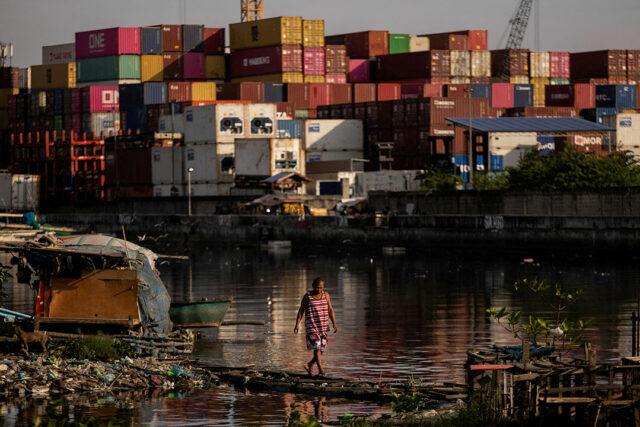
A container terminal in Manila is seen in this file photo taken on April 11, 2025. — REUTERS

THE PHILIPPINES’ trade-in-goods deficit widened to a two-month high in March as both exports and imports picked up, the Philippine Statistics Authority (PSA) reported on Wednesday.

Preliminary data from the PSA showed the country’s trade balance in goods stood at a $4.13-billion deficit in March, 23% higher than the $3.35-billion gap a year ago.

Month on month, the gap was 19.4% bigger than the $3.46-billion deficit in February.

Philippine Merchandise Trade Performance (March 2025)

March marked the widest trade deficit in two months or since the $5.12-billion deficit in January.

The country’s balance of trade in goods has been in a deficit for 118 straight months since the $64.95-million surplus recorded in May 2015.

In March, merchandise exports jumped by an annual 5.9% to $6.59 billion, marking the third straight month of growth.

It was also a turnaround from the 5.9% contraction in the same month last year.

By value, this was the highest export level since the $6.75 billion in August 2024.

Meanwhile, imports climbed by 11.9% year on year to $10.72 billion in March, the fastest pace in 11 months since the 13.2% logged in April 2024.

The value of imports was also the biggest since $11.49 billion in January.

In the first quarter, the trade deficit stood at $12.71 billion, widening by 12.8% from the $11.26-billion gap a year ago.

Exports expanded by 5.9% to $19.27 billion in the first three months of 2025, while imports rose by 8.4% to $31.98 billion.

The Development Budget Coordination Committee (DBCC) projects 6% and 5% growth in exports and imports, respectively, this year.

SEMICONDUCTOR SLUMP
Exports of manufactured goods, which made up 80.7% of the country’s total exports, grew by an annual 5.2% to $5.32 billion in March. Exports of agro-based products jumped by 27% to $586.86 million.

By commodity group, electronic products, which made up 55.2% of exported manufactured goods, inched up by 0.9% year on year to $3.64 billion in March.

Semiconductors, which accounted for 40.8% of electronic product exports, shrank by 3.8% to $2.69 billion in March.

Exports of other manufactured goods climbed 39.5% to $434.41 million, while other mineral products grew by 28.2% to $246.56 million in March. Coconut oil exports surged by 78% to $240.77 million.

The United States remained the top destination for Philippine-made goods in March, with exports valued at $1.11 billion accounting for 16.8% of the total.

This was followed by Hong Kong with $1.01 billion (15.3% share), Japan with $960.5 million (14.6%), China with $762.78 million (11.6%), and Singapore with $273.74 million (4.2%).

Sergio R. Ortiz-Luis, Jr., president of Philippine Exporters Confederation, Inc., said in a phone interview that exports are “inching up slowly but surely.”

“Unfortunately, we are still not able to meet our original targets for exports, but we hope to make at least $110 billion. The original target is $120 billion,” he said.

RECOVERY IN RAW MATERIALS
Meanwhile, imports of raw materials and intermediate goods, which had the biggest share of total imports at 36.5%, jumped by 22.4% to $3.92 billion in March from $3.2 billion a year earlier.

Imports of capital goods grew by 12.2% to $3.16 billion, while consumer goods increased by 25.8% to $2.3 billion.

“We saw a healthy recovery in imports of raw materials and capital goods, possibly as firms were able to finally restart their capacity building after the BSP (Bangko Sentral ng Pilipinas) decided to support the economy by cutting rates,” Nicholas Antonio T. Mapa, a senior economist at the Metropolitan Bank & Trust Co., said.

Mr. Mapa noted the rebound in capital and raw materials imports was accompanied by “sustained consumer imports, reflecting healthy household consumption, which points to a decent first-quarter GDP (gross domestic product) print.”

By commodity group, electronic products had the highest import value at $2.52 billion, up 24.8% in March from $2.02 billion a year ago.

Imports of semiconductors, which accounted for the bulk of electronic products, jumped by 21.4% to $1.69 billion.

Imports of mineral fuels, lubricants and related materials, on the other hand, declined by 23.1% year on year to $1.31 billion, while transport equipment rose by 12.1% to $1.06 billion.

China was the biggest source of imports in March with $3.1 billion worth of goods, accounting for 28.9% of the total import bill.

It was followed by Indonesia with $888.27 million (8.3% share), Japan with $834.38 million (7.8%), South Korea with $728.94 million (6.8%), and Thailand with $627.65 million (5.9%).

“We’ll need to see how trade flows perform in the coming months as the pickup in both imports and exports could have been frontloading activity carried out by traders in anticipation of Trump’s trade war. If exports continue while imports sustain their growth on investment activity by firms despite the Trump trade war, this could bode well for overall Philippine economic growth prospects,” Mr. Mapa said.

In April, US President Donald J. Trump implemented a 10% blanket tariffs on all its trading partners. However, his plan to impose higher reciprocal tariffs on most countries, including the Philippines, has been suspended until July.

Philippine exports to the US are facing a 17% tariff, the second lowest among Association of Southeast Asian Nations member countries after Singapore’s baseline rate of 10%.

Mr. Mapa said the trade outlook is uncertain but imports of raw materials, capital goods and consumer goods are expected to continue.

“Exports, meanwhile, may face a challenging year; however, the Philippines could find alternative markets for outbound shipments,” he added.

For his part, Mr. Ortiz said exports may sustain growth this year although there will be some challenges.

He said he does not think exports and imports will achieve the original growth targets for this year.

“We’ll probably fall short by a little, not much. It’s hard to predict the next few months because of the uncertain and very volatile US policies… Hopefully at this stage, it won’t be too negative on us. We may also find opportunities,” Mr. Ortiz said. — JPGV

DoTr hopes to privatize 15 more airports by 2026 

Airplanes are seen on the runway of Manila’s main airport. — PHILIPPINE STAR/WALTER BOLLOZOS

By Ashley Erika O. Jose, Reporter

THE Department of Transportation (DoTr) is hoping to privatize at least 15 airports by 2026 as the government seeks to make regional airports “more economically viable.”

“The DoTr has informed its advisors to start working on bundling regional airports to make them more economically viable,” DoTr Spokesperson for Business Infrastructure Maricar L. Bautista said at the Public-Private Partnerships (PPP) in action: Transforming Infrastructure and Services briefing facilitated by the British Chamber of Commerce Philippines on Tuesday.

“Seven airports are now under PPP and by 2026, the DoTr targets to increase the number of airports under PPP arrangement to around 15,” she added.

Ms. Bautista noted that the government is targeting to have at least 20 airports under PPP by 2028 before the end of the Marcos administration.

She said the airports being eyed for PPP arrangement include the Iloilo International Airport, Davao International Airport, Laoag International Airport, Bicol International Airport, Bacolod-Silay International Airport, General Santos International Airport, as well as airports in Siargao, Dumaguete and Busuanga.

The DoTr is also working on bundling of smaller airports to offer as one project, Ms. Bautista said, without identifying the airports.

The Transportation department said last year that it is studying the possibility of offering smaller airports under a single contract as it is more enticing to private companies.

At present, the airports under PPP include Ninoy Aquino International Airport (NAIA) which is operated by San Miguel Corp.-led New NAIA Infra Corp; and the New Manila International Airport and Caticlan Airport which are under SMC’s units San Miguel Aerocity Inc. and Trans Aire Development Holdings Corp., respectively.

Other airports being managed by private operators include Mactan-Cebu International Airport by Aboitiz InfraCapital Cebu Airport Corp., Laguindingan International Airport, New Bohol-Panglao International Airport by Aboitiz InfraCapital, Inc., and Clark International Airport operated by Luzon International Premiere Airport Development Corp.

Sought for comment, PPP Center Deputy Executive Director Jeffrey I. Manalo said the Transportation department is still preparing the requirements for approval of the Department of Economy, Planning, and Development (DEPDev) for the Iloilo International Airport.

To recall, Villar-led Prime Asset Ventures, Inc.’s (PAVI) unsolicited proposal for the operations and maintenance of the Iloilo International Airport is now awaiting the approval of the Investment Coordination Committee of DEPDev. Once approved, it will then undergo a Swiss challenge.

PAVI holds the original proponent status for the P21.16-billion rehabilitation, expansion, operation, and maintenance of the Iloilo International Airport. The project needs to be endorsed and recommended for final DEPDev approval as the project’s cost is above P15 billion.

Mr. Manalo said the unsolicited proposal for the operations and maintenance of the Davao International Airport is still pending assessment.

According to the PPP Center website, the project is still being evaluated by the implementing agency.

The P12.9-billion project was submitted by Davao International Airport Consortium composed of Asian Infrastructure and Management Corp.; Filinvest Infra-Solutions Ventures, Inc.; and JG Summit Infrastructure Holding Corp.

For Rene S. Santiago, former president of the Transportation Science Society of the Philippines, the agency’s goal to privatize more airports is quite ambitious and may not be feasible within the timeline.

“It took more than five years to bid for privatization of three airports,” he said in a Viber message, referring to the privatization of NAIA, Laguindingan and New Bohol-Panglao airports.

The viability of airports under PPP arrangement would likely depend on the airports’ capacity, as some smaller regional airports are better off under the management of the government through Civil Aviation Authority of the Philippines (CAAP), Nigel Paul C. Villarete, senior adviser on PPP at the technical advisory group Libra Konsult, Inc., said.

“Some airports would have sufficient passenger volumes that would warrant sufficient income streams to generate profitability, but there are the smaller ones which won’t be and are better with the government which can provide subsidies. In general, PPP arrangements would be beneficial for the public inasmuch as it invites efficiency, which will redound to better services to our traveling public,” he said.

Balisacan says tariff impact ‘very minimal’

A US FLAG and a “tariffs” label are seen in this illustration taken on April 10, 2025. — REUTERS/DADO RUVIC/ILLUSTRATION

THE IMPACT of the US reciprocal tariffs on the Philippines will likely be minimal, the Department of Economy, Planning, and Development (DEPDev) said, but noted the country will still need to enhance its investment environment to benefit from shifting trade paths.

“We find the overall impact on the economy was minimal,” DEPDev Secretary Arsenio M. Balisacan told reporters on the sidelines of National Innovation Day on Wednesday.

“In fact, it was even slightly positive, but very minimal. And the reason for that is that we had some of the trade diversion benefits because we had lower tariffs (than) our neighbors,” he added.

The United States set a 17% reciprocal tariff on the Philippines, the second lowest in Southeast Asia.

While the implementation of the higher duties was suspended until July, US trading partners are currently subject to a blanket 10% tariff.

Though shifting trade routes would work in the favor of the Philippines, Mr. Balisacan said the country is still not fully equipped to capitalize on this.

“For us to be able to respond to diversion benefits, we should be able to have so much capacities. But we don’t have that. We need investments to expand existing capacities,” he said.

“That’s why the overall net effect is not that high. The overall net effect is quite minimal.”

“But that doesn’t take into account the longer term because if the trade uncertainty continues, then the global economy will further slow down. That would come back to us also because we are part of the global supply chain,” he added.

Despite many multilaterals slashing the Philippines’ growth forecast, the country is still in a better position compared with its neighbors, Mr. Balisacan said.

“If you look at it from that perspective, we are so much better off than many of the countries around us… But that, to me, does not give me space for complacency because the challenge is when the global economy recovers… will we be ready? Will we be able to export a lot? Will we be able to get those investments? That’s what we must be thinking about.”

The country needs to significantly enhance the environment for investments, he added.

“Regardless if there are reciprocal tariffs or not, we know our constraints, we know what’s limiting the economy from growing faster,” Mr. Baliscan said.

Based on the latest edition of Kearney’s FDI Confidence Index, the Philippines fell three spots to 16th place out of 25 emerging markets. The index ranks markets that are likely to attract the most FDI in the next three years.

“The ease of doing business, high cost of services, infrastructure, governance, institutions, and regulations. Those are the things that we need to fix.”

“Because if you look at our history in the last five decades, when the opportunities come, we missed the boat. Because we did not prime, we did not shape up.”

TRADE DEFICIT
Meanwhile, Mr. Baliscan said a widening trade deficit would also not be worrisome if the composition of imports would help spur growth, he added.

“Well, it’s double-edged. Of course, it increases the trade deficit, but it’s okay. If those are raw materials or capital equipment, then they should be good indications of a growing and robust economy.”

The country’s trade deficit widened $4.13 billion from the $3.46-billion gap in February and the $3.35 billion shortfall a year earlier.

This could also be reflected in the first-quarter gross domestic product (GDP) data, he added.

“The trade sector could have been hit hard by the slowdown which started in the beginning of the year,” he said.

“Although the net export is a relatively small component of the GDP, when the drop in the growth rate is quite large, then of course, it will pull down the overall growth.”

First-quarter gross domestic product data is set to be released on May 8. — Luisa Maria Jacinta C. Jocson

Century Properties’ PHirst targets to deliver 10,000 units by mid-2025

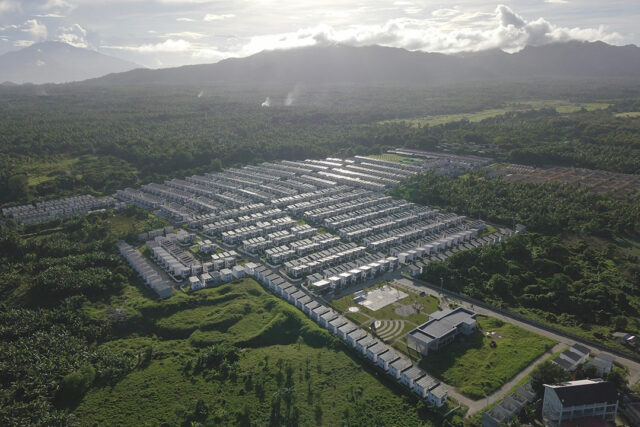
A DRONE SHOT showing a completed PHirst community.

PHIRST PARK HOMES, Inc., the affordable housing brand of Century Properties Group, Inc. (CPG), said it aims to turn over around 10,000 units to first-time homebuyers by mid-year.

“As of April 2025, PHirst has successfully completed the construction of around 15,000 units across its various projects nationwide,” CPG said in an e-mail statement on Wednesday.

“Following its construction milestone, by mid-2025 PHirst is looking into successfully handing over more than 10,000 homes to first-time homeowners,” it added.

The housing units are located across PHirst’s 27 active projects in Luzon and the Visayas, particularly in Cavite, Laguna, Batangas, Quezon Province, Bulacan, Pampanga, Bataan, Nueva Ecija, and Bacolod City.

PHirst Park Homes is the first-home (affordable housing) brand developed by PHirst Park Homes, Inc., a joint venture between CPG and Japan’s Mitsubishi Corp. CPG is known for upscale developments such as Trump Tower at Century City and Azure Urban Resort Residences, while its partner, Mitsubishi Corp., is one of Japan’s largest conglomerates with diverse business interests spanning finance, infrastructure, and consumer goods.

PHirst said it established its own water services management group, branded as PH20, to help ensure the efficient operation of water facilities and infrastructure in PHirst communities.

The PH20 team began operations in four PHirst subdivisions: PHirst Park Homes Batulao in Batangas, PHirst Sights Bay in Laguna, PHirst Park Homes Tayabas in Quezon, and PHirst Park Homes Balanga in Bataan.

“Through our in-house construction capabilities and water services management group, we not only ensure that we provide quality homes but also enable our residents to experience being part of thriving communities and elevated living standards,” PHirst President Ricky M. Celis said.

CPG also noted its planned expansion efforts through its in-house precast and cast-in-place construction divisions, operating under the PHirst-Build brand.

“To date, PHirst-Build covers various projects in Batangas, Bataan, Nueva Ecija, and Bacolod, and will continue its expansion into more locations nationwide as the company responds to the growing demand for housing with a variety of sizes and design options.”

CPG reported a 31% increase in net income to P2.44 billion for 2024, up from P1.86 billion in 2023, driven by strong performance in both its premium residential and affordable housing segments.

The company’s revenue rose by 15% to P14.64 billion.

Its first-home segment generated P9.9 billion in revenue, a 34% increase from P7.4 billion the previous year. Its premium residential projects contributed P3 billion, while leasing and property management operations brought in P1.31 billion and P464 million, respectively.

Total assets grew by 3% to P55.9 billion, while interest-bearing debt declined by 16%.

Shares of CPG ended flat at P0.64 on Thursday. — B.M.D. Cruz

SMIC sees resilience amid global trade uncertainties

PHILIPPINE STAR FILE PHOTO

THE SY FAMILY’S listed conglomerate SM Investments Corp. (SMIC) said it is confident it can sustain stable business performance, driven by strong consumer spending, despite market volatility and global trade uncertainties caused by the US government’s reciprocal tariffs.

“Consumption accounts for over 70% of gross domestic product (GDP), while exports of goods account for only about 15–16%, and manufacturing accounts for less than 30%. This structure gives us a certain amount of protection. We are less vulnerable,” SMIC Chairman Amando M. Tetangco, Jr. said during the company’s annual stockholders’ meeting in Pasay City on Wednesday.

“We may be less open than other countries. But in this current environment, it provides us some insulation from potential adverse effects from external developments,” he added.

SMIC President and Chief Executive Officer Frederic C. DyBuncio said during the meeting that easing inflation and a robust economy would create new opportunities.

“Our focus on consumer growth mirrors the over 70% of GDP driven by consumer spending. We are a strong group with leading businesses, a trusted brand and heritage, with a very conservative balance sheet, and we have world-regarded leadership,” he said.

“Our geographic expansion strategy — serving more communities and customers — follows the growth of the country,” he added.

For 2025, SMIC is allocating P115 billion for capital expenditures, higher than the P100-billion capex spent last year. SMIC’s core business interests are in retail, banking, and property.

In the renewable energy segment, Mr. DyBuncio said SMIC, through subsidiary Philippine Geothermal Production Co., Inc., has secured five new concessions from the Department of Energy to grow its geothermal portfolio.

“We’re exploring each one of them. But it takes time to be able to drill and be able to make things commercially viable. We actually purchased our own drilling rig, which arrived last September. We bought the rig from Houston,” he said.

“We will continue to drill and really explore geothermal fields to be able to help the country’s renewable drive,” he added.

Meanwhile, SMIC shareholders elected seasoned executive Marife B. Zamora as an independent director on Wednesday. She replaced Tomasa H. Lipana, who completed her maximum term as an independent director.

Ms. Zamora is the second female independent director of SMIC, joining Lily K. Gruba.

“I’m truly honored to join SM’s board. SM mirrors the energy and growth journey of the Philippine economy. I look forward to contributing to a growing company deeply committed to independence and strong corporate governance,” Ms. Zamora said.

Ms. Zamora has decades of leadership experience in telecommunications, insurance, and business process outsourcing.

She is also a known advocate for women in technology and leadership, serving on the Board of Trustees of the FTW (For The Women) Foundation and as co-founder of the Filipina CEO Circle, a network of women business leaders driving positive change.

SMIC shares rose by 1.75% or P15 to P870 per share on Wednesday. — Revin Mikhael D. Ochave

Offline-first database servers to help PHL companies be disaster-ready

PHILIPPINE STAR/MIGUEL DE GUZMAN

COUCHBASE, INC. is optimistic about its growth in the Philippine market with its offline-first database server that can help enterprises ensure uninterrupted operations during disasters.

“The Philippines sits in a very interesting position geographically because it has a lot of disaster disruptions during the year, which has significant impact on businesses,” Genie Yuan, regional vice-president for Asia Pacific at Couchbase, told BusinessWorld in a virtual interview.

“Our strategy is very simple going into the Philippine market and anchoring on a mission-critical application for the enterprise.”

The Philippines, which experiences an average of 20 typhoons every year, remained the world’s most disaster-prone country, according to the 2024 World Risk Index.

In March, the company launched Couchbase Edge Server, an offline-first, lightweight database that provides data access, consolidation, storage, and processing for applications at a low latency.

“There are a number of instances when I’m trying to find some food after a typhoon or a natural disaster, and a lot of shops say, ‘I can pop a generator at the back of the house, but I don’t have internet, I can’t make a transaction’,” Mr. Yuan said.

Many existing edge applications rely solely on cloud databases that are affected by connectivity issues, especially during natural disasters.

Couchbase Edge Server is designed to work in areas without internet connectivity on the edge device, running on resource-constrained infrastructures with as little as one gigabyte RAM (random access memory).

Once connectivity is restored in the area, data will automatically sync back to the enterprises’ cloud or centralized server, the company said.

“Couchbase is designed to have the database embedded on the edge device. This means as long as you have power or the battery that is available on the machine or on the terminal, it will store the data. It will transact. You will have the compute and storage capability,” Mr. Yuan added.

Couchbase Edge Server is built on the Couchbase Lite core engine, which is designed to power artificial intelligence (AI)-driven applications. The latter has a vector capability, which can handle localized knowledge bases to avoid “AI hallucinations.”

The edge server is also capable of horizontal scaling, allowing businesses to add as many workloads as they need, according to Mr. Yuan.

Around 65% of enterprises believe that edge solutions will be critical for deploying generative AI applications, Couchbase said, citing its recent survey of over 1,000 companies across the United States, United Kingdom, Germany, and Turkey.

Mr. Yuan said AI adoption among Philippine enterprises is still in its “early stages,” citing challenges related to compliance, costs, and scattered data.

“It is important to understand that AI is not going to happen only in the cloud. AI can happen in multiple locations — from the edge to the intermediate,” he said. — Beatriz Marie D. Cruz

Weaker business units drag AEV profit in Q1

ABOITIZPOWER.COM

LISTED conglomerate Aboitiz Equity Ventures, Inc. (AEV) posted a 35% drop in first-quarter (Q1) net income to P3.2 billion from P4.9 billion a year ago due to weaker contributions across its business units. 

“While this marks a temporary decline from the previous year, the group’s strategic investments in renewable energy and infrastructure expansion underscore its long-term vision for growth, resilience, and nation-building,” AEV said in a statement on Wednesday. 

Among its business units, power had the largest net income contribution at 62%, followed by food and beverage at 35%.

Net income contributions from the financial services, real estate, and infrastructure businesses were at 17%, -1%, and -13%, respectively.

“While revenues slightly dipped due to lower power selling prices, this reflects favorable cost trends — particularly in fuel and supply. Our focus remains on the quality of earnings, not just topline growth,” AEV President and Chief Executive Officer Sabin M. Aboitiz said. 

“Looking to 2025, we see even more opportunities to create value for our shareholders and contribute to national development,” he added.

Net income contribution from power unit Aboitiz Power Corp. fell by 39% to P2.5 billion from P4.2 billion a year earlier.

Beneficial earnings before interest, taxes, depreciation, and amortization dropped by 8% to P15.1 billion due to lower spot market prices and the upfront, scheduled outages of the Pagbilao, Therma Visayas, Inc., and GNPower Mariveles Energy Center plants. 

The banking unit Union Bank of the Philippines contributed P702.3 million in net income, down by 28% from P978.3 million a year ago. Revenue rose by 8% to P19.4 billion on higher net interest income and growth in consumer loans. 

Real estate subsidiary Aboitiz Land, Inc. recorded a P58.3-million consolidated net loss, a reversal from the P280.3-million net income a year earlier, due to lower sales and higher forfeitures. 

Net income contribution from the food and beverage segment rose by 54% to P1.4 billion, driven by profitability gains, margin and volume growth in the flour and agribusiness segments, and full contributions from Coca-Cola Europacific Aboitiz Philippines, Inc. (CCEAP). 

Companies under the segment include CCEAP, Pilmico Foods Corp., Pilmico Animal Nutrition Corp., and Pilmico International Pte. Ltd.

Meanwhile, infrastructure unit Aboitiz InfraCapital, Inc. recorded a P207-million net loss due to higher interest expense from increased debt availments for its expansion.

The conglomerate’s share in Republic Cement & Building Materials, Inc.’s loss grew by 48% to P338.1 million on lower sales volume and selling prices due to weak demand.

AEV earmarked P105 billion in capital expenditure this year, of which P78.1 billion will go to the expansion of its renewable energy business.

AEV shares retreated by 2.4% or 80 centavos to P32.50 apiece on Wednesday. — Revin Mikhael D. Ochave

Term deposit yields end mixed

BW FILE PHOTO

YIELDS on the Bangko Sentral ng Pilipinas’ (BSP) term deposits ended mixed on Wednesday following the Treasury’s recent issuance of new 10-year benchmark bonds and as the offering was undersubscribed.

The central bank’s term deposit facility (TDF) attracted bids amounting to P91.654 billion on Wednesday, below the P100 billion placed on the auction block and the P162.305 billion seen a week ago for a P140-billion offer. The BSP awarded just P91.154 billion in deposits as both tenors went undersubscribed.

Broken down, tenders for the seven-day papers reached only P42.526 billion on Wednesday, lower than the P50-billion auctioned off by the central bank. This was also below the P78.059 billion in bids for the P70-billion offer seen the previous week. The central bank awarded only P42.026 billion in one-week papers.

Accepted yields ranged from 5.455% to 5.6%, a slightly higher band compared with the 5.45% to 5.585% recorded a week ago. This caused the average rate of the one-week deposits to increase by 1.2 basis points (bps) to 5.5642% from 5.5522% previously.

Meanwhile, bids for the 14-day term deposits amounted to P49.128 billion on Wednesday, lower than the P50-billion offering and the P84.246 billion in tenders for the P70 billion placed on the auction block last week. The BSP accepted all bids submitted for the tenor.

Accepted bids carried rates from 5.53% to 5.7%, slightly narrower than the 5.52% to 5.7% margin recorded a week ago. With this, the average rate for the two-week deposits declined by 1.62 bps to 5.6176% from the 5.6338% logged in the prior auction.

The BSP has not auctioned off 28-day term deposits for more than four years to give way to its weekly offerings of securities with the same tenor.

The term deposits and the BSP bills are used by the central bank to mop up excess liquidity in the financial system and to better guide market rates.

“The latest BSP TDF auction yields were mixed after the recent 10-year local Treasury note issuance siphoned off some of the excess peso liquidity from the financial system,” Rizal Commercial Banking Corp. Chief Economist Michael L. Ricafort said in a Viber message.

The government raised a total of P300 billion from its offering of new 10-year fixed-rate Treasury notes (FXTN), 10 times the initial P30-billion program. The issuance was listed on the Philippine Dealing & Exchange Corp.’s fixed-income board on Monday.

The Bureau of the Treasury borrowed an initial P135 billion from the benchmark papers at the rate-setting auction on April 15 and held a public offer that ended on April 23.

The notes fetched a coupon rate of 6.375%. Accepted bid yields ranged from 6% to 6.4%, resulting in an average rate of 6.286%.

The FXTN offer was held under a new issuance format targeting institutional investors like corporates, cooperatives, trust funds, retirement funds, and provident funds.

Mr. Ricafort added that TDF yields were mixed as global markets remain volatile amid the ongoing US tariff policy developments.

Risks are high that the global economy will slip into recession this year, according to a majority of economists in a Reuters poll, in which scores said US President Donald J. Trump’s tariffs have damaged business sentiment, Reuters reported.

Just three months ago, the same group of economists covering nearly 50 economies had expected the global economy to grow at a strong, steady clip.

But Mr. Trump’s push to reshape world trade by imposing tariffs on all US imports has sent shockwaves through financial markets, wiping out trillions of dollars in stock market value, and shaken investors’ confidence in US assets, including the dollar, as a safe haven.

Showing unusual unanimity, none of the more than 300 economists polled April 1-28 said tariffs had a positive impact on business sentiment, with 92% saying “negative.” Only 8% said “neutral,” mostly from India and other emerging economies.

Three-quarters of economists cut their 2025 global growth forecast, bringing the median to 2.7% from 3% in a January poll. The International Monetary Fund was a tad higher at 2.8%.

Asked about the risk of a global recession this year, 60% — 101 of 167 — said it was high or very high. Sixty-six said it was low, including four who said very low. — Luisa Maria Jacinta C. Jocson with Reuters

Kiwami reopens with new concepts

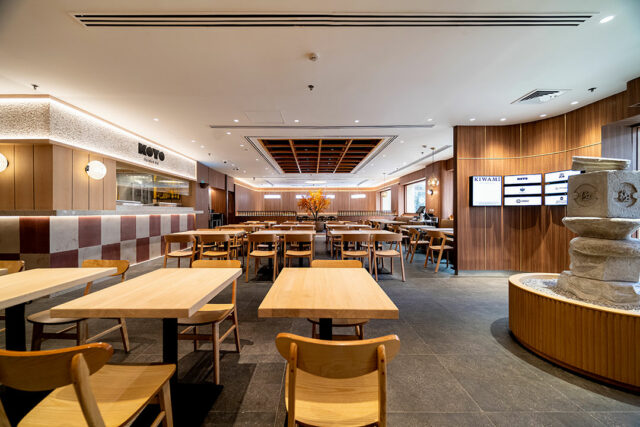
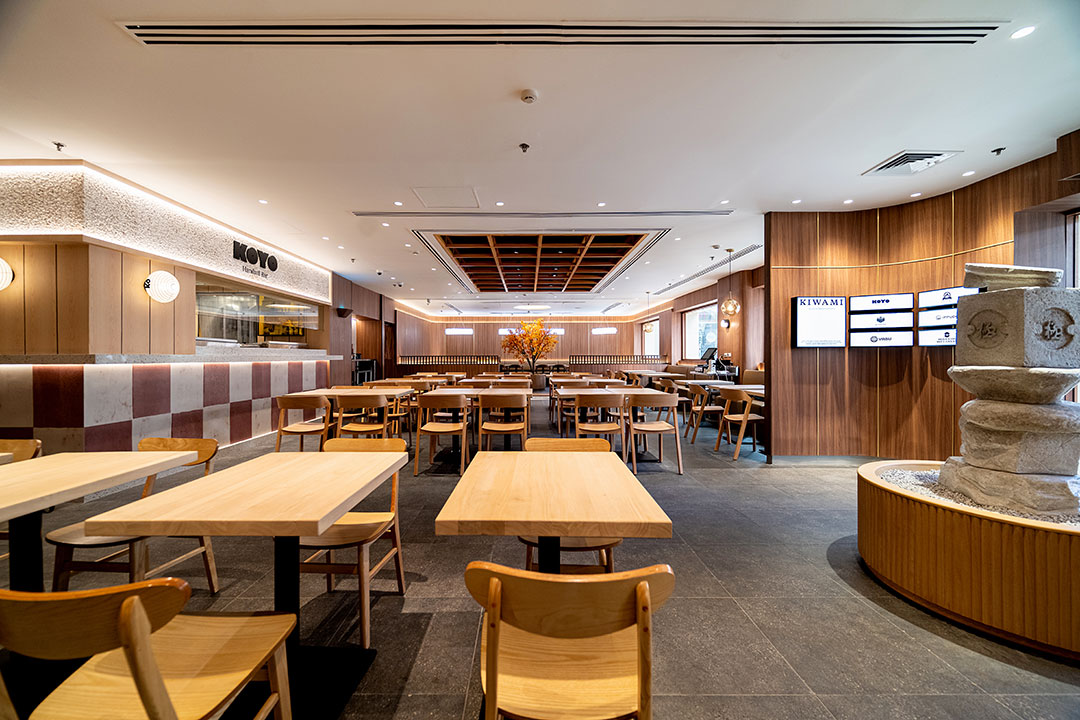
KIWAMI’S new look

KIWAMI: JAPANESE MASTER Kitchens in Alabang Town Center (ATC) is back after a touch-up and expansion.

The renovation has transformed the food hall’s interiors into those of a traditional Japanese house, complete with an autumnal tree by the entrance, wooden frames and furniture, and warmly lit lanterns. Most importantly, they’ve added concepts that are new to the Alabang branch of Kiwami — contemporary sushi handrolls by Koyo and meals for sharing called Hibachi Large Plates.

“This is a culmination of all our learnings from customers the last three years. We realized there were gaps in our menu. We didn’t have sushi and we didn’t have large plates,” said Nicole Concepcion, product manager for The Standard Hospitality Group (SHG), which brings in Japanese specialties to the Philippines.

“People want the ambiance. They want to dine together as a family and share dishes. That’s why we created Koyo, the perfect appetizer, and Hibachi, providing meals for sharing,” Ms. Concepcion explained.

The Koyo sushi handroll concept was developed by New York-based chef Mark Manaloto. At the reopening of Kiwami ATC on April 21, we got to try two newly developed handheld roll flavors. The unagi tamago (eel with egg) wrap was noticeably fresh and mildly sweet in flavor, winning over those of us who weren’t usually unagi fans. As with all good sushi, the nori seaweed had a crisp and firm texture.

The new chirashi handheld roll is a play on the Japanese-style rice bowl, with raw fish and vegetables scattered on top. Koyo’s take on it contains bits of salmon, tuna, snapper, tamago, salmon roe, and shrimp, with the nori sheet encrusted with sesame seeds. It’s full of color, flavor, and love for seafood, grounded by a delicious kimizu (egg and rice vinegar) sauce.

“I get exposed to things in New York, the mecca of food in the US, then I develop my own stuff and bring it here,” said Mr. Manaloto, on how he comes up with new flavors. “Sometimes it’s a little too advanced, so we [at SHG] collaborate to kinda meet in the middle with the Filipino market, to capture the Filipino palate.”

He added that Koyo sources fish both from Japan and from within the Philippines so that the price range is not too expensive. However, his dream is “to bring New York fishermen’s sustainable methods of processing fish, which they learned from Japan, to the Philippines.”

As for Koyo’s sushi flavors, Mr. Manaloto teased that more items will be introduced at Kiwami’s opening in Mall of Asia (MOA) later this year. “There’s constant development. We’ll have new stuff by the time Kiwami MOA opens.”

The April 21 reopening in ATC also saw a launch of Hibachi Large Plates, this time a partnership between SHG and Sydney-based chefs Max Smith and Douglas Barker. The grilled meat options, ideal for enjoying with friends and family, include charcoal chicken, pork chop, blue marlin, and kampachi (longfin yellowtail).

What was new on the sharing menu was the hanger steak. The medium-well beef slab was an instant hit for the tables that ordered it, the black garlic miso sauce topped with ginger vinaigrette-soaked leeks naturally complementing the Japanese white rice. The protein itself was cooked to perfection.

The concept of Kiwami is to bring various Japanese kitchens, each with its own specialty dish, under one roof. Aside from Koyo and Hibachi, the other offerings are Yabu, known for katsu; Ippudo, serving ramen; Hannosuke, experts at tempura; and Hokkaido Soft Cream, providing soft-serve ice cream for dessert.

On what makes it different from the basic food hall, Ms. Concepcion said, “We try to give customers the best dining experience possible. You can order anything but you don’t have to line up at each kitchen separately like at a food hall. You can sit down and order.”

“It actually all started because my dad was obsessed with this idea of having all the best of Japanese cuisine in one place,” she said. Her father, John Concepcion, known for being the longtime managing director of the Selecta ice cream brand, now leads SHG as its chief executive officer.

“For me, what makes Kiwami so amazing is that it shows our dedication to quality and consistency,” said Ms. Concepcion.

She added that this dedication will continue with the opening of the MOA branch by the middle of 2025. “You can expect another really beautiful space there,” she said.

For now, Kiwami: Japanese Master Kitchens has two branches, in Alabang Town Center, Muntinlupa City, and in Bonifacio High Street Central, Taguig City. — Brontë H. Lacsamana