Home Blog Page 1597

BSP short-term debt rates fall

MARI GIMENEZ-UNSPLASH

RATES of the Philippine central bank’s short-term securities fell on Friday amid higher demand.

The Bangko Sentral ng Pilipinas (BSP) bills fetched bids worth P137.87 billion, higher than the P90-billion offer and P119.459 billion in tenders for the P80 billion auctioned off a week earlier. The central bank awarded P90 billion in securities as planned.

The tenders for the 28-day BSP bills reached P52.165 billion, more than the P40 billion placed on the auction block and higher than the P48.109 billion in bids for a P30-billion offer in the previous week. The central bank fully awarded the one-month debt.

Banks asked for rates ranging from 5.63% to 5.692%, lower than the 5.64% to 5.7135% margin a week earlier. This caused the average rate of the one-month securities to decline by 1.84 basis points (bps) to 5.6628%.

Meanwhile, bids for the 56-day bills hit P85.705 billion, more than the P50-billion offer and P85.705 billion in tenders for the same volume offered by the central bank a week earlier. The BSP fully awarded P50 billion in two-month bills.

Accepted yields were 5.625% to 5.675%, lower than 5.64% to 5.718% a week ago. The average rate of the 56-day securities went down by 4.86 bps to 5.6555%.

“The resulting bid-to-cover ratios stood at 1.30x for the 28-day tenor and 1.71x for the 56-day tenor,” the BSP said in a statement.

The central bank uses the BSP securities and its term deposit facility to mop up excess liquidity in the financial system and better guide short-term market rates towards its policy rate.

The BSP bills also contribute to improved price discovery for debt instruments while supporting monetary policy transmission, the central bank said.

The central bank securities were calibrated to not overlap with the Treasury bill and term deposit tenors also being offered weekly.

Data from the central bank showed that about 50% of its market operations are done through short-term BSP bills.

The bills are considered high-quality liquid assets for the computation of banks’ liquidity coverage ratio, net stable funding ratio, and minimum liquidity ratio. They can also be traded on the secondary market. — Aaron Michael C. Sy


UK farmers welcome no weakening of import standards in US trade deal

REUTERS

LONDON — The British farmers union gave on Thursday’s US-UK economic deal a mixed reception, welcoming the retention of British food standards on US imports and reciprocal market access for beef, but flagging concern over a removal of tariffs on bioethanol.

The deal gave UK farmers a US quota for beef of 13,000 metric tons, which the National Farmers Union (NFU) said was a positive. Under the deal, US farmers will have the same quota for sales into Britain.

Crucially there will be no weakening of UK food standards on US beef imports, which was a red line for the union and an election manifesto pledge for the Labor government. That means US beef bred with growth hormones still won’t be allowed into the UK.

“We appreciate the government’s efforts in listening to our concerns, particularly around maintaining high standards, protecting sensitive agricultural sectors and securing reciprocal access for beef,” NFU President Tom Bradshaw said.

Brooke Rollins, US Secretary of Agriculture, said the deal would “exponentially increase” US beef exports to Britain.

However, with little price differential between British produced beef and US beef that does meet UK standards, the US product could struggle to find a UK market.

Finding favor with the UK consumer may also be a tough task. Currently 100% of the fresh beef sold by Britain’s two biggest supermarket groups — Tesco and Sainsbury’s — is British and Irish.

Mr. Bradshaw also said he was concerned that the US had been given full access to Britain’s market for bioethanol, which is used to produce beer.

“Two agricultural sectors have been singled out to shoulder the heavy burden of the removal of tariffs for other industries in the economy,” he added. — Reuters

SM Foundation, TESDA partner to support workforce development

(From left) Frederic C. DyBuncio, president and CEO of SM Investments; Carmen Linda Atayde, executive director for education of SM Foundation; Technical Education and Skills Development Authority (TESDA) Secretary Jose Francisco Benitez; TESDA Deputy Director General for TVET Partnership and Community-Based TVET Nelly Dillera

SM FOUNDATION, Inc., the corporate social responsibility arm of the SM Group, has partnered with the Technical Education and Skills Development Authority (TESDA) to help enhance Filipino workers’ skills and expand access to employment opportunities.

Under the partnership, TESDA learners and graduates will be linked to various career opportunities within the SM Group, covering industries such as construction, food and beverage, hospitality, logistics, and others, SM Foundation said in an e-mail statement over the weekend.

The initiative is aligned with the SM Job Opportunities Building Skills advocacy, which aims to establish industry-responsive training standards and curricula, and implement skills training and enterprise-based education programs.

SM Foundation and TESDA recently signed a memorandum of understanding to formalize the partnership.

“We strongly believe that our continued growth as a business is deeply connected to the development of the people we serve and partner with. That’s why this partnership is important to us,” SMIC President and Chief Executive Officer Frederic C. DyBuncio said.

“We know it’s not always easy, especially in industries where finding qualified talent is a challenge, but it is exactly through collaborations like this that we can help build and strengthen our future workforce,” he added.

The agreement will also support job matching efforts through SM job fairs and other employment programs.

“This partnership is for our future, current trainees, employers, and industry leaders. May this endeavor bring us closer to a nation where every Filipino has the skills, tools, and opportunity to succeed,” Secretary Jose Francisco “Kiko” B. Benitez, director general of TESDA, said.

SM Foundation said the collaboration builds on its existing efforts to support upskilling and employment facilitation in coordination with other partners.

On May 1, in celebration of Labor Day, SM Supermalls hosted 20 job fairs across its malls nationwide, connecting around 15,000 job seekers with approximately 1,000 employers. The events resulted in over 2,000 individuals being hired on the spot.

Asia Pacific College, an SM-affiliated institution, is also conducting upskilling sessions in partnership with the American Chamber of Commerce of the Philippines. The programs cover artificial intelligence (AI) fundamentals and business applications, as well as data analytics and AI maturity. — Revin Mikhael D. Ochave

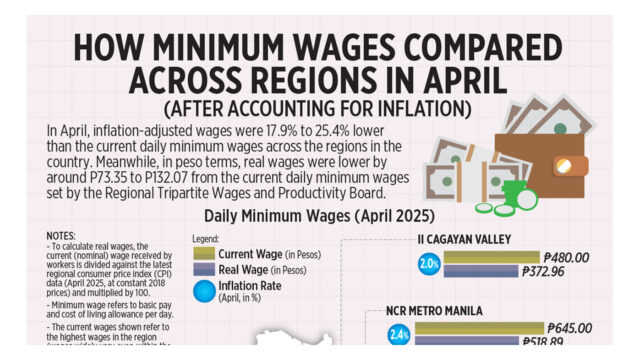
How minimum wages compared across regions in April

(After accounting for inflation)

In April, inflation-adjusted wages were 17.9% to 25.4% lower than the current daily minimum wages across the regions in the country. Meanwhile, in peso terms, real wages were lower by around P73.35 to P132.07 from the current daily minimum wages set by the Regional Tripartite Wages and Productivity Board.

How minimum wages compared across regions in April

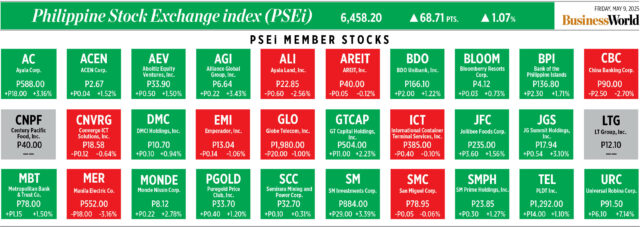
How PSEi member stocks performed — May 9, 2025

Here’s a quick glance at how PSEi stocks fared on Friday, May 9, 2025.


Easing bets, midterm elections may drive PSEi

BW FILE PHOTO

EXPECTATIONS of further policy easing after slower economic growth in the first quarter and easing inflation are expected to drive Philippine stocks this week.

Stock market sentiment would also be dictated by how well midterm elections pan out on May 12, analysts said.

“Despite a GDP (gross domestic product) miss, the Philippine Stock Exchange Index (PSEi) nearly touched 6,500, buoyed by resilient local earnings and investor optimism around an earlier-than-expected Fed rate cut,” online brokerage firm 2TradeAsia.com said in a market note.

On Friday, the bellwether PSEi rose 1.07% or 68.71 points to 6,458.2, while the broader all-share index added 0.6% or 22.5 points to 2,762.85. Week on week, the index rose 0.72% or 46.34 points.

Markets will be closed on Monday as Filipinos pick a new set of congressmen, 12 of the 24-member Senate and thousands of local officials in midterm elections considered a referendum of President Ferdinand R. Marcos, Jr.’s three-year rule.

Investors would monitor the results of the May 12 elections, Japhet Louis O. Tantiangco, a senior research analyst at Philstocks Financial, Inc., said in a Viber message.

“Investors are expected to watch out for the results of the midterm elections here at home as these would provide clues on future policies,” he said.

Mr. Tantiangco said the market would also be driven by hopes of further local policy rate cuts after slower inflation in April and the weaker-than-expected economic growth last quarter.

“Hopes of aggressive monetary policy easing by the Bangko Sentral ng Pilipinas for the rest of the year following inflation and GDP data are still expected to provide support to the local market,” he added.

Inflation slowed to 1.4% in April from 1.8% in March and 3.8% a year earlier as food and transport prices declined.

Last month’s inflation was also the slowest in over five years.

The Philippine economy expanded by a weaker-than-expected 5.4% in the first quarter, slower than 5.9% a year ago, amid uncertainty from US President Donald J. Trump’s sweeping reciprocal tariffs.

“Investors are also expected to watch out for developments with respect to trade talks with the US, with signs of progress to be taken by the market positively,” Mr. Tantiangco said.

“If the market is able to hold its ground at 6,400, this will be considered as its new support while the next resistance level would be at 6,600,” he added.

Michael L. Ricafort, chief economist at Rizal Commercial Banking Corp., put the PSEi’s minor support at 6,255 to 6,360 and resistance at 6,490 to 6,516.85.

2TradeAsia.com estimated the PSEi’s support at 6,200, primary resistance at 6,500 and secondary resistance at 6,600.

“Despite softer growth, earnings thus far, particularly in consumer and banking names, have proven resilient, and with election tailwinds extending into the second quarter, the broader picture remains constructive for local risk assets,” it said.

“Monitor volume as momentum may pick up post-election once the political noise clears and fiscal visibility improves,” the brokerage said. “While PSEi attempts to find escape velocity past 6,500, focus on quality and second-half follow-through.” — Revin Mikhael D. Ochave

Peso may track US-China trade talks

BW FILE PHOTO

THE PHILIPPINE PESO could trade sideways against the dollar this week as the market awaits the results of US-China trade talks in Geneva.

“The dollar-peso initially went to highs of P55.82, tracking the dollar strength after Trump’s talk with the German chancellor and trade talks with the US,” a trader said by telephone. “Later, there was profit taking and defensive trading because of US- China trade talks over the weekend and elections.”

The peso closed at P55.51 a dollar on Friday, 11.5 centavos stronger than a day earlier, according to Bankers Association of the Philippines data posted on its website. Week on week, it gained six centavos.

US President Donald J. Trump said on his Truth Social platform the US and China had made “great progress” in negotiating trade policies.

After taking office this year, Mr. Trump increased tariffs on Chinese imports to 145%, leading China to retaliate by raising levies on US imports to 125%.

Market optimism also supported the peso on Friday after Bangko Sentral ng Pilipinas (BSP) Governor Eli M. Remolona said the Monetary Board could cut rates by up to 75 basis points (bps) more this year, Michael L. Ricafort, chief economist at Rizal Commercial Banking Corp., said in a Viber message.

Last week, the BSP chief told Bloomberg the central bank is open to cutting key rates by 75 bps more this year as inflation continues to ease.

The Monetary Board last month resumed its easing cycle after an unexpected pause in February, cutting benchmark rates by 25 bps to 5.5%. Its next meeting is on June 19.

The trader expects the peso to move sideways this week, depending on the results of the US-China trade negotiations.

Mr. Ricafort said local remittance data due this week could affect the peso’s movement.

The trader expects the peso to trade at P55.30 to P55.80 a dollar this week, while Mr. Ricafort expects it at P55.20 to P55.70. — Aaron Michael C. Sy

Hospitals bat for tax perks, lower import tariffs

By Justine Irish D. Tabile, Reporter

THE GOVERNMENT needs to provide tax incentives and streamline the import process for key healthcare goods, the hospital industry said.

“The government is providing incentives for the tourism industry, so why not healthcare?” Private Hospitals Association of the Philippines, Inc. President Jose Rene de Grano told BusinessWorld.

He said tax incentives will ease the burden of acquiring capital-intensive hospital equipment.

“Actually, some of our smaller hospitals would like to expand, but there’s a lot of equipment needed, which is expensive, so they can’t do it,” he said.

“Public hospitals have the funding, but for private hospitals it is too expensive; even more for smaller hospitals,” he added.

He said smaller hospitals are also struggling with personnel costs.

“Salaries have been increasing, and while secondary and tertiary hospitals can do it, smaller hospitals cannot; they will close, and now they want to legislate wage increases; that will hurt a lot of industries,” he added.

He said that the government could also help the industry by reducing the tariffs for imported equipment.

“Before we used to import from Germany, the US, and the UK, but it has become too expensive” because of the duties, he added.

He said that only big hospitals can now afford to source equipment from Germany, adding that it has become too costly for smaller hospitals due to the high tariffs.

“I hope the tariffs are reduced so we can buy proper equipment,” he added.

He said he is hoping the Food and Drug Administration can streamline the import process for medical devices.

“Right now it takes months, sometimes even years,” he said.

‘Hijacking’ of party-list system erodes farmer representation

Farmers are seen in a rice field in Bustos, Bulacan, Oct. 17, 2023. — PHILIPPINE STAR/KJ ROSALES

By Kyle Aristophere T. Atienza, Reporter

THE party-list system was designed to represent specific interests in Congress like agriculture, but has been co-opted by dynastic politicians, political analysts said.

“The party-list system has been hijacked by traditional politicians and dynasties. It is difficult to win seats if the playing field is not even,” Maria Ela L. Atienza, a political scientist at the University of the Philippines, said via Viber.

“While we have genuine progressive candidates from the farming and fishing sectors running at the Senate level, elections in the Philippines are still dominated by elites, celebrities and political dynasties,” she added.

The Philippines will hold midterm elections today, Monday, with 12 seats in the 24-member Senate and over 300 seats in the House of Representatives up for grabs.

Randy P. Tuaño, dean at the Ateneo School of Government, said the achievement of major reforms has been marked by concerted efforts by farmer interest groups.

He said the farm lobby was strong in the 1980s, when the main issue was land justice, which led to the passage of the Comprehensive Agrarian Reform Program law in 1988.

He said land reform was a significant component of the 1987 Constitution, thanks to the efforts of the Congress for a People’s Agrarian Reform, which brought together over 200 groups representing farmers and fisherfolk, alongside civic and church groups.

Mr. Tuaño said some of the notable recent reforms include the Sagip Saka Act, which gave local government units the power to purchase agriculture produce for their feeding and relief programs directly from farmers groups, without the need to go through public bidding.

The law was written by Francis Pancratius N. Pangilinan, who is seeking to return to the Senate as a farmer advocate.

The other advocates for farmers and fisherfolk seeking Senate seats are Roberto Ballon, a Ramon Magsaysay awardee recognized for his mangrove and marine conservation efforts; Danilo H. Ramos of the Kilusang Magbubukid ng Pilipinas; and Ronnel G. Arambulo of fisherfolk group Pamalakaya.

In the House, at least four party-list organizations are billing themselves as farmer advocates.

According to an international observer mission fielded by the International Coalition for Human Rights, at least 78 of the 156 party-list organizations certified by the Commission on Elections are affiliated with political families.

“If we are talking about the farming lobby per se, its strength is tied to the connections our various farmer organizations and federations have with sympathetic politicians,” according to Hansley A. Juliano, who teaches politics at the Ateneo de Manila.

The result has been that “many of our leading lawmakers (are tied to) agribusiness or are landowners,” he said via Messenger chat.

He said the last major item of legislation that advanced farming industry reform was a 2009 law that extended the deadline by five years for distributing agricultural land — originally set to expire in 2008.

De La Salle University political science professor Anthony Lawrence Borja said agrarian groups have “little to no power in the policy process” in the absence of any “effective, comprehensive, and nationalist policy on agrarian reform and industrialization.”

According to an ASEAN briefing report in March, the growth of Vietnamese agriculture, which employs 33% of that country’s workforce and which is set to grow 3.5% to 4% annually over the next five years, is driven by its focus on higher-value crop production and export-oriented agribusiness.

Mr. Borja added that the case of Japan highlights how comprehensive agrarian reform under strong state institutions can foster agrarian industrialization that is high-value and capital-intensive.

“Some lessons for the farming sector interests include consolidation of the various farmers groups so that more unified and effective lobbying efforts can be undertaken,” Mr. Tuaño said.

Farmers’ groups should also wage campaigns at the local level, pressing for greater local budgets for food security and agricultural modernization, and climate change adaptation, he added.

Retail industry seeks gradual cuts to de minimis threshold

BW FILE PHOTO

THE Philippine Retailers Association (PRA) said it supports the gradual abolition of the de minimis rule for imports, adding that the lowering the threshold for taxing such shipments would be a good start.

It said the outright abolition of the de minimis rule could be “too aggressive” a move for consumers.

Retailers have been complaining about competition from overseas online sellers, whose shipments are untaxed if their value falls below P10,000.

“Considering the current importation climate in the Philippines, removal may be too aggressive of a step,” the PRA said in a letter to the Bureau of Customs (BoC) dated May 6.

The PRA said that the government could explore alternatives like lowering the threshold, limiting the availment of the de minimis tax-free privilege to once per month per consumer, and applying tax if the goods are for commercial resale and not personal use.

PRA President Roberto S. Claudio said that the group will continue pushing for the eventual removal of the de minimis rule.

“The European Union has already completely abolished de minimis; in the US, they also eliminated it,” Mr. Claudio said by telephone.

“If we don’t abolish it, we could just gradually lower the threshold. We are not giving a figure because we want the BoC to determine that,” he added.

The P10,000 de minimis rule was implemented through Customs Administrative Order (CAO) 2-2016. The exemptions are designed to ease the administrative burdens of such imports.

“The reason they implemented the de minimis rule is to ease the clearance of personal effects, so there will be fewer administrative steps involved in bringing in small and insignificant products,” he said.

“But with the advent of e-commerce, items come by piece; they don’t come in bulk shipments. So this leads to a tremendous loss of government revenue,” he added.

The PRA has yet to receive a response from the BoC, but noted that Finance Secretary Ralph G. Rector has said that the CAO is currently being reviewed. — Justine Irish D. Tabile

Mercedes-Benz says PHL market for EVs growing more attractive

MERCEDES-BENZ.PH

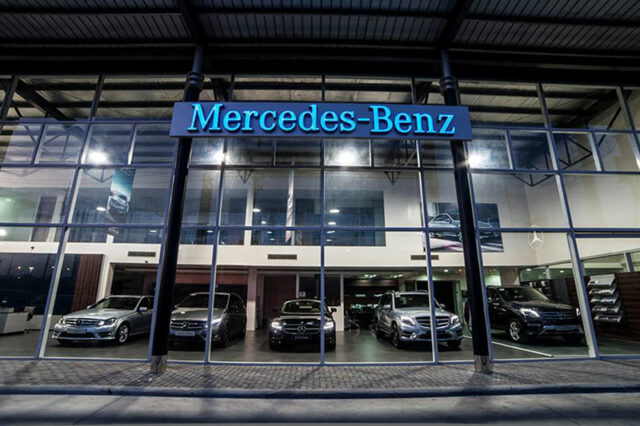
DEMAND for electrified vehicles (EVs) has been growing in the Philippines, making it more attractive for car brands to launch new models, Mercedes-Benz Philippines said.

“I think acceptability has been growing for new energy vehicles, and that includes full electric, hybrids, and mild hybrids,” Maricar Parco, general manager at Mercedes-Benz Philippines, told BusinessWorld on Friday.

“We have seen that from the previous year, this has doubled. If I am not mistaken, it is from about 3.5%, and this year for the first quarter it is about 7% already. So most brands are also providing opportunities for Filipinos to try the new energy vehicles,” she added.

She said Mercedes-Benz vehicles with some form of electric propulsion consist of 10% of the sales mix.

“It’s significant, and we want to grow that further with our plug-in hybrid electric vehicles (PHEV) to about 15% of our sales mix,” she added.

On Friday, Mercedes-Benz launched two plug-in hybrid models — the GLC 350e PHEV and the E 350e PHEV, the brand’s initial PHEV models in the Philippine market, which will sell for P4.89 million and P5.49 million, respectively.

“We introduced the full electric models two years ago, which is the EQ line. Now, we are building on that portfolio with PHEVs … And we are starting with two models, a sedan and an SUV. These are just additional products in our portfolio for new energy vehicles,” Ms. Parco said.

“This is really part of our business strategy towards electrification. Mercedes-Benz set a target in 2018 to go fully electric by 2039. So that will also depend on the market readiness. But for our part, we feel that PHEVs would be a good alternative for Filipino motorists who are not ready yet to go full electric,” she added.

Last year, Mercedes-Benz sold over 700 vehicles, while in the first four months of this year, the brand accounted for 15% of the luxury segment.

“We are looking into the introduction of a couple more plug-in models for the second half of the year. So people can expect more to come,” she added.

She said that the company is looking to add one more dealership in Northern Luzon.

“We are still in talks with potential partners. But we are looking at having that up hopefully by the third quarter,” she added.

Currently, Mercedes-Benz has four dealerships, located in Greenhills, Bonifacio Global City, Alabang, and Cebu. — Justine Irish D. Tabile

P1.6-B NGCP Ilocos Norte substation project approved

THE National Grid Corp. of the Philippines (NGCP) has won approval from the Energy Regulatory Commission (ERC) to pursue its P1.63-billion substation project in Ilocos Norte.

In a notice, the ERC said that the approval of the projects is subject to “optimization based on actual use and verified expenses, and the additional instructions issued by the Commission during the deliberation.”

According to the NGCP’s 2022 application, the proposed Pinili 230-kilovolt Substation Project seeks to address load growth in the Ilocos Region.

The grid operator said the project will serve as the new connection point for future renewable energy power plants in the area.

The project is expected to be finished within 62 months.

Pinili Substation is among six projects worth a total of P20.33-billion that NGCP is seeking to pursue under the application.

Under Section 9 of the Electric Power Industry Reform Act (EPIRA) of 2001, the grid operator is required to seek the approval of the ERC for any plan to expand or improve its facilities.

Last month, the ERC said it completed the NGCP’s fourth regulatory period rate reset spanning 2016 to 2022.

In a decision by the majority composed of commissioners Alexis M. Lumbatan, Floresinda G. Baldo-Digal, and Marko Romeo L. Fuentes, the regulator approved a maximum allowable revenue of P335.78 billion for NGCP for the period.

Following the decision, the majority authorized the NGCP to collect P28.29 billion in under-recoveries, which will result in an increase in transmission charges.

Under the seven-year recovery period set by the majority, the NGCP is allowed to collect an additional P0.1013 per kilowatt-hour in transmission charges over the 84 months from issuance of the decision.

EPIRA authorizes the ERC to establish a method for setting transmission and distribution wheeling rates. The rates must be set in a way that allows the recovery of “just and reasonable costs and a reasonable return on rate base” to enable the entity to operate viably. — Sheldeen Joy Talavera

ADVERTISEMENT
ADVERTISEMENT