Home Blog Page 1586

Fed sees rising risks to economy as it leaves rates unchanged

A sign for the Federal Reserve Board of Governors is seen at the entrance to the William McChesney Martin Jr. building in Washington, D.C. — REUTERS

WASHINGTON – The Federal Reserve held interest rates steady on Wednesday but said the risks of higher inflation and unemployment had risen, further clouding the US economic outlook as its policymakers grapple with the impact of President Donald Trump’s tariffs.

At this point, Fed Chair Jerome Powell said, it isn’t clear if the economy will continue its steady pace of growth, or wilt under mounting uncertainty and a possible coming spike in inflation.

With so much unsettled about what Trump will ultimately decide and what of that survives possible court and political battles, “the scope, the scale, the persistence of those effects are very, very uncertain,” Powell said in a press conference at the end of a two-day policy meeting. “So it’s not at all clear what the appropriate response for monetary policy is at this time … It’s really not at all clear what it is we should do.”

“I don’t think we can say which way this will shake out.”

It was Powell’s subtle way of saying the U.S. central bank, a key actor in shaping the economy, was effectively sidelined until Trump’s sweeping policy agenda takes full effect.

The Fed’s policy statement, which held the benchmark overnight rate steady in the 4.25%-4.50% range, noted that since the central bank’s last meeting in March “uncertainty about the economic outlook has increased further,” and that risks were increasing that both inflation and unemployment could increase.

Thomas Simons, chief U.S. economist at Jefferies, said the language downplayed just how much disruption had occurred since the Fed’s March 18-19 meeting, and how unpredictable the outlook had become.

“All of the ‘Liberation Day’ tariff news, the April 9 announcement of a 90-day delay, the back and forth on trade deals and tariff exemptions in the headlines, and the resultant negativity expressed in business and consumer surveys make it impossible to judge what the economic outlook is, let alone whether the skew of risks around it has changed,” Simons wrote, calling Powell “predictably noncommittal” given the situation.

RISKS TO DUAL MANDATE

The Fed’s statement, and much of Powell’s comments to reporters as well, vouched for the economy’s continued resilience, with job gains continuing and the economy still growing at a “solid pace.” The recently reported decline in gross domestic productin the first quarter, Powell said, was skewed by a record rush of imports as businesses and households tried to front-run expected import taxes, with measures of domestic demand still growing.

But even that data demonstrated the dilemma facing the Fed. The rush of front-loading to buy goods and stock shelves won’t likely be repeated, and it is unclear whether underneath it all demand and investment are starting to weaken – and how that will eventually express itself in “hard” data on inflation and jobs.

The Fed’s own “Beige Book” of anecdotal reports about the economy recently gave a dour picture of suspended business deals, falling demand, and rising prices.

“Businesses and households are concerned … and postponing economic decisions of various kinds,” Powell said. “If that continues and nothing happens to alleviate those concerns, you would expect that to show up in economic data.”

The Fed can’t respond, however, until it is clear which way the economy pivots, and how it assesses the risks to its two goals of holding inflation to 2% and sustaining maximum employment.

“The current stance of monetary policy leaves us well positioned to respond in a timely way to potential economic developments,” Powell said, affirming a wait-and-see approach that has become the central bank’s calling card in the first months of the Trump administration.

U.S. stock prices extended gains after the release of the Fed’s unanimous policy decision and ended higher on the day. Treasury yields fell, while the dollar .DXY gained against a basket of currencies.

‘HOLDING PATTERN’

The direction of Fed policy will depend on which of the job and inflation risks develop, or, in the more difficult outcome, whether inflation and unemployment increase together and force the central bank to choose which risk is more important to try to offset with monetary policy.

A weaker job market would typically strengthen the case for rate cuts; higher inflation would call for monetary policy to remain tight.

“For the time being the Fed remains in a holding pattern as it waits for uncertainty to clear,” said Ashish Shah, chief investment officer of public investing at Goldman Sachs Asset Management, adding that “recent better-than-feared jobs data has supported the Fed’s on-hold stance, and the onus is on the labor market to weaken sufficiently to bring a resumption of its easing cycle.”

The Fed’s policy rate has been unchanged since December as officials struggle to estimate the impact of Trump’s tariffs, which have raised the prospect of higher inflation and slower economic growth this year.

When policymakers last updated their economic and policy projections in March, they anticipated reducing the benchmark rate by half a percentage point by the end of this year. — Reuters

Black smoke signals no pope elected in first conclave vote

Black smoke rises from the chimney on the Sistine Chapel, indicating no decision has been made to elect a new pope, at the Vatican, May 7, 2025. -- REUTERS/Murad Sezer

VATICAN CITY — Black smoke billowed from the chimney of the Sistine Chapel on Wednesday evening, signalling an inconclusive first vote by cardinals locked in the Sistine Chapel in a conclave to elect a new pope to guide the Roman Catholic Church.

Thousands of faithful gathered in St. Peter’s Square waiting for smoke to pour from a narrow flue on the roof of the chapel at the end of a day rich in ritual and pageantry, with prelates praying for divine guidance in their secret ballot.

The crowds had to be patient as it took longer than expected for the smoke to appear, more than three hours after the start of the conclave. This was an hour more than it took for smoke to be seen after the first vote in the 2013 conclave that picked the late Pope Francis.

When a pope is chosen, white smoke will emerge, but this had not been expected on Wednesday – a pontiff has not been picked on the first day of a conclave in modern times.
However, some cardinals said this week that they hoped to wrap things up by Thursday or Friday to show the Church can remain unified after the often divisive, 12-year papacy of Francis, who died last month.

The 133 cardinal electors, who are all aged under 80, will spend the night secluded in one of two Vatican guesthouses – where they can continue their deliberations in a more informal setting before returning to the chapel on Thursday morning.

Following Wednesday’s single round of voting, the red-hatted “princes of the Church” will hold two votes in the morning session and two in the afternoon, continuing in coming days until one man has secured a majority of at least two-thirds – 89 cardinals this time around.

Their only communication with the outside world will be the smoke from the chimney as they burn their completed ballot papers mixed with special chemicals – black when a voting session ends with no result, white when a pontiff is elected.

Modern papal conclaves are typically short. The 2013 conclave lasted just two days, likewise in 2005 when his predecessor, Benedict XVI, was picked.

In recent days, cardinals have offered different assessments of what they are looking for in the next pontiff who will lead the 1.4-billion-member Church.

While some have called for continuity with Francis’ vision of greater openness and reform, others have said they want to turn the clock back and embrace old traditions. Many have indicated they want a more predictable, measured pontificate.

‘GOOD OF THE CHURCH’

In a sermon ahead of the conclave, Italian Cardinal Giovanni Battista Re, who at 91 is too old to take part in the vote, told his fellow prelates they must set aside “every personal consideration” in choosing the new pontiff and keep in mind “only … the good of the Church and of humanity”.

He also suggested the next pope had to respect diversity within the Church. “Unity does not mean uniformity, but a firm and profound communion in diversity,” he said.

Some ultra-conservatives had branded Francis as a heretic, accusing him of being too welcoming to the LGBT community, too accommodating to Protestants and Muslims and too open on a range of topics, including offering communion for the divorced.

No clear favorite has emerged, although Italian Cardinal Pietro Parolin and Filipino Cardinal Luis Antonio Tagle are considered the front-runners.

However, if it quickly becomes obvious that neither can win, votes are likely to shift to other contenders, with the electors possibly coalescing around geography, doctrinal affinity or common languages.

Among other potential candidates are France’s Jean-Marc Aveline, Hungary’s Peter Erdo, American Robert Prevost and Italy’s Pierbattista Pizzaballa.

A record 133 cardinals from 70 countries entered the Sistine Chapel, up from 115 from 48 nations in the last conclave in 2013 – growth that reflects efforts by Francis during his 12-year reign to extend the geographical reach of the Church.

Among their considerations will be whether they should seek a pope from the global South where congregations are growing, as they did in 2013 with Francis, from Argentina, or hand back the reins to Europe, or even pick a first U.S. pope.

Latin chants and organ music accompanied the cardinals as they processed into the frescoed Sistine Chapel before the conclave began, with Michelangelo’s depiction of Christ delivering the Last Judgment dominating the 500-year-old room.

They laid their hands on the Gospels, taking a vow of secrecy not to divulge anything about their gathering.

Archbishop Diego Ravelli, the Vatican’s master of ceremonies, then pronounced the Latin command “Extra omnes!” (Everyone out!) telling those not involved in the gathering to leave the room, with the chapel’s heavy wooden doors slamming shut on the outside world.

There is not meant to be any discussion in the voting sessions but past experience suggests there will be plenty of covert campaigning during breaks and meals as the names of “papabili” rise and fall in successive ballots. — Reuters

Agricultural output rises 1.9% in Q1

Pork is sold at a market in Manila. Agricultural output rose by 1.9% in the first quarter, as improvements in crops, poultry and fisheries offset a decline in livestock. — PHILIPPINE STAR/EDD GUMBAN

AGRICULTURAL OUTPUT grew by an annual 1.9% in the first quarter, as good weather helped boost crops, fisheries and poultry production, the Philippine Statistics Authority (PSA) said.

Data from the PSA showed the value of agriculture and fisheries production rose by 1.9% in the January-to-March period to P437.74 billion, faster than 0.2% in the first quarter of 2024.

This was a turnaround from the revised 2% contraction in the fourth quarter and ended three quarters of decline.

Performance of Philippine Agriculture

“The value of crops, poultry, and fisheries production recorded improvements, while livestock continued to decline during the quarter,” the PSA said in a report, citing constant 2018 prices.

At current prices, the value of production in agriculture and fisheries rose by 2.3% in the first quarter to P623.66 billion.

“We are optimistic that the recovery in the first quarter signals momentum for the latter half of the year — especially as we bring new infrastructure online such as cold storage facilities and rice processing systems,” Agriculture Secretary Francisco Tiu Laurel, Jr. said in a statement.

However, former Agriculture Undersecretary Fermin D. Adriano said the first-quarter agricultural output results were “expected.”

“(This follows the) normal pattern of agri performance for first quarter of the year given the absence of typhoons and extreme weather occurrences… The harvest season extends in the first quarter of the year. Wait till the second quarter, which is planting (lean supply) season for rice and intense heat affects water supply for irrigation,” he said in a Viber message.

Crop production, which accounted for 57% of the total, increased by 1% to P249.61 billion in the January-to-March period. This was a turnaround from the 0.3% decline in the same period last year.

Palay or unmilled rice production inched up by 0.3%, an improvement from the 2% contraction a year ago.

The volume of palay production went up to 4.7 million metric tons (MMT) in the period ending March from 4.69 million MMT in the same period last year.

The Department of Agriculture (DA) said that yield reached a record high of 4.09 MT per hectare, offsetting the decline in rice-planted areas. It targets a record palay output of 20.46 MMT this year.

PSA data showed corn production declined by 5.1% in the first quarter, a reversal of the 0.5% growth last year.

Coconut output slipped by 0.3%, slower than the 3.3% decline in the same quarter in 2024.

Crops that saw a double-digit increase in the value of output include tobacco (80.4%), cacao (23.6%), sugarcane (19%), rubber (13.6%), coffee (10.7%) and mongo (10.1%).

On the other hand, the value of production contracted for abaca (15.4%), sweet potato (9.4%), mango (7.5%), cabbage (6.4%) and calamansi (0.8%).

PSA data showed the poultry sector grew by 9.4% to P75.22 billion, contributing 17.2% to total farm production.

The value of chicken egg production rose by 12.1%, while chicken output increased by 8.7% and duck by 1.5%.

On the other hand, duck egg production declined by 2.2% in the first quarter.

“We can see a little shift in the consumption pattern of consumers to the poultry sector as a source of food protein due to higher prices of meat, especially of hogs,” Philippine Chamber of Agriculture and Food, Inc. President Danilo V. Fausto said in a Viber message.

“This can be seen in the good performance of chicken and egg production and decrease in growth of the hog sector,” he added.

However, Mr. Fausto warned the local poultry industry may face challenges if there are increased imports from the US.

“The poultry sector will experience headwinds, however, if the US will require the entry of more chicken to the country as a bargaining chip to reconsider the tariff imposed by Trump for Philippine exports to the US,” he said.

SLUMP IN LIVESTOCK
Meanwhile, the value of livestock production continued to decline in the first quarter.

PSA data showed livestock output slipped by 2.8% to P57.82 billion in the period ending March, although the pace of decline was slower than 3.5% in the same quarter last year. This accounted for 13.2% of the total farm output.

Hog production slumped by 3.7% in the first quarter, while carabao output dipped by 0.2%.

However, an increase in production was seen in dairy (10.5%), cattle (1.3%), and goat (1.2%).

“Livestock contraction is expected as the much-vaunted ASF (African Swine Fever) vaccine of the DA is ineffective with little adoption by hog raisers,” Mr. Adriano said.

The DA in March said it was expecting the approval of the Food and Drug Administration by April for the commercial rollout of ASF vaccines from Vietnam.

“Hopefully, we could also begin later this year the commercial roll out of the long-awaited vaccine for ASF, which will help kickstart the DA’s a large-scale hog repopulation effort,” Mr. Laurel said.

Bureau of Animal Industry data as of April 11 showed ASF had been detected in 54 villages, up from 39 as of March 14.

Meanwhile, fishery production rose by 1.5% to P55.1 billion in the first quarter, accounting for 12.6% of the total output. This was an improvement from the 0.2% drop in the same period in 2024.

Milkfish (bangus) production rose by 7.8%, while tilapia inched up by 2.2%.

Double-digit growth was seen for slipmouth or sapsap (21%), mudcrab or alimango (20%), Indian mackerel or alumahan (14.5%) and blue crab or alimasag (12.1%).

However, declines were seen for fimbriated sardines or tunsoy (34.5%), roundscad or galunggong (14.7%), cavalla or talakitok (12.7%) and bigeye tuna or tambakol (11.2%).

Raul Q. Montemayor of the Federation of Free Farmers said the agriculture sector still has a lot of catching up to do, especially since output declined last year.

In 2024, farm output shrank by 2.2%, due in large part to the El Niño weather pattern, which is estimated to have caused about P15-billion in damage to local agriculture. — K.A.T.Atienza

NG debt hits record P16.7-T at end-March

BW FILE PHOTO

By Aubrey Rose A. Inosante, Reporter

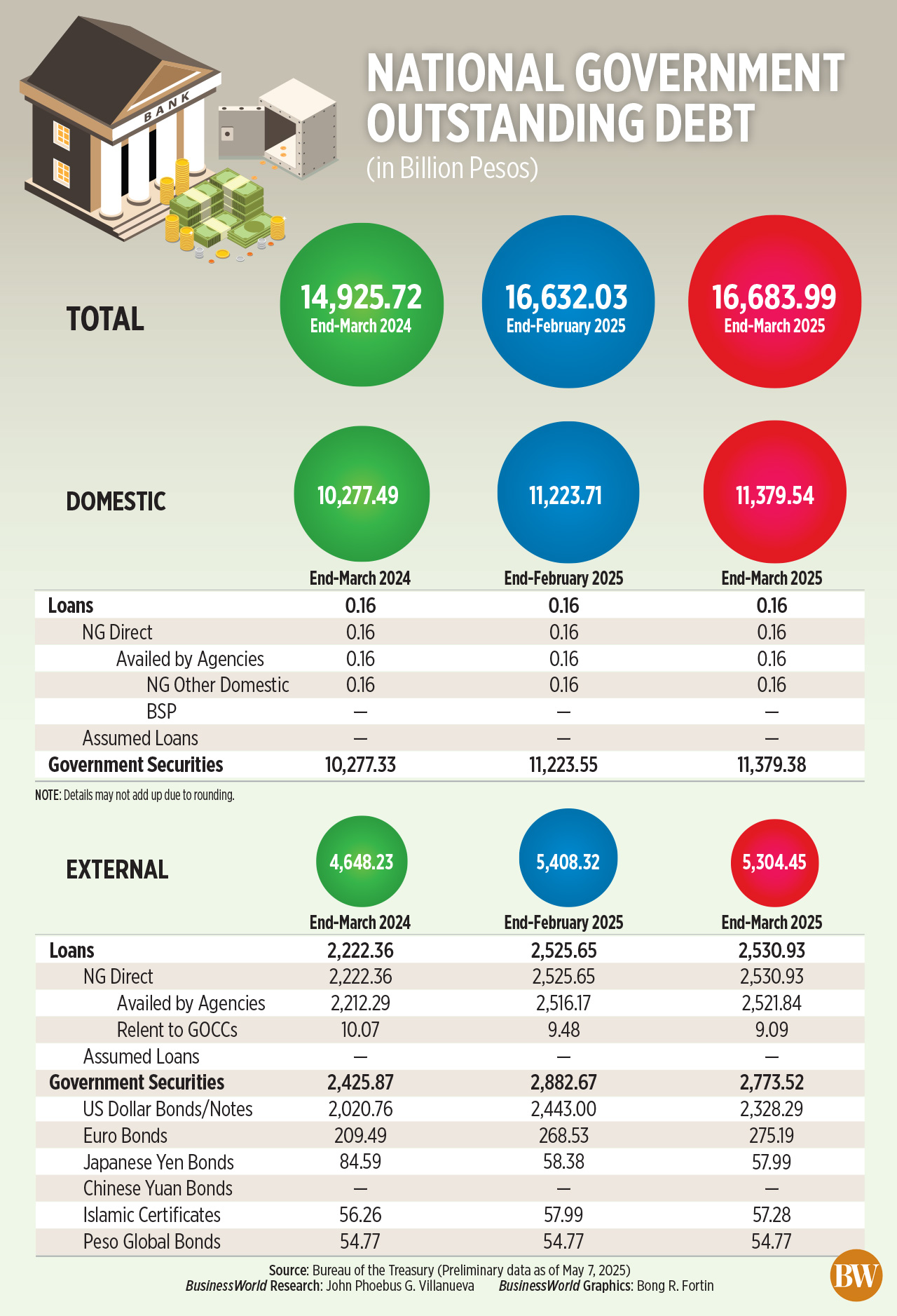
THE National Government’s (NG) outstanding debt edged up to a fresh high of P16.68 trillion as of end-March, the Bureau of the Treasury (BTr) said on Wednesday, adding that this debt “remains manageable.”

Latest data from the Treasury showed that the debt rose by 0.31% from P16.63 trillion at the end of February.

Year on year, outstanding debt went up by 11.78% from P14.93 trillion at end-March 2024.

“The NG’s robust revenue performance in the first quarter of 2025 has enabled the government to finance key priority programs without imposing new taxes, keeping debt growth well within sustainable levels,” the BTr said in a statement.

NG debt is the total amount owed by the Philippine government to creditors such as international financial institutions, development partner-countries, banks, global bondholders and other investors.

The bulk or 68.2% of the total debt stock came from domestic sources, while the rest were external borrowings.

“This financing mix reflects a prudent approach to debt management to help mitigate exposure to external risks while taking advantage of the country’s liquid domestic market,” BTr said.

Domestic debt, which was composed of government securities, rose up by 1.39% to P11.38 trillion at end-March from P11.22 trillion at end-February.

Year on year, it jumped by 10.72% from P10.28 trillion in the same period.

“This was mainly due to the net issuance of domestic securities worth P157.86 billion, demonstrating strong investor confidence in government instruments,” the BTr said.

However, the increase in domestic debt was partially offset by the peso appreciation against the US dollar, which reduced the overall valuation by P2.03 billion.

Rizal Commercial Banking Corp. Chief Economist Michael L. Ricafort said the higher debt in March partly reflected the widening budget deficit, which required additional borrowings by the government.

Oikonomia Advisory and Research, Inc. economist Reinielle Matt M. Erece said the rise in domestic debt reflected the high demand for government bonds, which continues to be oversubscribed.

“This is an indication of confidence in this asset and the risk-averse sentiment while waiting for major market catalysts,” he added.

Meanwhile, external debt dropped by 1.92% to P5.3 trillion as of end-March from P5.41 trillion at end-February.

However, it jumped by 14.12% from P4.65 trillion in March 2024.

“The (year-on-year) reduction was primarily due to the P66.22-billion decrease in the peso equivalent of US dollar-denominated debt behind local currency appreciation, as well as the net repayment of external loans, which further trimmed the external debt total by P60.84 billion,” the Treasury said.

“These more than offset the P23.19-billion upward revaluation effect of third-currency movements against the US dollar,” it added.

The peso closed at P57.21 against the dollar at end-March, appreciating by 78.5 centavos from its P57.995-per-dollar finish at end-February.

External debt was composed of P2.77 trillion in global bonds and P2.53 trillion in loans.

The NG’s guaranteed obligations slipped by 0.37% to P339.86 billion as of end-March from P341.11 billion in the previous month.

The Treasury attributed the monthly decline to the net repayment of external guarantees amounting to P1.29 billion and the P1.13-billion downward revaluation amid the continued appreciation of the peso versus the greenback.

“These more than offset the P0.77 billion in additional domestic guarantees and the P0.4- billion impact of third-currency exchange rate movements on external guarantees, reflecting the government’s continued efforts to prudently manage contingent liabilities while supporting key development initiatives,” it added.

Year on year, guaranteed obligations declined by 1.79% from P346.04 billion.

The BTr said that 91.5% of the debt stock had fixed interest rates, shielding the Philippines from abrupt shifts in global interest rates and currency movements.

It also noted that 81.3% of the obligations are long term, “giving the government ample fiscal space and time to support growth-enhancing investments.”

Mr. Ricafort said in the following months, the debt stock could hit a new fresh high due to the need to hedge both local and foreign borrowings because of the “Trump factor.”

This year’s financing program is set at P2.545 trillion, with 80% coming from local lenders and 20% from foreign sources.

The NG’s outstanding debt is projected to reach P17.35 trillion by end-2025.

“With the economy continuing to grow faster than its obligations, the country remains firmly on track to achieve fiscal consolidation and reduce the debt-to-GDP (gross domestic product) ratio to below 60% by 2028,” the BTr said.

Under the Medium-Term Fiscal Framework, the government seeks to bring the ratio down to 60.4% by the end of 2025, and to 56.9% by 2028.

“The Marcos administration has inherited a large debt due to the pandemic, amounting to approximately P12.79 trillion, but it has already made improvements to the country’s debt statistics by reducing the NG debt-to-GDP ratio to 60.7% in 2024, below the 70% international threshold,” the BTr said.

First-quarter GDP and debt-to-GDP ratio data will be released on May 8.

“Moreover, the country’s recent credit rating upgrades and reaffirmations underscore strong investor confidence in the country’s economic fundamentals, translating to greater demand for Philippine bonds, thereby preserving government access to reasonable borrowing costs, crucial for sustaining the country’s inclusive growth momentum,” the BTr said.

In late April, Fitch Ratings affirmed its “BBB” investment grade rating and “stable” outlook amid the country’s strong growth prospects and minimal exposure to trade tensions.

Unemployment rate inches up in March

Jobseekers flock to a jobs fair at a mall in Quezon City, March 21. The jobless rate stood at 3.9% in March, steady from a year ago, the statistics agency said on Wednesday. — PHILIPPINE STAR/MIGUEL DE GUZMAN

THE Philippines’ unemployment rate inched up to 3.9% in March from a month earlier, even as the number of jobless Filipinos fell by the tens of thousands from a month and a year earlier, according to the statistics agency.

In its latest Labor Force Survey, the Philippine Statistics Authority (PSA) said the jobless rate rose to 3.9% in March from 3.8% in February, but flat from a year ago.

This is equivalent to 1.93 million jobless Filipinos in March, slightly lower than the 1.94 million unemployed in February and the two million jobless in March last year.

Philippine Labor Force Situation

The country’s unemployment rate averaged at 4% in the first three months of 2025, unchanged from the same period last year.

PSA data also showed underemployment worsened to 13.4% in March from 10.1% in February and 11% a year earlier.

The ranks of underemployed Filipinos — those who want longer work hours or an additional job — reached 6.44 million in March. This was higher than 5.39 million in March 2024 and 4.96 million in February.

“Underemployment rose by 1.05 million, it was mainly contributed by what we call the ‘invisible underemployed.’ They work for 40 hours and above but seek additional work or other jobs with higher salaries,” National Statistician Claire Dennis S. Mapa said at a media briefing.

He added that the rise in the underemployment rate in March was spread out across all sectors.

For the first three months, the unemployment rate stood at 12.3%, unchanged from last year.

PSA data showed 49.96 million Filipinos were part of the labor force in March, lower than the 51.09 million in February and 51.15 million in March 2024.

The labor force participation rate (LFPR) — the proportion of the working-age population (15 years old and over) that is part of the total labor force — slipped to 62.9% in March from 64.5% in February. Year on year, the LFPR fell from 65.3%.

“In March 2025, we saw that a substantial number decided to go back to school. That means that they had to forego their opportunities in the labor market to continue their studies,” Mr. Mapa said.

He said some may have also opted out of the labor force due to “household family duties.”

The employment rate was steady at 96.1% from a year ago, but slightly lower than the 96.2% in February.

However, the number of Filipinos with jobs dropped by over a million to 48.02 million in March, from 49.15 million a year ago, signaling concerns about labor participation and underemployment.

Job losses by Industry

For the first quarter, the average employment rate was unchanged at 96%.

Mr. Mapa said that the decline in the employment rate in March can be traced to the drop in jobs in the agriculture sector.

He said the suspension of government hiring may have also affected the labor data in March.

“There was a ban on hiring in government positions, we think this had an impact on the reduction of employed persons,” he said, referring to the election ban on hiring of new government employees that runs from March 28 to May 12.

By sector, services remained the top employer, accounting for 62% of total employed persons in March, followed by agriculture (20.1%) and the industry sector (17.9%).

The education sector saw the largest annual increase in jobs during the month, adding 210,000 jobs. This was followed by administrative and support service activities (+145,000), fishing and aquaculture (+138,000), arts, entertainment and recreation (+91,000), and human health and social work activities (+51,000).

Job losses by Industry

On the other hand, agriculture and forestry saw the biggest annual decline in employment (-609,000). This was followed by public administration and defense and compulsory social security (-349,000), manufacturing (-281,000), wholesale and retail trade, repair of motor vehicles and motorcycles (-175,000), and professional, scientific and technical activities (-100,000).

Wage and salary workers accounted for 63.4% of the workforce in March, followed by self-employed individuals without paid employees (27.9%), unpaid family workers (6.6%), and employers in family-operated farms or businesses at 2.1%.

Working hours averaged 41.2 hours per week in March, increasing from the average 40.7 hours reported last year and the 41.4 hours in February.

“The Philippines’ unemployment rate remained low, signaling a robust labor market that should help support domestic demand and overall economic growth amidst external headwinds,” Chinabank Research said in a statement.

University of the Philippines Diliman School of Labor and Industrial Relations Assistant Professor Benjamin B. Velasco, in a Facebook chat, said the month-on-month uptick in the jobless rate could be due to the loss of seasonal jobs in construction and trade.

“The loss of jobs in those sectors could not be compensated by higher temporary employment created by the election season — falls under the administrative and support service activities,” Mr. Velasco said.

Federation of Free Workers Vice-President Julius H. Cainglet said the rise in the underemployment rate could be due to Filipinos looking for extra work.

“Workers seek additional jobs since the wages in their existing jobs are not enough to sustain their family’s needs. They need living wages, not starvation wages,” Mr. Cainglet said in a Viber message.

Chinabank Research said the rise in underemployment shows the need for more quality jobs for Filipinos.

Mr. Velasco said that the annual increase in employment in the education sector shows the need for new teachers as the student population grows.

“The (increase in) administrative and support services is due to temporary employment related to elections. There are thousands of ward leaders and so-called volunteers doing paid work for candidates,” Mr. Velasco added. — A.H.Halili

Philippine government approves more infrastructure flagship projects

PHILIPPINE STAR/EDD GUMBAN

By Luisa Maria Jacinta C. Jocson, Senior Reporter

MILAN, Italy — The government has approved more infrastructure flagship projects (IFP), bringing the total to 207 projects worth $178 billion (around P9.86 trillion), the Department of Economy, Planning, and Development (DEPDev) said.

As of April 30, the government’s list of flagship projects had risen to 207 from the previous 186 projects that were valued at P9.6 trillion.

“These projects aim to lower costs, promote inclusion, and build resilience across the economy,” DEPDev Secretary Arsenio M. Balisacan said at the Philippine Economic Dialogue on the sidelines of the 58th ADB Annual Meeting here.

The IFPs are in various stages of implementation, he said, and mainly cover connectivity, agriculture, water security, and health.

Broken down, the bulk of the projects are related to physical connectivity (139).

This is followed by water resources (32), agriculture (nine), digital connectivity (six), health (five), power and energy (three), housing (two) and education (two), among others.

“Our renewable energy sector ranks among the world’s most attractive, supported by abundant solar, wind, hydro, and geothermal resources and a firm national commitment to sustainability,” Mr. Balisacan said.

DEPDev Undersecretary Joseph J. Capuno said that they added some projects but also cut others. There were also projects included that are purely private sector undertaking, he said.

“They fall into the definition of what we call flagship. That’s why if there’s a PPP (public-private partnership) that is already private, that satisfies the criteria of flagship, then it can be counted,” Mr. Balisacan added.

“Provided the private sector proponent will agree and comply with the requirements, like full disclosure.”

Last year, the government completed seven IFPs. It is targeting for 13 of these projects to be accomplished this year.

The Marcos administration is seeking to spend 5-6% of gross domestic product (GDP) on infrastructure annually.

$2-TRILLION ECONOMY
Meanwhile, the Philippines could swell to a $2-trillion economy in the next 25 years, Mr. Balisacan said.

“At current growth trajectories — and barring significant external shocks — we anticipate reaching a $2-trillion economy by 2050, supported by a young and expanding population, making the Philippines an attractive destination for long-term investment.”

The country’s economic output was valued at around $392 billion in 2024.

“With a median age of just 27, our youthful, tech-savvy workforce is a competitive advantage in today’s dynamic global environment,” Mr. Balisacan said.

“Gross national income (GNI) per capita stands at $4,320, positioning us firmly on the path toward upper middle-income status,” he added.

By 2050, DEPDev sees the country’s GNI per capita reaching $18,336, with a population of 136 million and a median age of 37 years.

The Philippines is currently classified as a lower middle-income country based on latest World Bank data.

According to the World Bank’s classification, an economy is considered lower middle income if the GNI per capita level is $1,146 to $4,515.

Upper middle-income countries are those that have a GNI per capita of $4,516 to $14,005.

FREE TRADE
Meanwhile, Mr. Balisacan said the Philippines should continue pursuing free trade agreements with as many countries.

“My view is that we should be opening  more FTAs. Not just with the US, but with many countries. And do it fast. Because that’s where many of our neighbors are going.”

He noted that Singapore has an FTA with nearly all countries. The best strategy would be to forge bilateral and multiregional FTAs, he added.

Prior to the tariff orders, the Philippines had been seeking to secure a bilateral free trade agreement with the United States.

Earlier this year, the Department of Trade and Industry said that it will double down on securing an FTA with the US.

Mr. Balisacan said the country should negotiate an FTA with the United States amid these tariff orders.

“It’s hard to negotiate on a piecemeal basis because that can distort your tariff trade policy. When you negotiate, you should look at… the net effect, and be able to see that in the end, you’ll get better results.”

Ginebra San Miguel, Inc. to hold Regular Stockholders’ Meeting on May 29 via remote communication

GINEBRA SAN MIGUEL INC.

NOTICE OF THE REGULAR STOCKHOLDERS’ MEETING

May 29, 2025

NOTICE is hereby given that the Regular Stockholders’ Meeting of Ginebra San Miguel Inc. (the “Company”) will be held on Thursday, May 29, 2025, at 2:00 P.M, via remote communication and livestreamed at the Company’s website:  http://www.ginebrasanmiguel.com. Only stockholders of record at the close of business hours on April 25, 2025 are entitled to vote at this meeting.

The Agenda of the Meeting is as follows:

  1. Call to Order/Certification of Notice and Quorum
  2. Approval of the Minutes of the Regular Stockholders’ Meeting held on May 30, 2024
  3. Presentation of the 2024 Annual Report
  4. Ratification of Acts and Proceedings of the Board of Directors and Corporate Officers
  5. Election of Directors
  6. Appointment of External Auditor
  7. Other Matters
  8. Adjournment

An explanation for each agenda item is shown in Appendix 1 of the Definitive Information Statement (DIS).

As approved by the Board of Directors, attendance to the meeting will be via remote communication in compliance with SEC Memorandum Circular 6, Series of 2020, and questions will be sent only through a dedicated email address.  Stockholders should access the Company’s website to access the link to view the livestream of the meeting which will be available on the day of the meeting. Stockholders of record as of April 25, 2025, who intend to attend the meeting are requested to register by notifying the Company through email at gsmirsm@ginebra.sanmiguel.com.ph, not later than May 15, 2025. The procedure and further details for attending the meeting through remote communication are set forth in Appendix 2 of the DIS. There will be a visual and audio recording of the meeting.

Votes will be cast only through ballots or proxies. Ballots and proxies may be submitted to the Corporate Secretary through email at gsmirsm@ginebra.sanmiguel.com.ph, which shall be acknowledged and validated with the assistance of the Company’s stock transfer agent, SMC Stock Transfer Service Corporation. Validated ballots and proxies will be considered for purposes of determining quorum and voting results. For your convenience, a sample of a ballot/proxy is attached as Appendix 3 of the DIS. For an individual, his ballot or proxy must be accompanied by a valid government-issued identification card with a photo. For partnerships, corporations or associations, the proxy must be accompanied by a notarized Secretary’s Certificate stating the representative’s authority to represent the corporation in the meeting.   Proxies need not be notarized. Stockholders who provide their personal information shall be deemed to agree to the collection and processing of their personal information in accordance with the Company’s privacy statement for its 2025 RSM posted on its website.

The deadline for the submission of ballots and proxies is on May 15, 2025. Validation of ballots and proxies will be on May 23, 2025 at 10:00 a.m. at the SMC Stock Transfer Service Corporation Office, 2nd Floor, SMC Head Office Complex, No. 40 San Miguel Ave., Mandaluyong City, Philippines.

A copy of the full version of the DIS together with all its annexes, including the 2024 Audited Consolidated Financial Statements and 17-Q (1st Quarter 2025) can be found in the Company’s website through the link https://www.ginebrasanmiguel.com/company-disclosures/ (In the SEC Filings tab, please Click “SEC Form 20-IS Information Statement”, then click “2025”), and in the PSE Edge, https://edge.pse.com.ph/.

 A copy of the Company’s SEC Form 17-A and 17-Q (1st Quarter 2025) can also be found in the Company’s website through the link https://www.ginebrasanmiguel.com/company-disclosures/ (In the SEC Filings tab, please click the desired report), and in the PSE Edge, https://edge.pse.com.ph/.

A stockholder may request for a copy of the full version of the DIS, SEC Form 17-A and/or SEC Form 17-Q. Any of the foregoing requests, which shall be provided by the Company free of charge, should be in writing and addressed to: SMC Stock Transfer Service Corporation, 2nd Floor, San Miguel Corporation No. 40 San Miguel Avenue, Mandaluyong City,1550 Metro Manila, Philippines.  


(Original Signed)

Virgilio S. Jacinto

Corporate Secretary


Spotlight is BusinessWorld’s sponsored section that allows advertisers to amplify their brand and connect with BusinessWorld’s audience by publishing their stories on the BusinessWorld Web site. For more information, send an email to online@bworldonline.com.

Join us on Viber at https://bit.ly/3hv6bLA to get more updates and subscribe to BusinessWorld’s titles and get exclusive content through www.bworld-x.com.

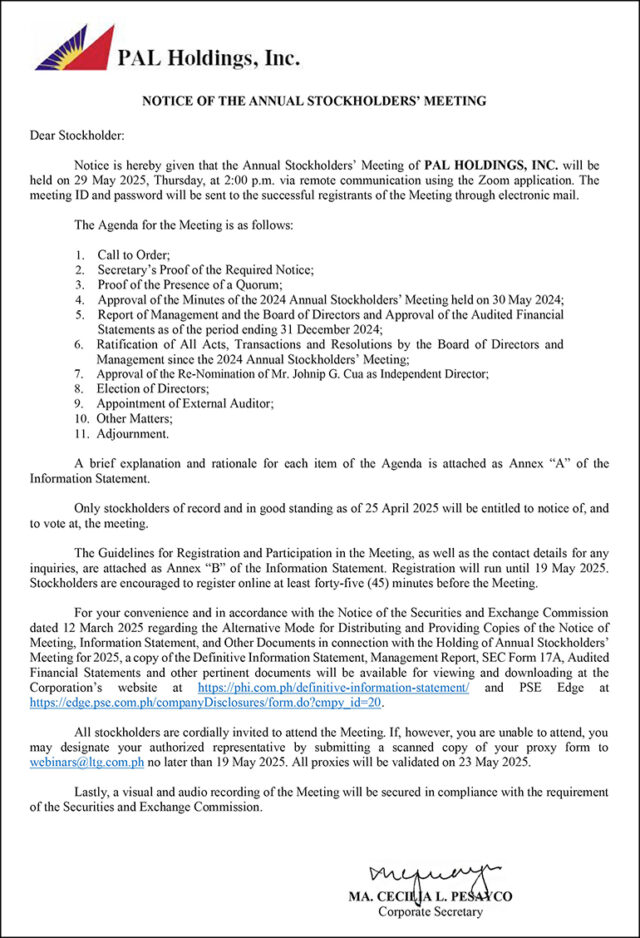
PAL Holdings, Inc. to conduct Annual Stockholders’ Meeting on May 29 via Zoom


Spotlight is BusinessWorld’s sponsored section that allows advertisers to amplify their brand and connect with BusinessWorld’s audience by publishing their stories on the BusinessWorld Web site. For more information, send an email to online@bworldonline.com.

Join us on Viber at https://bit.ly/3hv6bLA to get more updates and subscribe to BusinessWorld’s titles and get exclusive content through www.bworld-x.com.

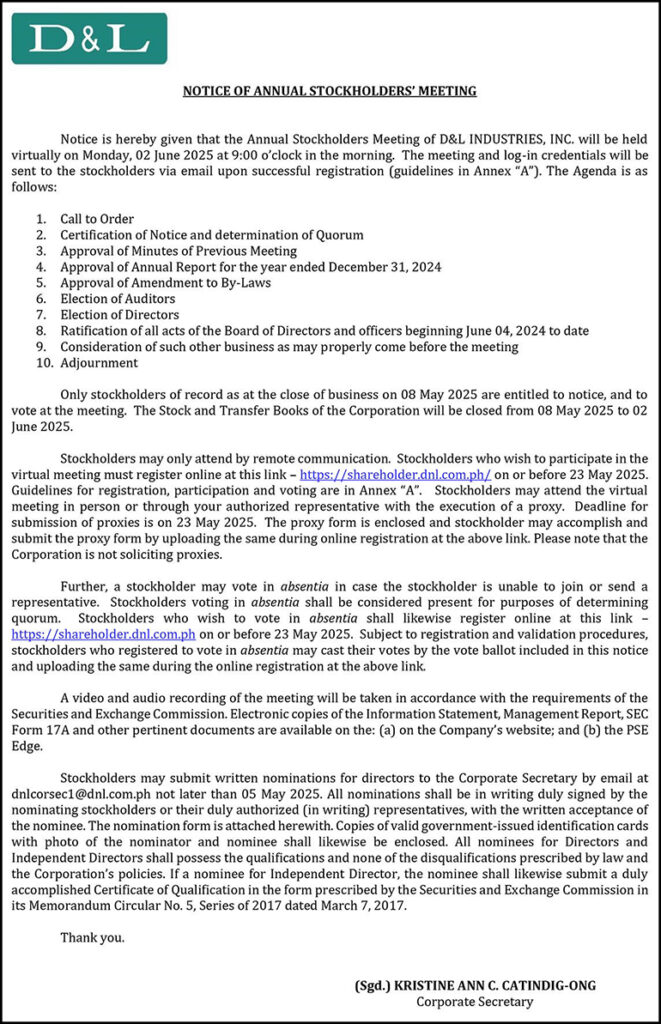
D&L Industries, Inc. to hold virtual Annual Stockholders’ Meeting on June 2


Spotlight is BusinessWorld’s sponsored section that allows advertisers to amplify their brand and connect with BusinessWorld’s audience by publishing their stories on the BusinessWorld Web site. For more information, send an email to online@bworldonline.com.

Join us on Viber at https://bit.ly/3hv6bLA to get more updates and subscribe to BusinessWorld’s titles and get exclusive content through www.bworld-x.com.

SMIC posts P20.1-B Q1 profit; banking leads with 51% share

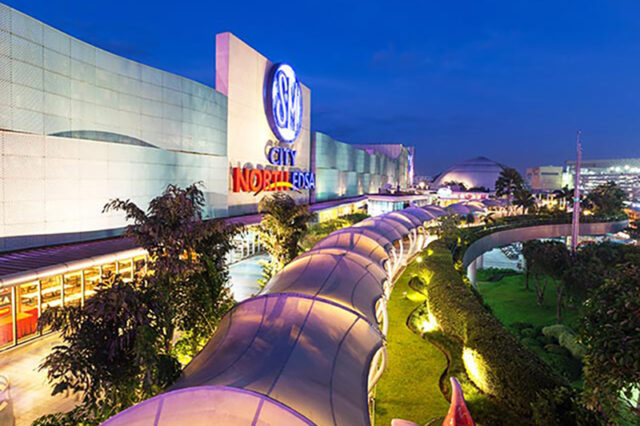
SMSUPERMALLS.COM

SY-LED conglomerate SM Investments Corp. (SMIC) reported a 9% increase in its first-quarter (Q1) consolidated net income to P20.1 billion from P18.4 billion a year ago, driven by growth across its core business segments.

January-to-March consolidated revenue rose by 6% to P152 billion from P143.7 billion in the same period last year, SMIC said in a regulatory filing on Wednesday.

The banking segment accounted for 51% of reported net earnings, followed by property at 29%, retail at 14%, and portfolio investments at 6%.

“We are encouraged by the positive start to 2025. Consumer confidence remains good and our businesses are well-positioned to serve in all categories. Positive sentiment is supported by falling inflation, which was at 1.4% in April,” SMIC President and Chief Executive Officer Frederic C. DyBuncio said.

“We continue to monitor uncertainties in the global macroeconomic environment but remain positive about the Philippines. SM remains focused on serving and enabling our local customers and stakeholders,” he added.

In the retail business, SM Retail recorded an 18% increase in net income to P3.6 billion as revenue climbed by 7% to P100.3 billion.

Food retail revenue rose by 8% to P61.5 billion on improved margins, while non-food retail revenue increased by 6% to P23.5 billion, led by the health and beauty and fashion categories.

In the banking segment, BDO Unibank, Inc. grew its net income to P19.7 billion on the back of double-digit growth in loans and a solid performance in fee-based income.

China Banking Corp. posted a 10% increase in net income to P6.5 billion as net interest income rose by 14% to P17.1 billion, driven by higher asset yields and loan volume.

The property business, led by SM Prime Holdings, Inc., reported an 11% increase in net income to P11.7 billion as total revenue climbed by 7% to P32.8 billion, supported by higher rental income, revenue recognition from real estate sales, and other income sources.

SMIC said its portfolio investments were driven by office developer NEO, which contributed 38% of total portfolio income, followed by renewable energy company Philippine Geothermal Production Co. at 36%, and resort developer Belle Corp. at 11%.

In a separate statement, SM Prime outlined a three-pronged roadmap for long-term growth that focuses on organic expansion, regional development, and diversification.

SM Prime will add over 316,000 square meters of new gross floor area to its mall portfolio and redevelop more than 309,000 square meters of existing mall space in the near term.

NEW MALLS
The real estate developer will also open new malls in Laoag, La Union, and Zamboanga this year to expand its provincial footprint.

It is also pursuing diversification into high-value segments, with integrated property developments and premium residential projects expected to drive growth over the next five years.

Regarding its upcoming entry into the premium residential market, SM Prime said it is open to partnerships for future projects. The initial launch market for the new premium residential venture will be in Metro Manila.

“For certain developments that we have already planned and have strong confidence in, we will pursue them on our own. However, if the project requires additional expertise or broader organizational support, we are more than willing to bring in partners,” SM Prime Executive Vice-President for the premium residential segment Jose Juan Z. Jugo said.

Pricing for SM Prime’s premium residential segment will start at P15 million, with upper price ranges to be determined by market conditions.

SM Prime has earmarked P100 billion in capital expenditure for this year.

On Wednesday, SMIC shares fell by 0.45% or P4 to P876 per share, while SM Prime shares declined by 0.21% or five centavos to P24.15 apiece. — Revin Mikhael D. Ochave

Megaworld Q1 income rises 16% to P5.83B

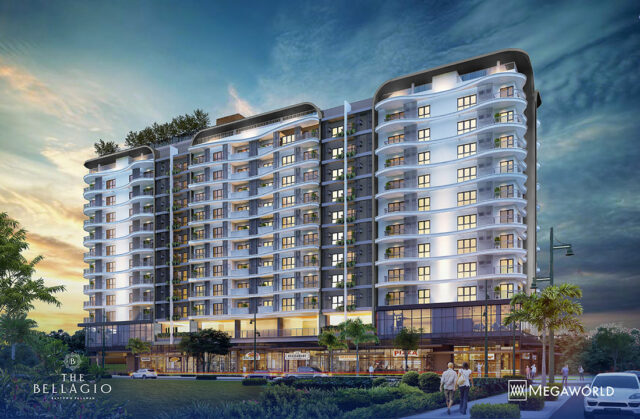
THE BELLAGIO PALAWAN

MEGAWORLD Corp. saw its first-quarter (Q1) net income rise by 16% to P5.83 billion, driven by leasing activity and growth across its residential, office, mall, and hotel businesses.

Consolidated revenue for the first three months grew by 11% to P20.93 billion on the back of strong contributions from its residential, leasing, and hotel operations, Megaworld said in a regulatory filing on Wednesday.

“This strong start to the year is a reflection of our clear strategy and the strength of our diversified portfolio. All of our core businesses — residential, office, malls, and hotels — grew during the first quarter. More than half of our township developments are in the provinces, and the opportunity for expansion and growth is there,” Megaworld President Lourdes T. Gutierrez-Alfonso said.

Real estate sales improved by 8% to P13.09 billion on project sales across Metro Manila and key growth centers in the provinces.

Leasing revenue went up by 15% to P5.34 billion due to tenant demand and synergy between Megaworld’s office and retail ecosystems.

Megaworld Premier Offices grew its revenue by 17% to P3.69 billion. It secured over 50,000 square meters (sq.m.) of new office leases during the quarter — the highest quarterly total in five years — driven by expansions and new tenants from business process outsourcing firms and multinational companies.

Megaworld Lifestyle Malls saw an 11% revenue increase to P1.66 billion on higher foot traffic, sustained consumer spending, and more than 13,000 sq.m. of new tenant openings during the quarter.

Megaworld Hotels and Resorts recorded a 27% increase in revenue to P1.43 billion due to higher room rates.

As of end-March, Megaworld held nearly half a trillion pesos in total assets. It has 35 townships nationwide and approximately 7,000 hectares of land bank.

The property developer aims to expand its office gross leasable area (GLA) to two million sq.m. by 2030 and its retail GLA to one million sq.m. by the same year.

These targets will bring Megaworld’s total leasing portfolio GLA to three million sq.m. by 2030.

Megaworld is the real estate arm of listed conglomerate Alliance Global Group, Inc. (AGI).

“Megaworld remains to be the top contributor to the revenue pie of the Alliance Global Group. This quarter’s results affirm the strength of the company’s township model, which thrives because of the unique connections it fosters between people, businesses, and experiences,” AGI President and Chief Executive Officer Kevin L. Tan said.

Meanwhile, AGI said in a separate disclosure that it plans to raise P26.7 billion from the issuance of warrants to fund expansion plans and settle debt.

The issuance covers up to 2.226 billion underlying common shares at a minimum price of P12 per share.

Warrants refer to derivative instruments that give holders the right — but not the obligation — to purchase or sell a stated number of shares of stock at a specified price and within a specific period.

“The proceeds of the offer will be used to finance capital expenditures, repayment of debt obligations, general corporate purposes, and transaction costs,” AGI said.

“The offering of the warrants to eligible stockholders will allow the latter to have the opportunity to maintain their ownership ratio prior to the issuance of the warrants,” it added.

On Wednesday, Megaworld shares rose by 1.11% or two centavos to P1.82 each, while AGI stocks climbed by 2.1% or 13 centavos to P6.32 apiece. — Revin Mikhael D. Ochave

DigiPlus profit jumps to P4.2B on surge in engagement with digital entertainment

BingoPlus livestreaming studio

TANCO-LED digital entertainment provider DigiPlus Interactive Corp. recorded a 110% increase in first-quarter (Q1) net income to P4.2 billion, driven by its flagship platforms and new game offerings.

Revenue for the January-to-March period climbed by 69% to P23.06 billion, while earnings before interest, taxes, depreciation, and amortization surged by 118% to P4.59 billion, DigiPlus said in a stock exchange disclosure on Wednesday.

“This was fueled by the strong performance of its flagship platforms and the contribution of new game offerings across BingoPlus, ArenaPlus, and GameZone,” DigiPlus said.

“The company’s performance was further boosted by reinforcing operational efficiency, enabling more reinvestment in marketing, product innovation, and user experience, as well as the rationalization of the Philippine Amusement and Gaming Corp. share rate on e-games,” it added.

For the first quarter, the company contributed P8.8 billion in taxes and regulatory fees, up by 28% from last year.

DigiPlus said it is on track to begin its Brazil operations in the fourth quarter. It has started hiring efforts to craft a team that can drive growth and local market relevance.

The company also recently incorporated DigiPlus Global Pte. Ltd. in Singapore, setting the stage for broader growth opportunities and global expansion.

With this, DigiPlus said it remains confident in its ability to sustain its growth, led by data-driven operations and its innovation pipeline.

“DigiPlus aims to bring the success it has established in the Philippines to participate in the thriving digital entertainment and electronic gaming industry globally,” DigiPlus Chairman Eusebio H. Tanco said. 

“Our performance in the first quarter shows that we are building not just for scale, but for long-term value creation. We continuously invest in technology, talent, and trust — and this is what sets us apart,” he added.

DigiPlus has over 40 million registered users. It offers bingo, sports betting, and live-streamed games.

On Wednesday, DigiPlus shares rose by 0.6% or 25 centavos to P41.95 apiece. — Revin Mikhael D. Ochave