Home Blog Page 1561

A Minute With: Author Lee Child about the hit Jack Reacher books and TV show

LONDON — The television series Reacher, based on the best-selling Jack Reacher books, returns for season three this week with the titular character going undercover.

The show, one of Prime Video’s most popular releases, stars Alan Ritchson as the former US military police major turned drifter, a character British author Lee Child first introduced in his 1997 debut novel Killing Floor.

Mr. Child has published 29 Jack Reacher books in total, the latter ones with his brother Andrew, and serves as an executive producer on the Reacher show.

In an interview with Reuters, Mr. Child spoke about season three, an adaptation of his seventh Reacher book Persuader, and what his famous hero means to him. 

Below are excerpts edited for length and clarity.

Q: How would you describe Reacher season three?

Child: It’s about the feel and it’s about the emotional core and the fear that we feel on behalf of Reacher because he’s undercover, he’s alone… He’s entirely isolated, literally on a promontory in the Atlantic Ocean, surrounded on every side by hostility.

Q: How do you decide which book to adapt for the show?

Child: It’s a random choice in a way… it’s like a reader can pick up any of the books and be entirely satisfied… They all stand alone. So, in a sense it can be random, but we try to impose some kind of logic to it, in that season one was really about Reacher’s emotional roots with his real family. Then season two was his emotional roots with his professional family. And season three, therefore, we can launch him on his own, the classic lone wolf Reacher and Persuader was a great story for that.

Q: What does Jack Reacher mean to you?

Child: A character like that I wrote absolutely personally, it was written for one person, which was me. I was losing my job. He was losing his job in the army. I was worried. He was not worried. It was about wish fulfillment. What would it be like to not be worried about things, to not be afraid of things, to not be nervous? What would it be like to be utterly confident in your life? And I think that’s something that we all can respond to on a very personal level.

Q: Given the long list of Jack Reacher books, do you see scope for growth for the TV series as well?

Child: Theoretically, we could do every book… and then write original stories. Historically, that’s unlikely. Not many things run for 30 plus years, but there’s still plenty of stuff we can use. And there are spin-off possibilities, too… There’s plenty of fertile ground there. I just feel like it’s a runaway horse and I’m trying to cling on and ride it as far as I can. — Reuters

CALAX Governor’s Drive Interchange launch moved to 2nd half

CAVITE-LAGUNA Expressway (Laguna section - Mamplasan entry) — LMP 2001

MPCALA HOLDINGS, Inc., a unit of Metro Pacific Tollways Corp. (MPTC), said it remains committed to opening the full stretch of the Cavite-Laguna Expressway (CALAX) within the year, although the expected opening of the Governor’s Drive Interchange has been pushed back to the second half. 

“We are committed to completing the entire stretch of CALAX by 2025. Its full opening will not only ease traffic and improve connectivity but also support economic growth by enhancing access to key areas in Cavite and Laguna,” MPCALA Holdings Officer-in-Charge Elnora D. Rumawak said in a media release on Thursday. 

The company said the construction of the Governor’s Drive Interchange, the longest segment of CALAX, is now 40% complete. It is expected to open in the second half of the year.

The 8.64-kilometer CALAX Governor’s Drive Interchange, which connects the Silang (Aguinaldo) Interchange to Governor’s Drive in General Trias, Cavite, is expected to ease traffic congestion in the area by linking Aguinaldo Highway in Silang with other major roads in Cavite.

The construction of the remaining sections of CALAX is also ongoing, MPCALA Holdings said, noting that Subsection 1 (Kawit Interchange) is now about 31% complete, while Subsection 2 (Open Canal Interchange) has reached 21.9% completion.

In September last year, the company said the Governor’s Drive Interchange was initially projected to open in the first quarter of this year, while the two other segments are scheduled to open in the third quarter of 2025.

MPCALA Holdings is the concessionaire of CALAX. It is a unit of Metro Pacific Tollways Corp., the toll road arm of Metro Pacific Investments Corp.

CALAX is a 45-kilometer, four-lane expressway with eight interchanges. Once fully operational, it is expected to serve at least 95,000 motorists daily.

MPCALA Holdings is a unit of Metro Pacific Tollways Corp., the toll road arm of Metro Pacific Investments Corp., one of three key Philippine units of Hong Kong-based First Pacific Co. Ltd., alongside Philex Mining Corp. and PLDT Inc. 

Hastings Holdings Inc., a unit of PLDT Beneficial Trust Fund subsidiary MediaQuest Holdings Inc., holds a majority stake in BusinessWorld through the Philippine Star Group, which it controls. — Ashley Erika O. Jose

Philippines slips to 53rd in Soft Power Index 2025

The Philippines fell a notch to 53rd out of 193 nations in the 2025 edition of the annual Global Soft Power Index by brand valuation consultancy firm Brand Finance. The Philippines had an overall score of 39.9 out of 100, a tad higher than a year earlier. The index measures “soft power” — the ability of a nation to influence others through persuasion and attraction. The stronger a nation’s soft power, the greater its ability to attract investments, market its products and services, promote tourism, and invite talent.

Philippines slips to 53<sup>rd</sup> in Soft Power Index 2025

DBP’s net earnings rise 20% to P7.1 billion

BW FILE PHOTO

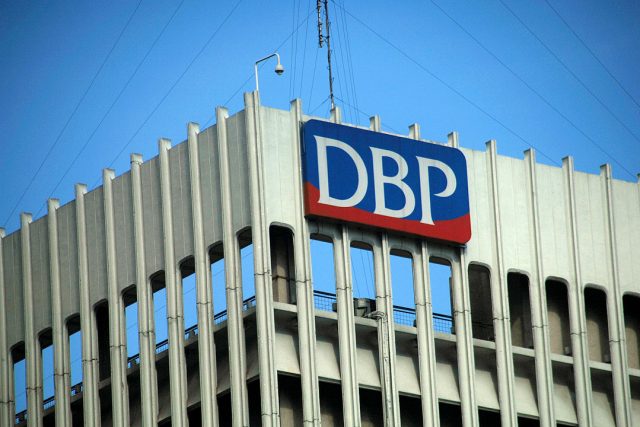
THE DEVELOPMENT BANK of the Philippines’ (DBP) net profit climbed by 20% year on year to P7.1 billion in 2024 on increased lending.

The state-run bank’s 2024 net income was the highest in the past 10 years, it said in a statement on Thursday. This was likewise well above its P5.5-billion profit target for the year.

Its net income was driven by the 13% increase in its net core earnings as it ramped up its lending activities, DBP added.

“DBP’s resurgent performance in 2024 is a clear testament that it remains a strong and stable government financial institution that is greatly capable of funding the priority programs of the National Government,” DBP President and Chief Executive Officer Michael O. de Jesus said.

The bank’s income from its lending operations rose by 6% to P31.7 billion in 2024 from P29.8 billion a year prior, while earnings from treasury operations went up by 2% to P14.9 billion from P14.6 billion, both on the back of the high interest rate environment.

Meanwhile, DBP’s non-interest income stood at P4.04 billion amid higher earnings from fees, foreign exchange transactions, and trading gains. This was 81% higher than the target, the bank said.

DBP’s total loans expanded by 5% to P536.8 billion in 2024 from P509.2 billion in 2023.

“Out of the amount, 61% or P326.48 billion went to the infrastructure and logistics sector with projects mostly found in the National Capital Region, Metro Davao, Central Visayas, and Eastern Visayas,” Mr. De Jesus said.

The bank also disbursed P99.33 billion in loans for social infrastructure and community development projects, P55.12 billion for projects for the environment, and P26.94 billion for initiatives benefiting micro, small, and medium enterprises (MSMEs).

DBP’s capital adequacy ratio stood at 14.9% last year, up from 13.92% in 2023, while its common equity Tier 1 ratio went up to 13.98% from 13%. Both were well above the required minimum.

The bank expects its net income to reach about P7.3 billion to P7.35 billion this year, DBP Senior Vice-President Catherine T. Magana earlier said.

Mr. De Jesus earlier said they expect their loan portfolio to grow by 5% this year.

Congress this month ratified the bicameral conference report on the DBP’s new charter, which would raise the state-run lender’s authorized capital stock to P300 billion from P35 billion.

The capital boost will allow the DBP to provide financing to strategic and critical sectors such as infrastructure and logistics, MSMEs, community services, and the environment.

DBP’s new charter will also allow the bank to sell shares to the public, provided that the National Government owns 70% of its capital stock at all times, with P32 billion or 10.67% being fully subscribed to and paid for by the state.

The bank has a network of 148 branches nationwide, including 15 branch lite units. — AMCS

Memorare to honor 100,000 WWII war-dead

By Joan Orendain

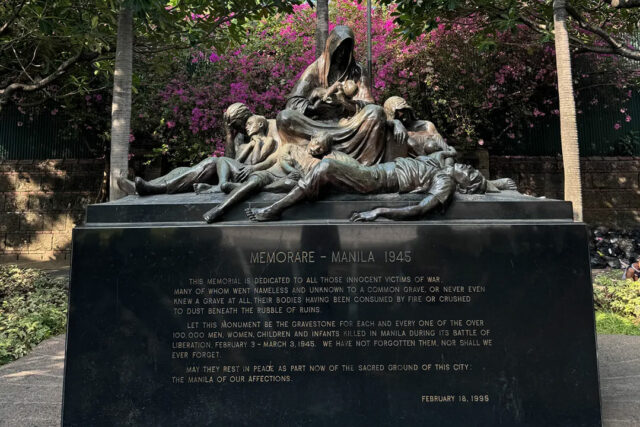
WREATHS will be laid, and taps resound through Intramuros, when Memorare Manila 1945 commemorates 29 deadly days in February 1945.

From Feb. 3 to March 3, 1945, 100,000 non-combatants died from Japanese atrocities: infants were tossed in the air and caught impaled on bayonets. Homes with their inhabitants locked within, were doused in gasoline and set to the torch, among many other unbelievable cruelties inflicted by the enemy on innocent Filipinos. Civilians fleeing the bloodbath to take cover at the Philippine General Hospital went waterless, with children having to drink their own pee to quench thirst.

Low on ammunition, the enemy sought various other ways to kill.

At its fiercest, Filipinos sought safe cover away from the Ermita-Malate area, the eye of the storm. Leopoldo Cu-unjieng who had ingeniously fashioned a “Red Cross flag” from towels on a pole, found himself leading a procession of dozens of Filipinos taking cover behind his flag.

Streets, rivers, and estuaries were littered with bodies by the time fighting ended on the 3rd of March.

Decades later sometime in 1993, Philippine Ambassador to Spain Juan Jose Rocha and two Zobel de Ayala relatives, Roderick McMicking Hall and his sister Connie McHugh, whose parents were killed in that period, got together to plan an annual commemoration of the 1945 atrocities, resulting in the formation of Memorare Manila 1945, led by Ambassador Rocha.

A lovely spot under calachuchi trees on the corner of Heneral Luna and Anda Streets in Intramuros, where the commemoration is held, was donated to Memorare, on which a striking sculpture of that terrible time was fashioned by Peter de Guzman. It is inscribed by National Artist Nick Joaquin.

This year, Memorare Manila 1945’s newly elected president, Marian Aboitiz, inheriting the mantle from her brother, Jose Miguel Cabarus, will lead Memorare, members of the diplomatic corps, other guests, and the Philippine Navy in observing that period. Japanese representatives of Bridge for Peace led by its founder, Naoko Jin, will also be in attendance. She will deliver a brief message. A short speech will also be delivered by Regalado Trota Jose, Chair of the National Historical Commission of the Philippines.

The public is invited to join the brief but stirring ceremony which starts at 8:30 a.m. on Saturday, Feb. 22.

Philippines: Balance of Payments (BoP) Position

THE PHILIPPINES in January posted its biggest balance of payments (BoP) deficit in over a decade, preliminary data from the Bangko Sentral ng Pilipinas (BSP) showed. Read the full story.

Philippines: Balance of Payments (BoP) Position

US aviation industry calls for emergency funding for air traffic technology, staffing

MARK OLSEN-UNSPLASH

WASHINGTON — The US aviation industry called for “robust emergency funding” from Congress for air traffic control technology and staffing after a series of crashes that have raised alarm.

Airlines for America, the Aerospace Industries Association, International Air Transport Association and others including major aviation unions urged Congress in a joint letter on Wednesday to take action, noting the Federal Aviation Administration (FAA) faces serious technology needs and is about 3,500 air traffic controllers short of targeted staffing levels.

“We must support air traffic controller workforce hiring and training, modernize and deploy state-of-the-art air traffic control facilities and equipment,” according to the letter seen by Reuters from groups representing American Airlines, Delta Air Lines, United Airlines, Boeing, Airbus and others adding they do not support “pursuing privatization of US air traffic control services and believe it would be a distraction from these needed investments and reforms.”

The Department of Transportation, FAA and key House and Senate committees did not immediately respond to a request for comment on the letter.

A persistent shortage of controllers has delayed flights and, at many facilities, controllers are working mandatory overtime and six-day weeks to cover shifts.

Earlier this month, Transportation Secretary Sean Duffy said he is reconsidering rules that allowed air traffic control supervisors to reduce staffing at Washington’s Reagan National Airport before a fatal Army helicopter-plane collision that killed 67 people in January.

The FAA last year cut minimum flight requirements at congested New York City-area airports through October, citing air traffic controller staffing shortages.

In March, then-President Joseph Biden proposed spending $8 billion over the next five years to replace or modernize more than 20 ageing air traffic control facilities and 377 critical radar systems.

A quarter of all FAA facilities are 50 years or older. A 2023 report noted air traffic control facilities with leaking roofs, broken heating and air conditioning systems, and old surveillance radar systems that must soon be replaced at a cost of billions of dollars.

The report said the FAA’s communications system has been outdated for years and the agency can no longer get spare parts for many systems.

An outage of a pilot alerting system in January 2023 led to the first nationwide US ground stop since 2001, disrupting more than 11,000 flights. The system suffered a brief outage earlier this month but without significant impacts. — Reuters

Twists and turns in the Year of the Snake

(This is an edited version of the speech given by the author during the Institute of Corporate Directors’ induction on Feb. 14.)

TODAY I will share my outlook on the Philippine economy — a topic that aligns with my present responsibilities. I chose the title “Twists and Turns in the Year of the Snake.” The snake seemed to be the apt Chinese astrological animal at this time of unprecedented uncertainty, where we can be unsuspectingly fatally bitten, or, to mix metaphors, be tempted by forbidden fruit with tragic consequences. (Although, as the old joke goes, if Adam and Eve were Chinese, they would have eaten the snake instead!).

On a more serious note, I must also ask for your understanding. I cannot be as open as I used to be when I did briefings as private global analyst for GlobalSource Partners.

My talk will be in three parts. First a situationer on the Philippine economy, how it is doing, what are the sources of strength. Second, what are the uncertainties and risks that we need to keep an eye on. Finally, what is the role of corporate governance in ensuring that our companies are resilient, agile and nimble, fast strong and tough, in the face of these threats and challenges.
The Year of the Snake is off to an interesting start. Global markets are grappling with the possible repercussions of the ongoing geopolitical fragmentation. Much has already unfolded this early in 2025, and there are bound to be more twists and turns in the months ahead.

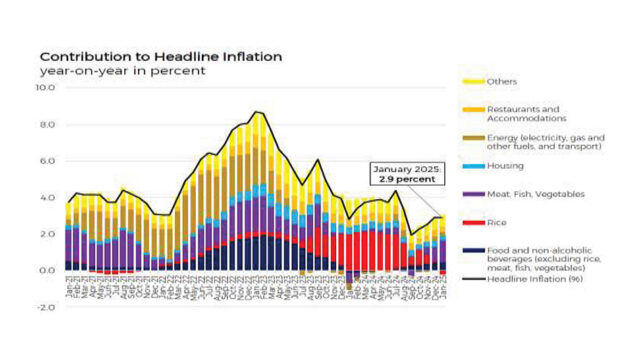
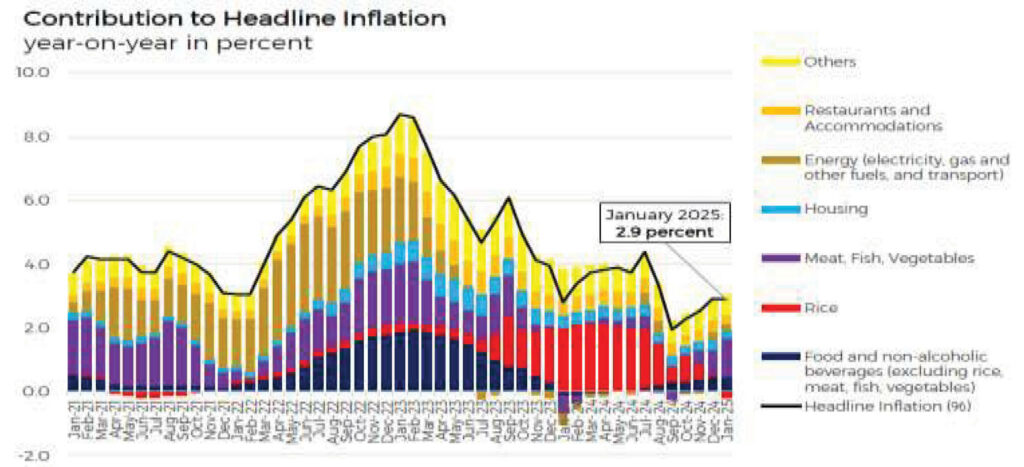
In this environment, the Monetary Board decided yesterday to keep policy rates steady. This followed three consecutive rate cuts beginning August last year that reduced the key overnight RRP rate from 6.50% to 5.75%. The cuts reflect the country’s progress in lowering inflation. Headline inflation decreased from a peak of 8.7% in January 2023 to 2.9% in January this year. Measures of underlying inflation have declined and our projections indicate we will be within target average inflation through 2026. Inflation expectations also remain within target.

Nonetheless, as I mentioned earlier, elevated policy uncertainty over the external environment warranted a pause in monetary policy easing at this juncture. The BSP (Bangko Sentral ng Pilipinas) is attentive to the risks to our inflation outlook, which are broadly balanced until 2026, and it remains to be seen how the current geoeconomic shifts will impact us.

Let me be clear that the BSP looks to continue its measured shift toward less restrictive monetary policy settings but it will remain data-dependent in deciding on the pace and timing of further reductions in the policy rate.

Although our primary focus is inflation, in calibrating the monetary stance we also take into account the impact on the real and financial sectors to ensure that the country remains resilient on a wide front.

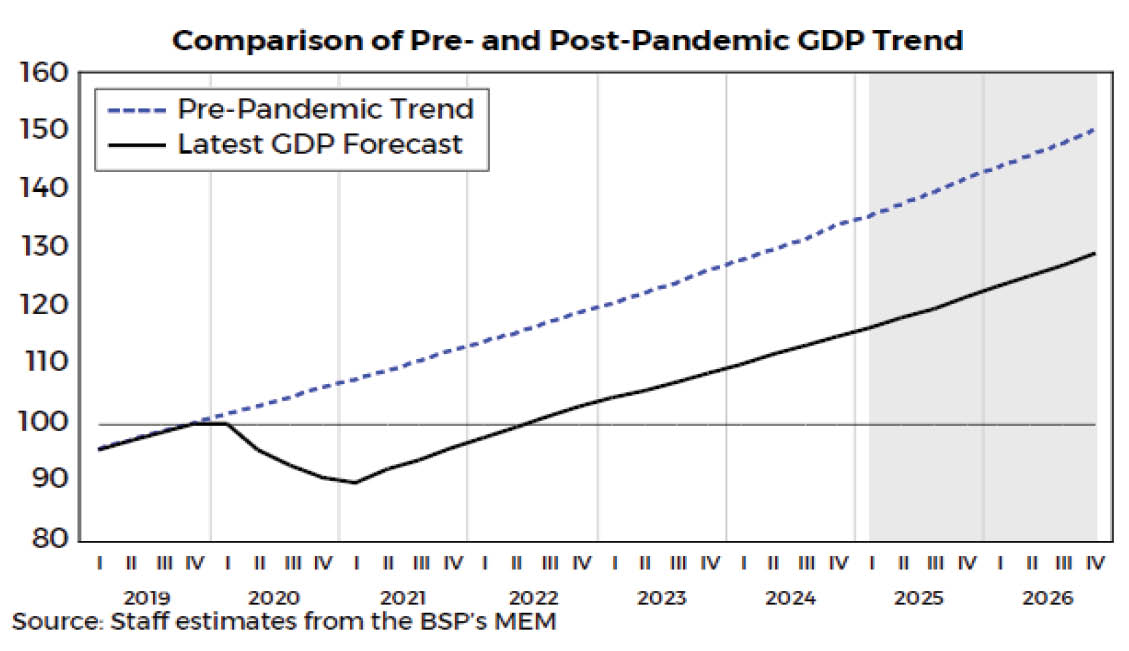
After a brief post-pandemic spike, economic growth has slowed to an average of 5.6% in the last two years compared with the 6% to 7% growth clip pre-pandemic. Nevertheless, we expect GDP growth to breach 6% this year and next. Disinflation and a less restrictive monetary policy stance, including the impact of prior monetary policy adjustments on the economy, form part of the growth story. The main part of our growth story will continue to be driven by OFW (overseas Filipino workers) remittances, BPO (business process outsourcing) revenues and government’s infrastructure program, which has been kept at 5% to 6% of GDP. The growth story will be supported further by government’s commitment to fiscal consolidation, credible monetary policy, and healthy international reserves that serve as a reliable backstop against external shocks. Note also that our sovereign rating has a good chance of getting an upgrade based on S&P’s positive outlook on credit.

These positive macro developments will also contribute to financial sector stability. The banking sector has maintained solid performance, demonstrated by a continued uptrend in assets, loans, deposits, and earnings, along with reasonable provisions for non-performing loans (NPL). As we gradually dial back monetary policy restrictions, we see that further reductions in the reserve requirement ratio will appropriately support our continuing shift towards more market-based monetary operations. We want to minimize financial system distortions in the form of high intermediation costs and transaction fees so that banks can more efficiently channel their funds towards productive loans and investments. Future adjustments in reserve requirement ratio to bring the Philippine’s reserve requirement ratio in line with its peers in the region will ultimately enhance monetary policy transmission.

I hope I have not made it sound like that all is well with the economy.

As we all know, the pandemic has left a mark on the economy with outputs in some sectors, notably real estate and some manufacturing industries, still below their pre-pandemic levels. Investments as a share of GDP are lower than they were pre-pandemic despite higher public construction under government’s Build Better More infrastructure program. This has contributed to weaker labor productivity and lower potential economic growth rate. Public debt as a share of GDP is 20 percentage points higher than it was pre-pandemic, highlighting the need to rebuild fiscal buffers. Poorer education outcomes as well as skills shortage are also very much part of our pandemic scars and present medium-term challenges to growth, including in the IT-BPM (Information Technology and Business Process Management) industry.

We also emerged from the pandemic having to face unprecedented geopolitical turmoil. The Russia-Ukraine war, the war in Gaza, and now Donald Trump in the White House. The landscape of external risks arising from policy uncertainty, particularly from Trump 2.0, calls for increased vigilance against potential supply shocks and a global growth slowdown. Perhaps the big question on everyone’s minds at the moment is just how far this trade war could go and how much of a blow this could be to the global economy and the Philippines. Yesterday, our economic research group showed us indices of trade uncertainty and policy uncertainty, both of which spiked, graphically a vertical line up.

Although nobody really knows at this point how far the trade war will go, I think we can learn from the experience during the first Trump administration when the US-China trade conflict led to tariffs on over $500 billion worth of goods in both economies.

• First, between September 2018 and December 2019, total exports from the ASEAN+3 region contracted significantly in value, after growing previously at an average rate of 10%. The Philippines was largely insulated from trade tensions during this time, reflecting its low participation in global trade and value chains. Today, the Philippines’ trade surplus with the US is relatively small, which makes it less likely to face targeted US tariffs.

• Second, despite the Philippine’s close trade ties with the US, the country did not benefit much from the resulting relocation of firms’ production bases unlike, for example, Vietnam and Mexico. The fear this time is that the anticipated higher tariffs on other countries, particularly China, could lead to inefficient fragmentation of global supply chains and further dampen global trade flows. With the Philippine’s friendlier ties with the US under the current administration, will it be able to strengthen trade relations with the US through a bilateral Free Trade Agreement (FTA) and other sectoral agreements?

• Third is on trade in services. Seventy percent of the market of the country’s IT-BPM industry is in North America (predominantly the US). Under Trump’s previous term, growth in Philippine BPO earnings slowed sharply to 2.5% in 2017 and 3.9% in 2018, from 12.3% in 2016. Given Trump’s protectionist bent, there appear to be plans by US firms offshore to move operations closer to the US, either through reshoring or relocating to politically stable or geographically convenient countries. This adds another layer of complication to an industry that is being disrupted by the emergence of generative artificial intelligence. I have talked with industry insiders who seem fairly confident of sustaining growth in line with the overall economy. Their optimism that the Philippines can adapt hinges on moving up the value chain with further AI integration supporting growth and catering to increasing demand in healthcare outsourcing. Expanding markets in Europe and Asia-Pacific would also help in partially offsetting the possible decline in US outsourcing demand.

On the local front, we only need to open the front pages of the newspapers to appreciate the looming risks that may impact the economy, not just this year but beyond. Though 2025 is only holding senatorial and local elections, it is shaping up to be an existential contest among the protagonists, with profound consequences on our country’s medium term domestic and foreign policy (including on big power conflict) and our future.

Now to the subject close to our hearts as fellow advocates of good corporate governance. At the risk of bringing coal to Newcastle, let me share some of my thoughts on the role of the board and good corporate governance in the face of such heightened VUCA (volatility, uncertainty complexity and ambiguity) the likes of which we have not seen since the concept was introduced in the US Army War College in 1987.

I will give some current thoughts and draw from a column I wrote in June 2017 when I was an independent director in a major bank. The column, “Corporate Governance in the Digital Age,” excerpted remarks I gave to a forum organized by the BSP and IFC on corporate governance for banks. While the landscape has evolved since then, I believe the core principles remain just as relevant today.

1) Board Composition. Governance starts at the top. Good corporate governance is ultimately the responsibility of the board. As is often rightly said — companies do not fail, boards do. It starts with having the right men and women in the board with rich and diverse backgrounds. Diverse in the terms of gender, age, cultural background, education, professional experience, length of service.

A diverse board is not just about representation. It is a matter of resilience. The more diverse perspectives we have in scanning the horizon, the better prepared we are for what comes next. When leaders from different backgrounds, disciplines, and experiences come together, they collectively bring unique insights that help organizations think through complex risks, challenge assumptions, and seize opportunities. In an age of rapid disruption — from trade policy shifts to AI driven transformation — having a boardroom that mirrors the complexities of the world is not just valuable; it is essential.

As Darwin famously observed, the species that survives is the one that is best able to adapt and adjust to the changing environment in which it finds itself. The same holds true for corporations. Those with diverse, dynamic leadership are the ones that will endure.

Listen to Darwin, ignore Donald.

2) Culture. Governance is more than compliance. My 2017 column mentioned that in the institution I was with, governance went beyond formal rules. “For us it is all about imbibing and nurturing a culture of integrity, fairness, accountability and transparency cascaded from the Board, its management, and to all our employees.”

I am sure here in the ICD you are making progress towards nurturing such a culture in all the companies you monitor, as well as in your own practices.

Culture determines behavior. Without the right governance culture, even the best policies and structures will fall short.

We need only look at past crises to see why this matters. Take the Global Financial Crisis — a textbook case of failed governance, where conflicts of interest went unchecked. Credit rating agencies, for example, were paid by the same companies they rated, even advising them on securitization structures that will result in good rating scores. That lack of independence and integrity had catastrophic consequences. The lesson? Strong governance is not just about ticking the boxes, or even following the letter of the rules. It is about embedding the right values.

3) Risk Management. In that same column, I quoted BSP Governor Amando Tetangco, who said that “risk management is at the heart of corporate governance for banks.” That remains true not just for banks, but for all businesses. Risk today comes in many forms — geopolitical uncertainty, cyberthreats, regulatory shifts, financial market volatility, and even reputational risks amplified by social media. Given the unprecedented risks all around, we all need to upgrade our risks management systems commensurate to the heightened threats.

We are all navigating an era of economic shifts, geopolitical tensions, and rapid technological advancements. Businesses that embrace good corporate governance — not just as a compliance exercise, but as a strategic imperative— will be the ones that remain resilient, adaptable and competitive. Good governance is not just about rules and regulations; it is about building organizations that can anticipate and respond effectively to change. It is about ensuring that decision-making is informed, transparent, and accountable.

As corporate leaders, policymakers, and advocates of good governance, we have a responsibility to uphold these principles. The choices we make today — who we bring to the table, how we structure our decision-making, and how we anticipate risks — will determine our ability to navigate the twists and turns ahead. I highly commend and congratulate ICD, its Founder, leaders past and present for being at the forefront of corporate governance reforms for the past two decades!

The Year of the Snake will surely bring its share of surprises. But with strong governance, diverse leadership, and a steadfast commitment to resilience, we can ensure that Philippine businesses remain agile, competitive, and ready for the future — no matter what it holds.


Romeo L. Bernardo is a member of the Monetary Board.

globalsourcepartners.com

romeo.lopez.bernardo@gmail.com

Ayala Land Estates to open The Blue Leaf at Arca South by 2026

AYALA LAND ESTATES, Inc. (ALEI) said The Blue Leaf events space at the Arca South estate in Taguig City is set to open in 2026 as part of efforts to expand the estate’s offerings. 

The company, in partnership with events space operator The Blue Leaf, recently broke ground for the planned venue, ALEI said in an e-mail statement late Wednesday.

The Blue Leaf at Arca South will feature a single, exclusive events hall with a capacity of up to 250 guests. It is designed with a focus on food-centered experiences and advanced theatrical features.

According to ALEI, the venue will be the most environmentally friendly branch in The Blue Leaf’s portfolio, incorporating rainwater catchment systems, energy-efficient appliances, and solar power harvesting.

ALEI is a subsidiary of listed property developer Ayala Land, Inc. (ALI).

“The integration of The Blue Leaf into Arca South is a synergistic approach to strengthen the mix of developments within the estate,” ALI Senior Vice President and Senior Project Development Head of Estates Group May P. Rodriguez said.

“It is a key component in ensuring our promise of delivering a mixed-use estate that offers diverse uses for a holistic and dynamic urban living experience,” she added.

For 2024, ALI recorded a 15% increase in net income to P28.2 billion as revenue rose by 21% to P180.7 billion.

Arca South is a 74-hectare mixed-use estate featuring residential, commercial, and recreational spaces. It is located near the Makati City central business district and Bonifacio Global City.

On Thursday, ALI shares declined by 8.06% or P2 to close at P22.80 each. — Revin Mikhael D. Ochave

CIMB Bank PH expects to double profit this year

CIMB BANK Philippines, Inc. (CIMB Bank PH) expects to double its profit this year as it looks to launch new features and services on its platform.

“We expect to double [our profit] in 2025 from 2024. So, the growth trajectory will still be quite strong. And as the business matures, we would be able to grow at an aggressive pace,” CIMB Bank PH Chief Executive Officer Vijay Manoharan told reporters on Monday.

The digital-only commercial bank earlier said its profit before tax for 2024 grew by 45 times year on year as it continued to expand its customer base. It did not give a specific income figure.

Mr. Manoharan said CIMB Bank PH’s profit growth this year will be driven by the continued expansion of its customer base as it taps new segments and launches new products.

“The more products we launch, the more we’re able to tailor the different products to the big base that we have,” he said.

CIMB Bank PH expects its customer base to breach the 10-million mark by the end of the year. At end-2024, its customers stood at over nine million, it earlier said.

CIMB Pay, which allows its mobile app users to pay using QR codes, will also drive customer growth, Mr. Manoharan said, adding that he expects the recently launched feature to bring the bank about P300 million in monthly transactions.

“My goal is for us to be able to do P300 million to P400 million very soon and grow from there. That is where we intend to get ourselves to, at a steady state. Of course, now it’s still new, but it is realistic,” he said.

“I would hope at least a million customers that we have (use the product) daily,” he added.

The bank recorded P800 billion in transactions at end-2024.

CIMB Bank PH was recently recognized as the best digital bank in the Philippines in 2024 by The Asian Banker and part of the top 100 digital banks globally.

“Asian Banker is known to have quite a rigorous selection process. Across these five [indicators] — customer, product relevance, balance sheet growth, financial stability, and growth, and lastly funding — they measured across all these five indicators, and we were selected. We’re very proud,” Mr. Manoharan said.

CIMB Bank PH broke even in 2023, based on the CIMB Group’s annual report posted on its website.

CIMB Group is based in Malaysia and offers consumer, commercial, wholesale, and Islamic banking, as well as wealth management and digital payment products and services across Southeast Asia.

CIMB Bank is the group’s commercial bank in Malaysia, which has subsidiaries in Thailand, Cambodia and Vietnam and branches in the Philippines, China, Singapore, and London. — A.M.C. Sy

Stuff to Do (02/21/25)


Take a rubbercut printmaking workshop

FOR the first in a series of printmaking workshops hosted by The M, a collection of contemporary prints serves as the inspiration for the Rubbercut Printmaking Workshop. The workshop will be facilitated by Ambie Abaño, a multi-awarded Filipino artist, printmaker, and board member of the Philippine Association of Printmakers. The workshop will take place on Feb. 22, 1 to 5 p.m., at the 3rd floor South Gallery in Metropolitan Museum of Manila in BGC. It is meant for those aged 13 years old and up. Register via the link bit.ly/4hkWETT.


Honor the Battle of Manila’s fallen

WREATHS will be laid, and taps resound through Intramuros, when Memorare Manila 1945 commemorates the Battle of Manila, when from Feb. 3 to March 3, 1945, 100,000 non-combatants died from Japanese atrocities. The public is invited to join the brief ceremony which starts at 8:30 a.m. on Saturday, Feb. 22, at the corner of Heneral Luna and Anda Streets in Intramuros, Manila.


Watch a Maiko and Geiko performance

THE Japan Foundation Manila is presenting a rare opportunity to witness the elegance and artistry of Japan’s renowned Maiko and Geiko from Gion Higashi, Kyoto. This performance will take place on Feb. 22, 6:30 p.m., at Shangri-La Plaza Grand Atrium, in Mandaluyong as part of Nihongo Fiesta 2025. Maiko (apprentice Geiko) and Geiko from the historic district of Gion in Kyoto will perform classical Japanese dances. The audience will have a rare chance to experience traditional Japanese performing arts, showcasing the grace, refined movements, and time-honored culture of Kyoto’s Hanamachi (flower town). Admission is free.


Snag a travel sale deal

DAVAO resort Discovery Samal is offering exclusive deals as part of the Davao Mega Travel Sale. These deals are available until Feb. 23, with the discounted stays applicable until Feb. 28, 2026. Discovery Samal is a luxurious resort in Samal Island in Davao. The sale includes room rates of P25,221 for a Junior Suite, P34,505 for an Executive Beach Suite, P36,052.80 for a Samal Suite, and P43,789.20 for a Premier One Bedroom Suite. Guests can also enjoy 15% off on all food and beverage outlets and Samal Escape Spa treatments. Guests who stay between June 15 and Aug. 31 will receive an additional P500 Spa credit. Guests can choose from three-month or six-month installment plans.


View exhibits at Shangri-La Plaza galleries

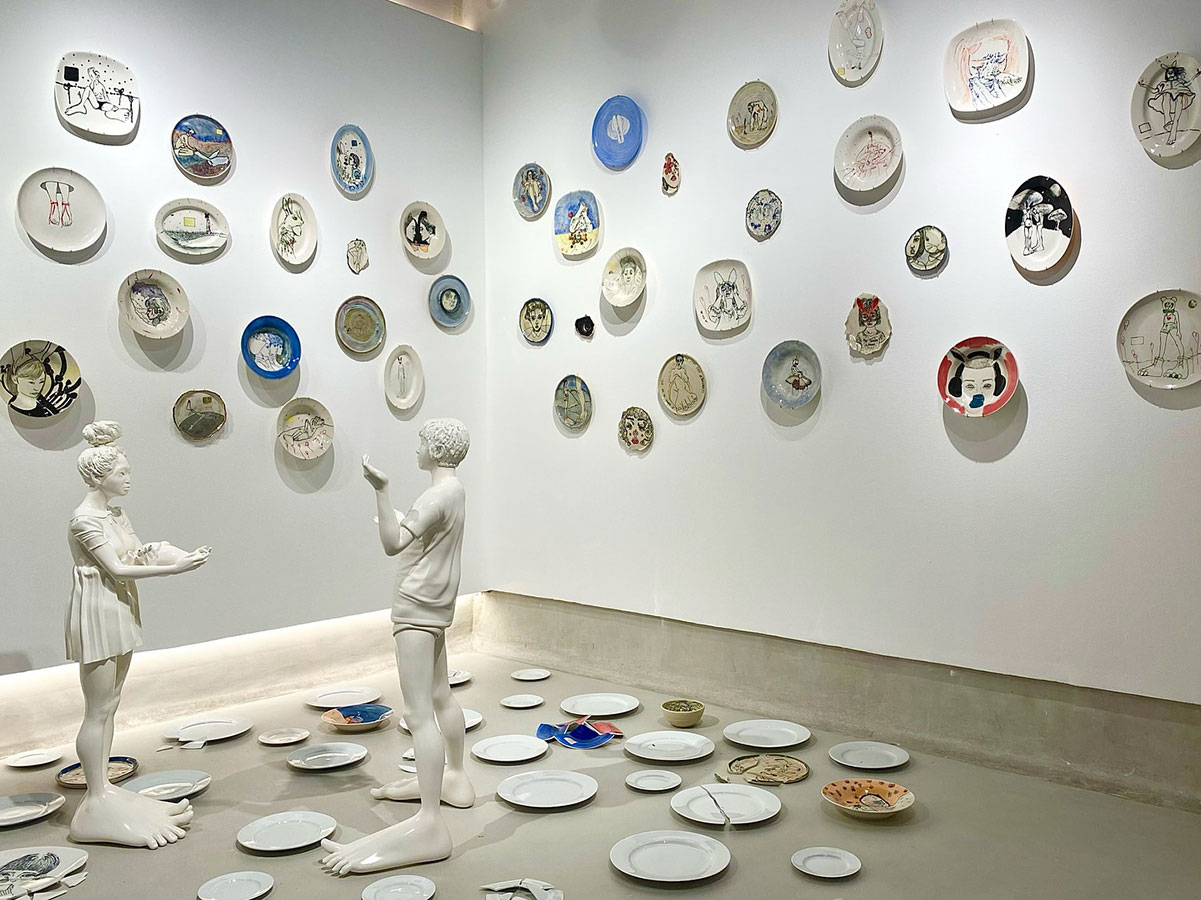
FOR National Arts Month, Shangri-La Plaza has its own lineup of galleries with new exhibits. At Gallery BiG, there is the exhibit Renditions of Epicurean Delights, a selection of Cubist-inspired drawings by New York-based Fil-Am physician and nuclear medicine expert Dr. Wilfrido Sy. The exhibit is ongoing until Feb. 24 at Gallery BiG at the Art Plaza on Level 4, Main Wing. Meanwhile, Galerie Stephanie is serving a triple exhibit treat this February: Swimming in my Head by Indonesian artist Imam Santoso; Breaking to Mend, a solo exhibition of handmade porcelain plates by Brazil-born pop surrealist Ciane Xavier; and, What We Carry, What We Grow by Shireen Co, Jem Magbanua, Thea Quiachon, and Nunzio Paci. All three shows are running until March 2 at Level 6, East Wing. Finally, Asian contemporary art space Cartellino presents In the dust of this planet, an exhibit of collage works and paintings by Marybob Arce and Regina Reyes running until March 2. Cartellino is located at Level 6, East Wing.


Go to NCCA’s two exhibits for Arts Month

TWO exhibitions are on view at the National Commission for Culture and the Arts (NCCA) Gallery in Intramuros. The first is PiDi: Piding-Pidi!, featuring 20-years of art by Elmer I. Nocheseda, an artist with Parkinson’s Disease. Curated by Joseph S. Santiago, the showcase offers a unique set of undated artworks created at the early and severe stages of his disorder, challenging guests to guess which artworks were done at each stage. The second exhibit is Living Pages, which narrates children’s stories through robotics engineer and sculptor Sven Wilbur Lim’s art made of discarded book pages. It interprets the stories of Cinderella, Snow White, and Alice in Wonderland. Both exhibits are on view at the NCCA Gallery until Feb. 28.


Visit Mylene Quito’s solo show

VISUAL ARTIST Mylene Quito holds her 5th solo exhibition, Blossoms of the Heart, Love in Bloom, at the Nami Gallery in Quezon City until Feb. 28.  Known for her signature pointillism technique and vibrant floral works, this features colorful depictions of peonies, cherry blossoms, rain lilies, Madonna lilies, and daffodils. In addition to her solo show, Ms. Quito is participating in an international collaboration with Tan Kay Nguan, founder of Art Alliance Singapore, and Kayson Chen, Chairman of the 15th Art Alliance in Taiwan. The group exhibit runs until Feb. 25 at the 15th Asia Art Alliance in Taoyuan, Taiwan, featuring the work of 17 Filipino artists, including Ms. Quito.


Go to Ali Mall’s art festival, Zamboanga exhibit

THE Love of Art Festival is ongoing at the ground floor Activity Area of Ali Mall. Presented by Araneta City and Gateway Gallery in partnership with Quatro Arts and Events, the festival features artworks by independent artists from around the Philippines. At the same time, at the lower ground floor Activity Area, there is the Sinag: Sigla ng Sining exhibit showcasing works by Zamboanga’s special children and youth artists and creatives. It is presented in partnership with the National Commission for Culture and the Arts, Philippine Association for Citizens with Developmental and Learning Disabilities, and the National Council on Disability Affairs. Both shows run until Feb. 28.

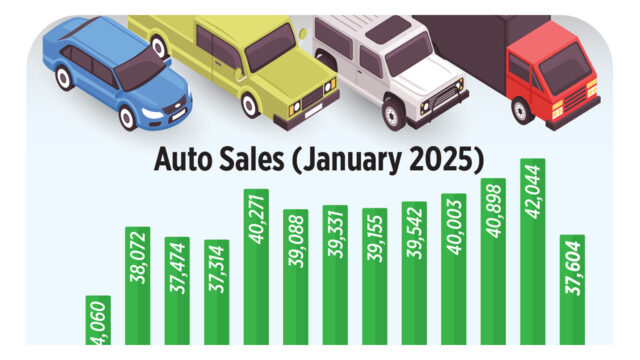
Auto Sales (January 2025)

PHILIPPINE AUTOMOTIVE sales are expected to reach 500,000 units in 2025, according to the Chamber of Automotive Manufacturers of the Philippines, Inc. (CAMPI). Read the full story.

Auto Sales (January 2025)