Home Blog Page 1557

Metro Retail posts 73% plunge in Q1 income, pushes store expansion

METRORETAIL.COM.PH

LISTED Metro Retail Stores Group, Inc. saw its first-quarter (Q1) net income fall 73.4% to P13.4 million from P50.3 million last year, weighed down by non-cash charges linked to its expansion program.

Despite the decline, the company is actively expanding its store network, reaching 72 outlets with the opening of a new Metro Value Mart in Talisay City, Cebu last month.

“Through 2025, Metro Retail will continue to elevate customer experience, optimize operations, and strategically expand to strengthen its market position and deliver sustainable growth,” President and Chief Operating Officer Joselito G. Orense said.

Net sales rose 2% to P8.9 billion, driven by growth in food retail and general merchandise, but same-store sales dropped 1.7%.

Blended gross margin improved 4.4% to P1.9 billion, with gross margin as a percentage of sales rising to 21.3% from 20.8%.

Earnings before interest, taxes, depreciation, and amortization (EBITDA) increased 6.1% to P413 million, while operating expenses rose due to higher utilities and labor costs.

Metro Retail operates formats including Metro Supermarket, Metro Department Store, Super Metro Hypermarket, Metro Value Mart, and Metro Home and Lifestyle.

Shares rose 0.81% to close at P1.24 on Tuesday. — Revin Mikhael D. Ochave

In Indonesia, fears grow that dark past may be rewritten with government’s new history books

STOCK PHOTO | Image by jorono from Pixabay

JAKARTA — The Indonesian government’s plan to release new history books has sparked concerns that some of the country’s darkest chapters could be recast to show President Prabowo Subianto and late authoritarian ruler Suharto in a favorable light.

The 10-volume series would have an Indonesia-centric narrative and aims “to reinvent the Indonesian identity,” Culture Minister Fadli Zon told Reuters in an interview.

Several historians said the commissioning of the books presents an opportunity for historical revisionism at a time when Indonesia’s younger generations — largely responsible for Mr. Prabowo’s resounding election victory last year — have little or no memory of Mr. Suharto’s 1966-1998 New Order era.

Mr. Prabowo openly praises Mr. Suharto, who was once his father-in-law, and is increasingly turning to the military to carry out his government’s vision.

Mr. Prabowo has also been accused of rights abuses while in the military, including involvement in the kidnapping of student activists during riots in 1998 — allegations he has repeatedly denied and which Mr. Fadli said had been debunked.

Asvi Warman Adam, a leading historian who used to work at the National Research and Innovation Agency, said he was calling on academics to lobby lawmakers to scrutinize what he said would be “propaganda.”

“I suspect there is an intention to legitimise the ruling regime … such as by excluding gross human rights violations in 1998 linked to Prabowo,” he said, adding that he expected the government would soon confer the posthumous title of “National Hero” on Mr. Suharto.

Asked about concerns by some analysts and historians that the books could be used as propaganda, be politicised, and omit human rights abuses that have been linked to Mr. Prabowo and Mr. Suharto, Mr. Fadli said: “History will be written correctly.”

The president’s office did not immediately respond to a request for comment on the new books. Mr. Prabowo has previously said that former activists were his supporters.

Mr. Fadli, who has authored a book that defended Mr. Prabowo’s actions as a special forces commander during Mr. Suharto’s 32-year rule, added that neither he nor Mr. Prabowo would be involved in the editorial process.

The books, which Mr. Fadli said were commissioned last year, will chronicle the history of humankind in Indonesia from homo erectus to Dutch colonization to Mr. Prabowo’s election. They will be authored and edited by about 100 historians and Mr. Fadli says he wants them ready by Aug. 17, Indonesia’s Independence Day.

MASS KILLINGS IN FOCUS
Made Supriatma, a visiting fellow at the ISEAS-Yusof Ishak Institute in Singapore, said he believes the government will use the same playbook as Mr. Suharto, who released a six-volume book series in 1975 titled The National History of Indonesia that he said glorified the military and was fraught with inaccuracies.

“Prabowo’s history within this republic is not good, to be frank … Do they dare to write that?” said Made.

Jajat Burhanuddin, a historian involved in the project, said so far there has been no state intervention. The 1998 kidnappings and torture of student activists would be included, he said, although he declined to say whether Mr. Prabowo would be mentioned in those accounts.

Another key focus for historians will be how the books portray the mass killings of communists and sympathizers in 1965 and 1966, led by military and Islamic leaders. Some historians estimate more than half a million people were killed.

No investigation has been conducted into the killings, which were in response to the murder of generals by the communist party in an abortive coup.

Mr. Suharto rose to power in the aftermath and remained president until 1998, when he stepped down during a popular uprising and economic crisis after allegations of corruption and nepotism.

The 1965 events continue to be debated in Indonesia. Mr. Fadli said the new books would not take a deeper look into the massacres.

Mr. Fadli, who was among the student activists who demonstrated against Mr. Suharto, now speaks highly of the former ruler, highlighting economic achievements in his early presidency, including slashing poverty and tackling inflation.

“My opinion has always been for a long time that Suharto should be considered a national hero,” he said.

On Monday, several historians and rights activists met with a parliamentary committee overseeing the Ministry of Culture, rejecting the new history books.

“This project could be used as a tool to wash away the sins of the existing regime or New Order era,” Marzuki Darusman, a rights advocate told the committee.

The committee would soon summon the minister to convey these concerns and seek more explanation about the books’ content. — Reuters

Telcos seen to post mixed Q2 results amid rising costs

BW FILE PHOTO

By Ashley Erika O. Jose, Reporter

LISTED telecommunications (telcos) and information and communication technology (ICT) companies are projected to deliver mixed second-quarter (Q2) results amid rising operational costs and heightened competition, analysts said.

“Telecommunications companies are likely to face a mixed profitability landscape by the second quarter despite increased demand for digital connectivity,” Globalinks Securities and Stocks, Inc. Head of Sales Trading Toby Allan C. Arce said in a Viber message.

Mr. Arce noted that the increasing demand for digital connectivity will drive remote work and digital transformation across industries, thereby boosting companies’ revenue streams.

“Philippine telecom and ICT firms [are expected] to deliver modestly higher aggregate profits in the second quarter, though the improvement will be uneven across players,” said Jayniel Carl S. Manuel, equity trader at Seedbox Securities, Inc.

Andrei Jorge G. Soriano, research associate at China Bank Securities Corp., said mobile and data revenues may remain pressured as discretionary spending continues to face challenges amid economic uncertainties.

Globe Telecom, Inc. posted a 2.65% rise in first-quarter attributable net income to P6.98 billion, driven by one-off gains, despite a 3.42% decline in combined revenues to P43.76 billion from P45.31 billion a year ago.

Service revenues, which comprise most of Globe’s topline, fell by 3.16% to P39.85 billion from P41.15 billion, while non-service revenues dropped 6.25% to P3.9 billion from P4.16 billion.

Home broadband service revenues remain key growth drivers for telecommunications and ICT firms, Mr. Soriano said.

“With respect to costs, we expect to see elevated depreciation and financing expenses to sustain amid telcos’ respective expansion pipelines,” he added.

PLDT Inc.’s attributable net income fell 8.04% to P9.03 billion in the first quarter, as rising expenses outpaced modest revenue growth.

Total revenues increased 1.95% to P55.28 billion from P54.22 billion in the same period last year.

Service revenues grew 2.34% to P53.42 billion from P52.2 billion, while non-service revenues declined 8.38% to P1.86 billion from P2.03 billion.

Fiber internet service provider Converge ICT Solutions, Inc. recorded an 18.43% increase in first-quarter attributable net income to P3.02 billion, mainly supported by growth in its residential business.

Converge’s total revenues for the period rose 13.21% to P10.8 billion from P9.54 billion a year earlier.

“Demand for data and enterprise connectivity remains structural, with mobile data traffic still growing in the mid-20% range and fiber subscriptions continuing to climb,” Mr. Manuel said.

He noted this would help offset slower service-revenue growth as consumers become more value conscious.

DITO CME Holdings Corp., operator of DITO Telecommunity Corp., reduced its first-quarter attributable net loss to P1.66 billion from P4.11 billion a year ago.

“I would characterise the second quarter as a ‘steady-to-slightly-better’ quarter for Philippine telcos. Core connectivity remains a cash-generating utility, and the BSP (Bangko Sentral ng Pilipinas) rate cut throws them a lifeline on financing costs,” Mr. Manuel said.

Mr. Arce added that telecom and ICT companies are well-positioned to benefit from emerging technologies and artificial intelligence solutions.

“Those with robust digital infrastructure and strong consumer bases could potentially outperform their peers. But sustained profitability growth across the sector hinges on their ability to navigate economic challenges and maintain competitive differentiation,” he said.

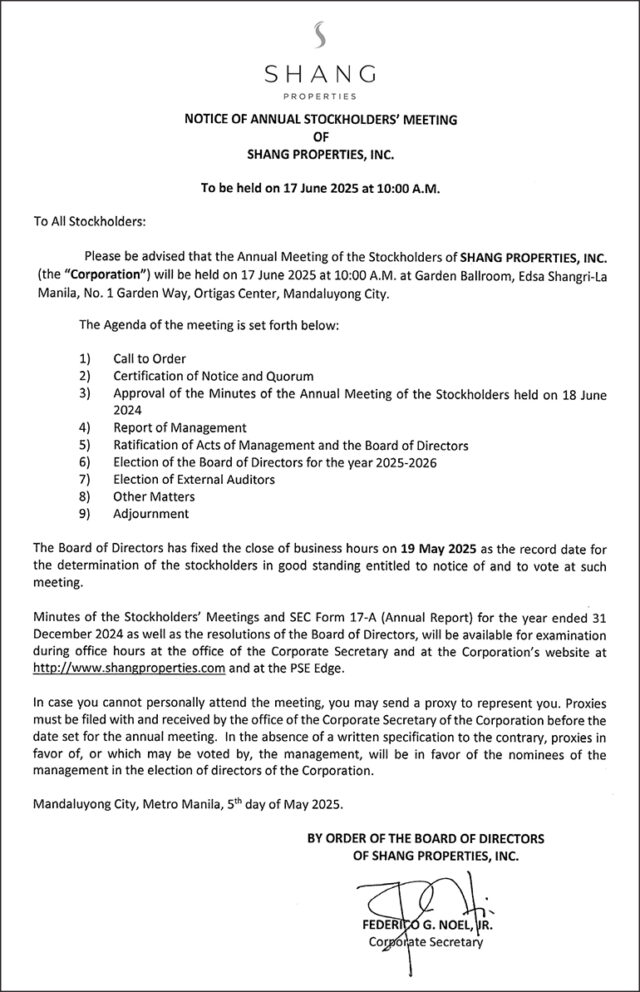
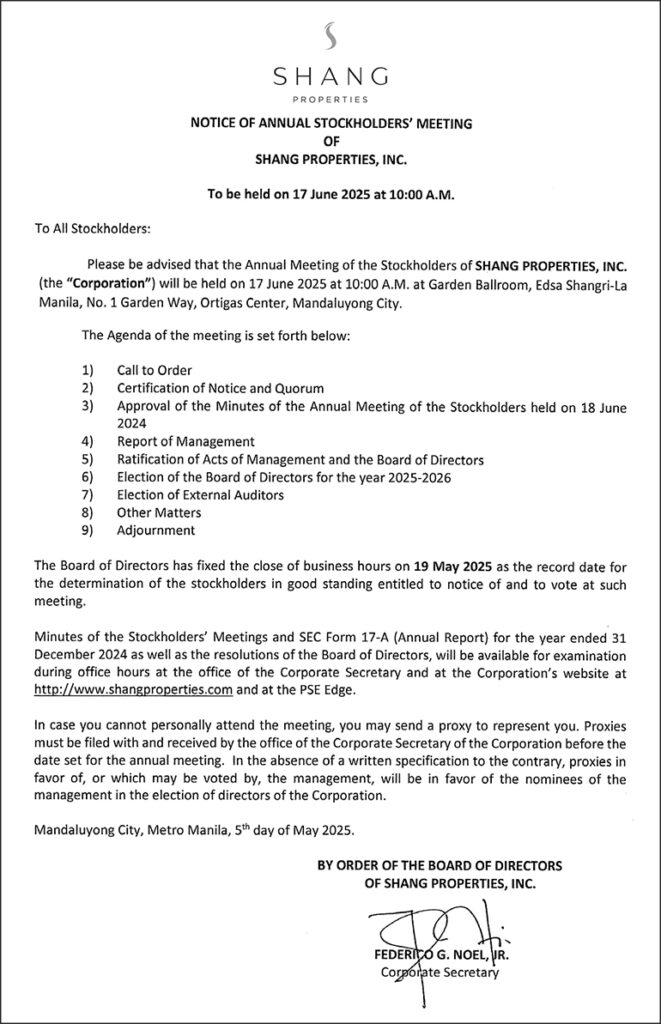
Shang Properties, Inc. to hold Annual Meeting of Stockholders on June 17


Spotlight is BusinessWorld’s sponsored section that allows advertisers to amplify their brand and connect with BusinessWorld’s audience by publishing their stories on the BusinessWorld Web site. For more information, send an email to online@bworldonline.com.

Join us on Viber at https://bit.ly/3hv6bLA to get more updates and subscribe to BusinessWorld’s titles and get exclusive content through www.bworld-x.com.

BTr fully awards reissued 10-year bonds

BW FILE PHOTO

THE GOVERNMENT made a full award of the reissued Treasury bonds (T-bonds) it auctioned off on Tuesday as investors flocked to higher-yielding assets after Moody’s downgraded the United States’ sovereign credit rating.

The Bureau of the Treasury (BTr) raised P30 billion as planned via its offering of reissued 10-year bonds as total bids reached P109.504 billion, or more than thrice the amount on the auction block.

The papers are part of the P300 billion in new benchmark fixed-rate Treasury notes (FXTN) priced on April 15 and issued on April 28.

“The 10-year Treasury bond FXTN 10-73 reissuance attracted strong demand, prompting the Auction Committee to fully award the security at today’s auction… With its decision, the Committee initially raised the full program of P30 billion while accepting further subscription through the tap facility. The total outstanding volume for the series is currently at P330 billion,” the BTr said in a statement on Tuesday. It offered another P10 billion of the same bonds via the tap facility.

It added that it made a full award as the average rate fetched for the bonds was lower than the issue’s coupon and the prevailing secondary market yield for the security.

The bonds, which have a remaining life of nine years and 11 months, were awarded at an average rate of 6.226%. Accepted bid yields ranged from 6.21% to 6.24%.

The average rate for the reissued papers was 14.9 basis points (bps) lower than the 6.375% coupon and 6 bps below the 6.286% average fetched for the bond series when it was first issued on April 28.

This was likewise 2 bps below the 6.246% quoted for the same bond series but 3.4 bps above the 6.192% seen for the 10-year bond at the secondary market before Tuesday’s auction, based on PHP Bloomberg Valuation Service Reference Rates data provided by the BTr.

The BTr fully awarded the bond offer as demand was strong, with market sentiment supported by US Treasury yield movements overnight, a trader said in a text message.

US Treasury yields recently rose as the market continued to react to Moody’s Ratings’ move to cut its rating for the world’s largest economy, stripping it of its last “Aaa” status, Rizal Commercial Banking Corp. Chief Economist Michael L. Ricafort said in a Viber message.

“That could lead to higher financing costs for governments, corporates, and other borrowers since their debt are priced at a spread above the comparable US Treasury yields,” he said.

Longer-dated Treasury yields gained amid concerns about the US debt load and a tax-cut bill, following Moody’s downgrade of the country’s sovereign credit rating, Reuters reported.

The 30-year Treasury yield hit an 18-month high before backing off those levels. Investors were concerned that the tax bill will increase the debt load by more than previously expected.

The 30-year bond yield gained 3.7 bps to 4.934% after touching 5.037%, the highest since November 2023. The yield on benchmark US 10-year notes rose 3 bps to 4.469%, having earlier reached 4.564%, the highest since April 11.

On Friday, Moody’s lowered the US government’s credit rating one notch amid mounting concerns over deficits and interest costs that remain on an unsustainable pace. It was the last of the major ratings agencies to cut the US sovereign rating from the highest level.

US Federal Reserve officials speaking on Monday took on cautiously the ramifications of the latest downgrade of the US government’s credit rating and unsettled market conditions as they continued to navigate a very uncertain economic environment.

While not an imminent issue for the Fed, over time, higher market borrowing costs tied to a deteriorating US financial position make credit generally more expensive and create restraint on economic activity. In turn, that becomes a consideration for how the Fed sets monetary policy and its expectations for the longer-run path of economic activity.

After a brief sell-off in Treasuries on Monday, they stabilized by Asian trading hours on Tuesday.

The 30-year bond yield was 2.8 bps lower at 4.912% after hitting an 18-month high of 5.037% in the previous trading session.

The BTr is looking to raise P260 billion from the domestic market this month, or P100 billion via Treasury bills and P160 billion through T-bonds

The government borrows from local and foreign sources to help fund its budget deficit, which is capped at P1.54 trillion or 5.3% of gross domestic product this year. — A.M.C. Sy with Reuters

Denzel Washington receives surprise honorary Palme d’Or award at Cannes

DENZEL_WASHINGTON — COMMONS.WIKIMEDIA.ORG

CANNES, France — US actor Denzel Washington received a surprise honorary Palme d’Or award at the Cannes Film Festival on Monday evening in recognition of his outstanding career, according to organizers.

Mr. Washington, 70, was in southern France for the premiere of US director Spike Lee’s latest film Highest 2 Lowest, an adaptation of legendary Japanese filmmaker Akira Kurosawa’s High and Low, which also celebrated its premiere on Monday.

Mr. Washington, who was joined by co-stars A$AP Rocky and Jeffrey Wright on the red carpet, stars as David King in the crime thriller that marks the fifth time he and Lee have worked together.

The two-time Oscar winner’s movie roles have ranged from black activist Malcolm X, to a drunk but heroic pilot in Flight. His turn as a rogue detective in Training Day earned him his second Oscar in 2002 following his first win in 1990 for Glory.

He also directed and starred in the 2007 film The Great Debaters about a professor who coached a debate team from a black US college to national glory, and produced and starred in the drama Antwone Fisher.

Robert De Niro received a Palme d’Or honorary award for lifetime achievement, announced in advance, at the festival’s opening ceremony last week, where he used his acceptance speech to call for protests against US President Donald J. Trump.

Highest 2 Lowest is set to hit theaters in the United States on Aug. 22. — Reuters

An alternative to the MBA

UNIVERSITY OF ASIA AND THE PACIFIC

(Part 1)

In 1989, when I joined a group of university professors and business people to found the CRC College of Arts and Sciences (CRC-CAS) that was the precursor of the University of Asia and the Pacific (UAP), we decided to start with four undergraduate specializations.

The first obvious one was Industrial Economics, the field associated with the very start of the Center for Research and Communication (CRC) in 1967. CRC was established as a think tank by Dr. Jesus Estanislao to do research and train personnel in the field of industrial economics that was not offered at that time by any Philippine college or university. It was logical, therefore, that the first undergraduate offering of CRC-CAS would be in this field. The second specialization was also readily identified, i.e., business management or business administration, the most closely allied program with industrial economics. This was the precursor of the present School of Management of UA&P, the largest in enrollment among the existing schools of the university and the first one to offer a Master of Science in Management.

The founders of CRC-College came out with an innovative idea, inspired by the fact that CRC started its educational history by offering in 1969 a Master in Science in Industrial Economics (MSIE) when then Secretary of Education Onofre (O.D.) Corpuz was sufficiently progressive to break the rules by allowing us to offer a Master’s degree without a corresponding undergraduate offering in the same specialization. In fact, I remember distinctly that the Asian Institute of Management (AIM) was allowed to offer an MBA only on the condition that it was a joint venture of the Ateneo University and De La Salle University. As then Dean of the Graduate School of Business of De La Salle, I was in the working committee that gave rise to AIM with the help of the Ford Foundation and Harvard University.

Because of our unique condition of already having a masteral program in Industrial Economics even before having an equivalent undergraduate program, we thought of a game-changing way to offer a masteral degree. We asked permission from the Department of Education to offer a straight five-year curriculum that would allow some of our more academically gifted undergraduate students to obtain a masteral degree in industrial economics or management (and later in other fields) in five years. In my view back then, such a program would enable the best and brightest of our students to start their professional life already with a master’s degree as a foundation either for a few of them to work for a doctorate, or for the rest to continue upskilling and reskilling themselves with short certificate courses throughout their professional lives, without the need to go back to school to obtain another academic degree (except, of course, a doctoral degree).

I am proud of the fact that those who obtained our Master Science in Management (MSIM) have risen in the management world without having to take the more expensive route of an MBA — which usually requires first working for three to four years after college, and then spending a big sum of money, in addition to the opportunity cost involved in having to stop working for remuneration for some 18 months that are usually the conditions in a full time MBA program in AIM or other graduate business schools, especially in the prestigious business schools in the US like Harvard, Wharton, Chicago, or Columbia or in Europe like IESE, INSEAD, or IMD.

We introduced other Straight Bachelor’s plus Master’s programs in other fields. Thus, we have the Master of Arts in Integrated Marketing, Master of Arts in Media and Entertainment Management, Master of Arts in the Humanities, and Master of Arts in Political Economy with Specialization in International Relations and Development, in addition to the Master of Science in Industrial Economics and Master of Science in Management.

With the introduction of the K to 12 Curriculum, we introduced the six-year Integrated University Program (6YP) which is a seamless and integrated program with three distinct phases: the first two years are Senior High School (or Junior College), the next three years are the Bachelor’s program, and the final year, if the student qualifies, is the Master’s program with the same masteral offerings as the five-year straight bachelor’s plus master’s programs.

To my mind, these various masteral programs, which can be completed by anyone with sufficient intellectual capacity and financial means (including generous scholarship programs for the economically disadvantaged) at the average age of 23, can prepare any knowledge worker for a lifetime of upskilling and reskilling through shorter courses or seminars covering breakthroughs in technology and management sciences.

From the demographic point of view, it also allows marriages at earlier ages so that our country will not fall into the same demographic trap that has victimized practically all the advanced countries in which late marriages have been a factor in the precipitous drop in fertility rates. It is difficult for a country to maintain the 2.1 babies per fertile woman required to avoid significant declines in population if couples increasingly marry in their thirties or forties.

For these reasons, I was glad to learn that one of the best business schools in the world, the IESE Business School in Barcelona and Madrid, Spain, has introduced a shorter course leading to a Master in Management that can be taken by qualified college graduates in any specialization, most of them with ages from 23 to 25. Although the traditional MBA program that requires three or four years of work after graduating from college will always be attractive to many with the intellectual capacity and financial means, this alternative means of getting a Master in Management is beginning to attract an increasing number of college graduates from the likes of Ateneo, De La Salle University, and the University of the Philippines. In fact, I have been personally advising my grandnephews and grandnieces and those of my close friends to seriously consider the MiM of IESE as an alternative to the MBA, either in the same business school or elsewhere in the US, Europe, or Asia.

Here let me share with my readers (both parents and children) some basic information about the IESE Business School, with which my university, the UA&P, has an academic partnership. Modesty aside, I would be the most knowledgeable person in the Philippines about this leading business school because I got in contact with it during its foundational years.

Just five years after it was established with some help from the Harvard Business School in 1958, I spent an academic year as a young research fellow in its very elegant premises in Barcelona. While completing my Ph.D. in Economics at Harvard University, I had met some of their founding professors who were taking short courses at Harvard Business School. They invited me to spend a year on their campus in Barcelona after I got my doctoral degree in 1963. I can really say that I was the first Filipino to know of the existence of the school that would become one of the best business schools in the world today, sometimes even ranking higher than Harvard in some categories of business education. For example, year after year in the Financial Times’ ranking of business schools all over the world, IESE is rated Number One in the offering of customized management training programs for business enterprises. In the MBA category, it is among the top 10.

It is always worth noting that among the enrollees in the first MBA batch of IESE in 1966 were two De La Salle graduates — Joseph Delano Bernardo who in later years became the Philippine Ambassador to Spain during the presidency of Gloria Macapagal Arroyo, and late real estate entrepreneur Cecilio (Tagan) Reyes.

(To be continued.)


Bernardo M. Villegas has a Ph.D. in Economics from Harvard, is professor emeritus at the University of Asia and the Pacific, and a visiting professor at the IESE Business School in Barcelona, Spain. He was a member of the 1986 Constitutional Commission.

bernardo.villegas@uap.asia

BPI begins offering of 1.5-year SINAG bonds

BW FILE PHOTO

BANK of the Philippine Islands (BPI) on Tuesday priced and began its offering of 1.5-year fixed-rate sustainability bonds, from which it aims to raise at least P5 billion.

The 1.5-year peso denominated fixed-rate BPI Supporting Inclusion, Nature, and Growth (SINAG) bonds carry an interest rate of 5.85% per annum to be paid quarterly, the listed bank said in a disclosure to the stock exchange on Tuesday.

BPI wants to raise at least P5 billion from the bond offer with an option to upsize. The bonds are being sold at a minimum investment amount of P500,000 and in increments of P100,000 thereafter.

The SINAG bonds will make up the first tranche of the bank’s P200-billion bond and commercial paper program approved by its board of directors in October last year.

“BPI will use the net proceeds of the offer to finance or refinance eligible projects under BPI’s Sustainable Funding Framework consistent with the ASEAN Sustainability Bond Standards,” it said.

“BPI is committed to creating value for its stakeholders, the environment, and the communities in which it operates. It strives to have sustainability at the core of its corporate strategies, ultimately achieving its business growth aspirations alongside its environmental and social responsibility.”

The bond offer period, which began on Tuesday, is set to run until May 30, unless adjusted by the bank. The papers are expected to be issued and listed on the Philippine Dealing and Exchange Corp. on June 10.

The bank has tapped BPI Capital Corp. and Standard Chartered Bank as the joint lead arrangers and selling agents for the offer.

The Securities and Exchange Commission on March 17 confirmed that the BPI SINAG Bonds qualify as ASEAN Sustainability Bonds. “Bonds carrying this classification have been independently verified to have systems in place to ensure that proceeds raised will be directed toward projects with environmental and social benefits. This gives bondholders confidence that their investments will have clear and measurable sustainable impacts,” the bank said.

BPI last tapped the domestic bond market in August last year, raising P33.7 billion from its offering of 1.5-year Sustainable, Environmental, and Equitable Development or SEED bonds, which marked its first foray into the sustainable bond space.

The listed bank’s net income increased by 9% year on year to P16.6 billion in the first quarter.

BPI’s shares dropped by P4.80 or 3.53% to close at P131.10 apiece on Tuesday. — Aaron Michael C. Sy

Maynilad reports positive investor feedback ahead of IPO demand assessment

MAYNILADWATER.COM.PH

MAYNILAD Water Services, Inc., the west zone water concessionaire, remains confident despite a slight reduction in the size of its planned initial public offering (IPO) to P45.8 billion.

Maynilad said in a May 19 letter to the Philippine Dealing and Exchange Corp. (PDEx) that it has received positive preliminary investor feedback but that a formal demand assessment for the initial public offering has yet to be conducted.

The letter was sent following PDEx’s request for clarification on reports concerning the IPO’s size.

“We thus remain confident as we proceed to the next phase of the IPO process,” Maynilad said.

“Contrary to what may have been suggested in the articles, there is currently no indication of weak demand,” it added.

Maynilad said that the IPO still represents at least 30% of its outstanding capital stock, in compliance with its legislative franchise.

“While there has been a slight adjustment in the number of shares to be offered, this reflects a marginal reduction in the shares available for sale and does not change the intended offering size relative to the company’s capital structure,” the company said.

The water provider also said the IPO’s upsize option now consists solely of secondary shares.

“The decision for Maynilad not to pursue the upsize option, which now consists entirely of secondary shares, was made in line with the preferred structure of the offering. This is a common feature of IPO transactions,” it said.

Maynilad lowered the IPO size to a maximum of P45.8 billion from the previous indication of up to P49 billion, based on the company’s latest prospectus draft dated May 14.

The revised IPO comprises up to 2.29 billion common shares, down from the earlier maximum of 2.46 billion shares. The indicative maximum price remains at P20 per share.

The notice of final offer price to regulators is scheduled for July 1.

The IPO offer period will run from July 3 to July 9, with listing scheduled on July 17.

Maynilad appointed BPI Capital Corp., HSBC, Morgan Stanley, and UBS as joint global coordinators and joint bookrunners for the IPO. BPI Capital Corp. will also serve as the domestic lead underwriter.

The local stock market is expecting six IPOs this year, with Cebu-based fuel retailer Top Line Business Development Corp. as the sole debut so far.

Metro Pacific Investments Corp., which holds a majority stake in Maynilad, is one of three Philippine units of Hong Kong-based First Pacific Co. Ltd., alongside Philex Mining Corp. and PLDT Inc.

Hastings Holdings, Inc., a unit of PLDT Beneficial Trust Fund subsidiary MediaQuest Holdings, Inc., holds an interest in BusinessWorld through the Philippine Star Group, which it controls. — Revin Mikhael D. Ochave

Pop singer testifies to Sean ‘Diddy’ Combs’ abuse, faces sharp cross-examination

Sean “Diddy” Combs on the talk show Late Night with Seth Myers. — IMDB

NEW YORK — Pop singer Dawn Richard told a jury on Monday that she saw Sean “Diddy” Combs beat his girlfriend repeatedly, but she faced sharp questioning from a defense lawyer over apparent inconsistencies in her account.

Ms. Richard, a former member of the pop group Danity Kane, testified during Mr. Combs’ sex trafficking trial that she feared for her life after Mr. Combs told her to keep quiet about the alleged beatings and that he comes from a place where people “go missing.”

Danity Kane was signed with Mr. Combs’ record label. She worked directly with the mogul and often saw him with his then-girlfriend, Casandra Ventura, who last week testified to years of Mr. Combs’ alleged physical and emotional abuse.

“I was shocked but also scared,” Ms. Richard told jurors on Monday, saying she feared she and her band mates “could die” if they spoke up.

Ms. Richard was on the stand for the sixth day of the high-profile trial in Manhattan federal court.

Mr. Combs, 55, has pleaded not guilty to five felony counts of racketeering conspiracy, sex trafficking and transportation to engage in prostitution.

He has been held since September in a Brooklyn jail when not in court. If convicted on all counts, he could face 15 years to life in prison.

The trial in Manhattan federal court, which has drawn intense media coverage because of Mr. Combs’ wealth and towering influence in the music industry, could last two months.

During a pointed cross-examination that revealed many apparent inconsistencies in her account, Ms. Richard admitted to giving different versions of the events and not mentioning certain details during her interviews with prosecutors.

The apparent discrepancies included saying she saw Mr. Combs throw a pan at Ms. Ventura in 2009 versus only hearing it, not mentioning Mr. Combs’ alleged threats during interviews with prosecutors, and telling jurors she saw Mr. Combs do drugs despite previously telling prosecutors she hadn’t.

The questioning by defense lawyer Nicole Westmoreland was notably more pointed than other lawyers’ cross-examinations of prior witnesses.

“We can agree your testimony has changed on quite a few things?” Defense lawyer Nicole Westmoreland asked.

“I think as time progresses I get better at knowing what went on because it was quite a long time ago,” Ms. Richard replied.

The 38-year-old Ms. Ventura, a rhythm and blues singer known as Cassie, said over four days of testimony last week that Mr. Combs coerced and blackmailed her into days of drug-fueled sex parties he called “Freak Offs,” the heart of the prosecution’s case.

Ms. Ventura, the prosecution’s star witness, said she suffered years of physical and emotional abuse during their tumultuous 11-year relationship, and that Mr. Combs raped her in August 2018 at her home after they broke up.

A lawyer representing Mr. Combs sought to undercut the rape claim, showing jurors text messages indicating Ms. Ventura had consensual sex with Mr. Combs a month after the alleged rape.

Ms. Ventura did not testify about the alleged 2009 attack.

Following Ms. Richard’s testimony on Friday, Ms. Ventura’s onetime friend Kerry Morgan told jurors about other times when Mr. Combs allegedly attacked Ms. Ventura.

“I saw him hit her… pull her, kick her, push her,” Ms. Morgan said.

Ms. Ventura’s mother, Regina Ventura, is among witnesses to be called by prosecutors on Tuesday.

Mr. Combs, previously known as Puff Daddy and P. Diddy, founded Bad Boy Records, and is credited with helping turn artists like Mary J. Blige, Faith Evans, Notorious B.I.G. and Usher into stars in the 1990s and 2000s.

Part of the criminal case stems from Ms. Ventura’s November 2023 civil lawsuit against Mr. Combs. She testified that he agreed after 24 hours to settle for $20 million. — Reuters

RevAds platform boosts SME visibility with motorcycle ads

REVADS.COM.PH

By Edg Adrian A. Eva, Reporter

REVADS, the Philippines’ first app-based motorcycle ad platform, is helping startups and small and medium enterprises (SMEs) gain visibility in high-traffic areas.

The Pasig-based company, founded in October 2024, aims to level the playing field for smaller businesses by offering out-of-home advertising through motorcycles that travel through high-foot-traffic areas, particularly along the busiest roads of the Philippine capital.

“If you look around for burger brands, for example on the road, I bet you’ll just find McDonald’s, Jollibee — the bigger ones, right?”  Lance Arthur S. Martinez, RevAds founder and chief executive officer, said in an interview.

“Now, we’re opening it up for smaller businesses to compete in an area where there are real impressions. Smaller businesses normally have no access,” he added.

By mounting advertising panels on the back of motorcycles, businesses can promote their brands while providing drivers with additional passive income as they go about their usual work with other app-based motorcycle services.

RevAds’ main product is its rolling billboards, which start at P4,000 a month with no long-term commitment — a more accessible alternative compared with standard billboards along EDSA, which cost P200,000 to P400,000 a month.

Mr. Martinez said the platform’s affordability and accessibility stem from its app-based model, which allows brands and riders to connect directly.

Through this service, a brand’s ad stays on the rider’s ad panel uninterrupted for an entire month.

“Your brand can reach homes, hospitals and business districts where only the bigger brands usually compete,” he said.

The motorcycle ad company also offers other services such as motorcades for larger ad campaigns.

The out-of-home advertising market in the Philippines is projected to reach $316.47 million this year, with traditional formats such as transit ads and billboards accounting for the biggest share at $198.29 million, according to German data platform Statista.

But for smaller companies with limited resources, advertising is a bigger gamble. To ensure its effectiveness, Mr. Martinez said the RevAds platform strategically selects riders who often travel within the brand’s target area.

“We save the riders’ location preferences for targeting purposes,” he said. “Secondly, we consider the amount of exposure they’re generating. Their equipment, as mentioned earlier, includes tracking capabilities.”

Brands, companies, and campaigns can also add personalized QR (quick response) codes to make their ads more interactive, allowing viewers to be directly routed to their links.

Mr. Martinez said the company has helped about 600 motorcycle drivers on the RevAds fleet by giving them additional income.

He added that half of the monthly fees paid by businesses, or about P2,000 monthly, is the typical amount a rider earns, provided they reach at least 1,500 kilometers a month.

Mr. Martinez said there has been strong interest, with 10,000 motorcycle riders on their waiting list. They expect to expand their team to 2,500 riders by the end of the year.

“Our goal really is to make it available across all metropolitan cities in the Philippines because the more we help brands get their message out on the road, the more value we are able to add for our hard-working riders on the streets,” he said in mixed English and Filipino.

ALI says it sold 43% of Southmont Central on launch day

LISTED property developer Ayala Land, Inc. (ALI) said it sold 43% of its inventory during the launch day of Southmont Central, citing robust investor confidence in Cavite.

Southmont Central, a 36-hectare development within Ayala Land’s 800-hectare Southmont Estate in Cavite, is positioned to become the estate’s civic and commercial hub.

The project was launched in March. It is being developed by Ayala Land and Cathay Land, Inc.

The first phase covers 5.8 hectares and offers 37 commercial lots averaging 925 square meters each. ALI said it expects to deliver the commercial lots by the third quarter of 2028.

Designed with green open spaces, the lots aim to attract local businesses, retail concepts, and services catering to nearby residential communities.

The retail and institutional components are set to complement adjacent residential developments, the company said.

Amenities within the estate include a six-hectare sports club, as well as church and civic spaces intended to enhance community life.

Southmont Central benefits from proximity to key infrastructure such as the Cavite–Laguna Expressway (CALAX), Sta. Rosa–Tagaytay Road, Pook Road, and Carmen Road. Future infrastructure projects, including the Cavite–Tagaytay–Batangas Expressway (CTBEX) and the Light Rail Transit (LRT) 1 Cavite Extension, are expected to further improve connectivity.

Ayala Land said it also saw steady sales in surrounding residential projects.

Hillside Ridge in Silang, Cavite, is 97% sold with 543 lots turned over since early 2023. Landwood Hills by Ayala Land Premier is 90% sold, with turnover starting late last year. Verdea, Alveo Land’s second residential development within Southmont Estate, has sold 52% of its 372 lots, with turnover expected by early 2026.

Southmont is among four major estates developed by Ayala Land in Southern Luzon, alongside Nuvali in Laguna, Broadfield in Biñan, and Aéra in Cavite.

“These masterplanned developments reflect the company’s long-term strategy of integrating residential, commercial, and institutional uses to support the region’s sustained urban growth,” the company said.

On Tuesday, ALI shares closed up 0.44%, or one centavo, at P23. — Beatriz Marie D. Cruz

ADVERTISEMENT
ADVERTISEMENT