Home Blog Page 1543

Erring politicians must be held accountable — Stratbase

PHILIPPINE STAR/EDD GUMBAN

POLITICIANS must be held accountable for their actions to foster political stability and rebuild public trust, a think tank said.

“If erring authorities are not held accountable, they will continue to use hard-earned taxpayers’ money for their self-interest,” Stratbase ADR Institute President Victor Andres C. Manhit said in a statement on Sunday.

He added the taxes should instead be used to build more classrooms, equip teachers and students with learning materials, and create job and livelihood opportunities, among others.

Mr. Manhit said that the social services meant for ordinary Filipinos will continue to fail if leaders remain unaccountable for their acts.

“When citizens feel that their concerns are not being addressed and that those in power are immune, it can lead to social unrest and instability. This is when faith in government and institutions is lost, making it harder to implement policies and reforms that benefit the public,” he added.

He said that the upcoming impeachment trial of Vice-President Sara Duterte-Carpio is a call for incumbent, returning, and newly elected lawmakers to put aside coalitions and their own personal gain.

“With this, senators must rise above political alliances and personal interests, and base their decisions on credible and reliable evidence,” he added

“Senators must keep in mind that their loyalty is not to certain personalities or allies — but to the Filipino people,” he said.

Ms. Duterte, who was impeached by more than 200 congressmen on Feb. 5, will face the Senate as an impeachment court in July, following accusations of misusing secret funds, unexplained wealth, destabilizing act, and plotting the assassination of the President. — Adrian H. Halili

Four soldiers hurt in Bukidnon encounter

COTABATO CITY — Four personnel of the Army’s 28th Infantry Battalion (IB) were wounded in an encounter with New People’s Army (NPA) guerillas in Barangay Hagpa in Impasug-ong, Bukidnon on Friday.

Major Gen. Michele B. Anayron, Jr., commander of the Army’s 4th Infantry Division based in Cagayan de Oro City, confirmed on Sunday that four soldiers are now recuperating in a hospital.

Local executives and leaders of indigenous tribes in Bukidnon had told reporters that a group of NPAs provoked the gunfight when they opened fire on the soldiers dispatched to Barangay Hagpa to check on reports by traditional community elders about their presence in the area, collecting money and rice from villagers at gunpoint.

Ms. Anayron said adequate medical support will be provided to the injured 28th IB members.

Chieftains of ethnic groups in Bukidnon province, who requested anonymity for fear of reprisals, had told reporters that four NPAs, identified only as Ruben, Mario, Ariel and Sandro, were wounded in the incident.

The four wounded NPAs were reportedly seen being carried away by companions as they fled when they sensed that the Army teams that they attacked were about to encircle their location.

Provincial officials and members of the multi-sector Impasug-ong Municipal Peace and Order Council said the guerillas involved in the hostilities are among the few remaining remnants of the NPAs extorting money from hapless residents in far-flung hinterland areas in their municipality. — John Felix M. Unson

Trump’s new tariff threats show trade uncertainty here to stay

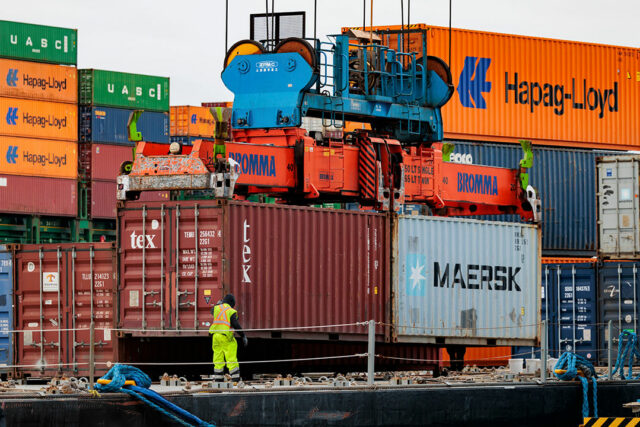
CONTAINERS at the Port of Philadelphia. — BLOOMBERG

INVESTORS were growing optimistic that US President Donald J. Trump’s trade wars had started to calm down. His latest tariff broadsides quickly disabused them of that notion.

Initial agreements with the UK and China buoyed hopes on Wall Street and in corporate boardrooms that the US president was starting to peel back the highest US tariffs in nearly a century.

But Friday delivered a harsh reminder of Mr. Trump’s volatile policymaking and penchant for brinkmanship, when he threatened a 50% tariff on the European Union (EU) and a 25% levy on smart phones if companies including Apple Inc. and Samsung Electronics Co. failed to move production to the US.

Equities dropped across the globe, the dollar slumped to its lowest level since 2023 and business leaders were left to grapple with the notion that Trump-generated uncertainty is here to stay.

“Today’s news that Trump is threatening enormous tariffs on the EU and is singling out Apple as a firm are examples of what we should expect for the next two months if not for the rest of the year,” said Marcus Noland, executive vice president of the Peterson Institute for International Economics. “Peace has not broken out.”

Mr. Trump made that clear when from the Oval Office on Friday afternoon, he dug in, declaring he is “not looking for a deal” with the EU.

“I just said it’s time that we play the game the way I know how to play the game,” he told reporters. 

His ire was notable given that he notched a major economic win this week, with the House passing his massive tax and spending legislation after Mr. Trump led a furious, last-minute lobbying effort that won over enough Republican holdouts.

A White House official said this week that the president was hoping to ink more trade agreements with some major economies and then fast-track deals with others during a 90-day pause on his tariffs announced April 2. Some arrangements are said to be close, including one with India, Treasury Secretary Scott Bessent told Fox News on Friday.

Business leaders and consumers will be watching carefully for next steps. The president’s Friday directive on the EU offered a preview of what he said his administration might do with dozens of trading partners seeking lower duties: simply dictate tariff levels.

As he did last month after Mr. Trump’s initial tariff announcement shook markets, Mr. Bessent sought to project a sense of order onto the president’s pronouncements.

Mr. Bessent said in the same interview that many deals are nearing conclusion and labeled the EU as an “exception.” That echoed comments from Commerce Secretary Howard Lutnick, who said at an Axios event earlier this week that the EU has been “very difficult.”

Longtime Trump ally Steve Bannon said the president’s reaction was in part due to what he saw as a lack of progress on trade issues this week at a Group of Seven finance ministers meeting, particularly given the relatively quick deal he was able to strike with the UK. Mr. Bannon said other countries without deals in progress should be worried, calling it a “storm warning.”

The president seemed as committed to his tariff push as ever to close the week. He threw his support behind a partnership between United States Steel Corp. and Japan’s Nippon Steel Corp., crediting his tariffs for finalizing the pact that had been in the works for years. That announcement came as Japanese trade negotiators were holding talks with US trade officials in Washington.

NEGOTIATIONS BECKON
The EU plans to move forward with preparing countermeasures if negotiations fail to produce a satisfactory outcome. The trade bloc has assembled plans to hit €95 billion ($107 billion) of US exports with additional tariffs in response to Mr. Trump’s “reciprocal” levies and 25% duties on cars and some parts.

European nations agreed earlier this month to pause for 90 days a separate set of retaliatory tariffs against the US over 25% levies Mr. Trump imposed on the bloc’s steel and aluminum exports. That move came after Mr. Trump lowered his so-called reciprocal rate on most EU exports to 10% from 20% for the same amount of time.

Lutnick predicted at the Axios event that most countries will “have an idea of what we want to do with them” by summer. He repeated the administration’s stance that partners will likely not get below a 10% baseline tariff, but made clear the White House is open to negotiation.

“If they’ve made us an offer worthy of modifying their tariff terms, we’ll do it. And if they haven’t made us an offer that modifies it, the president will write them a letter saying ‘Dear Country A, we deeply appreciate doing business with you, here’s your tariff rate,’” he said.

When Mr. Trump paused his higher April 2 tariffs, he left in place a 10% charge on most trading partners. Separate levies on steel, aluminum and autos remain. And Mr. Trump has promised a range of new import taxes on copper, semiconductor chips, pharmaceutical drugs, lumber and aircraft parts — all of which could drive up the total effective tariff rate.

At the same time, Mr. Trump showed a willingness to negotiate on duties imposed on specific sectors when the US and UK agreed to negotiate new rates on metals.

Tariff levels remain uncertain but “will probably remain elevated for the foreseeable future,” Goldman Sachs Group, Inc. analysts wrote in a May 14 research note. The bank forecast that the effective US tariff rate would rise by 13 percentage points this year, to the highest level since the 1930s.

It could all be for naught, with Goldman saying “higher bilateral tariffs are unlikely to drive a substantial increase in domestic production,” a stated goal of Mr. Trump.

Talks are advancing with other partners including India, Japan, Vietnam and Israel. Some short-term relief could be possible, but the threat of fresh trade feuds is widespread across several countries.

Mr. Trump’s penchant for out-of-nowhere threats, even on countries with which the US has trade agreements, sows doubt in the longevity of any deal he strikes, Mr. Noland said.

“It’s really quite extraordinary that we had free trade agreements with some of these countries — Korea, Australia — and they’re just getting hit with tariffs,” Mr. Noland said. “His willingness to tear up previous agreements and ignore them has to be highly concerning for other countries.” — Bloomberg


Taiwan students heading to Harvard ‘anxious’ after US enrollment block

PEOPLE walk on the campus of Harvard University in Cambridge, Massachusetts, US, April 15. — REUTERS

TAIPEI — With an admission letter in hand, Taiwanese student Yu-hsuan Lin was ready to attend her dream school, Harvard University, this September.

But the decision of US President Donald Trump’s administration to revoke Harvard University’s ability to enroll foreign students made her feel anxious and helpless, Lin told Reuters at her Taipei apartment.

“The path towards my dream is actually harder and tougher than I expected. There are so many uncertainties,” she said.

“I thought that I could accept all the changes along the way as what we have gone through in the past half year. However, this one is specifically (targeted) at the international students. So I kind of feel like really hit by it. And that’s why I feel kind of anxious.”

The decision marked a significant escalation of the Trump administration’s campaign against the elite Ivy League university in Cambridge, Massachusetts.

Harvard called it a “blatant violation” of the US Constitution and other federal laws.

A US judge temporarily blocked the administration’s order, but it did not provide comfort to Lin who has yet to receive her visa.

“I think I would either defer my studies at Harvard, as they said that’s one of the possibilities, or I would probably apply for master programs in Europe or the UK.”

Taiwan’s education ministry said it expects 52 Taiwanese students to be affected by the US government’s move, the island’s official Central News Agency reported.

Another Taiwanese student, who asked to be identified only by his first name Vince, planned to start his public health studies at Harvard this year.

“We are certainly feeling pretty nervous, and it’s been a dream for me to come from a small town in Taiwan all the way to Harvard,” he said.

“I think that this is the best that the United States can offer. So, I would like to plead to the president that, please, I hope that this continuous generosity can be continued.” — Reuters

US EPA drafting plan to erase greenhouse gas limits on coal and gas-fired power plants

CHRIS LEBOUTILLIER-UNSPLASH

WASHINGTON — The US Environmental Protection Agency (EPA) confirmed on Saturday that it was drafting a plan to eliminate all limits on greenhouse gases from coal and gas-fired power plants in the United States and would be published after interagency review.

“Many have voiced concerns that the last administration’s replacement for that rule is similarly overreaching and an attempt to shut down affordable and reliable electricity generation in the United States, raising prices for American families, and increasing the country’s reliance on foreign forms of energy,” a spokesperson for the agency said. “As part of this reconsideration, EPA is developing a proposed rule.”

The draft plan was first reported by the New York Times, which said the EPA argued in its proposed regulation that carbon dioxide and other greenhouse gases from power plants that burn fossil fuels “do not contribute significantly to dangerous pollution” or to climate change because they are a small and declining share of global emissions.

The EPA also said that eliminating those emissions would have no meaningful effect on public health and welfare, the report added.

According to the United Nations, fossil fuels are by far the largest contributors to global warming, accounting for more than 75% of global greenhouse gas emissions and nearly 90% of carbon dioxide emissions.

The US government under President Donald J. Trump has moved quickly to remove all federal spending related to efforts to combat climate change and to eliminate any regulation aimed at addressing greenhouse gas emissions as part of its effort to bolster oil, gas and mining operations.

On Thursday, the US House of Representatives advanced Trump’s sweeping tax and spending bill, which may end numerous green-energy subsidies that have supported the renewable energy sector.

Mr. Trump’s budget package – which he calls “one big beautiful bill” – would eliminate funding established under former US President Joseph R. Biden’s administration through the Inflation Reduction Act and repeal grants intended to reduce air pollution, greenhouse gas emissions or purchase electric heavy-duty vehicles.

Mr. Trump in his first term promised to repeal regulations focused on reducing carbon pollution from power plants.

“We continue to build on that progress now,” said EPA administrator Lee Zeldin. — Reuters

South Korea frontrunner Lee suggests extending US tariff talks

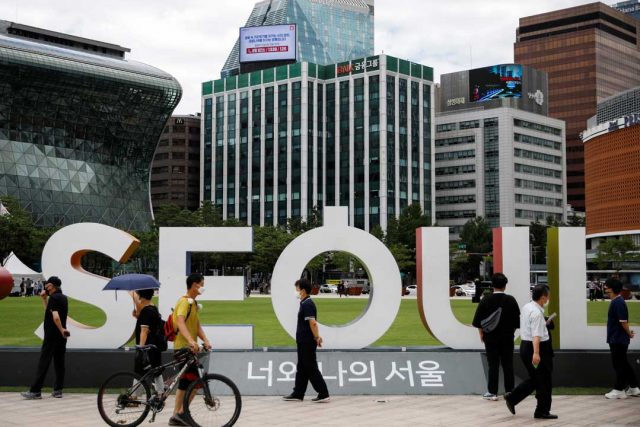
REUTERS

SEOUL — South Korean presidential frontrunner Lee Jae-myung said on Sunday the deadline to reach a deal with the US on President Donald J. Trump’s trade tariffs needs to be reconsidered to find a mutually beneficial agreement between the two allies.

Tariff negotiations with the United States will be one of the biggest challenges for the winner of the June 3 election, Mr. Lee told a press conference.

The snap election was called after Yoon Suk Yeol was impeached as president and removed from office for briefly declaring martial law in December. Mr. Lee, from the main opposition Democratic Party of Korea, is leading in opinion polls over conservative contestants.

Seoul and Washington have said they aim to craft a package on tariffs and economic cooperation by July 8. But the South Korean minister for trade and industry said recently that was not enough time and delays would be possible due to the election.

“There is not much time,” Mr. Lee said. “Isn’t diplomacy something that benefits both sides? If one country benefits and the other country suffers unilaterally, that is not diplomacy. It is called plunder.”

He called for mutual respect between the two countries, saying they “need to reconsider whether the timeline set by one side should be bound to.”

Mr. Lee said South Korea must compile an extra budget to boost the economy in the short term and vowed that if elected he would form and head a task force to tackle the slowing economy.

“I will swiftly prepare immediately actionable economic measures and actively respond to the domestic economic slowdown with the determination to fight the recession,” he said.

Mr. Lee said he would pursue peace on the Korean peninsula, criticizing the ousted Mr. Yoon’s tough policy on North Korea, which he said had raised tensions high, burdening the economy and adding to concerns among foreign investors.

“We should maintain and strengthen our powerful defense capabilities, military power and strengthen the South Korea-US security alliance, but find a path toward dialogue, cooperation, communication and coexistence where possible,” said Mr. Lee, who considers pragmatism as a key to diplomacy.

Mr. Lee is leading the race with 45% support ahead of conservative rival Kim Moon-soo, Mr. Yoon’s labour minister, with 36% support in a Gallup Korea poll released on Friday.

Mr. Kim has been closing the initially double-digit gap with Mr. Lee. Asked about his recent decline in polls, Mr. Lee said he was confident that South Koreans would not choose those who supported or staged the “insurrection,” referring to the criminal charges against Yoon over martial law. — Reuters

[B-SIDE Podcast] What changed? A closer look at the 2025 midterm polls

Follow us on Spotify BusinessWorld B-Side

“The 2025 midterm elections delivered unexpected results, with outcomes that defied pre-election surveys. Some familiar names were left out of the Magic 12, while underdogs made a surprising climb into the Top 5.

What led to this shift?

Political expert Michael Henry Ll. Yusingco, senior research fellow at the Ateneo Policy Center, breaks down the Senate results and offers insights into what they reveal about Filipino voting behavior.

Interview by Edg Adrian Eva
Audio editing by Jayson Mariñas

Follow us on Spotify BusinessWorld B-Side

Toyota Motor Philippines offers event-exclusive promos at the TOYOTA GAZOO Racing Philippine Cup this weekend

Get up to P170,000 of discounts on Toyota vehicles from May 23 to 25

Toyota Motor Philippines (TMP) is giving people more reasons to join in the fun at Race Weekend 2 of the TOYOTA GAZOO Racing Philippine Cup this weekend at Villar City, south of Manila. From May 23 to 25, customers can get event-exclusive deals on their favorite Toyota vehicles.

Customers who will attend the event and reserve a unit onsite can get a walk-in discount of up to P10,000 and a reservation discount of up to P30,000. The reserved unit must be released between May 23 to June 15, 2025 for the discounts to apply.

If the reserved unit is released between the abovementioned releasing period, the customer will also be eligible for a raffle coupon, where the customer can win P100,000 in cash!

The exclusive promos are also available to customers who will visit any Toyota dealership from May 23 to 25. During the promo period, dealership customers will get a P10,000 reservation discount when they reserve a Toyota vehicle and receive it between May 23 to June 15, 2025.

Onsite customers who trade in their vehicles during the event and purchase a new vehicle can also get an additional discount of up to P30,000, while dealership customers get P10,000. The trade-in discount can be used when purchasing a new vehicle during the promo period.

Dealership customers will also get to enjoy the TGR Philippine Cup races, which will be livestreamed in the showrooms.

Below are the participating Toyota models for the event-exclusive promo:

  • Vios
  • Tamaraw
  • Hilux
  • Yaris Cross
  • Corolla Cross
  • Fortuner
  • Raize
  • Wigo
  • Corolla Altis
  • Rush
  • Camry
  • Zenix

Promo runs from May 23 to 25, 2025 only. Check out the full mechanics, offers, and participating models here: https://www.toyota.com.ph/promos/toyotadrivefest

The TGR Philippine Cup is open to all. Attendees can get their event pass at https://www.tgrphcup.com/. Admission is free.

The TOYOTA GAZOO Racing Philippine Cup is sanctioned by the Automobile Association Philippines and is brought to you by Official Fuel & Lubricants Partner Petron and Official Tire Partner GT Radial, in cooperation with Official Venue Partners Villar City and Brittany.

This event is also supported by Official Timekeeper Seiko, Toyota Financial Services Philippines, Tuason Racing, AVT, 3M, Denso, ROTA, PIAA, Autoplus, OMP, Bebang Halo-Halo, AutoQuix, and Kinto One.

For more information on the TGR Philippine Cup and other TGR events, visit https://toyota.com.ph/tgrphilippines and follow TOYOTA GAZOO Racing Philippines on FacebookInstagramXYouTube and TikTok.

Follow TMP’s official pages—ToyotaMotorPH on FacebookInstagram, and X, and join the Viber community at Toyota PH for updates.


Spotlight is BusinessWorld’s sponsored section that allows advertisers to amplify their brand and connect with BusinessWorld’s audience by publishing their stories on the BusinessWorld Web site. For more information, send an email to online@bworldonline.com.

Join us on Viber at https://bit.ly/3hv6bLA to get more updates and subscribe to BusinessWorld’s titles and get exclusive content through www.bworld-x.com.

Philippines’ Marcos keeps economic team, replaces foreign minister in cabinet revamp

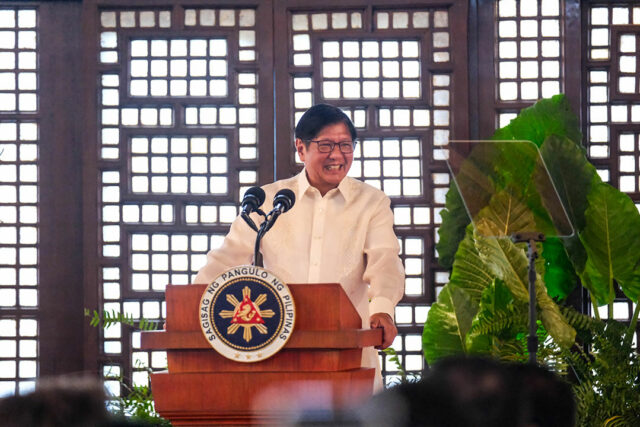
PRESIDENT FERDINAND R. MARCOS, JR. — YUMMIE DINGDING / PPA POOL 

MANILA – Philippine President Ferdinand Marcos Jr is keeping his trade, finance, budget and economic planning secretaries in a cabinet reorganization, but will replace the foreign affairs secretary, his executive secretary said on Friday.

Executive Secretary Lucas Bersamin announced the changes to the president’s cabinet after Mr. Marcos had asked all his cabinet secretaries to resign to allow him to review the performance of all departments. — Reuters

PHL current account deficit seen to narrow this year – IMF

REUTERS

The International Monetary Fund (IMF) expects the Philippines’ current account deficit to narrow this year.

“The current account deficit is projected to narrow from 3.8% of gross domestic product (GDP) in 2024 to 3.4% of GDP in 2025, supported by weaker commodity prices,” IMF Mission Chief Elif Arbatli Saxegaard said in a statement.

Latest data from the Bangko Sentral ng Pilipinas (BSP) showed the current account deficit widened by 41.4% to $17.5 billion last year from $12.4 billion in 2023. This brought the current account to 3.8% of economic output in 2024 from the 2.8% the year prior.

The central bank expects the current account deficit — which covers transactions involving goods, services, and income — to reach $19.8 billion this year, equivalent to 3.9% of GDP.

Ms. Saxegaard also noted that while the country’s gross international reserves (GIR) have declined since the record-high in September, the dollar reserve level remains adequate.

The Philippines’ GIR declined by 1.9% to $104.6 billion as of end-April from $106.7 billion as of end-March, BSP data showed. Dollar reserves hit a record $112 billion in September 2024.

Meanwhile, the multilateral institution said it remains critical that the Philippines sticks to its medium-term fiscal consolidation path.

This will also require “sustained and durable efforts to mobilize tax revenues and ensure efficiency of government spending,” it added.

Ms. Saxegaard said the government’s fiscal stance will likely be broadly neutral this year.

“The medium-term fiscal consolidation remains appropriate and should be supported by a sustainable plan to raise tax revenues and implement expenditure reforms to ensure that deficit targets are met and to create more space for priority spending.”

Under the latest Development Budget Coordination Committee (DBCC) figures, the NG capped its deficit ceiling at 5.3% of GDP this year.

“Tax reforms could prioritize raising excise taxes, enhancing VAT efficiency, improving tax administration, and ensuring effective control of tax incentives. Efforts to enhance public financial management and manage fiscal risks should continue.”

“Enhancing capacity at the local government level to execute additional spending responsibilities in line with the higher revenues allocated to them in the decentralization process is critical to support growth,” she added.

Ms. Saxegaard led an IMF team during its meetings in Manila from May 14 to 20.

For the coming months, she said the IMF will continue its dialogue in the context of this year’s Article IV Consultation. — Luisa Maria Jacinta C. Jocson

Japan pledges immediate rice relief for consumers to prevent shift to foreign brands

FREEPIK

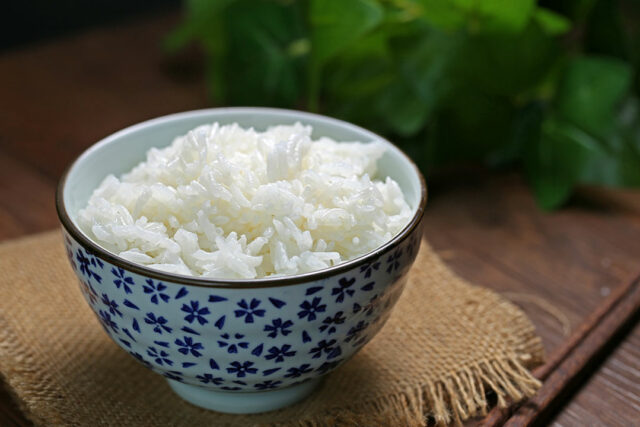
TOKYO, May 23 (Reuters) – Japan’s new agriculture minister pledged on Friday to quickly move rice from government stockpiles to store shelves where they would be offered at prices significantly lower than current levels, seeking to stem a consumer shift to cheaper, foreign brands.

Soaring rice prices, due in part to crop damage from extreme heat and additional demand from a boom in tourism, have become a major concern for Japanese consumers as well as the government with upper house elections set for July.

The government has been releasing some of its stockpiled rice since March but that has yet to translate to lower supermarket prices.

“The abnormal surge in prices that we’re seeing now could accelerate the shift away from domestically produced rice in Japan,” Shinjiro Koizumi told a press conference.

“We’re already seeing supermarkets buying directly from the United States despite having to pay tariffs… We have to quash this abnormal situation and speed is of the essence.”

Japan has historically been reluctant to encourage imports of rice, seeking self-sufficiency for its most basic food and putting up high tariffs to protect local farmers from competition.

Koizumi, the son of former prime minister Junichiro Koizumi, took up his post just two days ago. His predecessor, Taku Eto, was forced to resign after angering voters by saying he had never had to buy rice thanks to gifts from supporters.

Koizumi said he aimed for stockpiled rice to reach store shelves for under 3,000 yen ($21) per 5 kg by early June. That compares with an average price of 4,268 yen in the seven days to May 11, double the same period a year earlier.

Nationwide consumer price index (CPI) data on Friday showed soaring rice prices accelerating overall food inflation to 7.0% in April, from 6.2% in March.

Koizumi also met with Rakuten Group 4755.T CEO Hiroshi Mikitani, who said the online retail giant was prepared to support the government’s efforts.

Upon taking office, Koizumi immediately terminated the auction method of releasing emergency-use rice and said the government would instead sell via discretionary contracts.

The government first released rice from its emergency stock in March through two auctions for 210,000 metric tons, but as of late April, only about 7% had reached retailers due to a complex and time-consuming processing and distribution scheme.

Koizumi said the ministry plans to outline a basic framework for how the new process would work next week.

Questions remain over how the government would select whom to sell to and at what price. It is planning to release 100,000 tons every month through July. — Reuters

Some US banks explore venturing into crypto with joint stablecoin, WSJ reports

REUTERS

Some of the biggest U.S. banks are exploring whether to team up to issue a joint stablecoin, The Wall Street Journal reported on Thursday.

The conversations have so far involved companies co-owned by JPMorgan Chase, Bank of America, Citigroup, Wells Fargo and other large commercial banks, the report said, citing people familiar with the matter.

However, the newspaper said that the bank consortium discussions are in early, conceptual stages and could change.

Reuters could not immediately confirm the report. The banks did not respond to Reuters’ requests for comment late on Thursday.

Stablecoins, a type of cryptocurrency designed to maintain a constant value, usually pegged to a fiat currency such as U.S. dollar, are commonly used by crypto traders to move funds between tokens.

One bank consortium possibility that has been discussed would be a model that lets other banks use the stablecoin, in addition to the co-owners of the Clearing House and Early Warning Services, the Journal said, citing unnamed sources.

Some regional and community banks have also considered whether to pursue a separate stablecoin consortium, it added.

Mr. Trump has promised to be the “crypto president,” popularizing its mainstream use in the U.S. He has said he backs crypto because it can improve the banking system and increase the dominance of the dollar. — Reuters

ADVERTISEMENT
ADVERTISEMENT