
How PSEi member stocks performed — February 28, 2025
Here’s a quick glance at how PSEi stocks fared on Friday, February 28, 2025.
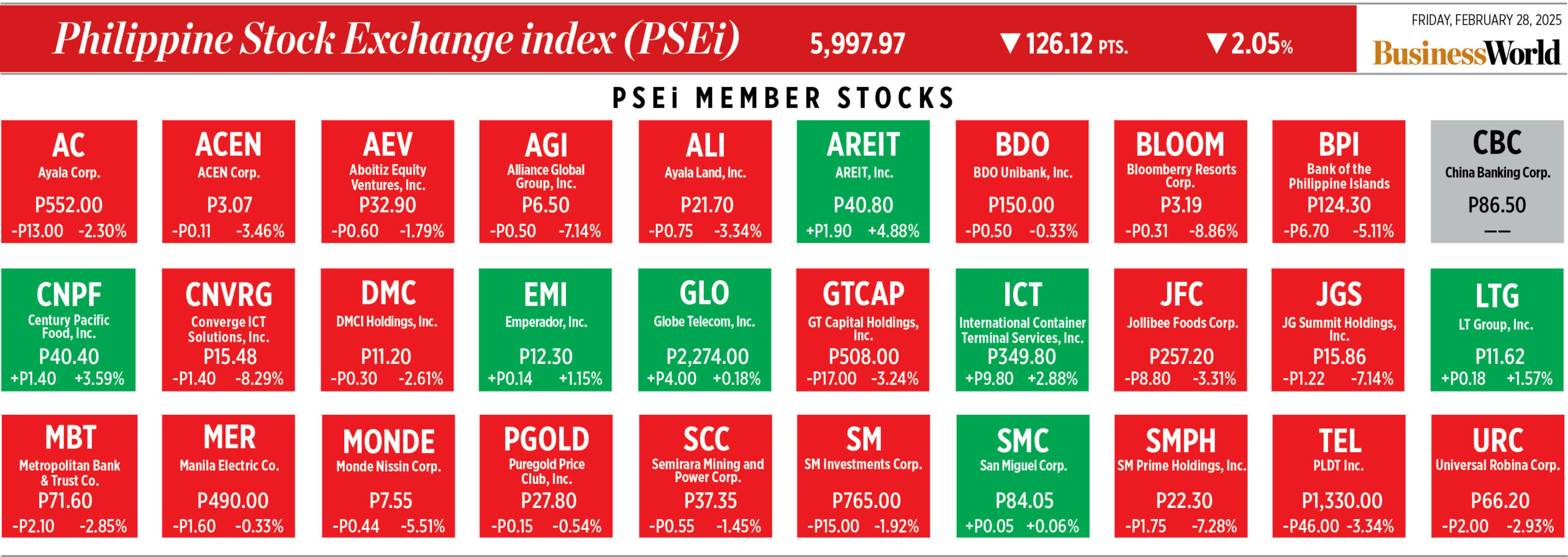

Here’s a quick glance at how PSEi stocks fared on Friday, February 28, 2025.

THE PESO could continue to move sideways against the dollar this week as the market digests key US economic data released over the weekend, which could affect the US Federal Reserve’s policy path moving forward.
On Friday, the local unit closed at P57.995 per dollar, weakening by 8.5 centavos from its P57.91 finish on Thursday, Bankers Association of the Philippines data showed.
Week on week, the peso also declined by three centavos from its P57.94-per-dollar finish on Feb. 21.
“The dollar-peso traded lower after US President Donald J. Trump said the tariffs on Canada and Mexico will take effect next week, and an additional 10% tariffs on China,” a trader said in a phone interview on Friday.
Rizal Commercial Banking Corp. Chief Economist Michael L. Ricafort said in a Viber message that Mr. Trump’s comments caused safe-haven demand for the greenback on Friday.
Investors unnerved by the prospect of Mr. Trump’s impending tariffs drove a wave of selling on Friday that hit risk-sensitive currencies such as the Australian dollar and sent bitcoin tumbling, thereby boosting the dollar in the Asian session, Reuters reported.
On Thursday, Mr. Trump said his proposed tariffs of 25% on Mexican and Canadian goods would take effect on March 4, along with an extra 10% duty on Chinese imports, defying expectations of those who hoped for a further delay in the levies.
For this week, the trader said the peso’s movement would depend on US core personal consumption expenditures (PCE), personal income, and consumer spending data, which were released after the Asian trading session on Friday.
The trader sees the peso moving between P57.70 and P58.20 per dollar this week, while Mr. Ricafort expects it to range from P57.75 to P58.15.
In the US session, the US dollar edged lower on Friday following two straight days of gains, after a reading on inflation was largely as anticipated by investors while consumer spending unexpectedly fell, Reuters reported.
The PCE price index increased 0.3% in January, in line with expectations of economists polled by Reuters, after advancing by an unrevised 0.3% in December. In the 12 months through January, prices rose 2.5% after increasing 2.6% in December.
The Fed tracks the PCE price measures for its 2% inflation target. The US central bank paused rate cuts in January, leaving its benchmark overnight interest rate in the 4.25%-4.5% range, having reduced it by 100 basis points since September, when it started its easing cycle.
But consumer spending, which accounts for more than two-thirds of US economic activity, dropped 0.2% in January after an upwardly revised 0.8% increase in December.
The dollar index, which measures the greenback against a basket of currencies including the yen and the euro, fell 0.1% to 107.25, with the euro up 0.18% at $1.0416.
For the week, the dollar was up about 0.5% but down more than 1% for February, poised for its largest monthly decline since August.
Expectations the Federal Reserve will cut rates by at least 25 basis points (bps) at its June meeting edged up after the data, with markets pricing in a 71.4% chance of a cut, up from nearly 70% in the prior sessions, according to CME’s FedWatch Tool.
Fed officials have recently indicated they expect the central bank to hold rates steady until there is more clarity surrounding the impact of tariffs on inflation and a slowing economy.
Minutes of the US central bank’s Jan. 28-29 policy meeting showed officials were worried about higher inflation from Mr. Trump’s initial policy proposals. The policy rate was hiked by 5.25 percentage points in 2022 and 2023 to quell inflation.
The greenback had fallen earlier last week by nearly 4% from a more than two-year high in January on renewed worries about US economic growth and inflation as Mr. Trump shifted tariff deadlines on Canada and Mexico.
Investors are also bracing for the labor market impact from actions by the Department of Government Efficiency under Elon Musk.
Against the Japanese yen, the dollar strengthened 0.65% to 150.77 but has fallen nearly 3% for February as investors largely expect the Bank of Japan to hike interest rates this year. — AMCS with Reuters
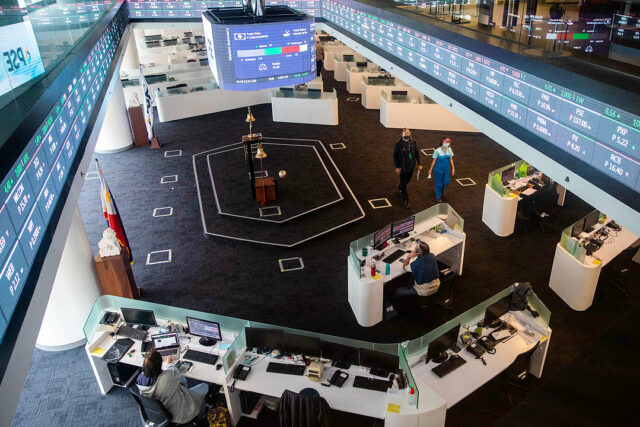
PHILIPPINE SHARES may rebound this week on increased flows amid fresh catalysts, including inflation and factory activity data, and with the market awaiting developments regarding the Trump administration’s trade policy.
On Friday, the Philippine Stock Exchange index (PSEi) slumped by 2.06% or 126.12 points to close at 5,997.97, while the broader all shares index declined by 1.83% or 67.07 points to end at 3,588.12.
Week on week, the PSEi went down by 1.64% or 100.07 points from its 6,098.04 finish on Feb. 21.
“The benchmark index failed to hold above the 6,000 psychological support level, impacted by the latest MSCI (Morgan Stanley Capital International) rebalancing,” online brokerage 2TradeAsia.com said in a market note.
For this week, 2TradeAsia.com said the release of February Philippine headline inflation data on March 5 (Wednesday) will take center stage. The consumer price index may have settled within 2.3%–3% last month, the Bangko Sentral ng Pilipinas said on Friday.
Anticipation for the report may cause the PSEi to rise on Monday, Rastine Mackie D. Mercado, research director at China Bank Securities Corp., said in an e-mail.
“We think that the PSEi could bounce back at Monday’s open given the MSCI-flows related forced downward closure on Friday. If this expectation materializes, we see the PSEi continuing to traverse the 6,000-6,150 range for most part of the week,” he said. “Upcoming data releases, such as the domestic February manufacturing PMI (purchasing managers’ index) and inflation could also spur reactive moves.”
“If the PSEi is able to find its footing atop 6,000 in the coming week, then prospects of a retest of the 6,150 level remain in play in the short term.”
Meanwhile, tariff announcements from US President Donald J. Trump could continue to weigh down market sentiment, said Toby Allan C. Arce, head of sales at Globalinks Securities and Stocks, Inc.
“The international community is increasingly wary of Trump’s hardline stance, which targets countries accused of unfair trade practices, drug trafficking, and immigration challenges… Investors, who had become less reactive to trade headlines, are now recalibrating their outlook as these measures threaten to exacerbate global economic uncertainties,” Mr. Arce said in a Viber message.
Mr. Trump said on Thursday that 25% duties on imports from Canada and Mexico will come into effect on March 4 — not April 2 as he had suggested a day earlier — and said goods from China will be subject to an additional 10% duty, Reuters reported. Last week, he also floated 25% tariffs on shipments from the European Union.
2TradeAsia.com placed the PSEi’s immediate support at 5,800 and resistance at 6,000.
“External risks continue to cap rallies, but mean reversion and factor rotation could create tactical opportunities once confidence stabilizes,” it added. — Sheldeen Joy Talavera with Reuters

THE Department of Energy (DoE) said it has launched a knowledge-sharing program with South Korea on clean energy.
In a statement on Sunday, the DoE said its 2024/25 knowledge sharing program serves as a platform for the exchange of expertise and best practices.
“We aim to gain invaluable insights and best practices that will help us draft policy, strengthen our institutions, and implement innovative energy solutions that respond to our country’s evolving energy landscape,” Energy Undersecretary Alessandro O. Sales said.
The two governments held high-level discussions in August to explore ways for the Philippines to benefit from South Korea’s advances in energy technology while showcasing its own strengths in renewable energy, particularly in geothermal and pumped hydropower generation.
The Korea Energy Economics Institute, Korea Advanced Institute of Science and Technology, Korea Trade-Investment Promotion Agency, and Korea Hydro & Nuclear Power, are participating in the program.
The Asia Economic Development Committee (AEDC) of South Korea serves as the program’s official coordinating organization for Philippine government-related knowledge-sharing matters, facilitating energy cooperation between the two countries.
“This program is not just about technology transfer, it is a testament to the enduring friendship and shared commitment of our nations to sustainable energy development,” AEDC Chairman Yoon Sukhun said.
As part of the program, the Philippines submitted three key proposals aligned with its energy transition and socioeconomic development goals. These include initiatives accelerating electric vehicle adoption and charging infrastructure, integrating floating solar and smart grid technologies, and strengthening capacity building for clean energy development.
Since its inception in 2004, the program has supported over 759 research projects, fostering collaborations that drive innovation and enhance institutional capacity.
“The Philippines and Korea reaffirm their dedication to fostering strong energy cooperation, leveraging shared knowledge, and driving forward sustainable energy solutions that will benefit both nations in the years to come,” the DoE said.
The Energy department is seeking to increase the share of renewable energy in the power generation mix to 35% by 2030. — Sheldeen Joy Talavera

THE Department of Trade and Industry (DTI) said it hopes to release a jobs blueprint for the wholesale and retail trade industry by midyear.
“We need to finalize it because we have to validate it with our partners,” Trade Undersecretary Mary Jean C. Pacheco told reporters.
The DTI’s partners for the blueprint are the Supply Chain Management Association of the Philippines (SCMAP) and the Philippine Retailers Association (PRA).
“(We expect to release it) maybe by midyear,” she said.
The blueprint will set targets, which Ms. Pacheco said it will require buy-in by the partners.
“We haven’t presented (the first draft) yet. Because we finished it in December,” she said.
“Our plan is to do consultations first with SCMAP, then do one with PRA, and then do another with the both of them.”
In October, Trade Secretary Ma. Cristina A. Roque said that the blueprint will help create a thriving job market in the industry and ensure that innovation and technological advancements translate into opportunities for workers.
It is projected to benefit over 10 million workers in wholesale and retail, which accounted for P4.4 trillion of gross domestic product in 2023, the DTI said.
In December, PRA President Roberto S. Claudio welcomed the roadmap, noting that it will bolster the economy.
“The retail sector is ready to embrace innovation and enhance the customer experience. This blueprint provides a clear roadmap for us to achieve those goals while contributing to economic progress,” Mr. Claudio said. — Justine Irish D. Tabile

Second of two parts
IN BRIEF:
• With consumers still adapting to recent sharp rises in the cost of living, regulators’ focus on ensuring financial resilience and good consumer outcomes will increase.
• In 2025, regulators will look at accountability and timely remediation of long-standing risk management weaknesses that had gone unaddressed. They will continue to engage financial institutions in ensuring that governance and risk management are strengthened, in line with the institutions’ changing strategy and ambitions.
The past years highlighted several critical issues for financial institutions and regulators, ranging from geopolitical and macroeconomic issues to growing challenges in balancing support for technology innovation with protecting consumer and markets from the attendant risks. This presents a convergence of risk factors over the coming year and beyond, with regulatory fragmentation expected to continue as policymakers prioritize country-specific approaches to matters such as financial stability, financial inclusion, sustainability, artificial intelligence (AI), resilience, and governance.
The EY 2025 Global Financial Services Regulatory Outlook identifies critical themes that will shape the regulatory landscape over the coming year, exploring key regulatory priorities for financial institutions in 2025 and offering strategies for navigating these challenges effectively.
The first half of this article explored the first two key regulatory priorities: navigating the fragmented regulatory landscape driven by national interests and emphasizing operational and financial resilience. This second half will discuss remaining priorities: focusing on securing positive outcomes for consumers and managing risk in an evolving environment.
POSITIVE CONSUMER OUTCOMES AND EXPANDING SUSTAINABILITY EFFORTS
While inflation is easing, financial difficulties for consumers and businesses continue. In many countries, there is a contradiction in the approaches to regulations on financial stability and financial inclusion. On one hand, policymakers are encouraging international competitiveness and deregulation, and on the other, focusing on ways to boost citizens’ financial wellbeing and empowerment by helping them to build savings for later life, protecting access to financial services, and promoting competition.
With consumers still adapting to recent sharp rises in the cost of living, regulators’ focus on ensuring financial resilience and good consumer outcomes will increase. The UK’s adoption of the Consumer Duty in 2023 has attracted global attention, with several national regulators preparing to enhance consumer protections. This greater focus on helping customers build financial resilience supports the ESG agenda on financial inclusion, and looking beyond compliance to actual customer outcomes can offer financial institutions an opportunity to gain a competitive advantage.
On the global sustainable finance front, ESG reporting on emissions, climate risks and sustainability is becoming a business norm for the largest companies. There are similar initiatives and roadmaps with timelines on the Philippine front, not only on reporting requirements but also other areas like the sustainable finance taxonomy guide and climate risk stress testing.
The sustainability agenda is starting to widen and deepen, including a broadening focus on the “E” of ESG beyond climate and a deliberate look at the “S” as it relates at least to financial, digital and economic inclusion. It will take time before financial institutions also face specific accountabilities on biodiversity and nature-related risks, but it is now increasingly clear that banks need to accept that sustainability has a direct link to financial stability and will continue to shape future regulatory responses.
Organizations need to understand how regulators may view the principle of fairness and be prepared to demonstrate how they are delivering in customers’ interests. This involves showing how their products and services cater to the needs of specific customer groups, including vulnerable customers. Additionally, firms should help customers understand common fraud and scams, use technology to monitor transactions, enhance security, and verify customer identity. By doing so, firms can build trust and ensure they are meeting regulatory expectations for consumer protection.
MANAGING RISK IN AN EVOLVING ENVIRONMENT
Governance will remain a top agenda. The banking crisis of early 2023 highlighted long-standing risk management weaknesses and failures to strengthen governance in line with changing strategies. Going into 2025, regulators will look at accountability and timely remediation of long-standing risk management weaknesses that had gone unaddressed. They will continue to engage financial institutions in ensuring that governance and risk management are strengthened, in line with the institutions’ changing strategy and ambitions.
Moreover, they will put greater pressure on boards to ensure that they have effective oversight over risk management frameworks. It is imperative for financial institutions to pay close attention to feedback from supervisory interactions and cross-sector reviews.
The outlook provides the following points for organizations to consider for risk management, governance and accountability:
• Prioritize investments in systems and data that allow the proactive self-identification of issues and implementation of controls before the risks crystallize
• Explore how advanced technologies such as data analytics and AI can help predict future issues
• Conduct regular testing to better anticipate emerging issues
• Evaluate whether the three-lines-of-defense model is delivering optimal results
• Ensure governance arrangements give board members sufficient oversight of the firm’s risk environment
• Approach regulatory relationships systematically, with feedback being tracked and revisited to ensure that issues are being addressed
By doing so, firms can demonstrate their commitment to robust risk management and governance practices, meeting regulatory expectations and building a foundation for long-term success.
NAVIGATING THE REGULATORY LANDSCAPE FOR LONG-TERM SUCCESS
Governments see the finance sector as key to delivering economic and social objectives. Firms must engage with regulatory agendas to contribute insights and understand the issues driving policymakers’ and regulators’ thinking. They must also demonstrate that their risk management is flexible and responsive to a changing environment, and that they have the data and tools to deliver against regulators’ priorities.
As we move into 2025, financial institutions must be prepared for market disruption and volatility while delivering good outcomes for customers. The onus is on firms to prove that their risk management and governance arrangements are agile and robust enough to meet these concerns. By focusing on resilience, consumer outcomes, and timely remediation of weaknesses, financial firms can navigate the regulatory landscape effectively and build a foundation for long-term success.
This two-part article is part of a larger series on future trends for the financial services industry. In the following weeks, we will discuss how digital transformation drives the workforce in financial institutions, harnessing the power of Generative AI in banking, and building operational and financial resilience.
This article is for general information only and is not a substitute for professional advice where the facts and circumstances warrant. The views and opinions expressed above are those of the author and do not necessarily represent the views of SGV & Co.
Christian G. Lauron is the financial services organization (FSO) leader of SGV & Co.

Games on Wednesday
(SM Mall of Asia Arena)
10 a.m. – UE vs FEU (men)
12 p.m. – UP vs UST (men)
2 p.m. – UE vs FEU (women)
4 p.m. – UP vs UST (women)
DE LA SALLE University (DLSU) got back on track by drubbing host University of the Philippines (UP), 25-22, 24-26, 25-18, 25-17, to dodge a worst start in almost two decades in the UAAP Season 87 women’s volleyball on Sunday at the Mall of Asia Arena.
Former Rookie-MVP Angel Canino led the way with 24 points on 20 hits as the Lady Spikers improved to 2-2 for a share of the third spot with the UP Fighting Maroons and the Adamson University Lady Falcons halfway through the first round.
La Salle, the UAAP Season 85 champion, absorbed another meltdown against the University of Santo Tomas earlier this week for a 1-2 start that matched the school’s dismal start in 2006, when it ironically won the title behind a 10-game winning streak.
Against the vastly improved UP, La Salle said enough with hopes of taking control of its fate as early as possible — especially against a tough field led by unbeaten champion National University.
The Lady Spikers did behind the contributions of Shevana Laput and Katrina del Castillo with 21 and 11 points, respectively. Libero Lyka De Leon took care of the floor defense with 18 digs and 14 receptions as new playmaker had Julyana Tolentino had 10 sets.
La Salle yielded an extended second set, regrouped in the third and was on the verge of allowing a rubber only to unleash a strong 9-2 finishing kick from a close 16-15 cushion to capitalize on UP’s inexperience.
Irah Jaboneta dropped an all-around game of 15 points, 11 receptions and eight digs while Joan Monares had 11 in UP’s second straight defeat.
In the men’s division, leader Far Eastern University (4-0) topped Ateneo De Manila University (2-2), 25-23, 32-30, 23-25, 25-15, to stay undefeated while La Salle (2-2) bested UP (1-3), 23-25, 25-13, 26-24, 25-15. — John Bryan Ulanday

TOKYO — Filipino runner Arlan Arbois, Jr. always had a knack for turning something out of nothing.
With little time to prepare after juggling national team duties and his responsibility as a newly enlisted Army personnel, the 24-year-old 2023 Phnom Penh Southeast Asian Games silver medalist came through with his best effort to date in the Tokyo Marathon on a windy, cold Sunday morning here.
Armed with nothing less but an iron will, the proud son of San Rafael, Davao City, who is an ASICS ambassador, clocked two hours, 24 minutes and 23 seconds in this 42.195-kilometer race that started in front of the Tokyo Metropolitan Government Building and ended between the Imperial Palace and the Tokyo train station.
He surpassed his previous best time of 2:26.38 in December a year ago in a race back home.
Forget about finishing 125th out of over 38,000 in this annual race considered as one of the seven “majors” of the sport, what mattered was Mr. Arbois accomplished what he had set out for.
“I didn’t expect it because I had little preparation because I was just recently accepted in the Army,” said Mr. Arbois, who wore ASICS’ newly released Meta Speed Edge, in Filipino.
“But every time I race, I always try to improve on my time. And I’m happy I did here,” he added.
Veteran Richard Salaño, in contrast, had a strong start but the chilly weather caught up on him and struggled in the end and finished at 174th in 2:28.40, or less than four minutes off his target.
“I was doing okay in the first 32 minutes and I thought I was on course of reaching my target and even touching the national record,” said the 33-year-old Army Corporal from Bulacan, whose trip was funded by ASICS.
“But I felt the chills in the 34th minute and I was just never the same. The cold weather got into me. Maybe because I stopped training for a week last month because I got sick,” he added.
It was the second time Mr. Arbois got the better of Mr. Salaño, after the former bested the latter in Cambodia two years ago in snatching the silver when not many even considered him a medal contender.
But Mr. Arbois came through.
And here in the land of the rising sun, he did it again. — Joey Villar

LONDON — Favorites Manchester City stayed on track for an eighth FA Cup triumph but were given a scare by second-tier Plymouth Argyle and Bournemouth reached the quarterfinals for only the third time by knocking out Wolverhampton Wanderers on Saturday.
Crystal Palace moved into the last eight after they beat second-tier Millwall although their 3-1 win was marred by an injury to French forward Jean-Philippe Mateta who was taken to hospital with concussion and a head wound after being clattered by Millwall goalkeeper Liam Roberts who was sent off.
Plymouth, second from bottom of the Championship, had stunned Premier League leaders Liverpool in the previous round and thousands of their fans made the long trip from Devon to the northwest hoping for another massive upset.
Maksym Talovierov gave them reason to dream when he headed Plymouth in front at The Etihad Stadium.
But teenager Nico O’Reilly equalized with a header from a Kevin de Bruyne free kick in first-half stoppage time and the left back then put City in front late on with another header from De Bruyne’s corner.
De Bruyne then made sure of City’s progress in the final minute but it was a battle for the Premier League champions who also came from a goal down to beat third-tier Leyton Orient in the previous round.
Bournemouth is chasing a European qualifying spot in the Premier League and their superb season under Andoni Iraola continued as it beat top-flight rival Wolves on penalties after a 1-1 draw on the south coast.
Evanilson gave Bournemouth the lead after 30 minutes and they should have finished the job before Matheus Cunha levelled for Wolves on the hour mark with a stunning long-range shot.
Cunha was sent off near the end of extra time after a clash with Bournemouth defender Milos Kerkez.
Wolves full back Matt Doherty had the chance to send his side through in the penalty shoot-out but missed the target and when Boubacar Traore’s effort struck the crossbar, Luis Sinisterra calmly sent Bournemouth through.
“I feel like we could have done it in 90 minutes, but the most important thing is we got the win and we’re into the next round,” Bournemouth’s Antoine Semenyo said.
Wolves could rue the loss of Cunha in the relegation battle as he faces a three-match ban.
“Cunha is a special player, he played in extra time when he was not in condition to play,” manager Vitor Pereira said.
“Last three weeks he has hamstring issue, emotional side was high in game, a lot of pressure and in the end it has happened, we must now cope.”
Palace eased past south London rivals Millwall but not without a cost. The 27-year-old Maheta was kicked in the head by Millwall keeper Roberts in the seventh minute at Selhurst Park and needed oxygen on the pitch before being taken to hospital. — Reuters

DEMAR DEROZAN and Zach LaVine combined for 41 points as the visiting Sacramento Kings rode a balanced offensive attack to a 113-103 victory over the Houston Rockets on Saturday.
Six Kings players scored in double figures as the team completed a sweep of the three-game season series with Houston. The Kings overcame the loss of center Domantas Sabonis to a left hamstring injury just over a minute into the game by shooting 50.6% from the field.
Jonas Valanciunas replaced Sabonis and produced 15 points, 14 rebounds and four steals. Malik Monk added 16 points and Keegan Murray posted 13. Keon Ellis chipped in 12 off the bench.
 DeRozan (21 points, six assists) and LaVine (20 points, six rebounds) worked in tandem to confound the Houston defense. The Rockets trailed by 16 points midway through the first quarter and rallied to secure the lead in the second, only for DeRozan or LaVine to fashion responses to keep Houston at bay.
Alperen Sengun collected 30 points, 10 rebounds and five assists for the Rockets, while Jalen Green added 24 points. Guard Fred VanVleet returned after missing 11 games due to an ankle injury, and he tallied three points on 1-for-8 shooting in 35 minutes. The Rockets committed 16 turnovers.
The Kings turned a 15-0 run into a 19-3 lead while the Rockets opened the game shooting 1 for 12. Houston fashioned a 14-3 rally to work back into contention, with Jabari Smith Jr. capping the quarter with a transition dunk that cut the Sacramento lead to 25-21 entering the second.
LaVine, Trey Lyles and Jake LaRavia opened the second period with 3-pointers that helped the Kings extend to a 40-31 lead.
The Rockets rallied behind Dillon Brooks, who combined a 3-pointer with two three-point plays that pulled Houston even at 51-51. When Brooks followed with a 3-pointer at the 3:11 mark, the Rockets led 54-51. Brooks finished with 12 points.
Sacramento reclaimed a 63-59 halftime lead and, after Houston closed to within 84-82 on a three-point play by Sengun, the Kings used a 13-3 run bridging the final two periods to seize control.
The Rockets missed their final five shots of the third while committing three turnovers, and when Sacramento opened the fourth with a 3-pointer by Ellis and a driving layup by DeRozan, the lead reached 96-85. — Reuters
JALEN DUREN powered for 18 points, 11 rebounds and a career-high six blocks and the host Detroit Pistons won for the ninth time in 10 games, downing the Brooklyn Nets 115-94 on Saturday night.
Detroit bounced back from a 15-point loss to Denver on Friday as Tobias Harris had 18 points and nine rebounds and Malik Beasley also scored 18. Beasley was ejected with 6:39 remaining after picking up his second technical foul.
Cade Cunningham tossed in 15 points with nine assists and Ausar Thompson added 13 points.
Tyrese Martin led the Nets with 23 points off the bench. Jalen Wilson had 14 points and Cameron Johnson added 13.
The Pistons jumped to a 39-22 lead by the end of the first quarter. Hardaway gave Detroit its first double digit lead at 14-4 with a 3-pointer. Beasley scored 14 points in the final five minutes of the quarter. He knocked down four 3-pointers during that span.
Brooklyn pulled within 11 at 41-30 on a pair of Martin free throws with 9:22 left in the first half but the Pistons scored the next six points, including another Beasley 3-pointer.
A three-point play from Harris with 5:53 left in the half upped Detroit’s advantage to 23, 56-33. Duren’s three-point play with 3:14 remaining in the quarter gave the Pistons their biggest lead of the half at 63-38.
The half ended with Detroit leading 68-45. Duren already had a double-double before the break with 13 points and 10 rebounds
The Nets opened the second half with a 14-5 run to pull within 14 points.
Johnson’s 3-pointer with 2:47 left in the quarter cut Detroit’s lead to 81-69, igniting a 9-0 Brooklyn run to end the quarter. Martin’s layup moved the Nets within six points at 81-75.
Detroit’s Tim Hardaway Jr. opened the fourth with a 3-pointer. After the Nets cut their deficit to eight points with 8:18 to play, Detroit scored eight unanswered points to put the game away.
Cunningham knocked down a 3-pointer and Duren had a three-point play. Cunningham then set up Harris for a dunk. Cunningham’s three-point play with 5:56 remaining pushed the Pistons’ lead to 20. — Reuters

When the Bynum Faith Foundation officially became recognized as a charitable organization in spring 2023, Camryn Bynum was already deep into underscoring his Christian and Filipino roots. Both were, needless to say, instrumental in framing his character growing up in Corona, California, and certainly when he felt moved to, as the nonprofit’s website noted, “leverage his platform to offer hope, assistance, and support to underserved communities in the United States and the Philippines.” By then, he was already the Vikings’ starting safety, if nothing else proof of his progressive body of work in the two years since the National Football League franchise drafted him in the fourth round.
Bynum became intent on doing all he could to provide assistance to underprivileged Filipinos in a visit to the Philippines during his rookie year. It was, in retrospect, providence, especially since he would not have otherwise been privy to the myriad problems faced by struggling communities in his mother Jennifer’s home country. As much as he had been touched by God, he, too, wanted to be the vessel for change as witness to his Christian faith.
Not coincidentally, providence was also how Bynum first met his wife Lalaine by chance in Dubai. There was instant chemistry, he said, and they got engaged not long after. Needless to say, they exchanged vows in the Philippines, and now devote much of their time steering the foundation’s outreach programs, including weekly food distribution in Manila and his yearly Camp Beezy. Initially set up to grow American football in the Pearl of the Orient, the latter is now committed to push for the formation of a Philippine flag football team in time for the 2028 Summer Games in Los Angeles.
To this end, Camp Beezy played host to some 75 flag football players from the Philippines and other Southeast Asian countries the other week in Cavite. Professional coaches subjected camp participants to a training regimen — and, of course, a series of games — designed to raise awareness of the sport. Given Bynum’s ultimate objective, the camp likewise sought to show how flag football’s unique set of rules benefits Filipinos and highlights their innate quickness, dexterity, smarts, and, yes, craftiness. After all, unlike American football, flag football allows little to no contact; instead, a tackle is made when a defender succeeds in removing a flag — in reality more closely resembling a pennant — on either side of the offensive player.
As with anything involving sports in the Philippines, the key is, to be sure, generating enough buzz to encourage and entice corporate support. For all the seeming advantages of Filipinos in the sport, financial backing is critical in terms of finding the best players, and then prepping them for the Olympics in three years. The good news is that this early, the endeavor already has one backer: service hospitality company RIESA Management, Inc., whose chief operations officer, Anthony Raymond, just so happens to be an avid flag football player. Still, is garnering critical mass wishful thinking? Don’t tell that to Bynum, who has encountered more than enough success amid adversity to know everything happens in His time.
Anthony L. Cuaycong has been writing Courtside since BusinessWorld introduced a Sports section in 1994. He is a consultant on strategic planning, operations and human resources management, corporate communications, and business development.
