Home Blog Page 1505

BDO launches Visa travel card with instant rebates

BW FILE PHOTO

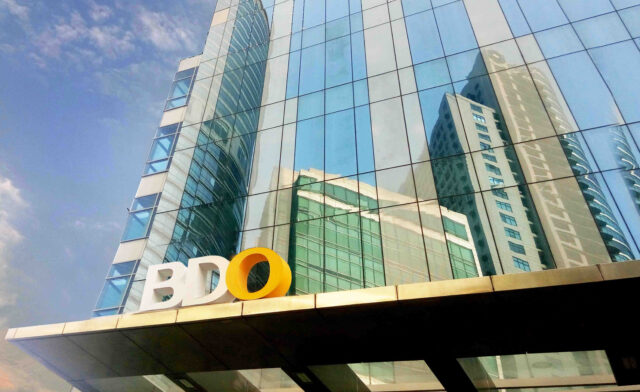
BDO UNIBANK, Inc. has partnered with Visa to launch a credit card with travel-related rewards and rebates that caters to the affluent segment as demand for travel is expected to continue growing.

The BDO Visa Signature credit card features a 1.7% foreign exchange conversion rate for overseas purchases, a 3% travel rebate on overseas and airline spending and 0.3% on everything else, as well as up to P2,500 rebate per month.

The credit card also offers up to P20 million in travel insurance coverage and complimentary access to over 1,600 VIP airport lounges worldwide.

“Over the last year, there was 22% more global travel that we see through the Visa network than there was in prior years. And when we spoke to Filipino travelers, 57% of them are planning to travel overseas in the coming year,” Visa Asia Pacific Regional President Stephen Karpin said at the launch event on Tuesday.

Unlike other travel credit cards in the market, the Sy-led bank said BDO Visa Signature offers instant rebates.

“No one gives you an instant rebate on travel and airline spends. So, this is one of them (benefits)… that and the low foreign exchange rate,” BDO Senior Vice-President and Consumer Lending Group Marketing Head Maria Nanette R. Regala told reporters on the sidelines of the launch.

Cardholders will also have access to over 900 luxury hotels partners worldwide via the Visa Luxury Hotel Collection website, including perks such as best available rate guarantee, automatic room upgrades, VIP guest status, late checkout, and complimentary breakfast, BDO said.

The card likewise has shopping, dining, and travel offers locally and internationally.

New cardholders will receive a P15,000 welcome bonus with a minimum P75,000 ($1,300) spend.

“We seek ways to provide our cardholders better benefits and experiences. BDO Visa Signature is the perfect credit card for the elite traveler… Our cardholders can expect to travel in style and comfort with these exclusive perks and privileges,” BDO Senior Executive Vice-President and Consumer Banking Group Head Rolando C. Tanchanco was quoted as saying in a statement.

“We are thrilled to celebrate this milestone in our partnership with BDO through the launch of BDO Visa Signature, marking Visa’s first product launch with BDO since they began issuing Visa cards,” Visa Philippines Country Manager Jeffrey Navarro said. “BDO Visa Signature is designed to transform the travel experience for affluent Filipino travelers… BDO Visa Signature offers a world of privileges that cater to the sophisticated tastes and demands of our cardholders.”

BDO’s net income grew by 13.26% annually to P21.18 billion in the third quarter of 2024, bringing its nine-month net profit to P60.62 billion, climbing by 12.47% year on year.

Its shares climbed by P2.50 or 1.73% to end at P147 apiece on Wednesday. — Aaron Michael C. Sy

Alphabet plans massive capex hike, reports cloud revenue growth slowed

REUTERS

ALPHABET said on Tuesday it will spend $75 billion on its artificial intelligence (AI) buildout this year, 29% more than Wall Street expected, and investors signaled disappointment at a missed cloud revenue target and began showing impatience over profitability.

Shares of the Google parent fell 9% in extended trading. Alphabet has gained about 9% so far this year.

Wall Street had been expecting 2025 capital expenditures of about $58 billion, according to LSEG data. That would have marked a modest increase over the $52.5-billion spending in 2024.

Chief Executive Officer Sundar Pichai defended the dramatic increase on a conference call with analysts, who are raising new questions about capital spending by Google and US rivals following the emergence of China’s DeepSeek, which offers cut-rate AI. He said Google’s Gemini family of AI models is comparable in efficiency to DeepSeek.

“The cost of actually using (AI) is going to keep coming down, which will make more use cases feasible,” Mr. Pichai said. “The opportunity space is as big as it comes, and that’s why you’re seeing us invest to meet that moment.” Still, the company posted a deceleration in cloud revenue growth.

Alphabet has been spending heavily on infrastructure development to support AI research and integration into products such as search and cloud services. The majority of capex for 2025 would go into building servers and data centers, Chief Financial Officer Anat Ashkenazi said on the call. She attributed the fourth-quarter results in part to capacity constraints on cloud AI offerings.

Alphabet plans to spend $16 billion to $18 billion in the first quarter, a far bigger number than the roughly $6 million DeepSeek said it spent on the final training run to develop its AI model.

To be sure, developers at leading US AI firms said the total training cost was likely magnitudes larger. But revelations around DeepSeek’s training cost in January shocked tech stocks, contributing to Nvidia’s record one-day drop of $593 billion in market value.

“It’s very hard to defend Google after the earnings report,” said Dave Wagner, portfolio manager at Aptus Capital Advisors, which holds Alphabet stock. He pointed to the cloud revenue miss and Google’s poor track record on utilizing cash for profitability.

“DeepSeek has started to teach the market that maybe some things can be done a little bit more efficiently,” he said. “Maybe we’re starting to see the market dislike the continued increase in capex.”

LEVELING OFF
Google Cloud had previously grown fast enough to offset concerns around increased spending, said Brian Mulberry, client portfolio manager at Zacks Investment Management, which holds Alphabet shares.

“When you start to see that revenue level off or at least the growth start to top off a little bit, how you’re going to finance the future growth of the company becomes an issue,” he said.

Google’s cloud business posted a 30% rise in revenue to $11.96 billion in the fourth quarter, slowing down from the 35% increase in the September quarter. Analysts were expecting a rise of 32.3% to $12.16 billion, according to data compiled by LSEG.

The soft cloud numbers come even as Google has built out AI features within its cloud computing platform. Mr. Pichai said on the conference call that developer usage on Gemini had doubled in six months to 4.4 million users.

Larger cloud rival Microsoft also reported weaker-than-expected growth in its Azure cloud platform last week. Shares of Amazon, the largest cloud provider, which will publish quarterly results on Thursday, were down 1.8% in after-hours trade.

Alphabet’s mainstay ad business, which represents about three-quarters of its overall revenue, has been facing rising competition as more advertisers eye social media platforms such as Meta’s Facebook and Instagram or ByteDance’s TikTok.

Advertising revenue rose 10.6% to $72.46 billion in the fourth quarter. That beat the third quarter’s 10.4% growth and topped analysts’ estimates of $71.84 billion, according to LSEG.

Ad revenue from YouTube grew 13.8% to $10.47 billion in the fourth quarter, compared with the 12.2% growth in the third quarter. Chief business officer Philipp Schindler said the growth was helped by US election advertising, with combined spending by Democrats and Republicans nearly doubling compared with the 2020 election.

The ad tech products and ad-driven search business are both facing scrutiny from US regulators seeking to break up the company, though policy may change under the Trump administration.

Overall, Google’s revenue rose 12% to $96.47 billion in the fourth quarter, compared with the average analyst estimate of $96.56 billion, according to data compiled by LSEG.

The company reported a profit of $2.15 per share, beating estimates of $2.13 per share.

Search revenue rose 12.5% to $54.03 billion. Pichai said that AI Overviews, the AI-generated summaries for search queries displayed above Google’s traditional links to the Web, had increased search usage.

The monetization rate on ads for AI Overviews, introduced last October, was approximately the same compared to traditional search ads, chief business officer Philipp Schindler said.

Self-driving car unit Waymo will debut internationally in Tokyo in the coming weeks, Mr. Pichai said. Reuters

Negative thoughts

FREEPIK

OPTIMISTS seem to be defined as people who have a positive outlook on life. What drives their actions is the thought that things will turn out positively — stocks they hold will move positively, careers they’re in will move up, and changes in life will be about addition, not subtraction.

Negative thoughts are often dismissed as inappropriate.

A boss who is always shooting down proposals because of doubts and perceived risks is considered “too negative.” A person always posing obstacles and challenges to any initiative is considered “nega.” Bad vibes accompany him like a dark cloud.

Is negativity always unwelcome?

In medicine, negative results are welcomed with a sigh of relief, followed by a big celebration. Tests are done on lumps in the body or X-rays are taken of one’s lungs. The best news a doctor can give his nervous patient is that the results turned out to be negative — that the suspected condition is not present. (It’s just muscle tightness.)

For travelers, the customs office of a country provides a negative list. These are items that are not allowed entry. Anything else outside the list is allowed.

Still, being negative is the opposite of affirming and supportive.

Advertising sometimes does comparative demonstrations of products to highlight the advantages of its client’s offering. The ad may not mention the other brand by name, except maybe as “Brand X.” The negative comparison is intended to highlight the positive attributes of the brand being endorsed.

The cosmetic industry too uses a “before” and “after” presentation of its product or service. The negative features in the former are replaced by glowing improvements “after” the treatment.

Negative campaigning in politics is publicly denounced as inappropriate. Still, the negative attack is embraced as a way out of low ratings in the polls. “Opposition research” is intended to flush out all the negatives about a candidate, even going to the extent of manufacturing non-existent problems. Even candidates themselves use oppo research to check for their vulnerable spots.

Demolition jobs are not just for building construction.

Negative thinking is quite prevalent. Why are objects defined by what they are not? History and current affairs are referred to as “non-fiction.” Fresh faces in politics that have no chance of winning the election even when they are surging in the surveys are called “non-traditional.” Healthy food is not nutritious but “non-fattening.”

Even the commandments are mostly expressed in prohibitions (Thou shalt not kill) rather than encouragement — honor thy father and thy mother.

People define themselves by what they don’t like. Hate objects are specified and categorized as hate objects. CEOs are known for what irritates them — do not call him on his golf day. He is pissed off by tardiness. Getting along entails avoiding negative traits that are known to be “pet peeves.”

Architects interview customers and elicit only what they abhor. Shown a home design, the negative thinker can pick the nits and say that there are too many arches, or the shelves are too small. Maybe the design of the windows makes the rooms too shadowy. But asked what design the client has in mind, she draws a blank. In the construction stage for such a client, there are continuous change orders, with walls being torn down and floors ripped up, even before the cement has dried. Of course, this adds to the project cost.

The default position in politics is to launch attacks on everyone in the guise of promoting the public good. Crusading types claim to represent the little people in their fight against corruption and abuse of power. What attributes do they like? Is it better to give a negative list of what to avoid?

A negative list, because it is always shorter, seems easier to remember and follow. With a diet, food types to avoid (high fat, sugar, carbo) are a small slice of the food pyramid. Food not on the null list is therefore allowed. Rules for visa application (must not have a reason to stay indefinitely) or literary contests (must not have been previously published) also tend to be negatively phrased.

For organizations and high-profile individuals always covered by media, no news is good news. Negative thoughts have entered social discourse. When asked how our day has gone, the best answer is a double negative… not bad.


Tony Samson is chairman and CEO of TOUCH xda

ar.samson@yahoo.com

How much did each commodity group contribute to January inflation?

How much did each commodity group contribute to January inflation?

Juliette Binoche to head Cannes Film Festival jury

COMMONS.WIKIMEDIA.ORG

PARIS — Juliette Binoche, who won an Oscar for her portrayal of a nurse in The English Patient, was named as jury president for the 2025 Cannes Film Festival on Tuesday.

Ms. Binoche had her first major role in André Téchiné’s Rendez-vous, which premiered in Cannes in 1985.

“In 1985, I walked up the steps for the first time with the enthusiasm and uncertainty of a young actress,” Ms. Binoche was quoted in the festival statement as saying.

“I never imagined I’d return 40 years later in the honorary role of president of the jury. I appreciate the privilege, the responsibility, and the absolute need for humility.”

Ms. Binoche has won awards at Europe’s three biggest film festivals: Cannes, Venice, and Berlin. In Cannes, she won the award for Best Actress in 2010, for her role as an antiques dealer in Abbas Kiarostami’s Certified Copy.

Ms. Binoche will succeed Barbie director Greta Gerwig, who served as jury president last year.

The 78th Cannes Film Festival runs from May 13 until May 24. — Reuters

PSALM to open new bidding CBK hydropower complex

CBKPOWER.COM

STATE-RUN Power Sector Assets and Liabilities Management (PSALM) Corp. said it will initiate a rebidding process for the privatization of the Caliraya-Botocan-Kalayaan (CBK) hydroelectric power plant (HEPP) complex.

In an announcement posted on its Facebook page, PSALM said it will hold a new bidding “to optimize the assets to be privatized and provide maximum value to its stakeholders.”

“PSALM hopes to attract significant interest from industry players and invites robust participation from potential bidders,” the company said.

The CBK hydro facilities are under a 25-year build-rehabilitate-operate-transfer and power purchase agreement between independent power producer CBK Power Co. Ltd. and National Power Corp. (NPC), which will expire in 2026. These facilities include the 39.37-megawatt (MW) Caliraya HEPP in Lumban, the 22.91-MW Botocan HEPP in Majayjay, and the 366-MW Kalayaan I and 368.36-MW Kalayaan II pumped-storage power plants in Laguna.

Asked for further details on the rebidding process, PSALM President and Chief Executive Officer Dennis Edward A. Dela Serna said that, given the short term of the independent power producer administrator (IPPA) contract, the company decided to proceed with a direct asset sale.

IPPAs are responsible for administering and managing the output from energy conversion agreements and power purchase agreements that NPC has entered into with independent power producers.

“We will proceed with the rebidding via a competitive bidding process. One month prior to the bid date is the target release date for the minimum bid price,” Mr. Dela Serna said.

The Department of Energy earlier indicated that the auction is scheduled for April, a step back from the previously planned 2024 timeline.

Energy Secretary Raphael P.M. Lotilla cited the delay as stemming from the pending issuance of the pricing methodology for the third green energy auction (GEA-3) set for next month, which will also include pumped-storage hydro capacities.

The government awaited the pricing scheme for GEA-3 to avoid affecting the value of the CBK hydropower plant complex.

In a pre-proposal conference in July 2024, five energy firms participated, including Marubeni Corp., Semirara Mining and Power Corp., Thunder Consortium, First Gen Prime Energy Corp., and Giga Ace 11, Inc.

Thunder Consortium comprises Aboitiz Renewables, Inc., Electric Power Development Co., and Sumitomo Corp.

The government expects the CBK privatization to generate up to P100 billion.

PSALM was created under Republic Act No. 9136, or the Electric Power Industry Reform Act of 2001, to oversee the privatization of NPC generation assets, liabilities, independent power producer contracts, real estate assets, and other disposable assets. Its corporate life is set to expire in June 2026, 25 years after the effectivity of the Electric Power Industry Reform Act. Should PSALM be dissolved, all of its assets and liabilities will revert to the National Government. — Sheldeen Joy Talavera

BSP sets data collection guidelines

BW FILE PHOTO

THE BANGKO SENTRAL ng Pilipinas (BSP) has approved a circular detailing the guidelines for the submission of data requested by the regulator for statistical and policy development purposes.

In a circular posted on its website, the central bank said the Monetary Board approved guidelines for the implementation of Section 23 of Republic Act (RA) No. 7653, as amended, to ensure the “accurate and timely” submission of the required data.

“The mandates of the BSP are to promote and maintain price stability and financial stability, a strong financial system, and a safe and efficient payments and settlements system conducive to a sustainable and inclusive growth of the economy. The attainment of these mandates is founded on accurate, timely, and relevant data/information, which are used in the formulation of evidence-based policies. In view of the foregoing, it is important that data obtained by the BSP from economic agents are complete, accurate, consistent, reliable, and timely,” the BSP said.

“To carry out its authority to require any data from any person or entity, the BSP through the governor or in his absence, a duly authorized representative, shall have the power to issue a data request or a subpoena for the production of books and records for statistical and policy development purposes,” it said.

The guidelines will apply to any person or entity, including government offices and or government-owned or -controlled corporations that shall be requested by the BSP to provide data.

These data requests include reports and surveys on monetary and economic matters, including related statistics, such as on government and corporate borrowings; financial supervision; financial inclusion; consumer protection; and systemic risk surveillance, among others.

“All submissions to the BSP must be complete, accurate, consistent, reliable, and timely to be considered compliant with the BSP standards. To ensure completeness, accuracy, and correctness, submissions should be reviewed and validated by the respondent individuals and entities prior to transmittal to the BSP. The submissions must conform to the standards to be prescribed by the BSP in the data request. Submissions with incomplete schedules or attachments shall be considered non-compliant with the BSP standards,” the central bank said. — Luisa Maria Jacinta C. Jocson

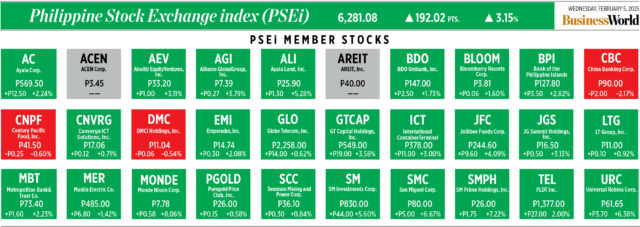
How PSEi member stocks performed — February 5, 2025

Here’s a quick glance at how PSEi stocks fared on Wednesday, February 5, 2025.


Stocks extend rally as CPI data boost BSP cut bets

BW FILE PHOTO

PHILIPPINE SHARES surged on Wednesday, with the bellwether rising to the 6,200 level, on continued bargain hunting and as inflation was steady in January, which would support further rate cuts by the Bangko Sentral ng Pilipinas (BSP).

The Philippine Stock Exchange index (PSEi) jumped by 3.15% or 192.02 points to close at 6,281.08 on Wednesday, while the broader all shares index rose by 2.17% or 78.73 points to 3,696.66.

“The local market extended its rally this Wednesday as investors continued with their bargain hunting,” Philstocks Financial, Inc. Senior Research Analyst Japhet Louis O. Tantiangco said in a Viber message. “Investors also cheered the Philippines’ January inflation figure, which came in at 2.9%. The tamed inflation number sets expectations that the Bangko Sentral ng Pilipinas will continue with their monetary policy easing.”

“Philippine shares made another furious comeback as the latest CPI (consumer price index) came within many analysts’ expectations, paving the way for more leeway for the BSP to time the cutting of interest rates,” Regina Capital Development Corp. Head of Sales Luis A. Limlingan said in a Viber message.

The January CPI of 2.9% was steady from December but up from 2.8% in the same month in 2024, the Philippine Statistics Authority reported on Wednesday.

This was within the BSP’s 2.5%-3.3% forecast for the month but was a tad higher than the 2.8% median estimate in a BusinessWorld poll of 16 analysts.

The BSP said following the data release that it will continue to monitor risks to the inflation outlook and maintain a “measured approach” to policy easing.

BSP Governor Eli M. Remolona, Jr. last week said that a rate cut is “on the table” at the Monetary Board’s Feb. 13 policy meeting, adding that they may slash benchmark interest rates by a cumulative 50 basis points (bps) this year in a gradual manner as “policy insurance” against risks.

The BSP has cut borrowing costs by 75 bps since kicking off its easing cycle in August last year, bringing the policy rate to 5.75%.

“Sentiment also received an additional push as Wall Street edged higher on Tuesday as investors sought stability amid fresh global trade developments,” Mr. Limlingan added.

All sectoral indices closed in the green on Wednesday. Property surged by 4.80% or 110.38 points to 2,405.82; holding firms went up by 4.09% or 205.04 points to 5,216.62; industrials leaped by 2.53% or 213.87 points to 8,667.06; mining and oil rose by 2.39% or 171.23 points to 7,328.26; services climbed by 2.19% or 44.2 points to 2,059.16; and financials jumped by 1.68% or 38.21 points to 2,304.88.

Value turnover increased to P7.50 billion with 673.73 million shares exchanged from the P7.35 billion with 700.47 million issues traded on Tuesday.

Advancers beat decliners, 127 versus 68, while 50 names were unchanged.

Net foreign buying went up to P324.94 million on Wednesday from P47.6 million on Tuesday. — Revin Mikhael D. Ochave

Peso surges to over one-month high

BW FILE PHOTO

THE PESO rose to an over one-month high on Wednesday as the dollar dropped overnight following weak US job openings data and the delayed US import tariffs on Mexico and Canada.

The local unit closed at P58.095 per dollar on Wednesday, strengthening by 24.5 centavos from its P58.34 finish on Tuesday, Bankers Association of the Philippines data showed.

This was the peso’s best close in more than a month or since its P57.91-a-dollar finish on Jan. 2.

The local unit opened Wednesday’s session sharply stronger at P58.05 against the dollar. It touched the P57 level for the first time in over a month, with its intraday best at P57.98. Meanwhile, its worst showing was at just P58.135 versus the greenback.

Dollars exchanged went down to $1.82 billion on Wednesday from $2.13 billion on Tuesday.

The peso “tracked the dollar’s weakness overnight due to lower jobs data and the delay of tariffs over Mexico and Canada,” a trader said by phone.

The Labor department’s Job Openings and Labor Turnover Survey, or JOLTS report, on Tuesday showed there were 1.1 job openings for every unemployed person, down from 1.15 in November, Reuters reported.

Job openings, a measure of labor demand, had decreased 556,000 to 7.6 million by the last day of December, the Labor department’s Bureau of Labor Statistics said. The decline was the largest since October 2023.

The peso was also boosted by data showing that Philippine headline inflation was steady in January, Rizal Commercial Banking Corp. Chief Economist Michael L. Ricafort said in a Viber message. The consumer price index rose 2.9% year on year in January, steady from December. This was within the central bank’s 2.5%-3.3% forecast for the month.

For Thursday, the trader expects the peso to move between P57.90 and P58.40 per dollar, while Mr. Ricafort sees it ranging from P57.95 to P58.15. — A.M.C. Sy with Reuters

House impeaches VP Duterte, paves the way for her trial by Senate court

VICE-PRESIDENT SARA DUTERTE-CARPIO — FACEBOOK.COM/MAYORINDAYSARADUTERTEOFFICIAL

By Kenneth Christiane L. Basilio, Reporter

THE House of Representatives on Wednesday impeached Philippine Vice-President (VP) Sara Duterte-Carpio for alleged abuse of power and constitutional violations stemming from her use of confidential funds, paving the way for her trial by the Senate.

The impeachment complaint against Ms. Duterte, daughter of former President Rodrigo R. Duterte, was filed and signed by 215 congressmen, more than the one-third legal requirement before it can be sent to the 23-member Senate, which will try her as an impeachment court. Several congressmen will act as prosecutors.

The House delivered a quick and stunning blow against the estranged vice-president, who has denied wrongdoing, allowing it to send the ouster charges immediately to the Senate without further hearings.

Her office did not immediately reply to separate Viber message and e-mail seeking comment.

“The undersigned members of the House of Representatives, comprising at least one-third of the lower chamber of the 19th Congress, and as representatives of the Filipino people, cannot, and will not remain silent or indifferent,” according to a copy of the complaint.

Her impeachment is a major setback for the influential Duterte family, whose popularity grew rapidly after Rodrigo R. Duterte was swept to power in 2016 as a maverick, crime-busting mayor. As President, he upended Philippine foreign policy and launched a drug war that killed thousands.

Ms. Duterte is the fourth Philippine official to be impeached or charged with misconduct after ex-President Joseph E. Estrada in 2000, Ombudsman Merceditas Gutierrez in March 2011 and Chief Justice Renato Corona in December 2011.

Mr. Estrada and Mr. Corona were both convicted and removed from office by the Senate on corruption charges, while Ms. Gutierrez resigned before she could be tried. Chief Justice Maria Lourdes P.A. Sereno was ousted by the Supreme Court in 2018 amid impeachment proceedings before a House committee.

Congressmen sent the bill of the impeachment complaint to the Senate on the last day of the congressional session, before lawmakers take a four-month break for the midterm elections in May. Filipinos will pick a new set of congressmen, 12 of the 24-member Senate and other local government officials on May 12.

President Ferdinand R. Marcos, Jr. could call for a special session to allow the Senate to hold the impeachment trial despite being on a legislative break, according to the 1987 Constitution.

The ouster charges consisted of seven articles of impeachment, including allegations of plotting the assassination of the President, misusing secret funds, amassing unexplained wealth and committing acts of destabilization.

‘WOEFULLY SHORT’
“Respondent Ms. Duterte’s conduct throughout her tenure clearly displays gross faithlessness against public trust and a tyrannical abuse of power that, taken together, showcases her gross unfitness to hold public office and her infidelity to the laws and the 1987 Constitution,” according to a copy of the complaint.

“She has not only conducted herself in a manner contrary to, and woefully short of the lofty standards to which we hold our public officials, she has also clearly and blatantly committed culpable violations of the Constitution, betrayed the public trust, engaged in graft and corruption and committed other high crimes.”

“This is about upholding the Constitution and ensuring that no public official, regardless of their position, is above the law,” Speaker Ferdinand Martin G. Romualdez said in a separate statement.

The Vice-President’s impeachment marks the peak in the escalating political conflict between two of the country’s most influential clans. The falling out of the Dutertes and Marcoses has resulted in the shattering of what was once a formidable political alliance that gave them landslide wins in the 2022 elections.

The quarrel between the Marcos and Duterte families reached a climax when Ms. Duterte in a November news briefing said she had hired an assassin to kill Mr. Marcos, his wife and the Speaker, in case she herself were killed. She later said her remarks had been taken out of context.

The President has dissuaded the House from pursuing her impeachment.

The House should have acted on the impeachment complaints when they were first filed, said Arjan P. Aguirre, who teaches political science at the Ateneo de Manila University.

“Had they pushed this in December 2024, this would have at least had a veneer of legitimacy since it was pushed right after the filing of the first impeachment complaint,” he said in a Facebook Messenger chat.

Civil society groups, activists and clergymen separately slapped Ms. Duterte with three impeachment complaints in December. They accused her of betraying the public trust arising for her alleged misuse of P612.5 million worth of confidential and intelligence funds.

“It will be easy for critics, and even Ms. Duterte herself to question the motive of such a sudden decision to proceed with the impeachment,” Mr. Aguirre said.

He added that the House leadership, led by Mr. Romualdez, the President’s cousin, pushed Ms. Duterte’s impeachment in the absence of a “clear successor” to Mr. Marcos for the 2028 presidential election.

“We urge that the trial be promptly scheduled in the Senate,” Neri J. Colmenares, a party-list nominee in the midterm elections, said in a statement after Ms. Duterte’s impeachment.

Senators are likely lukewarm to the idea of convicting Ms. Duterte, Mr. Aguirre said. “They cannot afford to antagonize Ms. Duterte, who is a presidential contender.”

The Dutertes have some allies in the Senate, including Mr. Duterte’s ex-police chief and former chief presidential aide. At least 16 votes are needed to convict her.

Her trial could give reelectionists a platform where they could either appeal to her supporters or detractors, Anthony Lawrence A. Borja, an associate political science professor at De La Salle University, said in a Facebook Messenger chat.

A January Social Weather Stations poll found that four of 10 Filipinos support efforts to remove Ms. Duterte from office. — with Norman P. Aquino


New PhilHealth chief seeks faster processing of claims

PHILIPPINE STAR/MIGUEL DE GUZMAN

By John Victor D. Ordoñez, Reporter

THE newly appointed chief of the Philippine Health Insurance Corp. (PhilHealth) on Wednesday vowed to speed up the processing of healthcare claims and expand the benefits for members, calling systemic problems of the agency as “illnesses” that should be treated.

“Hopefully, we can release new procedures to identify the causes and expedite minor issues,” PhilHealth President and Chief Executive Officer Edwin M. Mercado told a news briefing at the presidential palace in mixed English and Filipino.

“This will not only be prospective but also retroactive. We will review the old denied claims and determine what can be paid if the basis is set in compliance with Commission on Audit (CoA) rules,” he added.

Mr. Mercado, a US-trained orthopedic surgeon with 35 years of experience in hospital management, replaced Emmanuel R. Ledesma, Jr., who was criticized for failing to increase members’ benefits even after the agency declared excess funds worth P90 billion.

In October, the Supreme Court  blocked the transfer of P29.9 billion — the last tranche of PhilHealth’s P89.9 billion in excess funds — to the national Treasury.

Mr. Mercado got his medical degree from the University of the Philippines in 1987 and a master’s degree in medical sciences at Harvard Medical School in 2023.

He was also a lecturer at the Ateneo School of Medicine and Public Health on medical research methods and implementation science.

The surgeon has been a fellow at the Brigham and Women’s Hospital Division of Global Health Equity since July 2023, where he studies the use of artificial intelligence as a tool for community health workers.

Congress in December stripped PhilHealth of P74 billion in subsidy this year, citing its nearly P90-billion reserve funds that could be used to increase members’ benefits.

Senator Joseph Victor G. Ejercito, the primary author of the Universal Health Care Act, urged the new PhilHealth chief to avoid treating the agency as a private, profit-driven corporation and focus on reducing the out-of-pocket medical costs borne by Filipinos.

“PhilHealth’s coverage of every Filipino’s hospital and medical expenses must significantly improve in line with universal healthcare’s vision of reducing out-of-pocket costs to ease the burden on every family,” he said in a statement.

In August, the Senate passed on final reading a bill that seeks to cut PhilHealth premiums to 3.25% this year from 5% last year under the Universal Health Care Act.

It sets PhilHealth premium contributions at 3.25% for those with a monthly income of P10,000 to P50,000, with incremental increases of 0.25% each year

Mr. Mercado said he seeks to work with other agencies with robust information technology systems (IT) to boost the agency’s digital infrastructure.

“Shifting to a new system is not easy, as I experienced when I was running a chain of hospitals,” he said. “The go-live, when everyone transitions to the new system, involves a lot of debugging — it can take years; but we will prioritize immediate aspects like claims adjudication.”