Home Blog Page 1479

Miley Cyrus must face lawsuit over claims she copied Bruno Mars

POP STAR Miley Cyrus lost an early bid to dismiss a lawsuit in California federal court that accused her of unlawfully copying Bruno Mars’ song “When I Was Your Man” for her number one hit “Flowers.”

On Tuesday, US District Judge Dean Pregerson rejected Ms. Cyrus’ argument that Tempo Music Investments, which said it owns a share of the copyright in Mr. Mars’ song, could not bring the lawsuit.

Tempo is unaffiliated with Mr. Mars, who is not involved in the lawsuit.

Spokespeople and attorneys for Ms. Cyrus’ label Sony Music did not immediately respond to requests for comment on the decision on Wednesday.

Tempo attorney Alex Weingarten of Willkie Farr & Gallagher said on Wednesday that the company is “thrilled but not the least surprised” by the decision and “extremely confident in prevailing” in the case.

Ms. Cyrus released “Flowers” on her 2023 album Endless Summer Vacation. “Flowers” has over 1 billion streams on Spotify and won the Song of the Year Grammy award in 2024.

Tempo sued Ms. Cyrus and Sony Music in September, arguing that “Flowers” duplicates “numerous melodic, harmonic and lyrical elements” of Mr. Mars’ “When I Was Your Man,” which topped the Billboard Hot 100 in 2013.

Tempo said in the complaint that it bought its share of “When I Was Your Man” from the song’s co-writer Philip Lawrence in 2020. Ms. Cyrus and her song’s co-writers asked the court in November to dismiss the claims against them, arguing that Tempo lacked standing to sue under US copyright law because it did not have “exclusive rights” to the song.

Mr. Pregerson ruled against Ms. Cyrus on Tuesday.

“Because Lawrence as a co-owner could sue for infringement, Tempo as co-owner, in lieu of Lawrence, can sue for infringement without joining the other co-owners,” Mr. Pregerson said. — Reuters

BSP’s 2024 net income up on higher revenues

BW FILE PHOTO

By Luisa Maria Jacinta C. Jocson, Reporter

THE BANGKO SENTRAL ng Pilipinas’ (BSP) net profit rose by more than four times in 2024 as it posted higher revenues and lower expenses, preliminary data showed.

The central bank’s net earnings surged by 343.8% to P117.6 billion last year from P26.5 billion in 2023, according to its income statement posted on its website.

This was the highest BSP net income on record, based on available data.

The central bank’s revenues jumped by 41% year on year to P300.4 billion in 2024 from P212.7 billion in 2023.

Broken down, the BSP’s interest income climbed by 21.7% to P240.8 billion from P197.9 billion in the previous year.

Miscellaneous income, which includes fees, penalties and other operating income, surged by 302.7% to P59.6 billion from P14.8 billion.

Meanwhile, the BSP’s expenses amounted to P226.7 billion in 2024, down by 6.7% from P243 billion the year prior.

Interest expenses slipped by 0.7% to P167.2 billion from P168.3 billion.

Other expenses, which include net trading losses, likewise declined by 20.2% to P59.5 billion last year from P74.6 billion a year prior.

This brought the BSP’s net income before foreign exchange (FX) gains, tax and capital reserves to P73.7 billion in 2024. This was a turnaround from the P30.3-billion net loss posted in 2023.

The central bank saw a P44.1-billion net FX gain from its foreign currency-denominated transactions last year, slightly lower than the P57 billion booked in 2023.

Meanwhile, separate data showed that the BSP’s total assets rose by 3.5% to P7.81 trillion at end-2024 from P7.55 billion a year earlier.

Bulk of its assets were international reserves at P6.11 trillion, up from P5.71 trillion in 2023.

On the other hand, the central bank’s liabilities went up by 2.4% year on year to P7.59 trillion at end-2024 from P7.4 trillion.

These liabilities included currency in circulation, which stood at P2.7 trillion, while deposits with the central bank were at P2.31 trillion.

The central bank’s net worth rose to P223.5 billion at end-2024 from P142.5 billion from a year prior.

Rizal Commercial Banking Corp. Chief Economist Michael L. Ricafort said the increase in the central bank’s earnings was driven by “still relatively higher interest income, reduced expenditures, and also some forex gains as also seen in recent months.”

“Volatility in the peso exchange rate near the record low of P59 led to some forex gains,” he added.

The peso closed at P57.845 per dollar at end-2024, depreciating by P2.475 or 4.28% from its end-2023 finish of P55.37 against the greenback. It closed at its all-time low of P59 thrice last year.

“The net decline in long-term interest rates since the latter part of 2023 may have also led to some gains in bond holdings,” Mr. Ricafort said.

Further cuts in benchmark interest rates could lead to more investment gains and reduce interest expenses for the central bank, he added.

BSP Governor Eli M. Remolona, Jr. has said that a rate cut is still on the table at the Monetary Board’s next policy meeting on April 10.

The central bank unexpectedly paused its easing cycle last month, keeping the policy rate at 5.75%. This was after it reduced borrowing costs by a cumulative 75 basis points in three straight meetings last year.

SEC clears Prime Media’s use of paid-in capital to offset deficit

SEC.GOV.PH

PRIME MEDIA Holdings, Inc. said it had obtained approval from the Securities and Exchange Commission (SEC) for its equity restructuring plan.

In a stock exchange disclosure on Thursday, the company said the restructuring involves applying P253 million in additional paid-in capital to offset its deficit.

Prime Media’s board approved the equity restructuring in 2024, utilizing the additional paid-in capital, it said.

Last year, the company announced plans to raise P531 million through private placements to support its expansion. 

Its board approved the share subscriptions of Valiant Consolidated Resources, Inc. and Cymac Holdings Corp., which will inject a total of P531 million. 

Valiant Consolidated will subscribe to 75 million common shares at P2.95 each, amounting to P221.25 million, to be issued from Prime Media’s unissued capital.

The company previously said Valiant Consolidated is set to subscribe to an additional 86.36 million common shares at P2.95 apiece, or P254.75 million, to be issued from the increased capital stock following a share-swap agreement with Golden Peregrine Holdings, Inc. stakeholders.

On Thursday, Prime Media shares closed at P1.75 apiece, down 12 centavos or 6.42%. — Ashley Erika O. Jose

The Wedding Banquet remake gives romcom modern spin

LONDON — The Wedding Banquet, a reimagining of Ang Lee’s Oscar-nominated 1993 film of the same name, will resonate with a new generation, its star-studded ensemble cast says.

The romantic comedy, directed by Andrew Ahn and co-written and produced by James Schamus, who also co-wrote and produced the original film, is set in Seattle and centers on two same-sex couples and close friends, Angela and Lee, played by Kelly Marie Tran and Lily Gladstone, and Chris and Min, played by Bowen Yang and Korean newcomer Han Gi-chan.

The plot revolves around Angela and Lee, who are trying to have a baby, but costly in vitro fertilization treatments block their dream of becoming parents. Meanwhile, Min, the heir of a wealthy Korean business family, is nearing the end of his student visa stay and proposes to his long-term partner Chris. But when commitment-averse Chris turns him down, Min offers to fund Angela and Lee’s treatment in exchange for a green card marriage.

“It’s been 32 years since the original film came out. A lot has changed in queer life,” said SNL and Wicked actor Mr. Yang at the movie’s London premiere on Wednesday. “I feel like Andrew updated this in such a clever way to check in with how we feel about marriage these days as queer people.”

Ms. Gladstone, Oscar-nominated for her performance in Martin Scorsese’s Killers of the Flower Moon, described the movie as a tribute to her mother, who lost a baby boy before giving birth to her.

“Knowing how much miscarriage and infertility affected my mum and affect a lot of women that I know, I wasn’t sure I was ready to explore any of that,” Ms. Gladstone said. “That little lifelong pang of knowing that there may have been a brother that I missed out on but getting to reconcile and find a version of what we both feel he would have been like in this film was just a little extra magic.”

Mr. Ahn’s fresh ideas compelled Mr. Schamus and Mr. Lee to give their blessing to the project.

“I think my favorite part of being a part of this new movie was not looking too much back. This is not a nostalgia trip for me,” said Mr. Schamus.

Mr. Ahn initially had reservations about making the film. Mr. Lee’s version was the first gay film he saw as a youngster, Mr. Ahn said, which had a profound impact on him. Getting to explore the themes of marriage and children that many in his community were wrestling with convinced him to go ahead.

“Pressure, that’s there. But because I found something really personal to talk about in this new film, I felt like I had a creative North Star that I could always rely on,” Mr. Ahn said. “I wanted to do something a little different, but building off of the philosophy of the original.”

The film also stars Oscar-winning South Korean actress Youn Yuh-jung as Min’s grandmother, whose unexpected arrival creates tension and chaos among the couples and veteran actress Joan Chen as Angela’s activist mother May.

Wednesday’s premiere marked the opening of the 39th BFI Flare: London LGBTIQ+ Film Festival, which runs through March 30 with a program made up of 56 features, 81 shorts and a television series from 41 countries. — Reuters

Okada Manila earns Asia Gaming Awards recognition

BW FILE PHOTO

OKADA MANILA was named Best Integrated Resort and Best Sustainability Program at the 2024 Asia Gaming Awards, the company said on Wednesday. 

The Asia Gaming Awards recognizes leading integrated resorts in the region, highlighting those “who set the standard for hospitality and entertainment in the region.” 

The Best Integrated Resort award recognizes Okada Manila’s premium offerings, brand strength, and customer loyalty, the company said in a statement.

“With its iconic interiors, unique design, and state-of-the-art facilities, Okada Manila has become a favorite destination for both local and international guests,” it said.

The company also received the Best Sustainability Program award for its Green Heart initiative, which focuses on six key pillars: waste management, energy efficiency, water conservation, talent and community, safety, security and welfare, and responsible gaming. 

Okada Manila recently secured its sixth consecutive Forbes five-star integrated resort rating and became the first integrated resort in the Philippines to earn the Forbes Travel Guide VERIFIED Responsible Hospitality badge. 

“Okada Manila remains committed to continue to deliver exceptional experiences for our guests, while we also play a crucial role in driving forward sustainable tourism in the country,” Okada Manila President and Chief Operating Officer Byron Yip said. — Beatriz Marie D. Cruz

The rice farmers and their rice farms

PHILIPPINE STAR/EDD GUMBAN

(Part 1)

THERE have been continuing commentaries on how bad our agricultural sector, particularly rice farming, has been for a long time now. Sadly, there appears to be no clear dramatic improvement in sight. For this reason, I thought I would try to get an understanding of the current characteristics of the two major factors in rice production — the rice farmers and their farmland.

I have been able to obtain some relevant information through the internet which I am using in this commentary. These are: “Factsheet: Resilience Solutions for the Rice Sector in the Philippines” which forms part of the Private Markets Resilience Project for selected emerging markets countries published in June 2020 by a group of non-government entities, namely, the Nordic Development Fund, the Inter-American Development Bank, Grupo Laera, and the Oscar M. Lopez Center (to be referred to here as Factsheet); “The Philippine Rice Industry Road Map – 2030,” published by the Department of Agriculture in September 2018 (Road Map); and press releases from the Philippine Statistics Authority (PSA) in December 2024 and January 2025 relating to its Census of Agriculture and Fisheries conducted in 2022 (Census). The Census has much broader coverage as it combines the whole agriculture sector, consisting of all crops and livestock and poultry.

The Factsheet indicates that rice is the staple food for about 80% of the Philippine population. It consists of 23% of the total “consumption” (I take this to mean “food consumption”) of the poor and 10% of that of the non-poor. At the outset, this portrayal clearly shows that if we could significantly reduce the number of our poor citizens, we can largely lower our rice consumption requirements, a substantial proportion of which we are currently importing.

RICE FARM OWNERS AND RICE FARM WORKERS
The Factsheet reports that our rice farmers who own their farmland number come to about 2.4 million Filipinos and each own farmland with an average area of 1.4 hectares. Most rice farmers are poor and old (with an average age of 57 years).

On average, each rice farm owner had an annual income in 2018 of $2,000. This dollar amount is now equivalent to P116,000. It is likely that this peso equivalent has increased by now, but it is still useful for purposes of this commentary.

The P116,000 annual income is an average. If we plot in a graph the distribution of each of the landowning farmers’ annual income and determine the mean (middle point) it is reasonable to expect that the mean is lower than the average. This means that the annual income of most of the landowning farmers is below the average of P116,000, indicating that most of them had an annual income from rice farming that is significantly lower than the comparable poverty threshold of P129,000 in 2018.

And so, with the average farm size of 1.4 hectares owned by these rice farmers, when determined, the mean can reasonably be expected to be lower than the average, meaning that there are more rice farmers whose farm has an area falling below the average than those whose farm size is above it. These two measures, farm income and farm size, generally relate to each other in harmony.

While the Census covers the whole agriculture sector, it provides some insights that we can use to relate to rice farming. The Census indicates that the agricultural population, 18 years and older, number to a total of 19.68 million persons. Of this total, those who have ownership and secured rights over their farmland number to 4.3 million persons or 21.8% of the total agricultural population. This means that the balance of 78.2% or 15.4 million persons is not farm owners but are farm workers. This information translates to a ratio of one farm owner to 3.6 farm workers. There is no way to extricate from these data the equivalent ratio pertaining to rice farming only.

But making an inference may be good enough. A few agricultural sectors, such as sugar cane farming and livestock and poultry raising, may have a higher ratio. This means that the rice sector farm owner/farm worker ratio is lower than 3.6. The significance of this proportion is that for one rice farm owner, there are one or more rice farm workers. Given that the average annual income of the 2.4 million rice farm owners of P116,000 in 2018, the average annual income of more than 2.4 million rice farm workers is much less than P116,000 in the same year. Combining then the landowning rice farmers and rice farm workers, the average farming annual income of most of them in 2018 is much lower than the poverty threshold of P129,000 in that year.

Of course, some of these farmers and members of their families may have additional income that raises each of these families’ total income. But I consider that taking account of such additional income earned by each of these farmer families will not make much difference, for purposes of this commentary, when comparing the family’s total income with the poverty threshold, especially in the case of rice farm workers.

The Census does not provide for a separate count of sharecroppers or tenants. I gathered that in Tarlac and Nueva Ecija there are two forms of this practice: a “sama” shares with the farm owner half of the net profit of the harvest after deducting all allowable expenses, while a “tenant” may be given a share of the produce or be paid in the form of wages, depending upon the agreement between the two parties.

A “sama” or “tenant” may hire additional farm workers at his own expense. Presumably, similar arrangements are practiced in the other parts of the country. What is important to note for purposes of clarity is that a “sama” or “tenant” or a similar person described by some other name is not a landowner and therefore is part of the term “farm workers” in this commentary.

RICE FARMLAND
The Fact Sheet reports that the total land area devoted to rice farming is 4.8 million hectares in 2018 which represents about 35% of total agricultural land. It also indicates that the average farmland area is 1.4 hectares as mentioned earlier (this average does not add up when related to the reported rice farm owners of 2.4 million people mentioned earlier, which difference I had ignored).

Interesting to note is the related information in the Census which reported that the average farm area in the whole agriculture sector (covering all crops and non-crops) continued to drop from 3.5 hectares in 1960 to .83 hectare (yes, .83 hectare) in 2022.

It can be implied that the average rice farm area follows the same downward trend over time and, therefore, the average rice farm area today is smaller than 1.4 hectares in 2018.

(To be continued.)


Benjamin R. Punongbayan is the founder of Punongbayan & Araullo. Contact him at ben.punongbayan@ph.gt.com.


Fed balancing act gives respite to tariff-struck investors

REUTERS

NEW YORK — Investors are taking some comfort from the US Federal Reserve’s wait-and-see approach, after being rattled by tariff-related turmoil that poses a threat to markets and the economy.

Since returning to the White House on Jan. 20, US President Donald J. Trump’s rapid-fire tariff policies have spooked stock markets and dented consumer and business confidence, with investors balancing hopes of a pro-business, deregulatory and lower tax agenda against fears of a trade war and potential recession.

Fed policy makers signaled a cautious stance of their own on Wednesday at a policy meeting that left interest rates unchanged but acknowledged rising risks to both growth and inflation. Still, the US central bank remained hesitant to price in a lasting inflation surge or a significant economic blow from Trump’s trade policies. Fed Chair Jerome H. Powell stressed that uncertainty was high and that the central bank was waiting for greater clarity — a message that resonated with markets.

“The Fed is in tune to the economic risks,” said Josh Emanuel, chief investment officer at Wilshire. “I think there’s a clear acknowledgement that this is a period of tremendous uncertainty, and it would be somewhat irresponsible for them to imply a meaningful, material shift in policy without clarity on what administrative policies are going to look like.”

Futures bets in money markets on Wednesday showed traders were now expecting 68 basis points (bps) in interest rate cuts this year, up from about 56 bps — or just over two 25-bp cuts — earlier in the day before the Fed issued its rate decision.

Stocks pushed higher following the Fed’s decision, with the benchmark S&P 500 ending up 1.1% on the day, while benchmark 10-year Treasury yields were down about 4 bps.

Still, the S&P 500 index has dropped by about 8% over the past month, giving up all of its gains since Mr. Trump’s November election, and in a sign of mounting investor worries about recession and a global trade war, the spreads between the yields on corporate bonds and US Treasuries last week hit their widest in about six months.

A nearly unanimous majority of economists see increased risks of recession, according to a recent Reuters poll. Surveys of business and consumer confidence have weakened, and administration officials have acknowledged their actions could be painful, at least in the short run.

“We were on a pretty good trajectory coming into the year, and we know that policy uncertainty… is pulling back a lot of spending at the consumer level, and it is going to pull back capital expenditure at the corporate level,” said James Camp, managing director of strategic income at Eagle Asset Management.

“Whether that lasts 100 days or four years is the question,” he said.

RISK AVERSION
A big focus for markets will be the implementation of new reciprocal and sectoral tariffs that Mr. Trump has said will take effect on April 2.

“It’s all going to come down to the administration’s sporadic implementation of tariffs and how that will affect consumers,” said Jason Britton, president and chief investment officer of Reflection Asset Management.

While taking comfort from a Fed that appears vigilant about economic risks, he said he was not advising clients to make any changes to their investment portfolios. “I didn’t hear anything to make me believe there has been a structural shift in the Fed’s thinking,” he said.

Others echoed that approach. Brendan Murphy, head of fixed income for North America at Insight Investment, said he maintained a preference for Treasuries and corporate bonds. He expects 10-year Treasury yields, which move inversely to prices and tend to fall in anticipation of slower growth, to decline to 3.9% over the next year. They stood at 4.25% on Wednesday.

Emanuel at Wilshire said he continued to be cautious about his risk exposure. “We are tighter in our active risk relative to our benchmarks because there’s so much uncertainty, it’s really hard to say what tariff policy is going to actually look like right now.”

On the margin, a positive note for investors came from the Fed’s announcement of a slowdown in its balance sheet drawdown, known as quantitative tightening (QT).

The Fed was forced to intervene in 2019 in a prior round of QT because falling bank reserves led to a surge in the cost that banks and other market players pay to raise overnight loans to fund their trades. Mindful of that episode, the Fed is slowing down QT because a binding government debt cap this year could complicate the central bank’s ability to gauge market liquidity.

“They’re definitely trying to make sure that markets remain stable,” said Clayton Triick, head of portfolio management for public strategies at Angel Oak Capital. — Reuters

Sadie Sink celebrated the chance to sing again in film O’Dessa

LOS ANGELES — Ms. Sink felt vulnerable when singing in the Searchlight film O’Dessa, but found joy in being part of a project that combined her love for both music and acting.

“That was the first time I’ve done that since I was really little,” the Stranger Things actor told Reuters.

“Definitely like a challenge, but one that I was willing to take,” Ms. Sink added.

Ms. Sink began acting on Broadway as a child, including the lead role as the title character in the musical Annie.

However, the now 22-year-old, took a long break from Broadway musical roles as her screen acting career took off, including the breakout role of Maxine “Max” Mayfield in the second season of the popular Netflix series Stranger Things.

O’Dessa is an American post-apocalyptic musical drama written and directed by Geremy Jasper. It follows a farm girl named O’Dessa, portrayed by Ms. Sink, who embarks on a journey to recover a precious family heirloom and rescue her true love named Euri Dervish, played by Kelvin Harrison, Jr.

The movie also stars Murray Bartlett and Regina Hall as the antagonists Plutonovich and Neon Dion.

The film, which premiered at the 2025 South by Southwest Film and Television Festival on March 8, will begin streaming on Hulu today.

For Mr. Jasper, O’Dessa combines his affinity for “Americana folklore and European fairy tales and science fiction.”

Being a musician who grew up in the 1980s and early ’90s inspired the Patti Cake$ director to collage “operatic” and “psychedelic music” together, but it wasn’t always easy to blend so much into one musical movie.

“I was trying to figure out a story that could contain all of those things, and so, that’s what O’Dessa became,” he added. — Reuters

Sun Life Philippines launches insurance plan for overseas Filipino workers

BW FILE PHOTO

SUN LIFE of Canada (Philippines), Inc. (Sun Life Philippines) has launched a life insurance and health protection plan for overseas Filipino workers (OFWs).

Sun Life OFW Health Protect gives policyholders coverage up to age 100 for prevention, diagnosis, treatment, and rehabilitation.

“There is a lot at stake for OFWs if their health is compromised. Unfortunately, for many of them, they do not have healthcare coverage when they come home for vacation or when their employment contract ends. This prompted Sun Life to explore possible solutions,” Sun Life Philippines Client Segment Marketing Head Cary Casipit said in a statement on Thursday.

“As OFWs work hard to care for their families, Sun Life is here to care for them as well. It is our hope that with Sun Life OFW Health Protect, they can be in the best of health as they work hard to achieve their dreams and secure their future,” Mr. Casipit said.

OFW clients can only avail of the health services covered under the policy in the Philippines, Sun Life Philippines said.

These include annual physical examinations, specific vaccinations, or teleconsultations, which can be availed of starting on their second policy year until the sixth.

The insurance plan can also help fund treatment or other medical expenses for over 100 critical illnesses through a lump sum cash benefit.

Booster benefits are also available for specific cancers, providing additional cash benefits for medical expenses including hospitalization, follow-up care, and home recovery.

Starting age 65, policyholders may receive 5% of the policy’s face amount in advance for eight consecutive years. 

Sun Life Philippines booked a premium income of P55.79 billion last year, data from the Insurance Commission showed. Its net income stood at P8.8 billion. — A.M.C. Sy

SPAVI plans around P1-B capex to drive 2025 growth

SHAKEYSGROUP.PH

LISTED restaurant operator Shakey’s Pizza Asia Ventures, Inc. (SPAVI) plans to allocate about P1 billion in capital expenditures (capex) this year.

“Last year, the guidance we gave was P1 billion… This year, again, we should be around those areas,” SPAVI President and Chief Executive Officer Vicente L. Gregorio said during a media briefing in Makati City on Wednesday.

SPAVI previously said it had spent nearly P900 million in capex as of the end of the third quarter of 2024, funding store renovations and new openings.

The company’s portfolio includes Shakey’s Pizza, Peri-Peri Charcoal Chicken and Sauce Bar, Potato Corner, R&B Milk Tea, and Project Pie.

As of the end of 2024, SPAVI operated more than 2,500 stores across all brands, nearly 300 of which were under the Shakey’s Pizza brand.

Mr. Gregorio said SPAVI plans to open one store per day in 2025 across its brands, totaling 365, as part of its expansion into Visayas and Mindanao.

The company previously announced plans to open 20 new Shakey’s Pizza branches this year.

“Definitely, one (store) a day is safe to say. We’re growing that fast. In 2023 alone, we opened more than 300 stores as a group,” he said.

“Peri-Peri has a lot of room for growth outside Metro Manila. Shakey’s Pizza is underpenetrated in Visayas and Mindanao. Potato Corner is very aggressive domestically but is also ramping up internationally. The brands that we have will keep us busy for the next two to three years,” he added.

Mr. Gregorio said SPAVI is also “actively looking” at potential acquisitions but remains focused on scaling its existing brands.

“We remain open to any opportunity. But we’re focused now on the potential of the current brands we have,” he said.

Last week, Po-led private holding company Century Pacific Group, Inc. increased its stake in SPAVI to 63.8% from 62.06% after acquiring 29.1 million SPAVI shares for P200 million.

The company’s expansion plan comes as it marks the 50th anniversary of the Shakey’s Pizza brand in the Philippines.

“We look forward to taking this brand to greater heights, reaching more guests as we build more stores across the country, and creating more jobs as we grow. As we celebrate 50 years of Shakey’s, we remain committed to honoring its legacy while shaping its future — one slice, one store, and one community at a time,” Mr. Gregorio said.

On Thursday, SPAVI shares declined by 0.14% or one centavo to P6.99 per share. — Revin Mikhael D. Ochave

Strengthening investment and upskilling workforce for the Philippines’ long-term growth

FREEPIK

THE PHILIPPINES aims to transition to an upper middle-income country over the next few years and achieve high-income status by 2050. While these goals are achievable, there are significant challenges to be addressed.

The “scarring effects” caused by the COVID-19 pandemic have impaired corporate balance sheets, curtailed investment, and hindered human capital development, inflicting lasting damage on economic fundamentals and diminishing the country’s long-term potential growth. Understanding the impact of these scarring effects on the Philippine economy and identifying effective policies to mitigate their consequences are crucial for achieving long-term goals.

SOURCES OF SCARRING EFFECTS
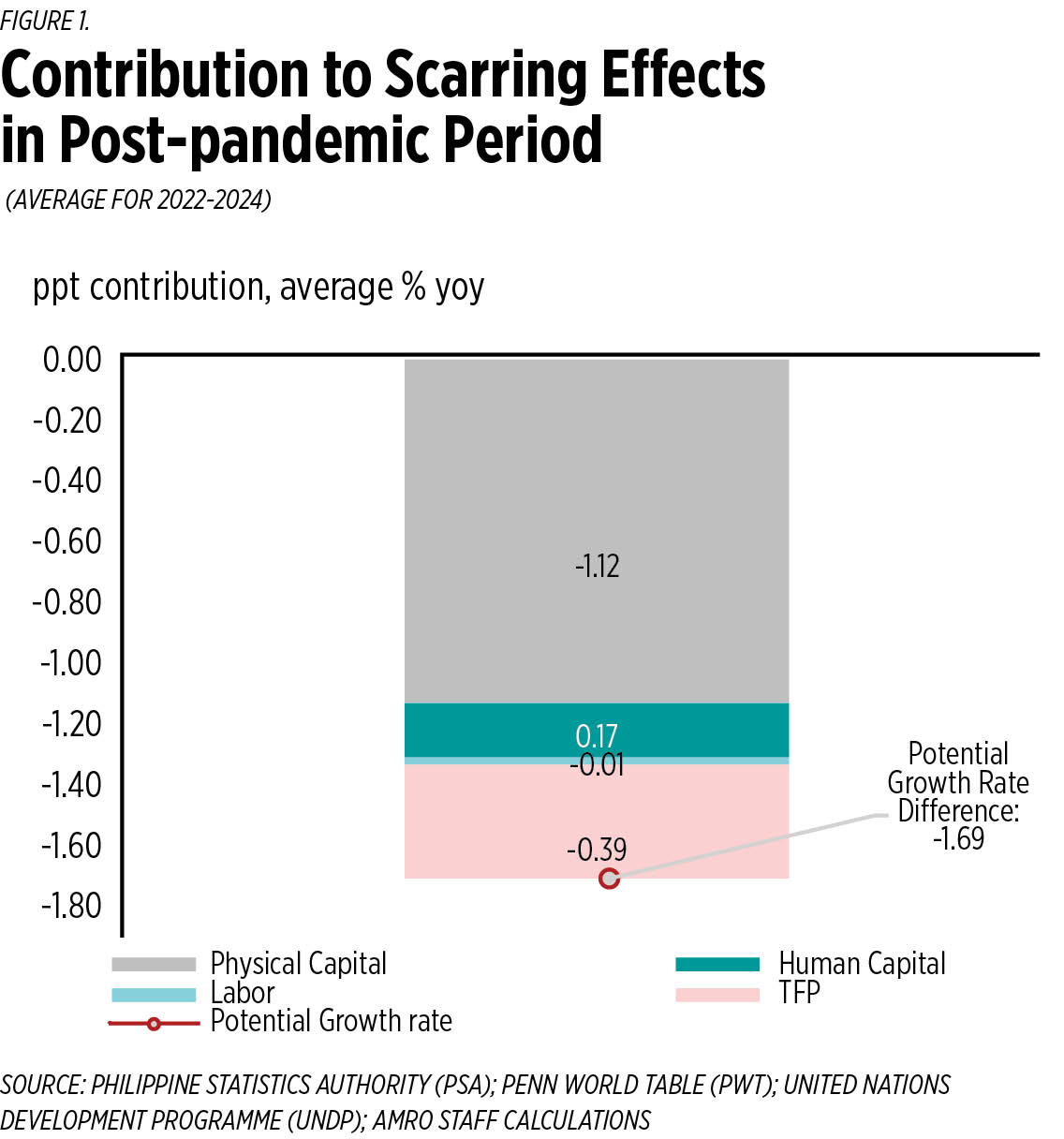
The Philippine economy experienced a drastic 9.5% contraction in 2020, triggered by the COVID-19 outbreak. Despite a strong rebound in economic activities since 2022, key segments including private investment and the performance of some industries such as accommodation, food services, and construction have yet to reach their pre-pandemic levels. AMRO’s latest estimates indicate that the pandemic’s scarring effects have lowered the country’s annual potential growth by an average of 1.69 percentage points for the 2022-2024 period (See the figure). About two-thirds of this decline (1.12 percentage point) is due to slower growth in physical capital. The remaining impact comes from weaker total factor productivity (TFP) — likely caused by temporary productivity drops, underutilization, and efficiency losses — as well as reduced human capital formation.

Among the different production factors of the Philippine economy, physical capital suffered the most from the pandemic due to sluggish growth in investment. Investment in the Philippines in 2020 plummeted by 34% from 2019, with modest recovery only in subsequent years. Many firms were left with weakened balance sheets due to losses incurred during the pandemic, further hampering and discouraging new investments.

Meanwhile, post-pandemic domestic infrastructure development is hindered by a challenging business environment, deficiencies in planning, coordination, and financing, as well as a decline in private-sector participation in infrastructure projects. The weak sentiment in private investment and foreign direct investment (FDI) has slowed the accumulation of capital stock.

The pandemic also reduced the TFP, which captures the efficiency and innovation in an economy. The decline is attributed to lower job quality and productivity, and ongoing structural challenges exacerbated by the pandemic. Lower job quality is reflected in the higher share of self-employment and unpaid family work, which remains at an elevated level of over 30% compared with the pre-pandemic period, although it has gradually improved in recent years.

The pandemic also has a significant impact on human capital formation. Growth in the Philippines’ human capital decelerated sharply in 2020-2021, primarily driven by prolonged school closures and lower returns on education during the pandemic. However, human capital growth is now slower than the pre-pandemic period, partly due to the high learning losses.

SECURING LONG-TERM GROWTH
In the pursuit of sustainable long-term growth, the Philippines should overcome the scarring effects of the pandemic through an increase in productive investment, productivity enhancement, and labor upskilling.

To help stimulate productive investment, the Philippines should focus on attracting more FDIs that emphasize technology and knowledge transfer. This can be achieved by enhancing infrastructure, reforming regulatory frameworks, fostering a competitive business environment, promoting digitalization and innovation, and developing a sustainable economy. Furthermore, it is imperative to introduce measures that help micro, small, and medium enterprises (MSMEs) restore their balance sheets and secure funding. Initiatives such as temporary loan restructuring incentives and the Philippine Open Finance Pilot have played a key role in improving financial access for MSMEs.

The government should also prioritize upgrading labor productivity and job quality by diversifying the economy and incentivizing investment in high-productivity sectors such as manufacturing, digital services, and agribusiness. This includes expanding the Technical Education and Skills Development Authority’s (TESDA) vocational training programs to focus on technology upgrade and digital skills. Collaboration between TESDA, industries, and educational institutions is crucial to align training with industry needs, ensuring a skilled workforce, and improving job placement opportunities for students post-training.

The scarring effects of the COVID-19 pandemic have posed unprecedented challenges to the Philippine economy, severely impacting its growth potential. Overcoming these long-term effects will depend on the country’s ability to implement effective investment and human capital policies. A comprehensive strategy — focused on digitalization, infrastructure investment, and sustainable economic development — will be crucial in enhancing competitiveness and advancing the Philippines toward its goal of achieving high-income status.


Dr. Andrew Tsang is AMRO’s country economist for the Philippines and backup economist for Cambodia. Dr. Tsang received his Ph.D. in Economics from the University of Hamburg. He also holds an M.Phil. in Economics and a Bachelor of Social Science in Economics; both from the Chinese University of Hong Kong.

Hiring startup PasaJob targets 10 million users by year’s end

IMAGE VIA PASAJOB

PASAJOB, a job referral platform, said it is looking to grow its user base to 10 million, touting its artificial intelligence (AI) technology to match jobseekers with prospective employers.

“For now, with our 2.5 million users, we’re very focused on Metro Manila. Part of our plan this year is to expand outside Metro Manila,” PasaJob CEO Eddie F. Ybañez told BusinessWorld, seeking new users in Cebu, Iloilo, Bacolod, and Davao.

PasaJob, in collaboration with electronic wallet provider GCash, offers a range of blue- and white-collar jobs across industries like retail, sales, and information technology-business process outsourcing.

The platform, known as GJobs, connects employers and job seekers through long-chain referrals. This is expected to address inefficiencies and mismatching in the talent marketplace.

Since its launch in 2023, GJobs has onboarded 2.5 million users, generating about 400,000 job applications and one million job referrals.

PasaJob is also looking to increase its partnerships with various employers to expand its job listings.

“Last year, our focus really was acquiring users as applicants or referrers. But now, we have doubled down in terms of reaching out to the partners on the other side — which are our employers,” Mr. Ybañez said.

The number of jobless increased to 1.63 million in December from 1.6 million a year earlier, the Philippine Statistics Authority reported.

GJobs allows job applications and profiles to be filed via the GCash app.

The platform’s long-chain referral system allows users to pass around job vacancies within their network. If a candidate gets hired, each participant in the referral line gets a portion of the referral fee.

PasaJob offers a minimum referral fee of P500 to motivate the network of referrers to actively promote job openings.

Applicants hired through the platform also get a hiring bonus of at least P500, according to Mr. Ybañez.

Companies may increase the hiring and referral fees at their own discretion. Rewards can be accessed via the My Wallet section of GCash.

Job referrals shorten the hiring period from 42 days to 29 days on average, with referred employees having 70% longer tenures than the others, PasaJob said in a statement.

PasaJob’s AI generates a “matching score” based on whether applicants’ credentials match the qualifications of the job applied for.

Likewise, the platform’s “invite to apply” option recommends users who have not applied but may fit a job opening.

“Because we value privacy, you cannot see the whole profile of the users that matched — all you can do as an employer is invite them to apply,” Mr. Ybañez said.

Employers can only access a user’s profile once they’ve applied for a job, he added.

The platform allows job applicants to conduct asynchronous interviews, with AI used to provide employers with a summary and transcript.

PasaJob is also looking to collaborate with organizations to integrate short courses into the GJobs platform, allowing users to earn a certificate or badge and increase their hireability.

“With our job platform built around smarter referrals, these enterprises can quickly find the talent they need and at scale,” Mr. Ybañez said. — Beatriz Marie D. Cruz