Home Blog Page 147

Yuchengco-led BKS energizes P1.8-B solar farm in Isabela

STOCK PHOTO | Image by jcomp from Freepik

YUCHENGCO-LED BKS Green Energy Corp. said it expects to supply electricity to around 33,000 households annually after energizing a 40-megawatt (MW) solar farm in San Pablo, Isabela.

In a statement on Wednesday, BKS Green said it has switched on its first renewable energy project in the Cagayan Valley, which can generate about 59 gigawatt-hours of clean energy per year.

The P1.8-billion solar power plant uses 52,640 solar photovoltaic panels supplied by Chinese manufacturer Trina Solar.

The project was developed in two phases: a 6-MW Phase 1, which is connected to the Isabela Electric Cooperative II system, and a 34-MW Phase 2, which will connect to the National Grid Corp. of the Philippines’ 69-kilovolt Tuguegarao-Cabagan line through a dedicated transmission line.

BKS Green is a subsidiary of Rizal Green Energy Corp., a joint venture between PetroGreen Energy Corp. and Japan’s Taisei Corp. PetroGreen is the renewable energy arm of listed PetroEnergy Resources Corp.

“The current Middle East conflict highlights once more the absolute necessity of securing our country’s energy supply and reducing our dependence on imported energy sources,” PetroGreen President and Chief Executive Officer Francisco G. Delfin, Jr. said.

The Department of Energy has certified the solar power project as an energy project of national significance due to its contribution to economic growth.

PetroGreen currently operates four utility-scale solar projects across Tarlac, Bohol, and Nueva Ecija. — Sheldeen Joy Talavera

SSS rolls out MySSS Card with EastWest Rural Bank

PHILSTAR FILE PHOTO

THE SOCIAL SECURITY SYSTEM (SSS) has partnered with East West Rural Bank, Inc. to expand the MySSS Card to underserved areas.

SSS President Robert Joseph M. de Claro and EastWest Rural Bank President Shiela Marasigan-Bajado signed a memorandum of agreement authorizing the bank to issue the card, which serves as both an official SSS ID and debit card, mainly for rural members while remaining accessible nationwide.

“The MySSS card also allows SSS to provide digital payment facilities for our registrants, members, pensioners and beneficiaries,” Mr. de Claro said in a statement on Wednesday.

The state pension fund uses the national ID database to verify membership and issues cards via partner banks, with benefits disbursed through linked accounts.

Ms. Bajado said the application process would be available at EastWest Rural Bank’s 112 branches and branch-lites nationwide this year, most of which are in Mindanao and the Visayas, and may also be offered digitally at cross-selling desks at EastWest Bank branches.

Cardholders will have waived maintaining balance requirements and can earn interest once balances reach P500, she added.

Launched in October 2025, the MySSS Card replaces the unified multi-purpose identification card and functions as a digital banking tool. — Aaron Michael C. Sy

On rising government bond rates, US public debt and war

Positive economic news is hard to find these days. Nonetheless I consider these reports in BusinessWorld as positive news, all published on March 17: “Slightly positive business sentiment signals ‘cautious optimism’ in the Philippines,” “House approves bill allowing Marcos to suspend or cut excise tax on fuel,” “Senate approves bill authorizing President to temporarily reduce or freeze fuel excise,” and “PHL in talks with China to obtain more fertilizer.”

I believe that the government should cut the various oil taxes under the Tax Reform for Acceleration and Inclusion (TRAIN) Act of 2017 (RA 10963), implemented in 2018-2020, which made the tax on diesel go from zero to P6/liter, gasoline from P4 to P10/liter, LPG from zero to P3/kilo, and so on.

Sure, revenue will decline slightly, but government has windfall revenues from higher VAT collection on oil products — while the VAT on P60/liter diesel will garner it P6.60/liter, VAT on P90/liter diesel will give the government P10.80/liter. That will help compensate for the temporary removal of the diesel excise tax of P6/liter.

Another measure is to have spending cuts on certain sectors and agencies, like climate and war-mongering agencies and departments.

Other sectors in the Philippines oppose an oil tax cut and prefer creating or expanding subsidies for public transportation. I do not support this because it creates sectoral favoritism. Tractors, harvesters, irrigation pumps, trucks, fishing boats, and other agri-fishery machinery also need subsidies and the government will ignore them under the current transportation subsidy scheme. If the government should subsidize, it should subsidize all or none at all. An oil tax cut coupled with a spending and subsidy cut somewhere is still the easiest to administer, and would be most fair to all.

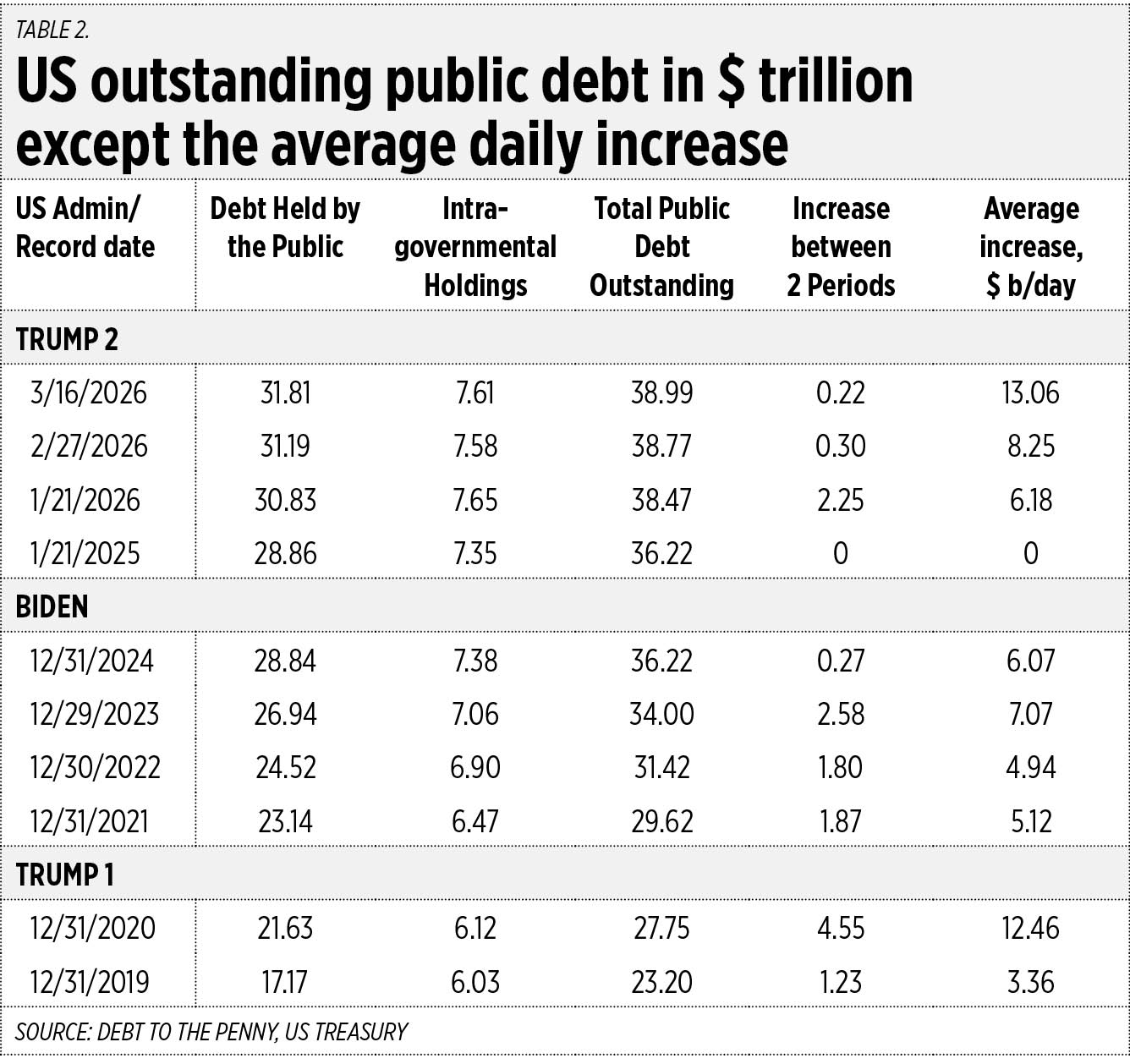
With these moves for either higher spending or cutting taxes, the yields on Philippine 10-year government bonds have spiked, from 5.92% on Feb. 27 (the day before Israel and the US attacked Iran) to 6.73% on March 17 — a 13.7% jump. Thailand has seen a higher expansion of 27% as it plans a huge oil subsidy via its Oil Fuel Fund. In Europe, the largest increase in 10-year bonds was that of Switzerland, from 0.20% to 0.33% yield (see Table 1).
Our outstanding public debt in 2025 was P18.05 trillion. Even if we do not borrow more in 2026, at a 6.7% average interest rate our public debt will rise to P19.26 trillion by end-2026 — the P1.21 trillion increase represents interest payment alone.

Hence, the need to confront the bloated spending problem. Tax revenues keep rising, but any gain or increase is quickly dissipated by increases in public spending. The various agencies, bureaucracies, and legislators have very fertile imaginations when it comes to expanding spending. We also need to do large-scale privatization of some government assets and corporations, like the Agus-Pulangi hydro plants in Mindanao.

We also need to embrace hydrocarbons and fossil fuels, not demonize them. We should encourage more exploration and development of indigenous oil, gas, and coal, and stop these “net zero” and “decarbonization” moves. The global energy transition now is from Middle East fossil fuels to fossil fuels from Russia, North America, Indonesia, etc.

Meanwhile, the US under President Donald Trump has gone crazy, embroiled in various wars, both actual and in preparation for. They have had a proxy war against Russia in Ukraine for more than four years now. They are engaged in a Middle East-wide war against Iran, and they are preparing for war against China over Taiwan and the South China Sea.

Wars are never cheap, they are costly, both in public finance, people’s lives, and property damage. I checked the numbers of US public debt — it is getting worse.

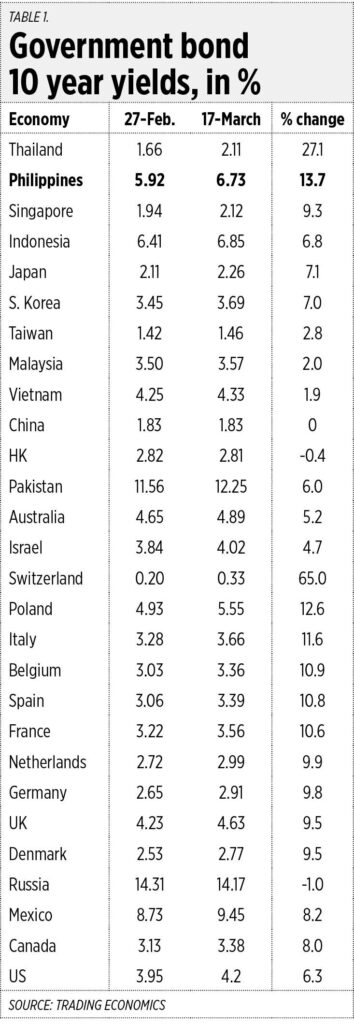
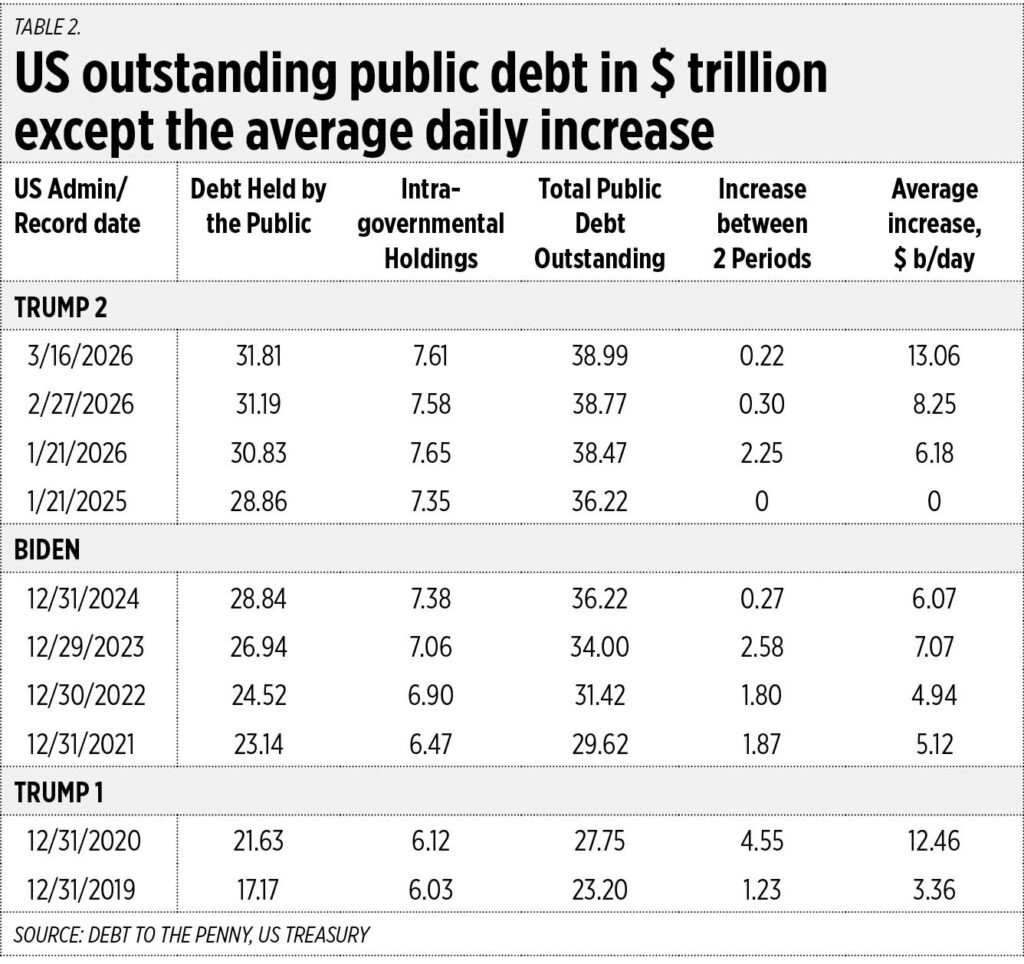
During the four years of the Biden administration, US public debt was rising by $2.12 trillion/year, or an average of $5.8 billion/day. During Trump’s first year, the debt increased by $2.25 trillion or $6.2 billion/day.

During war preparations against Iran, from Jan. 21 to Feb. 27, US debt was rising by $8.2 billion/day. Since the war started, debt has been rising by $13.1 billion/day. So, estimates of $1 billion/day spent on the Iran war alone may be understated (see Table 2).
Ending the current big war in the Middle East is the logical thing to do. But the US-Israel tandem is already embroiled, and Iran is already heavily damaged and will seek prolonged revenge. Then there has been some damage to seven Middle East countries that host US military bases or facilities.

The Philippines, as Chair of the ASEAN in 2026, should play a major role in pursuing peace and prosperity, at least in East Asia. It should focus more on trade and commerce, investments and tourism, and not war mongering. Peace and prosperity, not war and destruction.


Bienvenido S. Oplas, Jr. is the president of Bienvenido S. Oplas, Jr. Research Consultancy Services, and Minimal Government Thinkers. He is an international fellow of the Tholos Foundation.

minimalgovernment@gmail.com

Using traditional ingredients in modern ways

SCREEN GRAB from Seaweed Harvesters Risk Their Lives in the Philippines (Gamet) from FEATR’s YouTube channel. — YOUTUBE.COM/@FEATRMEDIA

HOW CAN ONE use traditional Filipino ingredients when following a modern lifestyle? That was a topic tackled by James Beard awardee Erwan Heussaff* and the team behind his digital video channel in a talk at the Maya Kitchen on March 14 called “The Not-So-Modern Filipino Pantry.”

In line with FEATR’s work, which features the creation and procurement of obscure Filipino ingredients and how to use them in the kitchen, they told a story using ingredients they had made already documentaries about: gamet, podpod, and pakaskas, among others.

These came in a small market bag thoughtfully provided by Featr so guests at the talk could see, feel, and taste these ingredients — and also featured some of them in a buffet lunch later in the day.

“Filipino food begins with geography,” Mr. Heussaff said, and they conveniently provided a brochure with a map showing how far-flung these ingredients can seem from the capital. Not only do the ingredients show the different flavors one can have on a Filipino plate, but the sheer diversity of ways of living in the Philippines.

For example, there’s gamet from Ilocos Norte and Cagayan Valley. Showing clips from their documentary, Mr. Heussaff explained that it is a local species of seaweed, and quite rare — it costs about P1,000 for one square foot, giving it the name “black gold.” There isn’t much gamet to go around in the country because of the sheer difficulty of collecting it: the seaweed is collected as it is thrown closer to shore by huge waves.

Pakaskas, meanwhile, is a sweetener that comes from the buri palm (the same one whose leaves are used for hats), and typically made in Isla Verde in Batangas. Podpod, meanwhile, is a smoked fish patty made in San Vicente in Eastern Samar. It is a labor-intensive process. The fish is cooked with rice, simmered in vinegar, deboned, skinned, crushed, seasoned, pressed into molds, then smoked over coconut husks.

“If you put the pressure on having to serve Filipino ingredients in traditional ways, the spectrum is too small (in) what you’re allowed and not allowed to do,” said Mr. Heussaff. That is why they used these ingredients in myriad of ways during the lunch: they used a kiping (a thin rice wafer best known for its use in decorations in Lucban, Quezon’s fiesta) as a chip to dip into an aioli that used gamet (coloring it purple), and used the podpod to flavor roasted cabbage.

“Filipino food is not just Filipino recipes. It’s also Filipino ingredients used in international recipes. Representation happens on so many different fronts. It’s really about building that ecosystem of representation,” he said.

“A lot of things can be true at the same time. You can enjoy eating Chickenjoy next to podpod. You don’t have to be one or the other. I think if you become a little too purist with your food and your ingredients, you also run the risk of being elitist, and also the food not moving forward, because it’s so difficult [to make].

“I always tell people: be flexible on how you eat. Be flexible in how you think about Filipino food,” he said. “You don’t want food to become pieces in a museum,” he added. “Food is an artifact of culture: but at the same time, it’s continuously evolving.”

Despite the laxity this philosophy provides, Mr. Heussaff still recommends further exploration. “I recommend everyone to go home today, look in your pantry, and then try to understand the geography of that pantry.

“If it only comes from one area; one supermarket: question it.” — Joseph L. Garcia

*Erwan Heussaff won in the Social Media Category of the James Beard Broadcast Media Awards in 2023.

Megawide order book climbs to P50B, driven by housing projects

MEGAWIDE.COM

MEGAWIDE Construction Corp. said its order book reached P50 billion last year, up 15% from a year earlier, driven mainly by residential project contracts.

“We are back to our comfortable level of around P50 billion, which will give us more revenue visibility over the medium term,” Megawide Chairman and Chief Executive Officer Edgar B. Saavedra said in a statement on Wednesday.

The company said the order book represents about three to four years’ worth of revenue and serves as an indicator of its construction segment’s performance.

Megawide said residential projects accounted for 35% of the total order book, followed by office and commercial projects at 28%, expanded Pambansang Pabahay Para sa Pilipino (4PH) projects at 23%, and infrastructure at 15%.

“More important, we want to highlight an emerging segment in our portfolio — the expanded 4PH — which we believe will provide a solid and sustainable pipeline as we aspire to build over 100,000 socialized housing units in the next five to seven years,” he said.

The expanded 4PH is a national government program aimed at delivering affordable housing.

Megawide said it expects to utilize unused capacity in its precast facility as it expands into the 4PH program, while also strengthening its traditional order book to support a steady revenue stream.

The company added that nearly half of the P23.4 billion in new contracts secured last year came from 4PH projects — Avesta, JAB, and Jenara Residences in Cavite — amounting to P10.7 billion.

Other new projects include Megaworld developments Uptown Modern and One Portwood worth P11 billion; the new passenger terminal building of Caticlan Airport valued at P1.6 billion; and solar power plants in Lucanin and Lumbangan from its affiliate Citicore Power, Inc. worth P270 million.

“On a broader scale, the company hopes that by sharing and adopting the technology, it can accelerate housing construction in the country and serve as a catalyst for modernizing the local industry,” it said.

Megawide said it plans to expand its precast capacity by setting up a new facility next year of similar size to support its growing 4PH order book.

Earlier, the company announced plans to redeem its maturing P1.5-billion Series 5 preferred shares on April 17.

“The redemption is part of our long-term financial management program. Already, we see substantial improvement in our debt levels this first quarter of 2026 and, combined with a healthy order book and reduction in preferred shares, can free up incremental cash flows. This will allow us to explore a shift in our dividend strategy to tap a broader shareholder base,” Mr. Saavedra said.

On Wednesday, shares in the company rose by four centavos, or 1.39%, to close at P2.92 each. — Ashley Erika O. Jose

FM Resilience Index: Philippines improves, but remains fourth least resilient among Southeast Asian nations

The Philippines climbed four places to 90th out of 130 countries and territories in the 2026 FM Resilience Index by commercial property insurance company FM Global. The index assesses a country or territory’s business environment resilience based on 18 equally weighted factors, including six physical factors and 12 macro factors. On a scale of 0 to 100, where 0 is the lowest resilience and 100 is the highest, the Philippines scored 48.92. It was the fourth least resilient compared with other Southeast Asian countries and territories.

7 Filipino AI startups head to GITEX AI Asia

COLLO

SEVEN FILIPINO startups developing artificial intelligence (AI)-driven solutions will showcase their technologies at GITEX AI Asia 2026 in Singapore, highlighting the Philippines’ growing presence in the global innovation space.

The firms span sectors from education and agriculture to property technology and disaster monitoring, reflecting a broader push to bring locally developed solutions to international markets, the Department of Science and Technology-Technology Application and Promotion Institute (DoST-TAPI) said in a statement on Wednesday.

GradeChum, developed by CodeChum Software Solutions, Inc., uses AI to evaluate handwritten and digital student assessments, reducing teachers’ workload while providing real-time insights.

Farmesto Technologies, Inc. combines AI and Internet of Things sensors to automate nutrient dosing, irrigation and climate control in greenhouses, helping farmers improve yields and resource use.

Duon Technologies, Inc. developed DUON Wayfinding, a real-time indoor navigation platform that lets users locate facilities in large buildings while generating foot-traffic data for businesses.

Also among the seven is Collo Property Technology Solutions, Inc., which offers a cloud-based system that automates tenant management, billing and collections for property operators.

Meanwhile, Cerebro provides an integrated platform for school administration and digital learning, supporting hybrid education systems for K-12 institutions.

GreenVisions delivers AI-driven farm diagnostics and monitoring tools designed to reduce costs and improve crop output through precision agriculture.

WEHLO Resilience Technology Corp. has developed a localized weather and environmental monitoring system aimed at improving disaster preparedness and climate-related decision-making.

The startups are backed by the Technology Application and Promotion Institute, the commercialization arm of the DoST, which supports innovators through intellectual property protection, pre-commercialization services and market linkages.

Their participation in GITEX AI Asia is supported under government programs including the Grants and Assistance to Leverage Innovations for National Growth, Technology Innovation and Commercialization program and Expanded Venture Financing program.

The showcase comes as the Philippines continues to improve its standing in global innovation rankings. In the Global Innovation Index 2025 released by the World Intellectual Property Organization, the country ranked 50th out of 139 economies and third among lower middle-income economies.

Other reports point to steady progress in the startup ecosystem. The Global Startup Ecosystem Index 2025 by StartupBlink cited continued growth, while the 2025 Global Startup Ecosystem Report by Startup Genome said the Philippines is transitioning from an emerging ecosystem to a growth-stage hub, particularly in fintech, artificial intelligence and sustainability.

The seven startups are scheduled to present at GITEX AI Asia 2026 on April 9 to 10 as part of efforts to expand the global reach of Philippine technologies and connect with international investors and partners. — Norman P. Aquino

From enforcement to insight: Modernizing data loss prevention for today’s threats

TRUSTPAIR.COM

By Bambi Escalante

ORGANIZATIONS today operate in an environment where data moves faster and farther than ever before. As digital transformation accelerates, many are rethinking how to secure sensitive information across complex cloud, SaaS (software as a service) and artificial intelligence (AI) ecosystems. Every transaction, collaboration and innovation depends on data that is constantly being accessed, shared and stored across multiple platforms. This has made data security a core element of business resilience rather than a back-end function.

Many organizations are now taking a more structured and strategic approach to protecting sensitive information, going beyond technology alone. Investments in insider risk management and data protection rose significantly last year, reflecting a stronger awareness among leaders of the need to safeguard their most valuable assets.

Despite this progress, data loss incidents continue to rise. The 2025 Data Security Report by Cybersecurity Insiders and Fortinet found that 77% of organizations worldwide experienced at least one insider-related incident in the past 18 months, with 58% reporting six or more. The same trend is evident in the Philippines, where insider threats ranked as the fourth-most common cyber-risk, according to a recent Fortinet-commissioned IDC study.

With higher budgets and smarter strategies already in motion, the question remains: Why does data loss continue to happen?

OUTGROWING OLD DEFENSES
The Cybersecurity Insiders and Fortinet report revealed that most organizations have increased their investments in insider risk management and data protection. Seventy-two percent raised their budgets last year, with more than a quarter implementing significant increases. However, despite these efforts, data loss incidents continue to cause substantial impact.

Almost half of the surveyed organizations experienced direct financial losses from insider-related incidents. Among them, 41% estimated damages ranging from $1 million to $10 million in their most significant case, while 9% reported losses of more than $10 million. The consequences extended beyond financial impact, with 43% citing reputational harm and 39% encountering operational disruptions.

The issue lies not in how much organizations invest, but in the tools many still rely on. Traditional data loss prevention (DLP) solutions were designed for an era when data resided largely within on-premises networks. Their primary role was to prevent regulated information such as credit card details, personal identifiers or medical records from leaving the organization. These tools focused on perimeter control and compliance, which worked when data stayed within defined boundaries.

Today’s reality is far more complex. Sensitive information now moves continuously across cloud infrastructures, SaaS platforms and AI-driven systems. Teams collaborate across borders, share intellectual property with partners and increasingly use AI tools to analyze and generate data. While these practices drive productivity and innovation, they also introduce new and often invisible data exposure risks.

Legacy data loss prevention tools struggle in this environment. Many lack visibility into how employees actually interact with sensitive data, particularly within SaaS and generative AI tools, and they often fail to distinguish between malicious activity and simple human error. Almost half of insider-related incidents stem from negligence rather than intent, yet traditional systems treat every event the same. These tools also operate in silos, with endpoint, e-mail and network data loss prevention rarely working together, making it difficult to connect events into a clear risk picture. In many cases, organizations wait weeks or even months before gaining meaningful insight from these deployments.

The result is a false sense of control: more alerts, but less clarity. In fast-moving, data-driven environments, that lack of context undermines resilience rather than strengthening it.

FROM ENFORCEMENT TO INSIGHT
Protecting data today requires more than enforcing static rules. It demands a deeper understanding of behavior and context, how people interact with information and why certain actions occur. Knowing that a file was shared is no longer enough. Security teams need to understand who shared it, whether the behavior is typical and if the activity represents genuine risk.

Modern data loss prevention solutions are designed to deliver this level of insight. By using behavioral analytics and contextual monitoring, they help distinguish mistakes from malicious intent and surface abnormal patterns early. Crucially, these platforms provide visibility from day one, enabling teams to see how sensitive data moves across users, applications and environments as soon as they are deployed.

As data flows beyond traditional perimeters into cloud services, SaaS applications and AI platforms, advanced data loss prevention solutions help close visibility gaps by correlating activity across channels. This transforms isolated events into coherent risk narratives, allowing security teams to prioritize what truly matters and respond with confidence.

A strong example of this approach is the unification of data loss prevention with insider risk management to deliver real-time, behavior-aware visibility across endpoints, cloud, SaaS, and AI environments. Fortinet enables this through FortiDLP and the Fortinet Security Fabric, which integrate identity, access and activity data to help prevent small mistakes from escalating into costly breaches.

DATA LOSS PREVENTION FOR THE MODERN ERA
Despite stronger security strategies and increased executive support, many organizations continue to experience damaging insider incidents. A key reason is continued reliance on legacy data loss prevention tools that were never designed for today’s distributed, cloud-first environments and often add complexity without delivering clarity.

As data protection programs evolve, real progress will come from adopting platforms that deliver insight and understanding, not just alerts. Moving from enforcement to intelligence-driven data protection is essential to building resilience, maintaining trust and enabling secure growth in an increasingly connected digital economy.


Bambi Escalante is the country manager at Fortinet Philippines.

IC joins agencies to boost insurance cybersecurity

REUTERS

THE INSURANCE COMMISSION (IC) has partnered with five government agencies to strengthen cybersecurity in the insurance sector.

On March 16, the IC signed a memorandum of agreement with the Bureau of the Treasury, Social Security System, Government Service Insurance System, Philippine Deposit Insurance Corp. and Land Bank of the Philippines (LANDBANK), it said in a statement on Wednesday.

The collaboration aims to improve detection, prevention and response to cyberthreats through advanced monitoring, enhanced analytics and stronger security controls.

Finance Secretary Frederick D. Go said the initiative protects Filipinos’ savings, supports sector stability and reinforces public trust in insurance as a financial security tool.

LANDBANK will serve as procurement agent, handling bidding and acquisition of the cyber-defense solution.

Participating agencies will form a joint technical working group to set requirements and oversee implementation, and an interagency oversight committee of chief information officers and information technology security officials will monitor developments and recommend safeguards.

“Cybersecurity is a critical component of institutional resilience in today’s increasingly digital environment,” IC Commissioner Reynaldo A. Regalado said in the statement. “Through this collaboration, the Insurance Commission is strengthening its capacity to protect critical systems and safeguard sensitive information against evolving cyberthreats,” said. — Aaron Michael C. Sy

Taking a bow

STOCK PHOTO | Image from Freepik

TAKING A BOW after a public performance, and before an audience, is usually expected. This is an occasion for others to show appreciation for a public feat, like a long speech before a crowd, even one that has been given incentives to wildly show their approval. The loud accolade can be a disguised sigh of relief that the long ordeal of pretending to be mesmerized is over.

Competition in talent contests even requires the audience to vote with their applause and choose the best performance staged before them. The judges still have the final say on when to push the buzzer of approval.

College athletes too stand before their school’s cheering crowd to hear the alma mater song as they bathe in the applause and love of supporters after a victory. Even in a defeat, especially if a close one where the last shot to win the game is missed, there is some acknowledgement of appreciation. The losing team gets to weep in public as players simultaneously raise their arms and wipe their tears at the school song.

In the healthcare arena, doctors and nurses do not feel the need to take a bow for a successful procedure. This is done quietly when visiting the recovering patient in his room. A few questions are enough to complete the performance. (Do you feel any pain?) Only when the bill is presented can the patient applaud the doctors involved. (Were there really eight?) There is no need to take a bow.

What about karaoke evenings with friends? Here, there is an unwritten rule not to hog the mike. The audience also happens to be the performing group. They are waiting for their turn after chugging down two beers. Does the singer take a bow? (You want me to do “My way” again?) Please pass the mike to the next belter — “Let me try again?”

Theater has a tradition at the end of the play to call back the performers to take their bow. This allows the audience to show appreciation with standing ovations and prolonged applause, with shouts of “bravo.” Even the sequence of onstage entrances is preordained. The “extras” come on stage first and receive polite applause. Then it’s the supporting cast, building up to the main stars. The applause builds up to a crescendo as the main star enters the stage and holds hands with the front row cast to take her bow.

The number of curtain calls signifies the success of the performance when the exiting artist is called back to take yet another bow and sometimes accommodates the audience with an encore number. (The audience can sing along at this point.)

Movies in the end credits sometimes employ this device to show the actor and his role or to splice together bloopers and outtakes. The movies of Marvel uses the rolling end credits to introduce sequels, a nasty device that early moviegoers miss when they leave the theater thinking there’s nothing more to see but the name of the caterers and hairdressers.

The curtain call’s equivalent in corporate life is the “despedida party.” This quaint event honors a departing colleague and thus displays some of the curtain call’s theater tradition. Still, unless the retiree is off to a well-deserved mandatory retirement and migrating to Spain after discovering ancestors with the required racial credentials, the manner of exit can be more quietly observed. (Sir, no need to take a bow.)

Throughout a career, there is the constant opportunity to take a bow for a job well done. The rating system which determines promotions and the level of variable pay depends on who gets the credit for the delivered targets.

There is sometimes the issue of determining who really deserves the credit. And it is not always the one who struts on the stage waving at the audience, even if he’s making a full bow from the waist.

The desire for applause is not universal. Taking a bow is a ritual more than a requirement of social graces. There are those who prefer to work behind the scenes and keep their financial successes quiet. After all, the response may not be applause, but envy… and a possible investigation.


Tony Samson is chairman and CEO of TOUCH xda.

ar.samson@yahoo.com

Dining In/Out (03/19/26)


Mang Inasal holds halo-halo blowout

ON MARCH 22 and 29, Mang Inasal is treating all its customers to a marked down 12 oz Mang Inasal Extra Creamy Halo-Halo. On March 22, customers can visit any of the over 600 Mang Inasal stores nationwide and enjoy the discounted halo-halo for P39, exclusively for dine-in and take-out clients. On March 29, customers can order the treat via the new Mang Inasal app, Grab Food, and foodpanda and get it for P49. The Mang Inasal National Halo-Halo Blowout is an annual activity that serves as the company’s gesture of appreciation for its customers who have made the Extra Creamy Halo-Halo a leader in its category. Mang Inasal recently added milk dusting to its halo-halo for longer lasting creaminess. It also improved the look and features of its take-out and delivery cups. This is part of the #MangInasalCREAMINESS campaign for summer.


Krispy Kreme marks 20 years with churros, fruit teas

KRISPY KREME Philippines is celebrating its 20th anniversary by bringing back an OG favorite and introducing new beverages. Among this year’s highlights is the relaunch of the Mini Churros with Dips, a twist on the classic churro. Each C-shaped, unglazed mini ring doughnut is tossed in a cinnamon-sugar mix. A box of six includes 12 Mini Churro Doughnuts and three dips: Dark Chocolate, White Chocolate, and the new Dulce de Leche. Meanwhile, this summer they are introducing two Freshly Brewed Fruit Teas, made with Assam black tea. The collection features Tropical Mango (made with mango puree) and Strawberry Hibiscus (strawberry puree, a hint of hibiscus, topped with chopped dried strawberries). The Mini Churros with dips and Freshly Brewed Fruit Teas are now available until May 31. Get the Mini Churros with dips nationwide starting at P349 per box of 12 doughnuts, in limited quantities per store. Enjoy the Freshly Brewed Fruit teas at select stores starting at P109, available for dine-in, take-out, drive-through, and delivery.


Jollibee launches new Super Meal

JOLLIBEE has introduced a new Super Meal that brings several of its bestselling products together in one serving. The new Super Meal A features Chickenjoy, Jolly Spaghetti, and Yumburger, served with steamed rice and a drink, all for P185, as the lowest-priced option in the big meals category. Super Meal B pairs Chickenjoy and Jolly Spaghetti with regular Jolly Crispy Fries, rice, and a drink. Meanwhile, Super Meal C features Chickenjoy, Jolly Spaghetti, and a Burger Steak, served with rice and a drink. The new Super Meals are now available in all Jollibee stores nationwide, via dine-in, takeout, drive-through, and delivery.

SEC cancels Dual Fuel registration over investment solicitation

BW FILE PHOTO

THE Securities and Exchange Commission (SEC) has canceled the certificate of incorporation of Dual Fuel Petroleum Corp. over what it described as the illegal solicitation of investments from the public.

In an order dated Feb. 17, the SEC’s Enforcement and Investor Protection Department (EIPD) said it revoked the company’s registration for violating Section 44 of Republic Act (RA) No. 11232, or the Revised Corporation Code of the Philippines (RCC); Sections 8.1, 26.1, and 28.1 of RA No. 8799, or the Securities Regulation Code (SRC); and Presidential Decree No. 902-A.

The RCC prohibits corporations from exercising powers beyond those stated in their articles of incorporation (AoI).

Sections 8.1 and 28.1 of the SRC prohibit the sale or offering of unregistered securities and require brokers, dealers, or salespersons to register, while Section 26.1 prohibits fraudulent schemes in securities transactions.

Dual Fuel Petroleum, which was incorporated in 2020, is engaged in the establishment, operation, management, and maintenance of gas stations, with franchising listed as a secondary purpose in its AoI. The company is not authorized to solicit investments from the public or issue investment contracts.

The SEC said its investigation found that the company offered securities in the form of investment contracts without the required licenses.

“Considering that nowhere is it stated in its primary purpose that Dual Fuel Petroleum is authorized to engage in the selling or offering for sale of securities to the public… the activity of [the company] of selling or offering for sale of investments is considered an ultra vires act and therefore constitutes serious misrepresentation,” the order read.

The SEC also imposed a P1-million fine on the company for offering securities without the required registration or license. Its incorporators were also ordered to pay a P1-million administrative fine.

The SEC said Dual Fuel partnered with Legends Petroleum Corp., a franchising company, to attract public investment by offering franchise co-ownership with a minimum investment of P500,000 and promising quarterly profits for 20 years. The company offered 280 co-owner slots across eight gas stations.

The regulator said the scheme constituted fraud and resembled a Ponzi operation, in which returns to investors were derived from funds contributed by new investors or additional contributions from existing ones rather than from legitimate business activities.

Dual Fuel did not immediately reply to an e-mail seeking comment. — Alexandria Grace C. Magno

ADVERTISEMENT
ADVERTISEMENT