Home Blog Page 1447

On trade expansion and fiscal consolidation
The US tariff escalation policy generated heavy public discussions and fears last April, but these have simmered down recently. There are winners and losers in the non-disruption in trade, and there are also winners and losers in trade disruption. In conventional economic trade theory, there is “net gain” (gainers and winners outnumber losers) in free trade which at the optimum implies zero tariffs and very few non-tariff barriers.

Last Tuesday, June 10, I attended a forum called “The US-China Tariff Trade War: Implications for the Philippines” at the AIM Conference Center in Makati, organized by Leverage International (Consultants), Inc. Among the panelists were Mike Toledo, Chair of the Chamber of Mines of the Philippines; Dr. Jess Arranza, Chair of the Federation of Philippine Industries; and Ruth Yu Owen, Chair of the Energy Committee of the Management Association of the Philippines. Jose Luis Yulo was the forum chairman and moderator.

I liked Mr. Toledo’s discussions on the mining export ban and the need for mining processing after a 10 year transition and preparation period, Metro Pacific Investments Corp.’s corporate farming, and Terra Solar projects; Mr. Arranza’s talk about the economic damage caused by smuggling and illicit trade on Philippines industries; and Ms. Owen’s talk on solar energy where she also recognized the need for coal and gas plants for baseload power generation.

Later in the afternoon, my former boss (and former Congressman, and former Finance Secretary) Gary Teves talked about macroeconomics and trade and he emphasized that we should focus on measures where we have control, like our own economic and trade policies, and not on events and policies abroad over which we have little control. I support that.

Then Congressman Joey Salceda talked about “Ruthless Ricardianism,” referring to David Ricardo’s theory of comparative advantage, but now in the context of the “ruthlessness” of a trade and tariff war. As usual he produced a lot of numbers and finance-related policy measures.

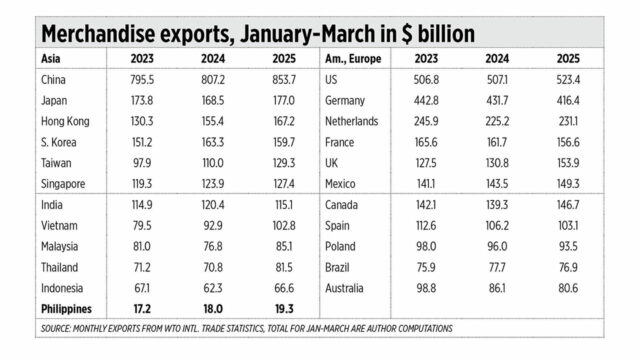
During the open forum, I briefly commented that when I checked the monthly trade data from the World Trade Organization (WTO), China, which is supposed to suffer a decline in exports actually experienced an expansion in exports.

Looking at the comparative January to April period, China’s exports increased from $1.084 trillion in 2023 to $1.10 trillion in 2024, and $1.169 trillion in 2025. In particular, their exports increased from $288.1 billion in April 2023, to $291.9 billion in April 2024, and $315.7 billion in April 2025.

In the accompanying table are the total exports for the first quarter of this year (many countries have not reported their April 2025 data yet). Like China, Hong Kong, Taiwan, Thailand, Vietnam, and Singapore also experienced a sustained increase in exports, as did the Philippines but with a very small margin increase. The US, UK, and Mexico also showed marginal increases.

In contrast, many countries experienced a decline in exports, or remained steady, neither increasing or declining: Japan, South Korea, India, Malaysia, Germany, the Netherlands, France, Spain, Poland, Brazil, Canada, and Australia (see the table).

PHILIPPINES’ FISCAL CONSOLIDATION
Last Monday, June 9, the economic team held a big Investment Coordination Committee-Cabinet Committee (ICC-CC) meeting at the Department of Finance (DoF). Finance Secretary Ralph G. Recto, as ICC-CC Chairperson, led the deliberations on the proposed and modified Official Development Assistance (ODA) and Public-Private Partnership (PPP) projects submitted for the committee’s approval.

Also present were Economics Secretary and ICC-CC Co-Chairperson Arsenio M. Balisacan, Department of Budget and Management (DBM) Secretary Amenah F. Pangandaman and Undersecretary Joselito R. Basilio, Trade Secretary Ma. Cristina A. Roque, Agriculture Secretary Francisco P. Tiu Laurel, Jr., Public Works Secretary Manuel M. Bonoan, Monetary Board member Romeo L. Bernardo, and PPP Executive Director Ma. Cynthia C. Hernandez, among other government officials.

For me, fiscal consolidation implies a reduction in certain spending and an expansion in revenues, tax and non-tax revenues so that the annual budget deficit and public borrowings can be controlled. Having more PPP infrastructure projects and less ODA is a good way to attain fiscal discipline and consolidation.

Last week, on June 4, the Government Optimization Bill, formerly called National Government Rightsizing Program was passed and ratified by the Bicameral Committee and now awaits the President’s signature. DBM Secretary Pangandaman was understandably happy with this development as the soon-to-be law will create a more efficient and responsive government.

Three weeks ago, on May 21, I was one of several NGO leaders invited by the DBM for the “Macroeconomic Insights for National Action: An Economic Dialogue with Civil Society” held at Luxent Hotel in Quezon City. While one transport NGO leader proposed another oil tax to discourage car usage and to shift more people to using bicycles and the mass transport system, I spoke to disagree because of the inflationary impact of any energy tax hike.


Bienvenido S. Oplas, Jr. is the president of Bienvenido S. Oplas, Jr. Research Consultancy Services, and Minimal Government Thinkers. He is an international fellow of the Tholos Foundation.


minimalgovernment@gmail.com

Vistamalls Q1 net income falls 15% on lower rental revenue

VISTAMALLS.COM.PH

VILLAR-LED Vistamalls, Inc. reported a 15% decline in its first-quarter net income to P1.91 billion from P2.25 billion a year earlier, weighed down by lower rental revenue.

In a regulatory filing, the company said its total revenue fell by 12.1% to P3.25 billion from P3.69 billion in the same period last year.

Rental income dropped by 7% to P3.16 billion from P3.4 billion, primarily due to lower rental payments from tenants.

Other operating income declined by 71% to P85 million, attributed to lower administrative fees and mall maintenance and advertising charges to tenants.

Total costs and expenses rose by 7% to P740 million, driven by higher depreciation and operating expenses.

Vistamalls is a holding firm engaged in the leasing of retail malls and business process outsourcing commercial centers.

Shares of Vistamalls dropped by 1.65% or three centavos to P1.79 apiece on Wednesday. — Revin Mikhael D. Ochave

Labubu human-sized figure sells for over $150,000 at Beijing auction

STOCK PHOTO | Image by David Kristianto from Unsplash

BEIJING/SHANGHAI — A Beijing auction house sold a human-sized Labubu figure for 1.08 million yuan ($150,275.51) on Tuesday, setting a new record for the “blind box” toy as it moves from craze to collectible.

The event held by Yongle International Auction, which traditionally specializes in modern art as well as jewelry, marked the first ever auction dedicated to Labubu, toothy monster figurines that are mainly sold by China’s toy company Pop Mart and have been at the center of a global frenzy for the past year.

The auction offered 48 lots for sale and was attended in person by roughly 200 people, while over a thousand bidders put down offers via Yongle’s mobile app, the auction house said. The starting price for all the items was zero and it eventually raised a total of 3.73 million yuan.

The highest grossing item, a mint green, 131 cm (4.3 feet) tall Labubu figure, received several bids to sell for 1.08 million yuan. The auctioneer said it was the only one available in the world.

A set of three Labubu sculptures, about 40 cm tall and made of PVC material, sold for 510,000 yuan. The set, from a series called “Three Wise Labubu,” was limited to a run of 120 sets in 2017 and another one sold for HK$203,200 ($25,889.64) at Sotheby’s most recent auction in Hong Kong.

Labubu was created a decade ago by Hong Kong artist and illustrator Kasing Lung. In 2019, Lung agreed to let them be sold by Pop Mart, a Chinese toy company that markets collectible figurines often sold in “blind boxes.”

A buyer of a blind box toy does not know exactly what design they will receive until they open the packaging. The starting price for Labubu blind box toys sold in Pop Mart’s stores is around 50 yuan.

The character’s popularity skyrocketed after Lisa of the Korean pop music group Blackpink was spotted with a Labubu and praised the doll in interviews and online posts. Many celebrities followed. In May, British football star David Beckham shared a photo on Instagram of his Labubu attached to a bag.

One Yongle auction bidder, a restaurant owner who only gave her surname as Du, said she had planned to spend a maximum of 20,000 yuan but walked away empty handed as the final prices were too high.

“My child likes it so every time when Labubu released new products we will buy one or two items. It is hard to explain its popularity but it must have moved this generation,” she said. — Reuters

IBM aims for quantum computer in 2029, lays out road map for larger systems

IBM FACEBOOK PAGE

SAN FRANCISCO — International Business Machines (IBM) on Tuesday said it plans to have a practical quantum computer by 2029, and it laid out the detailed steps the company will take to get there.

Quantum computers tap into quantum mechanics to solve problems that would take classical computers thousands of years or more. But existing quantum computers must dedicate so much of their computing power to fixing errors that they are not, on net, faster than classical computers.

IBM, which also said it aims to have a much larger system by 2033, plans to build the “Starling” quantum computer at a data center under construction in Poughkeepsie, New York, and said it will have about 200 logical qubits. Qubits are the fundamental unit of quantum computing, and 200 qubits would be enough to start showing advantages over classical computers.

IBM is chasing quantum computing alongside other tech giants such as Microsoft, Alphabet’s Google and Amazon.com, as well as a range of startups that have raised hundreds of millions of dollars in capital.

All of them are tackling the same basic problem: Qubits are fast but produce a lot of errors. Scientists can use some of a machine’s qubits to correct those errors, but need to have enough left over for doing useful work.

IBM changed its approach to that problem in 2019 and says it believes it has landed on a new algorithm that will drastically reduce the number of qubits needed in error correction.

In an interview, Jay Gambetta, the vice president in charge of IBM’s quantum initiative, said the company’s researchers took a different tack than they had historically, when they would work out the scientific theory of an error-correction method and then try to build a chip to match that theory.

Instead, IBM’s quantum team looked at which chips were practical to build and then came up with an error-correction approach based on those chips. That has given IBM confidence to build a series of systems in between this year and 2027 that will eventually result in larger systems.

“We’ve answered those science questions. You don’t need a miracle now,” Mr. Gambetta said. “Now you need a grand challenge in engineering. There’s no reinvention of tools or anything like that.” — Reuters

PSBank offers personal loan

PHILSTAR FILE PHOTO

PHILIPPINE Savings Bank (PSBank) is offering a personal loan product with flexible payment options.

PSBank’s Flexi Personal Loan allows customers to borrow up to P250,000 through two options, namely a revolving credit line or a fixed-term loan.

“Whether it’s surprise home repairs, tuition fees, or emergency medical bills, unexpected expenses don’t have to hold you back. With PSBank’s Flexi Personal Loan, you’ve got a financial backup that’s ready to use when you need it,” the thrift banking arm of Metropolitan Bank & Trust Co. said in a statement.

“With a revolving credit line, you can borrow, repay, and borrow again — no need to reapply. If you prefer steady monthly payments, a fixed term or deferred loan gives you repayment options of 24 or 36 months with fixed monthly installments,” it said.

Borrowed funds can be accessed via a free automated teller machine (ATM) card through any Mastercard-affiliated ATM worldwide. 

Payments can be made through PSBank Mobile, PSBank Online, or over the counter at PSBank branches. Clients can also pay at 7-Eleven Stores, BancNet ATMs, through InstaPay and via online bills payment services.

Borrowers can track and manage their loan through the bank’s mobile application.

PSBank also presented a Prime Rebate program as an add-on for the Flexi Personal Loan to help borrowers save on interest charges when they make payments. “Rebates are computed daily and automatically applied to qualified term loans — rewarding you for paying early or more than the minimum due.”

Borrowers can use the bank’s Loan Calculator and pre-qualification checklist to see how much they can borrow. Interested borrowers can apply via PSBank Online or at its branches.

PSBank booked a net income of P1.21 billion in the first quarter, inching up from P1.204 billion a year prior.

Its shares went down by 45 centavos or 0.77% to close at P58.10 apiece on Wednesday. — A.M.C. Sy

Analyzing the past

STOCK PHOTO | Image from Freepik

IN THE LAST ELECTIONS, with some surprise winners and losers, political analysts and self-proclaimed experts of all stripes came out of the woodwork to explain what happened. It’s a tradition in the field of personal contests to extract lessons on what went wrong or right. The pre-election polls now seem to be discredited as predictive tools after exposing their erroneous listings of winners and losers in the contest.

In his 2012 book Antifragile: Things that gain from Disorder, author Nassim Nicholas Taleb dismisses the notion of planning for the future based on analyzing the past. Such an approach is what he calls “postdiction,” which he considers an idle and irrelevant meditation on what already happened. Prediction, on the other hand, should deal with the future.

Events are no longer linear and what happened before will not necessarily happen again even in some modified form. In a discontinuous world, old trends seldom repeat themselves. Even the alliances and personalities can change.

Is hindsight completely useless? Doesn’t a good driver need both the windshield and the rearview mirror to maneuver through traffic? Let’s not forget the side mirror for those overtaking motorcycles.

In a murder mystery, hindsight solves the puzzle. The story opens with a corpse. From here, our trusty detective tries to reconstruct the victim’s life and how he died. This leads him to look at motives, activities, rivalries, and possible suspects around the victim.

The postmortem (or “after death”) is a favorite approach in the murder mystery. The autopsy provides details of how death occurred (trajectory of the knife, choke marks on the neck, dinner residue in the stomach) and even how it might have taken place.

Basketball coaches study videos of defeats to analyze what went wrong. A blowout in the first quarter leaving a team behind by 20 points can be an occasion to take to task the players responsible for turnovers, weak defensive plays allowing easy points, or poor shooting by the starters. (Why do you keep hoisting the low-percentage perimeter shots?) The adjustments in player rotation and game plans are results of studying the past game. The lessons are learned, and adjustments are made. Do winners also review tapes to check how well they did?

In the MBA using the case-method for discussion and analysis, the hindsight approach is also dominant. The postmortem of the corporate corpse (or near-corpse) provides the points for discussion. A real company and its woes are presented for analysis to understand the dynamics of decision-making and priority-setting in a crisis.

Management theories are applied to the facts of the case. The corporate situation, however, is sanitized to exclude extraneous forces like family affiliations, favoritism, political machinations, and the envy of peers. Such details are considered irrelevant in the academic exercise… but not in real life.

In any corporate planning session, the starting point seems to be past numbers. The facilitator steps back and plays detective with what happened the year before, perhaps also looking for suspects. (Do we need a succession plan?) The “situation analysis” starts the ball rolling in determining future moves.

Using hindsight in electoral analysis may still be useful in spotting socio-political trends such as the impact of feuding groups, endorsements of a religious sect, the rise of social media in influencing opinion, the lessening advantage of celebrity status, the waning influence of traditional media except perhaps billboards, and the growing number of young voters.

Those who read history will insist that it has lessons to teach us even in modern times. The rise of a dictator and his well-defined personality as a hate-spewing leader that launches attacks on minority groups, erodes freedom of expression, and picks fights with other countries can be valuable takeaways in dealing with the present.

Using hindsight to determine future strategy tends to select trends that support preconceived ideas (or obsessions). This selective bias tends to promote pet theories and conspiracies already held for a long time.

An undue reliance on hindsight and what went wrong (or right) can overlook what events to prepare for, especially in a discontinuous future with trends and surprises not yet encountered before… like a flock of black swans.


Tony Samson is chairman and CEO of TOUCH xda

ar.samson@yahoo.com

Transmission rates up in May on higher ancillary charges

PHILIPPINE STAR/MICHAEL VARCAS

TRANSMISSION charges for May, which will appear in June electricity bills, increased due to higher ancillary service (AS) charges, the National Grid Corp. of the Philippines (NGCP) said.

In a statement on Wednesday, NGCP said overall transmission rates increased by 4.6% month on month to P1.1482 per kilowatt-hour (kWh).

AS charges rose by 9.29% to P0.5655 per kWh.

Ancillary services are deployed by grid operators to support the transmission of power from generators to consumers and to maintain reliable operations.

These are pass-through charges billed by the grid operator and remitted directly to generation companies.

“As a pass-through cost, AS rates are only collected by NGCP and remitted directly to generation companies,” the grid operator said.

Transmission wheeling rates — or what NGCP charges for its primary service of delivering electricity — declined by 0.27% to P0.4593 per kWh.

Transmission charges reflect the cost of delivering electricity from power generators to the distribution system. — Sheldeen Joy Talavera

Striking Hollywood video game actors reach tentative agreement with studios

STOCK PHOTO | Image by Peter Thomas from Pixabay

LOS ANGELES — Hollywood video game voice and motion capture actors and video game studios reached a tentative agreement on Monday with new conditions for the interactive media contract, pending review from the actor guild’s national board.

A press release from Screen Actors Guild-American Federation of Television and Radio Artists (SAG-AFTRA) detailed the deal following the almost year-long strike centered on artificial intelligence (AI) protections and wage increase.

SAG-AFTRA has pending agreements with Activision Productions, Inc., Blindlight LLC, Disney Character Voices, Inc., Electronic Arts Productions, Inc., Epic Games, Inc., Formosa Interactive LLC, Insomniac Games, Inc., Take 2 Productions, Inc., and WB Games, Inc. after striking since July 2024.

After the strike began, the guild filed an unfair labor practice charge in 2024 and added the company Formosa Interactive to the list of studios for work stoppage.

Formosa provides voiceover services for the popular online game League of Legends.

“Patience and persistence has resulted in a deal that puts in place the necessary AI guardrails that defend performers’ livelihoods in the AI age, alongside other important gains,” SAG-AFTRA National Executive Director Duncan Crabtree-Ireland said in the press release.

The guild said until the official agreement is made, video game actors will remain on strike against these employers.

The work stoppage of video game voice actors and motion-capture performers started following failed contract negotiations focused around AI-related protections for workers, bringing about another work stoppage in Hollywood following the dual writers’ and actors’ strikes in 2023.

The strike brings with it a larger call to action across Hollywood as people in the industry advocate for a law that can protect them from AI risks as well.

The NO FAKES Act, a bipartisan bill in Congress which would make it illegal to make an AI replica of someone’s likeness and voice without their permission, has gained support from the SAG-AFTRA performers union, the Motion Picture Association, The Recording Academy, and Disney. — Reuters

Philippines worsens in Financial Secrecy Index

The Philippines rose* seven spots to 65th out of 141 jurisdictions in the 2025 edition of the Financial Secrecy Index (FSI) by Tax Justice Network. The Philippines got an FSI value of 173, the second lowest among its peers in the East and Southeast Asian region. The index evaluates and ranks jurisdictions most complicit in helping individuals to hide their finances from the rule of law.

Philippines worsens in Financial Secrecy Index

How PSEi member stocks performed — June 11, 2025

Here’s a quick glance at how PSEi stocks fared on Wednesday, June 11, 2025.


House wants Senate to clarify ‘unclear’ order to remand VP impeachment case

VICE-PRESIDENT SARA DUTERTE-CARPIO FACEBOOK PAGE

CONGRESSMEN-PROSECUTORS want the Senate to clarify its decision to return the impeachment complaint against Vice-President (VP) Sara Duterte-Carpio to the House of Representative.

The prosecutors will draft a motion to seek clarification from senator-judges about their order to “remand” the impeachment complaint against Ms. Duterte, who is facing a trial that could end her political career.

“The prosecution panel sees the impeachment court order last night somewhat unclear,” Batangas Rep. Gerville R. Luistro, a House prosecutor, told a news briefing in mixed English and Filipino on Wednesday. “So we have decided to seek clarification from the impeachment court.”

“With respect to the… certification of our compliance with the Constitution in filing the impeachment complaint, we stand by our position — we fully and strictly adhered to the constitutional requirements,” she added.

More than 200 congressmen signed the impeachment complaint against the Vice-President, who was accused of secret fund misuse, unexplained wealth, acts of destabilization and plotting the assassination of President Ferdinand R. Marcos, Jr., his wife and the Speaker.

Ms. Duterte has denied any wrongdoing.

Ms. Duterte’s impeachment at the House should not be questioned by senator-judges, because it “enjoys a presumption of legality,” Ms. Luistro said.

She cited the ruling of then Presiding Judge and Senator Juan Ponce Enrile during the impeachment trial of the late Chief Justice Renato C. Corona in 2011.

“He stated in the resolution that when the two basic requirements are met — namely, the signature of at least one-third of all House members and the verification — the filing of the impeachment complaint already carries a presumption of legality and can no longer be questioned, unless there is a strong controverting evidence.” she added.

Philippine senators on Tuesday night voted to return the complaint to the House to clarify its constitutionality, in a surprise move just hours after convening the impeachment court.

After heated debates among members that included efforts by a Duterte ally to dismiss the case, the senators agreed not to terminate the trial, but first send it back to the House to certify that its handling of the process had been lawful.

The impeachment of the daughter of firebrand former President Rodrigo R. Duterte follows an acrimonious falling out last year with Mr. Marcos, with whom she ran on a joint ticket that won the 2022 election in a landslide.

The Senate’s late-night move could provide a lifebuoy for presidential contender Ms. Duterte in her make-or-break trial, and affect the policy agenda and succession plans of her former ally.

Mr. Marcos is limited to a single term in office and has created a powerful enemy in Ms. Duterte. He is expected to try to retain influence and protect his legacy by grooming a successor who can fend off his rival in the next election should she be acquitted.

On Wednesday, Senate President Francis G. Escudero said the House has a duty to respond to the Senate’s questions.

“It is out of place for the House to not follow the impeachment court’s order,” he told reporters, noting that issues in the trial are unlike disagreeing provisions of Senate and House bills that could be ironed out in a bicameral conference committee.

“This is an order from the impeachment court that focuses on the prosecutor who is only a party to the case. The party and the court are not equal,” he added.

He said the impeachment court has given Ms. Duterte 10 days to respond, while the House will have five days to file its answer.

SUPREME COURT CASE
Also on Wednesday, supporters of Ms. Duterte asked the Supreme Court (SC) to stop the impeachment proceedings at the Senate, which they said has no authority to hear the case beyond June 30.

The 45-page supplemental petition was filed by Ms. Duterte’s supporters led by Davao-based lawyer Israelito P. Torreon.

Mr. Torreon, who is also the lawyer of Mr. Duterte and doomsday preacher Apollo C. Quiboloy, asked the tribunal to declare the articles of impeachment void for failing to meet constitutional requirements on verification and proper proceedings.

The plea also alleged that the House had failed to give Ms. Duterte due process before sending the complaint to the Senate.

“The petitioners respectfully seek the immediate intervention of this honorable court to enjoin the Senate of the Philippines from proceeding with the impeachment trial,” according to a copy of the petition.

“This supplemental petition updates the court on critical developments since the filing of the original petition and underscores the urgent need for a temporary restraining order to prevent irreparable harm and preserve the Vice-President’s constitutional rights pending judicial review of the impeachment process’s validity,” the plaintiffs said.

They argued that while impeachment is inherently political, it must be guided by the minimum requirements of constitutional due process, legality and adherence to the rule of law.

Mr. Torreon told reporters outside the court that the 19th Congress would soon be replaced by a new set of lawmakers next month, and they won’t have jurisdiction over the case.

He added that they would file a manifestation to inform the high court of recent developments in both the House and Senate.

“The jurisdiction of the Senate sitting as an impeachment court is not perpetual, unbounded, or self-sustaining across different legislative assemblies,” the plaintiffs said. “It is constitutionally and institutionally contingent upon the continuity of the Senate that received the articles of impeachment.”

“Any attempt by the 20th Congress to pick up and resume a trial left unresolved by the 19th Congress is an unconstitutional usurpation of jurisdiction, violating the principle of legislative discontinuity and undermining the integrity of the impeachment process,” they added. — Kenneth Christiane L. Basilio, Chloe Mari A. Hufana and Adrian H. Halili

Maiden mission: BRP Miguel Malvar’s vigilant watch begins

THE BRP MIGUEL MALVAR. — ARMED FORCES OF THE PHILIPPINES

By Kenneth Christiane L. Basilio, Reporter

SUBIC BAY, ZAMBALES — The sound of a sharp whistle echoed through the BRP Miguel Malvar — the Philippines’ newest warship — at dawn on Wednesday, as a voice from the ship’s intercom called sailors to gather on the ship’s deck.

The vessel’s maiden mission is to hold exercises with US forces and patrol the South China Sea, which has become a major flashpoint amid worsening tensions between the Philippines and China.

Crew members were briefed about their tasks, and it wasn’t long before they started moving with practiced precision, untethering the thick ropes of the ship as it prepared to leave the Philippines’ Naval Operating Base in Subic Bay north of the capital.

On deck, about 30 men worked in tandem, their movements guided by a loud voice barking orders.

Then, two tugboats slowly flanked the warship, guiding it steadily from the port. At 6 a.m., the hum of the ship’s diesel engine whirred, a steady pulse signaling the warship’s departure into the open sea.

This was Philippines and US’ seventh joint exercise in the South China Sea since their “maritime cooperative activities” started in 2023 — drills meant to bolster their forces’ interoperability at sea amid China’s increased assertiveness in the waterway.

The US sent a detachment of marines stationed in Zambales province and a sea reconnaissance plane as part of the drill’s targeting exercises.

“This new ship is a symbol of our commitment to regional peace and stability in the Indo-Pacific region,” Philippine Navy Captain Paul Michael P. Hechanova, commander of BRP Miguel Malvar, told BusinessWorld in an interview. “This warship is a tool for us to assert our rights.”

BusinessWorld happened to be one of the few local and international media selected to cover the event on June 4.

The BRP Miguel Malvar is armed with missiles and torpedo systems and fitted with sonar, radar and electronic warfare capabilities. It was built by South Korean shipbuilder HD Hyundai Heavy Industries Co.

The namesake of its class ship, the Philippine frigate left South Korea in late March and was commissioned in late May.

BRP Miguel Malvar’s engines roared, smoke billowing from the stack as it powered through choppy waves for about two hours before meeting the Philippine Coast Guard (PCG) vessel BRP Cabra off the coast of Zambales.

The coast guard vessel belched black smoke against the blue skies as its twin engines pushed through the rough seas, seeking to catch up with the navy frigate while holding communication exercises as part of the drills.

CHINESE NAVY SHIP
Passengers aboard Miguel Malvar rocked back and forth as it showed no signs of slowing down. By 9 a.m., the coast guard ship had closed the gap, at about 100 feet.

Shortly after, we spotted a Chinese Navy ship near the horizon — its silhouette noticeable behind BRP Cabra. It was first detected about 10 nautical miles (18 kilometers) from the Philippine vessel and seemed to be monitoring the exercises, Mr. Hechanova said.

“We were the first to spot it,” Philippine Lieutenant Roilan S. Seño, combat information center officer of BRP Miguel Malvar, told BusinessWorld in in Filipino. “When we were about to rendezvous with BRP Cabra, we saw it and informed that someone was following her.”

“We monitored it during the conduct of the maritime cooperative activity,” he added.

The combat information center, which manages the ship’s weapon systems, were on high alert throughout the mission, especially after the Chinese vessel was detected, Philippine Ensign Krystlenn Ivany G. Quemado, the ship’s assistant anti-surface warfare officer, said in an interview.

“We maintain alertness at all times as part of our duty in the combat center, so that in case of any situation, we could react,” she said. “We have prepared for it, we have trained for it, so we were confident.”

The joint Philippine-US drills featured land- and air-based targeting after meeting with the PCG ship, with US Marines stationed in Zambales and an American sea reconnaissance plane coordinating strikes on decoy targets, according to a media brief given aboard the ship on Tuesday night, ahead of the drills.

The Philippines and China have repeatedly clashed over disputed South China Sea features, fueling tensions as both uphold their claims in the vital trade route.

A United Nations-backed tribunal voided China’s claims in 2016 for being illegal, a decision Beijing does not recognize.

China claims nearly all of the resource-rich waterbody based on a 1940s nine-dash line map, overlapping with the Philippines’ exclusive economic zone. These include Scarborough Shoal, a key fishing ground near major shipping lanes that lies about 249 kilometers from Masinloc, Zambales. Beijing seized it in 2012 after a standoff with Philippine forces.

By noon, we stepped into the ship’s cool interior, a stark contrast to the sweltering, humid deck.

Pushing through heavy pressurized doors, we were met with a gust of cold air, red floors that squeaked with every step and pipes lining the walls as we climbed two flights of stairs to reach the bridge — the heart of the ship’s operations.

There, we got a better view of the Chinese ship as a Philippine Coast Guard helicopter circled around BRP Miguel Malvar and BRP Cabra as part of the drills. The Chinese ship was still monitoring the exercises from the horizon hours after being spotted by the Philippine Navy.

The bridge ran like a well-oiled machine, with about 10 officers seamlessly managing the main control panels under the command of Mr. Hechanova, who was seated at the side, scanning the sea using binoculars.

BRP Miguel Malvar’s large, tinted windows softened the sunlight as two crewmates stationed at the side and front of the bridge scribbled notes on the glass about the ship’s sailing. Every so often, they called out vessels spotted on the horizon.

A navy officer guided us back on deck after the drills, but the tight stairwells made for a tricky descent.

The ship again moved forward at full steam, slicing through the waves as it headed back to Subic Bay just before sunset.

We docked before dusk as sailors hurried to secure the ship to the pier. A navy officer slipped while hauling a heavy rope across the wet deck, while senior officers taught crew members how to tie knots.

HIGH SPIRITS
Mr. Hechanova said the crew felt a sense of accomplishment after completing their sea exercise, crediting the extensive preparations that went with it.

“I have no doubt that I selected the best group for this,” he told reporters on the deck of the ship. “We’ve prepared a lot since last year. We’ve been training for months.”

BRP Miguel Malvar’s crew was rigorously selected, involving interviews and thorough reviews to ensure each member’s operational compatibility with the ship.

“The higher headquarters has set parameters for selecting officers and crew for new assets,” Mr. Seño said.

“We were interviewed so they could assess our reaction to certain situations,” Philippine Ensign Krystlenn Ivany G. Quemado, the ship’s assistant anti-surface warfare officer, told BusinessWorld.

The sailors chosen for BRP Miguel Malvar were finalized in August last year and flew to South Korea a month later for hands-on training with the ship’s manufacturer, Mr. Seño said.

“This maiden mission of BRP Miguel Malvar is a mix of excitement and challenge for the crew,” he said. “There’s the excitement of applying what we learned during our training in South Korea.”

He said they faced challenges during the mission, including some “lapses” since it had been months since the crew were aboard a vessel. “But in the coming weeks and months, our crew will be able to adapt to them.”

“We’re looking forward to more missions that will help and contribute to the maritime security we are striving to protect,” Mr. Hechanova said.

ADVERTISEMENT
ADVERTISEMENT