Home Blog Page 1429

Stuff to Do (02/28/25)



Attend a mini book fair, exhibit at Fundacion Sansó

ART books and Filipiniana titles will be showcased at “One for the Books,” a mini book fair on March 1 at Fundacion Sansó. It also serves as the official end of Dibujo: Sketches by Juan Luna and Juvenal Sanso, an exhibition in collaboration with Rising Sunday Foundation under ICArE (Initiative for the Continuation of Artist’s Estate). There will be rare books from the Ayala Museum, the Fundacion Sansó Museum Shop, Vibal Publishing, Tahanan Books, Federico Magat, and more. Special guests will be giving talks in the afternoon: Esperanza Gatbonton at 1 p.m., and Czar Kristoff JP at 2 p.m. Admission is free. Fundacion Sansó is located at 32 V. Cruz, San Juan City.


Go to The Itchyworms concert at Newport

FILIPINO BAND The Itchyworms are set to stage the concert, Good Time Show, at the Newport Performing Arts Theater in Pasay City on March 1, 8 p.m. Presented by Aexponent Media Productions, the special concert will benefit the Philippine Science High School community. The concert’s title refers to the band’s iconic, generation-defining album, Noontime Show, which catapulted them to mainstream success. It will feature intricate musical arrangements by the Manila String Machine on select tracks and a special guest performance from The CompanY. Tickets are available via TicketWorld, with prices ranging from P1,800 to P7,000.


Attend Denise Weldon’s exhibit walkthrough

TO END Arts Month and to kick off Women’s Month, “Witness of the Quiet: A Photographer’s Talk & Meditative Experience” will be held at the Yuchengco Museum in Makati on March 2, 3 p.m. The event blends visual storytelling and mindfulness, with renowned photographer Denise Weldon guiding guests to explore the beauty of stillness through the photographs in her exhibit, Witness of the Quiet. This will be followed by an intimate meditation circle. The walkthrough and experience will take place at the Photography Gallery on the 4th floor of the Yuchengco Museum, with a fee of P500. Participants are invited to come in comfortable clothing, with a yoga mat or towel and a journal. Register via https://bit.ly/PTMEDW500.


View the Lenten season exhibit at Ali Mall

THE new exhibition, Mater Dolorosa, will be opening on March 2 at the MacArthur Activity Area on the ground floor of Ali Mall in Cubao, Quezon City. As a kickoff to the Lenten season, the exhibit showcases religious statues that reflect themes of sorrow, strength, and compassion. It runs until March 13.


Watch a cinematic reimagining of Nosferatu

A BRAND new take on Nosferatu is now on the big screen, helmed by director Robert Eggers. Starring Bill Skarsgård, Lily-Rose Depp, and Nicholas Hoult, the folk legend comes alive in rural Europe, with the goal to project the mythic terror that the vampire character is known to embody. “The folk vampire is not a suave dinner-coat-wearing seducer, nor a sparkling, brooding hero. The folk vampire embodies disease, death, and sex in a base, brutal, and unforgiving way. This is the vampire I wanted to exhume for a modern audience,” Mr. Eggers said in a statement. Nosferatu is screening nationwide in Philippine cinemas.


Listen to Plume’s new single about unexpected love

ALTG RECORDS artist Plume has released a new single, “Kidlat,” about the beauty of falling in love unexpectedly. “It is a reflection on how love can surprise you when you least expect it — when you think you’re done with the idea of romance, only to find your heart opening again,” the Baguio-based singer said of his new track. It was recently featured in GMA Network’s series Mga Batang Riles and is now streaming on all digital music platforms worldwide.


See Maris Racal, Anthony Jennings’ movie on Netflix

SOSYAL CLIMBERS is the first Netflix Original with ABS-CBN. Now available on the platform, it stars Maris Racal and Anthony Jennings as a financially struggling couple who are mistaken for new residents of a posh neighborhood and play into the charade to fool the upper class and have a taste of luxury. The two test their skill, charm, and love for each other as their scheme goes too far.

NLEX Corp. taps China Road for NLEX–C5 Northlink project

NLEX.COM.PH

NLEX CORP. has partnered with China Road and Bridge Corp. (CRBC) for the construction of the new NLEX–C5 Northlink segment, the Metro Pacific Tollways Corp. (MPTC) unit said on Thursday.

In a media release, NLEX said it had signed a contract with CRBC for the NLEX–C5 Northlink Segment 8.2 Section 1A project, which has an overall cost of P2.2 billion.

The elevated road will extend the NLEX Mindanao toll plaza to Quirino Highway in Novaliches via an expressway crossing the Tullahan River in Quezon City.

“The Metro Pacific Group actively contributes to driving infrastructure development across the Philippines, focusing on supporting nation-building through an extensive tollway network,” MPTC President and Chief Operating Officer Arrey A. Perez said.

“NLEX–C5 Northlink Segment 8.2 Section 1A will offer 24/7 access for all vehicle classes, facilitating smoother and more efficient travel across the east and west routes of North Metro Manila.”

The entire NLEX–C5 Northlink project spans 11.3 kilometers and is expected to ease daily traffic congestion along parts of Mindanao Avenue and Quirino Highway by providing a direct route for motorists.

MPTC is the tollway unit of Metro Pacific Investments Corp. (MPIC), one of the three key Philippine subsidiaries of Hong Kong-based First Pacific Co. Ltd., alongside Philex Mining Corp. and PLDT Inc.

Hastings Holdings, Inc., a unit of PLDT Beneficial Trust Fund subsidiary MediaQuest Holdings, Inc., holds a majority stake in BusinessWorld through the Philippine Star Group, which it controls. — Ashley Erika O. Jose

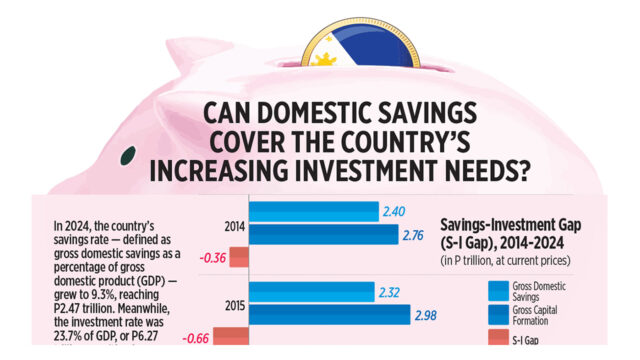
Can domestic savings cover the country’s increasing investment needs?

In 2024, the country’s savings rate — defined as gross domestic savings as a percentage of gross domestic product (GDP) — grew to 9.3%, reaching P2.47 trillion. Meanwhile, the investment rate was 23.7% of GDP, or P6.27 trillion, resulting in a P3.8-trillion gap. The savings-investment gap (S-I) gap — the difference between gross domestic savings and gross capital formation — shows a country’s ability to finance its overall investment needs. An S-I deficit occurs when a country’s investment expenditures exceed its savings, forcing borrowing to fund the gap.

Can domestic savings cover the country’s increasing investment needs?

EV-killer cobalt has backfired, Wile E. Coyote-style

MICHAEL FOUSERT-UNSPLASH

LISTENING to the various “yes, but” theoretical challenges raised to the energy transition over the years has at times felt like watching Road Runner cartoons.

Time and again, portentous and alarming arguments have been dragged out — like the cartoons’ antagonist Wile E. Coyote, hauling along an Acme Rocket-Sled to catch his feathered prey — only to backfire spectacularly, leaving the proponents frazzled. Meanwhile the energy transition, undaunted, has sped onward.

The latest EV-killer to run into the canyon has been cobalt. The Democratic Republic of Congo, which produces about three-quarters of the bluish-silver metal used in lithium-ion batteries, has suspended output for four months to help mop up a glut that’s caused prices to slump to their lowest levels in decades.

It wasn’t meant to be this way. At pretty much any point over the past decade, wise heads were warning that a looming shortage might stop the rise of electric vehicles in its tracks.

“A Cobalt Crisis Could Put the Brakes on Electric Car Sales,” Wired magazine warned in 2020. Prices might surge north of $600,000 a metric ton, an International Monetary Fund study cautioned the following year, about 30 times the current price. There simply isn’t enough cobalt in global mine reserves, and we may be better off reinventing the internal combustion engine instead of switching to electric cars, according to a 2021 report for the Geological Survey of Finland.

How did all those predictions turn out so wrong? If you’d paid attention to the history of commodities, you’d have known the answer long ago.

Permanent shortages of raw materials are almost unheard of in human history. That’s a consequence of the laws of supply and demand: When demand for a material runs too far ahead of supply, prices rise. Consumers respond by using less, while producers rush to get more of it to market. The result is a price slump and, typically, a return to equilibrium.

That’s precisely what we’ve seen in the cobalt market over the past decade. The metal helps pack extra energy into a lithium-ion battery, so seemed critical in the early years of EVs when manufacturers were struggling to develop vehicles which could travel for more than a few hundred kilometers on a charge.

The shortage of global supplies was a concern from the outset, though. By the middle of the 2010s, cell-makers were working to shift from the NMC 111 chemistry — which used equal quantities of nickel, manganese, and cobalt — to NMC 811 and NMC 955, which were respectively 10% and 5% cobalt.

Miners, meanwhile, were finding far more of it than anyone expected. In Indonesia, weathered nickel-rich rock contains just the right proportion of cobalt for an NMC battery. Now a country whose production was negligible has become the world’s second-largest producer. In Congo, hunger for another energy-transition metal — copper — caused cobalt output to more than double in five years, thanks to the way local ores contain a mixture of the two elements.

The coup de grâce came from China’s lithium-ion battery giants Contemporary Amperex Technology Co. and BYD Co. Rather than scrimping on your use of cobalt with NMC 811 and NMC 955 batteries, why not give up on it altogether? The rival lithium-iron-phosphate or LFP cathode chemistry, long overlooked as a technology more suited to golf carts than performance cars, has improved by leaps and bounds — driven by the necessity of innovation in the face of cobalt’s tight market.

These days, LFP batteries have energy densities that match the best NMC cathodes from the early 2020s, cost about half as much, and are installed in nearly 50% of Chinese EVs. Premium overseas carmakers are joining the club: Audi AG, BMW AG, Mercedes-Benz Group AG, and Tesla, Inc. are all now selling or developing LFP-based models.

The result of all this is a bust, even as EVs boom. “Cobalt is far less important than imagined,” a spokesman for China’s CMOC Group Ltd., the biggest miner of the metal, told Bloomberg News last year. “EV batteries will never return to the era that relies on cobalt.”

Demand for cobalt sulfate, the compound used in batteries, has already nearly topped out. Having doubled to about 160,000 metric tons a year since 2019, it will tick up to just over 180,000 tons by 2027, where it will plateau for the foreseeable future, according to forecasts out to 2035 by BloombergNEF. That’s in marked contrast to other battery metals such as lithium, nickel, and manganese, which are expected to experience ongoing growth.

Cobalt won’t go away entirely — but in future it will increasingly occupy a niche position at the most performance-oriented end of the EV market. There’s a rich irony in this. For years, people have warned that this one metal would kill off electric cars and keep the world hooked on gasoline. To the extent that cobalt still has a future now, it’s because that prediction turned out to be spectacularly wrong.

BLOOMBERG OPINION

Manulife Philippines eyes ‘double-digit’ growth

MANULIFE Philippines expects double-digit growth across all its business metrics this year, its top official said on Thursday.

“Our forecast for the future years continues to be positive and we are aiming to continue growing at a faster rate moving forward,” Manulife Philippines President and Chief Executive Officer Rahul Hora told reporters. “We target double-digit growth across our key financial metrics.”

The company’s growth will be driven by the Philippines’ dominantly young demographic, he added. He declined to give exact figures.

In the past five years, Manulife Philippines has paid claims worth P12.9 billion, the company said in a separate statement.

“The Philippines is a market which has a lot of young people for whom our products are extremely relevant. That market on a year-on-year basis keeps growing,” he said.

Mr. Hora said the country’s continued economic growth would boost disposable income, which would contribute to the industry’s overall growth.

“The economy of the country continues to do well, which means people are going to become richer, and hence, disposable income for them will increase,” he said. “So all those factors are contributing to the growth in the industry.”

Mr. Hora said Manulife Philippines would continue to create products that fit the demands of customers to supplement its growth.

“We do a lot of research to first understand what the customers want, and then we try to bring products which are relevant to our customers,” he said. “That to me is the most important reason why we are very bullish about our growth prospects in the country in the years to come.”

Mr. Hora said longevity and mental health are two themes that the company would incorporate in its product design this year because they expect these to trend.

In the past five years, Manulife Philippines has paid claims worth P12.9 billion, the company said in a separate statement.

Manulife Philippines’ premium income stood at P15.83 billion as of end-2024, up by 1.78% from a year earlier. Net income rose 46.2% to P2.78 billion. — Aaron Michael C. Sy

Lufthansa Technik pandemic layoffs upheld by CA

LUFTHANSA-TECHNIK.COM

THE Court of Appeals (CA) has upheld the validity of Lufthansa Technik Philippines’ retrenchment program in dismissing a petition filed by former employees who had claimed illegal dismissal.

The appellate court’s Second Division found that the National Labor Relations Commission (NLRC) did not commit grave abuse of discretion in upholding the dismissal of the employees, as the decision was supported by substantial evidence.

It acknowledged that Lufthansa Technik’s serious financial losses due to the COVID-19 pandemic, with a loss of $28.9 million in 2020 and projected further losses in 2021, justified the retrenchment program as a necessary measure to prevent further losses.

“In sum, for a valid retrenchment, the employer must show that: (a) retrenchment was a necessary measure to prevent substantial and serious business losses; (b) it was done in good faith and not to defeat employees’ rights; and (c) the employer was fair and reasonable in selecting the employees who will be retrenched,” according to the 17-page ruling written by Justice Perpetua Susana T. Atal-Paño.

The ruling, released on Feb. 18, found that Lufthansa Technik implemented the retrenchment program in good faith, noting the various cost-cutting measures taken by the company before the retrenchment, including the cancellation of planned capital expenditure, alternative work schemes, dismissal of probationary and contractual workers, and offers of early retirement packages.

The tribunal also determined that the company used fair and reasonable criteria in selecting employees for retrenchment.

The criteria included competencies and skills, performance, values and behavior, potential, and seniority. The employees who were retrenched had the lowest scores based on these criteria.

The CA also noted that the company complied with the procedural requirements of Article 298 of the Labor Code, including serving notices of termination to affected employees, submitting an Establishment Report to the Department of Labor and Employment, and paying separation pay to the retrenched employees.

Meanwhile, it rejected the petitioners’ claim that they were entitled to higher separation pay based on an “Employees’ Manual,” as the document was not a valid Collective Bargaining Agreement (CBA) item.

The manual lacked essential particulars, such as the parties involved and the date of the agreement, and was not signed by either party, it noted.

“We are also not impressed with petitioners’ assertion that they must be paid 200% of their wages as their separation pay for every year of service in accordance with a purported CBA. A review of the records reveals that petitioners referred to a document denominated “Employees’ Manual” as the applicable CBA to them,” the ruling said.

“It provides that a retrenched employee shall be entitled to any of the following whichever is highest: a) at least one (1) month of pay for every year of service; b) benefits under the retirement plan; or c) entitlement under existing legislation,” it added.

The case originated from separate complaints filed by seven workers, who were regular employees of the company.

They alleged they were constructively dismissed due to an improperly implemented retrenchment program during the COVID-19 pandemic.

The employees claimed that the company did not adhere to its “last in, first out” policy and that they were not given notice of their subpar performance ratings.

The Labor Arbiter initially dismissed the employees’ complaint, a decision that was later reversed by the NLRC.

However, the NLRC eventually reversed its decision and affirmed the Labor Arbiter’s ruling, with a modification awarding nominal damages to the employees. — Chloe Mari A. Hufana

Hollywood fights to keep its role as the world’s film capital

NATHAN DEFIESTA-UNSPLASH

LOS ANGELES — Behind the glitz of the movie awards season that culminates with the Oscars on Sunday, Hollywood is fighting a battle to keep its place at the center of the global film business.

None of the 10 best picture contenders to be celebrated at Hollywood’s Dolby Theater were filmed in Los Angeles (LA), home to most major film companies for more than a century. Nominee Wicked, for example — a prequel to the classic movie The Wizard of Oz — was filmed in Britain.

Movie and TV production has been exiting Hollywood for years, heading to locations with tax incentives that make filming cheaper. Crew members were hoping for a rebound in Los Angeles after strikes by writers and actors in 2023, but statistics show the comeback has been slow.

The wildfires that destroyed sections of Los Angeles in January accelerated concerns that producers may look elsewhere, and that camera operators, costume designers, sound technicians, and other behind-the-scenes workers may move out of town rather than try to rebuild in their neighborhoods.

“There are a lot of people that haven’t worked in a while because of the strikes and everything, and now the fires,” said Samantha Quan, producer of Oscar best picture nominee Anora, filmed in Brooklyn, New York, and Las Vegas. “I think it’s been a good wake-up call for everyone to push for production to go back to Los Angeles.”

Advocates have launched a “Stay in LA” campaign, hoping to capitalize on the goodwill toward Angelenos following the fires. A petition calls for politicians to lift the cap on tax incentives for filming in the city for the next three years as part of the wildfire recovery effort.

They also are urging studios to commit to increasing production in LA by at least 10% over the next three years.

Gavin Newsom, California’s Democratic governor, has proposed boosting the state’s film and TV tax credits to $750 million a year, up from $330 million annually.

Filmmaker Sarah Adina Smith, an organizer of the “Stay in LA” campaign, said she backed that increase but called on the state to do even more, including making permitting easier.

“We’re not saying that everything should be shot in LA, but it’s almost never an option anymore,” she said.

Ms. Smith said she had developed a show in which “the entire culture of it was LA and Malibu.”

“When it came time to budget that show, they had us choose between South Africa and Australia,” she said. “LA was never a contender.”

“That’s the kind of thing that needs to change, because I think it’s really short-sighted of us to lose this absolutely amazing industry and legacy we have here,” she added.

More than 21,000 people have signed the “Stay in LA” petition, including big names such as Kevin Bacon, Zooey Deschanel, Bette Midler, Keanu Reeves, and Olivia Wilde.

“I hope people realize how important it is to bring jobs to LA,” said Susan Sprung, chief executive officer (CEO) of the Producers Guild of America. “We have the best crews in the world. We have the best producers in the world. Most people live here. They want to work at home.”

PREFERRED FILMING LOCATIONS OUTSIDE US
Permitting data shows production in Los Angeles in 2024 fell to the second-lowest level on record, ahead of only the COVID-19 year of 2020. Production dropped 5.6% from 2023 to 2024 to 23,480 shoot days, according to FilmLA.

A survey of executives by ProdPro found California was the sixth most preferred place to film in the next two years, behind Toronto, Britain, Vancouver, Central Europe, and Australia.

While studios including Walt Disney and Netflix are still based in Los Angeles, that could change, said writer Alexandra Pechman, a “Stay in LA” organizer.

“If they don’t commit to shooting projects here, where their offices are, why are the studios here? Those jobs might pick up and leave too,” Ms. Pechman said.

Duncan Crabtree-Ireland, national executive director of the SAG-AFTRA actors union, said he was optimistic after talks with Hollywood CEOs. One executive told him they had committed to shooting 60 projects in Los Angeles this year.

“I think that we’re going to see this rebuild, but it can’t be fast enough for me,” Mr. Crabtree-Ireland said. “I wish it was immediate.”

Sunday’s Oscars will acknowledge the fires and celebrate the resiliency of Los Angeles, according to organizers. Some speakers may try to rally support for keeping production in Hollywood, as they have at other awards shows.

At February’s Critics Choice Awards, Hacks co-creator Paul W. Downs urged power players in the business to insist on filming in the city.

“The more we tell people that we shoot in Los Angeles, the more we hear, ‘you are so lucky,’” Mr. Downs said. “That shouldn’t be the case because this is an industry town, and we should have more productions in LA.”

“I feel like the people in this room have the power to make that happen,” he added, “so we need to ask to shoot our shows here in LA.” — Reuters

Meralco activates switching station for data center in Quezon City

POWER DISTRIBUTOR Manila Electric Co. (Meralco) said on Thursday that it has energized a new 115-kilovolt (kV) switching station worth P220 million for ST Telemedia Global Data Centres Philippines’ (STT GDC) hyperscale facility in Fairview, Quezon City.

“Meralco works closely with data center operators such as STT GDC to cater to their unique requirements. We are fully committed to providing reliable power and energizing critical infrastructure that will support the growth and development of the hyperscale industry in the country,” Meralco Executive Vice President and Chief Operating Officer Ronnie L. Aperocho said in a statement.

Hyperscale data centers are massive, business-critical facilities for companies with major data processing and storage needs.

Meralco and STT GDC partnered for the construction of the switching station, which is housed within the latter’s Polaris Data Center—the first of its kind in the power distributor’s franchise area. The in-building, dual-feed switching station will ensure a stable power supply and enhance the data center’s operational efficiency.

STT GDC Philippines, a joint venture of Globe Telecom, Ayala Corp., and Singapore-based STT GDC, operates data centers in Metro Manila, Cavite, and Davao.

Harmonic System Inc. and Meralco subsidiary MIESCOR jointly constructed the new 115-kV sub-transmission lines, providing reliable and redundant electric service to the data center. The company’s energy services unit, MSERV, supplied and installed key data center electrical equipment, including high-voltage gas-insulated switchgear, oil-immersed transformers, and medium-voltage dry-type transformers.

“Meralco’s support for data centers in the country aligns well with the current administration’s priorities under its socioeconomic agenda, particularly on energy security and infrastructure development,” the company said.

In 2023, Meralco energized hyperscale-ready data centers with an initial capacity of 22 megawatts (MW), which can ramp up to 180 MW.

Meralco’s controlling stakeholder, Beacon Electric Asset Holdings Inc., is partly owned by PLDT Inc.

Hastings Holdings Inc., a unit of PLDT Beneficial Trust Fund subsidiary MediaQuest Holdings Inc., has an interest in BusinessWorld through the Philippine Star Group, which it controls. — Sheldeen Joy Talavera

Philippine budget deficit reaches P1.506 trillion in 2024

THE NATIONAL GOVERNMENT’S (NG) budget deficit narrowed year on year in 2024, but overshot the target by 1.48%, the Bureau of the Treasury (BTr) said. Read the full story.

Philippine budget deficit reaches P1.506 trillion in 2024

Bawal plastic dito! Elections shouldn’t pollute

PHILIPPINE STAR/JOHN RYAN BALDEMOR

WITH the election season in full swing, the streets, walls, and public spaces are flooded with plastic tarpaulins — typically made of polyethylene, a durable and flexible thermoplastic — bearing the faces and promises of political candidates. Everywhere you look, you’ll see these aspiring politicians, hoping for your vote and support. But once the votes are counted, these campaign materials are abandoned, contributing to the country’s growing plastic waste crisis.

This unchecked waste significantly worsens the Philippines’ reputation as one of the world’s top ocean polluters. While regulations like the Extended Producer Responsibility (EPR) Act of 2022 hold corporations accountable for their plastic waste, political campaigns remain largely exempt from such oversight.

But should we really wait for a law to force politicians to take responsibility?

If we can’t hold them accountable for this simple matter, how can we trust them with more significant issues, such as the taxes we pay and their actions or inactions that have lasting negative impacts on the future of our nation and generations to come?

If these aspiring leaders genuinely care about the environment and the people who are greatly impacted by pollution, they should voluntarily commit to recovering, recycling, or repurposing their campaign materials. More than that, they should set an example by publicly reporting how they manage their plastic waste after the election.

A candidate’s commitment to sustainability should not begin only after they are elected, it should be evident in how they run their campaign. Voters must demand accountability, and politicians must prove they are responsible leaders before they take office.

THE ENVIRONMENTAL TOLL
Election-related waste, especially plastic tarpaulins, poses a significant environmental threat. These materials are designed for durability, but once the elections are over, they become useless and are often dumped in landfills, burned, or left to litter public spaces.

Elections are often linked with massive amounts of campaign waste polluting communities. Plastic tarpaulins and posters clog drainage systems, worsen flooding, and release toxic emissions when incinerated. Despite these clear environmental consequences, no formal system ensures politicians take responsibility for cleaning up after their campaigns.

The EPR Act of 2022 requires large enterprises to manage the full life cycle of their plastic waste, ensuring proper collection, recycling, and disposal. This law disrupts the traditional approach, where consumers were primarily responsible for collecting and recycling plastic waste.

However, campaign materials are not currently covered under this law, allowing politicians to generate massive amounts of plastic waste without consequences. Just as businesses are held accountable for their environmental impact, political candidates should be responsible for recovering and diverting 100% of their plastic campaign materials.

If they can afford to print thousands of tarpaulins, they should also bear the cost of collecting and repurposing them. This is their moment to prove to Filipinos that they genuinely care — not just about winning, but about the people and the environment.

I believe this is the right and responsible thing to do. Regardless of the law, they should hold themselves accountable for the waste generated by their campaign. After all, they are running for office to serve the public, and this entails ensuring our protection from the environmental consequences of plastic waste.

SOLUTIONS FOR A MORE SUSTAINABLE ELECTION
To minimize the environmental impact of political campaigns, candidates should commit to the following:

1. Use Eco-Friendly Alternatives

• Replace plastic tarpaulins with biodegradable or recyclable materials

• Require political parties to disclose the materials used in their campaign paraphernalia.

2. Implement a Take-Back Program for Used Campaign Materials

• Politicians — not voters — should be responsible for collecting and properly disposing of their campaign materials.

• Campaign teams must set up collection points and retrieval systems to ensure proper recycling and disposal.

3. Partner with Recycling Organizations

• Work with recycling companies and organizations to repurpose used tarpaulins into useful products like school bags, wallets, roofing materials, or eco-bricks.

• Incentivize local governments to facilitate sustainable waste management for campaign materials.

4. Introduce Plastic Footprint Accounting

• Candidates must track and publicly disclose their campaign’s plastic footprint.

• A third-party organization should validate waste management efforts.

• Implement penalties for those who fail to recover and properly dispose of their plastic waste.

VOLUNTARY AND TRANSPARENT ACCOUNTABILITY
While legislative changes are necessary, politicians do not need to wait for new laws to act responsibly. A true leader leads by example, and one way to demonstrate genuine concern for the environment is by voluntarily committing to sustainable campaign practices. Political candidates should:

• Make a public commitment to recover and recycle 100% of their campaign materials.

• Submit a transparent post-election report detailing how they managed their plastic waste.

• Pledge to use eco-friendly campaign materials in future elections.

Voters, in turn, should hold candidates accountable and support those who prioritize environmental responsibility.

DEMAND SUSTAINABLE ELECTIONS NOW
The Commission on Elections (Comelec) must strengthen regulations by integrating sustainability requirements for campaign materials. The absence of strict guidelines on eco-friendly election materials allows politicians to pollute without consequence. Countries like Taiwan and Germany have successfully enforced stricter regulations on election campaign materials, reducing their environmental impact. The Philippines should follow suit by extending the EPR Act to include political tarpaulins and making sustainable election campaigns the standard. We must demand action before the May 2025 elections.

The battle for political office should not come at the cost of environmental destruction. By holding politicians accountable for the full life cycle of their campaign materials, we can significantly reduce election-related plastic waste and set a precedent for sustainability in governance.

A sustainable future starts with responsible choices — both from those who seek to lead, and those who choose their leaders. Let’s demand more from our candidates and ensure that every election contributes to progress, not pollution.

This May, let’s cast a vote not just for leaders — but for our environment, for our future, and for our planet.

P.S. — The bottomline is “bawal plastic” sa May 2025 election! (“Plastic is forbidden” in the May 2025 election!)

The opinions expressed in this article are solely the author’s and do not reflect those of his firm or any organization he is affiliated with.


Lucky Cimatu is the senior managing consultant for the Advisory Services Practice Area at P&A Grant Thornton, one of the leading audit, tax, advisory, and outsourcing firms in the Philippines.

business.development@ph.gt.com

www.grantthornton.com.ph

To an upper middle-income country and beyond

Our economic managers, including Finance Secretary Ralph G. Recto and National Economic and Development Authority (NEDA) Secretary Arsenio Balisacan, have set a goal for the Philippines to become an upper middle-income country this year, even though we have been classified as a lower middle-income country since 1987. The World Bank established this classification based on a country’s gross national Income (GNI) per capita reaching $4,516. While it is an excellent sign that the Philippine economy is growing, the downside to attaining upper middle-income status is the loss of perks such as access to preferential interest rates on official development assistance loans from multilateral banks and donor nations. These loans accounted for 14.5% of our national debt in 2023. While interest rates on national debt might go up, in the long run, this should be offset by improved foreign investment due to our upper middle-income status and recent developments such as the Philippines’ removal from the grey list of the Financial Action Task Force (FATF) and the implementation of the CREATE MORE Act.

We tend to hear of economic growth in terms of gross domestic product (GDP) per capita. However, there are slight differences in how GDP and GNI are calculated. In the Philippines, our GNI is slightly higher than GDP as the Bangko Sentral ng Pilipinas (BSP) adds net primary income from the rest of the world. For purposes of our economic managers, GDP growth is more within their control, and the question, therefore, is how can Philippine GDP grow sufficiently for us to achieve our upper middle-income country aspirations, especially as we have fallen short of government targets over the last two years?

One reason investors are optimistic about the Philippines’ economic fundamentals is the so-called “demographic dividend,” thanks to our young, growing population, which is anticipated to boost consumption spending in the coming decades. This contrasts with other nations that face the fiscal burden of supporting aging populations. As I have noted in previous columns, this young population must be equipped for the workforce through proper education and training to fully benefit from the demographic dividend. Consumption spending last year was also hindered by high inflation that raised the cost of essential goods, although food inflation in 2024 was 4.5% compared with 8% in 2023. To promote further consumption this year, the government should focus on controlling inflation, especially food inflation, so our fellow countrymen can afford to eat.

Businesses are investing in growth projects amid a more favorable macroeconomic outlook. However, this is tempered by volatile global risks, including the potential impact of trade wars stemming from US threats to sanction trading partners to boost its competitiveness. Foreign companies are increasingly eyeing the Philippines, with the Philippine Economic Zone Authority (PEZA) approving almost P53 billion worth of investment pledges in the first two months of the year, more than quadruple the amount from a year earlier. These investments are expected to create more than 11,000 jobs, leading to increased consumption. We must ensure these pledges materialize. Additionally, the recent cut on the reserve ratio requirement (RRR) by the BSP is anticipated to add P330 billion in liquidity and hopefully contribute to lower interest rates, further encouraging investment.

In 2024, the state expenditure-to-GDP ratio was 24.32%, highlighting the impact of government spending on economic growth. Beyond the actual spending, the funds have to be allocated to areas that will strengthen our economy in the long run, such as President Marcos’ priority projects. This emphasizes the importance of agencies such as the Department of Budget and Management in developing a national budget that will suit the needs of our nation, including investing in social services and infrastructure development. Consequently, funds that are diverted from allocated government spending to individual pockets hinder our economic growth, as does increased debt service costs resulting from borrowing to fund projects.

The challenge before us is vast, but the business community stands with the government in our efforts to achieve high middle-income country status and beyond.

The views expressed herein are his own and does not necessarily reflect the opinion of his office as well as FINEX.


EJ Qua Hiansen is the CFO of PHINMA Corp. and president of the Financial Executives Institute of the Philippines.

Low-cost approaches to motivating staff

We are a small business that can’t afford high salaries and benefits. How do we motivate people to do what they can to help management? What indicators should we be tracking? — Water Lily.

​It’s not rocket science. It’s easy to motivate people if your line leaders, supervisors, and managers are first and foremost highly motivated and highly engaged with top management. If they’re not motivated, how can they motivate their workers? They can’t give what they don’t have. That’s your top agenda. Start with your line executives.

​There are many ways to discover their motivational level. One is conducting a morale survey. The most important question is how line executives are empowered to independently solve problems and make decisions.

Two is monitoring the absenteeism, tardiness, and turnover rate of their workers. The higher the rates, the bigger the problem.

Three is noting the number of disputes line executives have prevented or resolved. The objective is to manage workplace conflict to the bare minimum without the matter being brought to a labor court.

Four is the number of ideas, suggestions, and even complaints that they’re submitting to management. When employees connect, they know they are free to speak up. When they speak up, they show the extra energy to do more for the organization.

​And five, measuring their leadership competence. This can be done easily through an online test but more accurately if the workers show their loyalty to their bosses and the commitment to achieve department objectives.

​In general, everything can be shown by workers who perform at the highest level with discretionary effort. “Discretionary effort” means doing what’s not expected and working beyond the job description.

MEASUREMENT SYSTEM
​There’s no need to come up with a sophisticated measurement system. My rule of thumb is to have a 60% in-person attendance at town hall meetings. That’s not to say that we don’t need to measure performance.

What I’m saying is — we don’t have to come up with a complex system.

The simpler, the better. However, management must have one metric to be used as a monitoring device to capture the monthly picture and analyze developments. You can be guided by the following simple approaches:

One, communicate management views with honesty. If the organization is losing money, but its executives refuse to share important financial records and continue receiving perks, the workers will feel that management is not serious.

Two, give employees a role in creating performance goals. That’s the essence of co-ownership. If management allows that, people will be happy to make things happen knowing they can’t afford to lose face in the process.

Three, ensure that everyone has the resources they need. This may include training, which may not be limited to classroom learning experience. Less theoretical approaches are better so workers can learn it by themselves through cross-posting in other jobs.

Four, allow management accessibility and visibility. This applies to all levels from line leaders to top management. For Western managers, it’s called Management by Walking Around. For the Japanese, it’s called the Gemba Walk. The important thing is regularity and not a once-in-blue-moon occurrence.

Five, listen carefully to all concerns and issues. It’s easy for management to go on autopilot. However, this can always be corrected by asking clarificatory questions and limiting them to practical issues, while avoiding encouraging any  false hopes.

Six, reward and recognize regularly. Ensure that you have an objective process in choosing the deserving. That alone can play an important role in energizing employees and improving their morale with special emphasis on meritocracy rather than seniority.

CULTURE AND HISTORY
The above list is not exhaustive. You can do more than that. There are many things that management can do depending on the company’s culture and history. Management must avoid being lulled into complacency and mechanically mouthing that “people are the company’s most valuable asset.”

​Instead of mouthing that cliché, prepare to make things happen with impressive results. Don’t be afraid to experiment with many tools and techniques that you’ve not done before. Learn from the experience of other dynamic organizations known to have staff who enjoy coming to work. 

​These organizations are easy to identify. For one, they have a low turnover rate, normally pegged at less than 5%. In these companies, morale is always strong and productivity is even stronger. Their employees are often seen discussing their best ideas and thinking in the workplace on a daily basis and without much prodding by management.

​Don’t be ashamed of copying their best practices and adjust them accordingly.


Consult your workplace issues with Rey Elbo on Facebook, LinkedIn, Twitter, or e-mail elbonomics@gmail.com or via https://reyelbo.com. Anonymity is guaranteed.