Home Blog Page 1426

Actor Depardieu admits to ‘grabbing’ woman by the hips, denies assault in court

Gérard Depardieu in a scene from 2021’s Adieu Paris.

PARIS — French movie star Gerard Depardieu admitted in court on Tuesday that he had grabbed by the hips a woman who has accused him of sexual assault, but denied it was assault, attributing any crude comments he had made to being in a bad mood.

The plaintiff, Amelie K, a set decorator, spoke in court after Mr. Depardieu, and said the actor had groped her all over her body as he trapped her between his legs and made explicit sexual comments, terrifying her while they were on a film set in 2021.

“He grabbed me and groped me in the front of my body, the back, all around. He trapped me with his legs,” she told the court. “He touched everything, including my breasts,” she said. “I was terrified, he was laughing.”

A towering figure of French cinema, Mr. Depardieu, 76, has faced a growing number of sexual assault allegations in recent years.

Mr. Depardieu’s trial is the highest-profile #MeToo case in the media industry to come before the courts in France. He has denied wrongdoing, and this is the first case over which he is standing trial.

“Yes, I confirm I grabbed her by the hips to tell her not very nice things, but not to grope her,” Mr. Depardieu said.

Earlier, he had said he had grabbed Amelie K to avoid slipping, as he was tired and upset.

After Amelie K’s lawyer said Mr. Depardieu had changed his version of events yet again, as he had thus far denied touching her, the actor said: “If you say so.”

The actor told the court he was not at ease with how society was evolving. “I think my time is over,” he said.

If found guilty, Mr. Depardieu could face a sentence of up to five years in jail and a 75,000 ($81,000) fine.

DRAMA
The second day of the trial was marked by high drama, with Mr. Depardieu’s lawyer interrupting and screaming at Amelie K’s lawyer, while Mr. Depardieu heatedly denounced the “hysteria” of some women.

Often wandering off topic, Mr. Depardieu said he had accused Amelie K of doing her job badly, shocking her, and that any crude comments he made were related to her work.

Amelie K repudiated this, saying Mr. Depardieu had not criticized her work but had made repeated, crude, sexual comments and assaulted her.

She said someone — she did not know who — eventually stepped in, freeing her from his grasp and pulling her away.

Prosecutors have given a similar account of what they described as a sexual assault, witnessed by three people.

They said the alleged assaults against Amelie K and another woman — their full identities were not revealed — took place during the 2021 filming of Les Volets Verts (The Green Shutters).

The second woman was groped by Mr. Depardieu on set and in the street, prosecutors said.

Mr. Depardieu’s lawyer Jeremie Assous told reporters on Monday the accusations were false and based on lies. In court, he accused investigators of bias and wanting to bring Mr. Depardieu down.

The accusations against Mr. Depardieu and his trial, have divided French actors, with some supporting him and expected to speak at the trial, and others backing the plaintiffs.

At the time of the alleged assaults on the set of Les Volets Verts, Mr. Depardieu was already under investigation over a rape allegation by actress Charlotte Arnould, who was present in court this week to follow the proceedings.

The Paris prosecutor’s office last year said Mr. Depardieu should face trial over Ms. Arnould’s complaint. Mr. Depardieu has denied any wrongdoing. It is now up to an investigative judge to say if there will be a trial over those allegations. — Reuters


The Philippines is cementing its place in regional venture capital

PHILIPPINE STAR/RYAN BALDEMOR

THE PHILIPPINES is making waves in Southeast Asia’s venture capital scene. A record-breaking $1.12 billion in deals in 2024 signals a maturing startup ecosystem, drawing international investors and shifting the region’s investment balance. But beyond the headline numbers, a deeper question remains: how do Filipinos ensure that this is sustained dominance and not just a cyclical peak?

Our recent report, “The Philippine Venture Capital Report 2025,” published by Foxmont Capital Partners and Boston Consulting Group (BCG), reveals a striking shift: the Philippines captured 19% of total funds raised in Southeast Asia in 2024, up from just 5% three years prior. This jump isn’t just about quantity — it reflects a qualitative evolution. The ecosystem is moving beyond early-stage bets to larger, growth-stage deals exceeding $20 million.

Fintech continues to lead the charge, but direct-to-consumer and cleantech sectors are gaining momentum. More significantly, foreign investment inflows surged 45%, signaling confidence that the Philippines is no longer just a frontier market but a core player in Southeast Asia’s economic engine.

With growing interest from international investors, now is the perfect time to examine how local startups have adapted — and must continue to adapt — to an evolving market. In this case, we look at the potential of the rising middle class.

ENGINE OF TRANSFORMATION
Beyond venture capital, the Philippines’ economic landscape is being reshaped by a rising middle class. Since 2012, middle-income groups have expanded from 42% to 47.5% of the population, while the lowest-income bracket shrank by 39%. This shift isn’t just about statistics — it’s about behavior.

With incomes rising faster than expenses, savings rates have nearly doubled over two decades, reaching 27% in 2023. Spending is no longer purely necessity driven. Filipinos are prioritizing personal growth, aspirations, and experiences, fueling a “premiumization” trend. Consumers are willing to pay more for quality, and businesses that understand this shift stand to benefit.

FOUR SECTORS PRIMED FOR GROWTH
We see these economic changes creating tailwinds for four key industries.

Healthcare is experiencing a surge in demand as wellness becomes a priority, with increased interest in preventive care, insurance, and premium healthcare services.

In financial services, entrepreneurship is on the rise, with more than half of surveyed Filipinos aspiring to start their own business — making access to financing more critical than ever.

Meanwhile, energy consumption is rapidly increasing, as rising incomes drive demand for modern conveniences, manufacturing expansion, and retail growth. This puts pressure on the grid to improve efficiency, reliability, and sustainability.

Lastly, agriculture must evolve to meet the middle class’ growing appetite for higher-quality food, requiring innovations in supply chains, sustainable farming, and scalable production.

Businesses that recognize and adapt to these shifting behaviors and needs will be best positioned to lead — and win — in this evolving economic landscape.

THE AGRICULTURAL IMPERATIVE
The Philippines faces a looming food security challenge. The middle class’s demand for premium goods, combined with population growth, risks deepening the country’s reliance on imports and straining domestic production. Addressing this requires a deeper understanding of the factors that drive farm productivity — and the barriers that hold farmers back.

A survey commissioned by Foxmont Capital Partners and BCG, which examined a representative group of 300 farmers across the Philippines, provides insights into what separates well-performing farms from struggling ones. Education, access to technology and equipment, and third-party support emerged as key enablers of success.

However, farmers across the board face persistent challenges, including high input costs, volatile sales prices, climate-related risks, and limited access to finance. Closing the productivity gap requires better access to credit, technology (both digital and mechanical), and education — whether through cooperatives, private investment, or government intervention.

With 75% of farmers believing government support is insufficient, the private sector has a clear opportunity to step in, leveraging fintech, agritech, and data-driven financing solutions to modernize an industry that remains fundamental to national stability.

THE ROAD AHEAD
The Philippines is cementing its place in private capital markets in the region. Venture capital is playing a critical role in its transition to a middle-income economy and can enable further growth together with the help of the public sector and other stakeholders.

Positive changes in the regulatory environment are creating opportunities for international investors to introduce global best practices to the local market. The investment boom is real, and by harnessing the country’s entrepreneurial mindset, the Philippines can unlock long-term prosperity and drive broad-based economic growth.


Bea Mantecon is director of Value Creation at Foxmont Capital Partners. Lance Katigbak is a principal at Boston Consulting Group’s Manila office. Read the full report here: https://tinyurl.com/26jvkmfe

BankCom net profit climbs to P3.02 billion in 2024

BANKCOM.COM.PH

BANK of Commerce’s (BankCom) net income climbed by 7.95% year on year in 2024, as strong loan growth boosted its interest earnings.

The San-Miguel Corp.-led bank’s net profit stood rose to P3.02 billion last year from P2.8 billion in 2023, its financial statement disclosed to the stock exchange on Wednesday showed.

This translated to a return on equity of 9.44% and a return on assets of 1.22% last year, down from 9.52% and 1.25%, respectively.

Net interest income increased by 9.82% to P9.11 billion from P8.296 billion amid higher loans. Interest income grew by 11.91% to P13.16 billion from P11.76 billion, while interest expense rose by 16.93% to P4.05 billion from P3.47 billion.

Net interest margin was at 4.17%, down from 4.28%.

This led its total operating income to rise to P10.76 billion last year from P9.98 billion in 2023, with earnings from service charges, fees and commissions at P1.07 billion, up from P886.38 million a year prior.

Meanwhile, BankCom’s operating expenses climbed by 9.21% to P6.81 billion last year from P6.24 billion in 2023.

The bank set aside loan loss provisions of P139.41 million last year, up by 76.82% from P78.84 million.

This resulted in a cost-to-income ratio of 62%.

The bank’s total loans expanded by 24.59% to P136.51 billion at end-2024 from P109.57 billion in the previous year.

Its nonperforming loan (NPL) ratio was at 1.25%, while NPL cover was at 97.47%.

On the funding side, total deposits rose by 14.04% to P212.01 billion from P185.91 billion.

As a result, BankCom’s loan-to-deposit ratio stood at 0.64% in 2024.

The bank’s total assets expanded by 14.58% year on year to P265.44 billion at end-2024 from P231.68 billion.

Total equity also increased by 7.71% to P33.23 billion.

The bank’s capital adequacy ratio stood at 17.58% last year while common equity Tier 1 ratio was at 13.75%, down from 19.88% and 15.32%, respectively.

BankCom’s shares rose by nine centavos or 1.28% to close at P7.10 each on Wednesday. — A.M.C. Sy

SecureLink plans tech lab in Makati

SECURELINKNETWORKS.COM

SECURELINK NETWORKS, Inc., a joint venture between PT&T Corp. and Australia’s Netlinkz Ltd., plans to establish a multimillion-dollar technology facility in the Philippines to enhance the country’s connectivity and cybersecurity, the company’s top official said.

“We are establishing a lab that will be a multimillion-dollar investment for us. We are engaging with local development firms to establish that lab here in order to license the technology for the Philippines,” SecureLink Networks Chairman James Tsiolis told reporters on the sidelines of an event on Tuesday night.

SecureLink Networks Co-founder and Chief Executive Officer James G. Velasquez said the company is working to further develop and deploy a solution to strengthen the country’s connectivity and cybersecurity infrastructure.

“We are actually looking at bringing the solution from a development standpoint to the Philippines to open up a lot of opportunities — not just in resources that we need in the Philippines but also in further technology development. As you know, software can always be improved. So, we’re bringing a strong product from Australia and porting it over to the Philippines,” Mr. Velasquez said.

He said the planned technology lab, set to be built within the year, will be located in Makati.

The company launched the Virtual Secure Network Plus (VSN+) on Tuesday, offering an advanced cybersecurity and networking solution.

“SecureLink’s entry into the Philippine market isn’t just about launching a product — it’s about changing the way cybersecurity and connectivity are delivered,” the company said in a media release.

SecureLink said it plans to leverage PT&T’s infrastructure and expertise while integrating Netlinkz’s advanced technology to set new standards for a secure digital environment.

“VSN+ is our way of safeguarding digital infrastructure across Southeast Asia. With PT&T as our partner, we aim to transform how cybersecurity is delivered in the region,” Mr. Tsiolis said.

PT&T’s partnership with Australia’s Netlinkz aims to enhance the country’s connectivity through fiber broadband and wireless solutions while integrating Netlinkz’s technology to strengthen cybersecurity networks.

“The idea behind the collaboration is not only to provide connectivity but to extend a secure network built on that connectivity. What we do is connect all points and encrypt all data traffic. So, PT&T provides the connection, we provide the security, and together we deliver the network,” Mr. Tsiolis said. — Ashley Erika O. Jose

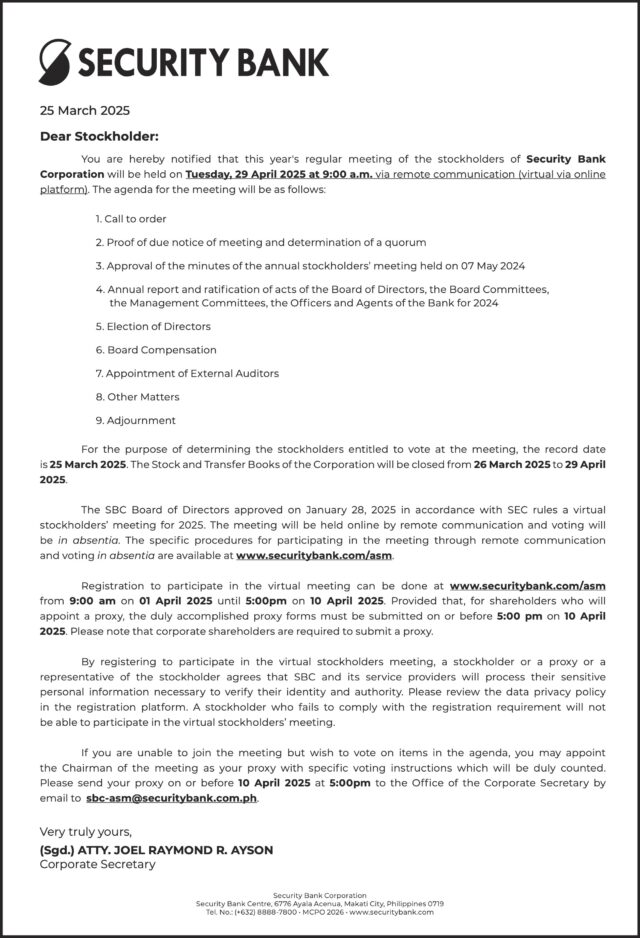
Security Bank Corp. to hold 2025 regular meeting of stockholders via remote communication on April 29


Spotlight is BusinessWorld’s sponsored section that allows advertisers to amplify their brand and connect with BusinessWorld’s audience by publishing their stories on the BusinessWorld Web site. For more information, send an email to online@bworldonline.com.

Join us on Viber at https://bit.ly/3hv6bLA to get more updates and subscribe to BusinessWorld’s titles and get exclusive content through www.bworld-x.com.

China’s Xiaomi raises $5.5 billion in share sale as EV plans ramped up

CHINA’S Xiaomi Corp. said on Tuesday it had raised $5.5 billion in an upsized share sale as the company pushes forward with its ambitious electric vehicle (EV) manufacturing plans.

The company sold 800 million shares at HK$53.25 each, it said in a statement to the Hong Kong Stock Exchange. The world’s third-largest smartphone maker has seen its share price surge by nearly 150% from HK$21.5 in the past six months, buoyed by investor enthusiasm for its EV plans.

Xiaomi, which moved into electric vehicle manufacturing last year, had planned to sell 750 million shares but increased the size of the deal while the bookbuilding process was underway.

The final price was towards the bottom end of the HK$52.80 to HK$54.60 price range flagged to investors when the deal launched on Monday.

Xiaomi shares were down 5.3% in Hong Kong on Tuesday as the Hang Seng Index was off 2.1%.

There were more than 200 investors who placed orders during the bookbuilding process and the book was multiple times oversubscribed, said a person familiar with the matter.

The top 20 investors took about 66% of the stock sold in the share sale, the person added.

Xiaomi did not immediately respond to a request for comment on the deal statistics.

The price was a 6.6% discount to Xiaomi’s closing price of HK$57 on Monday. Xiaomi said the money raised would be used to fund the acceleration of its business expansion, research and technology development.

Xiaomi began manufacturing EVs last year with the launch of the SU7 sedan after selling smartphones, household appliances and smart gadgets for most of its 15-year history.

It reported an almost 50% jump in fourth-quarter revenue last week and raised its target for EV deliveries this year to 350,000 from 300,000.

The company reported 32.1 billion yuan ($4.4 billion) in revenue for its EV business in 2024, delivering more than 135,000 SU7 sedans. Xiaomi said it aimed to start shipping cars overseas in 2027.

The tech firm has purchased a new land plot of 52 hectares (128.5 acres) in Beijing’s south, where it would build the third phase of its auto factory as it ramps up its annual shipment target, Chinese media has reported.

Xiaomi will invest a quarter, about 7-8 billion yuan, out of its 2025 total research and development budget of 30 billion yuan into AI, President Lu Weibing said last week.

Xiaomi’s deal extends a rush of tech-focused capital raisings from Chinese firms in Hong Kong, as companies take advantage of positive sentiment towards the tech sector.

A summit led by Chinese President Xi Jinping with top tech leaders last month was widely seen as a sign that strict government scrutiny of the sector which began in 2020 was easing.

Before Xiaomi’s share sale, Chinese firms had carried out $16.8 billion worth of equity capital market activity in the first quarter, according to LSEG data, more than double the same period last year. Reuters

Ticketmaster may have misled UK Oasis fans, watchdog says

LONDON — Ticketmaster may have misled music fans into paying more for tickets than they had planned last year to see British band Oasis, the UK’s competition watchdog said on Tuesday, urging the company to change how it labels tickets and informs customers.

Thousands of fans waited for hours online to get their hands on highly coveted tickets for the band’s 2025 reunion shows, only to find prices had jumped by the time they got to the front of the queue.

“We’re concerned that Oasis fans didn’t get the information they needed or may have been misled into buying tickets they thought were better than they were,” said Hayley Fletcher, interim senior director of consumer protection at the Competition and Markets Authority (CMA).

The watchdog said it was concerned that Ticketmaster may have breached consumer law. CMA does not currently have power to levy fines for breaching consumer laws, which are enforced through the court system.

A Ticketmaster statement said that it aimed to provide a “simple, transparent and consumer-friendly experience” and welcomed the CMA’s input.

The CMA launched an investigation into Ticketmaster in September to examine if it had engaged in “unfair commercial practices,” and if they were pressured to buy tickets within a short period of time.

The CMA originally said it was also looking at how dynamic pricing models — a form of surge pricing — may have been used, but Ticketmaster has said it did not use dynamic pricing models.

The outcry over the way the ticket sale process was managed became a hot political topic, spurring Prime Minister Keir Starmer to promise to get a grip on the wider issue of event tickets being sold at inflated prices.

The government has since announced proposals to cap resale prices and hold reselling websites more accountable.

The CMA issued an update on its findings on Tuesday outlining two main concerns.

One was that seats labeled as “platinum” were sold at a premium without consumers being made fully aware that they didn’t come with any extra benefits.

Another was insufficient information provided to buyers at the start of the queue on different ticket categories and their prices if cheaper tickets were sold out before their turn to buy.

The CMA said Ticketmaster had made some changes since the investigation began, but that more work was still needed.

“We now expect Ticketmaster to work with us to address these concerns so, in future, fans can make well-informed decisions when buying tickets,” the CMA’s Ms. Fletcher said. — Reuters

Charmed and dangerous

FREEPIK

EVERY TIME there is an election, like the one coming up soon, the pundits bemoan the lack of relevant qualifications among the top contenders in the polls. They cite the illustrious line-up of experienced and academically qualified icons of the past. (The same names always come up.) Sure, there were actors in the mix even then, but they were a minority. And they were concentrated on the broadcast industry and media.

Is charm currently all it takes to get into the winning column in an electoral contest?

Charm deals with popularity which gives a big boost in surveys as the smoothie has probably enjoyed the spotlight in entertainment or media. The charmer projects compassion for the masses in his predictable denunciation of corruption and the need for helping the poor.

When asked a specific question like what an actor plans to do if elected in the upper house, he admits his ignorance. (I’ll know what when I get there.) He turns the question around to the one from the press impertinent enough to bring up this matter — what would you do? (I want to know your priorities.) He needs a script at this point.

The charmer glories in his high position in the survey, owing to his pleasing personality. The attitude is reminiscent of the song, “I Feel Pretty” from West Side Story — “it’s alarming how charming I feel.”

The brazenness of ambition in the charmer is packaged as a self-sacrificing willingness to give up malling and summer outings to serve the country even at a young age. He may even point to the dynasty he belongs to — our family has served the community for generations.

Those who question the charmer’s chutzpah to parlay a short stint in the public spotlight are dismissed as part of the elitist jeering squad that must be rejected — we need to embrace change.

Is a proclaimed modesty considered charming? (I know I’m not qualified. I just want to serve.) The incumbent charmer with the highest absentee rate while in office may parlay that inadequacy with a shrug — I’m out there with the people surveying what they want. (There are OFWs in Paris too, you know.) She may have a lot of unfinished projects and unliquidated advances, but she refuses to answer any questions on those. (Let’s change the topic.)

The emotions that the charmer targets involve the following: 1.) Here is a fresh and untainted personality in this dirty game of traditional politics; 2.) This novice appeals to the masses with his clean slate of achievements; and, 3.) Let’s throw out the old fogies by voting for inexperienced celebrities.

Charm is visceral. It seduces the emotion and shuns too much analysis. (Is there really a need for a debate?) It is difficult to be too critical of somebody who seems so reasonable and appealing. He is not picking a fight. He avoids issues and questions on which side of the political feud he is on. (I can only side with the people.)

What role does charisma play in the political contest?

Is it possible to be competent and qualified and still be charming? Does it have to be one or the other? This is the challenge for those who feel that their qualifications alone speak for themselves. They need to get off their high horse and try to relate to the voters. The default position for the qualified candidates seems to be a disappointment with the voters for their gullibility and lack of education.

Instead of bewailing the demand side of the voting equation, the candidate should try to understand the voters and their indifference if not outright animosity for elitist pretensions.

As any marketing practitioner understands, it’s not the customer who needs to justify her choice of which products to buy. It’s the seller of the product that needs to adjust and appeal to the consumer. Yes, the product on the shelf needs effective branding to charm the buyer to put it in her shopping cart, even impulsively.

It is a failure of marketing when a company explains poor sales by blaming the consumer for having poor judgment in making decisions. Certainly, it’s not all about charisma. But even a good product needs to project some charm to the buyer… even with a celebrity endorser on the stage.


Tony Samson is chairman and CEO of TOUCH xda

ar.samson@yahoo.com

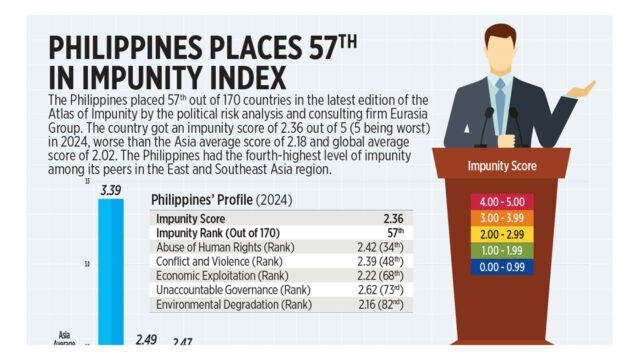
Philippines places 57th in Impunity Index

The Philippines placed 57th out of 170 countries in the latest edition of the Atlas of Impunity by the political risk analysis and consulting firm Eurasia Group. The country got an impunity score of 2.36 out of 5 (5 being worst) in 2024, worse than the Asia average score of 2.18 and global average score of 2.02. The Philippines had the fourth-highest level of impunity among its peers in the East and Southeast Asia region.

Philippines places 57<sup>th</sup> in Impunity Index

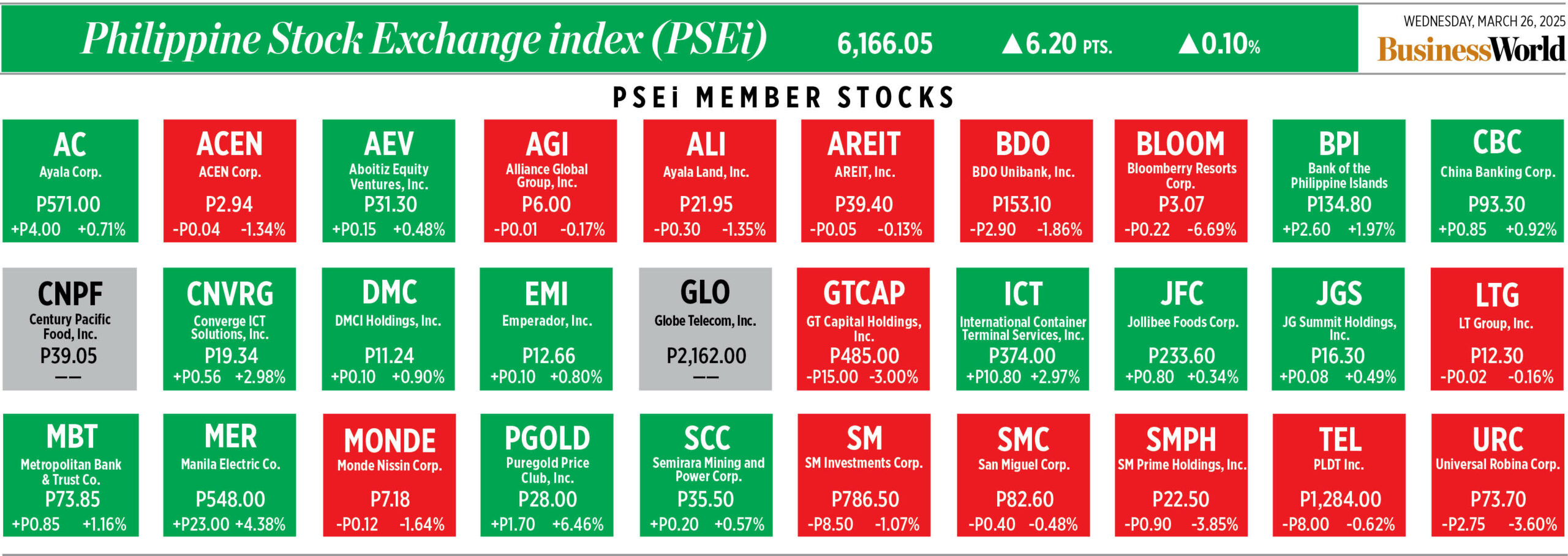
How PSEi member stocks performed — March 26, 2025

Here’s a quick glance at how PSEi stocks fared on Wednesday, March 26, 2025.


Peso tumbles to three-week low as tariff worries drag sentiment

BW FILE PHOTO

THE PESO sank to a three-week low against the dollar on Wednesday as the market remained worried over the potential economic impact of the Trump administration’s plan to impose reciprocal tariffs starting next week.

The local unit closed at P57.69 per dollar on Wednesday, weakening by nine centavos from its P57.60 finish on Tuesday, Bankers Association of the Philippines data showed.

This was the peso’s worst finish in over three weeks or since it ended at P57.753 on March 4.

The peso opened Wednesday’s session a tad stronger at P57.58 against the dollar. It dropped to as low as P57.74 intraday, while its best showing was at P57.57 versus the greenback.

Dollars exchanged declined to $1.34 billion from $1.54 billion on Tuesday.

“The dollar-peso closed lower on risk-off sentiment and due to momentum from yesterday’s announcement by the Bangko Sentral ng Pilipinas (BSP) on a possible rate cut in April,” a trader said in a text message, noting that this could result in a narrower rate differential with the US Federal Reserve.

The US dollar was slightly higher on Wednesday as nervy traders awaited clarity on President Donald J. Trump’s trade policy ahead of a new round of tariffs next week, Reuters reported.

Traders clung on to hopes of flexibility from the White House after Mr. Trump said on Monday that not all trade levies would come on the April 2 deadline, and some countries would get breaks, without providing further details.

At the same time, Mr. Trump opened a new front in his trade war with a directive for 25% secondary tariffs on any country that buys oil or gas from Venezuela. In turn, oil prices rose, although the impact was offset by relief from Black Sea maritime security deals struck by the US in the war in Ukraine.

The US dollar index, which measures the currency against a basket of six major peers, inched higher after slipping 0.1% on Tuesday, its first losing session in about a week.

The index plumbed a five-month low last week, weighed down by worries that Mr. Trump’s trade war could trigger a US recession. Data overnight showed consumer confidence plunged to the lowest level in more than four years this month.

Meanwhile, BSP Governor Eli M. Remolona, Jr. said in an interview with Bloomberg Television on the sidelines of the HSBC Global Investment Summit in Hong Kong on Tuesday that there is a “good chance” that the Monetary Board will cut rates by 25 basis points (bps) at their April 10 meeting, Bloomberg reported.

Mr. Remolona said the BSP remains on an easing cycle and could bring down borrowing costs by as much as 75 bps this year depending on data.

The central bank has reduced benchmark interest rates by a cumulative 75 bps since it began its rate-cut cycle in August last year, with its policy rate currently at 5.75%.

For its part, the US central bank last week reiterated its cautious policy stance, with Fed Chair Jerome H. Powell signaling that they are in no rush to cut rates.

The US central bank left interest rates unchanged last week, though policy makers indicated they expected to reduce borrowing costs twice this year.

Rizal Commercial Banking Corp. Chief Economist Michael L. Ricafort said in a Viber message that the peso could have been dragged down by the rupiah reaching near all-time lows.

The rupiah was flat at 16,580 per US dollar at 0645 GMT, hovering near the all-time low of 16,800 touched in June 1998, during the Asian Financial Crisis and just after the fall of Indonesia’s authoritarian leader, General Suharto, Reuters reported.

On Tuesday, the rupiah hit a post-crisis low of 16,640, before the central bank intervened to defend the currency.

For Thursday, the trader expects the peso to move between P57.50 and P57.80 per dollar, while Mr. Ricafort sees it ranging from P57.60 to P57.80. — A.M.C. Sy with Reuters

PSEi climbs on BSP easing bets, bargain hunting

BW FILE PHOTO

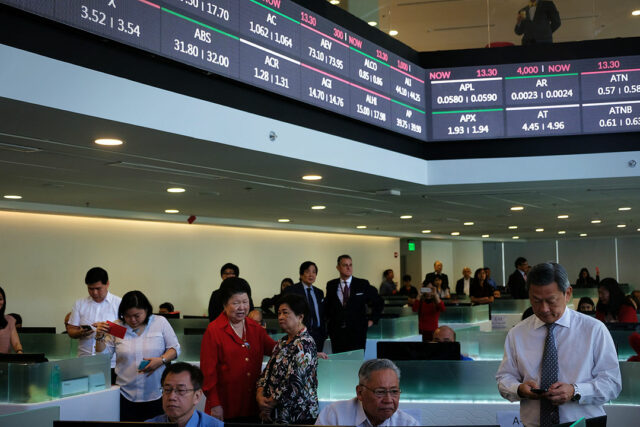
PHILIPPINE SHARES edged higher on Wednesday, buoyed by last-minute bargain hunting and growing expectations of a Bangko Sentral ng Pilipinas (BSP) rate cut next month.

The benchmark Philippine Stock Exchange index (PSEi) went up by 0.10% or 6.20 points to close at 6,166.05, while the broader all shares index increased by 0.53% or 19.53 points to 3,676.71.

“Last-minute bargain hunting brought the local market higher this Wednesday. Rising hopes that the Bangko Sentral ng Pilipinas will ease their policy in their April meeting helped in lifting sentiment,” Philstocks Financial, Inc. Senior Research Analyst Japhet Louis O. Tantiangco said in a Viber message.

BSP Governor Eli M. Remolona, Jr. said in an interview with Bloomberg Television on the sidelines of the HSBC Global Investment Summit in Hong Kong on Tuesday that there is a “good chance” that the Monetary Board will cut rates by 25 basis points (bps) at their April 10 meeting, Bloomberg reported.

Mr. Remolona said the BSP remains on an easing cycle and could bring down borrowing costs by as much as 75 bps this year depending on data.

The central bank has reduced benchmark interest rates by a cumulative 75 bps since it began its rate-cut cycle in August last year, with its policy rate currently at 5.75%.

The Monetary Board in February unexpectedly kept rates unchanged amid uncertainties stemming from the Trump administration’s policies.

“Philippine shares made a modest recovery as Wall Street also closed higher on Tuesday, extending gains as investors bet on narrower US tariffs,” Regina Capital Development Corp. Head of Sales Luis A. Limlingan said in a Viber message.

On Tuesday, the Dow Jones Industrial Average rose by 0.01% or 4.18 points to 42,587.50; the S&P 500 gained by 0.16% or 9.08 points to end at 5,776.65; and the Nasdaq Composite climbed by 0.46% or 83.27 points to 18,271.86.

Majority of sectoral indices posted gains on Wednesday. Services increased by 1.7% or 34.05 points to 2,032.03; mining and oil went up by 1.42% or 130.12 points to 9,291.43; financials climbed by 0.36% or 8.59 points to 2,397.42; and industrials rose by 0.29% or 25.41 points to 8,752.70.

Meanwhile, property declined by 2.13% or 47.11 points to 2,162.55 and holding firms shed 0.47% or 24.17 points to end at 5,031.71.

“Puregold Price Club, Inc. was the day’s index leader, jumping 6.46% to P28. Bloomberry Resorts Corp. was at the tail end, falling 6.69% to P3.07,” Mr. Tantiangco said.

Value turnover went up to P4.91 billion on Wednesday with 1.06 billion shares exchanged from the P4.75 billion with 520.59 million issues traded on Tuesday.

Decliners bested advancers, 111 versus 92, while 46 names were unchanged.

Net foreign selling surged to P1 billion on Wednesday from P604.51 million on Tuesday. — Revin Mikhael D. Ochave