Home Blog Page 142

Taking a bow

STOCK PHOTO | Image from Freepik

TAKING A BOW after a public performance, and before an audience, is usually expected. This is an occasion for others to show appreciation for a public feat, like a long speech before a crowd, even one that has been given incentives to wildly show their approval. The loud accolade can be a disguised sigh of relief that the long ordeal of pretending to be mesmerized is over.

Competition in talent contests even requires the audience to vote with their applause and choose the best performance staged before them. The judges still have the final say on when to push the buzzer of approval.

College athletes too stand before their school’s cheering crowd to hear the alma mater song as they bathe in the applause and love of supporters after a victory. Even in a defeat, especially if a close one where the last shot to win the game is missed, there is some acknowledgement of appreciation. The losing team gets to weep in public as players simultaneously raise their arms and wipe their tears at the school song.

In the healthcare arena, doctors and nurses do not feel the need to take a bow for a successful procedure. This is done quietly when visiting the recovering patient in his room. A few questions are enough to complete the performance. (Do you feel any pain?) Only when the bill is presented can the patient applaud the doctors involved. (Were there really eight?) There is no need to take a bow.

What about karaoke evenings with friends? Here, there is an unwritten rule not to hog the mike. The audience also happens to be the performing group. They are waiting for their turn after chugging down two beers. Does the singer take a bow? (You want me to do “My way” again?) Please pass the mike to the next belter — “Let me try again?”

Theater has a tradition at the end of the play to call back the performers to take their bow. This allows the audience to show appreciation with standing ovations and prolonged applause, with shouts of “bravo.” Even the sequence of onstage entrances is preordained. The “extras” come on stage first and receive polite applause. Then it’s the supporting cast, building up to the main stars. The applause builds up to a crescendo as the main star enters the stage and holds hands with the front row cast to take her bow.

The number of curtain calls signifies the success of the performance when the exiting artist is called back to take yet another bow and sometimes accommodates the audience with an encore number. (The audience can sing along at this point.)

Movies in the end credits sometimes employ this device to show the actor and his role or to splice together bloopers and outtakes. The movies of Marvel uses the rolling end credits to introduce sequels, a nasty device that early moviegoers miss when they leave the theater thinking there’s nothing more to see but the name of the caterers and hairdressers.

The curtain call’s equivalent in corporate life is the “despedida party.” This quaint event honors a departing colleague and thus displays some of the curtain call’s theater tradition. Still, unless the retiree is off to a well-deserved mandatory retirement and migrating to Spain after discovering ancestors with the required racial credentials, the manner of exit can be more quietly observed. (Sir, no need to take a bow.)

Throughout a career, there is the constant opportunity to take a bow for a job well done. The rating system which determines promotions and the level of variable pay depends on who gets the credit for the delivered targets.

There is sometimes the issue of determining who really deserves the credit. And it is not always the one who struts on the stage waving at the audience, even if he’s making a full bow from the waist.

The desire for applause is not universal. Taking a bow is a ritual more than a requirement of social graces. There are those who prefer to work behind the scenes and keep their financial successes quiet. After all, the response may not be applause, but envy… and a possible investigation.


Tony Samson is chairman and CEO of TOUCH xda.

ar.samson@yahoo.com

Dining In/Out (03/19/26)


Mang Inasal holds halo-halo blowout

ON MARCH 22 and 29, Mang Inasal is treating all its customers to a marked down 12 oz Mang Inasal Extra Creamy Halo-Halo. On March 22, customers can visit any of the over 600 Mang Inasal stores nationwide and enjoy the discounted halo-halo for P39, exclusively for dine-in and take-out clients. On March 29, customers can order the treat via the new Mang Inasal app, Grab Food, and foodpanda and get it for P49. The Mang Inasal National Halo-Halo Blowout is an annual activity that serves as the company’s gesture of appreciation for its customers who have made the Extra Creamy Halo-Halo a leader in its category. Mang Inasal recently added milk dusting to its halo-halo for longer lasting creaminess. It also improved the look and features of its take-out and delivery cups. This is part of the #MangInasalCREAMINESS campaign for summer.


Krispy Kreme marks 20 years with churros, fruit teas

KRISPY KREME Philippines is celebrating its 20th anniversary by bringing back an OG favorite and introducing new beverages. Among this year’s highlights is the relaunch of the Mini Churros with Dips, a twist on the classic churro. Each C-shaped, unglazed mini ring doughnut is tossed in a cinnamon-sugar mix. A box of six includes 12 Mini Churro Doughnuts and three dips: Dark Chocolate, White Chocolate, and the new Dulce de Leche. Meanwhile, this summer they are introducing two Freshly Brewed Fruit Teas, made with Assam black tea. The collection features Tropical Mango (made with mango puree) and Strawberry Hibiscus (strawberry puree, a hint of hibiscus, topped with chopped dried strawberries). The Mini Churros with dips and Freshly Brewed Fruit Teas are now available until May 31. Get the Mini Churros with dips nationwide starting at P349 per box of 12 doughnuts, in limited quantities per store. Enjoy the Freshly Brewed Fruit teas at select stores starting at P109, available for dine-in, take-out, drive-through, and delivery.


Jollibee launches new Super Meal

JOLLIBEE has introduced a new Super Meal that brings several of its bestselling products together in one serving. The new Super Meal A features Chickenjoy, Jolly Spaghetti, and Yumburger, served with steamed rice and a drink, all for P185, as the lowest-priced option in the big meals category. Super Meal B pairs Chickenjoy and Jolly Spaghetti with regular Jolly Crispy Fries, rice, and a drink. Meanwhile, Super Meal C features Chickenjoy, Jolly Spaghetti, and a Burger Steak, served with rice and a drink. The new Super Meals are now available in all Jollibee stores nationwide, via dine-in, takeout, drive-through, and delivery.

SEC cancels Dual Fuel registration over investment solicitation

BW FILE PHOTO

THE Securities and Exchange Commission (SEC) has canceled the certificate of incorporation of Dual Fuel Petroleum Corp. over what it described as the illegal solicitation of investments from the public.

In an order dated Feb. 17, the SEC’s Enforcement and Investor Protection Department (EIPD) said it revoked the company’s registration for violating Section 44 of Republic Act (RA) No. 11232, or the Revised Corporation Code of the Philippines (RCC); Sections 8.1, 26.1, and 28.1 of RA No. 8799, or the Securities Regulation Code (SRC); and Presidential Decree No. 902-A.

The RCC prohibits corporations from exercising powers beyond those stated in their articles of incorporation (AoI).

Sections 8.1 and 28.1 of the SRC prohibit the sale or offering of unregistered securities and require brokers, dealers, or salespersons to register, while Section 26.1 prohibits fraudulent schemes in securities transactions.

Dual Fuel Petroleum, which was incorporated in 2020, is engaged in the establishment, operation, management, and maintenance of gas stations, with franchising listed as a secondary purpose in its AoI. The company is not authorized to solicit investments from the public or issue investment contracts.

The SEC said its investigation found that the company offered securities in the form of investment contracts without the required licenses.

“Considering that nowhere is it stated in its primary purpose that Dual Fuel Petroleum is authorized to engage in the selling or offering for sale of securities to the public… the activity of [the company] of selling or offering for sale of investments is considered an ultra vires act and therefore constitutes serious misrepresentation,” the order read.

The SEC also imposed a P1-million fine on the company for offering securities without the required registration or license. Its incorporators were also ordered to pay a P1-million administrative fine.

The SEC said Dual Fuel partnered with Legends Petroleum Corp., a franchising company, to attract public investment by offering franchise co-ownership with a minimum investment of P500,000 and promising quarterly profits for 20 years. The company offered 280 co-owner slots across eight gas stations.

The regulator said the scheme constituted fraud and resembled a Ponzi operation, in which returns to investors were derived from funds contributed by new investors or additional contributions from existing ones rather than from legitimate business activities.

Dual Fuel did not immediately reply to an e-mail seeking comment. — Alexandria Grace C. Magno

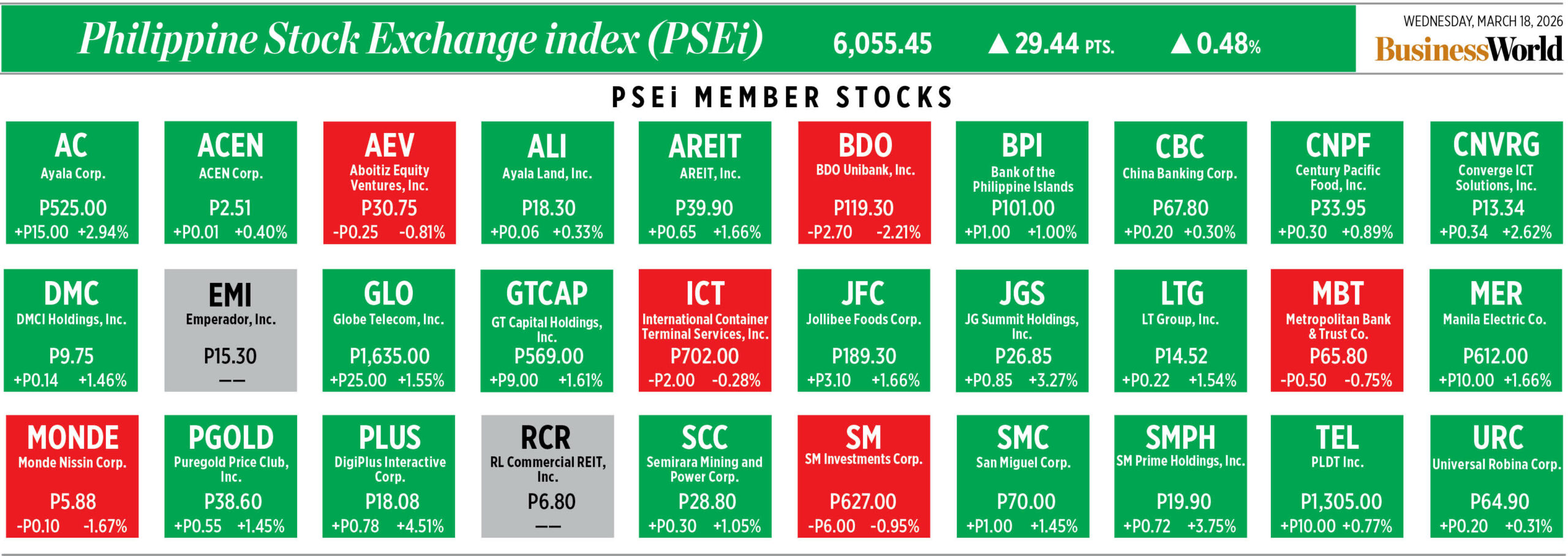
How PSEi member stocks performed — March 18, 2026

Here’s a quick glance at how PSEi stocks fared on Wednesday, March 18, 2026.


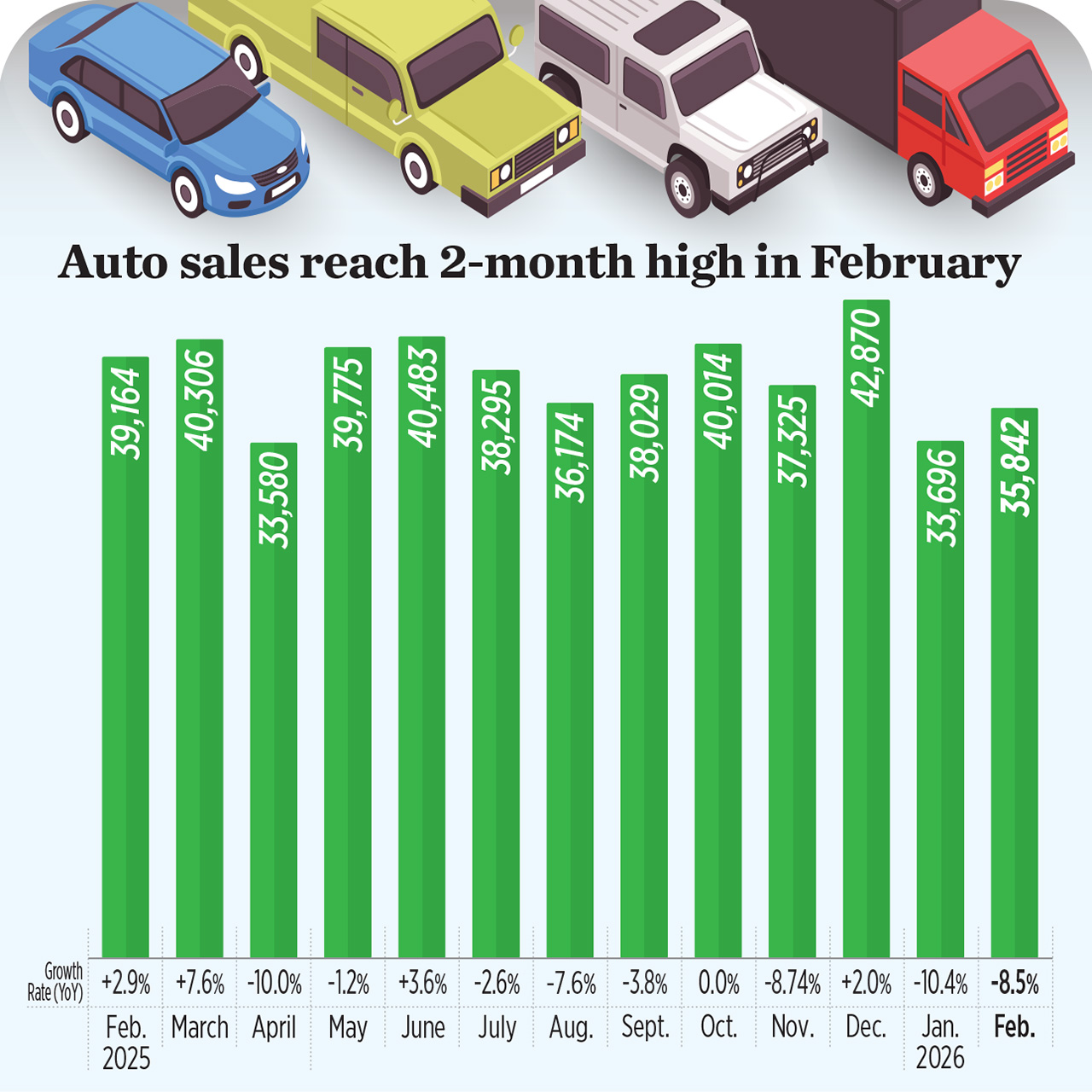
Auto sales reach 2-month high in February

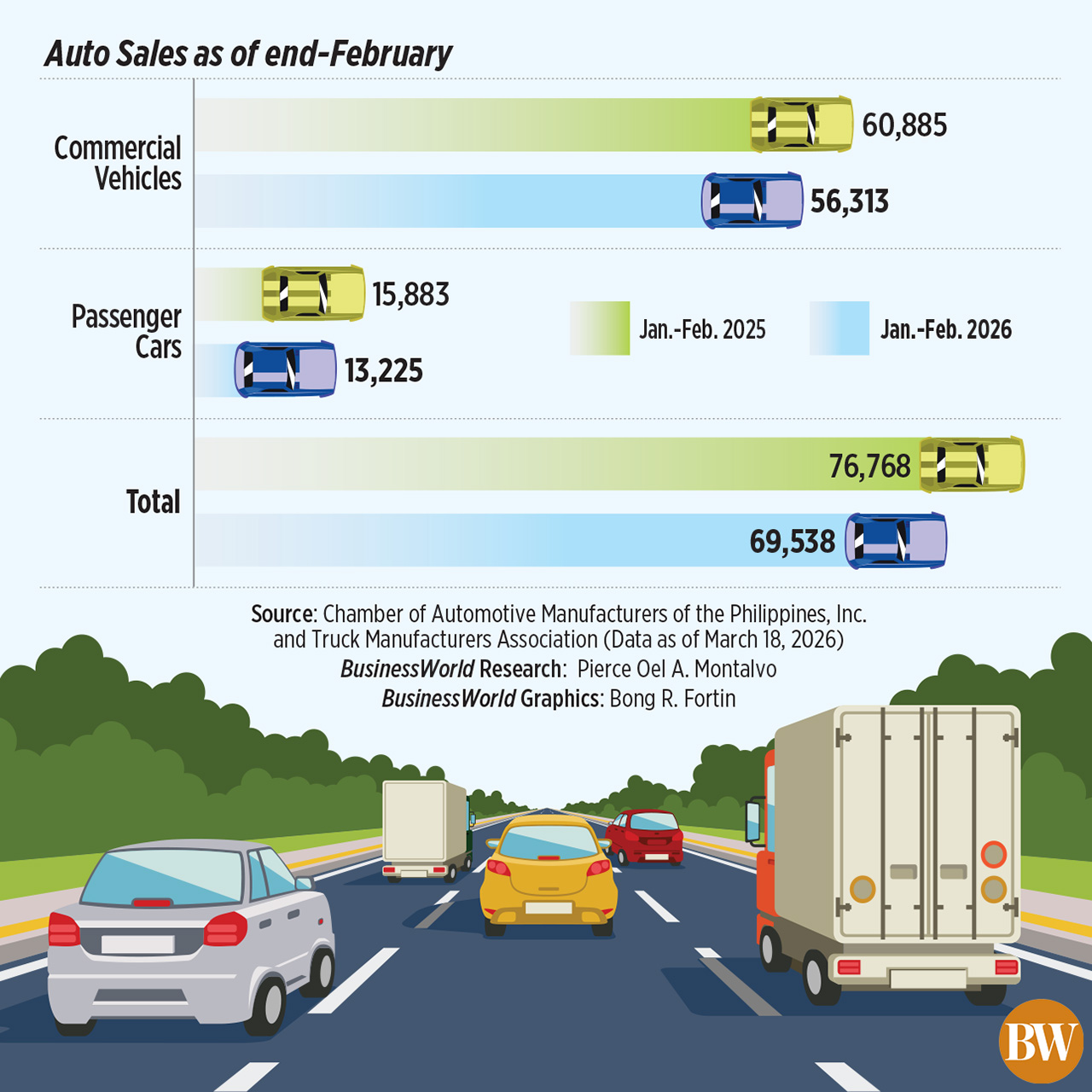
PHILIPPINE automotive sales dropped year on year in February as demand for passenger cars and commercial vehicles slumped, according to a joint report by the Chamber of Automotive Manufacturers of the Philippines, Inc. (CAMPI) and the Truck Manufacturers Association (TMA). Read the full story.

Measure granting Marcos fuel tax powers headed to Palace

A jeepney plies Taft Avenue in Manila. — PHILIPPINE STAR/RYAN BALDEMOR

By Kenneth Christiane L. Basilio, Reporter

THE measure granting President Ferdinand R. Marcos, Jr. the authority to suspend the excise tax on fuel is headed to the Palace, after the House of Representatives on Wednesday adopted the Senate’s version as lawmakers race to give him powers to ease surging oil prices linked to the Iran war.

Lawmakers adopted Senate Bill (SB) No. 1982 via voice vote, fast-tracking its enactment into law by bypassing a joint congressional committee tasked with reconciling differences between the Senate and the House versions.

“It’s practically an exact copy of our bill,” Marikina Rep. Romero “Miro” S. Quimbo, who heads the House Ways and Means Committee, told BusinessWorld in a phone call. “We’re absolutely pressed for time, and going through a bicameral conference committee might unduly delay it.”

Senate President Vicente C. Sotto III told the Senate floor the proposal will be sent to Mr. Marcos for his signature.

Moves to ease duties on petroleum products come as lawmakers scramble to authorize the chief executive with powers to cut rising fuel costs, which risks fanning inflation and weighing on economic growth, as global crude prices remain elevated due to the US-Israel war on Iran.

The bill’s approval comes as the conflict stretches into its third week with no end in sight as the US and Iran show no desire to strike a deal, and as Tehran continues to retaliate with missiles and drone strikes following unprovoked US and Israeli air attacks on Feb. 28.

The war has raised global concerns that it could fuel inflation as vital oil and gas shipments from the energy‑rich region remain blocked at the Strait of Hormuz, a key waterway where a fifth of global supplies pass.

Under SB No. 1982, the President, at the recommendation of an inter-agency budget committee, may suspend or cut the collection of excise taxes on fuel if the average Dubai crude oil based on Mean of Platts Singapore benchmark reaches or exceeds $80 per barrel for a month.

The bill also requires the President to submit to Congress within 15 days of issuing such an order a “factual basis” for halting or cutting the excise tax of petrol, including estimates of foregone revenue and the impact on inflation, fuel prices and economic activity, with monthly reports to follow.

Oil companies will also submit monthly information on its cost components for the price of petroleum products to the Energy department.

The Senate and House proposals differ mainly in duration and automatic triggers. The Senate bill limits the President’s power to three months, while House Bill No. 8418 allows a six-month suspension. Extensions cannot last for more than a year.

“It’s the same thing,” Mr. Quimbo said. “It doesn’t really matter because in three months, it’s again extendable for another period.”

The Senate measure also includes a safeguard that automatically restores the excise tax reductions once the average Dubai crude price falls below $80 per barrel, a condition absent from the House version.

“The suspension of the excise tax on fuel will not stabilize oil prices, which are volatile due to the Middle East war, but will only partially alleviate the pain caused by escalating oil prices,” Foundation for Economic Freedom President Calixto V. Chikiamco said in a Viber message.

He added that the potential effects of any cuts or suspension in fuel excise tax may only range from P10 for gasoline and P6 for diesel.

“It would also reduce much needed government revenue, which could have funded additional schools or infrastructure,” Mr. Chikiamco said.

Finance department estimates showed suspending excise tax collections could result in P136 billion in foregone revenue, which may further widen the government’s budget deficit and raise the country’s debt.

Suspending the fuel excise tax could slightly temper pump prices, Philippine Chamber of Commerce and Industry Chairman Emeritus George T. Barcelon said.

“I think it will slightly mitigate the price of oil for consumers,” he said in a phone call, noting that oil prices dictate market costs across products.

He said the government should consider reallocating funds from “non‑priority” state programs in the 2026 budget.

“Maybe they can repurpose some of this to help people meet their needs amid the crisis,” said Mr. Barcelon. “But all of this assistance extended must be on conditionality of the situation.”

“It would be better if this was implemented early, if the President was given emergency power earlier,” Mario “Mar” S. Valbuena, chairman of transport group Manibela, said in a phone call in Filipino. “The war has been going on for three weeks.”

He said lawmakers should consider reviewing a 28-year-old law that liberalized the downstream oil industry, while also scrapping the value-added tax on fuel. “That would be a big help,” he said in Filipino.

The Philippines imposes an excise tax of P10 per liter on gasoline, P6 per liter on diesel and P5 per liter on kerosene under the 2017 Tax Reform for Acceleration and Inclusion law. It previously allowed the government to suspend the collection of excise tax on fuel when world oil prices reach $80 per barrel for three straight months, but that provision lapsed six years ago.

House panel finds sufficient grounds to hear VP ouster raps

VICE-PRESIDENT SARA DUTERTE-CARPIO — PHILIPINE STAR/ RYAN BALDEMOR

A HOUSE of Representatives committee on Wednesday found the impeachment complaints against Vice-President (VP) Sara Duterte-Carpio sufficient in “grounds,” setting the stage for hearings into the accusations that have politically weighed on her.

The House Justice Committee ruled the two complaints seeking Ms. Duterte’s removal from office were sufficiently grounded under impeachable offenses in the 1987 Constitution and should proceed to hearings to determine whether there is enough proof to support the charges, Batangas Rep. Gerville R. Luistro, who heads the congressional panel, said.

“This will be a ‘mini-trial,’” she told a media briefing, adding that both the impeachment complainants and Ms. Duterte will be given “ample opportunity” to present witnesses and evidence during the hearings.

Michael T. Poa, spokesman for Ms. Duterte’s legal team, maintained that “the complaints suffer from a fundamental defect.”   

“They are built on conclusions, speculation, and narratives that are not anchored on the ultimate facts required under the Constitution and the Rules,” he said in a Viber message to reporters.

Mr. Poa said there have been no talks yet regarding Ms. Duterte’s attendance to the hearings, but noted her appearance is not required.

“There is no requirement under the applicable rules for her personal attendance. Any decision in that regard will be made in accordance with her rights and upon the advice of counsel.”

The 39-member congressional panel’s ruling will advance the complaints to an inquiry that will determine their merits and whether they should be endorsed for a vote on the House floor. At least 106 lawmakers must support the charges for them to be sent to the Senate, which would act as an impeachment court.

Ms. Duterte faces a range of accusations, including claims she misused hundreds of millions of pesos in secret funds under the Office of the Vice-President and the Education department during her tenure as its secretary.

The complaints also alleged she amassed wealth greater than her income, moved to destabilize the government and plotted to assassinate President Ferdinand R. Marcos, Jr., his wife and former Speaker Ferdinand Martin G. Romualdez, charges which she has denied.

Together, the ouster bids accused Ms. Duterte of graft, bribery, constitutional violations, betraying the public’s trust and other high crimes — all grounds for impeachment under the Constitution.

Ms. Luistro said the Justice committee will hold hearings even while Congress is on a six-week break, with proceedings beginning on March 25 and continuing on April 14, 22 and 29.

She said the Vice-President will be given the opportunity to refute the charges and present her case, even as her initial reply to the impeachment complaints did not directly address the accusations.

“The accusations are not trivial. They are serious, and they are weighty,” Ms. Luistro told the Justice committee.

Only the complainants and Ms. Duterte will be allowed to speak directly at the congressional hearings, she added.

“It is incumbent upon the respondent to present her evidence,” said Ms. Luistro, referring to the Vice-President. “If the respondent is not interested to present her evidence… there will be a proper party to do that presentation.”

Party-list Rep. Terry L. Ridon, a member of the Justice committee, said lawmakers will continue with assessing the impeachment cases even if Ms. Duterte does not appear before the congressional panel.

“The proceedings will still continue on a ground-by-ground basis,” he told the same media briefing.

Mr. Ridon added that lawmakers are expected to take up several motions related to the charges on March 25, including moves to subpoena Ms. Duterte’s statements of assets, liabilities and net worth, as well as her bank, tax and corporate records.

Ederson DT. Tapia, a political science professor at the University of Makati, said the impeachment hearings are likely to be heated and politically charged, taking note of how Ms. Duterte initially replied to the charges.

“Given her combative stance, the hearings are likely to be highly politicized, adversarial and protracted,” he said in a Facebook Messenger chat.

On Monday, Ms. Duterte asked the Justice committee to dismiss the cases against her, saying the allegations lacked evidence and were based on speculation. The charges, she said, lacked statements of “ultimate facts” and “recycle the same accusations” thrown against her in last year’s impeachment push

“Her camp will likely question jurisdiction, evidence and process at every stage, which could slow proceedings,” Mr. Tapia said. “Expect more strategic maneuvering than a swift resolution.”

The renewed impeachment effort against Ms. Duterte comes as she declared her intention to run for President in 2028, a move that could put her political standing to the test. She is the daughter of former President Rodrigo R. Duterte, who retains a strong grassroot support amid a rift with the Marcoses.

Impeachment proceedings against the Vice-President were revived after the Supreme Court blocked attempts in 2025 for violating procedural rules. — Kenneth Christiane L. Basilio

Senate sets aside biofuel blend bill over local producer concerns

REUTERS

THE PHILIPPINE Senate on Wednesday adjourned for a six-week break without taking up an urgent measure that would ease the importation of biofuel components, noting that many local producers may be affected by this move.

“Many of our colleagues want further discussion of the measure,” Senate Majority Leader Juan Miguel F. Zubiri told reporters after the chamber adjourned.

He added that local producers like coconut farmers, sugar farmers, ethanol producers, and biodiesel producers may be affected by the proposed liberalized importation measure.

“There was a lot of fear among our colleagues that they were really affected. They wanted a linger discussion on the floor, so we are not able to take it up in one day,” Mr. Zubiri said.

He added that the measure will be taken up once Congress resumes session on May 14.

Senator Sherwin T. Gatchalian said that the measure needs to be studied further, as more than 400,000 farmers and ethanol workers may be affected.

“We need to ensure that our farmers have protections and safeguards, and we should also study if the price of fuel will decrease,” he told reporters separately.

President Ferdinand R. Marcos, Jr. had earlier certified as urgent Senate Bill No. 1965 and House Bill No. 8469, which seek to amend Section 5 of Republic Act No. 9367 or the Biofuels Act of 2006, in a move to mitigate surging local fuel prices.

Under the Senate’s version, the President is granted powers to allow the importation of bioethanol and biodiesel once the price of blended gasoline or diesel is 5% higher than that of its pure counterpart regardless of the supply of locally produced biofuel components, and upon the recommendation of the Department of Energy and the National Biofuels Board.

The Senate bill also states that proceeds from tariff collections from imported biofuels will be allocated to social amelioration programs for farmers and workers in the domestic biofuels industry.

The program will be conducted through the Department of Social Welfare and Development, in consultation with the Department of Agriculture and other government agencies.

However, the House only allows for the temporary suspension of the mandatory biofuel blend requirement once blended fuel prices are at least 5% higher than its pure variant. It earlier approved its version on third and final reading.

Meanwhile, a senator on Wednesday filed a bill seeking to establish a national strategic petroleum reserve to cushion impacts of tensions in the Middle East where 90% of the country’s crude is sourced.

Under Senate Bill No. 1993, Senator Francis G. Escudero sought to create an oil reserve which can store supply for 90 to 180 days.

“Even temporary disruptions in the Strait of Hormuz have immediately sent fuel prices soaring in the Philippines, with cascading effects on transport, food logistics, and power generation,” Mr. Escudero said in a statement.

The bill is seeking an initial funding of P60 billion for the oil depot construction, also proposing for the Department of Energy (DoE) to be in charge of the reserve’s fuel inventory, construction, maintenance, and operations.

The bill also provided that the reserve may be utilized once the country’s fuel inventory declines by 20% in events of fuel supply disruption and 20% weekly average price hikes of Dubai Crude Oil.

Mr. Escudero proposed the municipality of Limay, Bataan to house the oil storage facility where the Petron refinery, the sole crude refinery in the country, is located.

The bill also features a Targeted Fuel Relief Program (TFRP) which may be tapped in cases of oil shock due to international price increase, calamities, and geopolitical tensions.

The TFRP aims to provide cash assistance and fuel vouchers for sectors directly affected by oil issues such as those in agriculture, transportation, micro and small enterprises operations, and other industries prescribed by the DoE.

Energy Secretary Sharon S. Garin said the country has enough fuel supply until the end of April.

Fuel prices in the Philippines have spiked due to tensions in the Middle East following the US-Israel and Iran conflict on Feb. 28.

The war, now in its third week, has increased gasoline prices by P12.90 to P16.60, diesel by P20.40 to P23.90, and kerosene by P6.90 to P8.90 per liter on March 17. — Adrian H. Halili and Kaela Patricia B. Gabriel

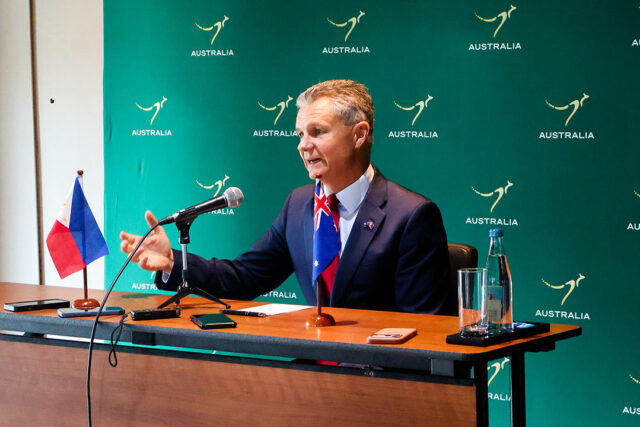
Australia turns to Philippines’ young population to address labor shortage

Australian Assistant Minister for Immigration and Assistant Minister for Foreign Affairs and Trade Matthew James Thistlethwaite speaks at a press briefing in Manila on March 18, 2026. — KAELA PATRICIA B. GABRIEL

AUSTRALIA is looking to strengthen its labor ties with the Philippines as it grapples with a workforce shortage brought by its ageing population.

In a briefing on Wednesday, Assistant Minister for Foreign Affairs and Trade Matthew James Thistlethwaite of Australia said the Philippines’ young population could help address Australia’s worker shortage, particularly in the healthcare and construction sectors.

“Australia doesn’t have such a young population unfortunately, ours is an aging population, which means that we’re not replacing the same number of workers in the workforce who are leaving our workforce,” Mr. Thistlethwaite of Australia said in a briefing on Wednesday.

“That requires us to look to our international partners to provide skilled labor in the Australian economy.”

He cited the Philippines’ young population, which he sees as a “great opportunity” for upskilling.

According to a 2024 report by the ASEAN+3 Macroeconomic Research Office (AMRO), the median age for Filipinos is at 24.5 in 2021, placing the Philippine population as the second youngest in Southeast Asia; while data from the Australian Bureau of Statistics showed Australia’s median population age in 2024 was 38.3 years old. Australians aged 65 and above also increased to 17% from 12% within two decades since 1994.

Mr. Thistlethwaite noted that their government is focusing on building more homes for Australians, necessitating a large number of skilled workers. 

“We’ll need a large number of skilled workers across all of the building trades to achieve that aim,” he said, adding the Australian government will provide training which can be beneficial to Filipino skilled workers.

Mr. Thistlethwaite is in Manila to lead the Australia-Southeast Asia Business Exchange mission, which aims to improve the trade and investment relations of Australia and the Philippines in terms of infrastructure, renewable energy, agriculture, and education.

He will also meet with the officials from the departments of Trade and Industry, Foreign Affairs, and the Technical Education and Skills Development Authority to discuss bilateral trade agreements including the enhancement of their education collaboration with the Philippines. Every year, 20,000 Filipinos come to Australia to study. — Kaela Patricia B. Gabriel

State of emergency still possible

BW FILE PHOTO

THE Philippines may declare a national state of emergency amid the prices of basic goods soaring due to the Middle East crisis, Malacañang said on Wednesday, though it added that such a move is not currently under discussion.

“It could happen, similar to what we did during typhoons or earthquakes,” Palace Press Officer Clarissa A. Castro told DZMM in Filipino.

“It hasn’t been discussed yet, but a declaration is possible if the situation warrants it, especially if we see abuses,” she added.

On Tuesday, she said there is no need for the country to declare a state of emergency yet because the government still has the situation under control.

In a bid to cushion Filipinos from rising costs driven by higher fuel prices, Congress on Wednesday approved a bill allowing President Ferdinand R. Marcos, Jr. to cut or suspend excise taxes on fuel.

Lawmakers transmitted the bill to Malacañang for the President’s signature, but Mr. Marcos earlier that day said he was still unsure whether or not he would use the emergency powers.

“Right now, we are just adjusting to the situation. When the situation calls for it, maybe we will see when to exercise that power and by how much,” he told reporters in San Juan City.

Ms. Castro also said there are no talks yet for a possible wage hike as workers intensify calls for higher pay to keep up with inflation.

For the middle class, which comprises 40% of the population according to the Philippine Institute of Development Studies, Ms. Castro said the cut on excise tax would benefit them as well.

“When the excise tax is reduced, even the wealthy will benefit. Some say that doesn’t seem right because the rich also gain from it. But all of us here are equal. Rich or poor,” she said.

“Whatever relief the President can provide, whether for the rich or the poor, we should appreciate it.” — Chloe Mari A. Hufana

NUPL backs March 19 transport strike

COMMUTERS crowd a portion of Commonwealth Avenue in Quezon City as they wait for available passenger jeepneys and buses on the first day of the planned three-day transport strike of Manibela, Sept. 17. — PHILIPPINE STAR/MIGUEL DE GUZMAN

A LAWYERS’ GROUP on Wednesday expressed support for a nationwide transport strike set this week in response to the spiraling costs of fuel and basic commodities.

In a statement, the National Union of Peoples’ Lawyers-National Capital Region (NUPL-NCR) endorsed the Pagkakaisa ng mga Samahan ng Tsuper at Operator Nationwide (PISTON) in launching the protest on March 19, as petroleum, electricity, and essential goods continue to surge in cost.

“The conduct of a transport strike is a unique way for workers and the citizens to express their sentiments and views to the government and the wider public,” the NUPL said in Filipino.

“Fuel subsidies for PUV (public utility vehicle) drivers and operators, along with free rides for commuters, are merely short-term solutions,” it added, noting that while oil price increases are staggered, the costs of basic necessities continue to climb without any corresponding increase in wages or income.

“It also seems that the impact of the four-day workweek on public service was not thoroughly considered. The government’s pessimistic message is: when the blanket is short, learn to curl up,” the NUPL said. 

The lawyers highlighted the country’s vulnerability as an export-driven, import-dependent economy sourcing 98% of crude oil from abroad, particularly West Asia, warning that rising oil prices create a domino effect on food, electricity, and water costs.

“The prudent proposal to remove the excise tax and value-added tax on oil products is timely,” the group added, urging the government to roll back fuel prices to P55 per liter and abolish oil deregulation in the industry among other demands. — Erika Mae P. Sinaking

Comelec ends Marcoleta probe

PHILSTAR FILE PHOTO

THE Commission on Elections (Comelec) cleared Senator Rodante D. Marcoleta of potential election offenses involving campaign finance disclosures from the 2025 national and local elections.

In a resolution on Wednesday, the Comelec en banc terminated its motu proprio investigation after finding no evidence that he committed a punishable election offense.

“Terminate this investigation as there being no other evidence to show that respondent committed any election offense,” the poll body said.

The investigation into Mr. Marcoleta, who placed sixth in the 2025 senatorial race with over 15 million votes, was initiated after Comelec noted a discrepancy between his statement of contributions and expenditures and his declared personal wealth.

Mr. Marcoleta argued that the P75 million in contributions he received were not subject to disclosure requirements because they were accepted more than a month before the campaign period, meaning he was not yet legally considered a candidate and the money constituted personal funds.

“Nevertheless, this investigation has established the fact that respondent did not comply with Section 109 of the Omnibus Election Code,” the Comelec said. 

It adopted the recommendations of its Political Finance and Affairs Department, noting that the three alleged donors remain legally obliged to file their reports.

“File a complaint for election offense before the Law Department for the requisite conduct of preliminary investigation against the three contributors of the respondent due to their failure to submit their respective individual Report of Contributions within thirty (30) days after the elections,” the Comelec said. — Erika Mae P. Sinaking

ADVERTISEMENT
ADVERTISEMENT