Home Blog Page 1391

Sean ‘Diddy’ Combs jury decides on some counts; verdict not yet known

Sean “Diddy” Combs on the talk show Late Night with Seth Myers. — IMDB

NEW YORK — The jury at Sean “Diddy” Combs’ sex trafficking trial has reached a verdict on four of the five counts the music mogul faces, the judge overseeing the case said on Tuesday, without revealing the outcome.

After two days of deliberation, the jury reached a verdict on four charges: two counts of sex trafficking and two of transportation to engage in prostitution, US District Judge Arun Subramanian announced.

But the judge said the jury had not been able to reach a verdict on a fifth charge, racketeering conspiracy, because jurors had “unpersuadable opinions on both sides.”

He instructed the jury to continue deliberating on the racketeering conspiracy count. The jury will resume deliberations at 9 a.m. EDT on Wednesday.

Mr. Combs, 55, had pleaded not guilty to all five counts. If convicted of sex trafficking or racketeering, the former billionaire known for elevating hip-hop in American culture could face life in prison.

Before Mr. Subramanian read the jury’s note, Mr. Combs rubbed his eyes and rested his face against his palm while seated at the defense table with his lawyers huddled around him. One defense lawyer, Brian Steel, rubbed Mr. Combs’ shoulder. Two of Mr. Combs’ other defense lawyers put their arms around each other.

The partial verdict comes after a seven-week trial in which two of the music mogul’s former girlfriends testified that he physically and sexually abused them.

Prosecutors say Mr. Combs was charged with racketeering because for two decades he used his business empire to force two of his romantic partners to take part in drug-fueled, days-long sexual performances sometimes known as “Freak Offs”  with male sex workers in hotel rooms while Mr. Combs watched, masturbated, and occasionally filmed.

His lawyers acknowledged that the Bad Boy Records founder, once famed for hosting lavish parties for the cultural elite in luxurious locales like the Hamptons and Saint-Tropez, was at times violent in his domestic relationships. But they said the sexual activity described by prosecutors was consensual.

JURY ASKS TO REVIEW CASSIE’S TESTIMONY
Earlier on Tuesday, the jury asked to review portions of the testimony of the rhythm and blues singer Casandra “Cassie” Ventura, who testified that Mr. Combs forced her to take part in “Freak Offs” throughout their decade-long relationship.

The 12-member jury asked to review Ms. Ventura’s testimony regarding a 2016 incident at an InterContinental hotel in Los Angeles, when a surveillance camera captured footage of Mr. Combs kicking and dragging Ms. Ventura in a hallway.

Jurors saw the security camera footage several times throughout the trial. Prosecutors say that at the time of the incident, Ms. Ventura was attempting to leave a “Freak Off,” Mr. Combs’ term for a drug-fueled sex marathon in which he would watch Ms. Ventura have sex with a paid male escort while he masturbated and sometimes filmed.

Prosecutors say that conduct amounted to sex trafficking because Mr. Combs used force and threats to cut off financial support or release sex tapes of Ms. Ventura to coerce her to take part in the performances, and because the escorts were paid.

Mr. Combs’ defense pointed to tender and sexually explicit text messages that Ms. Ventura sent Mr. Combs throughout their relationship to bolster their argument that she took part in the “Freak Offs” because she loved Mr. Combs and wanted to make him happy.

They say the violent 2016 altercation stemmed from a dispute about Mr. Combs’ relationship with another woman.

Prosecutors charged Mr. Combs with racketeering conspiracy because they say his employees facilitated his abuse by setting up hotel rooms for “Freak Offs” and procuring illegal drugs for the sex parties. The defense argued that Mr. Combs kept his personal and professional lives separate, and that the drugs were for his personal use. — Reuters
PLDT plans HQ in Filinvest City

FILINVEST ALABANG, INC.

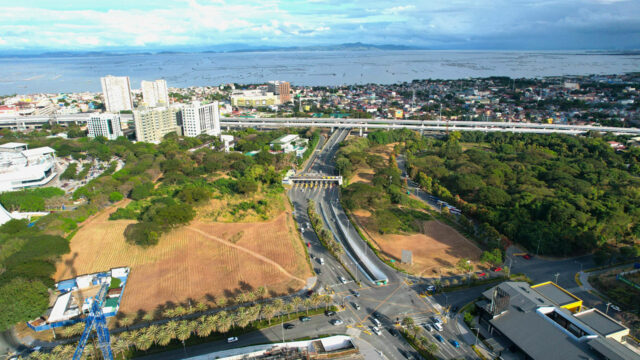
PANGILINAN-LED telecommunications giant PLDT Inc. has chosen the 244-hectare Filinvest City township in Alabang, Muntinlupa City as the location for its future headquarters (HQ).

PLDT, the newest major locator in Filinvest City, will build a five-hectare PLDT tech campus in the Southgate District, Filinvest Alabang, Inc. (FAI) said in an e-mail statement.

FAI, the township and luxury residential arm of the Filinvest Group, said the tech campus is slated for progressive development, with initial phases expected to begin soon.

“This campus is part of our effort to build a healthier, more collaborative work environment. It reflects our belief that the workplace must evolve alongside the industries we serve. We hope it will inspire creativity, encourage teamwork, and support the future of PLDT,” PLDT Chairman and Chief Executive Officer Manuel V. Pangilinan said.

FAI said the development will generate thousands of jobs during construction and upon completion, stimulating demand for residential and commercial spaces and benefiting local businesses and startups.

“What was once a quiet stock farm has been transformed into a vibrant garden metropolis. This transformation did not happen overnight. It took vision, dedication, and a steadfast sense of purpose. Filinvest City was designed with intention: to foster an environment where businesses thrive, innovation flourishes, and people live well,” said Josephine Gotianun-Yap, vice-chairperson of Filinvest Development Corp. (FDC), the parent company of FAI.

“We believe a great city is not simply a backdrop to success — but a catalyst for it,” she added.

Hastings Holdings Inc., a unit of PLDT Beneficial Trust Fund subsidiary MediaQuest Holdings Inc., holds a majority stake in BusinessWorld through the Philippine Star Group. — Revin Mikhael D. Ochave

Philippines still at ‘significant’ level in Political Risk Index

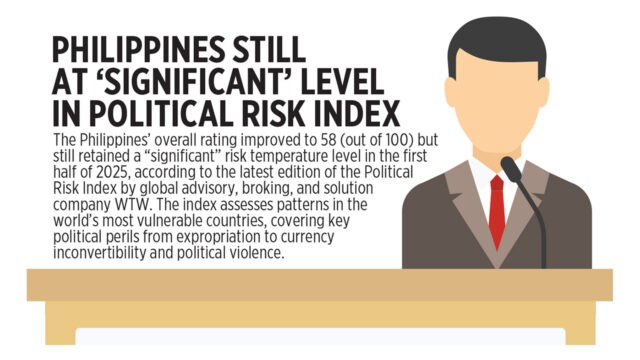
The Philippines’ overall rating improved to 58 (out of 100) but still retained a “significant” risk temperature level in the first half of 2025, according to the latest edition of the Political Risk Index by global advisory, broking, and solution company WTW. The index assesses patterns in the world’s most vulnerable countries, covering key political perils from expropriation to currency inconvertibility and political violence.

Philippines still at ‘significant’ level in Political Risk Index

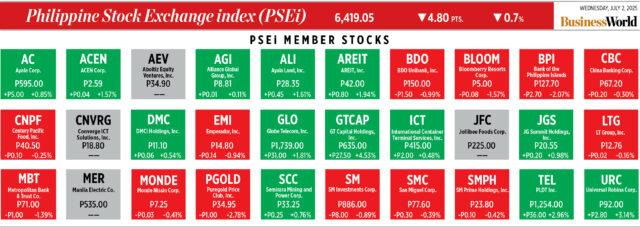
How PSEi member stocks performed — July 2, 2025

Here’s a quick glance at how PSEi stocks fared on Wednesday, July 2, 2025.


Shares slip as focus shifts to US tariff deadline

BW FILE PHOTO

PHILIPPINE STOCKS slipped on Wednesday as market focus turned to the Trump administration’s July 9 tariff deadline.

The main Philippine Stock Exchange index (PSEi) edged down by 0.07% or 4.80 points to close at 6,419.05, while the broader all shares index slipped by 0.06% or 2.45 points to 3,796.91.

“The local market pulled back as global trade uncertainties weigh on sentiment. This comes as the deadline of trade negotiations with the United States draws near, with no deals established leading to the imposition of reciprocal tariffs,” Philstocks Financial Inc. Research Manager Japhet Louis O. Tantiangco said in a Viber message.

“Investors also digested the latest comments from the Federal Reserve stating that [US President Donald J.] Trump’s tariffs are a hindrance to their policy easing. On a positive note, losses were trimmed at the last minute, allowing the market to maintain its ground above 6,400,” he added.

Mr. Trump said he was not considering extending the deadline for countries to negotiate trade deals with the United States, and cast doubts again that an agreement could be reached with Japan, although he expects a deal with India, Reuters reported.

Fed Chair Jerome H. Powell, under fire from Mr. Trump to cut rates immediately, reiterated that the US central bank plans to “wait and learn more” about the impact of tariffs on inflation before lowering interest rates.

Traders are pricing in about 64 basis points of cuts this year from the Fed, with the odds of a move in July at 21%.

The US’ planned “reciprocal” tariffs have been paused for 90 days until July 9, but a 10% blanket rate remains in effect.

“Philippine shares stayed afloat above the 6,400 level as investors maintained a cautious stance, closely monitoring the market ahead of Friday’s inflation report for signals on future economic conditions,” Regina Capital Development Corp. Head of Sales Luis A. Limlingan added in a Viber message.

Sectoral indices closed mixed on Wednesday. Mining and oil went down by 2.04% or 198.79 points to 9,513.42; financials decreased by 0.97% or 22 points to 2,246.86; and services fell by 0.21% or 4.65 points to 2,154.93.

On the other hand, property rose by 0.6% or 14.63 points to 2,454.67; industrials increased by 0.46% or 42.55 points to 9,107.31; and holding firms edged up by 0.26 point to 5,618.25.

“GT Capital Holdings, Inc. was the day’s index leader, climbing 4.53% to P635. Puregold Price Club, Inc. was the main index laggard, falling 2.78% to P34.95,” Mr. Tantiangco said.

Value turnover went up to P7.77 billion on Wednesday with 792.46 million shares traded from the P7.69 billion with 1.35 billion issues exchanged on Tuesday.

Decliners outnumbered advancers, 111 versus 76, while 67 names were unchanged.

Net foreign buying declined to P258.04 million on Wednesday from P969.71 million on Tuesday. — Revin Mikhael D. Ochave with Reuters

Peso halts winning streak on Fed, tariff concerns

BW FILE PHOTO

THE PESO snapped its six-day winning run against the dollar on Wednesday on better-than-expected US economic data, which led players to reconsider their bets on the timing of the US Federal Reserve’s next rate cut.

The local unit closed at P56.365 per dollar on Wednesday, dropping by 6.5 centavos from its P56.30 finish on Tuesday, Bankers Association of the Philippines data showed.

The peso opened the session stronger at P56.27 against the dollar. Its intraday best was at P56.26, while it dropped to as low as P56.42 versus the greenback.

Dollars traded fell to $1.59 billion on Wednesday from $1.97 billion on Tuesday.

“The dollar-peso closed higher on the dollar’s recovery overnight following the strong ISM (Institute for Supply Management) data and JOLTS (Job Openings and Labor Turnover Survey),” a trader said in a phone interview.

Sentiment was also dragged by renewed global trade uncertainties as the July 9 deadline for the Trump administration’s planned reciprocal tariffs looms, along with concerns over the fiscal health of the world’s largest economy, Rizal Commercial Banking Corp. Chief Economist Michael L. Ricafort said in a Viber message.

For Thursday, the trader expects the peso to move between P56.20 and P56.50 per dollar, while Mr. Ricafort said it could range from P56.25 to P56.45.

US job openings unexpectedly increased in May, but a decline in hiring added to signs that the labor market had shifted into lower gear amid uncertainty over the Trump administration’s tariffs on imports, with a 90-day pause on higher reciprocal duties drawing to an end, Reuters reported.

Anxiety over trade policy and ebbing labor market momentum was underscored by a survey from the ISM on Tuesday, with manufacturers variously describing the business environment as “hellacious” and “too volatile” for long-term procurement decisions.

Job openings, a measure of labor demand, were up 374,000 to 7.769 million by the last day of May, the Labor department’s Bureau of Labor Statistics said in its Job Openings and Labor Turnover Survey, or JOLTS report. Economists polled by Reuters had forecast 7.3 million vacancies. There were 1.07 jobs for every unemployed person, up from 1.03 in April.

Hiring, however, decreased 112,000 to 5.503 million, with declines concentrated in healthcare and social assistance, manufacturing as well as professional and business services. But hiring surged by 107,000 in accommodation and food services. The hires rate fell to 3.4% from 3.5%.

Economists say the lack of clarity on what happens after July 9, when the 90-day pause on President Donald J. Trump’s reciprocal tariffs expires, had left businesses unable to make long-term plans. A 90-day temporary reduction in tariffs between the US and China is due to end in mid-August. Treasury Secretary Scott Bessent said on Monday that trade partners could still face sharply higher tariffs next Wednesday.

Economists said the JOLTS report suggested the Federal Reserve could wait until September to resume cutting interest rates. The US central bank last month left its benchmark overnight interest rate in the 4.25%-4.5% range where it has been since December.

Fed Chair Jerome H. Powell on Tuesday reiterated the central bank’s plans to “wait and learn more” about the impact of tariffs on inflation before lowering interest rates.

Stocks on Wall Street fell. The dollar was little changed against a basket of currencies. US Treasury yields rose.

While the ISM’s manufacturing purchasing managers’ index nudged up to 49.0 in June from a six-month low of 48.5 in May, anecdotes from firms indicated tariffs were taking a toll. — A.M.C. Sy with Reuters

Hike in vehicle insurance premiums under study

PHILIPPINE STAR/JOHN UNSON

THE INSURANCE COMMISSION (IC) said it is considering increasing basic premiums for Compulsory Motor Vehicle Liability Insurance (CMVLI) in certain types of vehicles.

“In consonance with the President’s commitment to improve coverage for victims of road traffic incidents, increasing the Compulsory Motor Vehicle Liability Insurance benefits aligns with the national policy of ensuring accessible and adequate financial protection,” the regulator said in a draft circular dated June 27.

The basic premiums were set in 2006 and remained unchanged since.

The draft sets the limit for third-party liability for all CMVLI coverage at P400,000.

The draft also quadruples the benefits payable per loss resulting from any one incident as well as the maximum reimbursable fees for each service or accommodation.

The draft proposes basic premium hikes of AC and tourist cars to P905.79 for one-year CMVLI coverage from P590.82 previously, and to P2,594.94 for three-year coverage, from P1,692.61.

The basic premium for Taxis, Public Utility Jeepneys, and Minibuses increases to P1,346.3 for one-year coverage from P878.24 previously. It was raised to P3,855.70 from P2,514.97 for three-year coverage.

The draft proposes basic premiums for public utility buses and tourist buses of P1,303.21 per year, from P1,157.69 previously, and to P3,729.86 from P3,313.37 for three-year coverage.

Premiums are calculated by adding 12.5% documentary stamp tax, 12% expanded value-added tax, and 0.75% local government tax to the basic premium.

The proposed schedule of benefits and premium rates for each vehicle classification was submitted by the Philippine Insurers and Reinsurers Association, Inc. for review by the IC.

“The purpose of the CMVLI is to guarantee and ensure that the owners and/or operators of motor vehicles have the means and resources to indemnify, as far as applicable, the death and/or bodily injury of third parties or passengers arising from the operation of their motor vehicles,” the IC said. — Aaron Michael C. Sy

MSMEs vie to join Jollibee supply chain

BW FILE PHOTO

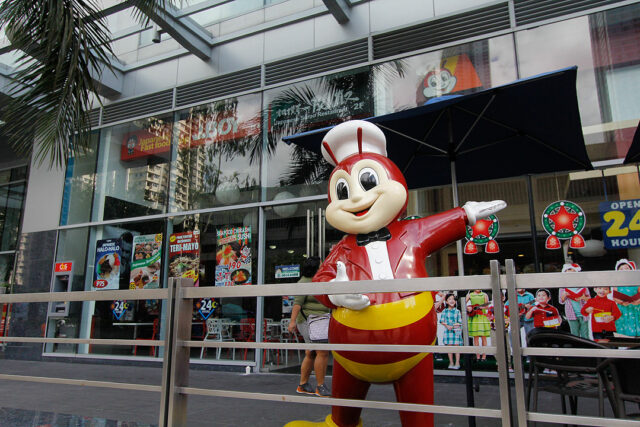
OVER 100 owners of micro, small and medium enterprises (MSMEs) participated in a session organized by the Department of Trade and Industry (DTI) which could make them eligible to become suppliers to Jollibee Foods Corp.

“This program is not just about upskilling our MSMEs. It’s about enabling livelihood,” Trade Secretary Ma. Cristina A. Roque said in a statement on Wednesday.

“By equipping entrepreneurs with the tools, knowledge, and network to become part of established value chains like Jollibee’s, we help them create sustainable income,” she added.

A total of 106 entrepreneurs participated in the session at the Jollibee Plaza in Ortigas Center on Wednesday, in a program organized by the DTI, Jollibee Foods Corp., and the Jollibee Group Foundation.

The MSMEs were given mentoring sessions by Jollibee Group executives on how MSMEs and smallholder farmers can join the Jollibee supply chain.

The program, which initially covered businesses in the agriculture and food sectors, now includes MSMEs from the construction and packaging industries.

“The DTI will actively work with Jollibee in tracking the progress of our MSME participants,” according to Trade Undersecretary for Regional Operations Blesila Lantayona.

“We want to see real outcomes, expanded markets, increased sales, streamlined operations, and even future partnerships with companies like Jollibee,” she added. — Justine Irish D. Tabile

Cisco says AI, cloud to require modernized networks

THE RISE of artificial intelligence (AI), cloud, and the Internet of Things will require information technology (IT) departments to overhaul their network technology, Cisco Philippines said.

“As AI assistants, agents, and data-driven workloads reshape how work gets done, they’re creating faster, more dynamic, more latency sensitive, and more complex network traffic,” Cisco said in a statement.

About 93% of IT officials expect improved infrastructure to drive revenue, while 97% expect meaningful cost savings when using smarter, more secure, and adaptive networks, Cisco added.

It also noted that 98% of those surveyed recognize the importance of secure networking to their operations and growth, while 97% believe an improved network will enhance their cybersecurity posture.

Cisco found that 82% have experienced major outages due to cyberattacks, congestion, and misconfigurations.

“(Around) 45%… say a modernized network’s greatest impact on revenue will come from deploying AI tools that automate and tailor customer journeys — enabling faster, more personalized experiences that can strengthen loyalty and drive growth,” Cisco added.

However, 65% of IT officials said their data centers are inadequate for AI demands, while 92% plan to expand capacity — whether on-premise, in-cloud, or both.

Some 99% consider autonomous, AI-powered networks to be essential to future growth, Cisco said.

“As businesses in the Philippines and around the world harness the power of AI, the network is the critical backbone that makes it all possible,” Zaza Soriano-Nicart, managing director at Cisco Philippines, said.

“To meet the needs of tomorrow’s businesses and protect against evolving threats, today’s networks must be faster, smarter, and more resilient,” she added. — Beatriz Marie D. Cruz

PHL wholesale price growth eases to 3-month low in May

PHILIPPINE STAR/MICHAEL VARCAS

WHOLESALE price growth of general goods eased further in May to its slowest pace in three months, led by the heavily weighted food index, the Philippine Statistics Authority (PSA) said in a report.

Citing preliminary data, the PSA said the general wholesale price index (GWPI) eased to 3.5% year on year, against 4% in April. A year earlier, the rate had been 2.3%.

The May indicator was the weakest reading since the 2.9% logged in February 2025.

Year to date, bulk price growth averaged 3.3%, slightly higher than the year-earlier 2.8%.

Michael L. Ricafort, chief economist at the Rizal Commercial Banking Corp., said in an e-mail that the year-on-year growth pickup in May was partly due to the midterm elections, which boosted demand for various goods and services.

He added that the May growth rate slowed from April as the campaign period wound down days before the May 12 midterm elections.

“The downtrend in the annual growth rate of the GWPI was mainly caused by the slower annual increase in the index of food at 2.2% in May 2025 from 2.9% in the previous month,” the PSA said in a report.

Additionally, the PSA said slower growth was also seen in the commodity groups of chemicals including animal and vegetable oils and fats, (14.5% from 15.3%), manufactured goods classified chiefly by materials, (0.9% from 1.3%), and machinery and transport equipment (1% from 1.4%).

Meanwhile, price growth accelerated in crude materials, inedible except fuels (96.2% from 94.6%), and beverages and tobacco (4.3% from 3.7%).

Price growth slowed in Luzon in May to 3.7% from 4.3% in April. The year-earlier reading had been 2.2%.

Meanwhile, price growth in the Visayas accelerated to 1.3% from 0.7% in April. Price growth had come down significantly from the 5.6% posted in May 2024.

Mindanao price growth eased to 0.9% from 1.1% in April and 1.9% in May 2024.

Mr. Ricafort said wholesale prices and inflation will be a function of external factors, especially those arising from the situation in the Middle East.

“This could determine any future volatility in global crude oil and other commodity prices (still uncertain; wait-and-see mode), since these are beyond the country’s reasonable control.” — Matthew Miguel L. Castillo

Telcos call for veto of Konektadong Pinoy bill

BW FILE PHOTO

By Ashley Erika O. Jose, Reporter

TELECOMMUNICATIONS companies urged President Ferdinand R. Marcos, Jr. to veto the Konektadong Pinoy bill, objecting to cybersecurity risks and the removal of Congressional oversight called for by the legislation.

“It is now up for review by Malacañang… since this is not an appropriations tax measure or revenue bill, the President cannot choose and pick any provisions to veto. It must be vetoed entirely and must be returned,” Globe Telecom Vice-President and Head of Legal Policy Ariel Tubayan said at the Kapihan sa Manila Bay on Wednesday.

Last month, Malacañang said that Mr. Marcos will be reviewing the bill, which is a priority measure for the administration.

The Department of Information and Communications Technology (DICT) has said that it is confident that the bill will be signed into law. 

The Senate and House of Representatives ratified on June 9 the bicameral conference committee report of Konektadong Pinoy.

The current version of the measure contained provisions that pose a threat to the industry, Mr. Tubayan said, citing the two-year grace period given to data transmission companies to ensure their systems are secure.

“That is very dangerous… threat actors can embed malware and other malicious software into the system,” he said.

The bill, which aims to increase internet access by relaxing regulations and allowing more entrants into the data transmission industry, has been opposed by telecommunications companies.

The Philippine Chamber of Telecommunications Operators (PCTO) has cited the weakening of regulatory oversight, the threat to national security and the removal of the rigorous approvals process undergone by the incumbents.

The bill seeks to raise competition in data transmission network, while encouraging investment n digital infrastructure to support reliable and affordable data services.

Smart Communications, Inc. Head of Regulatory Affairs and PCTO Vice-President Roy D. Ibay said another “dangerous” provision exempts satellite operators from review.

“There is a provision there that exempts them from getting any permission or authorization… And this is actually scary,” Mr. Ibay said.

The bill waives the legislative franchise requirement for operators of international gateway facilities, cable landing stations, and satellite service providers.

The bicameral version of Konektadong Pinoy also calls for the use of radio frequency spectrum to be optimized, and for underutilized and unutilized spectrum to be reallocated.

“Let us keep the playing field level, apply the same rules as you would to the incumbent players. We had to go through a rigid selection process and satisfy regulatory audits,” DITO Telecommunity Chief Executive Officer Ernesto R. Alberto told reporters on the sidelines of a briefing Tuesday.

The Philippine Competition Commission (PCC) has said that the measure will promote competition and will result in better services.

“The PCC believes that incorporating competition principles into the digital connectivity framework is essential to improving telecommunications services,” it said in a statement onTuesday.

The measure will streamline the approval process for telecommunications providers, while also promoting open access and easing barriers to entry, PCC Chairperson Michael G. Aguinaldo said.

“The bill also reinforces the state’s commitment to data inclusivity and consumer welfare by encouraging a more dynamic and responsive telecommunications market,” the PCC said.

The Financial Executives Institute of the Philippines said in a statement that Konektadong Pinoy’s simplified regulatory regime will attract foreign investors to digital infrastructure.

P20 rice program reaches 11,400 beneficiaries

PHILIPPINE STAR/EDD GUMBAN

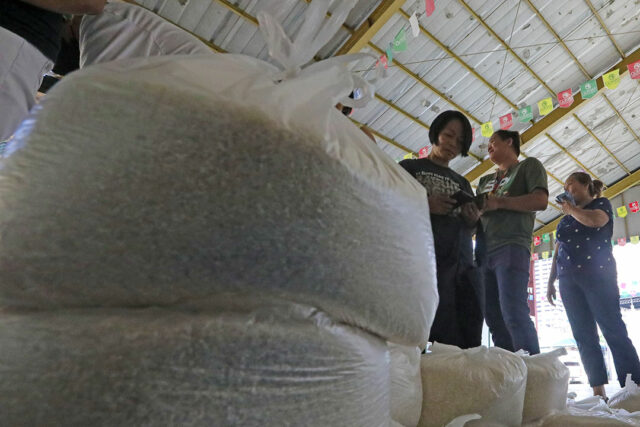
THE P20-per-kilo rice program has benefited 11,400 eligible households, Department of Agriculture (DA) spokesman Arnel V. de Mesa told reporters.

He said the subsidized rice, targeted at vulnerable segments of society, is now available at 94 locations nationwide.

Sales have amounted to 682 metric tons (MT) from National Food Authority (NFA) stock, he said, generating nearly P11 million in revenue, exclusive of P2.8 million in sales by outlets handled by the Department of Labor and Employment (DoLE).

DoLE is initially targeting 120,000 of the country’s 4 million minimum-wage workers.

Before DoLE introduced its priority list, the program was targeted at poor households eligible for cash transfers, senior citizens, solo parents, and persons with disabilities.

The expanded pilot program of the P20-per-kilo rice program seeks to reach up to 14 million individuals by September.

The program’s goals include freeing up NFA warehouse capacity to allow the agency to procure more palay (unmilled rice) from farmers at the favorable government support price.

However, farmers have been complaining of decreasing palay prices, receiving lower offers from traders for their grain.

President Ferdinand R. Marcos, Jr. in late June said that while the NFA purchases palay at P17 to P18 per kilo, private traders were offering only P11 to P12 per kilo.

Mr. De Mesa said Agriculture Secretary Francisco Tiu Laurel, Jr. has instructed his subordinates to investigate parts of Tarlac and Bulacan where traders are offering unreasonable prices for palay.

Rice imports fell to 2.17 million MT as of June 26, behind the pace compared with a year earlier of 2.34 MMT in imports, Mr. De Mesa said.

The US Department of Agriculture said in a report that Philippine rice production will likely hit 12.25 MMT in marketing year 2025-2026, which begins in July, citing “continued support from the government for the rice industry and the sale of subsidized milled rice.”

Farmers receive modernization support from the P30 billion in rice import tariffs given to the Rice Competitiveness Enhancement Fund (RCEF).

Mr. De Mesa said P10 billion in RCEF allocations have already been released under the General Appropriations Act, with the DA awaiting about P15 billion more that will be used for financial and credit assistance, solar-powered irrigation, soil health improvement, construction of composting facilities, and pest and disease management, among others.

“It will be requiring the concurrence and approval of the President,” he said. — Kyle Aristophere T. Atienza

ADVERTISEMENT
ADVERTISEMENT