Home Blog Page 1370

Maynilad IPO delay aligned with market conditions — analysts

MAYNILAD WATER SERVICES, INC.

By Revin Mikhael D. Ochave, Reporter

THE DECISION of Maynilad Water Services, Inc. (Maynilad) to delay its initial public offering (IPO) to no later than end-October reflects efforts to optimize pricing conditions amid weaker market sentiment caused by global geopolitical tensions, according to analysts.

“Maynilad’s decision to postpone its IPO to October is understandable given the recent shift in market sentiment following the United States’ strike on Iran,” DragonFi Securities, Inc. Equity Research Analyst Jarrod Leighton M. Tin said in a Viber message on Monday.

“Delaying the offering allows time for geopolitical tensions to ease and for investor confidence to recover — both of which are critical to the success of a major listing,” he added.

In a statement on Sunday, Maynilad said it moved the listing date of its IPO to no later than end-October from the initial schedule of July 17, citing potential demand from cornerstone investors.

Maynilad said it submitted an updated timetable to the Securities and Exchange Commission (SEC) and the Philippine Stock Exchange (PSE) to allow the inclusion of cornerstone investors. The company will list on the PSE under the trading symbol “MYNLD.”

“These investors have conveyed strong and sustained interest in participating in the offering, but requested additional time to complete their internal approval processes,” Maynilad said.

“The potential participation of these investors is expected to add even more value to Maynilad’s public offering and will be viewed positively by all investors and the markets at large,” it added.

On Sunday, Iran vowed to defend itself a day after the United States bombed three Iranian nuclear sites. The bombing came amid escalating tensions between Israel and Iran.

Amid the delay, Maynilad is expected to price its IPO at a discount to attract more investors and ensure demand, Unicapital Securities, Inc. Equity Research Analyst Peter Louise D.C. Garnace said in a Viber message.

“The deferment provides investors with additional time to evaluate key data points, including Maynilad’s first-half earnings performance, as well as developments on broader geopolitical risks such as the ongoing US trade tensions and escalating conflict in the Middle East, which could impact market sentiment and risk appetite,” he said.

“Maynilad’s postponement of its IPO to October 2025 is a move to accommodate anchor investors who we believe are crucial to the success of the issuance,” he added.

AP Securities, Inc. Research Head Alfred Benjamin R. Garcia said institutional investors’ increased caution amid global macroeconomic and geopolitical headwinds may have influenced Maynilad’s decision to defer its IPO.

“(The adjustment) was something that we expected, as we’ve been hearing that demand for the offer was only strong at the lowest range of its offer price,” he said in a Viber message.

“At this point, it might be too early to tell since the situation is very dynamic on the global front. But it’s increasingly likely that we’ll see another reduction in the size and price of the IPO,” he added.

Maynilad’s IPO consists of 1.93 billion primary shares and 354.7 million secondary shares priced at up to P20 apiece. The secondary shares will be sold by the water provider’s principal shareholder, Maynilad Water Holding Company, Inc.

It is expected to generate up to P37.41 billion in net proceeds from the IPO, assuming the overallotment option and preferential offer are fully subscribed. Proceeds will be used for capital expenditures and general corporate purposes. Maynilad will not receive proceeds from the sale of secondary shares.

The water provider said the proposed IPO remains subject to the issuance of the SEC order of registration and certificate of permit to offer securities for sale, as well as full compliance with regulatory conditions.

“Maynilad continues to coordinate with regulators and is proceeding with all necessary requirements for the proposed IPO,” it said.

The bellwether Philippine Stock Exchange Index (PSEi) went down 1.91% or 121.49 points to 6,218.28 on Monday. This was the PSEi’s lowest finish in nearly two months or since the 6,158.48 close on April 24.

The revised IPO timetable follows the recent approval by the Economy and Development Council — formerly the National Economic and Development Authority Board — of a ten-year extension to the concession agreements of Maynilad and Manila Water Co., Inc. The extension aligns Maynilad’s contract term with the expiration of its legislative franchise in 2047.

Pangilinan-led conglomerate Metro Pacific Investments Corp., which holds a majority stake in Maynilad, is one of three Philippine subsidiaries of First Pacific Co. Ltd., alongside Philex Mining Corp. and PLDT Inc.

Hastings Holdings, Inc., a unit of PLDT Beneficial Trust Fund subsidiary MediaQuest Holdings, Inc., has an interest in BusinessWorld through the Philippine Star Group, which it controls.

Filinvest sees upside in Alabang township despite new estate launches

CATHERINE A. ILAGAN, president and chief executive officer of Filinvest Alabang, Inc. — FILINVEST GROUP

By Revin Mikhael D. Ochave, Reporter

THE FILINVEST group is banking on unsold inventory and infrastructure readiness at its 244-hectare Filinvest City in Alabang, Muntinlupa to support growth in its township portfolio, as new large-scale developments emerge in Metro Manila and nearby provinces.

Catherine A. Ilagan, president and chief executive officer of Filinvest Alabang, Inc. (FAI), said Filinvest City continues to attract interest from businesses and residents, even as estates such as the 3,500-hectare Villar City, the 700-hectare Vermosa in Cavite, and the 74-hectare Arca South in Taguig expand their footprints.

“We’re the most developed. We have the essentials to back it up. We have the infrastructure and all of the utilities. All of that are already in place. Accessibility is also key. We also have access to talent,” Ms. Ilagan said in an interview with BusinessWorld.

“It takes a long time to develop into a real central business district (CBD),” she added.

FAI is the real estate arm of the Filinvest group, overseeing townships and high-end residential developments.

“In terms of densifying, there’s still a lot of potential for Filinvest City. The outlook for Filinvest City is really positive,” Ms. Ilagan said.

“The release of inventory is very deliberate,” she added.

According to a regulatory filing by the Filinvest group’s listed conglomerate, Filinvest Development Corp. (FDC), FAI beneficially owns 76.4 hectares of unsold lots in Filinvest City as of end-2024, indicating further growth capacity.

Launched in 1995, Filinvest City is a mixed-use township that integrates a CBD, residential communities, leisure destinations, educational institutions, and medical and wellness centers.

It is the country’s only CBD to hold both Leadership in Energy and Environmental Design (LEED) and Building for Ecologically Responsive Design Excellence (BERDE) certifications.

“The LEED and BERDE certifications are testaments to Filinvest City being a green development,” Ms. Ilagan said.

Filinvest City’s sustainability features include a district cooling system that reduces energy use and emissions by servicing multiple buildings, an integrated electric-powered transport system known as the 360 Eco-Loop, and dedicated green spaces and sustainable buildings in Northgate Cyberzone.

Under Ms. Ilagan’s leadership, FAI is replicating the Filinvest City model in other areas as it grows its portfolio of master-planned, sustainable townships and premium real estate developments under the Filigree brand.

Ms. Ilagan brings more than 30 years of experience in real estate and urban development.

“Filinvest City is a ten-minute city. Everything can be reached in ten minutes. This is the DNA that we want to replicate in the other townships,” Ms. Ilagan said.

“We’ve always subscribed to the idea of a balanced live-work-play. That’s the DNA of all of our townships, a well-rounded and balanced development,” she added.

Other FAI-led townships include the 58-hectare City di Mare in Cebu, the 201-hectare Filinvest Mimosa Plus in Clark, Pampanga, the 288-hectare Filinvest New Clark City in Tarlac, and the 677-hectare Timberland Heights in Rizal.

“Whether it’s a small development, a bigger development, a high development, or a denser development, there should always be that balance of live-work-play components. As a real estate developer, that is the sustainable way to do things. Now, we want everything to be walkable,” Ms. Ilagan said.

Ms. Ilagan said evolving market preferences have driven demand for township developments.

“Demand is there. The market is evolving. They are really appreciating developers who have evolved their way of thinking,” Ms. Ilagan said.

“It’s helpful that infrastructure has also shaped up. What’s important now is to listen to the market and see whether it is time to do something better or something grander,” she added.

The Filinvest group is celebrating its 70th anniversary this year. Its business interests span real estate, banking, power, utilities, hospitality, sugar, and infrastructure.

Apart from FAI, the group also operates in the real estate sector through Filinvest Land, Inc., which develops socialized, affordable, middle-income, and high-end housing projects. Its portfolio includes subdivision lots, mid-rise residential buildings, farm estates, industrial parks, residential resorts, and condominium projects. It also leases commercial and office properties.

FDC reported a 25% increase in first-quarter attributable net income to P3.6 billion, driven by contributions from its banking, real estate, hospitality, and sugar businesses. Total revenues and other income rose 11% to P29.3 billion.

Topline redirects IPO proceeds to fuel station expansion

PHILIPPINE STAR/EHDA M. DAGOOC

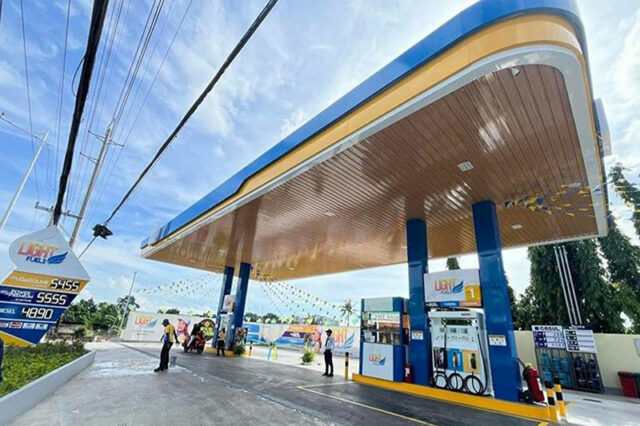
CEBU-BASED fuel retailer Top Line Business Development Corp. (Topline) has reallocated proceeds from its April initial public offering (IPO) to prioritize the expansion of its service station network.

In a regulatory filing on Monday, Topline said its board of directors approved the reallocation of IPO proceeds totaling P624.6 million.

The proceeds were previously earmarked for the construction of service stations and the acquisition of a fuel tanker.

Following a special meeting, the company said it redirected the funds, with the majority now allocated for expanding its service network. It also set aside P214.6 million for working capital and P10 million for general corporate purposes.

Topline said the reallocation is intended to optimize capital deployment by adopting more flexible strategies for expansion, while still including the construction of new service stations.

“As such, the proceeds initially allocated for the construction of new service stations will be reallocated to fund the broader expansion of the service station network,” the company said.

“This shift supports faster market entry and operational scalability while maintaining alignment with the company’s long-term growth objectives,” it added.

Topline said it has secured additional depot space through its existing lessor at a terminal in Mandaue City. The additional storage capacity is expected to enhance operational efficiency and inventory management, reducing the immediate need to invest in a fuel tanker.

“This reallocation is consistent with [Topline’s] ongoing commitment to practical financial management and its strategic focus on maximizing shareholder value,” the company said.

Topline was the first company to conduct an IPO on the Philippine Stock Exchange this year. Its shares, however, declined on their market debut. — Sheldeen Joy Talavera

Hyundai Motor Philippines Launches the All-New KONA Hybrid

Hyundai Motor Philippines, Inc. (HMPH) celebrates its 3rd anniversary, spotlighted by the launch of the all-new Hyundai KONA Hybrid at the Bonifacio High Street Amphitheater, BGC, Taguig City.

The Hyundai KONA first made its global debut in Seoul, South Korea in 2017, and made its way to the Philippine roads in 2018. This nameplate has acquired numerous awards globally as it progressed over the years, proving an exceptional reputation in the Hyundai lineup.

With the reintroduction of the brand’s iconic nameplates, HMPH will offer more options that will cater to the versatile needs and demands of the Filipino market. The return of the KONA in the PH roster further fortifies the presence of Hyundai in the country.

The second-generation Hyundai KONA is built for the passion-driven. While it retains its reputable character in supporting the active lifestyle of consumers, the all-new model comes with new features and conveniences, promising an exciting experience for those who are looking for more meaningful drives as they pursue their daily grind.

The all-new KONA has been upgraded for those who want to make a statement on the road. This sleek eye-catcher sports a revamped, future-oriented exterior led by its aerodynamic design. The fascia features a signature LED horizon lamp and 3D garnishes on the front bumper, which have been a signature in Hyundai’s latest designs. Furthermore, the Hybrid Premium variant is fitted with 18-inch, two-tone alloy wheels and a wheel arch cladding which emphasize the KONA’s rugged and unique SUV look. It also comes with a power sunroof and roof rail, increasing its appeal.
Under the hood, this subcompact Hybrid SUV is powered by a 1.6 Hybrid engine, mated to a 6-speed Dual Clutch Transmission with 141 Ps of power and 144 Nm of torque. This is paired with Smart Regenerative Braking and e-Motion Drive features to ensure smooth performance and handling.

The interior of the all-new KONA is thoughtfully designed as a ‘living space,’ carrying several features that provide its user with comfort and convenience. It has a contemporary cabin featuring a driver-centric cockpit with a floating dual 12.3-inch panoramic instrument cluster and infotainment display, electronic shift-by-wire system and 8-way power adjust driver seat. Wireless Apple CarPlay and Android Auto come standard in the KONA, as well as a wireless charging pad with a built-in cooling fan and Type-C USB ports. The front row passengers can enjoy an open console storage with rotating cup holders for better convenience, and comfortable second-row seats which are fold-flat compatible providing as flexible cargo space of up to 1,241L. A Smart Power Tailgate, which can be customized according to the user’s preferred height opening, allowing a more personalized experience for the user, is also present.

Safety is also enhanced through the Hyundai SmartSense, Hyundai’s suite of advance driver assistance systems (ADAS) that identify potential hazards for added peace of mind. This includes features like Smart Cruise Control with Stop & Go, Forward Collision Avoidance Assist, Lane Following Assist, and Lane Keeping Assist, among others. It’s also equipped with Blind Spot View Monitor and Surround View Monitor for optimal driver visibility.

Through the launch of the all-new KONA, HMPH expands its Hybrid line following the variant introductions of the SANTA FE, TUCSON, and ELANTRA.

The all-new KONA is available in two variants:

KONA 1.6 HEV GLS 6DCT — Php1,528,000.00

KONA 1.6 HEV Premium 6DCT — Php1,688,000.00

It comes in five colors, namely Neoteric Yellow, Atlas White, Abyss Black Pearl, Cyber Gray, and Meta Blue Pearl. Interested customers can inquire about the all-new KONA at their nearest Hyundai dealerships.

To learn more, visit https://www.hyundai.com/ph/en/find-a-car/kona/highlights. Stay updated with Hyundai through @HyundaiMotorPhilippines on Facebook and Instagram.


Spotlight is BusinessWorld’s sponsored section that allows advertisers to amplify their brand and connect with BusinessWorld’s audience by publishing their stories on the BusinessWorld Web site. For more information, send an email to online@bworldonline.com.

Join us on Viber at https://bit.ly/3hv6bLA to get more updates and subscribe to BusinessWorld’s titles and get exclusive content through www.bworld-x.com.

Andresons Group raises stake in Emperador

EMPERADORBRANDY.COM

THE ANDRESONS GROUP, Inc. has increased its stake in listed brandy and whisky maker Emperador, Inc. after acquiring P160 million worth of shares.

In a regulatory filing on Monday, Emperador said the Andresons Group, an affiliate of the company, purchased 10 million Emperador shares at P16 apiece on June 20.

Following the transaction, the Andresons Group now holds a 0.86% stake in Emperador, equivalent to 135 million shares. Both companies are controlled by tycoon Andrew L. Tan.

In May, the Andresons Group acquired 125 million Emperador shares through five separate transactions.

This year, Emperador has allocated P4 billion in capital expenditures, mainly for the ongoing expansion of its Dalmore distillery in Scotland, which is scheduled for completion in the second half.

The company is also doubling the size of its whisky maturation complex at the Invergordon distillery to 92 hectares from 45.4 hectares. The expansion will enable the facility to store an additional 1.5 million casks of maturing whisky.

For the first quarter, Emperador’s attributable net income rose by 6.5% to P1.85 billion, as revenues and other income increased by 0.6% to P13.21 billion.

On Monday, Emperador shares fell by 1.52% or 24 centavos to close at P15.50 apiece. — Revin Mikhael D. Ochave

A story of hope and tenacity in Superman

(L-R) David Corenswet, Rachel Brosnahan, director James Gunn, and co-producer Peter Safran visit Manila for the first stop of the Superman global promotions tour.

Iconic superhero gets new movie in July

THE 2025 iteration of the beloved comic book/movie/TV character Superman — this time played by David Corenswet — has him embark on a journey to reconcile his Kryptonian heritage with his human upbringing as Clark Kent.

Superman, which premieres in regular and IMAX theaters on July 9, is produced by Warner Bros. Pictures and DC Studios. It is the first film in DC’s freshly reimagined cinematic universe.

Co-starring in the film are Rachel Brosnahan as Lois Lane and Nicholas Hoult as Lex Luthor. Supporting actors include Edi Gathegi, Anthony Carrigan, Nathan Fillion, and Isabela Merced.

Mr. Corenswet, Ms. Brosnahan, movie director James Gunn, and co-producer Peter Safran kicked off the Superman global promotions tour in the Philippines, speaking to fans on June 19 at the Mall of Asia in Pasay, and to Asia Pacific press on June 20 at the Grand Hyatt Manila in Taguig.

BECOMING SUPERMAN
“The gym was the first place I started,” Mr. Corenswet said of his journey to become Superman — a journey that he called “isolating.”

“Whether you’re going to get that extra rep in, or do that extra set, or stay those extra 20 minutes to do your shoulders at the end of a long push day, at that moment, you feel very alone, even while you’re at the gym with other people,” he explained. “And so that was the first moment that I felt like I tapped into a central thing about Superman.”

The film follows the orphaned superhero grappling with the consequences of his mission to save humanity and yearning to find belonging on Earth.

For Mr. Gunn, who served as writer, director, and co-producer, this makes it “a story about humanity, about what it means to be a hero in a world that doesn’t always make it easy to be one.”

“What drew me to this film is Superman’s goodness at heart. He exists in a world that isn’t always kind, and he’s a symbol of hope — not just for the world, but especially for the Philippines. I’m used to writing flawed characters, but Superman is different. He’s not perfect, but he’s a truly good person,” he said.

EVOLVING CHARACTER
Meanwhile, Ms. Brosnahan pointed out that her take on Lois Lane is proof of “how much the character has evolved in the history of comics.”

“One of the first questions I asked James [Gunn] before the audition was, where does she fit into the canon of this character that is so familiar to so many of us?” she said. “And we really talked about the importance of her journalism.”

In Superman, Lois Lane balances her role as a love interest and as a superhero in her own right. This meant the actress had to speak with a lot of journalists and do her research on what would make one tick.

“Like Superman, she’s not knocked off balance easily. She can logic her way around just about anything. She’s 10 steps ahead of everyone else — and then along comes this thing she couldn’t have seen coming and it totally knocks her off her feet,” Ms. Brosnahan said.

LOVE OF THE COMICS
As for what longtime Superman fans can expect from the movie as a whole, Mr. Gunn shared that it is built on his own love of the comics as a child.

“I started reading the comics when I was around three or four years old. With this movie, I wanted to see the Superman I fell in love with from the comic books,” he said.

“I wanted to create that feeling I had as a kid, but also a version of Superman grounded in real stakes — real people who have issues and problems in relationships, and who could change themselves.”

Superman premieres in regular and IMAX theaters in the Philippines on July 9. — Brontë H. Lacsamana

Seeing opportunities beyond global economic uncertainties

CRECENCIO I. CRUZ

At the open forum of the recent Annual Stockholders’ Meeting of SM Investments Corp. held on April 30 at the Conrad Hotel in SM MOA, I was asked what I believed to be question of the day, if not the question of the year: “What would be the effects of the US tariffs on the company?”

I understood the genuine concern as the ripple effects of the new US policy were being felt on a global scale, not sparing even their staunch allies like the Philippines. It was important to analyze its possible repercussions against the backdrop of the Philippines’ own economic structure in recent years, and to understand not only how a company like SM can weather the headwinds of such a policy but also why the Philippines might be in a better position to rise up to the challenge.

The Philippine economy continues to post sound macroeconomic fundamentals in terms of continued GDP (Gross Domestic Product) growth, declining inflation and robust demand that is supported by resilient remittances.

The good news is inflation has been on a steady decline. The last figure was 1.4% in April from 1.8% in March. Notably, this is the lowest inflation rate since November 2019, which was 1.2%, thus bringing the national average inflation rate in the four-month period to 2%.

If we look closely at the structure of the economy, consumption accounts for over 70% of GDP. Manufacturing accounts for less than 20% of GDP. Trade with the US accounts for 17% of the Philippines’ total goods exports. A large part of the country’s dollar earnings come from services, like business process outsourcing and remittances, which are not subject to goods tariffs. This structure gives us a certain degree of protection, making us less vulnerable. We may be less open than other countries, but in this current environment, it provides us some insulation from potential adverse effects coming from external developments.

At SM, we remain conscious that the environment is changing and we should be alert to the changes, both in terms of what is happening on the trade side as well as what is happening in the markets that we serve.

Generally, to be resilient, we need to be flexible in shifting conditions and protecting long-term growth.

An article by Dunigan O’Keeffe, Karen Harris, and Austin Kimson in the Harvard Business Review pointed out that to succeed in an era of volatility, we need to invest in prediction, adaptability, and resilience. The article explored how vulnerable businesses can become when strategic foresight and operational flexibility are low on the list of priorities for boards and leadership teams. In order to tackle challenges, we need to factor in prediction, or the capability to generate beliefs about the future of our industry with enough precision and conviction to create opportunities for competitive advantage; secondly, adaptability, which means changing the business faster than competitors are changing; and lastly, resilience, where companies with superior resilience survive shocks better than their competitors do. This requires pressure-testing chosen strategies and business models.

In the case of SM, the core businesses — retail, banking, and property — are closely tied to the domestic economy and the everyday needs of Filipinos. These sectors continue to show stability and relevance even as market conditions change.

As consumption patterns continue to evolve, which form part of adaptability, we are positioning ourselves to meet new demands, while preserving the strengths that have anchored our group over the decades.

Our focus remains steadfast: to be agile and disciplined in our finances in order to stay well-positioned for sustainable long-term growth.


Amando M. Tetangco, Jr. was named the “MAP Management Person of the Year 2015” by the Management Association of the Philippines. He is the Chair of the SM Investments Corp. or SMIC.

map@map.org.ph

tetangcoa@gmail.com

BTr partially awards Treasury bills at mixed rates

BW FILE PHOTO

THE GOVERNMENT made a partial award of the Treasury bills (T-bills) it offered on Monday with mixed rates as risk sentiment took a hit due to the escalation of the war between Iran and Israel.

The Bureau of the Treasury (BTr) raised just P24.6 billion from the T-bills it auctioned off on Monday, short of the P25-billion plan, even as the offer was more than twice oversubscribed, with total bids reaching P65.47 billion. However, the demand seen was lower than the P74.205 billion in tenders recorded on June 16.

The Treasury partially awarded the three-month tenor as it rejected high bids, it said in a statement. The BTr awarded only P4.4 billion in 91-day T-bills on Monday, well below than the P8-billion plan and even as total tenders for the tenor reached P20.49 billion. The three-month paper was quoted at an average rate of 5.53%, 1.9 basis points (bps) lower than the 5.549% seen in the previous auction, with tenders accepted by the Treasury having yields of 5.45% to 5.555%.

Meanwhile, the government raised P11.2 billion from the 181-day securities it offered on Monday, higher than the P8-billion program, as bids amounted to P25.125 billion. The average rate of the six-month T-bill was at 5.557%, up by 3.4 bps from the 5.523% fetched last week, with accepted rates ranging from 5.522% to 5.588%.

Strong demand prompted the BTr to double its acceptance of non-competitive bids for the six-month T-bill to P6.4 billion, it said.

Lastly, the Treasury raised P9 billion as planned via the 364-day debt papers as demand for the tenor totaled P19.855 billion. The average rate of the one-year T-bill inched down by 0.2 bp to 5.655% from 5.657% previously. Accepted bids carried yields of 5.55% to 5.695%.

At the secondary market before Monday’s auction, the 91-, 182-, and 364-day T-bills were quoted at 5.4714%, 5.6213%, and 5.6842%, respectively, based on PHP Bloomberg Valuation Service Reference Rates data provided by the Treasury.

The T-bill auction saw mixed results for the second straight week despite the latest rate cut delivered by the Bangko Sentral ng Pilipinas (BSP) “largely due to and overshadowed by the recent Israel-Iran war and the surprise US attacks on Iran’s nuclear facilities,” Rizal Commercial Banking Corp. Chief Economist Michael L. Ricafort said in a Viber message.

The latest developments in the Middle East caused broad market uncertainty, leading a flight to safe-haven assets like the dollar, and also drove global oil prices higher, which could stoke inflation anew and affect the outlook for monetary easing at home and abroad, he said.

“Despite the rate cut, some are cautious with the inflationary impact of the geopolitical tensions in the Middle East,” a trader likewise said in a phone interview.

On Thursday, the BSP lowered benchmark borrowing costs by 25 bps for a second straight meeting, bringing the target reverse repurchase rate to 5.25%, as expected by 15 out of 16 analysts in a BusinessWorld poll.

It has now reduced benchmark borrowing costs by 125 bps since it began its easing cycle in August last year.

BSP Governor Eli M. Remolona, Jr. said they could deliver at least one more 25-bp cut this year, but noted that they remain watchful of emerging risks and their impact on prices, including the conflict in the Middle East and the uncertainties brought about by trade policy shifts among the world’s largest economies.

The Monetary Board has three more policy meetings this year.

Iran said on Monday that the US attack on its nuclear sites expanded the range of legitimate targets for its armed forces and called US President Donald J. Trump a “gambler” for joining Israel’s military campaign against the Islamic Republic, Reuters reported.

Tehran, which denies its nuclear program is for anything other than peaceful purposes, launched a volley of missiles towards Israel in the aftermath of the US attack, wounding scores of people and destroying buildings in Tel Aviv.

But it has not acted on its main options for retaliation, to attack US bases or choke off the 20% of global oil shipments that pass through the Strait of Hormuz.

Attempting to strangle the strait could send global oil prices skyrocketing, derail the world economy and invite conflict with the US Navy’s massive Fifth Fleet based in nearby Bahrain.

Oil prices jumped on Monday to their highest since January. Brent crude futures were up $1.11 or 1.44% to $78.12 a barrel as of 0653 GMT. US West Texas Intermediate crude advanced $1.08 or 1.45% to $74.87.

On Wednesday, the government will offer P40 billion in reissued Treasury bonds in a dual-tranche auction — P20 billion in seven-year bonds with a remaining life of two years and 10 months and P20 billion in 25-year notes with a remaining life of 24 years and seven months.  Aaron Michael C. Sy with Reuters

Victoria Industrial Park eyes up to 20 new locators by 2026

VICTORIAINDUSTRIALPARK.COM

VICTORIA INDUSTRIAL PARK (VIP) in Tarlac expects up to 20 locators to establish or expand operations within the facility by 2026, which could generate up to 10,000 jobs, its top official said.

“We are anticipating the expansion of approximately 15 to 20 locators in VIP within this year or the next, depending on the scale of each operation,” VIP Chief Executive Officer Melissa Yeung-Yap said in an e-mail.

“The majority of these are expected to come from the manufacturing and BPO (business process outsourcing) sectors, in line with our focus on attracting labor-intensive industries to promote job creation in the province,” she added.

The 30-hectare Victoria Industrial Park, located in Victoria, Tarlac, is the country’s first pharmaceutical-focused special economic zone. It was launched on May 1, following its declaration as a special economic zone last year.

The industrial park is located near the Tarlac–Pangasinan–La Union Expressway and is accredited by the Philippine Economic Zone Authority (PEZA).

Ms. Yeung-Yap said the park may be expanded by 60 to 100 hectares over the next two to three years to accommodate potential investors.

To attract more foreign investors, VIP is working to further streamline business entry processes and enhance incentives, she said.

“As a PEZA-accredited industrial park, VIP offers foreign locators access to a comprehensive suite of fiscal and non-fiscal incentives, significantly reducing operational costs and accelerating RoI (return on investment),” Ms. Yeung-Yap said.

VIP will also host a dedicated satellite laboratory of the Food and Drug Administration (FDA) to facilitate faster product market entry.

“This significantly de-risks and accelerates the often-lengthy product registration and facility licensing processes, particularly beneficial for pharmaceutical, food and beverage, and medical device manufacturers,” Ms. Yeung-Yap said.

She added that the park’s proximity to major highways, ports, and airports ensures reduced transport costs and shorter transit times. VIP also offers a skilled talent pool and concierge services to support ease of doing business.

“Attracting foreign locators to Philippine industrial estates hinges on creating an ecosystem that prioritizes efficiency, regulatory ease, and strategic advantages,” Ms. Yeung-Yap said.

The 30-hectare park is positioned to become a hub for investment, innovation, medical research, and inclusive growth. — Beatriz Marie D. Cruz

Danny Boyle uses iPhones to revive 28 Days zombie film franchise

AARON TAYLOR-JOHNSON and Alfie Williams are being chased by zombies in this scene from 28 Years Later. — IMDB

LONDON — More than two decades after the release of his zombie apocalyptic horror hit 28 Days Later, director Danny Boyle has returned to the franchise with a fresh set of eyes and a twist on a new technology.

The original film was set against the background of a “rage virus” that destroyed Britain and forced residents into quarantine. It was followed by the sequel 28 Weeks Later, directed by Juan Carlos Fresnadillo.

Even more time has passed in 28 Years Later, which was released last week and reunites Mr. Boyle with the original film’s writer, Alex Garland.

Starring Aaron Taylor-Johnson, Jodie Comer, Ralph Fiennes, and newcomer Alfie Williams, the movie follows a young boy’s journey with his father from a closed-off community on an island to the mainland to kill his first zombie.

His mother grapples with an illness which isolates her from the rest of her community and threatens to tear the family apart.

“There’d be occasional screenings of (28 Days Later) and… it hadn’t really dated,” Mr. Boyle told Reuters at the world premiere of 28 Years Later last Wednesday.

“More importantly, the people’s reaction to it felt like they were watching something very present day… and that led us to start thinking, should we introduce something else into this world?”

One of the innovations was the camera setup. Mr. Boyle got in close to the action by sometimes using up to 20 iPhones at a time on special rigs.

“Smartphones, they will now shoot at 4K resolution, which is cinema resolution. So you can use them,” Mr. Boyle said.

“They are incredibly light. You can go somewhere with a very light footprint and you can also build special rigs with them, which is what we did for some of the violent action in the movie.”

Mr. Taylor-Johnson said the technique gave the film a “visceral and immersive” texture. “It would make me feel a bit vulnerable at times because it’s very invasive.”

The film — which is now showing in Philippine cinemas with an MTRCB rating of R-18 — will also be first of a new trilogy of movies, with the second, 28 Years Later: The Bone Temple, due in January. — Reuters

Being the odd one out is working for the Philippines

BW FILE PHOTO

By Daniel Moss

GIVE the Philippines its due. The country could emerge as one of the winners from the trade war. Ironically, this reflects shortcomings from an earlier chapter in Asian commercial history.

Victory in the tariff era is relative. Few countries, if any, will come out ahead. Confidence was badly shaken by the vast scale of duties imposed by the White House in April, even if many were suspended for several months after a market swoon. The Philippines has a decent shot at being harmed least. The levy thrust on Manila by US President Donald Trump was 18%; within Southeast Asia, only Singapore fared better. 

It can count its lucky stars that manufacturing never really took off. When supply chains, particularly for electronics, began winding through Singapore, Malaysia, and Thailand in the last decades of the 20th century, the archipelago was largely overlooked. While the autocrat Ferdinand Marcos — father of the current president — was overthrown in 1986, big problems that discouraged investment remained. Infrastructure was shoddy, corruption was rampant, budgets were shaky, and political instability lingered. (The armed forces mounted a number of failed coup attempts, the most recent of which, in 2007, ended in a shootout in a top hotel in the capital’s business district.)   

The failure to become an industrial powerhouse may have held back growth during the region’s boom years, but now leaves the Philippines less exposed. Shipments of goods and services accounted for around 27% of gross domestic product in 2023, according to the World Bank. That compares with Vietnam’s 87.2% and Thailand’s 65.4%. Executives are sensing opportunity. “When buyers compute and see lower tariffs on the Philippines, they will start’’ to buy from us, George Barcelon, head of the Philippine Chamber of Commerce and Industry, told Bloomberg News shortly after Trump rolled out the levies. “Everybody in business has their eye on this.”

Not that the Philippines is invulnerable. The lack of opportunity at home has long meant that the country is a big exporter of human capital. Its citizens perform vital roles in the global economy. Singapore is offering bonuses to retain Filipino nurses, a street near Rizal Park in central Manila has long buzzed with agents hiring for some of the world’s biggest shipping lines, and Filipinos are a big source of foreign recruitment for the US military. Not to mention teachers, construction workers, and nannies. They wire a lot of money home. Remittances have climbed to around 8% of GDP and last year amounted to a record $38.4 billion. Those in the US might be vulnerable to the immigration crackdown launched by Trump, but the diaspora is not dependent on America for employment.

The country notched a fairly strong performance in 2024, with the economy expanding 5.6%. Inflation is under control and interest rates are coming down. But the downgrading of world growth forecasts won’t leave the Philippines unscathed. The peso has weakened this month along with a handful of other Asian currencies. Officials have adopted a pragmatic approach. “It’s futile to intervene when it’s a strong-dollar story driven by safe-haven flows,” Bangko Sentral ng Pilipinas Governor Eli Remolona told Bloomberg News. The good news is that the economy seems to be on its own, more positive track.

Manila still has formidable challenges. While infrastructure has improved, every visitor still has horror stories about traffic. The government also needs to use its declining birthrate wisely.* Officials know they have to invest in education and find ways to boost productivity, as peers did when families started becoming smaller. Tensions between Washington and Beijing in the South China Sea are also a negative. The Philippines, a former US colony and contemporary security partner, has rubbed up against Chinese vessels in recent years.

Politics serve as a distraction. Vice-President Sara Duterte, herself the child of a former leader, faces impeachment proceedings in the Senate over allegations of a plot to kill President Ferdinand Marcos, Jr. Her father awaits trial at the International Criminal Court for crimes against humanity allegedly committed in his deadly war against illegal drugs.

In large part, though, the country does seem to have put the “sick man of Asia  label behind it. Shrewd leaders and executives will seek advantage from the window Trump’s tariffs have opened.

BLOOMBERG OPINION

*The Philippines’ total fertility rate declined to 1.9 in 2022 from 2.7 in 2017. While this is still high compared with Japan, South Korea, and Singapore, it’s significantly less than the 3.0 recorded in 2013.

Sun Life Philippines names former AF Payments exec as new president

SUN LIFE of Canada (Philippines), Inc. President Jonathan Juan “JJ” D. Moreno — SUN LIFE OF CANADA (PHILIPPINES), INC.

SUN LIFE of Canada (Philippines), Inc. (Sun Life Philippines) has appointed former AF Payments, Inc. (AFPI) chief executive Jonathan Juan “JJ” D. Moreno as president of its insurance business.

“JJ Moreno’s appointment is a significant step in our journey, as we strive to further elevate Sun Life’s impact in the lives of Filipinos. His proven track record of achieving results with integrity, combined with his transformational leadership, will be instrumental as we continue to evolve to meet the changing needs of our clients and advisors,” Sun Life Philippines Chief Executive Officer (CEO) and Country Head Benedict C. Sison said in a statement.

Mr. Moreno has over 20 years of leadership experience across various industries, the life insurer said.

“A graduate of the Philippine Military Academy, Moreno is known for his ability to drive strategy execution and lead organizational transformation. He has consistently demonstrated a results-driven, values-centered, and client-focused leadership style,” it added.

Prior to his latest role with Sun Life Philippines, Mr. Moreno was the president and CEO of financial technology company AFPI, the company behind beep cards or the contactless cards used for transport fare payments.

“I am deeply honored and excited to embark on this new chapter with Sun Life Philippines. In a rapidly changing world, we are accelerating our transformation to be a future-ready and client-centric leader in the industry. The possibilities are endless, and Sun Life is ready to lead the way,” Mr. Moreno said.

Sun Life Philippines remained the top life insurer in the country in terms of premium income in the first quarter with P15.13 billion, it earlier said.

The life insurance industry’s premium income rose by 13.96% year on year to P99.9 billion in the first quarter, driven by variable life products, latest Insurance Commission data showed. — A.M.C. Sy