Home Blog Page 1363

Low inflation masks price hikes at sari-sari stores, study finds

BW FILE PHOTO

PRICES of various goods sold in mom-and-pop outlets, known in the Philippines as sari-sari stores, continue to increase despite a decline in inflation, a study by tech startup Packworks found.

“Key findings include significant retail price increases across the board for items like baby oil and baby powder,” Packworks said in a statement.

In particular, it said that a 50-milliliter bottle of Johnson’s regular baby oil increased 17% to P49 in 2025 compared to 2023 levels.

It added that prices of 100-gram packs of Tender Care baby powder also rose 25% to P50.

“These price hikes were observed in at least five regions: Ilocos Region (Region I), Cagayan Valley (Region II), Central Luzon (Region III), Mimaropa (Region IV-B), and Bicol Region (Region V),” it added.

Packworks also found price increases of at least 13% in 11 confectionery and snack stock-keeping units.

These include 50-gram Lala Fish Crackers Classic, which saw a 27% increase to P23, and 150-gram Fres candy, which rose 16% to P42.

Price increases were also seen in premium rice, which rose to P295 per five-kilogram pack.

Packworks Chief Data Officer Andoy Montiel said the study reveals how a slight increase in the products’ wholesale purchase price affects end-consumer pricing.

Sari-sari stores are known for their thin profit margins. While they operate as viable businesses, they also serve as extended pantries and community hubs for their neighbors,” he said.

“Even a slight increase in wholesale prices reveals how vulnerable micro-retailers are to cost shifts upstream. This creates a ripple effect, especially in low-income communities where these stores are the primary source of daily essentials,” he added.

According to Packworks, the price increases coincide with the declining inflation rate, which hit a low of 1.3% in May.

“Our latest analysis reveals gaps between national macroeconomic reports and the grassroots micro-retail reality,” Packworks Chief Executive Officer Bing Tan said.

“These insights can act as early indicators to inform distribution chains and policymakers of where support and aid are most needed,” he added. — Justine Irish D. Tabile

Nonbank financial institutions remain ‘cautious’ about sustainability practices

BW FILE PHOTO

NEARLY HALF of nonbank financial institutions (NBFIs) were evaluated as “cautious practitioners” of green finance, the Securities and Exchange Commission (SEC) said.

NBFIs classified as such have made moderate progress in green finance integration but remain risk-averse and selective in scaling their commitments.

To address this, a panel convened during the SEC’s Sustainability Week pointed to the need for unlocking investment in nature-based solutions and the transition of NBFIs toward more proactive, sustainable finance practices.

The SEC is pressing for the integration of sustainability in the financial system, steering companies into adopting sustainable practices.

SEC Commissioner McJill Bryant T. Fernandez said NBFIs play an important role in enabling economic transformation.

“As financial intermediaries and facilitators of investment flows, NBFIs are uniquely positioned to catalyze change — not just in markets, but in the communities and ecosystems that need it most,” he said.

SEC Chairman Francis Ed. Lim said sustainability must be a core principle in the financial system, through the observance of the Philippine Sustainable Finance Taxonomy Guidelines (SFTG).

“The real value of the Philippine SFTG lies in how well we apply it — in structuring financial products, shaping disclosures, guiding investment decisions, and delivering real-world impact,” Mr. Lim said in a statement on Monday.

Issued in February last year, the SFTG provides a framework for evaluating the environmental and social sustainability of economic activities. It also presents a “simplified approach” to assessing micro, small, and medium enterprises for financing.

Sustainability Week featured a training session on the SFTG, and capacity-building session on sustainable investments for NBFIs.

Separately, the SEC issued cease-and-desist orders against Bravo Zulo Romeo Lending Corp. (BZR Lending) for operating an unauthorized lending business, and Magic Peso for illegally operating an online lending platform (OLP) and unfair debt collection practices.

The SEC Financing and Lending Companies department found that the Magic Peso OLP is owned and operated by BZR Lending. The cease-and-desist orders were issued after complaints from borrowers regarding Magic Peso’s alleged unfair collection processes.

BZR Lending also failed to file a disclosure regarding any OLP operations despite being registered with the SEC as a lending company, the regulator said.

SEC Memorandum Circular (MC) No. 19 issued in 2019 requires the full disclosure and reporting requirements for financing and lending companies using OLPs. It also requires OLPs to disclose information such as their corporate name, SEC registration number, and certificate of authority to operate in a portion of their platforms.

Magic Peso’s operations also violate the moratorium imposed on new OLPs in November 2021 as outlined in SEC MC No. 10. — Revin Mikhael D. Ochave

Rice-processing system expected to benefit 6,000 Nueva Ecija farmers

PHILIPPINE STAR/KRIZ JOHN ROSALES

THE Department of Agriculture (DA) said a P64-million rice processing system opened to serve about 6,000 rice farmers in Nueva Ecija.

The system, which was funded through the Rice Competitiveness Enhancement Fund, consists of two recirculating dryers and a multi-stage mill that can handle 2-3 metric tons of palay (unmilled rice) per hour, the DA said in a statement.

“These assets will serve more than 6,000 rice farmers cultivating nearly 10,000 hectares of rice land in Nueva Ecija, enabling them to mill, package, and market their own produce — dramatically improving quality control and profit potential while slashing post-harvest losses,” the DA said.

The package also includes a four-wheel tractor, 16 combine harvesters, and a cultivator valued at P31.1 million.

Meanwhile, the DA also inaugurated 16 mobile soil laboratories — one for each region — designed to bring agronomic science closer to the farms.

Since its pilot release in December in Region III, the first lab has served over 1,500 farmers in 42 municipalities, issuing 362 soil-health cards and five fertility maps, the DA said. — Kyle Aristophere T. Atienza

Chicken, fish prices rise in mid-June

REUTERS

THE PRICES of key agricultural commodities, including chicken and fish, rose in mid-June, according to the Philippine Statistics Authority (PSA).

During the June 15-17 monitoring period, which the PSA calls the second phase of June,  galunggong (round scad) averaged P219.62 per kilogram at retail, against P215.65 during the first phase, it said in a report.

Compared to the second phase of May, galunggong prices fell from P221.08 per kilo.

The PSA said the average retail price of dressed chicken was P216.70 per kilo, against P214.49 in the first phase of June and P212.52 in the second phase of May.

The average retail price of snap beans (Baguio beans) rose to P126.90 per kilo from P117.96 in the first phase of June and P115.79 a month earlier.

The PSA said red onion fetched P154.27 per kilo at retail in the second phase of June, against P152.02 in the first phase of June and P151.48 a month earlier.

Calamansi averaged P95.54 per kilo in the second phase of June, against P98.60 in the first phase of June and P101.51 a month earlier.

The PSA said cooking oil averaged P181.46 per liter, against P179.49 in the first phase of June and P177.83 a month earlier. — Kyle Aristophere T. Atienza

The effects of VAT on digital services

Over the years, we’ve witnessed remarkable innovation, from the early days of basic communication tools to the sophisticated digital platforms we rely on today. What began with simple devices for messaging and calls has transformed into a global digital ecosystem powered by the internet.

Innovation has introduced a wide array of services that have reshaped how we live, work, and connect. Platforms such as Netflix, Disney+, HBO Go, and YouTube Premium revolutionized entertainment; Spotify and Apple Music redefined music listening consumption; app stores like the Apple App Store and Google Play Store enabled access to countless digital tools; and cloud services such as Google Drive and OneDrive changed how we store and share information.

Digital marketplaces like Shopee, Lazada, and Amazon; advertising platforms like Facebook Ads and Google Ads; gaming hubs such as Steam, PlayStation Store, and Xbox Live; and online learning platforms like Coursera, Skillshare, and Udemy have become integral to modern life and commerce.

This wave of innovation is more than technological progress; it is a strategic force that transforms industries, enhances productivity, and creates economic value. As digital services become central to economic activity, governments must adapt their fiscal policies to ensure fairness and sustainability.

To keep up with this digital transformation, the government passed Republic Act No. 12023, also known as the VAT on Digital Services. This law ensures that digital services consumed in the Philippines are taxed fairly, whether they come from local or foreign providers. Let’s break down the key features of the tax and understand how it affects the economy and consumers.

1. Classification and definition

Republic Act (RA) No. 12023 provides a clear and comprehensive definition of digital services, which includes automated services delivered over the internet or electronic networks. By classifying these services, the Act establishes a legal framework that enables the government to effectively monitor and tax digital transactions. (Sec. 03 of RA No. 12023, Sec. 108-A of NIRC)

2. 12% VAT on NRDSPs

A feature of RA No. 12023 is the imposition of a 12% VAT on gross sales from digital services consumed in the Philippines, regardless of the provider’s location. This measure ensures that nonresident digital service providers (NRDSPs) contribute to the Philippine tax base, just like their local counterparts. (Sec. 04 of RA No. 12023, Sec. 108-B of NIRC)

3. NDRSP tax compliance obligations

NRDSPs are required to register with the Bureau of Internal Revenue (BIR), issue VAT-compliant invoices, and remit taxes through the VAT on Digital Services (VDS) Portal. This requirement enhances transparency and accountability in cross-border digital transactions. (Sec. 07 of RA No. 12023, Sec. 113 of NIRC)

4. Some VAT exemptions

RA No. 12023 allows for VAT exemptions on specific digital services, particularly those related to education, government, or public interest. This provision ensures that essential services remain accessible and affordable, supporting social equity. (Sec. 05 of RA No. 12023, Sec. 109 of NIRC)

5. Local buyers’ obligation to withhold VAT

VAT-registered Philippine buyers are required to withhold and remit VAT when purchasing services from NRDSPs. This mechanism ensures tax collection even when foreign providers are non-compliant. (Sec. 08 of RA No. 12023, Sec. 114 (D))

6. Funding for creative industries (Sec. 12 of RA 12023, Sec. 288 of NIRC)

A portion of the revenue generated from VAT on digital services is earmarked to support creative industries. This initiative aims to stimulate local innovation, content creation, and cultural development.

7. Power to block non-compliant digital services (Sec. 9 of RA No. 12023, Sec. 115 (b) of NIRC)

The BIR, in coordination with the Department of Information and Communications Technology (DICT) and the National Telecommunications Commission (NTC), has the authority to block access to non-compliant DSPs.

IMPACT ON THE ECONOMY
One of the most notable benefits of the Act is the expansion of the government’s revenue base. By taxing digital services, especially those provided by foreign companies, the Act ensures that the government can collect more funds to support public services and infrastructure.

The Act strengthens tax enforcement mechanisms, reducing the chances of tax evasion and leakage. It introduces a more consistent and transparent system for collecting VAT from digital transactions, which is crucial for long-term fiscal sustainability. Additionally, by earmarking part of the revenue for the creative industries, the Act supports job creation and encourages innovation, helping to grow a vibrant local digital economy.

However, the Act also presents some challenges. Increased compliance requirements may discourage some foreign providers from entering or continuing operations in the Philippines. These restrictions could limit the diversity of digital services available and potentially slow down the pace of digital integration in some sectors. Moreover, the enforcement power to block non-compliant services, while necessary, could disrupt access to certain platforms if not implemented carefully.

IMPACT ON CONSUMERS
Just as the Act brings both advantages and challenges to the economy, its effects on consumers are equally nuanced. On the positive side, the Act ensures continued access to essential digital services such as educational platforms and public-interest tools by exempting them from value-added tax (VAT), thereby maintaining their affordability and accessibility.

Additionally, the Act contributes to the advancement of the creative industry by allocating a portion of the revenue generated from digital service taxation to its development. This strategic funding not only supports cultural and artistic innovation but also enhances public services and infrastructure, indirectly improving the quality of life for Filipinos.

However, the Act also poses some challenges. One of the most immediate effects is the potential increase in the cost of digital subscriptions and services. As providers adjust their pricing to include VAT, consumers may feel the pinch in their monthly bills. There’s also the risk that some foreign DSPs may choose to exit the Philippine market rather than comply with the new tax rules, which could limit access to certain platforms.

Furthermore, the Act gives the government the authority to block non-compliant services. While the legislation strengthens regulatory control, it may also reduce the variety of digital services available to consumers. For those who run businesses and are VAT-registered, there’s an added responsibility to withhold and remit VAT when purchasing services from abroad, which could mean updating accounting systems and learning new compliance procedures.

TAKEAWAY
As the Philippines embraces digital transformation, it is imperative that regulatory frameworks evolve in tandem with global technological advancements. RA 12023 addresses this need by requiring all DSPs, both local and foreign, to comply with VAT regulations. This policy ensures a level playing field in the digital marketplace and reinforces the principles of transparency, fairness, and accountability.

While the Act imposes positive and negative effects on the economy and consumers, our authorities remain committed to aligning with international best practices in digital taxation by strengthening the Philippines’ fiscal position while fostering an environment where innovation and regulation coexist in balance, ensuring that the benefits of digital progress are shared equitably across society.

Let’s Talk Tax is a weekly newspaper column of P&A Grant Thornton that aims to keep the public informed of various developments in taxation. This article is not intended to be a substitute for competent professional advice.


Diana Iris O. Terado is a semi-senior of the Tax Advisory & Compliance Practice Area of P&A Grant Thornton, the Philippine member firm of Grant Thornton International Ltd.

business.development@ph.gt.com

PHL shares end four-day rally on profit taking

REUTERS

PHILIPPINE STOCKS snapped a four-day rally on Monday on last-minute profit taking and as investors awaited fresh leads, including the release of key economic data this week.

The bellwether Philippine Stock Exchange index (PSEi) dropped by 0.67% or 43.33 points to close at 6,364.94, while the broader all shares index retreated by 0.27% or 10.39 points to 3,781.67.

“The local market ended in negative territory as investors booked profits on the final minutes of the trading day. This comes after the bourse posted four consecutive days of gains,” Philstocks Financial Inc. Research Manager Japhet Louis O. Tantiangco said in a Viber message. “Investors also took a cautious stance while waiting for fresh leads.”

“The local bourse opened higher on quarter-end window dressing but closed in the red as investors booked gains ahead of key data releases,” Regina Capital Development Corp. Head of Sales Luis A. Limlingan said in a Viber message. “Focus is on Friday’s June inflation print and Tuesday’s purchasing managers’ index and business confidence readings, with easing inflation likely to support Bangko Sentral ng Pilipinas (BSP) rate cut hopes.”

The Philippine Statistics Authority will release June inflation data on Friday, July 4.

“The PSEi corrected lower after gaining for four straight trading days, considered a healthy profit taking, with the decline seen in the final minutes of the last trading day of June, after the BSP downgraded its estimates for the balance of payments (BoP) and components amid external uncertainties recently,” Rizal Commercial Banking Corp. Chief Economist Michael L. Ricafort added in a Viber message.

The BSP said on Monday that it expects the country’s BoP position to end at a $6.3-billion deficit this year, wider than its previous forecast of a $4-billion gap, due to heightened global trade and geopolitical risks. The country posted a $3-billion BoP deficit in the first quarter.

Almost all sectoral indices closed lower on Monday. Services sank by 2.2% or 48.66 points to 2,162.58; financials declined by 1.68% or 38.99 points to 2,278.62; mining and oil went down by 0.77% or 74.65 points to 9,504.59; industrials retreated by 0.54% or 49.61 points to 9,042.65; and holding firms decreased by 0.25% or 13.89 points to 5,496.55.

Meanwhile, property rose by 2.17% or 50.92 points to 2,394.73.

“Ayala Land, Inc. was the top index gainer for the day, climbing 4.65% to P27. Jollibee Foods Corp. was the main index laggard, falling 5.51% to P216,” Mr. Tantiangco said.

Value turnover increased to P7.89 billion on Monday with 1.05 billion shares traded from the P6.52 billion with 1.66 billion issues exchanged on Friday.

Advancers bested decliners, 108 versus 82, while 61 names were unchanged.

Net foreign buying stood at P114.09 million on Monday, a turnaround from the P7.6 million in net selling recorded on Friday. — Revin Mikhael D. Ochave

Peso surges as markets eye Fed rate cuts

BW FILE PHOTO

THE PESO surged on Monday as the dollar fell on dovish US Federal Reserve bets.

The local unit closed at P56.33 per dollar on Monday, strengthening by 24 centavos from its P56.57 finish on Friday, Bankers Association of the Philippines data showed.

This was the peso’s best finish in over two weeks or since it closed at P56.21 against the dollar on June 13

The peso opened Monday’s session slightly stronger at P56.54 against the dollar, which was already its intraday low. It climbed to as high as P56.25 versus the greenback during the session.

Dollars traded rose to $1.82 billion on Monday from $1.57 billion on Friday.

“The dollar-peso closed lower on renewed dovish Fed bets after the release of US PCE (personal consumption expenditures) data last Friday,” a trader said by phone interview.

Improved risk appetite amid the ceasefire between Iran and Israel and hopes for a similar truce in Gaza also continued to boost other currencies against the greenback, Rizal Commercial Banking Corp. Chief Economist Michael L. Ricafort said in a Viber message.

For Tuesday, the trader expects the peso to move between P56.40 and P56.80 per dollar, while Mr. Ricafort sees it ranging from P56.50 to P56.75.

The dollar slid on Monday against the yen and was pinned to its lowest in almost four years against the euro, as market optimism over US trade deals bolstered bets for earlier interest rate cuts by the US Federal Reserve, Reuters reported

The dollar also languished near a four-year low against sterling and a trough of more than a decade versus the Swiss franc after the White House neared a deal with China, while Canada scrapped a digital services tax to restart stalled talks.

Investors interpreted Fed Chair Jerome H. Powell’s testimony to US Congress last week as dovish, after he said rate cuts were likely if inflation did not spike this summer because of tariffs.

Bets for at least one quarter-point reduction by September have risen to 91.5%, CME Group’s FedWatch Tool shows, from about 83% a week earlier. The Fed’s rate-setting committee also meets next month, but does not gather in August.

A string of data reports are expected out of the US this week including a key jobs report that could influence market expectations on what the central bank’s next move might be.

An additional weight on the dollar came from US President Donald J. Trump’s continued assault on Mr. Powell, after the US president said on Friday he would “love” it if the Fed chief resigned before his term ended in May.

Mr. Trump also said he wanted to cut the benchmark rate to 1% from 4.25% to 4.5% now, and reiterated that he planned to replace Mr. Powell with a more dovish Fed chairperson.

Investors are also keeping an eye on Mr. Trump’s massive tax cut and spending bill now facing the Senate, which could add $3.3 trillion to the national debt over a decade, the Congressional Budget Office has estimated.

The dollar index, which measures the US currency against six major counterparts, is on track for its biggest drop in the first six months to a year since the era of free-floating currencies began in the early 1970s. 

The index was last flat at 97.183, staying close to its more than three-year low it hit last week.

The dollar slumped 0.4% to 144.11 yen, while the euro was little changed at $1.1723, not far from its highest since September 2021 it touched last week. — A.M.C. Sy with Reuters

Congressmen file bills vs high prices, low wages on first day of their term

PCOO

By Kenneth Christiane L. Basilio, Reporter

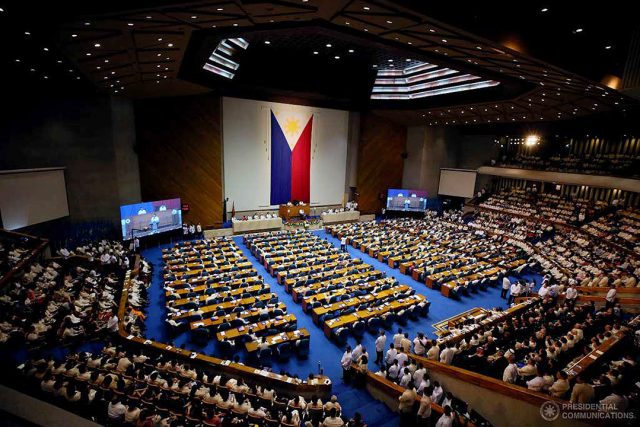
PHILIPPINE LAWMAKERS on Monday jump-started the legislative mill under the 20th Congress by filing bills on key socioeconomic issues including high rice prices, healthcare, low wages and education.

Congressional staff lined up at the House of Representatives to file the measures on the first day of their bosses’ term, with the queue starting as early as 5 a.m.

“We can see that the need for affordable basic necessities remains pressing for our people,” House spokeswoman Priscilla Marie T. Abante told a news briefing in Filipino.

Lawmakers won’t start sessions until July 28, when President Ferdinand R. Marcos, Jr. delivers his fourth annual state of the nation address before Congress.

Leyte Rep. Ferdinand Martin G. Romualdez submitted the first bill, which seeks to reform the National Food Authority (NFA) as part of efforts to bring down rice prices, according to a copy of the measure sent to reporters.

House Bill No. 1 seeks to amend a law that liberalized the rice industry by restoring the NFA’s regulatory powers, allowing it to intervene in the rice market when there are price spikes.

The measure also lets the NFA’s inspect grain warehouses and seize hoarded rice stocks and release them to the public to keep rice prices down during shortages and suspected market manipulation.

It also proposes to allow the NFA to maintain buffer rice stocks from local rice farmers and empowers the agency to set floor prices for rough rice.

“We cannot fight hunger without confronting price manipulation,” Mr. Romualdez said in a statement. “This bill is not about going backwards to failed models. It is about smarter regulation.”

Another Romualdez bill seeks to exempt overseas Filipino workers (OFW) from premium contributions to the Philippine Health Insurance Corp. (PhilHealth), he said in the statement.

House Bill No. 2 proposes that OFWs’ monthly PhilHealth contributions be charged and equally shared by the National Government and their foreign employers. Any rate hikes should undergo an actuarial review and require congressional approval.

The measure also seeks to ban the transfer of PhilHealth funds to government coffers, Mr. Romualdez added.

Meanwhile, Party-list Rep. Raymond Democrito C. Mendoza filed a bill for a P200 across-the-board wage increase, which the previous Congress failed to ratify after economic managers warned about its effects on the economy.

“We refiled the P200 legislated wage hike bill as the Trade Union Congress of the Philippines’ first measure because it is the top priority of the working-class majority of our people,” he said in a separate statement.

Party-list Rep. Elijah R. San Fernando also filed a bill that seeks to abolish regional wage boards and push a “universal minimum wage floor.” A copy of the bill was not immediately available.

“What we intend to do in the 20th Congress is to have a uniform wage floor,” he told reporters after filing his bill, which will repeal a 1980s law that created regional wage boards.

“There’s no logic behind provincial [wage] rates,” he pointed out.

A bill seeking a P1,200 minimum wage was also filed on Monday by Party-list Rep. Antonio L. Tinio, which he said is crucial in lifting Filipinos out of poverty. A copy of the measure was not immediately available.

“This is what a family needs in order to live with dignity,” he told reporters in Filipino on the sidelines of the bill’s filing.

The Philippines sets minimum wages regionally through wage boards, but lawmakers argue the system delivers slow and meager increases that fail to keep up with rising prices.

Congressmen also filed various education-related bills including proposals seeking to streamline the private school voucher program for students and provide them with direct cash assistance.

“This measure will strengthen our support to students who choose private schools, especially those in overcrowded or underserved areas,” Mr. Romualdez said, referring to House Bill No. 4, which offers students an education voucher with a value tailored to their economic status.

“Qualified students from middle-income and underprivileged families will be granted government-issued vouchers to enroll in private basic education schools when public schools in their area are either congested or unavailable,” he said in a separate statement.

Mr. Romualdez also proposes to create a Bureau of Private Education under the Education department. It will oversee the government’s implementation of his proposed voucher subsidies.

“Education is something that almost all of us here in Congress believe should continue to receive support from our government,” Batangas Rep. Leandro L. Leviste told reporters after personally filing his bill that seeks to give students direct cash assistance.

“I thought of taking swift action by providing educational assistance through a cash transfer for all students, as long as they are attending their classes,” he said in Filipino. “This would help cover their needs for food, transportation, technology and school supplies.”

Senate backs proposal to make budget bicam public

PHILIPPINE STAR/PAOLO ROMERO

THE SENATE is open to making the bicameral meetings on the 2026 budget open to the public amid calls to make the process more transparent, according to its secretary.

“Calls to increase transparency in the bicam are always welcome,” Senate Secretary Renato N. Bantug, Jr. said in a statement on Monday. “The Senate is open to serious proposals that will enhance public access and understanding of the crafting of the national budget.”

Senators and congressmen typically meet behind closed doors to reconcile conflicting provisions of their bills during bicameral conference committee meetings.

“The bicameral conference is a joint undertaking of the Senate and the House,” he said. “Both chambers have a shared responsibility to ensure that the process is open and transparent, consistent with the constitutional precept that public office is a public trust.”

He added that the Senate had allowed journalists to cover bicameral meetings on the national budget.

“Our [countrymen] have every right to know how their money is spent, and their active participation helps ensure that their elected representatives remain responsive and accountable to the people who entrusted us with this responsibility,” Mr. Bantug said.

Senator Jose “Jinggoy” Ejercito Estrada called for transparency in this year’s budget process.

“Any proposal to open the bicameral deliberations to the public must ensure that the integrity of the process is preserved and that the focus remains on arriving at a unified budget that truly reflects the priorities and needs of our [countrymen],” he said in a separate statement.

He added that Filipinos should be given the opportunity to understand, participate in and monitor how public funds are allocated and spent.

“I have always fought for opening the bicameral conference deliberations on the budget measure to the public, or at least to accredited nongovernment organizations, civil society organizations and the media,” Senator Panfilo M. Lacson said.

He added that he would prioritize legislation that would ensure transparency in bicameral deliberations on the national budget.

The House of Representatives minority bloc on Sunday backed a proposal to open bicameral conference meetings on the 2026 national budget to the public.

This would deter “last-minute” fund insertions, “closed-door arrangements” and promote fiscal discipline, while also enabling greater public scrutiny, Party-list Rep. Marcelino C. Libanan said in a statement.

Budget proceedings last year were criticized after the bicameral panel increased unprogrammed funds fourfold to more than P500 billion, aside from blank line-items, fueling concerns that the budget was tweaked after Congress ratified it.

President Ferdinand R. Marcos, Jr. later struck down P168 billion worth of projects under standby appropriations, noting that some line items were inconsistent with his government’s priorities.

Speaker Ferdinand Martin G. Romualdez last week said he supports moves to open the budget’s bicameral committee proceedings to scrutiny, citing the need to restore public trust in the budget process.

The Development Budget Coordination Committee has proposed a 7.4% increase in the national budget to P6.793-trillion national budget for 2026.

The budget process for next year’s spending plan is expected to kick off in August after the Executive branch submits the budget proposal to the House, according to a Budget department briefer.

Under the 1987 Constitution, Malacañang must transmit the proposed budget within 30 days after the opening of the regular session of Congress, which begins on July 28. — Adrian H. Halili

Justice secretary eyes Ombudsman position, says he has ‘a lot to offer’

OFFICE OF THE OMBUDSMAN PHILIPPINES FACEBOOK PAGE

JUSTICE SECRETARY Jesus Crispin C. Remulla on Monday said he would apply to become the country’s chief graft buster, as the post gets vacated next month.

Ombudsman Samuel R. Martires, whom ex-President Rodrigo R. Duterte appointed in 2018, will retire on July 27.

The Office of the Ombudsman, who investigates and prosecutes corrupt public officials, was created by the 1987 Constitution. He can only be removed through impeachment by the House of Representatives and conviction by the Senate impeachment court.

The Ombudsman can file administrative, civil and criminal cases against erring public officials before the Sandiganbayan, the country’s anti-graft court.

Mr. Remulla said he plans to file his application for the Ombudsman with the Judicial and Bar Council (JBC) this week, adding that he has shortlisted candidates to replace him as Justice secretary in case he gets appointed.

“I think I have a lot to offer there,” he told reporters.

The Ombudsman has a seven-year term, and if picked by President Ferdinand R. Marcos, Jr., Mr. Remulla would be holding the post until 2032.

The Justice secretary said he had signified his interest to become the next Ombudsman to the President.

“I’ve already communicated it,” he said. “I told a mutual contact that I was very interested.”

The JBC, which screens nominees for judicial and quasi-judicial bodies like the Office of the Ombudsman, started the application period for the next graft-buster in May.

Mr. Remulla is facing a complaint before the Ombudsman over the arrest of Mr. Duterte and his subsequent transfer to The Netherlands, where he is facing charges of crimes against humanity in connection with his deadly war on drugs.

The Justice secretary said he could still apply for the post despite the complaint. “That’s OK,” he said, noting that the JBC would take the complaint into consideration when screening him.

“I think the JBC is in the best position to appreciate whatever I have to offer as Ombudsman,” he added. — Kenneth Christiane L. Basilio

Military leaders to set up ‘one-theater’ approach in East, South China seas

SECRETARY of National Defense Gilberto C. Teodoro, Jr. and Lithuanian Minister for National Defense Dovilė Šakalienė signed a Memorandum of Understanding on Defense Cooperation on June 30, 2025, in Makati City. — DEPARTMENT OF NATIONAL DEFENSE

MILITARY LEADERS are working to enforce a “one-theater” concept in both the East and South China seas, the Philippines’ defense minister said on Monday, adding that the Southeast Asian country faces threats in disputed waters that are similar to Japan’s.

Japanese newspaper Asahi reported in April that Japanese Defense Minister Gen Nakatani made a proposal to US Pentagon Secretary Pete Hegseth to consider the East China Sea, the South China Sea, the Korean Peninsula and surrounding areas as a single “theater,” referring to a military area of operation.

Philippine Defense Secretary Gilberto C. Teodoro, Jr. said it was “reasonable” to treat both the East and South China seas as a single area of operation, saying both are maritime areas with no land borders involved. However, he said the area should exclude the Korean Peninsula.

“That will involve synergy in operations, synergy in domain awareness, in intelligence exchange, and in mutually reinforcing our strengths to work doubly real-time,” he said at a briefing during the visit of his Lithuanian counterpart Dovilė Šakalienė.

Japan and China have repeatedly faced off over uninhabited Japanese-administered islands in the East China Sea that Tokyo calls the Senkaku and Beijing calls the Diaoyu.

The Philippines and China, meanwhile, have clashed frequently in the South China Sea around disputed shoals and atolls that fall inside Manila’s exclusive economic zone.

China’s embassy in Manila did not immediately respond to a request for comment.

Japan’s Joint Operations Command is operationalizing the single-theater concept, and the “Squad” grouping that includes the defense ministers of Australia, Japan, the Philippines and the United States will establish a coordinating center in December to enforce it, Mr. Teodoro said.

“So, it is already an operating concept. It does not need any other agreement,” Mr. Teodoro said.

Japan and the Philippines last year signed a military agreement that could allow their soldiers on each other’s soil.

Under President Ferdinand R. Marcos, Jr., the Philippines has extended its arc of alliances beyond the United States, its traditional ally, signing defense deals with Japan and New Zealand, and negotiating for similar agreements with Canada and France.

PHL-LITHUANIA MOU
On Monday, the Philippines and Lithuania signed a memorandum of understanding (MoU) to deepen defense cooperation in areas like cyber security, maritime security and munitions production.

“The interesting thing is that we’re facing absolutely similar threats, and our hostile neighbors are using absolutely similar approach,” Lithuanian Defense Minister Šakalienė said in the joint briefing with Teodoro.

The MoU on defense cooperation is expected to bolster their security ties by providing a framework for possible defense industry partnership and maritime security activities.

“This MoU is not symbolic,” Ms. Šakalienė said in her opening remarks, according to a transcript from the Defense department.

“It’s a framework for meaningful cooperation, and we are really hoping that it will develop to a final plan that will provide us with a framework for further cooperation.”

The Philippine and Lithuanian defense chiefs earlier met at a top-level security forum in Singapore last month, where they both committed to upholding international law and countering “unilateral actions” that threaten regional stability, the Defense department said in a statement.

“We see great potential for cooperation with the Philippines in many areas such as maritime security, including challenges related to shadow fleets by some big countries,” said Ms. Šakalienė.

The MoU is a “groundbreaking” development as formalizes avenues for “closer” cooperation on various defense concerns, Mr. Teodoro said in a media briefing.

“Both of us agreed that we need to work together cross-regionally for several important things… [such as] the need to resist any unilateral attempts to reword or re-engineer maritime law and the international order to the benefit of new powers that want to dominate the world,” he said.

China claims nearly all of the South China Sea via a U-shaped, 1940s nine-dash line map that overlaps with the exclusive waters of the Philippines, resulting in clashes at disputed maritime features, as both the countries uphold their claims in the marine-rich water.

A United Nations-backed tribunal in 2016 voided China’s sweeping claims for being illegal, a ruling that Beijing does not recognize. — Kenneth Christiane L. Basilio with Reuters

Marcos names new Customs chief

PRESIDENTIAL COMMUNICATIONS OFFICE

PRESIDENT Ferdinand R. Marcos, Jr. on Monday appointed Ariel F. Nepomuceno as the new commissioner of the Bureau of Customs (BoC), according to the Presidential Communications Office (PCO).

The President administered the oath of office to Mr. Nepomuceno who will replace Bienvenido Y. Rubio. There was no reason cited behind the leadership change in the bureau.

Mr. Rubio submitted his courtesy resignation last May, but he was among the Cabinet officials whose resignation was not accepted by the President.

In a statement, the PCO said that Mr. Nepomuceno previously served as the executive director of the National Disaster Risk Reduction and Management Council and undersecretary of the Office of Civil Defense.

He also served as the BoC’s assistant commissioner of the Post Clearance Audit Group from 2017 to 2018 and deputy commissioner of the Enforcement Group from 2013 to 2017.

Mr. Marcos’ marching order to the agency is to safeguard the country’s borders and ensure transparency and efficiency in revenue collection.

“As the country’s principal border protection and trade facilitation agency under the Department of Finance, the BoC plays a vital role in generating revenue, ensuring national security, and promoting economic stability,” it added. — Adrian H. Halili

ADVERTISEMENT
ADVERTISEMENT