Home Blog Page 1302

Input VAT refund developments under CREATE MORE

The CREATE MORE Act ushered in changes to certain documentary requirements for VAT refund claims. Beyond compliance lies a jungle of possibilities and challenges — where does your business stand? Dive into this article to uncover recent updates and explore the intricacies of securing VAT refunds amidst a sea of change.

CREATE MORE has generally adopted the same standards from the old VAT refund laws, including the following: 1. the grant or decision should be made within 90 days from the date of the submission of the application, and 2. the application will be subject to a risk assessment. However, it also introduced a new recourse for denied VAT refund claims — request for reconsideration prior to proceeding to judicial appeal, i.e., filing with the Court of Tax Appeals.

With respect to supporting documents, CREATE MORE also codified that certified true copies (CTC) of invoices, receipts, and other documents required under the rules can now be submitted to support the taxpayer’s claim — a welcome development as this gives claimants more flexibility, as opposed to the previous rules which required the submission of original documents. Moreover, VAT zero-rating will apply to the sale of goods and services to an export-oriented enterprise (EOE) whose export sales are at least 70% of the total annual production of the preceding year.

As such, Revenue Memorandum Circular (RMC) 37-2025 was issued to clarify the amendments. It includes new checklists for claiming a VAT refund pursuant to Section 112(a) of the Tax Code for: (1) claims covering the period prior to April 1, 2025; and (2) those covering taxable period starting April 1, 2025.

For claims covering the period prior to April 1, 2025, the requirements generally remain the same save for some minor changes and added requirements: adjustments to the new Annexes numbers, flexibility to submit CTCs of the invoices or receipts; GIS of the claimant must again be submitted but the Articles of Incorporation and By-laws/DTI registration are no longer required; and if applicable, the Certificate of Accreditation issued by the Department of Energy (DoE) for manufacturers, fabricators, and suppliers of renewable energy.

For claims covering taxable periods starting April 1, 2025, the following new requirements are included:

(1) If the sales from the preceding year do not meet the 70% threshold, a copy of the notification from the Export Marketing Bureau (EMB) and a certified copy of the schedule or evaluation sheet from the EMB containing the result of the validation of export sales and inward remittances for the taxable year covered by the claim;

(2) Proof of delivery, service contract or any acceptable document to prove that the goods or services are delivered or rendered to a resident local EOE for the manufacturing, processing, packing in the Philippines, which goods are subsequently exported, and photocopies of proof of remittances;

(3) Proof of delivery to bonded manufacturing warehouses of EOEs and photocopy of the permit or license to operate as a bonded manufacturing warehouse for goods subsequently for export; and

(4) Copies of Registered Business Enterprise-supplier’s sales invoice together with the filed 1600VT or BIR form 0605.

Considering that only CTCs of the invoices or receipts are now required, the rules specify that these should be signed by the taxpayer-claimant’s president, proprietor, or head of finance or accounting. These officials may assign other signatory/ies who are knowledgeable in the accounting and/or custodianship of the documents. In that case, a notarized Secretary’s Certificate, Partnership Resolution, or Special Powers of Attorney designating the representative together with a copy of their valid company ID must also be submitted.

In the context of VAT refunds, compliance with these requirements should be carefully sought. As emphasized in a Court of Tax Appeals (CTA) case, entitlement to VAT refund is one matter, while compliance with the documentary and evidentiary requirements is another.

From my experience, one of the reasons certain refund items are denied is because of alterations to the invoices or receipts. If the alterations are not properly supported, they are considered tampered with and not qualified as documentary proof.

In practice, to support the alterations, a certification confirming the authority of the person countersigning the alteration should likewise be submitted. However, examiners often differ in how they treat computer-generated receipts and invoices. In some cases, claims have been denied due to manual alterations on computer-generated invoices even if they are accompanied by a certification of the authorized signatory because the examiner prefers that the invoices or receipts be reprinted entirely. In contrast, other applications were not required to reprint invoices but were still denied because the certification lacked a copy of the signatory’s ID.

In CTA cases, the validity of countersignatures on altered receipts and invoices depends on whether the signatory is authorized, whether the signature matches the signature of the authorized representative, and whether there is sufficient proof of such authority. These cases did not distinguish between computer-generated and manually issued invoices or receipts, nor did they clearly define what constitutes valid proof of authority or sufficient certification.

As may be noted, the rules are unclear regarding the required treatment of alterations in invoices or receipts. This lack of clarity poses challenges, especially for first-time applicants who may be unfamiliar with the unspoken preferences or varying interpretations of examiners. It is possible that an application may not be successful at one instance and the taxpayer claimant may need to file another application at the risk of another denial to determine the preference of the examiner, which is revealed only after the claim has been denied.

While the imposition of such requirements by the government is understandable to ensure that only eligible claims are granted, a greater degree of clarity and uniformity would benefit all stakeholders. Clear and consistent rules not only encourage voluntary compliance among taxpayers but also reduce the risk of legal disputes, ultimately building greater confidence in the system. Furthermore, such transparency fosters a more investment-friendly environment, particularly for investors who rely on VAT zero-rating and refunds as part of their financial strategy. As we look to the future, enhanced guidance will be essential in supporting compliance and ensuring the efficient processing of claims. Together, let’s advocate for clarity that empowers both businesses and the government, paving the way for a more robust and fair tax landscape.

The views or opinions expressed in this article are solely those of the author and do not necessarily represent those of Isla Lipana & Co. The content is for general information purposes only, and should not be used as a substitute for specific advice.


Rowelle Sheena Juarez-Ayson is a manager at the Tax Services department of Isla Lipana & Co., the Philippine member firm of the PwC network.

+63 (2) 8845-2728

rowelle.sheena.juarez@pwc.com

Philippine Defense chief rules out US as factor in China’s ‘expansionist’ agenda

DEFENSE SECRETARY GILBERTO C. TEODORO, JR. — DND

By Kenneth Christiane L. Basilio, Reporter

CHINA’S aggressiveness in the Indo-Pacific is rooted in long-standing strategic ambitions independent of any US policy, and the region’s challenges stem from Beijing’s own expansionist agenda, the Philippines’ top defense official said on Wednesday.

The Philippines and China have had a series of run-ins and heated exchanges in the busy waterway of the South China Sea over the past two years, including an incident in June last year when a Philippine sailor lost a finger.

“The aggressiveness of China has been several years in the making,” Defense Secretary Gilberto C. Teodoro, Jr. said in an interview at the Reuters NEXT Asia summit in Singapore.

“China’s design for the region does not depend on any American leader,” Mr. Teodoro said, replying to a query whether US President Donald J. Trump’s style and stance had served as a catalyst for China’s actions.

“It depends on its own plan of action in the region, its own expansionist activities, its own need to control the area.”

While acknowledging that US policies influence regional dynamics, Mr. Teodoro said China’s actions were “pre-determined” by its leadership, regardless of who was in power in Washington.

Despite rising tension in the major regional flashpoint of the South China Sea, Mr. Teodoro dismissed fears that conflict was on the horizon.

“The prospect of war is not imminent,” he added. “I believe it is remote, but that would entirely depend upon the internal conditions of China.”

China’s embassy in Manila did not immediately respond to a request for comment.

China claims almost the entire South China Sea, despite overlapping claims by Brunei, Indonesia, Malaysia, the Philippines, Vietnam and Taiwan.

Mr. Teodoro said Manila was focused on deterrence, backed by diplomacy.

“You can’t have diplomacy without a credible deterrent force, and what we are doing is merely putting a stop, as best as we can, to the illegal incursions of China, which I do not think any country in the world supports,” he said.

To boost its external defense capabilities, the Philippines is investing billions of dollars to modernize its military, and part of that plan is to acquire multi-role fighter jets.

While submarines were on the wish list, Mr. Teodoro said they were not a priority at the moment, with the focus on weaponizing and building infrastructure to maintain current platforms.

Mr. Teodoro rejected the notion that the Association of Southeast Asian Nations (ASEAN) had failed to respond to China’s actions, given that the 10-nation Southeast Asian bloc has been working on a code of conduct with Beijing to avert confrontations in the South China Sea.

“It is obvious that ASEAN countries are wary and worried about China’s activities. If not, there would be no call for a code of conduct in the South China Sea.”

“It doesn’t take a rocket scientist to be very concerned about what is happening.”

Since Philippine President Ferdinand R. Marcos, Jr. took office in 2022, Manila has grown increasingly vocal in its opposition to China’s actions in the South China Sea, while significantly strengthening ties with traditional ally the United States, and like-minded partners, such as Australia and Japan.

Mr. Teodoro believed it would be difficult for any future leader to reverse current policy because it has strong public backing. President Marcos’ single six-year term ends in 2028.

“I feel that any leader in the future, in the face of what China is doing, and in the face of public opinion… and there is a distrust, not of China, but of the Chinese government in what they are doing. So, it would be hard for any leader to reshape that narrative,” he said.

DEEPER PHL-JAPAN TIES
The remarks followed a meeting between senior military officials from the Philippines and Japan on Tuesday, where they reinforced bilateral defense cooperation, as Manila weighs a proposal from Tokyo to transfer used destroyer ships seen as reinforcing the Southeast Asian nation’s maritime security capabilities.

In a statement on Wednesday, the Philippine military said that Japan Maritime Self-Defense Force Rear Admiral Ikeuchi Izuru met with Armed Forces of the Philippines (AFP) Vice-Chief-of-Staff Lieutenant General Jimmy D. Larida in Manila for a courtesy visit.

The military officials discussed “mutual concerns” over persisting “regional maritime challenges,” the Philippine military said, as both countries grapple with China’s increasing assertiveness in the South China Sea.

They also talked about possible joint military exercises and exchanges in the future, it added.

“The visit served as a platform to reaffirm both nations’ shared commitment to maintaining peace, stability, and freedom of navigation in the Indo-Pacific region,” the AFP said.

Like the Philippines, Japan has been embroiled in a dispute with China over the Senkaku Islands, which lies close to key shipping lanes and is believed to be rich in marine resources.

Mr. Izuru’s visit to Manila highlights the deepening relations between the Philippines and Japan’s forces and underscores their need to enhance military operability amid “evolving security dynamics” in the South China Sea region, the AFP said.

The Japanese navy official’s visit came on the heels of Japan’s offer to transfer its used Abukuma-class destroyers to the Philippines, helping shore up Manila’s maritime security capabilities amid China’s persistent presence at disputed reefs and atolls in the South China Sea.

The Philippine Navy on Tuesday said that it will send a six-man team to Japan in August to inspect the Japanese destroyer ships being offered. Mr. Teodoro has said that Manila is factoring in the costs of integrating the warships to its fleet and system interoperability.

SCS MEASURES
Meanwhile, a coalition of Philippine lawmakers filed multiple proposals at the House of Representatives on Wednesday aimed at bolstering the country’s claims in the contested South China Sea (SCS).

Among the raft of measures filed include a resolution urging Manila’s Department of Interior and Local Government to reassess sister-city and province agreements with China, and a bill seeking to integrate lessons on the Philippines’ claim in the disputed waterbody in the education curriculum.

“These measures serve as a reminder that we have not forgotten the West Philippine Sea (WPS),” Party-list Rep. Jose Manuel “Chel” I. Diokno told BusinessWorld in a Viber message, using the Philippine name for parts of the waterbody falling within Manila’s 200-nautical mile exclusive economic zone.

Filed by the so-called “West Philippine Sea bloc,” the grouping of six congressmen said they filed the measures to help reinforce Manila’s claims in the disputed waterway.

House Resolution No. 39 calls for a government investigation into sister-city agreements between the Philippines and China, with a view to terminating those deemed detrimental to Philippine interests.

The Philippines has 29 such agreements with China, according to the resolution.

“We should reassess sister-city agreements with certain Chinese cities to ensure that no undue interference or influence is taking place at the local level,” said Mr. Diokno.

Meanwhile, House Bill No. 1625 aims to enhance public awareness of the Philippines’ claims in the South China Sea by integrating education content on the country’s exclusive economic zone, sovereign rights and entitlements, while also including the impact of China’s encroachment on the disputed waterway, according to a copy of the measure shared to reporters.

“This fight for our sovereignty is not just limited to the seas. It also extends into our schools, our homes and into the halls of Congress,” Party-list Rep. Percival V. Cendaña told BusinessWorld in a Viber message.

“This is a battle for the hearts and minds of our citizens and future generations.”

The Chinese Embassy in Manila did not immediately reply to a Viber message seeking comment.

The lawmakers also filed House Bill No. 1626, which seeks to declare July 12 — the day the Permanent Court of Arbitration voided China’s expansive claims in the South China Sea — as a special working holiday.

“July 12 is not just a date. Commemorating it as National WPS Victory Day is a reminder that international law is on our side,” Party-list Rep. Leila M. de Lima said in a statement, using the abbreviation for the Philippines’ exclusive economic zone. with Reuters

OVP spox says no confidential funds in 2026 budget

VICE-PRESIDENT Sara Duterte-Carpio, in this Aug. 27, 2024 photo, attended the deliberations on the proposed 2025 budget for the Office of the Vice-President at the House of Representatives in Quezon City. — PHILIPPINE STAR FILE PHOTO/MIGUEL DE GUZMAN

THE OFFICE of the Vice-President (OVP) on Wednesday said that it would no longer seek confidential and intelligence funds for its 2026 budget, its spokesperson said, amid questions over Vice-President Sara Duterte-Carpio’s 2022 secret fund expenditure.

“There are no confidential funds, we did not request that,” OVP Spokesperson Ruth B. Castelo told reporters, as the Department of Budget and Management (DBM) hiked the OVP’s budget to P903 million from the initial P803.6 million the agency allocated for 2026.

Ms. Castelo added that the almost P100-million increase will be used for the hiring of more personnel and the purchase of information technology (IT) equipment to improve its office functions.

“We requested for additional personnel services — of course, there is a cost to the additional employees — to fulfill the functions and other IT equipment,” she said.

Party-list Rep. Renee Louise M. Co said that the VP must first prove her innocence before granting the OVP a budget increase for 2026.

“We want accountability, not just delicadeza. Confidential or not, we cannot entrust the larger budget to VP Sara because the identity of Mary Grace Piattos and other corruption anomalies are still unanswered,” she said in a statement.

“Either prove her innocence in the impeachment trial first or resign from the OVP before a budget increase can be justified.”

The House of Representative had held an inquiry over Ms. Duterte’s alleged misuse of confidential funds allocated for the OVP in 2022 and the Department of Education, when she sat as its secretary in 2023.

This is also among the charges against Ms. Duterte when she was impeached by more than 200 congressmen last February. She has denied any wrongdoing.

Her other ouster charges include unexplained wealth, and plotting the assassination of President Ferdinand R. Marcos, Jr., his wife and the Speaker. Her impeachment trial awaits in the Senate.

Meanwhile, Ms. Castelo added that the Commission on Audit (CoA) had given the OVP an unmodified audit opinion for its 2024 annual audit report.

“Unmodified opinion means that the financial statements were fairly presented. It is honest, it’s transparent,” she said, noting an 85.6% utilization rate for its 2024 budget.

The OVP said that state auditors had affirmed that financial statements within the 2024 Annual Audit Report were “accurate, reliable, and compliant with applicable laws, regulations, and accounting standards.”

An unmodified opinion is given when auditors conclude that the financial statements, as a whole, are free from material mis-statements, which could arise from either error or fraud.  — Adrian H. Halili

Bills restoring NFA powers, creating Water Resources dep’t filed in Senate

PHILIPPINE STAR/MIGUEL DE GUZMAN

MEASURES RESTORING the regulatory powers of the National Food Authority (NFA) and creating dedicated government agencies for water resources management have been filed in the Senate.

Under Senate Bill No. 284, Rice Industry and Consumer Empowerment (RICE) bill, Senator Francis G. Escudero sought to grant the NFA the authority to import rice for its buffer stocking requirement in cases of emergencies.

“This bill will not restore the quantitative restrictions abolished by the Rice Tariffication Law. Rather, it will enable targeted state intervention to protect public welfare, support farmers, and ensure food security,” Mr. Escudero said in the explanatory note of the bill, filed on Wednesday.

“Rice is the staple crop of the Philippines, with each Filipino consuming around 136 kilograms each year. Given its central role in the Filipino diet, regulation is needed to protect families from the price fluctuations of this essential commodity.”

The bill proposes to reduce buffer stock requirement for rice to nine days from 15 days.

The NFA will also be granted the authority to sell rice to accredited NFA retailers, government and non-government agencies, or through public auction.

“The NFA shall dispose, on a monthly basis, a maximum of twenty 25% of its total existing buffer stock unless directed by the NFA council to dispose of a larger portion,” the bill said.

The Rice Tariffication Law of 2019 removed the NFA’s regulatory powers to import rice and intervene in the market if rice prices are elevated.

The proposed RICE bill also grants the Department of Agriculture (DA) the powers to impose a floor price for palay (unmilled rice) to protect farmers.

“The DA shall have the authority to set and enforce national, regional, or provincial floor prices of palay below which rice traders shall be prohibited from purchasing palay from farmers,” the bill stated.

The proposed measure also allows the agency to seize hoarders of rice stocks in accordance with Republic Act No. 12022, Anti-Agricultural Economic Sabotage law.

The bill also enforces strict penalties against practices that distort supply and pricing of rice, with violators facing a fine of up to P2 million or imprisonment of up to two years. Traders also risk revocation of their license, trading permits, or accreditation.

A similar measure was earlier filed before the House of Representatives by Leyte Rep. Ferdinand Martin G. Romualdez.

WATER RESOURCES AGENCIES
Separately, Senator Emmanuel Joel J. Villanueva on Tuesday filed a bill that seeks to create the Department of Water Resources and Water Regulatory Commission for a “more efficient, transparent, and effective management of the sector.”

The still-unnumbered Senate Bill, National Water Resources Management bill, tasked the agencies to craft policies and plans for the effective management of the country’s water resources.

The bill provided that the functions of the National Water Resources Board (NWRB), Local Water Utilities Administration (LWUA), River Basin Control Office, Manila Bay Coordinating Office, Water Supply and Sanitation Unit, and Water Resource Management Office will be absorbed by the new department.

It also transfers functions of the Department of Public Works and Highways, with regard to planning, programming, administration monitoring and management of the National Sewerage and Septage Management Program. It will also perform functions of the now-dissolved Pasig River Rehabilitation Commission.

Meanwhile, the Water Regulatory Commission will be established as an independent body, which will adopt the economic regulatory units and functions of the Metropolitan Waterworks and Sewerage System, NWRB, and the LWUA.

The Commission will be composed of five full-time members, including a chairperson and four members, all of whom will appointed by the President. — Adrian H. Halili

Marcos wants zero out-of-pocket hospitalization expense, Palace says

PRESIDENT Ferdinand R. Marcos, Jr. joined the Philippine Charity Sweepstakes Office in distributing 397 medical vehicles to various local government units in Luzon during a ceremony at the Quirino Grandstand in Manila on Wednesday. — PHILIPPINE STAR/ NOEL B. PABALATE

THE ADMINISTRATION of President Ferdinand R. Marcos, Jr., aims to reduce, if not eliminate, out-of-pocket hospitalization expense for Filipinos, the Palace said on Wednesday.

“Ideally, no Filipino would have to pay anything when they are hospitalized,” said Palace Press Officer Clarissa A. Castro in Filipino during a news briefing.

“So as much as possible, the President’s aspiration is to reduce, or if possible, eliminate entirely the out-of-pocket expenses of our countrymen when they are hospitalized.”

This comes as Mr. Marcos promised to provide all local government units (LGUs) with a patient tranport vehicle (PTV) by year-end at the distribution ceremony at Quirino Grandstand in Manila on the same day. He said 680 units have already been distributed since the start of his presidency in June 2022.

The government handed over an additional 397 vehicles to LGUs across Luzon on Wednesday, with 123 more set for Eastern Visayas and 105 for Mindanao. The vehicles were procured through the Philippine Charity Sweepstakes Office (PCSO).

Under the latest distribution, 397 units will be allocated as follows: 30 units to Ilocos, 72 to Cagayan Valley, 100 to Central Luzon, 27 to Calabarzon, 59 to Mimaropa, 64 to Bicol Region, and 35 to the Cordillera Administrative Region.

“With the Philippine Health Insurance Corp. (PhilHealth), we are expanding the insurance coverage,” Mr. Marcos said in Filipino, according to a transcript from his office.

“We are lowering the payment and the fees because right now, patients still have to contribute something when they get checked or treated. We are gradually reducing the patient contribution,” he added.

The President noted that if the government successfully reduces patient contributions and fixes the economy, “then maybe we can reach the point where patients won’t have to contribute anything anymore.”

The President underscored that the initiative goes beyond mere vehicle distribution, as it forms part of a broader plan to strengthen the national healthcare system.

“So, it is an ongoing program,” he added. “It just so happens that this release is mostly for Luzon, but we will continue doing this, and we will not stop until we have provided for all the needs of our LGUs and fulfilled their requirements for these PTVs.”

According to the Chief Executive, the coronavirus pandemic showed several gaps in the country’s healthcare system. These lessons, he added, are now being applied to build stronger systems.

“We applied those lessons to our programs, not just to these patient transport vehicles but to our entire healthcare system, including our hospitals and even PhilHealth,” he noted.

Mr. Marcos earlier approved a P2.2-billion budget to procure and distribute 1,000 PTVs nationwide. Each unit is equipped with essential medical tools, including a stretcher, oxygen tank, blood pressure monitor, and other supplies to ensure safe and timely patient transport.

Unlike ambulances, PTVs are designated for non-life-threatening cases, such as scheduled medical visits, routine checkups, and hospital discharges. The use of emergency blinkers and sirens is strictly prohibited. — Chloe Mari A. Hufana

DoE monitors suspected oil cartel

PHILSTAR FILE PHOTO

THE DEPARTMENT of Energy (DoE) is not ruling out the possibility of cartelization among oil industry players as it continues to monitor any anti-competitive practices.

“I would not say that there is no cartel. Who they are, that is something to confirm, but if there is no cartel, there’s no purpose for OIMB (Oil Industry Management Bureau) to be on guard all the time,” DoE Officer-in-Charge Sharon S. Garin said in a press briefing on Wednesday.

“But I would say there’s still some form of anti-competitive behavior in some, not all,” she said.

Questions on cartelization floated due to seeing similar price adjustments despite varying costs of supply procurement.

Under the Republic Act (RA) No. 8479, the Downstream Oil Industry Deregulation Act of 1998, cartelization refers to “any agreement to fix prices either by products or by areas, in restraint of trade or free competition.”

RA 8479 aims to liberalize and deregulate the downstream oil industry by removing the government’s power to directly control oil prices and instead allowing market forces to determine pricing, aiming to foster a competitive market.

OIMB Assistant Director Rodela I. Romero explained that oil companies based their price adjustments on Mean of Platts Singapore, a benchmark used for refined oil products, as well as Dubai crude.

“It’s [the monitoring of cartelization] still a working progress because even the smuggling is still not curtailed,” Ms. Garin said.

She said that there are “disparities” on the imports being reported, which is among the things that the DoE is working with the Bureau of Customs.

“I do believe that there are still players that have yet to play according to the rules, if you ask me. There are still distortions in the reporting, in our observations there are even mistakes,” Ms. Garin said in mixed English and Filipino.

While the DoE has no police powers, Ms. Garin said that the DoE observes possible smuggling activity and endorses to authorized agencies, including the Bureau of Internal Revenue, the Department of Finance, and the Philippine Competition Commission.

On Tuesday, several oil firms implemented a rollback of P0.70 per liter for gasoline, P0.10 per liter for diesel, and P0.80 per liter for kerosene. — Sheldeen Joy Talavera

Palace: No new PCO chief yet

PCO.GOV.PH

MALACAÑANG on Wednesday said Presidential Communications Office (PCO) Secretary Jaybee C. Ruiz is still its ad interim chief, debunking reports that another veteran journalist has been appointed.

“As far as I know, there is no (new secretary) yet,” Palace Press Officer Clarissa A. Castro said in Filipino during a news briefing. “Jay Ruiz remains the acting secretary.”

This comes after reports saying that former Philippine Star journalist Dave Gomez will replace Mr. Ruiz.

Ms. Castro said she cannot deny those reports, as she has not received any update on the change of leadership.

Last May, President Ferdinand R. Marcos, Jr., ordered all cabinet members to tender their courtesy resignations as part of a “bold reset” of his government. This included Mr. Ruiz, but he was later reappointed as acting communications chief.

The Commission on Appointments earlier deferred deliberations on Mr. Ruiz’s appointment as PCO chief.

He was named chief in February this year. A former broadcast journalist, Mr. Ruiz is the Marcos administration’s fourth PCO chief. — Chloe Mari A. Hufana

House probe vs online gambling urged

MACROVECTOR_OFFICIAL | FREEPIK

A LAWMAKER on Wednesday filed a resolution urging the House of Representatives to probe online gambling activities as part of efforts to curb its harmful effects on Filipinos.

Party-list Rep. Nathaniel M. Oducado filed House Resolution No. 42 to provide gambling stakeholders a formal platform to share insights that could guide lawmakers in crafting measures to regulate or ban online gaming in the Philippines.

“There’s a clear need for stronger surveillance, mandatory reporting and expanded rehabilitation services targeting online gambling harm,” he said in a statement.

Momentum is building among lawmakers to impose stricter regulations on the country’s online gambling industry, as concerns over its socioeconomic impact intensify.

“It’s about time we began investigating the crippling effects of online gambling on society, especially illegal or unregulated online gambling,” Party-list Rep. Brian Daniel P. Llamanzares said in a separate statement.

“Reports indicate a sharp rise in gambling-related debt, family strife, school dropouts, and mental health issues linked to unregulated online platforms,” he added.

Also on Wednesday, Mr. Oducado submitted House Resolution No. 43, seeking a congressional probe over the implementation of a vape regulation law to help policymakers plug regulatory gaps in the industry.

He said that widespread availability of wave products and the lack of health warnings make people vulnerable to using them despite known health risks.

“There should be a national campaign focusing on awareness to address misconceptions that vaping is safe, as well as banning advertisements enticing the youth to become vape users,” he said. — Kenneth Christiane L. Basilio

Speaker supports admin’s jobs push

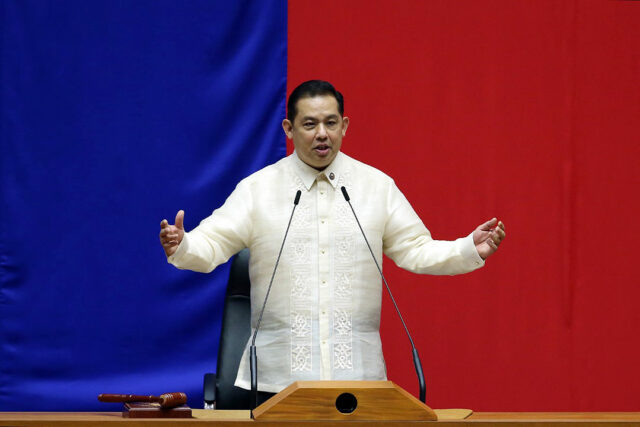
House Speaker Ferdinand Martin G. Romualdez — PHILIPPINE STAR/KRIZ JOHN ROSALES

A CONGRESSMAN on Wednesday voiced support for the Marcos administration’s push to spur job creation, pledging to pursue a legislative agenda aligned with the administration’s development priorities.

In a statement, Leyte Rep. Ferdinand Martin G. Romualdez said he would pursue measures aimed at enabling workers to reskill to better fit future job markets, while also ensuring ample funding for the Labor department and the government’s trade authority to boost employability.

“Strong economic growth is only possible if no Filipino is left behind,” he said. “We must make every opportunity — from skills training to dignified employment — within reach of every hardworking citizen.”

The Philippines’ unemployment rate dropped to 3.9% in May from 4.1% in April, as the number of jobless Filipinos declined to 2.03 million from 2.06 million during the same period.

“We will strengthen President Marcos’ initiatives to create more jobs by working together with foreign investors and the private sector,” said Mr. Romualdez. — Kenneth Christiane L. Basilio

GSIS signs P1-B deal with PSALM, NPC

GSIS FACEBOOK PAGE

THE GOVERNMENT Service Insurance System (GSIS) has signed a memorandum of agreement with the Power Sector Assets and Liabilities Management Corporation (PSALM) and the National Power Corporation (NPC) to settle over P1 billion in unremitted premium contributions arising from NPC’s 2003 restructuring.

“This is a significant day for the former 1,233 employees and their families who have lost their jobs in the course of privatization. Now, we are able to restore the benefits that the law granted to them with the cooperation of PSALM and GSIS. We commit to disbursing the benefits to the qualified beneficiaries in the most expedient and efficient way,” NPC President and Chief Executive Officer (CEO) Fernando Martin Y. Roxas said in a statement late on Tuesday.

The signing followed the ceremonial turnover of the check held earlier on June 17.

“The settlement covers the full restructured obligation for qualified former NPC employees, whose service periods have been validated by the Commission on Audit. GSIS also granted a 60% condonation on accrued interest in accordance with board-approved guidelines,” GSIS said.

GSIS will now proceed with the re-computation and crediting of service periods, allowing eligible claimants to receive their corresponding retirement and insurance benefits.

“Together we made it happen—the shared responsibility of PSALM, NPC and GSIS manifested in this ceremonial signing reflects the common commitment to fiscal responsibility, legal prudence and social justice,” PSALM President and CEO Dennis Edward Dela Serna said. — Aaron Michael C. Sy

VP trial should proceed despite polls

VICE-PRESIDENT SARA DUTERTE-CARPIO — FACEBOOK.COM/MAYORINDAYSARADUTERTEOFFICIAL

THE SENATE must proceed with Vice-President Sara Duterte-Carpio’s ouster trial despite a public opinion poll saying that nearly half of Filipinos disagreed with her impeachment, a lawmaker said on Wednesday.

Pollster Social Weather Stations (SWS) on Tuesday reported that 42% of Filipinos disagreed with the impeachment complaint against Ms. Duterte, 32% agreed, while about 18% were undecided. The remaining 7% said they were not knowledgeable on the matter, it said in a statement on its website.

“Regardless of the result of the survey, we have a constitutional duty that we must face,” Batangas Rep. Gerville R. Luistro told reporters in mixed English and Filipino, based on a statement released by the House of Representatives. “There is nothing more supreme than the Philippine Constitution, because it is the mandate of the people.”

Congressmen overwhelmingly voted to impeach Ms. Duterte in February over accusations ranging from budget anomalies to plotting the assassination of President Ferdinand R. Marcos, Jr. his wife and the House Speaker. She has denied any wrongdoing.

Ms. Luistro, a member of the House prosecution team for the impeachment trial, said the Vice-President should be tried by the impeachment court despite the SWS survey results as the 1987 Constitution mandates it.

She also pushed back against accusations that Ms. Duterte’s impeachment is political persecution.

“If there’s no evidence, that’s political prosecution. But if there is evidence, then that’s legitimate prosecution,” Ms. Luistro said. “As far as we are concerned, we have ample and strong evidence supporting the seven Articles of Impeachment.” — Kenneth Christiane L. Basilio

PSE index surges to 6,500 level on positive data

PHILIPPINE STAR/KRIZ JOHN ROSALES

STOCKS rallied for the third straight day on Wednesday, with the bellwether index climbing to the 6,500 level for the first time in nearly two months, as strong data improved sentiment towards the Philippine economy.

The benchmark Philippine Stock Exchange index (PSEi) surged by 1.1% or 70.74 points to close at 6,504.34, while the broader all shares index rose by 0.88% or 33.45 points to 3,817.62.

This was the PSEi’s best finish in nearly two months or since its 6,551.81 close on May 14.

“The market continued to rally backed by investors’ confidence towards the local economy,” Philstocks Financial Inc. Research Manager Japhet Louis O. Tantiangco said in a Viber message. “This comes following the recently released economic figures, which were deemed healthy, including the labor force survey, monthly integrated survey of selected industries, and bank lending data for the month of May.”

“The PSEi gained for the third straight trading day… after US President Donald J. Trump signaled openness to trade negotiations, with possible compromise in terms of much lower tariff rates, as seen in recent months,” Rizal Commercial Banking Corp. Chief Economist Michael L. Ricafort said in a Viber message.

He said the Philippines is “relatively insulated” from the threat of higher US import tariffs given its lower dependence on goods exports. Mr. Ricafort added that the strong data released recently affirm the country’s resilience.

Stock markets around the Asia-Pacific were mixed as investors digested Mr. Trump’s latest, shifting trade salvos, Reuters reported. Japan and South Korea are among major US trading partners in the region facing an Aug. 1 deadline to reach a trade deal or be subjected to new tariff rates, although Mr. Trump has sent mixed signals on how flexible that date is.

Only two US agreements, with Britain and Vietnam, have been reached since Mr. Trump’s April 2 “Liberation Day” reciprocal tariffs announcement roiled markets.

Majority of sectoral indices closed in the green on Wednesday. Services went up by 2.51% or 53.66 points to 2,183.89; property climbed by 2.37% or 57.61 points to 2,480.25; industrials rose by 1.08% or 98.59 points to 9,215.54; and holding firms increased by 0.93% or 52.64 points to 5,691.54.

Meanwhile, financials dropped by 0.77% or 17.44 points to 2,248.54; and mining and oil slipped by 0.05% or 4.92 points to 9,194.78.

“Bloomberry Resorts Corp. was the day’s top index gainer, jumping 5.78% to P4.76. China Banking Corp. was the worst index performer, dropping 2.32% to P65.40,” Mr. Tantiangco said.

Value turnover rose to P7.79 billion on Wednesday with 1.41 billion shares traded from the P6.96 billion with 1.06 billion issues exchanged on Tuesday.

Advancers bested decliners, 110 versus 90, while 50 names were unchanged.

Net foreign selling increased to P220.66 million on Wednesday from P168.05 million on Tuesday. — Revin Mikhael D. Ochave with Reuters