
Cash remittances reach $2.79 billion in February
MONEY SENT HOME by overseas Filipino workers (OFWs) fell to its lowest level in nine months in February, the Bangko Sentral ng Pilipinas (BSP) reported. Read the full story.
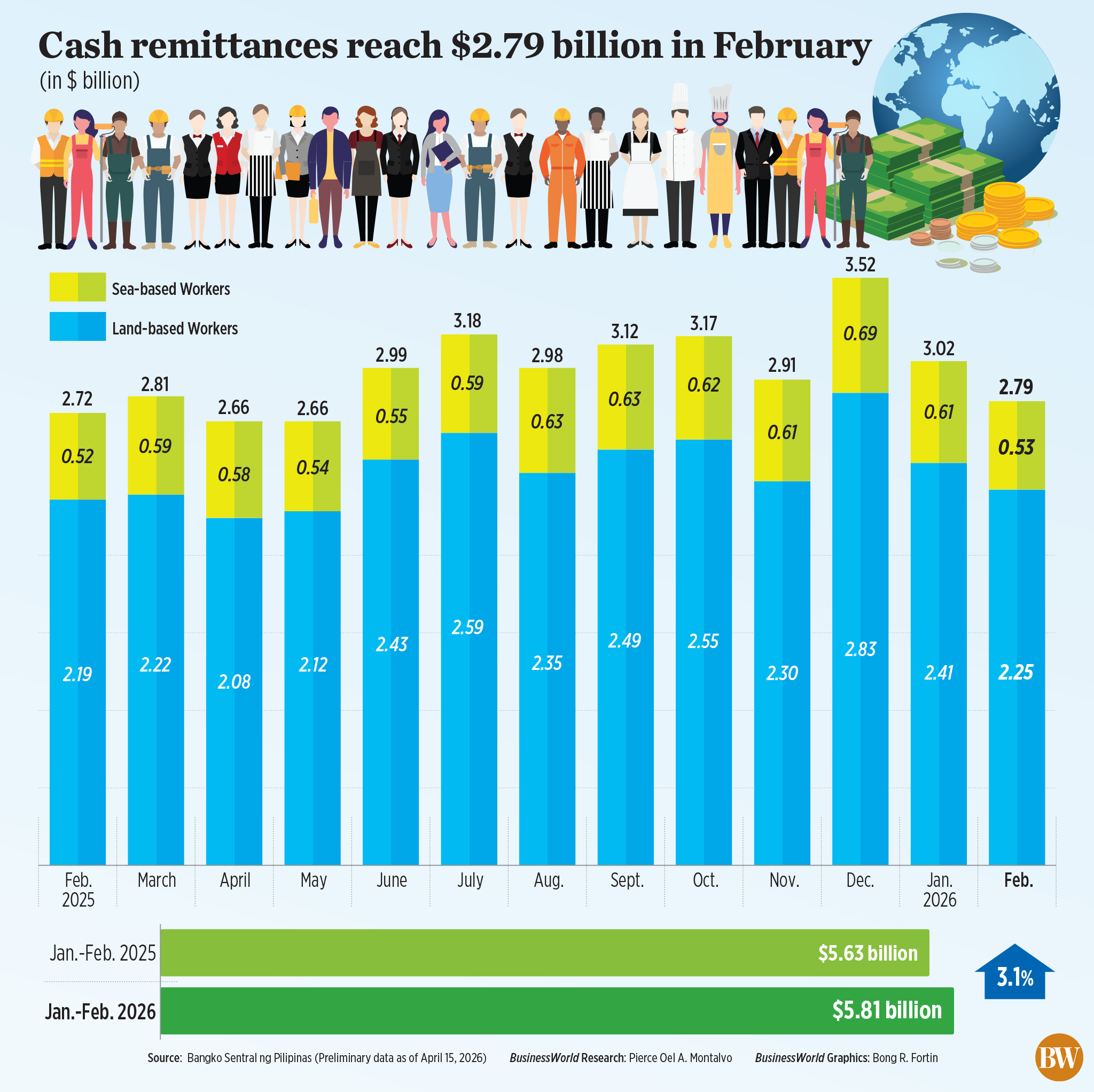
MONEY SENT HOME by overseas Filipino workers (OFWs) fell to its lowest level in nine months in February, the Bangko Sentral ng Pilipinas (BSP) reported. Read the full story.
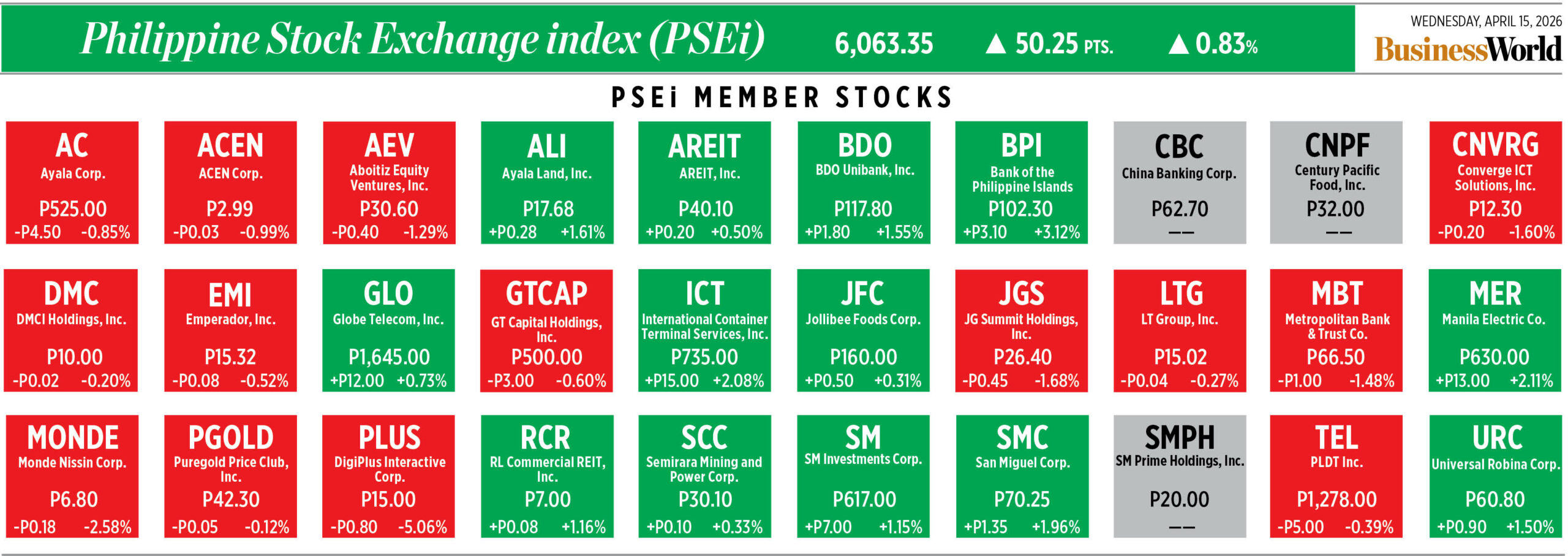
Here’s a quick glance at how PSEi stocks fared on Wednesday, April 15, 2026.


THE House of Representatives is targeting a May 4 vote on a proposal to remove the value-added tax (VAT) on petroleum products, as lawmakers push broader relief from rising fuel costs despite opposition from the government’s economic team.
“The members of Congress are ready to vote to lower the VAT,” Batangas Rep. Leandro Antonio L. Leviste said during a Legislative Energy Action and Development Council hearing on Wednesday, adding that the chamber has sufficient support to move forward with the measure.
Mr. Leviste said lawmakers are prepared to bypass resistance from the economic team and proceed with legislation that would suspend the 12% VAT on petroleum products.
“Our countrymen can expect Congress to open again on May 4 when we will vote to remove the value-added tax,” he said.
The proposal, covered under House Bills 4302 and 8838, seeks to ease the burden of elevated fuel prices on households, transport workers and other sectors.
Lawmakers backing the measure said removing VAT would provide immediate and visible relief compared with targeted subsidies.
The push comes amid mounting frustration among legislators, who accused the Executive branch and its economic managers of delaying action on fuel costs.
Mr. Leviste said continued inaction could erode public trust, adding that Congress must respond to the needs of Filipinos even amid differing views within the Cabinet.
However, some lawmakers urged caution, citing the need for a clearer policy basis before proceeding to a vote.
“There cannot be a vote now… We will wait for the consolidation of all of this,” Marikina Rep. Romero Federico “Miro” S. Quimbo told the hearing in Filipino, referring to discussions among committees.
“We will listen to the different sectors so that our decision will be right and we will not regret it,” he added, stressing that any measure should consider long-term implications rather than short-term relief.
Mr. Quimbo said deliberations would continue once Congress reconvenes, with the joint committee working to finalize a consolidated position.
The proposal has drawn opposition from the economic team and Executive Secretary Ralph G. Recto, who has cautioned against suspending VAT due to its impact on government revenues.
The Executive branch has instead backed targeted interventions. President Ferdinand R. Marcos, Jr. on Monday said he approved the suspension of excise taxes on liquefied petroleum gas and kerosene while keeping levies on gasoline and diesel unchanged.
Economic managers through the Development Budget Coordination Committee (DBCC), said across-the-board tax cuts such as VAT removal tend to benefit higher-income households that consume more fuel, while offering less targeted support to vulnerable groups.
Finance Undersecretary Karlo Fermin S. Adriano has said the DBCC has not recommended suspending VAT on diesel and gasoline, citing significant fiscal risks.
He said a full suspension could result in revenue losses exceeding P120 billion over eight months, adding to existing budget pressures.
Mr. Adriano also noted that VAT differs structurally from excise taxes, making it more complex to suspend.
He said the effective VAT rate on fuel is closer to 5% due to input-output mechanisms, and removing it could lead companies to pass on unrecoverable input VAT costs to consumers, potentially muting the expected price reductions.
Amid these concerns, the House committee has required the DBCC, Department of Finance and the Department of Budget and Management to submit detailed data supporting their positions.
Lawmakers said the requested documents would help clarify the fiscal impact of proposed tax measures, including foregone revenues and underlying assumptions, as Congress weighs its next steps on fuel tax policy. — Erika Mae P. Sinaking

By Chloe Mari A. Hufana, Reporter
PRESIDENT Ferdinand R. Marcos, Jr. on Wednesday called for the immediate activation of a regional oil-sharing mechanism and joint stockpiling initiatives, warning that Asia’s exposure to supply disruptions could prolong inflation and slow growth without stronger coordination.
“The energy disruptions of 2026 are testing Asia’s resilience,” Mr. Marcos said at the Asia Zero Emission Community Plus online summit convened by Japan. “However, I believe they also are creating an opportunity for us to build the regional energy security architecture that our region has long needed.”
He said the Philippines is preparing to diversify crude sourcing and expand fuel reserves as supply routes from the Middle East remain vulnerable following the US-Israel war on Iran.
He urged participating economies to back a regional study on joint oil stockpiling, building on research by the Economic Research Institute for ASEAN and East Asia (ERIA).
“ERIA has already identified viable models — national initiatives, ticket stockpiling arrangements and joint stockpiling with crude exporters,” he said. “Let us provide them the political commitment to move these from research to negotiation to implementation.”
The Philippines, an import-dependent economy, has been hit by rising oil prices since late February, contributing to inflation and increasing pressure on households and businesses.
Mr. Marcos also called for the early activation of the Association of Southeast Asian Nations (ASEAN) Petroleum Security Agreement, saying Manila is willing to host or co-chair the first full emergency simulation exercise under the agreement.
He said member economies should establish a mutual recognition mechanism for emergency fuel allocation protocols to ensure faster response during supply disruptions.
“So that, when a member is in distress, the administrative pathways for receiving assistance have already been clearly established and time is not lost to procedural uncertainty,” he said.
Within ASEAN, Indonesia, Malaysia, Thailand, Vietnam and Brunei are among the region’s oil producers, while countries such as the Philippines rely heavily on imports.
Domestically, the government is moving to strengthen energy security through higher stockholding requirements and long-term supply planning.
Authorities are working to raise mandatory petroleum reserves to 30 days from 15 days, and for liquefied petroleum gas (LPG) to 21 days from seven days.
The government is also fast-tracking the establishment of a strategic petroleum reserve to provide a buffer against supply shocks.
On the demand side, Mr. Marcos said the Philippines is pursuing transport electrification, energy efficiency measures and higher biofuel blending to reduce dependence on imported fuel.
“We cannot wait for the next crisis to act,” he said. “We must build resilience now as the urgency of this moment is clear.”
The Philippines is under a year-long state of national energy emergency as disruptions linked to the Middle East war threaten fuel supply and price stability.
The government has sought alternative oil sources, including nontraditional suppliers in South America, while negotiating supply arrangements with partners.
Congress earlier granted the President authority to suspend excise taxes on petroleum products, but Mr. Marcos has so far limited the relief to LPG and kerosene.
He has yet to decide on possible tax cuts for diesel and gasoline, which have a broader impact on transport and inflation.
To cushion vulnerable sectors, the government has rolled out cash and fuel subsidies for transport workers and low-income households, while coordinating response measures through the Unified Package for Livelihoods, Industry, Food and Transport Committee.
Inflation rose to 4.1% in March, nearing a two-year high, largely driven by higher fuel costs. Some lawmakers have proposed suspending the 12% value-added tax on petroleum products, but the administration has flagged its importance as a source of funding for government programs.

VICE-PRESIDENT (VP) Sara Duterte-Carpio on Wednesday rejected allegations raised at a House of Representatives Justice Committee hearing, defending her academic record and dismissing claims that she required special assistance in law school or had irregularities in her academic performance.
Following impeachment proceedings against her on Tuesday, Ms. Duterte said she passed the bar exam on her first attempt and accused her critics of spreading falsehoods to undermine her credibility.
“This mini-trial in the Committee on Justice is true to form for some of its members: abuse and corruption appear to be the only things they are capable of,” she said in a statement. “I never asked any professor for special accommodation for my grades because the bare minimum was easy enough to meet.”
She also cited past allegations involving earlier impeachment complaints, saying the process had been tainted by accusations of misconduct among lawmakers.
“Let us remember that the first impeachment case itself was marred by allegations of bribery involving members of the [House], and this second impeachment is no better,” she added.
The latest hearings form part of a House inquiry into allegations of misuse of public funds and other complaints against the Vice-President. Central to the proceedings was testimony from Ramil L. Madriaga, a former aide of her father former President Rodrigo R. Duterte.
Mr. Madriaga alleged that he acted as a private courier or “bagman,” delivering millions of pesos in cash to various recipients, including in relation to confidential funds. He also claimed he functioned as a “dummy” for financial transactions during the Duterte administration.
He further alleged a December 2022 operation involving the transfer of about P125 million in confidential funds to the Office of the Vice-President, saying the money was moved and distributed within a short period.
Mr. Madriaga also made broader claims linking ex-President Duterte and some retired military officials to political plans against President Ferdinand R. Marcos, Jr., including a supposed term-sharing deal and contingency discussions to remove him from office — assertions that have not been independently verified.
Ms. Duterte also criticized the Marcos administration’s response to the Middle East-driven fuel price surge, saying the government had failed to provide adequate relief and was instead engaged in political maneuvering.
A once allied political partnership that delivered a decisive victory in the 2022 elections, the Marcos and Duterte camps have since become increasingly divided following Ms. Duterte’s resignation from the Cabinet as Education secretary.
Malacañang Press Officer Clarissa A. Castro responded sharply to Ms. Duterte’s remarks, saying the Vice-President appeared unaware of government measures addressing the energy crisis.
“The brain that doesn’t feed itself eats itself,” Ms. Castro said, quoting the late American writer Gore Vidal.
“It’s sad for a public servant who appears to be ignorant,” she said, adding that accountability and transparency remain central to governance.
She also noted that President Marcos was elected to serve a full term and dismissed suggestions of instability as politically motivated.
Meanwhile, Senator Maria Imelda Josefa “Imee” R. Marcos rejected claims made by Mr. Madriaga regarding the supposed term-sharing agreement between the President and Vice-President.
“There is no such thing as term-sharing, that is a lie,” she told reporters, adding that she would remain impartial should impeachment proceedings reach the Senate.
She also called on her brother to refute the claims made by Mr. Madriaga. — Chloe Mari A. Hufana and Kaela Patricia B. Gabriel

THE Philippines and China reaffirmed their commitment to diplomacy as they navigate tensions in the South China Sea, following a meeting between Executive Secretary Ralph G. Recto and Chinese Ambassador to Manila Jing Quan.
In a statement on Wednesday, the Office of the Executive Secretary said the April 14 meeting covered cooperation on tourism, people-to-people exchanges, direct flights, efforts against transnational crime and broader economic ties, alongside discussions on the energy situation.
The meeting also touched on the Philippines’ chairmanship of the Association of Southeast Asian Nations and China’s leadership of the Asia-Pacific Economic Cooperation this year, with both sides citing opportunities for regional coordination.
Mr. Jing expressed hope for increased high-level engagements this year to improve ties and “send positive signals,” according to the statement.
The talks come amid continuing friction between Manila and Beijing over competing claims in the South China Sea, where both sides have traded accusations in recent months.
China has criticized Philippine actions in disputed waters and warned against moves it says could escalate tensions, while Manila has repeatedly asserted its sovereign rights under international law.
Beijing continues to assert its sweeping “nine-dash line” claim, which overlaps with the exclusive economic zones of several Southeast Asian countries, including the Philippines.
An international arbitral tribunal in The Hague ruled in favor of the Philippines in 2016, saying China’s claims had no legal basis under international law, a decision Beijing has rejected.
The meeting took place days before the start of the annual Balikatan (shoulder-to-shoulder) military exercises between the Philippines and the US, scheduled from April 20 to May 8.
This year’s drills are expected to involve more than 17,000 troops and expand into a broader multinational exercise, with participation from Japan, Australia, Canada, France and New Zealand. — Chloe Mari A. Hufana
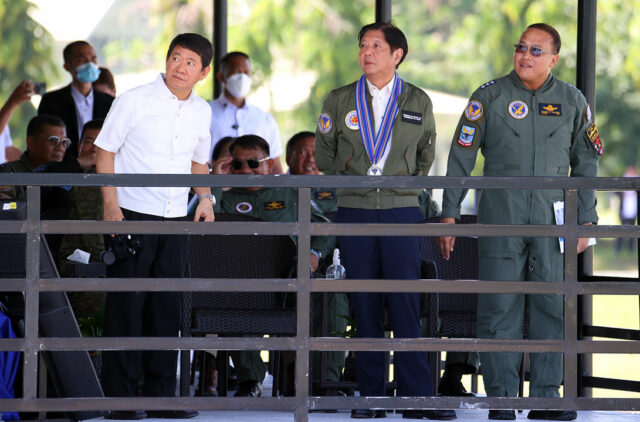
NATIONAL SECURITY ADVISER Eduardo M. Año on Wednesday said he will permanently retire as director general of the National Security Council (NSC), effective April 16, citing health reasons.
“In recent months, it has become apparent that I must prioritize my health and well-being,” Mr. Año said in a statement, published on the official NSC Facebook page.
“To ensure continuity, stability, and the highest standards of service in safeguarding our national security, I believe it is time to step aside and allow others to lead.”
The Palace confirmed earlier on Wednesday that President Ferdinand R. Marcos, Jr. accepted the resignation of Mr. Año, as it announced the appointment of former Chief of Staff of the Armed Forces of the Philippines (AFP) Eduardo SL. Oban, Jr.
“With his depth of experience, the President is confident that Secretary Oban will provide steady and capable leadership in advancing the country’s national security priorities and ensuring continuity in the government’s efforts to keep the nation safe and secure,” Palace Press Officer Clarissa A. Castro told a news briefing.
Mr. Oban is a graduate of the Philippine Military Academy Class of 1979. He was former President Benigno Simeon “Noynoy” C. Aquino III’s AFP chief.
He also served as Deputy Chief of Staff for Plans and head of the Visiting Forces Agreement Commission. He was also elected director of stock life insurance company Cocolife on Nov. 29, 2022. — Chloe Mari A. Hufana
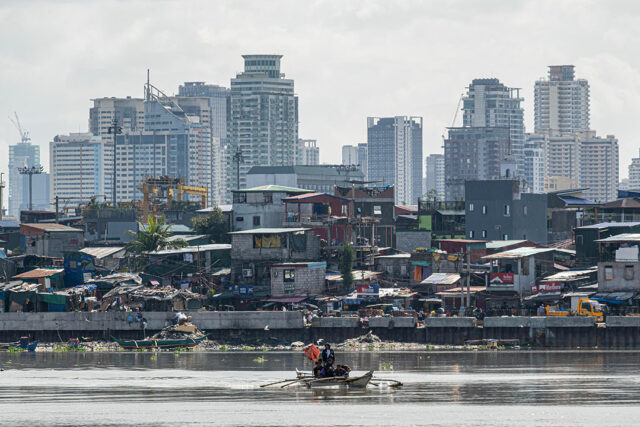
THE Philippine government remains confident it can achieve upper middle-income status and sustain poverty reduction during President Ferdinand R. Marcos, Jr.’s term, despite downgraded growth forecasts from the International Monetary Fund (IMF) and Moody’s Analytics.
Quoting the country’s chief economist Secretary Arsenio M. Balisacan, Palace Press Officer Clarissa A. Castro said the World Bank is set to assess by July 2026 whether the Philippines has met the income threshold based on its 2025 economic performance, though formal classification may take longer.
“We remain confident this will be achieved within the term of the Marcos administration. Despite geopolitical tensions and heightened uncertainty, we will stay the course in stabilizing the economy and centering social protection to sustain poverty reduction,” she added.
The IMF earlier slashed the country’s gross domestic product growth forecast to 4.1% in 2026, down from its initial 5.6% forecast in January. This is lower than the government’s 5%-6% growth target.
Moody’s, meanwhile, also trimmed its forecast for the country’s economy to grow by 4.9% in 2026, lower than its 5.1% projection earlier this year.
They cited the Middle East crisis and a sharp decline in public investment and confidence as reasons for the downward revision.
Ms. Castro said the government will still strive to lessen or prevent the adverse effects of the Middle East crisis from trickling down to the lives of Filipinos. — Chloe Mari A. Hufana

THE Department of Transportation (DoTr) expects toll discounts for public utility vehicles (PUVs) on expressways to reach about P80 million over two months, noting the relief may be extended amid rising fuel prices triggered by the Middle East conflict.
“In the span of two weeks, the monetary amount of the discount reached P20 million. I think it is good for (two months) and subject to another review,” Transportation Acting Secretary Giovanni Z. Lopez said during the Kapihan sa Manila Bay forum on Wednesday.
Starting March 23, toll operators Metro Pacific Tollways Corp. and San Miguel Corp. have agreed to grant two-month toll discounts in major expressways for PUVs, public utility buses and vehicles involved in freight services.
The total value of toll discounts now averages P10 million weekly, Mr. Lopez said, adding that the projection may vary depending on the number of vehicles using expressways.
The toll rate adjustments can help motorists save as much as P72, the DoTr said, noting that the discounts were provided through rebates and credited weekly to all qualified vehicles.
The toll discounts provided by toll operators are subject to review for a possible extension, Mr. Lopez said.
Further, the DoTr said that toll operators have volunteered to offer discounts, noting both companies have not sought conditions like possible concession extension.
SMC, through its unit SMC Infrastructure, operates South Luzon Expressway, Skyway system, Tarlac-Pangasinan-La Union Expressway; while MPTC operates North Luzon Expressway, Subic-Clark-Tarlac Expressway, and Cavite-Laguna Expressway.
MPTC is the tollway arm of Metro Pacific Investments Corp., which is one of three key Philippine units of Hong Kong-based First Pacific Co. Ltd., the others being Philex Mining Corp. and PLDT Inc.
Hastings Holdings, Inc., a unit of PLDT Beneficial Trust Fund subsidiary MediaQuest Holdings, Inc., has a majority stake in BusinessWorld through the Philippine Star Group, which it controls. — Ashley Erika O. Jose
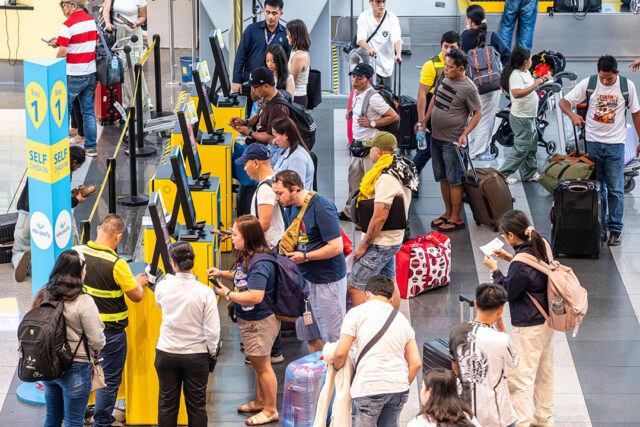
THE Bureau of Immigration (BI) said it expects international travel figures to remain robust in the coming weeks despite ongoing regional instability.
This, after passenger volumes remained high in the past week, notwithstanding flight disruptions caused by the war in the Middle East, Commissioner Joel Anthony M. Viado said in a news release on Wednesday.
During the peak period from March 29 to April 5, the agency said it processed a total of 782,344 passengers at international ports of entry. This volume included 391,243 arrivals and 391,101 departures.
This was also slightly higher than the 371,731 arrivals and 361,361 departures recorded during the same Holy Week period in 2025, suggesting relatively steady outbound and inbound demand year on year.
For the first quarter of 2026, the BI said it handled almost 4.22 million arrivals, higher than the 3.87 million recorded in the same period in 2025.
Departures reached 4.52 million in the first three months, also exceeding the 4.20 million logged a year earlier.
The agency noted, however, that travel to and from Middle Eastern countries fell by about 80% during the quarter, even as overall volumes held firm due to bookings made prior to the war.
The BI added that it expects passenger volumes to remain stable in the near term, while noting that any easing of conflict conditions could support a rebound in affected routes. — Erika Mae P. Sinaking

A TOTAL of 446 Filipinos from the Middle East (ME) have returned to the Philippines late on Tuesday and early Wednesday, the Overseas Workers Welfare Administration (OWWA) reported.
In a Facebook post late on Tuesday, OWWA said that 125 overseas Filipino workers (OFWs) and their dependents from the United Arab Emirates (UAE) have flown back to the Philippines on the evening of April 14 carried by the Emirates Flight EK334.
This was followed by a batch of 321 OFWs from Kuwait and their dependents, aboard the Kuwait Airways Special Flight KU417, which landed at the Ninoy Aquino International Airport on Wednesday.
“This flight is a part of the Kuwait Airways Special Flight coordinated by the government and the airlines where they prioritize and provide their available seats to the OFWs and their dependents amid the tension in the Middle East,” OWWA said in Filipino in a separate Facebook post on Wednesday.
OWWA said the newly repatriated Filipinos have been given post-repatriation assistance through food, transportation, temporary accommodation, and monetary aid.
The repatriation efforts of OWWA and the Department of Migrant Workers (DMW) is part of the government’s measures in ensuring the safety of Filipinos abroad amid the tensions in the Middle East.
Migrant Workers Secretary Hans Leo J. Cacdac on Monday reported that over 5,000 Filipinos have been brought home by the repatriation program for Filipinos in the Gulf region, primarily from countries like Kuwait, UAE, Saudi Arabia, Bahrain, Qatar, and Lebanon.
The DMW has been facilitating the repatriation of the Filipinos through identifying exit points and pick-up locations for those in areas with closed airspace before they do the land-crossing.
The repatriation assistance began on March 5, a week after the US and Israel launched a joint missile attack on Iran targeting to curb the latter’s nuclear assets.
Since the war, some 4,778 work-disrupted OFWs have been given financial assistance worth $200, while more than 13,243 OFWs have been given grocery packs, 1,549 were provided medical assistance, and 2,015 Filipinos requiring overnight stay due to land-crossing have been given temporary shelter, according to Mr. Cacdac. — Kaela Patricia B. Gabriel

PRESIDENT Ferdinand R. Marcos, Jr. vowed career advancement for all teachers as he led the oathtaking of 2,100 promoted educators in Tacloban City, Leyte, on Wednesday.
“I repeat, no teacher will retire Teacher I,” he said in Filipino.
A total of 2,121 newly promoted teachers and principals in the Eastern Visayas region took their oath before Mr. Marcos at the Tacloban City Convention Center.
The President reaffirmed the administration’s efforts to streamline teachers’ career growth, including the Expanded Career Progression (ECP) System for public school teachers.
Under the ECP, teachers can be promoted based on merit and competencies, not based on vacancies.
“That situation only worsens the shortage of teachers in the country [and] undermines the country’s overall educational system,” Mr. Marcos said.
Over 65,000 teachers and school heads have been promoted since August 2025. — Chloe Mari A. Hufana
